Basic Encryption and Decryption
• Encryption: a process of encoding a message
so that its meaning is not obvious
• Decryption: the reverse process
Encode(encipher) vs.
Decode(decipher)
• Encoding: the process of translating entire
words or phrases to other words or phrases
• Enciphering: translating letters or symbols
individually
• Encryption: the group term that covers both
encoding and enciphering
Basic operations
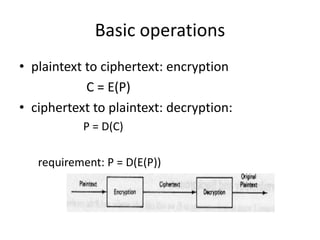
• plaintext to ciphertext: encryption
C = E(P)
• ciphertext to plaintext: decryption:
P = D(C)
requirement: P = D(E(P))
Classical Encryption
Techniques
• Symmetric key encryption
• Asymmetric key encryption
Symmetric Key Encryption
• Sender and recipient share a common key
• Was the only type of cryptography, prior to
invention of public-key in 1970’s
• All traditional schemes are symmetric / single
key / private-key encryption algorithms, with
a single key, used for both encryption and
decryption, since both sender and receiver are
equivalent, either can encrypt or decrypt
messages using that common key.
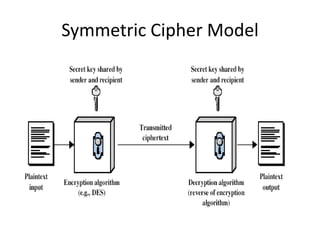
Symmetric Cipher Model
Requirements
• Two requirements for secure use of symmetric
encryption:
– a strong encryption algorithm
– a secret key known only to sender / receiver
Y = EK(X)
X = DK(Y)
Here, plaintext X, ciphertext Y, key K, encryption
algorithm Ek, decryption algorithm Dk.
• Assume encryption algorithm is known
• Implies a secure channel to distribute key
Types of Ciphers
• Substitution ciphers
• Permutation (or transposition) ciphers
Classical Substitution Ciphers
• A substitution cipher replaces one
symbol with another.
• Substitution ciphers can be categorized
as either monoalphabetic ciphers or
polyalphabetic ciphers.
Monoalphabetic Ciphers
• In monoalphabetic substitution, the
relationship between a symbol in the
plaintext to a symbol in the ciphertext is
always one-to-one.
• The simplest monoalphabetic cipher is
the additive cipher. This cipher is
sometimes called a shift cipher and
sometimes a Caesar cipher
Caesar Cipher
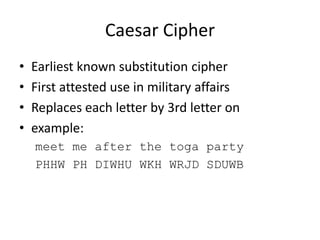
• Earliest known substitution cipher
• First attested use in military affairs
• Replaces each letter by 3rd letter on
• example:
meet me after the toga party
PHHW PH DIWHU WKH WRJD SDUWB
• Note: when letters are involved, the following
conventions are used in this course: Plaintext
is always in lowercase; ciphertext is in
uppercase
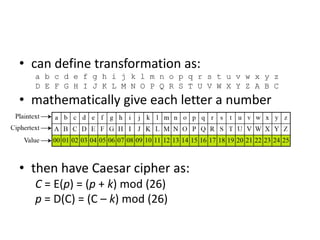
• can define transformation as:
a b c d e f g h i j k l m n o p q r s t u v w x y z
D E F G H I J K L M N O P Q R S T U V W X Y Z A B C
• mathematically give each letter a number
• then have Caesar cipher as:
C = E(p) = (p + k) mod (26)
p = D(C) = (C – k) mod (26)
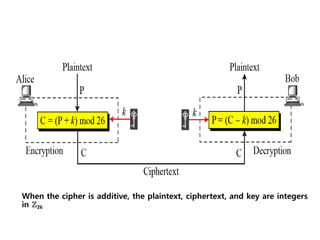
When the cipher is additive, the plaintext, ciphertext, and key are integers
in Z26
• This mathematical description uses modulo
arithmetic (ie clock arithmetic). Here, when
you reach Z you go back to A and start again.
Mod 26 implies that when you reach 26, you
use 0 instead (ie the letter after Z, or 25 + 1
goes to A or 0).
• Example: howdy (7,14,22,3,24) encrypted
using key f (5) is MTBID
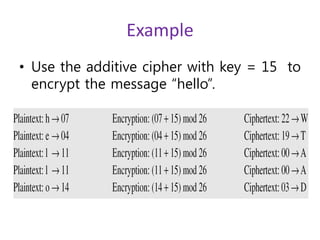
Example
• Use the additive cipher with key = 15 to
encrypt the message “hello”.
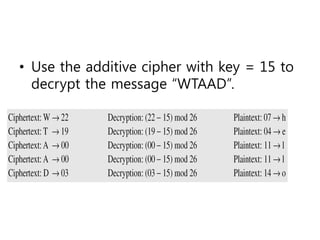
• Use the additive cipher with key = 15 to
decrypt the message “WTAAD”.
Cryptanalysis of Caesar Cipher
• only have 26 possible keys, of which only 25
are of any use, since mapping A to A etc
doesn't really obscure the message.
• Advantage : easy to use
• Disadvantage: simple structure and easy to
break
Polyalphabetic Ciphers
• another approach to improving security is to
use multiple cipher alphabets
• called polyalphabetic substitution ciphers
• makes cryptanalysis harder with more
alphabets to guess and flatter frequency
distribution
• use a key to select which alphabet is used for
each letter of the message
Vigenere Cipher
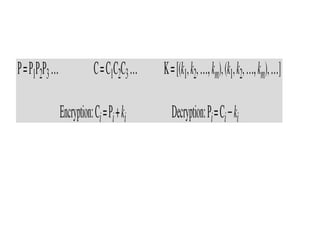
• Vigenere key stream does not depend
on the plaintext characters; it depends
only on the position of the character in
the plaintext
Example
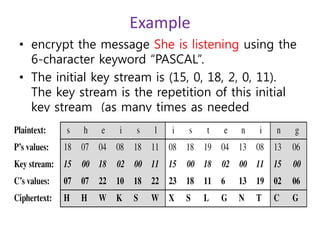
• encrypt the message She is listening using the
6-character keyword “PASCAL”.
• The initial key stream is (15, 0, 18, 2, 0, 11).
The key stream is the repetition of this initial
key stream (as many times as needed
TRANSPOSITION CIPHERS
• A transposition cipher does not
substitute one symbol for another,
instead it changes the location of the
symbols.
Keyless Transposition Ciphers
• Simple transposition ciphers, which were
used in the past, are keyless.
• Text is written into a table column by
column and then is transmitted row by
row.
• Text is written into a table and row by row,
then is transmitted column by column.
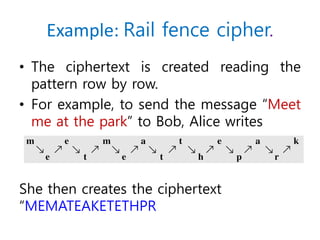
Example: Rail fence cipher.
• The ciphertext is created reading the
pattern row by row.
• For example, to send the message “Meet
me at the park” to Bob, Alice writes
She then creates the ciphertext
“MEMATEAKETETHPR
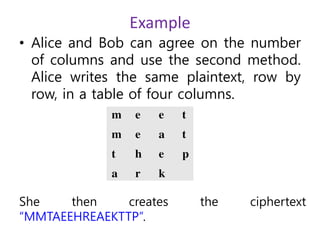
Example
• Alice and Bob can agree on the number
of columns and use the second method.
Alice writes the same plaintext, row by
row, in a table of four columns.
She then creates the ciphertext
“MMTAEEHREAEKTTP”.
Keyed Transposition Ciphers
• Divide the plaintext into groups of
predetermined size, called blocks, and
then use a key to permute the characters
in each block separately.
Steganography
• an alternative to encryption
• hides existence of message
– using only a subset of letters/words in a longer
message marked in some way
– using invisible ink
– hiding in LSB in graphic image or sound file
• has drawbacks
– high overhead to hide relatively few info bits
CONVENTIONAL ENCRYPTION
ALGORITHMS
CONVENTIONAL ENCRYPTION ALGORITHMS
• Triple DES
• International Data Encryption Algorithm (IDEA)
• Blowfish
• RC5
• CAST-128
• RC2
• Characteristics of Advanced Symmetric Block
Ciphers

basic encryption and decryption

  • 1.
  • 2.
    • Encryption: aprocess of encoding a message so that its meaning is not obvious • Decryption: the reverse process
  • 3.
    Encode(encipher) vs. Decode(decipher) • Encoding:the process of translating entire words or phrases to other words or phrases • Enciphering: translating letters or symbols individually • Encryption: the group term that covers both encoding and enciphering
  • 4.
    Basic operations • plaintextto ciphertext: encryption C = E(P) • ciphertext to plaintext: decryption: P = D(C) requirement: P = D(E(P))
  • 5.
    Classical Encryption Techniques • Symmetrickey encryption • Asymmetric key encryption
  • 6.
    Symmetric Key Encryption •Sender and recipient share a common key • Was the only type of cryptography, prior to invention of public-key in 1970’s • All traditional schemes are symmetric / single key / private-key encryption algorithms, with a single key, used for both encryption and decryption, since both sender and receiver are equivalent, either can encrypt or decrypt messages using that common key.
  • 7.
  • 8.
    Requirements • Two requirementsfor secure use of symmetric encryption: – a strong encryption algorithm – a secret key known only to sender / receiver Y = EK(X) X = DK(Y) Here, plaintext X, ciphertext Y, key K, encryption algorithm Ek, decryption algorithm Dk. • Assume encryption algorithm is known • Implies a secure channel to distribute key
  • 9.
    Types of Ciphers •Substitution ciphers • Permutation (or transposition) ciphers
  • 10.
    Classical Substitution Ciphers •A substitution cipher replaces one symbol with another. • Substitution ciphers can be categorized as either monoalphabetic ciphers or polyalphabetic ciphers.
  • 11.
    Monoalphabetic Ciphers • Inmonoalphabetic substitution, the relationship between a symbol in the plaintext to a symbol in the ciphertext is always one-to-one.
  • 12.
    • The simplestmonoalphabetic cipher is the additive cipher. This cipher is sometimes called a shift cipher and sometimes a Caesar cipher
  • 13.
    Caesar Cipher • Earliestknown substitution cipher • First attested use in military affairs • Replaces each letter by 3rd letter on • example: meet me after the toga party PHHW PH DIWHU WKH WRJD SDUWB
  • 14.
    • Note: whenletters are involved, the following conventions are used in this course: Plaintext is always in lowercase; ciphertext is in uppercase
  • 15.
    • can definetransformation as: a b c d e f g h i j k l m n o p q r s t u v w x y z D E F G H I J K L M N O P Q R S T U V W X Y Z A B C • mathematically give each letter a number • then have Caesar cipher as: C = E(p) = (p + k) mod (26) p = D(C) = (C – k) mod (26)
  • 16.
    When the cipheris additive, the plaintext, ciphertext, and key are integers in Z26
  • 17.
    • This mathematicaldescription uses modulo arithmetic (ie clock arithmetic). Here, when you reach Z you go back to A and start again. Mod 26 implies that when you reach 26, you use 0 instead (ie the letter after Z, or 25 + 1 goes to A or 0). • Example: howdy (7,14,22,3,24) encrypted using key f (5) is MTBID
  • 18.
    Example • Use theadditive cipher with key = 15 to encrypt the message “hello”.
  • 19.
    • Use theadditive cipher with key = 15 to decrypt the message “WTAAD”.
  • 20.
    Cryptanalysis of CaesarCipher • only have 26 possible keys, of which only 25 are of any use, since mapping A to A etc doesn't really obscure the message. • Advantage : easy to use • Disadvantage: simple structure and easy to break
  • 21.
    Polyalphabetic Ciphers • anotherapproach to improving security is to use multiple cipher alphabets • called polyalphabetic substitution ciphers • makes cryptanalysis harder with more alphabets to guess and flatter frequency distribution • use a key to select which alphabet is used for each letter of the message
  • 22.
    Vigenere Cipher • Vigenerekey stream does not depend on the plaintext characters; it depends only on the position of the character in the plaintext
  • 24.
    Example • encrypt themessage She is listening using the 6-character keyword “PASCAL”. • The initial key stream is (15, 0, 18, 2, 0, 11). The key stream is the repetition of this initial key stream (as many times as needed
  • 25.
  • 26.
    TRANSPOSITION CIPHERS • Atransposition cipher does not substitute one symbol for another, instead it changes the location of the symbols.
  • 27.
    Keyless Transposition Ciphers •Simple transposition ciphers, which were used in the past, are keyless. • Text is written into a table column by column and then is transmitted row by row. • Text is written into a table and row by row, then is transmitted column by column.
  • 28.
    Example: Rail fencecipher. • The ciphertext is created reading the pattern row by row. • For example, to send the message “Meet me at the park” to Bob, Alice writes She then creates the ciphertext “MEMATEAKETETHPR
  • 29.
    Example • Alice andBob can agree on the number of columns and use the second method. Alice writes the same plaintext, row by row, in a table of four columns. She then creates the ciphertext “MMTAEEHREAEKTTP”.
  • 30.
    Keyed Transposition Ciphers •Divide the plaintext into groups of predetermined size, called blocks, and then use a key to permute the characters in each block separately.
  • 31.
    Steganography • an alternativeto encryption • hides existence of message – using only a subset of letters/words in a longer message marked in some way – using invisible ink – hiding in LSB in graphic image or sound file • has drawbacks – high overhead to hide relatively few info bits
  • 32.
  • 33.
    CONVENTIONAL ENCRYPTION ALGORITHMS •Triple DES • International Data Encryption Algorithm (IDEA) • Blowfish • RC5 • CAST-128 • RC2 • Characteristics of Advanced Symmetric Block Ciphers