

CAESAR CIPHER
Cryptography & Cryptanalysis
Ramadhi Irawan
DEFINITION
• Plaintext
• Is a message to be communicated.
• Ciphertext
• A disguided version of a plaintext.
• Encryption
• The process of turning Plaintext into Ciphertext.
• Decryption
• The process of turning Ciphertext into Plaintext.
• Encipher / Decipher
• Are synonymous with the verb encrypt & decrypt.
DEFINITION
• Cryptology
• The study of encryption and decryption.
• Cryptography
• The application of Cryptology.
CAESAR CIPHER
• One of the earliest known example of substitution cipher.
• Said to have been used by Julius Caesar to communicate with his
army (secretly).
• Each character of a plaintext message is replaced by a character n
position down in the alphabet.
• Belongs to Substitution Cipher
CAESAR CIPHER
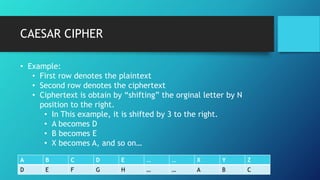
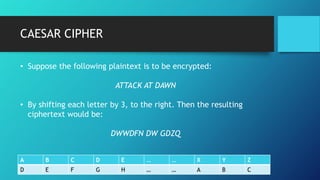
A B C D E … … X Y Z
D E F G H … … A B C
• Example:
• First row denotes the plaintext
• Second row denotes the ciphertext
• Ciphertext is obtain by “shifting” the orginal letter by N
position to the right.
• In This example, it is shifted by 3 to the right.
• A becomes D
• B becomes E
• X becomes A, and so on…
CAESAR CIPHER
A B C D E … … X Y Z
D E F G H … … A B C
• Suppose the following plaintext is to be encrypted:
ATTACK AT DAWN
• By shifting each letter by 3, to the right. Then the resulting
ciphertext would be:
DWWDFN DW GDZQ
CAESAR CIPHER
• One could shift other than 3 letters apart.
• The offset (Number of shift) is called the “Key”
• Decryption Process:
• Given that the key is known, just shift back N letter to the left.
• Example:
• Ciphertext:
WJYZWS YT GFXJ
• Key used: 3
• Plaintext:
RETURN TO BASE
CAESAR CIPHER
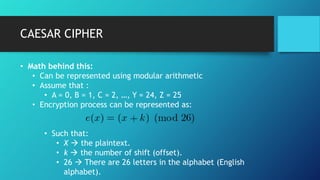
• Math behind this:
• Can be represented using modular arithmetic
• Assume that :
• A = 0, B = 1, C = 2, …, Y = 24, Z = 25
• Encryption process can be represented as:
• Such that:
• X  the plaintext.
• k  the number of shift (offset).
• 26  There are 26 letters in the alphabet (English
alphabet).
CAESAR CIPHER
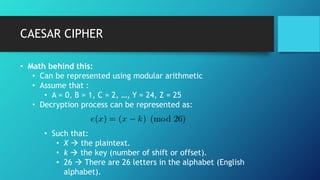
• Math behind this:
• Can be represented using modular arithmetic
• Assume that :
• A = 0, B = 1, C = 2, …, Y = 24, Z = 25
• Decryption process can be represented as:
• Such that:
• X  the plaintext.
• k  the key (number of shift or offset).
• 26  There are 26 letters in the alphabet (English
alphabet).
CAESAR CIPHER
• Summary
• Considerably easy to break.
• Brute force attack works pretty well, due to relatively small
keys (only allows 26 different keys).
• Also known as monoalphabetic cipher, which the same plaintext
letters are always replaced by the same ciphertext letters.
• Mono – means one, indicates that each letter has a single
substitute.

Caesar cipher

  • 1.
    CAESAR CIPHER Cryptography &Cryptanalysis Ramadhi Irawan
  • 2.
    DEFINITION • Plaintext • Isa message to be communicated. • Ciphertext • A disguided version of a plaintext. • Encryption • The process of turning Plaintext into Ciphertext. • Decryption • The process of turning Ciphertext into Plaintext. • Encipher / Decipher • Are synonymous with the verb encrypt & decrypt.
  • 3.
    DEFINITION • Cryptology • Thestudy of encryption and decryption. • Cryptography • The application of Cryptology.
  • 4.
    CAESAR CIPHER • Oneof the earliest known example of substitution cipher. • Said to have been used by Julius Caesar to communicate with his army (secretly). • Each character of a plaintext message is replaced by a character n position down in the alphabet. • Belongs to Substitution Cipher
  • 5.
    CAESAR CIPHER A BC D E … … X Y Z D E F G H … … A B C • Example: • First row denotes the plaintext • Second row denotes the ciphertext • Ciphertext is obtain by “shifting” the orginal letter by N position to the right. • In This example, it is shifted by 3 to the right. • A becomes D • B becomes E • X becomes A, and so on…
  • 6.
    CAESAR CIPHER A BC D E … … X Y Z D E F G H … … A B C • Suppose the following plaintext is to be encrypted: ATTACK AT DAWN • By shifting each letter by 3, to the right. Then the resulting ciphertext would be: DWWDFN DW GDZQ
  • 7.
    CAESAR CIPHER • Onecould shift other than 3 letters apart. • The offset (Number of shift) is called the “Key” • Decryption Process: • Given that the key is known, just shift back N letter to the left. • Example: • Ciphertext: WJYZWS YT GFXJ • Key used: 3 • Plaintext: RETURN TO BASE
  • 8.
    CAESAR CIPHER • Mathbehind this: • Can be represented using modular arithmetic • Assume that : • A = 0, B = 1, C = 2, …, Y = 24, Z = 25 • Encryption process can be represented as: • Such that: • X  the plaintext. • k  the number of shift (offset). • 26  There are 26 letters in the alphabet (English alphabet).
  • 9.
    CAESAR CIPHER • Mathbehind this: • Can be represented using modular arithmetic • Assume that : • A = 0, B = 1, C = 2, …, Y = 24, Z = 25 • Decryption process can be represented as: • Such that: • X  the plaintext. • k  the key (number of shift or offset). • 26  There are 26 letters in the alphabet (English alphabet).
  • 10.
    CAESAR CIPHER • Summary •Considerably easy to break. • Brute force attack works pretty well, due to relatively small keys (only allows 26 different keys). • Also known as monoalphabetic cipher, which the same plaintext letters are always replaced by the same ciphertext letters. • Mono – means one, indicates that each letter has a single substitute.