
SYSTEM OF
CLASSIFICATION
ERA’S OF PLANT CLASSIFICATION
There are 3 main era’s of plant classification :-
1. Ancient Era : This era starts with Theophratus (370-285 B.C.) and ends with Cesalpino.
 Classification based on gross morphology.
2. Modern Era : This era starts with Carolus Linnaeus and ends with Hutchinson.
 The main taxonomist are Bentham & Hooker and Engler & Prantl.
 This era is based on artificial classification.
3. Current Era : This era begins with Cronquist.
 This era based on phylogenetic classification.
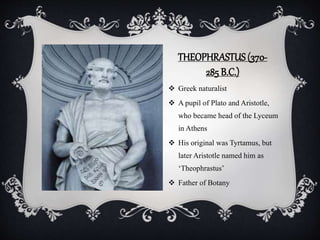
THEOPHRASTUS (370-
285 B.C.)
 Greek naturalist
 A pupil of Plato and Aristotle,
who became head of the Lyceum
in Athens
 His original was Tyrtamus, but
later Aristotle named him as
‘Theophrastus’
 Father of Botany
MAJOR CONTRIBUTIONS
 He is credited with having authored more than 200 works.
 He described about 500 kinds of plants, classified into four major groups :
the trees, shrubs, subshrubs and herbs.
 He recognized the differences between flowering plants and non –
flowering plants, superior ovary and inferior ovary, free and fused petals and
also fruit types.
 Two of his botanical works have survived intact, available in English are :-
1. Enquiry into plants (1916)
2. The Causes of plants (1927)
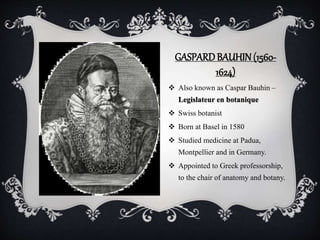
GASPARDBAUHIN (1560-
1624)
 Also known as Caspar Bauhin –
Legislateur en botanique
 Swiss botanist
 Born at Basel in 1580
 Studied medicine at Padua,
Montpellier and in Germany.
 Appointed to Greek professorship,
to the chair of anatomy and botany.
MAJOR CONTRIBUTIONS
 He formed a herbarium of 4000 specimens.
 He published Phytopinax (1596), Prodromus theatri botanici (1602) and
lastly, Pinax theatri botanici (1623), containing 6000 species of plants giving
synonyms and introducing the binomial nomenclature for several species.
 He sought to clarify in a single publication the confusion regarding
multiplicity of names for all species known at that time.
 Although he did not describe genera, and did not recognize difference
between species and genera.
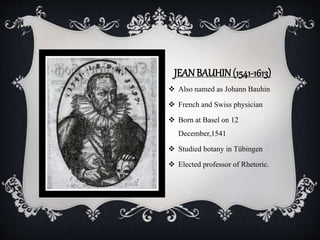
JEANBAUHIN(1541-1613)
 Also named as Johann Bauhin
 French and Swiss physician
 Born at Basel on 12
December,1541
 Studied botany in Tübingen
 Elected professor of Rhetoric.
MAJOR CONTRIBUTIONS
 He compiled a description of 5000 plants with more than 3500 figures, a work
published under the name Historia plantarum universalis in 1650-51 in 3
volumes, several years after his death.
 He nurtured several botanic gardens and also collected plants during his
travels.
 In 1591, he published a list of plants named after saints called De Plantis a
Divis Sanctisve Nomen Habentibus.
 Linnaeus named the genus Bauhinia (family Caesalpiniaceae) for brothers.
THANK YOU

Plant systematics

  • 1.
  • 2.
    ERA’S OF PLANTCLASSIFICATION There are 3 main era’s of plant classification :- 1. Ancient Era : This era starts with Theophratus (370-285 B.C.) and ends with Cesalpino.  Classification based on gross morphology. 2. Modern Era : This era starts with Carolus Linnaeus and ends with Hutchinson.  The main taxonomist are Bentham & Hooker and Engler & Prantl.  This era is based on artificial classification. 3. Current Era : This era begins with Cronquist.  This era based on phylogenetic classification.
  • 3.
    THEOPHRASTUS (370- 285 B.C.) Greek naturalist  A pupil of Plato and Aristotle, who became head of the Lyceum in Athens  His original was Tyrtamus, but later Aristotle named him as ‘Theophrastus’  Father of Botany
  • 4.
    MAJOR CONTRIBUTIONS  Heis credited with having authored more than 200 works.  He described about 500 kinds of plants, classified into four major groups : the trees, shrubs, subshrubs and herbs.  He recognized the differences between flowering plants and non – flowering plants, superior ovary and inferior ovary, free and fused petals and also fruit types.  Two of his botanical works have survived intact, available in English are :- 1. Enquiry into plants (1916) 2. The Causes of plants (1927)
  • 5.
    GASPARDBAUHIN (1560- 1624)  Alsoknown as Caspar Bauhin – Legislateur en botanique  Swiss botanist  Born at Basel in 1580  Studied medicine at Padua, Montpellier and in Germany.  Appointed to Greek professorship, to the chair of anatomy and botany.
  • 6.
    MAJOR CONTRIBUTIONS  Heformed a herbarium of 4000 specimens.  He published Phytopinax (1596), Prodromus theatri botanici (1602) and lastly, Pinax theatri botanici (1623), containing 6000 species of plants giving synonyms and introducing the binomial nomenclature for several species.  He sought to clarify in a single publication the confusion regarding multiplicity of names for all species known at that time.  Although he did not describe genera, and did not recognize difference between species and genera.
  • 7.
    JEANBAUHIN(1541-1613)  Also namedas Johann Bauhin  French and Swiss physician  Born at Basel on 12 December,1541  Studied botany in Tübingen  Elected professor of Rhetoric.
  • 8.
    MAJOR CONTRIBUTIONS  Hecompiled a description of 5000 plants with more than 3500 figures, a work published under the name Historia plantarum universalis in 1650-51 in 3 volumes, several years after his death.  He nurtured several botanic gardens and also collected plants during his travels.  In 1591, he published a list of plants named after saints called De Plantis a Divis Sanctisve Nomen Habentibus.  Linnaeus named the genus Bauhinia (family Caesalpiniaceae) for brothers.
  • 9.