Botanical  nomenclature
Botanical nomenclature Botanical nomenclature is the naming of plants and the related principles and rules Principles and rules of Botanical nomenclature are developed and adapted in series of International Botanical congresses  Principles and rules are listed in International Code of Botanical Nomenclature (ICBN) The main goal of ICBN is to provide one correct name for each taxonomic group within a stable system of names or classification
What is scientific name? A name is merely a conventional symbol or cipher that serves as  a means of reference  and avoid the need for continue use of a cumbersome descriptive phrases.  The fundamental principle of scientific nomenclature is that names must be  unambiguous  and  universal The formation and use of scientific names of organism for nomenclatural purposes are governed by  codes of nomenclature
Codes of Nomenclature International Code of Botanical nomenclature ( ICBN ) for Plants (including Fungi and Cyanobacteria )  International Code for Nomenclature of Cultivated plants ( ICNCP ) only for cultivated plants  ( www.actahort.org/books/647/) International Code of  Zoological  Nomenclature ( ICZN ) for Animals  International Code of Nomenclature of Bacteria (ICNB) -  for Bacteria International Committee on Taxonomy of Viruses ( ICTV ) for Viruses (http://www.virustaxonomyonline.com)
Some differences between codes These Codes differ: For example, the  ICBN  does not allow  tautonyms  whereas the  ICZN  does The starting points, the time from which these  Codes  are in effect (retroactively), vary from group to group.  In Botany the starting point will often be in 1753 (the year Linnaeus  first published  Species Plantarum  in Zoology in 1758.  Bacteriology started anew, with a starting point in 1980  A  Biocode  has been suggested to replace several codes, although implementation is not in sight.  There is also a debate concerning development of a  Phylocode  to name clades of phylogenetic trees rather than taxa.
Comparison between Scientific names and Common (vernacular) names Botanical names are universal while common names are limited to a single language or to a particular geographical region Sometime one vernacular name may be used to different taxa or one taxon may have different common names e.g.  Mnafu is a swahili name for about 30 species of section  Solanum   Common names may be misleading e.g. “ Nyanya chungu ” is not “common tomatoes”. But  Solanum aethiopicum   while common tomato is  Solanum  lycopersicon There are no eggs in egg plant =  Solanum melongana
Characteristics of Species scientific names   Species Scientific names are binomials (composed of two words i.e.  generic and species  ) Binomial system was founded by Jean Bauhin but used consistently first by Linnaeus in  Species plantarum  (1753) The first word of a species name is of a  Genus  to which the plant belongs and the second word is of a  species  A  generic  name is a ‘collective name’ for a group of plants that all share similar characteristics.  The  specific name , allows us to distinguish between different plants within a genus. There are over 2000  Solanum  species in the genus  Solanum  differentiated by specific names
Characteristics of Species epithets   Specific epithets refer to different things: May refer to distinctive morphological, ecological or chemical features e.g.  Alafia multiflora, Ipomoea aquatica, Tabernaemontana elegans, Ficus religiosa Honor individual who first collected the species  or a scientist who have contributed much to the botanical knowledge of a particular region or a taxonomic group e.g.  Solanum isabellii,  for  Isabella,  Trichaulax  mwasumbii  Vollesen after Mwasumbi (UDSM),  Sanrafaelia ruffonammari   Verdc. after Christopher K. Ruffo and Mmari   May refer to geographical origin
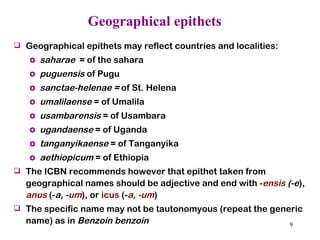
Geographical epithets Geographical epithets may reflect countries and localities: saharae  = of the sahara puguensis  of Pugu sanctae-helenae =  of St. Helena umalilaense  = of Umalila usambarensis  = of Usambara ugandaense  = of Uganda tanganyikaense  = of Tanganyika aethiopicum  = of Ethiopia The ICBN recommends however that epithet taken from geographical names should be adjective and end with - ensis   (-e ),  anus  (- a, - um ), or  icus  (- a, -um ) The specific name may not be tautonomyous (repeat the generic name) as in  Benzoin benzoin
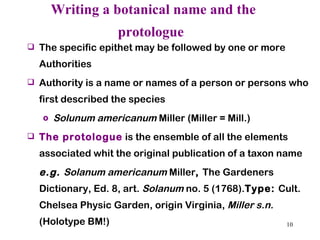
Writing a botanical name and the protologue   The specific epithet may be followed by one or more Authorities Authority is a name or names of a person or persons who first described the species  Solunum americanum  Miller (Miller = Mill.)  The protologue  is the ensemble of all the elements associated whit the original publication of a taxon name e.g.  Solanum americanum  Miller ,  The Gardeners Dictionary, Ed. 8, art.  Solanum  no. 5 (1768). Type:  Cult. Chelsea Physic Garden, origin Virginia,  Miller s.n.  (Holotype BM!)
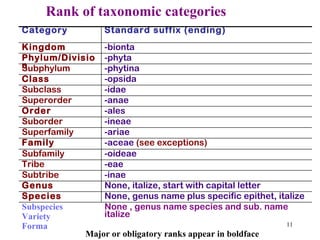
Rank of taxonomic categories Major or obligatory ranks appear in boldface None , genus name species and sub. name italize Subspecies Variety Forma None, genus name plus specific epithet, italize Species None, italize, start with capital letter Genus -inae Subtribe -eae Tribe  -oideae Subfamily -aceae  (see exceptions) Family -ariae Superfamily -ineae Suborder -ales Order -anae Superorder -idae Subclass -opsida Class -phytina Subphylum -phyta Phylum/Division -bionta Kingdom Standard suffix (ending) Category
Features of the Taxonomic Hierarchy Allowed alternative family names Apiaceae =  Umbelliferae Arecaceae =  Palmae Asteraceae =  Compositae Brassicaceae =  Cruciferae Clusiaceae =  Guttiferae[Hypericaceae Guttiferae] Fabaceae=  Leguminosae Lamiaceae =  Labiatae Poaceae =  Gramineae
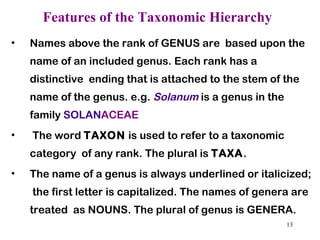
Features of the Taxonomic Hierarchy Names above the rank of GENUS are  based upon the name of an included genus. Each rank has a distinctive  ending that is attached to the stem of the name of the genus. e.g.  Solanum  is a genus in the family  SOLAN ACEAE   The word  TAXON  is used to refer to a taxonomic category  of any rank. The plural is  TAXA . The name of a genus is always underlined or italicized;  the first letter is capitalized. The names of genera are treated  as NOUNS. The plural of genus is GENERA.
Features of the Taxonomic Hierarchy end The scientific name of a species is the combination of  the name of the genus with the specific epithet. To be complete, the  scientific name includes the  authority  e.g.  Solanum nigrum  Linnaeus The word  species  is both singular  and plural It is always correct to write the specific epithet  in all lower case [species named after people and after old generic  names may be capitalized] The specific ephitet is usually considered to be an adjective  that modifies the genus (noun), and it agrees in gender with  the genus When several species of one genus are given in sequence,  the name of the genus can be abbreviated to its first letter e.g.  Hunteria congolana  and  H. zeylanica.
Features of the Taxonomic Hierarchy The authority can be abbreviated to save space, especially  for authors who described a large number of species.  The author's  name is never italicized or underlined.  The names of subspecific ranks (subspecies, variety, form)  consist of the name of the species followed by an abbreviation  of the rank, the subspecific ephitet, and the authority for the  subspecific name e.g.  Solanum villosum  subsp . miniatum  (Bernh. ex Willd) Edmonds
Principles of Botanical Nomenclature The naming of plants is covered by the ICBN New edition of ICBN is published after each International Botanical Congress, referred to by the city where the Congress took place.  The most current is the Vienna Code of 2006 Application of names is determined by nomenclatural  types  Nomenclature is based upon priority of publication
Principles of Botanical Nomenclature Each taxonomic group can have only one correct name,  which is the earliest that is in accordance with the rules, except  in specified cases Scientific names are in Latin  Rules of nomenclature are retroactive (conservative) unless expressly  limited
Transfer between ranks   When a genus, species, or subspecies is described at one  rank and then transferred to another rank, the original author  is placed in parentheses followed by the author who made the  transfer Linneaus named an alfalfa:  Medicago polymorpha  var.  orbicularis   L .  But, Allioni thought it was deserving of species status, so:  Medicago  orbicularis  (L.) Allioni The name "orbicularis" is called the  basionym  and  has priority.  The type for  Medicago orbicularis   is that of  Medicago polymorpha  var.  orbicularis   L.  The same occurs when a species is transferred  from one genus to another e.g. Linneaus named a fern:  Cheiranthus tristis  L .   but R. Brown thought it deserved a generic status so:  Matthiola  tristis  (L.) R. Brown
Transfer between ranks-Autonym When a subspecific taxon is named, another subspecific  taxon of the same rank is automatically created that repeats  the name of the species. This is called the  Autonym e.g. Edmonds created  Solanum villosum   subsp.  miniatum   (Bernh.ex Willd.)Edmond.  By so doing.  S. villosum  Mill. subsp.  villosum  was automatically created  Rehder created a variety under  Rosa carolina  i.e. Rosa carolina  var.  villosa   (Best) Rehder this automatically lead to creation of another variety  R. carolina   var.  carolina
Names of Hybrid Taxa Hybrids are indicated with the  "X "  sign  The sign may be given in two form: Where the parental taxa are indicated e.g.  Quercus alba  L. X  Q. michauxii  Nutt  Where the hybrid taxon is given a new  name  Quercus  X  beadlei  Trelease
Priority of names and synonyms Nomenclature is based upon  priority of publication  i.e.  the earliest  legitimate name  is the correct name (but note exceptions  below) Each taxonomic group can have only one correct name, which  is the earliest that is in accordance  with the rules , except  in specified cases Priority begins with the publication of Linnaeus’  Species Plantarum  on May 1, 1753 and applies to the rank of family  and below The correct name of a species is the combination of the  earliest published   valid generic name  with the  earliest published  valid specific epithet .
How do synonyms occur In some instances, the original author who describes the plant may  place it in a particular genus  but subsequent authors, often with a more complete understanding of the taxon and its representatives, may move that species  into a new genus , reflecting a more accurate classification Haumaniastrum minor  A.J. Paton  Acrocephallus minor  Briq. (1894) A. hptoides  Baker (1900) A. welwitschii  Briq. (1900) A. cononensis  G. Taylor (1931)
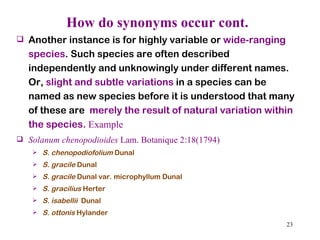
How do synonyms occur cont. Another instance is for highly variable or  wide-ranging species . Such species are often described independently and unknowingly under different names. Or,  slight and subtle variations  in a species can be named as new species before it is understood that many of these are  merely the result of natural variation within the species.  Example Solanum chenopodioides  Lam. Botanique 2:18(1794) S. chenopodiofolium  Dunal  S. gracile  Dunal S. gracile  Dunal var. microphyllum Dunal S. gracilius  Herter S. isabellii   Dunal S. ottonis  Hylander
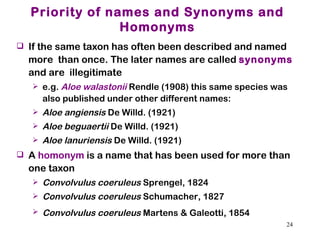
Priority of names and Synonyms and Homonyms If the same taxon has often been described and named more  than once. The later names are called  synonyms  and are  illegitimate e.g.  Aloe walastonii  Rendle (1908) this same species was also published under other different names:  Aloe angiensis  De Willd. (1921) Aloe beguaertii  De Willd. (1921) Aloe lanuriensis  De Willd. (1921) A  homonym  is a name that has been used for more than one taxon Convolvulus coeruleus  Sprengel, 1824  Convolvulus coeruleus  Schumacher, 1827  Convolvulus coeruleus  Martens & Galeotti, 1854
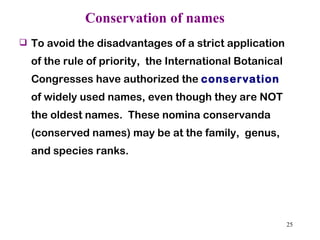
Conservation of names   To avoid the disadvantages of a strict application of the rule of priority,  the International Botanical Congresses have authorized the  conservation  of widely used names, even though they are NOT the oldest names.  These nomina conservanda (conserved names) may be at the family,  genus, and species ranks.
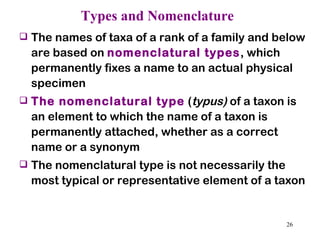
Types and Nomenclature The names of taxa of a rank of a family and below are based on  nomenclatural types , which permanently fixes a name to an actual physical specimen The nomenclatural type  ( typus)  of a taxon is an element to which the name of a taxon is permanently attached, whether as a correct name or a synonym The nomenclatural type is not necessarily the most typical or representative element of a taxon
Types and Nomenclature Holotype  is the specimen or illustration used by the author or designated by him/her as the nomenclatural type A lectotype   is a specimen or illustration selected from the original material to serve as a nomenclatural type when no holotype was indicated at the time of publication or is missing   An  isotype  is any duplicate of the holotype, it is always a specimen  A  synetype  is any one of two or more specimens cited by the author when no holotype was designated, or any of one of two or more specimens simultaneously designated as types
Types and Nomenclature A paratype  is a specimen or illustration cited in the protologue that is neither the holotype no an isotype, nor one of the syntypes if two or more specimens were simultaneously designed as types A  neotype  is a specimen or illustration cited in the protologue selected to serve as a nomenclatural type as long as all of the material on which the name of the taxon was based is missing When a holotype or a previously designated lectotype has been lost or destroyed and it can be shown that all the other original material differs taxonomically from the destroyed type a neotype may be selected to preserve the usage established by the previous typification
Definitions   Effective publication  is publication which is accordance with the rules (i.e. printed matters has to be distributed to the general public or at least to botanical institutions with libraries accessible to botanist generally).  Valid publication  is a publication that is accordance with the rules i.e.  Have a Latin diagnosis or description and  Give a clear indication of rank Designate a type and its location Publish in a scientific journal Follow the rules of nomenclature according to the most recent Code A legitimate name  is a name that is fulfills the rules  An illegitimate name  is a name which contravenes the rules  The correct name  of a taxon is one that is the legitimate name