ICBN
Roll no-1626011
Content
• Introduction
• Principles
• Who introduced this
• Important Rules of Nomenclature
• Subsequent Meeting of IBC
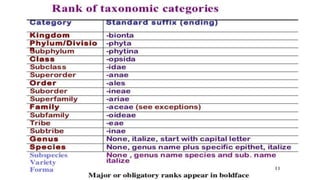
• Ranks of taxonomic catgories
• Codes of Nomenclature
• Typification
• Publication
• Author Citation
• Choice of names
• Rejection of names
Introduction
‘The nomenclature involves the principle govern by rules formulated &
adopted by International botanical congress , the rules developed by
IBC are listed formally in a code called International code of botanical
nomenclature’
Principles
• Botanical nomenclature is independent of zoology nomenclature
• The application of name of taxonomy groups is determined by means
of the nomenclature types
• The nomenclature taxonomic groups is based upon the priority of the
publication
• Each taxonomic group with a particular position & rank can only hare
one correct scientific name
• The scientific name of taxonomic group treated or written in latin
language
• The rules of nomenclature are retroactive unless expressly limited
Who introduced this
• The formal introduction of this system of naming species is credited
to Swedish natural Carl Linnaeus , effectively beginning with his work
species plantarum in 1753
• Linnaeus :- Swedish botanist , physician & zoologist who laid the
foundation for the modern biological naming scheme of bionomical
nomenclature
• He is known as the father of modern taxonomy & is also considered
one of the father of modern ecology
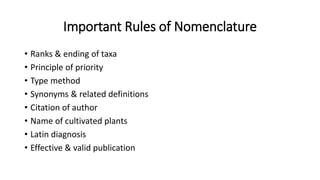
Important Rules of Nomenclature
• Ranks & ending of taxa
• Principle of priority
• Type method
• Synonyms & related definitions
• Citation of author
• Name of cultivated plants
• Latin diagnosis
• Effective & valid publication
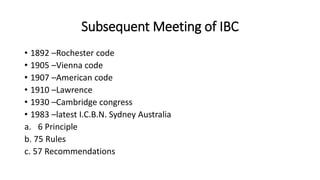
Subsequent Meeting of IBC
• 1892 –Rochester code
• 1905 –Vienna code
• 1907 –American code
• 1910 –Lawrence
• 1930 –Cambridge congress
• 1983 –latest I.C.B.N. Sydney Australia
a. 6 Principle
b. 75 Rules
c. 57 Recommendations
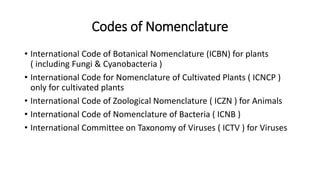
Codes of Nomenclature
• International Code of Botanical Nomenclature (ICBN) for plants
( including Fungi & Cyanobacteria )
• International Code for Nomenclature of Cultivated Plants ( ICNCP )
only for cultivated plants
• International Code of Zoological Nomenclature ( ICZN ) for Animals
• International Code of Nomenclature of Bacteria ( ICNB )
• International Committee on Taxonomy of Viruses ( ICTV ) for Viruses
Typification
• The code has greatly emphasized on typification of taxa in order to bring
about stabilization of names. The naming of taxonomic groups is
determined by means of nomenclature types where a nomenclatural type
is that element , to which the name of a taxon is permanently attached ,
either as a correct name or as a synonym. It is not necessarily the most
typical or representative element of the taxon.
1.Holotype
2.Isotype
3.Paratype
4.Syntype
5.Lectotype
6. Neotype
7.Topotype
Publication
Effective Publication – is publication which is accordance with the rules
( i.e. printed matters has to be distributed to the general public or at
least to botanical institutions with libraries accessible to botanist
generally )
Valid Publication –is a publication that is accordance with the rules I.e.
• Have a latin diagnosis or description &
• Give a clear indication of rank
• Designate a type & its location
• Publish in a scientific journal
Author Citation
The name of a taxon ( unitary , binary or ternary ) is incomplete unless
the name of the author or authors who first validly published the name
, is cited along the name with it. This helps in verifying the dates of
publication and in imparting precision in biological nomenclature.
There are several rules for author citation
• Usually the names are cited in abbreviated forms but never
underlined , e.g. Vitex Linn
• If the name of the plant is jointly published by two authors , their
names should be linked by means of et. Or an ampersand ( & )
• When more than three author are involved , citation is normally
restricted to the first author & is followed by et al.
Choice of names
• When the taxon rank is changed , for e.g. , species becomes a genus ,
the earliest legitimate name in its new rank is its correct name
• When two or more taxa of the same rank are united into one , e.g.
two or more genera are united , the oldest legitimate name of these
taxa should be retained as the name of the united taxon.
• When a genus or a species is divided into two or more genera or
species , the original name of the genus or species must be retained
• When a species is transferred to another genus without the change of
rank , the original name must be retained.
Rejection of names
a legitimate name or epithet must not be rejected merely because it is
inappropriate or disagreeable , or because another is preferable or better
known ,or because it has lost its original meaning. However , a name must be
rejected if it was nomenclaturally superfluous when published. Similarly , a
name or epithet rejected is replaced by the oldest legitimate name or in a
combination by the oldest available epithet in the rank concerned. The
following types of name can be considered to be illegitimate & unusable
Reference
• www.wkipidia.com
• www.google.com
• Taxonomy of Angiosperms By-A.V.S.S. Sambamurty
• Plant Systematics By- Gurcharan Singh
• Advanced plant taxonomy
Icbn

Icbn

  • 1.
  • 2.
    Content • Introduction • Principles •Who introduced this • Important Rules of Nomenclature • Subsequent Meeting of IBC • Ranks of taxonomic catgories • Codes of Nomenclature • Typification • Publication • Author Citation • Choice of names • Rejection of names
  • 3.
    Introduction ‘The nomenclature involvesthe principle govern by rules formulated & adopted by International botanical congress , the rules developed by IBC are listed formally in a code called International code of botanical nomenclature’
  • 4.
    Principles • Botanical nomenclatureis independent of zoology nomenclature • The application of name of taxonomy groups is determined by means of the nomenclature types • The nomenclature taxonomic groups is based upon the priority of the publication • Each taxonomic group with a particular position & rank can only hare one correct scientific name • The scientific name of taxonomic group treated or written in latin language • The rules of nomenclature are retroactive unless expressly limited
  • 5.
    Who introduced this •The formal introduction of this system of naming species is credited to Swedish natural Carl Linnaeus , effectively beginning with his work species plantarum in 1753 • Linnaeus :- Swedish botanist , physician & zoologist who laid the foundation for the modern biological naming scheme of bionomical nomenclature • He is known as the father of modern taxonomy & is also considered one of the father of modern ecology
  • 6.
    Important Rules ofNomenclature • Ranks & ending of taxa • Principle of priority • Type method • Synonyms & related definitions • Citation of author • Name of cultivated plants • Latin diagnosis • Effective & valid publication
  • 7.
    Subsequent Meeting ofIBC • 1892 –Rochester code • 1905 –Vienna code • 1907 –American code • 1910 –Lawrence • 1930 –Cambridge congress • 1983 –latest I.C.B.N. Sydney Australia a. 6 Principle b. 75 Rules c. 57 Recommendations
  • 9.
    Codes of Nomenclature •International Code of Botanical Nomenclature (ICBN) for plants ( including Fungi & Cyanobacteria ) • International Code for Nomenclature of Cultivated Plants ( ICNCP ) only for cultivated plants • International Code of Zoological Nomenclature ( ICZN ) for Animals • International Code of Nomenclature of Bacteria ( ICNB ) • International Committee on Taxonomy of Viruses ( ICTV ) for Viruses
  • 10.
    Typification • The codehas greatly emphasized on typification of taxa in order to bring about stabilization of names. The naming of taxonomic groups is determined by means of nomenclature types where a nomenclatural type is that element , to which the name of a taxon is permanently attached , either as a correct name or as a synonym. It is not necessarily the most typical or representative element of the taxon. 1.Holotype 2.Isotype 3.Paratype 4.Syntype 5.Lectotype 6. Neotype 7.Topotype
  • 11.
    Publication Effective Publication –is publication which is accordance with the rules ( i.e. printed matters has to be distributed to the general public or at least to botanical institutions with libraries accessible to botanist generally ) Valid Publication –is a publication that is accordance with the rules I.e. • Have a latin diagnosis or description & • Give a clear indication of rank • Designate a type & its location • Publish in a scientific journal
  • 12.
    Author Citation The nameof a taxon ( unitary , binary or ternary ) is incomplete unless the name of the author or authors who first validly published the name , is cited along the name with it. This helps in verifying the dates of publication and in imparting precision in biological nomenclature. There are several rules for author citation • Usually the names are cited in abbreviated forms but never underlined , e.g. Vitex Linn • If the name of the plant is jointly published by two authors , their names should be linked by means of et. Or an ampersand ( & ) • When more than three author are involved , citation is normally restricted to the first author & is followed by et al.
  • 13.
    Choice of names •When the taxon rank is changed , for e.g. , species becomes a genus , the earliest legitimate name in its new rank is its correct name • When two or more taxa of the same rank are united into one , e.g. two or more genera are united , the oldest legitimate name of these taxa should be retained as the name of the united taxon. • When a genus or a species is divided into two or more genera or species , the original name of the genus or species must be retained • When a species is transferred to another genus without the change of rank , the original name must be retained.
  • 14.
    Rejection of names alegitimate name or epithet must not be rejected merely because it is inappropriate or disagreeable , or because another is preferable or better known ,or because it has lost its original meaning. However , a name must be rejected if it was nomenclaturally superfluous when published. Similarly , a name or epithet rejected is replaced by the oldest legitimate name or in a combination by the oldest available epithet in the rank concerned. The following types of name can be considered to be illegitimate & unusable
  • 15.
    Reference • www.wkipidia.com • www.google.com •Taxonomy of Angiosperms By-A.V.S.S. Sambamurty • Plant Systematics By- Gurcharan Singh • Advanced plant taxonomy