 Rolf M.T. Dahlgren
 1932-1987
 Professor of botany in
University of Copenhagen.
 Published his original version
of his system in 1975.
 Most notable classification
system in the resent history.
 Major interest= evolutionary characters within the
angiosperms(class Magnoliopsida)
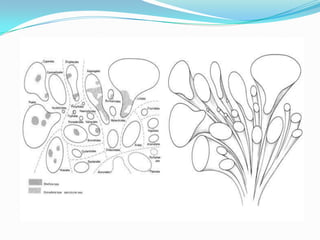
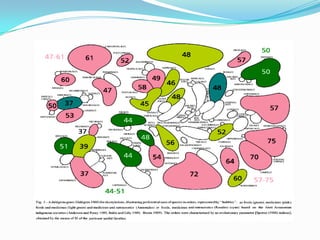
 Used a two dimensional graphic
system(Dahlgrenogram/bubble diagrams) to display
his phylogenetic system.
 Dahlgren himself was much interested in phylogeny.
 Mostly morphological and phytochemical characters
considered.
 Used the “-iflorae” endings in his superorders.
Characters concidered..
 Apocarpy,syncarpy & monocarpy conditions
 Choripetaly,sympetaly & mono-aperaturate pollen
types
 Sclered idioblasts
 Types of microsporogenesis
 Bi and uni-tegmic ovules
 Presence of raphids,silica bodies
 Presence of various alkaloids & flavonoids etc.
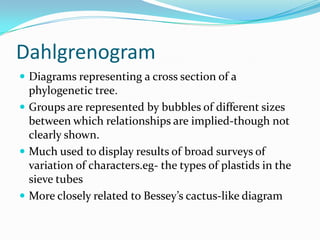
Dahlgrenogram
 Diagrams representing a cross section of a
phylogenetic tree.
 Groups are represented by bubbles of different sizes
between which relationships are implied-though not
clearly shown.
 Much used to display results of broad surveys of
variation of characters.eg- the types of plastids in the
sieve tubes
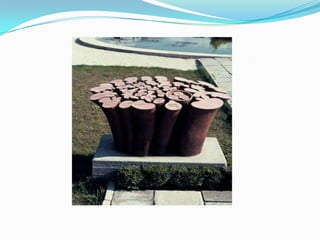
 More closely related to Bessey’s cactus-like diagram
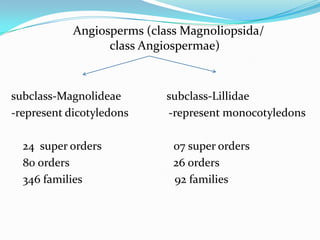
Angiosperms (class Magnoliopsida/
class Angiospermae)
subclass-Magnolideae subclass-Lillidae
-represent dicotyledons -represent monocotyledons
24 super orders 07 super orders
80 orders 26 orders
346 families 92 families
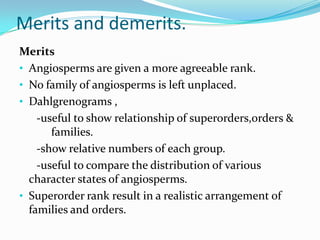
Merits and demerits.
Merits
• Angiosperms are given a more agreeable rank.
• No family of angiosperms is left unplaced.
• Dahlgrenograms ,
-useful to show relationship of superorders,orders &
families.
-show relative numbers of each group.
-useful to compare the distribution of various
character states of angiosperms.
• Superorder rank result in a realistic arrangement of
families and orders.
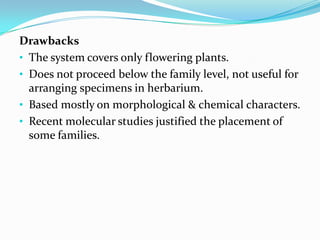
Drawbacks
• The system covers only flowering plants.
• Does not proceed below the family level, not useful for
arranging specimens in herbarium.
• Based mostly on morphological & chemical characters.
• Recent molecular studies justified the placement of
some families.
References
 Walters.D.R, Keil.D.J, Murrell Z.E, Vascular plant
taxonomy, 5th edition ,page 105-109,Kendall/Hunt
publishing company, Lowa,USA
 Jones.S.B, Luchsinger.A.E, Plant systematics, 2nd
edition,McGraw-Hill, Inc. NY .page 144-147
 http://www.jstor.org/pss/3667872 (02.02.2012)

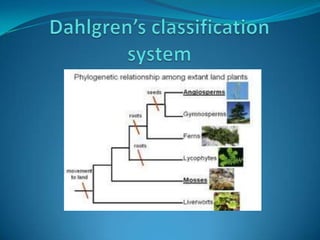
Dahlgren’s system

  • 3.
     Rolf M.T.Dahlgren  1932-1987  Professor of botany in University of Copenhagen.  Published his original version of his system in 1975.  Most notable classification system in the resent history.
  • 4.
     Major interest=evolutionary characters within the angiosperms(class Magnoliopsida)  Used a two dimensional graphic system(Dahlgrenogram/bubble diagrams) to display his phylogenetic system.  Dahlgren himself was much interested in phylogeny.  Mostly morphological and phytochemical characters considered.  Used the “-iflorae” endings in his superorders.
  • 5.
    Characters concidered..  Apocarpy,syncarpy& monocarpy conditions  Choripetaly,sympetaly & mono-aperaturate pollen types  Sclered idioblasts  Types of microsporogenesis  Bi and uni-tegmic ovules  Presence of raphids,silica bodies  Presence of various alkaloids & flavonoids etc.
  • 6.
    Dahlgrenogram  Diagrams representinga cross section of a phylogenetic tree.  Groups are represented by bubbles of different sizes between which relationships are implied-though not clearly shown.  Much used to display results of broad surveys of variation of characters.eg- the types of plastids in the sieve tubes  More closely related to Bessey’s cactus-like diagram
  • 10.
    Angiosperms (class Magnoliopsida/ classAngiospermae) subclass-Magnolideae subclass-Lillidae -represent dicotyledons -represent monocotyledons 24 super orders 07 super orders 80 orders 26 orders 346 families 92 families
  • 11.
    Merits and demerits. Merits •Angiosperms are given a more agreeable rank. • No family of angiosperms is left unplaced. • Dahlgrenograms , -useful to show relationship of superorders,orders & families. -show relative numbers of each group. -useful to compare the distribution of various character states of angiosperms. • Superorder rank result in a realistic arrangement of families and orders.
  • 12.
    Drawbacks • The systemcovers only flowering plants. • Does not proceed below the family level, not useful for arranging specimens in herbarium. • Based mostly on morphological & chemical characters. • Recent molecular studies justified the placement of some families.
  • 13.
    References  Walters.D.R, Keil.D.J,Murrell Z.E, Vascular plant taxonomy, 5th edition ,page 105-109,Kendall/Hunt publishing company, Lowa,USA  Jones.S.B, Luchsinger.A.E, Plant systematics, 2nd edition,McGraw-Hill, Inc. NY .page 144-147  http://www.jstor.org/pss/3667872 (02.02.2012)