CLASSIFICATION Finding Order  in Diversity
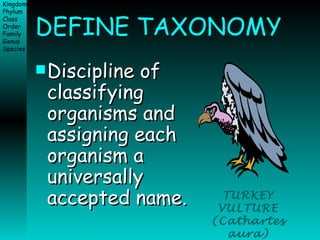
DEFINE TAXONOMY Discipline of classifying organisms and assigning each organism a universally  accepted name. TURKEY VULTURE (Cathartes aura)
WHY CLASSIFY? 1. How do biologists use a classification system to study the diversity of life? to name organisms and group  them in a logical manner.
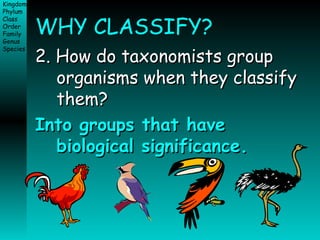
WHY CLASSIFY? 2. How do taxonomists group organisms when they classify them? Into groups that have  biological significance.
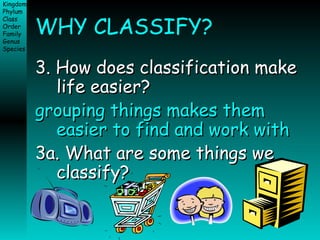
WHY CLASSIFY? 3. How does classification make life easier? grouping things makes them easier to find and work with 3a. What are some things we classify?
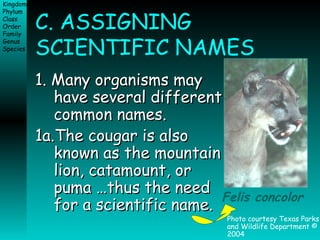
C. ASSIGNING SCIENTIFIC NAMES 1. Many organisms may have several different common names.  1a.The cougar is also known as the mountain lion, catamount, or puma …thus the need for a scientific name. Felis concolor Photo courtesy Texas Parks and Wildlife Department © 2004
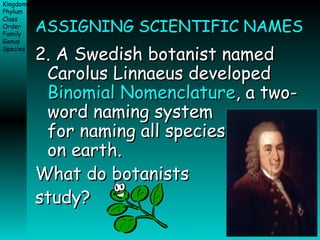
2. A Swedish botanist named Carolus Linnaeus developed  Binomial Nomenclature , a two-word naming system for naming all species on earth. What do botanists  study?  ASSIGNING SCIENTIFIC NAMES
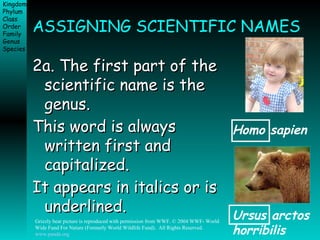
ASSIGNING SCIENTIFIC NAMES 2a. The first part of the scientific name is the genus.  This word is always written first and capitalized.   It appears in italics or is underlined.   Homo sapien Ursus arctos horribilis Grizzly bear picture is reproduced with permission from WWF. © 2004 WWF- World Wide Fund For Nature (Formerly World Wildlife Fund).  All Rights Reserved.  www.panda.org.
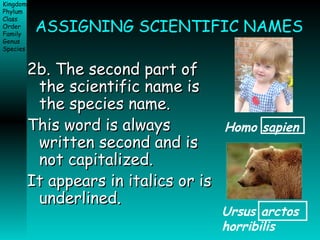
ASSIGNING SCIENTIFIC NAMES 2b. The second part of the scientific name is the species name. This word is always written second and is not capitalized. It appears in italics or is underlined. Homo sapien Ursus arctos horribilis
LINNAEUS’S SYSTEM OF CLASSIFICATION 1. Linnaeus’ hierarchical system of classification includes seven levels called taxa. They are, from largest to smallest,  Kingdom, Phylum, Class, Order, Family, Genus, Species .
LINNAEUS’S SYSTEM OF CLASSIFICATION 2. The Kingdom is the largest and most inclusive (includes) of the taxonomic categories.  3. Species is the smallest and least inclusive of the taxonomic categories.
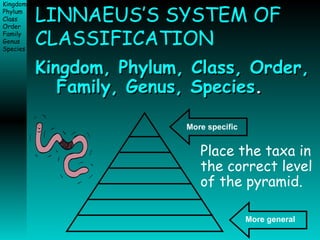
LINNAEUS’S SYSTEM OF CLASSIFICATION Kingdom, Phylum, Class, Order, Family, Genus, Species . Place the taxa in the correct level of the pyramid. More specific More general
LINNAEUS’S SYSTEM OF CLASSIFICATION 4. The more taxonomic levels that two organisms share, the more closely related they are considered to be.
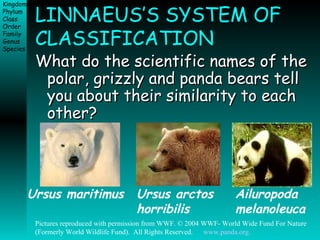
LINNAEUS’S SYSTEM OF CLASSIFICATION What do the scientific names of the polar, grizzly and panda bears tell you about their similarity to each other? Ursus maritimus Ursus arctos horribilis Ailuropoda melanoleuca Pictures reproduced with permission from WWF. © 2004 WWF- World Wide Fund For Nature (Formerly World Wildlife Fund).  All Rights Reserved.  www.panda.org.
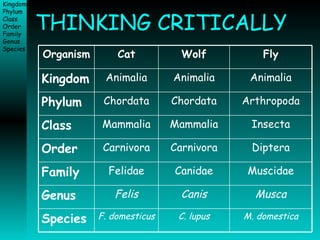
THINKING CRITICALLY M. domestica C. lupus F. domesticus Species Musca Canis Felis Genus Muscidae Canidae Felidae Family Diptera Carnivora Carnivora Order Insecta Mammalia Mammalia Class Arthropoda Chordata Chordata Phylum Animalia Animalia Animalia Kingdom Fly Wolf Cat Organism
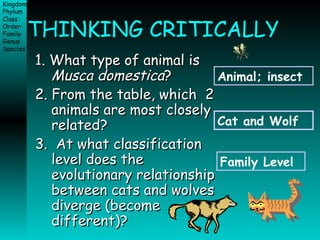
THINKING CRITICALLY 1. What type of animal is  Musca domestica ? 2. From the table, which  2 animals are most closely related? 3.  At what classification level does the evolutionary relationship between cats and wolves diverge (become different)? Animal; insect Cat and Wolf Family Level
E. EVOLUTIONARY CLASSIFICATION 1. Biologists group organisms into categories that represent lines of evolutionary descent, or phylogeny, not just physical similarities. 2. Define Phylogeny:  The study of evolutionary relationships among organisms.
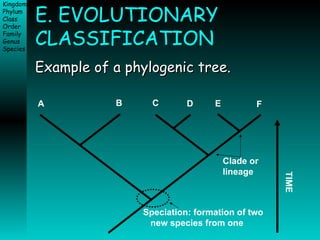
E. EVOLUTIONARY CLASSIFICATION 3. Classification using Cladograms a. Cladograms are diagrams that show the evolutionary relationships among a group of organisms. b. A phylogenic tree is a specific type of cladogram.
E. EVOLUTIONARY CLASSIFICATION Example of a phylogenic tree. A B C D E F Speciation: formation of two  new species from one Clade or  lineage TIME
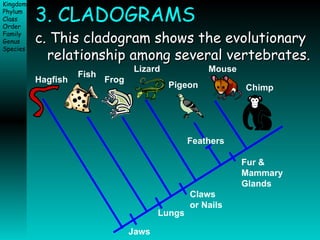
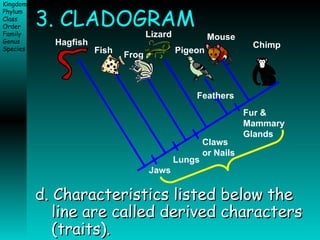
3. CLADOGRAMS c. This cladogram shows the evolutionary relationship among several vertebrates. Fur &  Mammary Glands Jaws Lungs Claws  or Nails Feathers Hagfish Fish Frog Lizard Pigeon Mouse Chimp
3. CLADOGRAM d. Characteristics listed below the line are called derived characters (traits).  Fur &  Mammary Glands Jaws Lungs Claws  or Nails Feathers Hagfish Fish Frog Lizard Pigeon Mouse Chimp
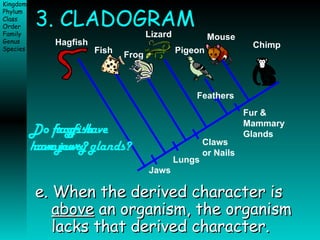
3. CLADOGRAM e. When the derived character is  above  an organism, the organism lacks that derived character.  Do hagfish have jaws? Do frogs have mammary glands? Fur &  Mammary Glands Jaws Lungs Claws  or Nails Feathers Hagfish Fish Frog Lizard Pigeon Mouse Chimp
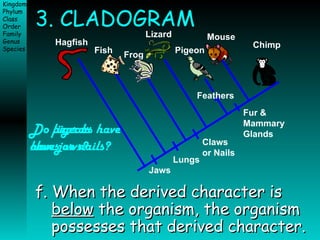
3. CLADOGRAM f. When the derived character is  below  the organism, the organism possesses that derived character.  Do lizards have jaws? Do pigeons have claws or nails? Fur &  Mammary Glands Jaws Lungs Claws  or Nails Feathers Hagfish Fish Frog Lizard Pigeon Mouse Chimp
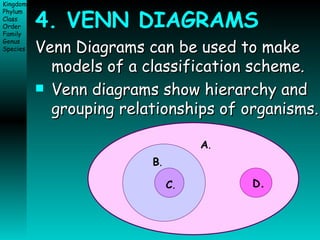
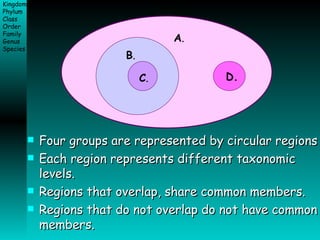
4. VENN DIAGRAMS Venn Diagrams can be used to make models of a classification scheme. Venn diagrams show hierarchy and grouping relationships of organisms. A . B . C . D.
Four groups are represented by circular regions Each region represents different taxonomic levels. Regions that overlap, share common members. Regions that do not overlap do not have common members. A . B . C . D.
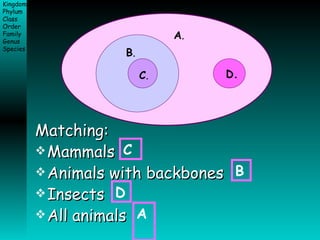
Matching: Mammals Animals with backbones Insects All animals C B D A  A . B . C . D.

Taxonomy ppt

  • 1.
  • 2.
    DEFINE TAXONOMY Disciplineof classifying organisms and assigning each organism a universally accepted name. TURKEY VULTURE (Cathartes aura)
  • 3.
    WHY CLASSIFY? 1.How do biologists use a classification system to study the diversity of life? to name organisms and group them in a logical manner.
  • 4.
    WHY CLASSIFY? 2.How do taxonomists group organisms when they classify them? Into groups that have biological significance.
  • 5.
    WHY CLASSIFY? 3.How does classification make life easier? grouping things makes them easier to find and work with 3a. What are some things we classify?
  • 6.
    C. ASSIGNING SCIENTIFICNAMES 1. Many organisms may have several different common names. 1a.The cougar is also known as the mountain lion, catamount, or puma …thus the need for a scientific name. Felis concolor Photo courtesy Texas Parks and Wildlife Department © 2004
  • 7.
    2. A Swedishbotanist named Carolus Linnaeus developed Binomial Nomenclature , a two-word naming system for naming all species on earth. What do botanists study? ASSIGNING SCIENTIFIC NAMES
  • 8.
    ASSIGNING SCIENTIFIC NAMES2a. The first part of the scientific name is the genus. This word is always written first and capitalized. It appears in italics or is underlined. Homo sapien Ursus arctos horribilis Grizzly bear picture is reproduced with permission from WWF. © 2004 WWF- World Wide Fund For Nature (Formerly World Wildlife Fund). All Rights Reserved. www.panda.org.
  • 9.
    ASSIGNING SCIENTIFIC NAMES2b. The second part of the scientific name is the species name. This word is always written second and is not capitalized. It appears in italics or is underlined. Homo sapien Ursus arctos horribilis
  • 10.
    LINNAEUS’S SYSTEM OFCLASSIFICATION 1. Linnaeus’ hierarchical system of classification includes seven levels called taxa. They are, from largest to smallest, Kingdom, Phylum, Class, Order, Family, Genus, Species .
  • 11.
    LINNAEUS’S SYSTEM OFCLASSIFICATION 2. The Kingdom is the largest and most inclusive (includes) of the taxonomic categories. 3. Species is the smallest and least inclusive of the taxonomic categories.
  • 12.
    LINNAEUS’S SYSTEM OFCLASSIFICATION Kingdom, Phylum, Class, Order, Family, Genus, Species . Place the taxa in the correct level of the pyramid. More specific More general
  • 13.
    LINNAEUS’S SYSTEM OFCLASSIFICATION 4. The more taxonomic levels that two organisms share, the more closely related they are considered to be.
  • 14.
    LINNAEUS’S SYSTEM OFCLASSIFICATION What do the scientific names of the polar, grizzly and panda bears tell you about their similarity to each other? Ursus maritimus Ursus arctos horribilis Ailuropoda melanoleuca Pictures reproduced with permission from WWF. © 2004 WWF- World Wide Fund For Nature (Formerly World Wildlife Fund). All Rights Reserved. www.panda.org.
  • 15.
    THINKING CRITICALLY M.domestica C. lupus F. domesticus Species Musca Canis Felis Genus Muscidae Canidae Felidae Family Diptera Carnivora Carnivora Order Insecta Mammalia Mammalia Class Arthropoda Chordata Chordata Phylum Animalia Animalia Animalia Kingdom Fly Wolf Cat Organism
  • 16.
    THINKING CRITICALLY 1.What type of animal is Musca domestica ? 2. From the table, which 2 animals are most closely related? 3. At what classification level does the evolutionary relationship between cats and wolves diverge (become different)? Animal; insect Cat and Wolf Family Level
  • 17.
    E. EVOLUTIONARY CLASSIFICATION1. Biologists group organisms into categories that represent lines of evolutionary descent, or phylogeny, not just physical similarities. 2. Define Phylogeny: The study of evolutionary relationships among organisms.
  • 18.
    E. EVOLUTIONARY CLASSIFICATION3. Classification using Cladograms a. Cladograms are diagrams that show the evolutionary relationships among a group of organisms. b. A phylogenic tree is a specific type of cladogram.
  • 19.
    E. EVOLUTIONARY CLASSIFICATIONExample of a phylogenic tree. A B C D E F Speciation: formation of two new species from one Clade or lineage TIME
  • 20.
    3. CLADOGRAMS c.This cladogram shows the evolutionary relationship among several vertebrates. Fur & Mammary Glands Jaws Lungs Claws or Nails Feathers Hagfish Fish Frog Lizard Pigeon Mouse Chimp
  • 21.
    3. CLADOGRAM d.Characteristics listed below the line are called derived characters (traits). Fur & Mammary Glands Jaws Lungs Claws or Nails Feathers Hagfish Fish Frog Lizard Pigeon Mouse Chimp
  • 22.
    3. CLADOGRAM e.When the derived character is above an organism, the organism lacks that derived character. Do hagfish have jaws? Do frogs have mammary glands? Fur & Mammary Glands Jaws Lungs Claws or Nails Feathers Hagfish Fish Frog Lizard Pigeon Mouse Chimp
  • 23.
    3. CLADOGRAM f.When the derived character is below the organism, the organism possesses that derived character. Do lizards have jaws? Do pigeons have claws or nails? Fur & Mammary Glands Jaws Lungs Claws or Nails Feathers Hagfish Fish Frog Lizard Pigeon Mouse Chimp
  • 24.
    4. VENN DIAGRAMSVenn Diagrams can be used to make models of a classification scheme. Venn diagrams show hierarchy and grouping relationships of organisms. A . B . C . D.
  • 25.
    Four groups arerepresented by circular regions Each region represents different taxonomic levels. Regions that overlap, share common members. Regions that do not overlap do not have common members. A . B . C . D.
  • 26.
    Matching: Mammals Animalswith backbones Insects All animals C B D A A . B . C . D.

Editor's Notes

  • #2 There is a student study guide sheet that goes with this Powerpoint lesson for TEKS Biology.
  • #3 In the United Kingdom, the word buzzard refers to a hawk, whereas in many parts of the United States, buzzard refers to a vulture.
  • #4 Ask students: What characteristics do these organisms have that might lead scientists to group them together? What differences do they have that distinguish one from the other?
  • #5 What is this first organism? How does this second organism relate to the first? And the third? And the fourth? All of these organisms are known as birds. When we hear the word bird, we immediately form a mental picture in our minds of what birds look like.
  • #6 Think of all the different types of music there is. What if you wanted to buy a new CD at the store? How do you go about finding the CD? When you grocery shop? How do you know where to look for Lucky Charms cereal? At school, what are some ways that we classify students? Think of how much more difficult our lives would be without the alphabet, without numbers, without the Dewey decimal system, without a phonebook.
  • #8 Botanists study plants.
  • #10 Ask students to notice how both words appear: in italics or they may both be underlined.
  • #11 You may want to have students draw a pyramid and draw 6 horizontal lines across to divide the pyramid up into 7 sections. Then have the students list the 7 taxonomic categories from bottom to top, starting with Kingdom at the bottom in the widest section and ending with species at the top in the smallest section.
  • #13 You may want to have students draw a pyramid and draw 6 horizontal lines across to divide the pyramid up into 7 sections. Then have the students list the 7 taxonomic categories from bottom to top, starting with Kingdom at the bottom in the widest section and ending with species at the top in the smallest section.
  • #15 The shared genus name Ursus indicates that the grizzly bear and polar bear are more closely related. The panda bear is a little more distantly related because it does not belong to the same genus as the other two. Pandas were believed to be a type of raccoon and only in the 20th century did genetic testing reveal that they are in fact bears. They are in a subfamily Ailurinae of the family Ursidae; all other bears are in the subfamily Ursinae. Aliuropoda melanoleuca means “black and white cat-foot”.
  • #16 Have students study this chart. The next slide lists three questions to answer using this chart. You may have to advance to the next slide, let students read the question and then come back to the chart so they can find the answer.
  • #19 A phylogenetic tree is a specific type of cladogram where the branch lengths are proportional to the predicted or hypothetical evolutionary time between organisms or sequences. Cladograms are branched diagrams, similar in appearance to family trees, that illustrate patterns of relatedness where the branch lengths are not necessarily proportional to the evolutionary time between related organisms or sequences.
  • #20 Definition of Clade: A group of organisms, such as a species, whose members share homologous features derived from a common ancestor. The American Heritage® Dictionary of the English Language, Third Edition copyright © 1992 by Houghton Mifflin Company. Electronic version licensed from INSO Corporation; further reproduction and distribution restricted in accordance with the Copyright Law of the United States. All rights reserved.