JJA Obico, Instructor
Department of Biology
U i it f th Phili i M ilUniversity of the Philippines Manila
A science that includes traditionalA science that includes traditional
taxonomy and phylogeny
GOAL:
Phylogenetic reconstructionPhylogenetic reconstruction
- evolutionary history of life
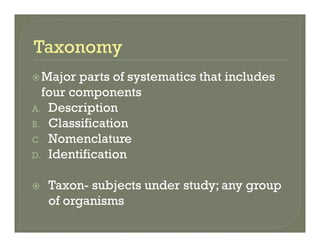
Major parts of systematics that includesMajor parts of systematics that includes
four components
A DescriptionA. Description
B. Classification
C NomenclatureC. Nomenclature
D. Identification
Taxon- subjects under study; any group
of organismsof organisms
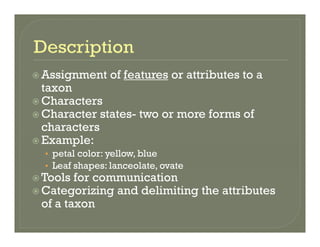
Assignment of features or attributes to aAssignment of features or attributes to a
taxon
Characters
Character states- two or more forms of
characters
Example:Example:
• petal color: yellow, blue
• Leaf shapes: lanceolate, ovatep
Tools for communication
Categorizing and delimiting the attributes
f tof a taxon
a statement of its characters which thusa statement of its characters, which thus
constitutes the definition of the taxon
Taxonomic characters
• Characters contributing to the description• Characters contributing to the description
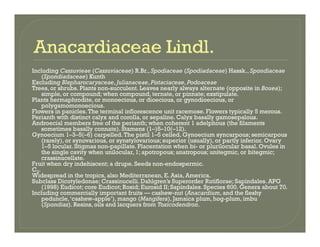
Including Cassuvieae (Cassuviaceae) R.Br., Spodiaceae (Spodiadaceae) Hassk., Spondiaceae
(Spondiadaceae) Kunth(Spondiadaceae) Kunth
Excluding Blepharocaryaceae, Julianaceae, Pistaciaceae, Podoaceae
Trees, or shrubs. Plants non-succulent. Leaves nearly always alternate (opposite in Bouea);
simple, or compound; when compound, ternate, or pinnate; exstipulate.
Plants hermaphrodite, or monoecious, or dioecious, or gynodioecious, or
polygamomonoecious.p yg
Flowers in panicles.The terminal inflorescence unit racemose. Flowers typically 5 merous.
Perianth with distinct calyx and corolla, or sepaline. Calyx basally gamosepalous.
Androecial members free of the perianth; when coherent 1 adelphous (the filaments
sometimes basally connate). Stamens (1–)5–10(–12).
Gynoecium 1–3–5(–6) carpelled.The pistil 1–5 celled. Gynoecium syncarpous; semicarpous
( l ) i t l i i ( ll ) tl i f i O(rarely), or synovarious, or synstylovarious; superior (usually), or partly inferior. Ovary
1–5 locular. Stigmas non-papillate. Placentation when bi- or plurilocular basal. Ovules in
the single cavity when unilocular, 1; apotropous; anatropous; unitegmic, or bitegmic;
crassinucellate.
Fruit when dry indehiscent; a drupe. Seeds non-endospermic.
CC3.
Widespread in the tropics, also Mediterranean, E. Asia, America.
Subclass Dicotyledonae; Crassinucelli. Dahlgren’s Superorder Rutiflorae; Sapindales. APG
(1998) Eudicot; core Eudicot; Rosid; Eurosid II; Sapindales. Species 600. Genera about 70.
Including commercially important fruits — cashew-nut (Anacardium, and the fleshy
peduncle,‘cashew-apple’), mango (Mangifera), Jamaica plum, hog-plum, imbup , pp ), g ( g ), J p , g p ,
(Spondias). Resins, oils and lacquers from Toxicodendron.
Arrangement of taxa into some type ofArrangement of taxa into some type of
order
System for cataloguing and expressingSystem for cataloguing and expressing
relationships between taxa
Grouping and RankingGrouping and Ranking
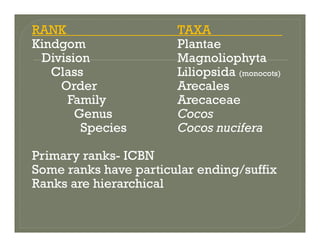
RANK TAXA___________
Kindgom PlantaeKindgom Plantae
Division Magnoliophyta
Class Liliopsida (monocots)p ( )
Order Arecales
Family Arecaceae
Genus Cocos
Species Cocos nucifera
Primary ranks- ICBN
Some ranks have particular ending/suffixSome ranks have particular ending/suffix
Ranks are hierarchical
PheneticPhenetic
- classification based on overall
similaritiessimilarities
- common to everyone
Phylogenetic
classification based on evolutionary- classification based on evolutionary
history or pattern of descent
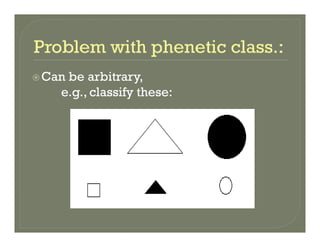
Can be arbitraryCan be arbitrary,
e.g., classify these:
Represented in the form of a cladogram/Represented in the form of a cladogram/
phylogenetic tree
CladogramCladogram
• Lines- lineage or clades; denote descent
• Branching- divergence from a common ancestorBranching divergence from a common ancestor
Evolution recognized as a change from
pre-existing character state(ancestral) topre existing character state(ancestral) to
a new (derived) character state
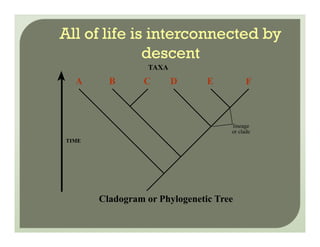
All of life is interconnected byAll of life is interconnected by
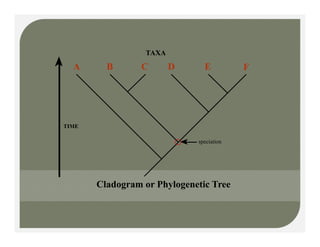
TAXA
descentdescent
A B C D E F
TIME
lineage
or clade
TIME
Cladogram or Phylogenetic TreeCladogram or Phylogenetic Tree
A B C D E F
TAXA
TIME
speciation
Cladogram or Phylogenetic Tree
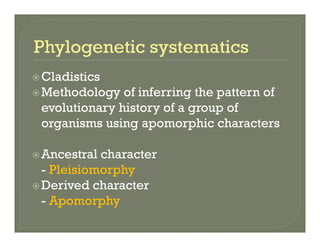
CladisticsCladistics
Methodology of inferring the pattern of
evolutionary history of a group ofevolutionary history of a group of
organisms using apomorphic characters
Ancestral character
Pleisiomorphy- Pleisiomorphy
Derived character
- Apomorphy- Apomorphy
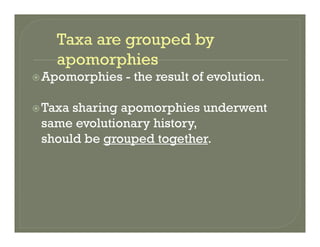
Apomorphies the result of evolutionApomorphies - the result of evolution.
Taxa sharing apomorphies underwentTaxa sharing apomorphies underwent
same evolutionary history,
should be grouped togethershould be grouped together.
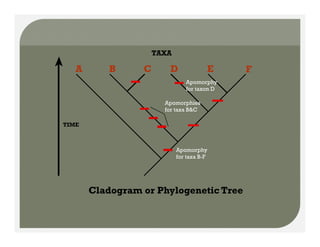
A B C D E F
TAXA
Apomorphies
f B&C
Apomorphy
for taxon D
for taxa B&C
TIME
Apomorphy
for taxa B-F
Cladogram or Phylogenetic Tree
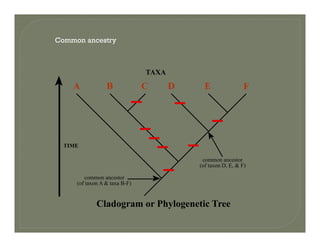
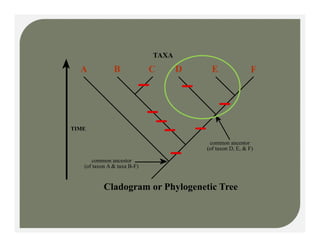
Common ancestry
TAXA
A B C D E F
TIME
common ancestor
(of taxon D, E, & F)
Cl d Ph l ti T
common ancestor
(of taxon A & taxa B-F)
Cladogram or Phylogenetic Tree
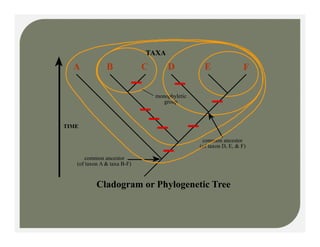
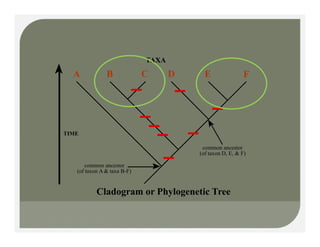
Recognized group in phylogeneticRecognized group in phylogenetic
systematics
Consisting of a common ancestor plus allConsisting of a common ancestor plus all
of its descendants
Sequential listing of monophyletic groupSequential listing of monophyletic group
- serve as a phylogenetic classification
schemescheme
A B C D E F
TAXA
monophyletic
group
TIME
t
common ancestor
(of taxon A & taxa B-F)
common ancestor
(of taxon D, E, & F)
Cladogram or Phylogenetic Tree
Consisting of a common ancestor but notConsisting of a common ancestor but not
all descendants of that common ancestor
Two or more separate groups each with a
separate common ancestor
A B C D E F
TAXA
TIME
common ancestor
(of taxon A & taxa B-F)
common ancestor
(of taxon D, E, & F)
Cladogram or Phylogenetic Tree
A B C D E F
TAXA
A B C D E F
TIME
common ancestor
( f t A & t B F)
common ancestor
(of taxon D, E, & F)
Cladogram or Phylogenetic Tree
(of taxon A & taxa B-F)
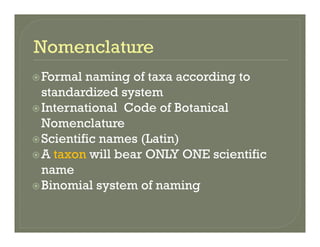
Formal naming of taxa according toFormal naming of taxa according to
standardized system
International Code of BotanicalInternational Code of Botanical
Nomenclature
Scientific names (Latin)Scientific names (Latin)
A taxon will bear ONLY ONE scientific
namename
Binomial system of naming
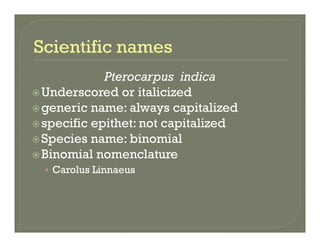
Pterocarpus indicaPterocarpus indica
Underscored or italicized
generic name: always capitalizedgeneric name: always capitalized
specific epithet: not capitalized
Species name: binomialSpecies name: binomial
Binomial nomenclature
• Carolus Linnaeus• Carolus Linnaeus
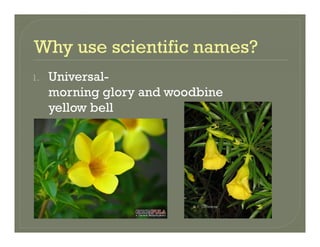
1 Universal1. Universal-
morning glory and woodbine
yellow bellyellow bell
2 common names are not consistent2. common names are not consistent
- two common names
one common name refers to more than- one common name refers to more than
one species
3 Tells nothing about the rank3.Tells nothing about the rank
Rose
4 Not all organisms have common name4. Not all organisms have common name
Principle I. (INDEPENDENCE)Principle I. (INDEPENDENCE)
Principle II. (TYPE)
Principle III. (PRIORITY)
P i i l IV (CORRECT NAME)Principle IV. (CORRECT NAME)
Principle V. (LATINIZED)c p e V ( N )
Principle VI. (RETROACTIVE)
HolotypeHolotype
• upon which a name is based, originally used or
designated at the time of publicationdesignated at the time of publication
Isotype
• duplicate of holotype (same time, same person,p yp ( , p ,
same population)
Lectotype
• selected from original material to serve as the
type when no holotype was designated, or the
holotype is missingholotype is missing
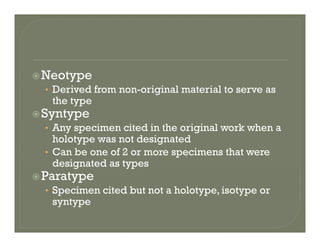
NeotypeNeotype
• Derived from non-original material to serve as
the type
Syntype
• Any specimen cited in the original work when a
holotype was not designatedholotype was not designated
• Can be one of 2 or more specimens that were
designated as types
Paratype
• Specimen cited but not a holotype, isotype or
syntypesyntype
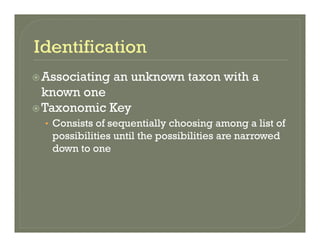
Associating an unknown taxon with aAssociating an unknown taxon with a
known one
Taxonomic KeyTaxonomic Key
• Consists of sequentially choosing among a list of
possibilities until the possibilities are narrowedpossibilities until the possibilities are narrowed
down to one
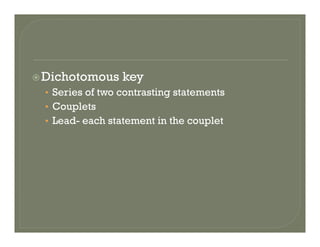
Dichotomous keyDichotomous key
• Series of two contrasting statements
• CoupletsCouplets
• Lead- each statement in the couplet
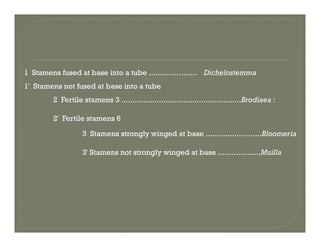
1 Stamens fused at base into a tube ........……....... Dichelostemma
1' Stamens not fused at base into a tube
2 Fertile stamens 3 ......................................................Brodiaea :
2' Fertile stamens 6
3 Stamens strongly winged at base ...............….......Bloomeria
3' Stamens not strongly winged at base .......….........Muilla
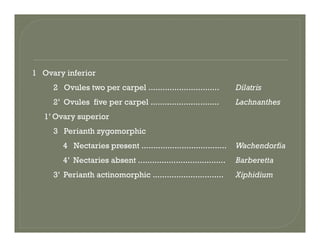
1 Ovary inferiory
2 Ovules two per carpel .............................. Dilatris
2’ Ovules five per carpel ............................. Lachnanthes
1’ Ovary superior
3 Perianth zygomorphic
4 Nectaries present .................................... Wachendorfia
4’ Nectaries absent ..................................... Barberetta
3’ Perianth actinomorphic .............................. Xiphidium
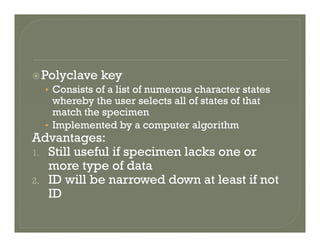
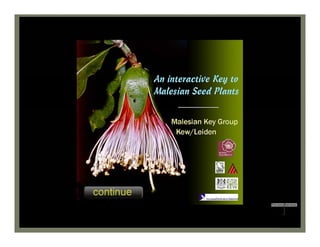
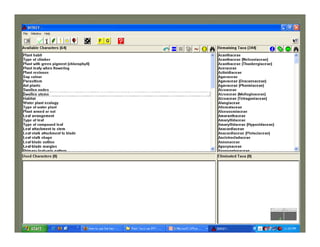
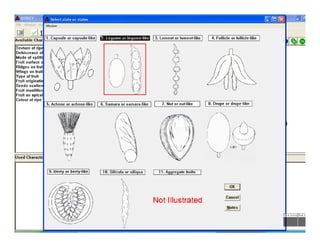
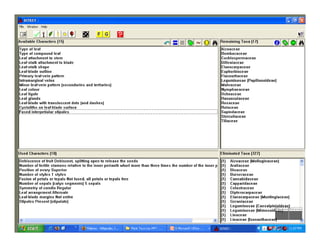
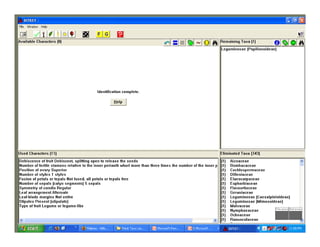
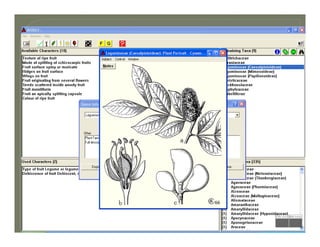
Polyclave keyPolyclave key
• Consists of a list of numerous character states
whereby the user selects all of states of that
match the specimen
• Implemented by a computer algorithm
Advantages:Advantages:
1. Still useful if specimen lacks one or
more type of datayp
2. ID will be narrowed down at least if not
ID
Written description
• Floras- Flora of Manila (E. Merrill)
Listing of plant taxa of a given region usu.
accompanied by keys and descriptionp y y p
• Monograph
Detailed taxonomy study of all species of a taxonomic
groupgroup
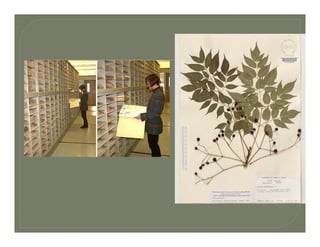
Specimen Comparison
• Herbarium- repository of preserved plant
collections
Image comparison
Expert DeterminationExpert Determination
Plant systematics
Plant systematics
Plant systematics
Plant systematics
Plant systematics
Plant systematics

Plant systematics

  • 1.
    JJA Obico, Instructor Departmentof Biology U i it f th Phili i M ilUniversity of the Philippines Manila
  • 2.
    A science thatincludes traditionalA science that includes traditional taxonomy and phylogeny GOAL: Phylogenetic reconstructionPhylogenetic reconstruction - evolutionary history of life
  • 3.
    Major parts ofsystematics that includesMajor parts of systematics that includes four components A DescriptionA. Description B. Classification C NomenclatureC. Nomenclature D. Identification Taxon- subjects under study; any group of organismsof organisms
  • 4.
    Assignment of featuresor attributes to aAssignment of features or attributes to a taxon Characters Character states- two or more forms of characters Example:Example: • petal color: yellow, blue • Leaf shapes: lanceolate, ovatep Tools for communication Categorizing and delimiting the attributes f tof a taxon
  • 5.
    a statement ofits characters which thusa statement of its characters, which thus constitutes the definition of the taxon Taxonomic characters • Characters contributing to the description• Characters contributing to the description
  • 6.
    Including Cassuvieae (Cassuviaceae)R.Br., Spodiaceae (Spodiadaceae) Hassk., Spondiaceae (Spondiadaceae) Kunth(Spondiadaceae) Kunth Excluding Blepharocaryaceae, Julianaceae, Pistaciaceae, Podoaceae Trees, or shrubs. Plants non-succulent. Leaves nearly always alternate (opposite in Bouea); simple, or compound; when compound, ternate, or pinnate; exstipulate. Plants hermaphrodite, or monoecious, or dioecious, or gynodioecious, or polygamomonoecious.p yg Flowers in panicles.The terminal inflorescence unit racemose. Flowers typically 5 merous. Perianth with distinct calyx and corolla, or sepaline. Calyx basally gamosepalous. Androecial members free of the perianth; when coherent 1 adelphous (the filaments sometimes basally connate). Stamens (1–)5–10(–12). Gynoecium 1–3–5(–6) carpelled.The pistil 1–5 celled. Gynoecium syncarpous; semicarpous ( l ) i t l i i ( ll ) tl i f i O(rarely), or synovarious, or synstylovarious; superior (usually), or partly inferior. Ovary 1–5 locular. Stigmas non-papillate. Placentation when bi- or plurilocular basal. Ovules in the single cavity when unilocular, 1; apotropous; anatropous; unitegmic, or bitegmic; crassinucellate. Fruit when dry indehiscent; a drupe. Seeds non-endospermic. CC3. Widespread in the tropics, also Mediterranean, E. Asia, America. Subclass Dicotyledonae; Crassinucelli. Dahlgren’s Superorder Rutiflorae; Sapindales. APG (1998) Eudicot; core Eudicot; Rosid; Eurosid II; Sapindales. Species 600. Genera about 70. Including commercially important fruits — cashew-nut (Anacardium, and the fleshy peduncle,‘cashew-apple’), mango (Mangifera), Jamaica plum, hog-plum, imbup , pp ), g ( g ), J p , g p , (Spondias). Resins, oils and lacquers from Toxicodendron.
  • 7.
    Arrangement of taxainto some type ofArrangement of taxa into some type of order System for cataloguing and expressingSystem for cataloguing and expressing relationships between taxa Grouping and RankingGrouping and Ranking
  • 8.
    RANK TAXA___________ Kindgom PlantaeKindgomPlantae Division Magnoliophyta Class Liliopsida (monocots)p ( ) Order Arecales Family Arecaceae Genus Cocos Species Cocos nucifera Primary ranks- ICBN Some ranks have particular ending/suffixSome ranks have particular ending/suffix Ranks are hierarchical
  • 9.
    PheneticPhenetic - classification basedon overall similaritiessimilarities - common to everyone Phylogenetic classification based on evolutionary- classification based on evolutionary history or pattern of descent
  • 10.
    Can be arbitraryCanbe arbitrary, e.g., classify these:
  • 11.
    Represented in theform of a cladogram/Represented in the form of a cladogram/ phylogenetic tree CladogramCladogram • Lines- lineage or clades; denote descent • Branching- divergence from a common ancestorBranching divergence from a common ancestor Evolution recognized as a change from pre-existing character state(ancestral) topre existing character state(ancestral) to a new (derived) character state
  • 12.
    All of lifeis interconnected byAll of life is interconnected by TAXA descentdescent A B C D E F TIME lineage or clade TIME Cladogram or Phylogenetic TreeCladogram or Phylogenetic Tree
  • 13.
    A B CD E F TAXA TIME speciation Cladogram or Phylogenetic Tree
  • 14.
    CladisticsCladistics Methodology of inferringthe pattern of evolutionary history of a group ofevolutionary history of a group of organisms using apomorphic characters Ancestral character Pleisiomorphy- Pleisiomorphy Derived character - Apomorphy- Apomorphy
  • 15.
    Apomorphies the resultof evolutionApomorphies - the result of evolution. Taxa sharing apomorphies underwentTaxa sharing apomorphies underwent same evolutionary history, should be grouped togethershould be grouped together.
  • 16.
    A B CD E F TAXA Apomorphies f B&C Apomorphy for taxon D for taxa B&C TIME Apomorphy for taxa B-F Cladogram or Phylogenetic Tree
  • 17.
    Common ancestry TAXA A BC D E F TIME common ancestor (of taxon D, E, & F) Cl d Ph l ti T common ancestor (of taxon A & taxa B-F) Cladogram or Phylogenetic Tree
  • 18.
    Recognized group inphylogeneticRecognized group in phylogenetic systematics Consisting of a common ancestor plus allConsisting of a common ancestor plus all of its descendants Sequential listing of monophyletic groupSequential listing of monophyletic group - serve as a phylogenetic classification schemescheme
  • 19.
    A B CD E F TAXA monophyletic group TIME t common ancestor (of taxon A & taxa B-F) common ancestor (of taxon D, E, & F) Cladogram or Phylogenetic Tree
  • 20.
    Consisting of acommon ancestor but notConsisting of a common ancestor but not all descendants of that common ancestor Two or more separate groups each with a separate common ancestor
  • 21.
    A B CD E F TAXA TIME common ancestor (of taxon A & taxa B-F) common ancestor (of taxon D, E, & F) Cladogram or Phylogenetic Tree
  • 22.
    A B CD E F TAXA A B C D E F TIME common ancestor ( f t A & t B F) common ancestor (of taxon D, E, & F) Cladogram or Phylogenetic Tree (of taxon A & taxa B-F)
  • 23.
    Formal naming oftaxa according toFormal naming of taxa according to standardized system International Code of BotanicalInternational Code of Botanical Nomenclature Scientific names (Latin)Scientific names (Latin) A taxon will bear ONLY ONE scientific namename Binomial system of naming
  • 24.
    Pterocarpus indicaPterocarpus indica Underscoredor italicized generic name: always capitalizedgeneric name: always capitalized specific epithet: not capitalized Species name: binomialSpecies name: binomial Binomial nomenclature • Carolus Linnaeus• Carolus Linnaeus
  • 25.
    1 Universal1. Universal- morningglory and woodbine yellow bellyellow bell
  • 26.
    2 common namesare not consistent2. common names are not consistent - two common names one common name refers to more than- one common name refers to more than one species 3 Tells nothing about the rank3.Tells nothing about the rank Rose 4 Not all organisms have common name4. Not all organisms have common name
  • 27.
    Principle I. (INDEPENDENCE)PrincipleI. (INDEPENDENCE) Principle II. (TYPE) Principle III. (PRIORITY) P i i l IV (CORRECT NAME)Principle IV. (CORRECT NAME) Principle V. (LATINIZED)c p e V ( N ) Principle VI. (RETROACTIVE)
  • 28.
    HolotypeHolotype • upon whicha name is based, originally used or designated at the time of publicationdesignated at the time of publication Isotype • duplicate of holotype (same time, same person,p yp ( , p , same population) Lectotype • selected from original material to serve as the type when no holotype was designated, or the holotype is missingholotype is missing
  • 29.
    NeotypeNeotype • Derived fromnon-original material to serve as the type Syntype • Any specimen cited in the original work when a holotype was not designatedholotype was not designated • Can be one of 2 or more specimens that were designated as types Paratype • Specimen cited but not a holotype, isotype or syntypesyntype
  • 30.
    Associating an unknowntaxon with aAssociating an unknown taxon with a known one Taxonomic KeyTaxonomic Key • Consists of sequentially choosing among a list of possibilities until the possibilities are narrowedpossibilities until the possibilities are narrowed down to one
  • 31.
    Dichotomous keyDichotomous key •Series of two contrasting statements • CoupletsCouplets • Lead- each statement in the couplet
  • 32.
    1 Stamens fusedat base into a tube ........……....... Dichelostemma 1' Stamens not fused at base into a tube 2 Fertile stamens 3 ......................................................Brodiaea : 2' Fertile stamens 6 3 Stamens strongly winged at base ...............….......Bloomeria 3' Stamens not strongly winged at base .......….........Muilla
  • 33.
    1 Ovary inferiory 2Ovules two per carpel .............................. Dilatris 2’ Ovules five per carpel ............................. Lachnanthes 1’ Ovary superior 3 Perianth zygomorphic 4 Nectaries present .................................... Wachendorfia 4’ Nectaries absent ..................................... Barberetta 3’ Perianth actinomorphic .............................. Xiphidium
  • 34.
    Polyclave keyPolyclave key •Consists of a list of numerous character states whereby the user selects all of states of that match the specimen • Implemented by a computer algorithm Advantages:Advantages: 1. Still useful if specimen lacks one or more type of datayp 2. ID will be narrowed down at least if not ID
  • 41.
    Written description • Floras-Flora of Manila (E. Merrill) Listing of plant taxa of a given region usu. accompanied by keys and descriptionp y y p • Monograph Detailed taxonomy study of all species of a taxonomic groupgroup Specimen Comparison • Herbarium- repository of preserved plant collections Image comparison Expert DeterminationExpert Determination