Taxonomy, Classification, and Identification Karl Hagenbuch Department of Biological Sciences San Antonio College
Taxonomy = the study of naming, describing and classifying organisms, including the rules, theories, principles and procedures Taxon =  a group of organisms recognized at any level of a taxonomical hierarchy (e. g. Family, Class)
Classification = the orderly arrangement of organisms into a hierarchal system that is derived from an accumulation of information about the individual organisms, the end result expressing an interrelationship Why? Because it provides humans with a means to address organisms and their relationships to one another Because it allows humans to make inferences about unfamiliar organisms Because it is in our nature
Classification Systems: Artificial = based on obvious or convenient items of information called characters (e.g. flower color, locality). Natural = based on morphological features that give the sense of correlation with those of another organism.  (e.g. trees, grasses) Phylogenetic = based on the proposed lineage derived from a wide variety of information.
Aristotle Greek Philosopher First to propose a system of classification Scala Naturalae Two types of animals: With blood Without blood
Theophrastus Greek Philosopher Father of plant taxonomy Classification of plants was based on: Mode of generation Locality Size Usefulness
Carl von Linné Swedish botanist, zoologist, and physician First to illustrate the usefulness of binomial nomenclature Developed the modern taxonomic hierarchy
Modern Hierarchy  (Biological Classification) Domain – Eukarya Kingdom – Animalia Phylum – Cordata Class – Mammalia Order – Primates Family – Hominidae Genus –  Homo Species –  Homo sapiens
Current system recognizes 3 Domains: Eukarya: Kingdom Animalia Kingdom Plantae Kingdom Fungi Archaea & Bacteria The previously recognized Kingdoms of Protista & Monera have been disolved Modern Taxonomic Hierarchy
Carolus Linnaeus = a two-word name consisting of a generic name and a specific epithet Binomial Nomenclature Specific epithets: Descriptives –  Quercus macrocarpa  = Oak with big fruit Honorifics –  Quercus buckleyi  = Oak named for Mr. Buckley Localities –  Quercus virginiana  = Oak first described in Virginia
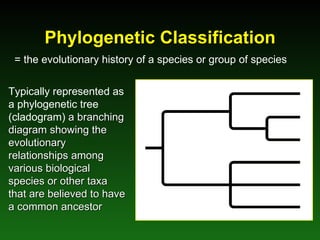
Phylogenetic Classification = the evolutionary history of a species or group of species Typically represented as a phylogenetic tree (cladogram)  a branching diagram showing the evolutionary relationships among various biological species or other taxa that are believed to have a common ancestor
 
The Pylogenetic Tree
 
Time
Species 1 Species 2 Species 3
 
Plant Classification Current classification systems follow the recognized taxonomic hierarchy, however, there is always some disagreement as to the membership requirements of various taxa The Core
Gymnosperms and Angiosperms Angiosperms plants with vascular (circulatory) tissues they produce flowers  reproductive unit is a seed produced within an enclosed ovary Gymnosperms plants with vascular (circulatory) tissues they lack flowers  reproductive unit is a seed produced on scales in a cone-like structure
Non-vascular land plants reduced plants that lack vascular (circulatory) tissues they neither have flowers nor produce seeds reproductive unit is a spore
Ferns and fern allies plants with vascular (circulatory) tissues they neither have flowers nor produce seeds reproductive unit is a spore
 
Identification = the assigning of an existing name to an unknown organism Methods Expert assistance – local university, school, museum Comparison method – guide books, internet Dichotomous key – local manuals, floras
Dichotomous Key Keys based on a sequence of pairs of contrasting statements The user chooses the statement that better describes the plant in question Each time a choice is made a number of plants are eliminated Eventually the number of possible identifications is reduced to one
Dichotomous Key 1.  Growth habit an herb 1.  Growth habit a vine, shrub or tree .  .  .  .  .  .  .  .  .  .  .  .  2 .  .  .  .  4 4.  Growth habit a vine 4.  Growth habit a shrub or tree .  .  .  .  .  .  .  .  .  .  .  .  5 .  .  .  .  .  .  .  7 7.  Growth habit a shrub 7.  Growth habit a tree .  .  .  .  .  .  .  .  .  .  .  .  8 .  .  .  .  .  .  .  .  .  .  .  .  30
Dichotomous Key 30.  Leaf arrangement opposite 30.  Leaf arrangement whorled or alternate .  .  .  .  Fraxinus .  31 31.  Leaves simple 31.  Leaves compound .  .  .  .  .  .  .  .  .  .  .  .  .  .  . 32 .  .  .  .  .  .  .  .  .  .  .  . 44 32.  Venation palmate 32.  Venation pinnate or reticulate .  .  .  .  .  .  .  Washingtonia .  .  .  .  .  .  33
Leaf Types
Leaf Types
Leaf Types
Leaf Types
Leaf Types
Dichotomous Key 33.  Margin entire 33.  Margin toothed .  .  .  .  .  .  .  .  .  .  .  .  .  .  .  34 .  .  .  .  .  .  .  .  .  .  .  .  .  .  39 34.  Lobes present 34.  Lobes absent .  .  .  .  .  .  .  .  .  .  .  .  .  .  . 35 .  .  .  .  .  .  .  .  .  .  .  .  .  .  37 35.  Blades palmately lobed 35.  Blades pinnately lobed .  .  .  .  .  Platanus .  .  .  .  .  .  .  .  .  36
Dichotomous Key 36.  Lobes rounded 36.  Lobes pointed .  .  .  Quercus macrocarpa .  .  .  .  .  Quercus buckleyi
Thank You It is both an honor and pleasure to speak before the Master Naturalist I wish you all continued success

Taxonomy

  • 1.
    Taxonomy, Classification, andIdentification Karl Hagenbuch Department of Biological Sciences San Antonio College
  • 2.
    Taxonomy = thestudy of naming, describing and classifying organisms, including the rules, theories, principles and procedures Taxon = a group of organisms recognized at any level of a taxonomical hierarchy (e. g. Family, Class)
  • 3.
    Classification = theorderly arrangement of organisms into a hierarchal system that is derived from an accumulation of information about the individual organisms, the end result expressing an interrelationship Why? Because it provides humans with a means to address organisms and their relationships to one another Because it allows humans to make inferences about unfamiliar organisms Because it is in our nature
  • 4.
    Classification Systems: Artificial= based on obvious or convenient items of information called characters (e.g. flower color, locality). Natural = based on morphological features that give the sense of correlation with those of another organism. (e.g. trees, grasses) Phylogenetic = based on the proposed lineage derived from a wide variety of information.
  • 5.
    Aristotle Greek PhilosopherFirst to propose a system of classification Scala Naturalae Two types of animals: With blood Without blood
  • 6.
    Theophrastus Greek PhilosopherFather of plant taxonomy Classification of plants was based on: Mode of generation Locality Size Usefulness
  • 7.
    Carl von LinnéSwedish botanist, zoologist, and physician First to illustrate the usefulness of binomial nomenclature Developed the modern taxonomic hierarchy
  • 8.
    Modern Hierarchy (Biological Classification) Domain – Eukarya Kingdom – Animalia Phylum – Cordata Class – Mammalia Order – Primates Family – Hominidae Genus – Homo Species – Homo sapiens
  • 9.
    Current system recognizes3 Domains: Eukarya: Kingdom Animalia Kingdom Plantae Kingdom Fungi Archaea & Bacteria The previously recognized Kingdoms of Protista & Monera have been disolved Modern Taxonomic Hierarchy
  • 10.
    Carolus Linnaeus =a two-word name consisting of a generic name and a specific epithet Binomial Nomenclature Specific epithets: Descriptives – Quercus macrocarpa = Oak with big fruit Honorifics – Quercus buckleyi = Oak named for Mr. Buckley Localities – Quercus virginiana = Oak first described in Virginia
  • 11.
    Phylogenetic Classification =the evolutionary history of a species or group of species Typically represented as a phylogenetic tree (cladogram) a branching diagram showing the evolutionary relationships among various biological species or other taxa that are believed to have a common ancestor
  • 12.
  • 13.
  • 14.
  • 15.
  • 16.
    Species 1 Species2 Species 3
  • 17.
  • 18.
    Plant Classification Currentclassification systems follow the recognized taxonomic hierarchy, however, there is always some disagreement as to the membership requirements of various taxa The Core
  • 19.
    Gymnosperms and AngiospermsAngiosperms plants with vascular (circulatory) tissues they produce flowers reproductive unit is a seed produced within an enclosed ovary Gymnosperms plants with vascular (circulatory) tissues they lack flowers reproductive unit is a seed produced on scales in a cone-like structure
  • 20.
    Non-vascular land plantsreduced plants that lack vascular (circulatory) tissues they neither have flowers nor produce seeds reproductive unit is a spore
  • 21.
    Ferns and fernallies plants with vascular (circulatory) tissues they neither have flowers nor produce seeds reproductive unit is a spore
  • 22.
  • 23.
    Identification = theassigning of an existing name to an unknown organism Methods Expert assistance – local university, school, museum Comparison method – guide books, internet Dichotomous key – local manuals, floras
  • 24.
    Dichotomous Key Keysbased on a sequence of pairs of contrasting statements The user chooses the statement that better describes the plant in question Each time a choice is made a number of plants are eliminated Eventually the number of possible identifications is reduced to one
  • 25.
    Dichotomous Key 1. Growth habit an herb 1. Growth habit a vine, shrub or tree . . . . . . . . . . . . 2 . . . . 4 4. Growth habit a vine 4. Growth habit a shrub or tree . . . . . . . . . . . . 5 . . . . . . . 7 7. Growth habit a shrub 7. Growth habit a tree . . . . . . . . . . . . 8 . . . . . . . . . . . . 30
  • 26.
    Dichotomous Key 30. Leaf arrangement opposite 30. Leaf arrangement whorled or alternate . . . . Fraxinus . 31 31. Leaves simple 31. Leaves compound . . . . . . . . . . . . . . . 32 . . . . . . . . . . . . 44 32. Venation palmate 32. Venation pinnate or reticulate . . . . . . . Washingtonia . . . . . . 33
  • 27.
  • 28.
  • 29.
  • 30.
  • 31.
  • 32.
    Dichotomous Key 33. Margin entire 33. Margin toothed . . . . . . . . . . . . . . . 34 . . . . . . . . . . . . . . 39 34. Lobes present 34. Lobes absent . . . . . . . . . . . . . . . 35 . . . . . . . . . . . . . . 37 35. Blades palmately lobed 35. Blades pinnately lobed . . . . . Platanus . . . . . . . . . 36
  • 33.
    Dichotomous Key 36. Lobes rounded 36. Lobes pointed . . . Quercus macrocarpa . . . . . Quercus buckleyi
  • 34.
    Thank You Itis both an honor and pleasure to speak before the Master Naturalist I wish you all continued success