CLAMP CONNECTIONS
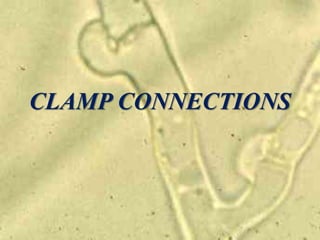
Clamp Connection
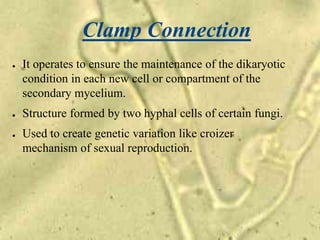
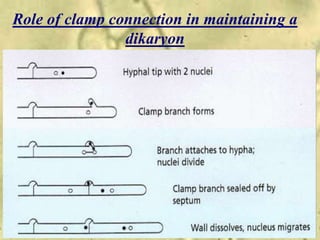
● It operates to ensure the maintenance of the dikaryotic
condition in each new cell or compartment of the
secondary mycelium.
● Structure formed by two hyphal cells of certain fungi.
● Used to create genetic variation like croizer
mechanism of sexual reproduction.
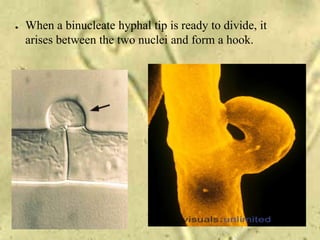
● When a binucleate hyphal tip is ready to divide, it
arises between the two nuclei and form a hook.
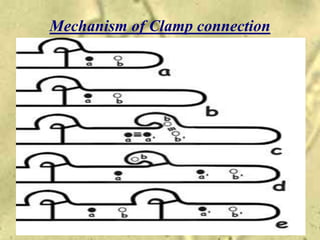
Mechanism of Clamp connection
Role of clamp connection in maintaining a
dikaryon
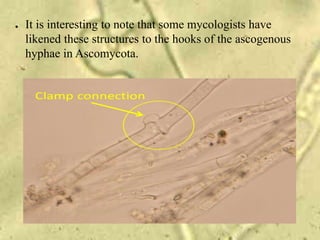
● It is interesting to note that some mycologists have
likened these structures to the hooks of the ascogenous
hyphae in Ascomycota.
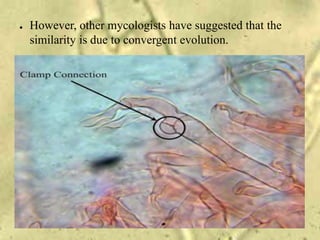
● However, other mycologists have suggested that the
similarity is due to convergent evolution.
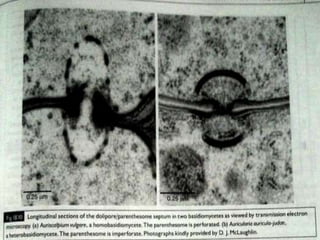
Dolipore Septum
● In some species, the septum wall simply tapers toward
the central pore while in others the septal wall near the
pore is thickened to form a characteristic dough nut
like or barrel- shaped swelling. This latter type of
septum is called a dolipore septum.
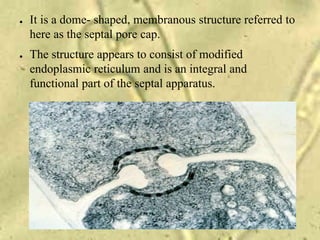
● It is a dome- shaped, membranous structure referred to
here as the septal pore cap.
● The structure appears to consist of modified
endoplasmic reticulum and is an integral and
functional part of the septal apparatus.
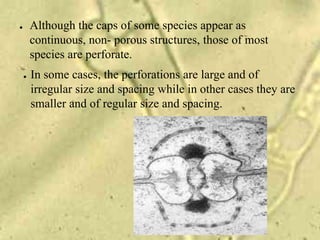
● Although the caps of some species appear as
continuous, non- porous structures, those of most
species are perforate.
● In some cases, the perforations are large and of
irregular size and spacing while in other cases they are
smaller and of regular size and spacing.
Functions of Doliopore Septum
● It is probably safe to say that its exact function remains
unclear.
● It would seem, however, that the pore cap acts as a
screen or sieve, possibly permitting the passage of
some cellular components from one cell to the next
while retarding others.
● Various ultrastructural and cytochemical changes also
have been reported in doliopore septa during
basidiocarp development.

Clamp connectins

  • 1.
  • 2.
    Clamp Connection ● Itoperates to ensure the maintenance of the dikaryotic condition in each new cell or compartment of the secondary mycelium. ● Structure formed by two hyphal cells of certain fungi. ● Used to create genetic variation like croizer mechanism of sexual reproduction.
  • 3.
    ● When abinucleate hyphal tip is ready to divide, it arises between the two nuclei and form a hook.
  • 4.
  • 5.
    Role of clampconnection in maintaining a dikaryon
  • 6.
    ● It isinteresting to note that some mycologists have likened these structures to the hooks of the ascogenous hyphae in Ascomycota.
  • 7.
    ● However, othermycologists have suggested that the similarity is due to convergent evolution.
  • 8.
    Dolipore Septum ● Insome species, the septum wall simply tapers toward the central pore while in others the septal wall near the pore is thickened to form a characteristic dough nut like or barrel- shaped swelling. This latter type of septum is called a dolipore septum.
  • 9.
    ● It isa dome- shaped, membranous structure referred to here as the septal pore cap. ● The structure appears to consist of modified endoplasmic reticulum and is an integral and functional part of the septal apparatus.
  • 11.
    ● Although thecaps of some species appear as continuous, non- porous structures, those of most species are perforate. ● In some cases, the perforations are large and of irregular size and spacing while in other cases they are smaller and of regular size and spacing.
  • 12.
    Functions of DolioporeSeptum ● It is probably safe to say that its exact function remains unclear. ● It would seem, however, that the pore cap acts as a screen or sieve, possibly permitting the passage of some cellular components from one cell to the next while retarding others. ● Various ultrastructural and cytochemical changes also have been reported in doliopore septa during basidiocarp development.