Angiosperms: Origin and Evolution (Pteridospermean and Bennititalean
Theory)
Mr.D.L.Gavande
Assistant Professor
Department of Botany
Shri Shivaji Science and Arts College, Chikhli.
Introduction
 Angiosperms or flowering plants form the largest group of plant kingdom, including about 300
families (411 families, Hutchinson), 8,000 genera and 300,000 species.
 They are considered to be highest evolved plants on the surface of the earth. From Cretaceous age,
the angiosperms eclipsed all other vegetation and now they are dominant.
 They are found almost everywhere in each possible type of habitat and climate.
 They occur in deep lakes, deserts, in beds of seas and even on high peaks of mountains.
 The species of Opuntia (Cactaceae) can survive without water in acute desert conditions, whereas
on the other hand the species of Hydrilla (aquatic plant) are extremely sensitive to drought
conditions.
 Some species are found on rocks, some in waterfalls and also some are marine. The species of
Rhizophora, popularly known as ‘mangrove vegetation’ are found near the water of the sea.
 The epiphytes, parasites, saprophytes, symbionts and even insectivorous plants are also not
uncommon.
 They may be annual, biennial or perennial herbs, shrubs, trees, climbers, twiners and lianes.
 On one hand the angiosperms may be as minute in size as a pin head, e.g., Wolffia microscopica, on
the other extremity like eucleptiles of Australia may reach upto 300 feet in height.
Originof Angiosperms
 The angiosperms appeared suddenly in Cretaceous age about 65 million years back.
 Charles Darwin described this sudden appearance of angiosperms in lower or upper
Cretaceous as an ‘abominable mystery.
 When angiosperms appeared for the first time in lower or upper Cretaceous, they were full
fledged like the trees and the herbs of today.
 In support of this view Prof. Knowlton advocates in his ‘Plant of the past’, “from the
time of their appearance they did not progress at all due to their full-fledged
appearance in the Cretaceous”.
 The forms of cycads and conifers, which long dominated the universe were already
pushed background and the earth had become infact the earth of flowering plants.
 Charles Darwin has called this sudden appearance of angiosperms as an “abominable
mystery”.
 However, some workers do not agree with the doctrine of ‘abominable mystery’.
 According to H.H. Thomas (1936), the angiosperms of the past replaced many of older
gymnosperms in estuarine and marshy waters.
 Graud Eury (1906) believes that the angiosperms came into existence through
mutation.
 Guppy (1919) however, supported the view of mutation.
 Prof. Bertrand is of opinion that all the great groups of vascular plants (Pteridophyta,
Gymnospermae and Angiosperms) not only arose quite independently of each other but
also they originated simultaneously as far back in the Archian period (2000 million
years old-oldest).
 There is a very considerable but scattered literature on the origin and phylogeny of
angiosperms.
 The palaeobotanical evidence shows that there seems three possibilities as regards the
origin of angiosperms.
These possibilities are
1.That the angiosperms are monophyletic in their origin but have had a very much longer
history than at present known, perhaps stretching back into Palaeozoic times and with a whole
series of missing links;
2. That the angiosperms are monophyletic but that the first and at present unknown group
diverged quickly in terms of geological time, into a considerable number of different
groups;
3. That the angiosperms are polyphyletic.
 According to Campbell, “both comparative morphology and the geological record
indicate that the existing angiosperms represent a number of distinct phyla which
cannot be traced back to a single ancestral type”.
 This statement shows that he does not believe in monophyletic origin of angiosperms.
 According to Thomas, the evolutionary tendencies detected in the three groups, i.e.,
Caytoniales, Bennettitales and Pteriodsperms furnish reasonable grounds for the idea
that the angiosperms were derived from various pteridosperms early in the Mesozoic
period.
 Parkin also argues for the monophyletic origin of the angiosperms.
 In conclusion we can say, that the history of the angiosperms is still almost as great a mystery as it was in
the time of Darwin.
 We do not know, when, where or from what the presumably most recent and now dominant large group of
existing terrestrial plants arose.
 Lotsy says, that hybridization is the key to evolution of angiosperms.
 This view has been supported by Anderson.
 He has suggested on the basis of cytological investigations that the angiosperms may have arisen as a
result of hybridization between two gymnosperms.
 According to Hagerup, the origin of some angiosperms took place from the Coniferales through Gnetales.
 According to Eames, Sinnott and Bailey the more primitive angiosperms were arboreal in habit and the
herbaceous angiosperms have been evolved from them.
 According to Hutchinson, in certain groups, trees and shrubs are probably more primitive than herbs.
 Evidently views in this respect are divergent and speculative, the available data being meagre, fragmentary
and isolated.
 Some of the theories proposed from time to time in this connection
1. Bennettitales Theory:
 This theory was proposed by Saporta and Marion (1885) and supported
by Arber and Parkins (1907).
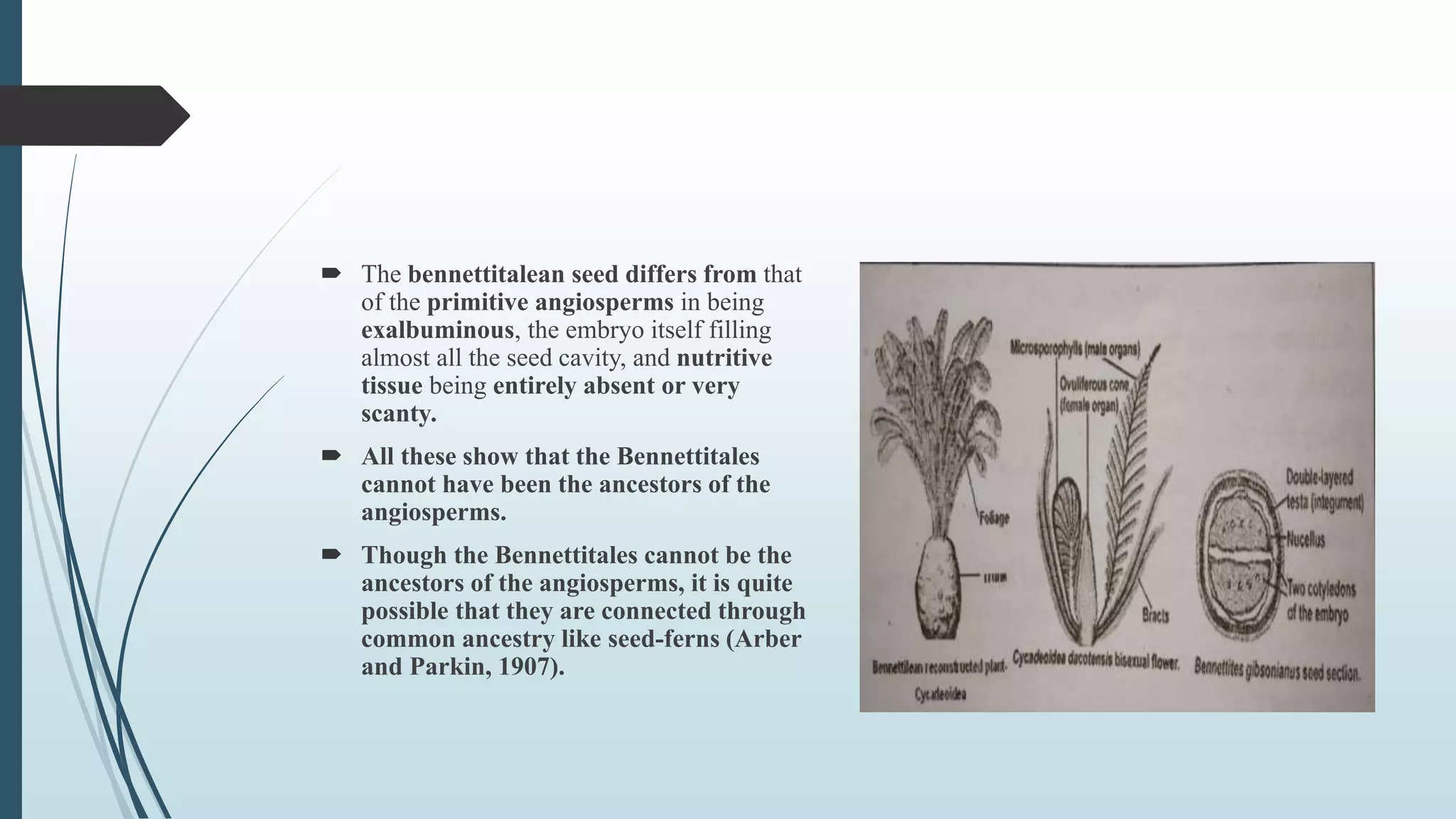
 Bennetitales have often been proposed as possible ancestors of
angiosperms, and in this connection is entirely based on the resemblance
in structure between the strobili of the Mesozoic genus Cycadcoidea
and the flower of Magnolia.
 But this resemblance is superficial, they are alike only in that both are
bisexual and both consist of an elongated axis on which protective
bracts (perianth members in Magnolia), microsporophylls and
megasporophylls are arranged successively and in the same order.
 But along with these few similarities there are profound differences.
 The microsporophylls (stamens) of Magnolia (as in other primitive angiosperms) are free and
arranged spirally on the axis, but in Bennettitales they are whorled and mostly connate.
 Bennettitalean microsporophyll is large, frond like compound structure and can not be
compared with stamen of magnoliaceae.
 The megasporophylls of the Bennettitales are much reduced, simplified stalk-like structures,
sometimes very abbreviated, each bearing at its apex a solitary erect ovule.
 Between these stalk-like megasporophylls and alternating with them, are sterile organs (interseminal
scales) which appear to be modified sterilized megasporophylls.
 These sterile scales, with their tightly packed expanded apices, form a kind of protective armour
round the ovules.
 Protection of the ovules is achieved, in a very different way from that found in the angiosperms.
 Another special feature of the Bennettitales is the presence of a distinct micropylar tube in the
ovule, formed by the integument and serving for the reception of the microspores.
 In angiosperms there is no such micropylar tube; the microspores are caught by the stigma, not
by the ovule.
 The bennettitalean seed differs from that
of the primitive angiosperms in being
exalbuminous, the embryo itself filling
almost all the seed cavity, and nutritive
tissue being entirely absent or very
scanty.
 All these show that the Bennettitales
cannot have been the ancestors of the
angiosperms.
 Though the Bennettitales cannot be the
ancestors of the angiosperms, it is quite
possible that they are connected through
common ancestry like seed-ferns (Arber
and Parkin, 1907).
2.Pteridospermean Theory:
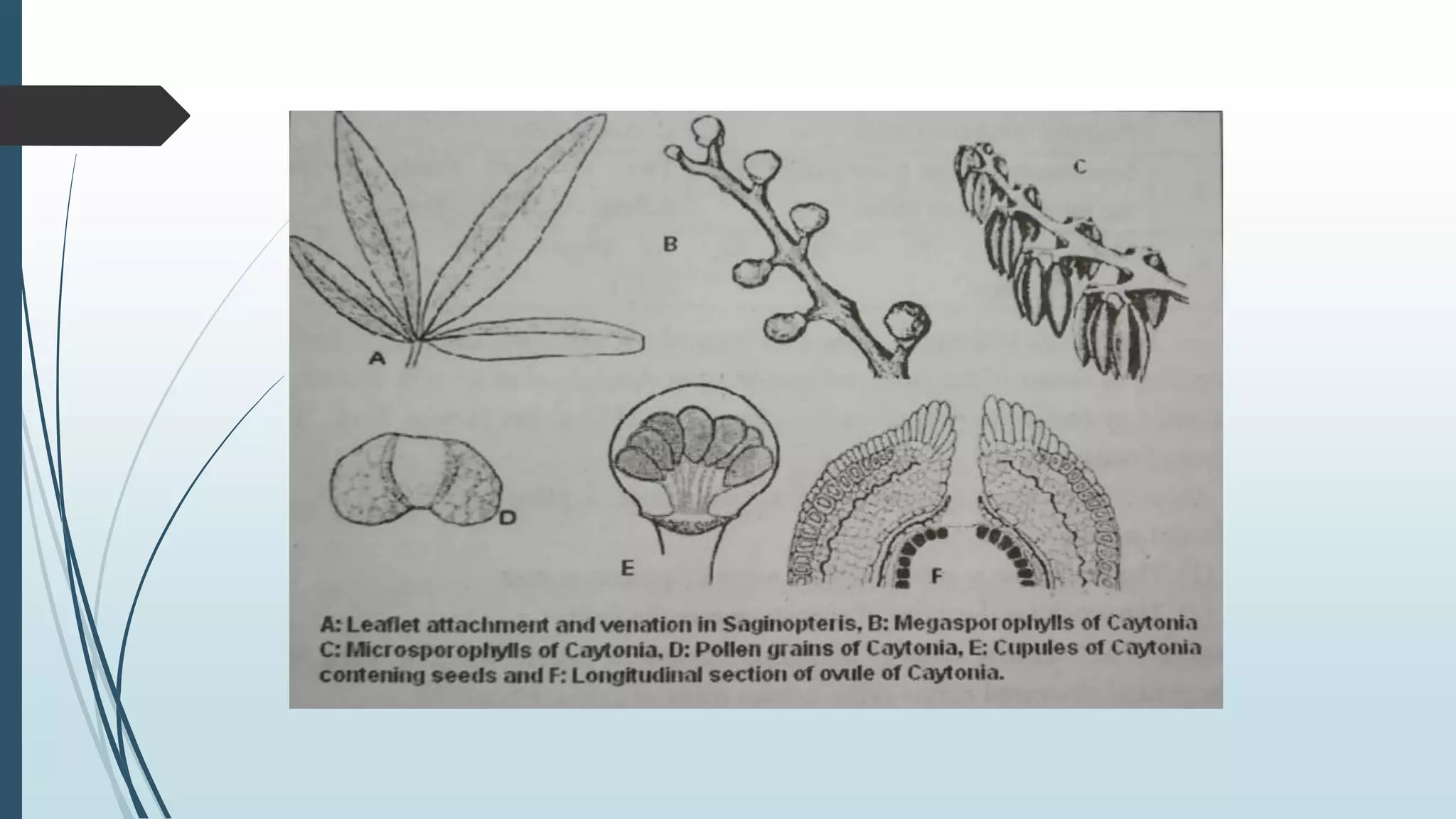
 Pteridospermean theory: Pteridosperms (Seed ferns) were considered as ancestors of Angiosperms
by Long (1966).
 He consider features like ;
i) Reticulate venation,
ii) monopodial branching.
iii) presence of cambium,
iv) presence of microsporophylls and megasporophylls on the same plant;
v) Origin of sepals from leaves and petals from sepals and stamens,
vi) development of triploid endosperm due to extreme reduction of female gametophyte,
vii) similarities of seed structure and
viii) existence of one or several ovules subtended by a cupule.
 The reproductive structures of Glossopteris are enough to bring seed ferns (Pteridosperms) closest to
Angiosperms.
 Glossopteris was described as deciduous tree having elongated leaves with reticulate venation and midrib.
 The reproductive organs developed on the leaves.
 Most of these characters are correlated with the modern angiosperms.
 Caytoniales is one of the orders from the Pteridosperms which showed some similarities with angiosperms.
 The angiospermic characters of Caytoniales includes,
1. Curved cupules have stalked orthotropus ovules which closed after pollination and resembles closely with that
of angiosperms.
2. Reticulate venation of leaves.
3. Development of abscission layer.
4. Presence of microsporophylls possessing tetralocular synangia.
5. Presence of bud scales.
But Pteridosperm ancestry of angiosperms appears to be untenable because of two serious objections.
 The scalariform xylem elements never occur in pterdiosperms while they are common in
angiosperms.
 No satisfactory explanation is given for cupules as an equivalent of carpellary wall in case
of multiovulate cupules.
 This theory was supported by many phylogenetists and the evidences provided by Andrew
(1947), Amold (1949), Thomas (1955) and Cronquist (1968) are in favor of this theory.
 Thorne (1996), after observing the entire evolutionary cladistic studies regarding
pteridosperms, agreed that angiosperms probably evolved during late Jurassic period from
some group of seed ferns probably pteridosperms.
 Doyle (2006), think that, probably Caytoniales is the connecting link responsible for the
origin of angiosperms.
Angiosperms - origin and evolution ( pteridospermean and bennititalean theory)

Angiosperms - origin and evolution ( pteridospermean and bennititalean theory)

  • 1.
    Angiosperms: Origin andEvolution (Pteridospermean and Bennititalean Theory) Mr.D.L.Gavande Assistant Professor Department of Botany Shri Shivaji Science and Arts College, Chikhli.
  • 2.
    Introduction  Angiosperms orflowering plants form the largest group of plant kingdom, including about 300 families (411 families, Hutchinson), 8,000 genera and 300,000 species.  They are considered to be highest evolved plants on the surface of the earth. From Cretaceous age, the angiosperms eclipsed all other vegetation and now they are dominant.  They are found almost everywhere in each possible type of habitat and climate.  They occur in deep lakes, deserts, in beds of seas and even on high peaks of mountains.  The species of Opuntia (Cactaceae) can survive without water in acute desert conditions, whereas on the other hand the species of Hydrilla (aquatic plant) are extremely sensitive to drought conditions.  Some species are found on rocks, some in waterfalls and also some are marine. The species of Rhizophora, popularly known as ‘mangrove vegetation’ are found near the water of the sea.  The epiphytes, parasites, saprophytes, symbionts and even insectivorous plants are also not uncommon.  They may be annual, biennial or perennial herbs, shrubs, trees, climbers, twiners and lianes.  On one hand the angiosperms may be as minute in size as a pin head, e.g., Wolffia microscopica, on the other extremity like eucleptiles of Australia may reach upto 300 feet in height.
  • 3.
    Originof Angiosperms  Theangiosperms appeared suddenly in Cretaceous age about 65 million years back.  Charles Darwin described this sudden appearance of angiosperms in lower or upper Cretaceous as an ‘abominable mystery.  When angiosperms appeared for the first time in lower or upper Cretaceous, they were full fledged like the trees and the herbs of today.  In support of this view Prof. Knowlton advocates in his ‘Plant of the past’, “from the time of their appearance they did not progress at all due to their full-fledged appearance in the Cretaceous”.  The forms of cycads and conifers, which long dominated the universe were already pushed background and the earth had become infact the earth of flowering plants.  Charles Darwin has called this sudden appearance of angiosperms as an “abominable mystery”.  However, some workers do not agree with the doctrine of ‘abominable mystery’.  According to H.H. Thomas (1936), the angiosperms of the past replaced many of older gymnosperms in estuarine and marshy waters.
  • 4.
     Graud Eury(1906) believes that the angiosperms came into existence through mutation.  Guppy (1919) however, supported the view of mutation.  Prof. Bertrand is of opinion that all the great groups of vascular plants (Pteridophyta, Gymnospermae and Angiosperms) not only arose quite independently of each other but also they originated simultaneously as far back in the Archian period (2000 million years old-oldest).  There is a very considerable but scattered literature on the origin and phylogeny of angiosperms.  The palaeobotanical evidence shows that there seems three possibilities as regards the origin of angiosperms.
  • 5.
    These possibilities are 1.Thatthe angiosperms are monophyletic in their origin but have had a very much longer history than at present known, perhaps stretching back into Palaeozoic times and with a whole series of missing links; 2. That the angiosperms are monophyletic but that the first and at present unknown group diverged quickly in terms of geological time, into a considerable number of different groups; 3. That the angiosperms are polyphyletic.  According to Campbell, “both comparative morphology and the geological record indicate that the existing angiosperms represent a number of distinct phyla which cannot be traced back to a single ancestral type”.  This statement shows that he does not believe in monophyletic origin of angiosperms.  According to Thomas, the evolutionary tendencies detected in the three groups, i.e., Caytoniales, Bennettitales and Pteriodsperms furnish reasonable grounds for the idea that the angiosperms were derived from various pteridosperms early in the Mesozoic period.  Parkin also argues for the monophyletic origin of the angiosperms.
  • 6.
     In conclusionwe can say, that the history of the angiosperms is still almost as great a mystery as it was in the time of Darwin.  We do not know, when, where or from what the presumably most recent and now dominant large group of existing terrestrial plants arose.  Lotsy says, that hybridization is the key to evolution of angiosperms.  This view has been supported by Anderson.  He has suggested on the basis of cytological investigations that the angiosperms may have arisen as a result of hybridization between two gymnosperms.  According to Hagerup, the origin of some angiosperms took place from the Coniferales through Gnetales.  According to Eames, Sinnott and Bailey the more primitive angiosperms were arboreal in habit and the herbaceous angiosperms have been evolved from them.  According to Hutchinson, in certain groups, trees and shrubs are probably more primitive than herbs.  Evidently views in this respect are divergent and speculative, the available data being meagre, fragmentary and isolated.  Some of the theories proposed from time to time in this connection
  • 7.
    1. Bennettitales Theory: This theory was proposed by Saporta and Marion (1885) and supported by Arber and Parkins (1907).  Bennetitales have often been proposed as possible ancestors of angiosperms, and in this connection is entirely based on the resemblance in structure between the strobili of the Mesozoic genus Cycadcoidea and the flower of Magnolia.  But this resemblance is superficial, they are alike only in that both are bisexual and both consist of an elongated axis on which protective bracts (perianth members in Magnolia), microsporophylls and megasporophylls are arranged successively and in the same order.  But along with these few similarities there are profound differences.
  • 8.
     The microsporophylls(stamens) of Magnolia (as in other primitive angiosperms) are free and arranged spirally on the axis, but in Bennettitales they are whorled and mostly connate.  Bennettitalean microsporophyll is large, frond like compound structure and can not be compared with stamen of magnoliaceae.  The megasporophylls of the Bennettitales are much reduced, simplified stalk-like structures, sometimes very abbreviated, each bearing at its apex a solitary erect ovule.  Between these stalk-like megasporophylls and alternating with them, are sterile organs (interseminal scales) which appear to be modified sterilized megasporophylls.  These sterile scales, with their tightly packed expanded apices, form a kind of protective armour round the ovules.  Protection of the ovules is achieved, in a very different way from that found in the angiosperms.  Another special feature of the Bennettitales is the presence of a distinct micropylar tube in the ovule, formed by the integument and serving for the reception of the microspores.  In angiosperms there is no such micropylar tube; the microspores are caught by the stigma, not by the ovule.
  • 9.
     The bennettitaleanseed differs from that of the primitive angiosperms in being exalbuminous, the embryo itself filling almost all the seed cavity, and nutritive tissue being entirely absent or very scanty.  All these show that the Bennettitales cannot have been the ancestors of the angiosperms.  Though the Bennettitales cannot be the ancestors of the angiosperms, it is quite possible that they are connected through common ancestry like seed-ferns (Arber and Parkin, 1907).
  • 10.
    2.Pteridospermean Theory:  Pteridospermeantheory: Pteridosperms (Seed ferns) were considered as ancestors of Angiosperms by Long (1966).  He consider features like ; i) Reticulate venation, ii) monopodial branching. iii) presence of cambium, iv) presence of microsporophylls and megasporophylls on the same plant; v) Origin of sepals from leaves and petals from sepals and stamens, vi) development of triploid endosperm due to extreme reduction of female gametophyte, vii) similarities of seed structure and viii) existence of one or several ovules subtended by a cupule.
  • 11.
     The reproductivestructures of Glossopteris are enough to bring seed ferns (Pteridosperms) closest to Angiosperms.  Glossopteris was described as deciduous tree having elongated leaves with reticulate venation and midrib.  The reproductive organs developed on the leaves.  Most of these characters are correlated with the modern angiosperms.  Caytoniales is one of the orders from the Pteridosperms which showed some similarities with angiosperms.  The angiospermic characters of Caytoniales includes, 1. Curved cupules have stalked orthotropus ovules which closed after pollination and resembles closely with that of angiosperms. 2. Reticulate venation of leaves. 3. Development of abscission layer. 4. Presence of microsporophylls possessing tetralocular synangia. 5. Presence of bud scales. But Pteridosperm ancestry of angiosperms appears to be untenable because of two serious objections.
  • 12.
     The scalariformxylem elements never occur in pterdiosperms while they are common in angiosperms.  No satisfactory explanation is given for cupules as an equivalent of carpellary wall in case of multiovulate cupules.  This theory was supported by many phylogenetists and the evidences provided by Andrew (1947), Amold (1949), Thomas (1955) and Cronquist (1968) are in favor of this theory.  Thorne (1996), after observing the entire evolutionary cladistic studies regarding pteridosperms, agreed that angiosperms probably evolved during late Jurassic period from some group of seed ferns probably pteridosperms.  Doyle (2006), think that, probably Caytoniales is the connecting link responsible for the origin of angiosperms.