BOTANY
FIRST QUARTER
WHAT IS THE FIRST THING THAT’S
COME INTO YOUR MIND
WHEN YOUR HEAR THE WORD ….?
BOTANY
WHERE DOES THE WORD BOTANY
COME FROM?
The term "botany" itself
probably came from the
Greek words botanikos
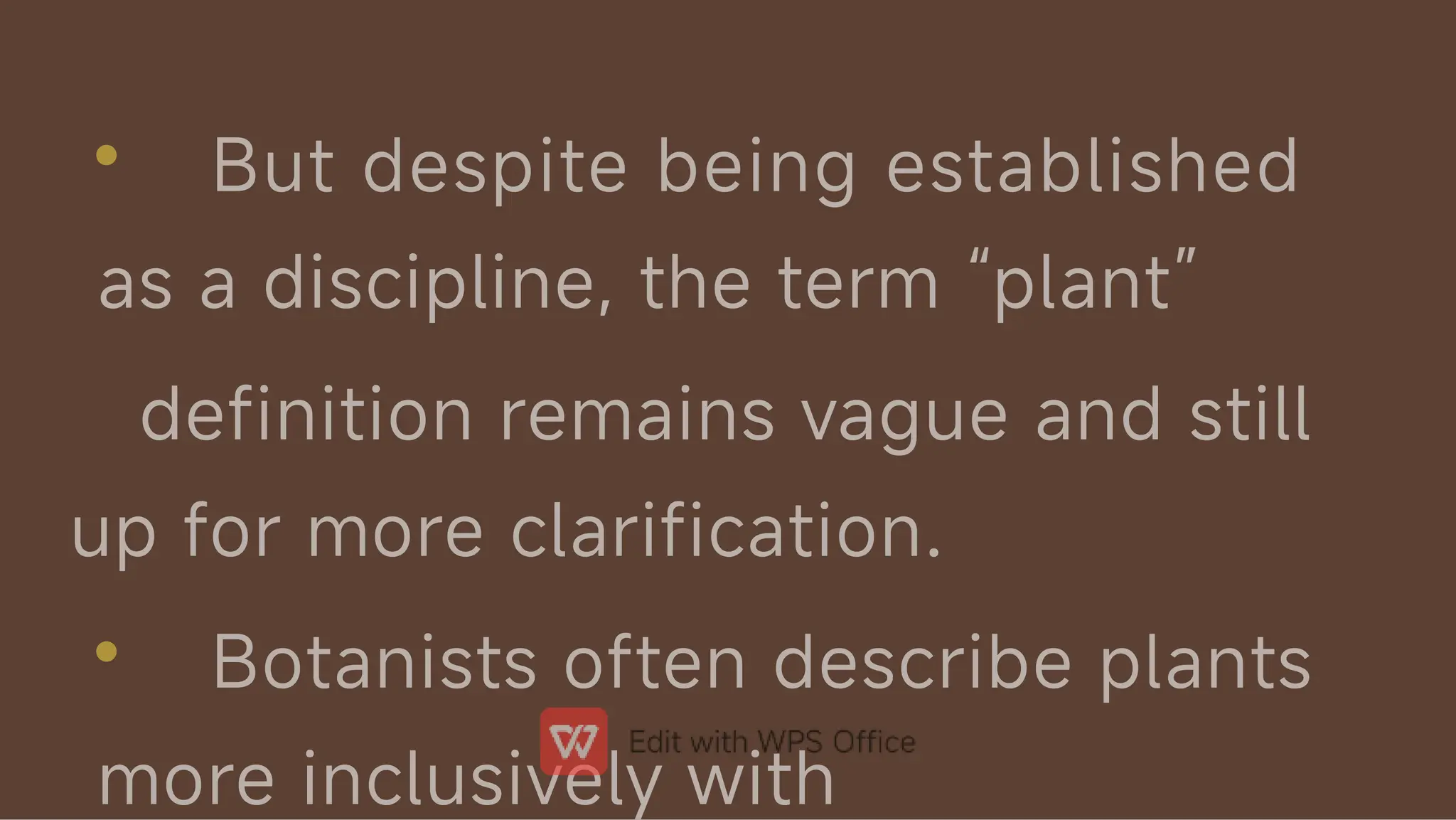
BOTANY-
•
•
is the systematic and scientific study of
plants.
This field primarily focuses on their
structure, biochemistry, physiological
processes, links to the environment, and
interactions with other living things.
•
•
But despite being established
as a discipline, the term “plant”
definition remains vague and still
up for more clarification.
Botanists often describe plants
more inclusively with
HISTORY
OF
BOTANY
(TIMELINE)
BOTANY
FIRST
EMERGE?
DURING THE
PRE-17TH
CENTURY
History of Botany – A Timeline
During the Pre-17th Century
•
•
•
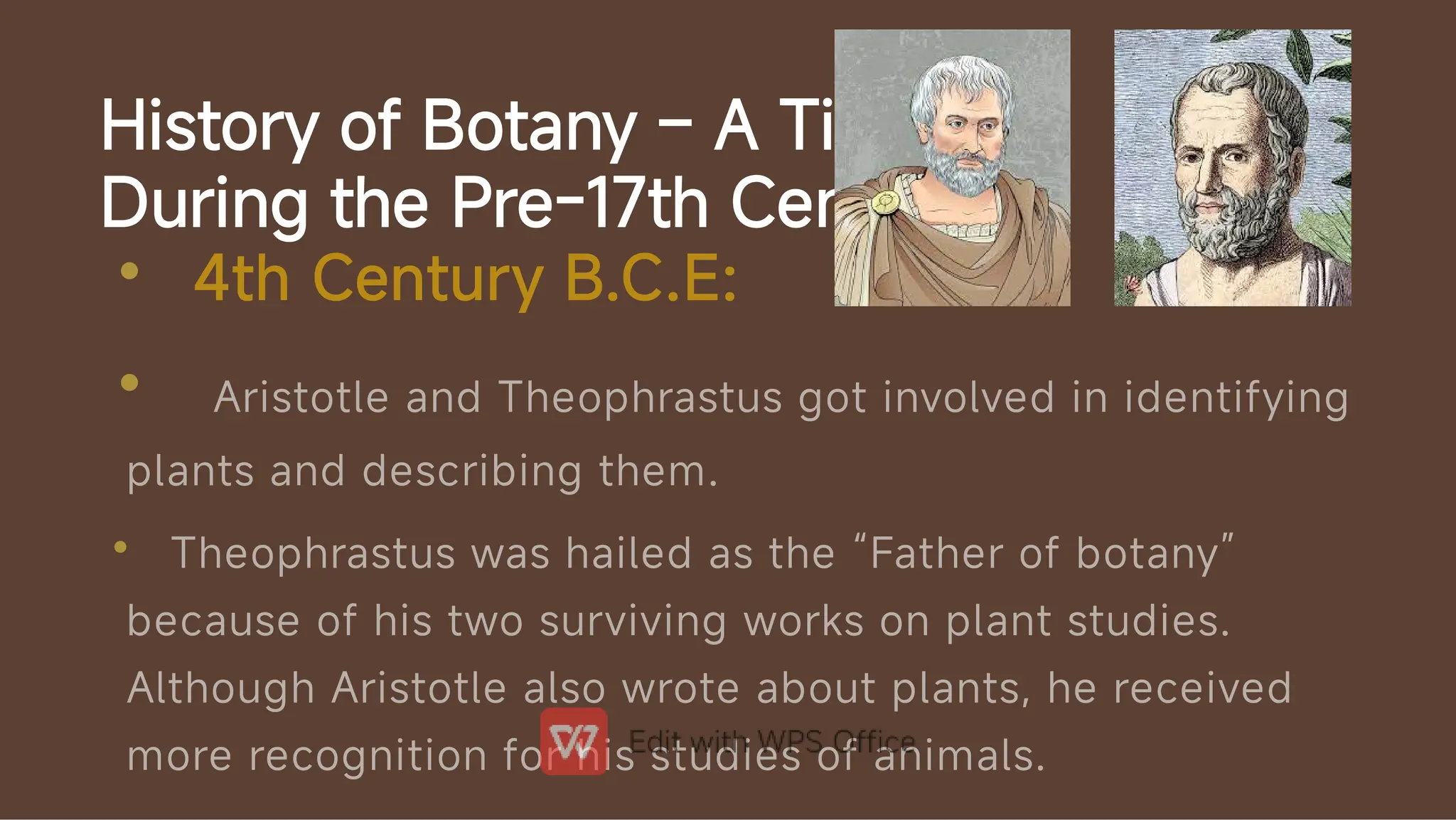
4th Century B.C.E:
Aristotle and Theophrastus got involved in identifying
plants and describing them.
Theophrastus was hailed as the “Father of botany”
because of his two surviving works on plant studies.
Although Aristotle also wrote about plants, he received
more recognition for his studies of animals.
History of Botany – A Timeline
During the Pre-17th Century
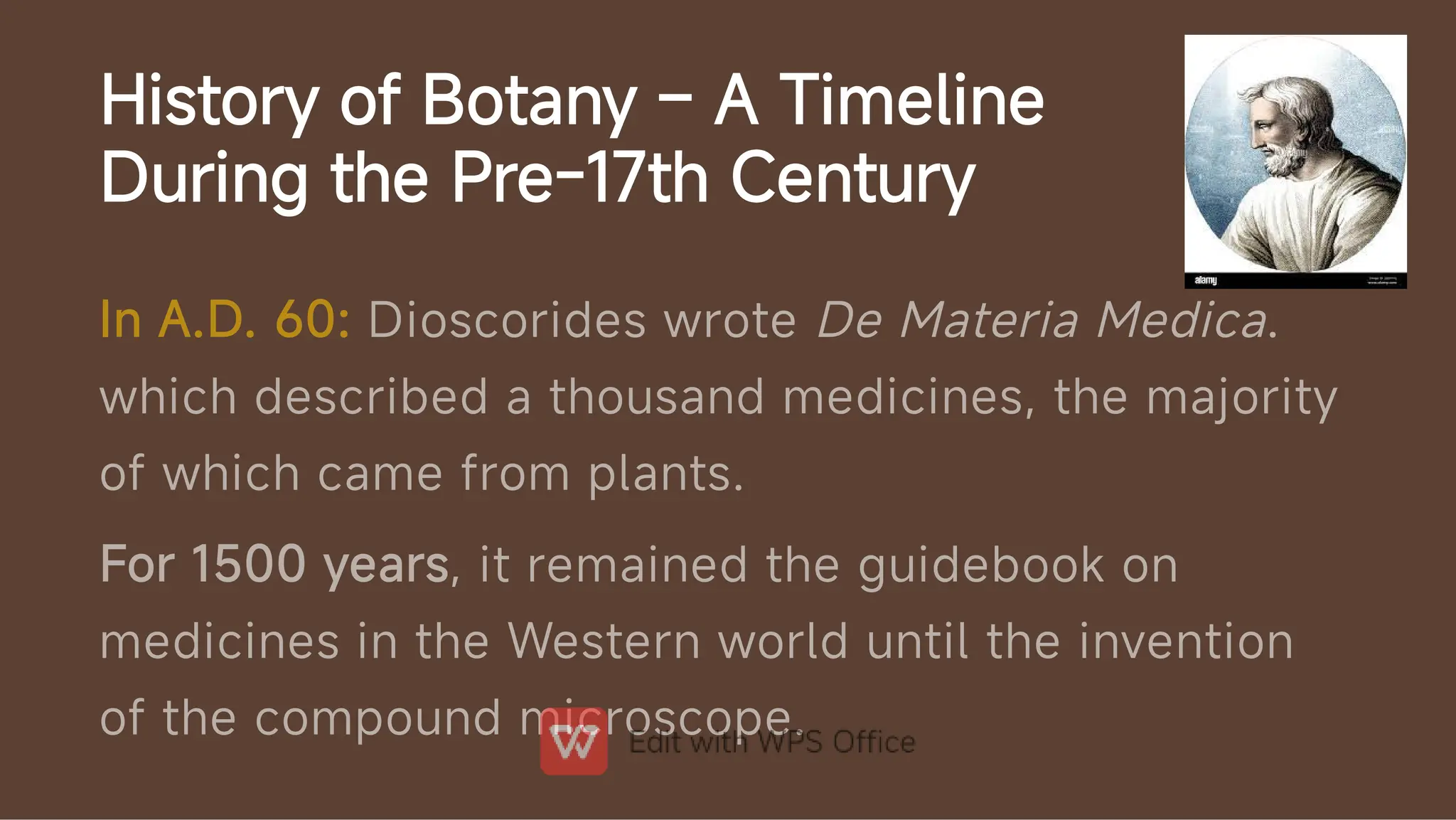
In A.D. 60: Dioscorides wrote De Materia Medica.
which described a thousand medicines, the majority
of which came from plants.
For 1500 years, it remained the guidebook on
medicines in the Western world until the invention
of the compound microscope.
History of Botany – A Timeline
During the 17th Century

Early 17th century:
For a brief period, the search for knowledge in the field
of Botany temporarily became stagnant.
However, the revival of learning during the European
Renaissance renewed interest in plants
History of Botany – A Timeline
During the 17th Century (Early 17th
century)


Prehistoric Era:
Humans have likely been using plants for food,
medicine, and other purposes for thousands of years.
The earliest evidence of plant cultivation dates back to
around 10,000 BCE in the Fertile Crescent region of the
Middle East.
History of Botany – A Timeline
During the 17th Century


Ancient Civilizations:
The ancient Egyptians, Greeks, and Romans all had a
strong interest in plants and made significant
contributions to the study of botany.
The ancient Greeks, in particular, made significant
advances in the classification and naming of plants.
History of Botany – A Timeline
During the 17th Century - 1640


Johannes van Helmont measured the
uptake of water in a tree.
Brittanica.com explains (refer to Major
Experiments section) “In what is perhaps
his best-known experiment, van Helmont
placed a 5-pound (about 2.2-kg) willow
History of Botany – A Timeline
During the 17th Century - 1640


After five years, he found that the
tree weighed 169 pounds (about 77
kg), while the soil had lost only 2
ounces (57 grams).
He concluded that “164 pounds of
History of Botany – A Timeline
During the 17th Century -

1665: Robert Hooke invented the
microscope. Because of this, Robert
Hooke had the chance to look closely at
what a cell looks like.
His description of these cells was
published in Micrographia.
History of Botany – A Timeline
During the 17th Century -

1674:
Botanist: Anton van
Leeuwenhoek1674: Anton van
Leeuwenhoek saw a live cell under
a microscope. Before his
History of Botany – A Timeline
During the 17th Century -
1686: John Ray published his
book, Historia Plantarum. This
became an important step toward
modern taxonomy (Arber 2010).
History of Botany – A Timeline
During the 17th Century -
Botanist: Rudolf Camerarius1694:
Rudolf Camerarius established
plant sexuality in his book entitled
De Sexu Plantarum Epistola. There,
he stated that: “No ovules of
History of Botany – A Timeline
During the 18th Century -
Botanist: Stephen Hales 1727:
Stephen Hales successfully
established plant physiology as a
science. He published his
experiments dealing with the
History of Botany – A Timeline
Botanist: Carolus Linnaeus1758:
Carolus Linnaeus (Carl von Linne),
the “Father of Taxonomy“,
introduced the science of
taxonomy which deals with the
History of Botany – A Timeline
1760s: Botany became even more
widespread among educated women
who painted plants, attended classes on
plant classification, and collected
herbarium specimens. However, their
study focused on the healing properties
of plants rather than plant reproduction.
History of Botany – A Timeline
Botanist: Joseph Priestley Later part of the
eighteenth century: Joseph Priestley laid the
foundation for the chemical analysis of plant
metabolism. Joseph Priestley published his works
as Experiments and Observations on Different
Kinds of Air in 1774. The published paper
demonstrated that green plants absorb “fixed air”
(carbon dioxide) from the atmosphere, give off
History of Botany – A Timeline (During
the 19th Century)
Early part of the nineteenth century: Progress in
the study of plant fossils was made.
1818: Chlorophyll was discovered.
1840: Advances were made in the study of plant
diseases because of the potato blight that killed
potato crops in Ireland. This led to the further
study of plant diseases (Richman 2016).
1847: The process of photosynthesis was first
History of Botany – A Timeline (During
the 19th Century)
1859: Charles Darwin proposed his theory of
evolution and adaptation, or more commonly
referred to as “survival of the fittest” (kenyon.edu
2016).
Charles Darwin and Alfred Russel Wallace
collaborated. Darwin soon published his renowned
and highly recognized book On the Origin of
Species by Means of Natural Selection.
History of Botany – A Timeline (During
the 19th Century)
1862: The exact mechanism of photosynthesis
was discovered when it was observed that starch
was formed in green cells only in the presence of
light.
1865: The results of Mendel’s experiments in
1865 showed that both parents should pass
distinct physical factors which code information to
their offspring at conception. The offspring then
History of Botany – A Timeline (During
the 20th Century)
Twentieth Century up to the Present:
Early 20th Century: The process of nitrogen
fixation, nitrification, and ammonification was
discovered.
1903: The two types of chlorophyll—a and b were
discovered. Learn more here.
1936: Through his experiment, Alexander Oparin
History of Botany – A Timeline (During
the 20th Century)
1940s: Ecology became a separate
discipline. Technology has helped
specialists in botany to see and
understand the three-dimensional nature
of cells and the genetic engineering of
plants. This greatly improved crops and

History of Botany – A Timeline (During
the 20th Century)

HISTORY-OF-BOTANY_ppt-Autosaved-Autosaved.pdf

  • 1.
  • 2.
    WHAT IS THEFIRST THING THAT’S COME INTO YOUR MIND WHEN YOUR HEAR THE WORD ….? BOTANY
  • 3.
    WHERE DOES THEWORD BOTANY COME FROM? The term "botany" itself probably came from the Greek words botanikos
  • 4.
    BOTANY- • • is the systematicand scientific study of plants. This field primarily focuses on their structure, biochemistry, physiological processes, links to the environment, and interactions with other living things.
  • 5.
    • • But despite beingestablished as a discipline, the term “plant” definition remains vague and still up for more clarification. Botanists often describe plants more inclusively with
  • 6.
  • 7.
  • 8.
  • 9.
    History of Botany– A Timeline During the Pre-17th Century • • • 4th Century B.C.E: Aristotle and Theophrastus got involved in identifying plants and describing them. Theophrastus was hailed as the “Father of botany” because of his two surviving works on plant studies. Although Aristotle also wrote about plants, he received more recognition for his studies of animals.
  • 10.
    History of Botany– A Timeline During the Pre-17th Century In A.D. 60: Dioscorides wrote De Materia Medica. which described a thousand medicines, the majority of which came from plants. For 1500 years, it remained the guidebook on medicines in the Western world until the invention of the compound microscope.
  • 11.
    History of Botany– A Timeline During the 17th Century  Early 17th century: For a brief period, the search for knowledge in the field of Botany temporarily became stagnant. However, the revival of learning during the European Renaissance renewed interest in plants
  • 12.
    History of Botany– A Timeline During the 17th Century (Early 17th century)   Prehistoric Era: Humans have likely been using plants for food, medicine, and other purposes for thousands of years. The earliest evidence of plant cultivation dates back to around 10,000 BCE in the Fertile Crescent region of the Middle East.
  • 13.
    History of Botany– A Timeline During the 17th Century   Ancient Civilizations: The ancient Egyptians, Greeks, and Romans all had a strong interest in plants and made significant contributions to the study of botany. The ancient Greeks, in particular, made significant advances in the classification and naming of plants.
  • 14.
    History of Botany– A Timeline During the 17th Century - 1640   Johannes van Helmont measured the uptake of water in a tree. Brittanica.com explains (refer to Major Experiments section) “In what is perhaps his best-known experiment, van Helmont placed a 5-pound (about 2.2-kg) willow
  • 15.
    History of Botany– A Timeline During the 17th Century - 1640   After five years, he found that the tree weighed 169 pounds (about 77 kg), while the soil had lost only 2 ounces (57 grams). He concluded that “164 pounds of
  • 16.
    History of Botany– A Timeline During the 17th Century -  1665: Robert Hooke invented the microscope. Because of this, Robert Hooke had the chance to look closely at what a cell looks like. His description of these cells was published in Micrographia.
  • 17.
    History of Botany– A Timeline During the 17th Century -  1674: Botanist: Anton van Leeuwenhoek1674: Anton van Leeuwenhoek saw a live cell under a microscope. Before his
  • 18.
    History of Botany– A Timeline During the 17th Century - 1686: John Ray published his book, Historia Plantarum. This became an important step toward modern taxonomy (Arber 2010).
  • 19.
    History of Botany– A Timeline During the 17th Century - Botanist: Rudolf Camerarius1694: Rudolf Camerarius established plant sexuality in his book entitled De Sexu Plantarum Epistola. There, he stated that: “No ovules of
  • 20.
    History of Botany– A Timeline During the 18th Century - Botanist: Stephen Hales 1727: Stephen Hales successfully established plant physiology as a science. He published his experiments dealing with the
  • 21.
    History of Botany– A Timeline Botanist: Carolus Linnaeus1758: Carolus Linnaeus (Carl von Linne), the “Father of Taxonomy“, introduced the science of taxonomy which deals with the
  • 22.
    History of Botany– A Timeline 1760s: Botany became even more widespread among educated women who painted plants, attended classes on plant classification, and collected herbarium specimens. However, their study focused on the healing properties of plants rather than plant reproduction.
  • 23.
    History of Botany– A Timeline Botanist: Joseph Priestley Later part of the eighteenth century: Joseph Priestley laid the foundation for the chemical analysis of plant metabolism. Joseph Priestley published his works as Experiments and Observations on Different Kinds of Air in 1774. The published paper demonstrated that green plants absorb “fixed air” (carbon dioxide) from the atmosphere, give off
  • 24.
    History of Botany– A Timeline (During the 19th Century) Early part of the nineteenth century: Progress in the study of plant fossils was made. 1818: Chlorophyll was discovered. 1840: Advances were made in the study of plant diseases because of the potato blight that killed potato crops in Ireland. This led to the further study of plant diseases (Richman 2016). 1847: The process of photosynthesis was first
  • 25.
    History of Botany– A Timeline (During the 19th Century) 1859: Charles Darwin proposed his theory of evolution and adaptation, or more commonly referred to as “survival of the fittest” (kenyon.edu 2016). Charles Darwin and Alfred Russel Wallace collaborated. Darwin soon published his renowned and highly recognized book On the Origin of Species by Means of Natural Selection.
  • 26.
    History of Botany– A Timeline (During the 19th Century) 1862: The exact mechanism of photosynthesis was discovered when it was observed that starch was formed in green cells only in the presence of light. 1865: The results of Mendel’s experiments in 1865 showed that both parents should pass distinct physical factors which code information to their offspring at conception. The offspring then
  • 27.
    History of Botany– A Timeline (During the 20th Century) Twentieth Century up to the Present: Early 20th Century: The process of nitrogen fixation, nitrification, and ammonification was discovered. 1903: The two types of chlorophyll—a and b were discovered. Learn more here. 1936: Through his experiment, Alexander Oparin
  • 28.
    History of Botany– A Timeline (During the 20th Century) 1940s: Ecology became a separate discipline. Technology has helped specialists in botany to see and understand the three-dimensional nature of cells and the genetic engineering of plants. This greatly improved crops and

  • 29.
    History of Botany– A Timeline (During the 20th Century)