Darwinism and Natural
Selection
Darwinism
 Darwinism is a theory of biological evolution
developed by Charles Darwin and others.
 It states that all species of organisms arise and
develop through the natural selection of small,
inherited variations that increase the individual's
ability to compete, survive, and reproduce. Also
called Darwinian theory.
Natural Selection
 Natural selection is Darwin’s most famous theory.
 It states that evolutionary change comes through the
production of variation in each generation and
differential survival of individuals with different
combinations of these variable characters.
 Individuals with characteristics which increase their
probability of survival will have more opportunities
to reproduce and their offspring will also benefit
from the heritable, advantageous character which
spread the population.
Conditions of Natural Selection
1. Reproduction
2. Heredity
3. Variation in individual characters among the
members of the population
4. Variation in the fitness of organisms according to
the state they have for a heritable character.
If these conditions are met for any property of a
species, natural selection automatically results.
Types of Natural Selection
Natural selection can occur with or without
environmental change. It is of three types:-
1. Directional Selection
2. Stabilizing Selection
3. Disruptive Selection
Directional Selection
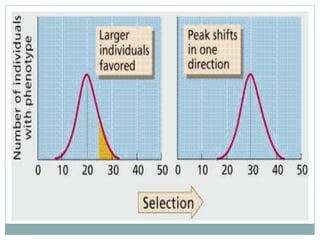
 The first type of natural selection is called directional
selection.
 It derives its name from the shape of the
approximate bell curve that is produced when all
individuals' traits are plotted.
 Instead of the bell curve falling directly in the middle
of the axes on which they are plotted, it skews either
to the left or the right by varying degrees. Hence, it
has moved one direction or the other.
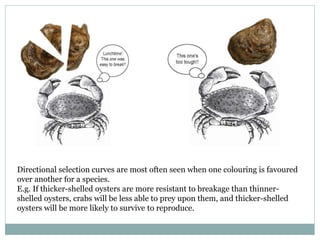
Directional selection curves are most often seen when one colouring is favoured
over another for a species.
E.g. If thicker-shelled oysters are more resistant to breakage than thinner-
shelled oysters, crabs will be less able to prey upon them, and thicker-shelled
oysters will be more likely to survive to reproduce.
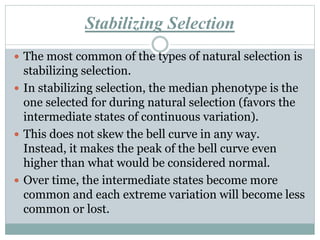
Stabilizing Selection
 The most common of the types of natural selection is
stabilizing selection.
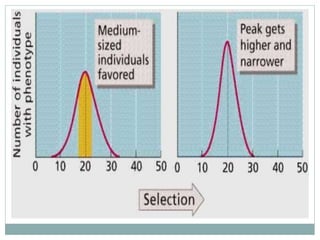
 In stabilizing selection, the median phenotype is the
one selected for during natural selection (favors the
intermediate states of continuous variation).
 This does not skew the bell curve in any way.
Instead, it makes the peak of the bell curve even
higher than what would be considered normal.
 Over time, the intermediate states become more
common and each extreme variation will become less
common or lost.
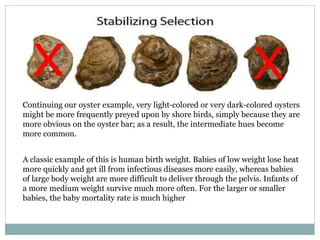
Continuing our oyster example, very light-colored or very dark-colored oysters
might be more frequently preyed upon by shore birds, simply because they are
more obvious on the oyster bar; as a result, the intermediate hues become
more common.
A classic example of this is human birth weight. Babies of low weight lose heat
more quickly and get ill from infectious diseases more easily, whereas babies
of large body weight are more difficult to deliver through the pelvis. Infants of
a more medium weight survive much more often. For the larger or smaller
babies, the baby mortality rate is much higher
Disruptive Selection
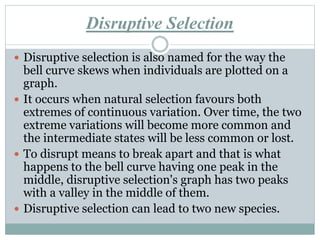
 Disruptive selection is also named for the way the
bell curve skews when individuals are plotted on a
graph.
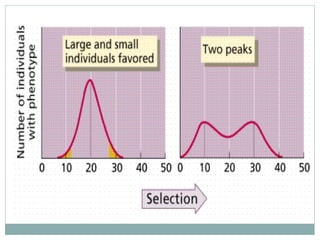
 It occurs when natural selection favours both
extremes of continuous variation. Over time, the two
extreme variations will become more common and
the intermediate states will be less common or lost.
 To disrupt means to break apart and that is what
happens to the bell curve having one peak in the
middle, disruptive selection's graph has two peaks
with a valley in the middle of them.
 Disruptive selection can lead to two new species.
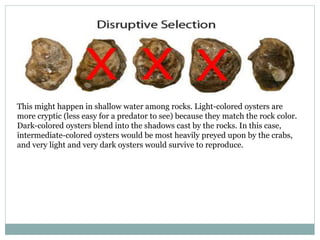
This might happen in shallow water among rocks. Light-colored oysters are
more cryptic (less easy for a predator to see) because they match the rock color.
Dark-colored oysters blend into the shadows cast by the rocks. In this case,
intermediate-colored oysters would be most heavily preyed upon by the crabs,
and very light and very dark oysters would survive to reproduce.
THANK YOU

Darwinism and natural selection

  • 1.
  • 2.
    Darwinism  Darwinism isa theory of biological evolution developed by Charles Darwin and others.  It states that all species of organisms arise and develop through the natural selection of small, inherited variations that increase the individual's ability to compete, survive, and reproduce. Also called Darwinian theory.
  • 3.
    Natural Selection  Naturalselection is Darwin’s most famous theory.  It states that evolutionary change comes through the production of variation in each generation and differential survival of individuals with different combinations of these variable characters.  Individuals with characteristics which increase their probability of survival will have more opportunities to reproduce and their offspring will also benefit from the heritable, advantageous character which spread the population.
  • 4.
    Conditions of NaturalSelection 1. Reproduction 2. Heredity 3. Variation in individual characters among the members of the population 4. Variation in the fitness of organisms according to the state they have for a heritable character. If these conditions are met for any property of a species, natural selection automatically results.
  • 5.
    Types of NaturalSelection Natural selection can occur with or without environmental change. It is of three types:- 1. Directional Selection 2. Stabilizing Selection 3. Disruptive Selection
  • 6.
    Directional Selection  Thefirst type of natural selection is called directional selection.  It derives its name from the shape of the approximate bell curve that is produced when all individuals' traits are plotted.  Instead of the bell curve falling directly in the middle of the axes on which they are plotted, it skews either to the left or the right by varying degrees. Hence, it has moved one direction or the other.
  • 8.
    Directional selection curvesare most often seen when one colouring is favoured over another for a species. E.g. If thicker-shelled oysters are more resistant to breakage than thinner- shelled oysters, crabs will be less able to prey upon them, and thicker-shelled oysters will be more likely to survive to reproduce.
  • 9.
    Stabilizing Selection  Themost common of the types of natural selection is stabilizing selection.  In stabilizing selection, the median phenotype is the one selected for during natural selection (favors the intermediate states of continuous variation).  This does not skew the bell curve in any way. Instead, it makes the peak of the bell curve even higher than what would be considered normal.  Over time, the intermediate states become more common and each extreme variation will become less common or lost.
  • 11.
    Continuing our oysterexample, very light-colored or very dark-colored oysters might be more frequently preyed upon by shore birds, simply because they are more obvious on the oyster bar; as a result, the intermediate hues become more common. A classic example of this is human birth weight. Babies of low weight lose heat more quickly and get ill from infectious diseases more easily, whereas babies of large body weight are more difficult to deliver through the pelvis. Infants of a more medium weight survive much more often. For the larger or smaller babies, the baby mortality rate is much higher
  • 12.
    Disruptive Selection  Disruptiveselection is also named for the way the bell curve skews when individuals are plotted on a graph.  It occurs when natural selection favours both extremes of continuous variation. Over time, the two extreme variations will become more common and the intermediate states will be less common or lost.  To disrupt means to break apart and that is what happens to the bell curve having one peak in the middle, disruptive selection's graph has two peaks with a valley in the middle of them.  Disruptive selection can lead to two new species.
  • 14.
    This might happenin shallow water among rocks. Light-colored oysters are more cryptic (less easy for a predator to see) because they match the rock color. Dark-colored oysters blend into the shadows cast by the rocks. In this case, intermediate-colored oysters would be most heavily preyed upon by the crabs, and very light and very dark oysters would survive to reproduce.
  • 15.