CONCURRENTSYNTHESISONTHE
LEADING ANDLAGGINGSTRANDS
LEADINGAND LAGGING STRAND
The parent strand that runs 5’-3’ in the reverse direction of
fork movement is termed the leading strand ,and it serves as a
template for the continuous DNA synthesis.
The other parent strand that runs 5’-3’ in the direction of fork
movement is termed the lagging strand , and it serves as a
template for the discontinuous strand .
DNAPolymerase III
 It is a haloenzyme consist of a dimer containing 10 different
polypeptide unit.
This haloenzyme is main polymerase of E. coil.
It is made up of three assemblies :
• Clamp loading complex
• B sliding clamp processivity factor
• Core enzyme
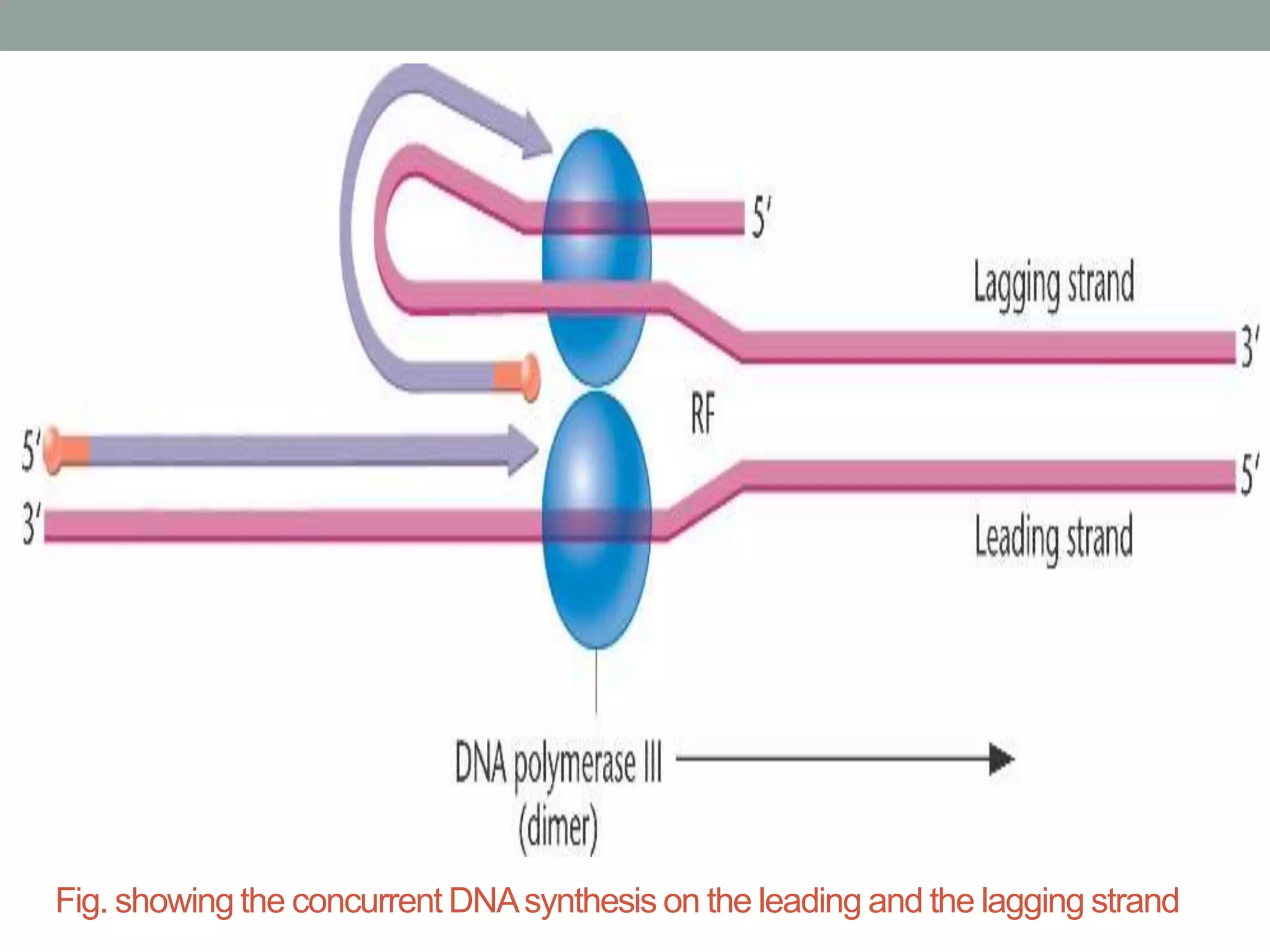
Fig. showing the concurrent DNAsynthesis on the leading and the lagging strand
CONCLUSION
• Concurrent DNA may be achieved on both the leading and
lagging strand at a single replication fork .
• The lagging template strand is “looped” in order to invert
the physical direction of synthesis , but not the biochemical
direction.
• The enzyme functions as a dimer with each core enzyme
achieving synthesis on one or the other strand.
THANKYOU

Concurrent synthesis on the leading and lagging strands

  • 1.
  • 2.
    LEADINGAND LAGGING STRAND Theparent strand that runs 5’-3’ in the reverse direction of fork movement is termed the leading strand ,and it serves as a template for the continuous DNA synthesis. The other parent strand that runs 5’-3’ in the direction of fork movement is termed the lagging strand , and it serves as a template for the discontinuous strand .
  • 3.
    DNAPolymerase III  Itis a haloenzyme consist of a dimer containing 10 different polypeptide unit. This haloenzyme is main polymerase of E. coil. It is made up of three assemblies : • Clamp loading complex • B sliding clamp processivity factor • Core enzyme
  • 4.
    Fig. showing theconcurrent DNAsynthesis on the leading and the lagging strand
  • 5.
    CONCLUSION • Concurrent DNAmay be achieved on both the leading and lagging strand at a single replication fork . • The lagging template strand is “looped” in order to invert the physical direction of synthesis , but not the biochemical direction. • The enzyme functions as a dimer with each core enzyme achieving synthesis on one or the other strand.
  • 6.