Dr Manoj Joshi
Department of Botany
Khandelwal College Of Management Science and Technology

 Classification denotes the arrangement of a single plant or
group of plants an distinct category following a system of
nomenclature, and in accordance with a particular and well
established plan.
 Some of the earlier systems of classification of angiosperms
were artificial systems, since they used only certain
superficial characteristics as the basis.
 With more and more detailed study on the morphological,
physiological and reproductive aspects of angiosperms, the
artificial systems of classifications were replaced by the
natural systems of classification.
INTRODUCTION

 George Bentham and Joseph Dalton Hooker - Two English
taxonomists who were closely associated with the Royal
Botanical Garden at Kew, England have given a detailed
classification of plant kingdom, particularly the angiosperms.
 They gave an outstanding system of classification of
phanerogams in their Genera Plantarum which was published
in three volumes between the years 1862 to 1883. It is a natural
system of classification.
 They described 97,205 species of flowering plants grouped into
202 orders (now recognised as families).
 The system has the advantage of being the first great natural
system of classification, which is very easy to follow.
INTRODUCTION
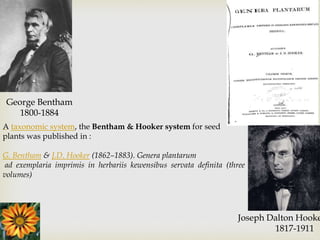
George Bentham
1800-1884
Joseph Dalton Hooke
1817-1911
A taxonomic system, the Bentham & Hooker system for seed
plants was published in :
G. Bentham & J.D. Hooker (1862–1883). Genera plantarum
ad exemplaria imprimis in herbariis kewensibus servata definita (three
volumes)

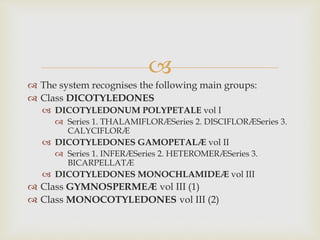
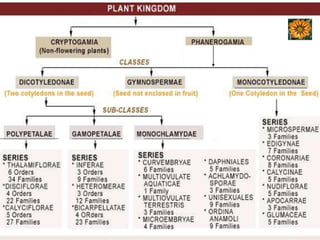
 The system recognises the following main groups:
 Class DICOTYLEDONES
 DICOTYLEDONUM POLYPETALE vol I
 Series 1. THALAMIFLORÆSeries 2. DISCIFLORÆSeries 3.
CALYCIFLORÆ
 DICOTYLEDONES GAMOPETALÆ vol II
 Series 1. INFERÆSeries 2. HETEROMERÆSeries 3.
BICARPELLATÆ
 DICOTYLEDONES MONOCHLAMIDEÆ vol III
 Class GYMNOSPERMEÆ vol III (1)
 Class MONOCOTYLEDONES vol III (2)
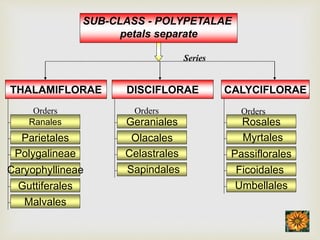
SUB-CLASS - POLYPETALAE
petals separate
THALAMIFLORAE DISCIFLORAE CALYCIFLORAE
Parietales
Polygalineae
Caryophyllineae
Guttiferales
Malvales
Ranales Geraniales
Olacales
Celastrales
Sapindales
Rosales
Myrtales
Passiflorales
Ficoidales
Umbellales
Series
Orders Orders Orders
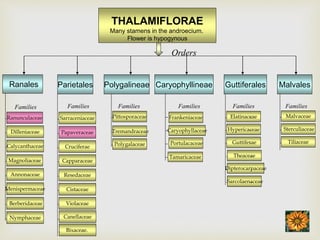
THALAMIFLORAE
Many stamens in the androecium.
Flower is hypogynous
Ranales
Ranunculaceae
Dilleniaceae
Calycanthaceae
Families
Parietales
Families
Polygalineae
Pittosporaceae
Tremandraceae
Polygalaceae
Families
Caryophyllineae Guttiferales
Elatinaceae
Hypericaceae
Guttiferae
Families Families
Malvales
Families
Sarraceniaceae
Papaveraceae
Cruciferae
Capparaceae
Resedaceae
Cistaceae
Violaceae
Frankeniaceae
Caryophyllaceae
Portulacaceae
Tamaricaceae
Malvaceae
Sterculiaceae
Tiliaceae
Annonaceae
Menispermaceae
Magnoliaceae
Berberidaceae
Nymphaceae Canellaceae
Bixaceae.
Theaceae
Dipterocarpaceae
Sarcolaenaceae
Orders
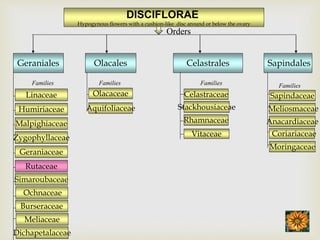
DISCIFLORAE
Hypogynous flowers with a cushion-like disc around or below the ovary
Olacales
Olacaceae
Aquifoliaceae
Families
Sapindales
Families
Sapindaceae
Meliosmaceae
Anacardiaceae
Celastrales
Families
Celastraceae
Stackhousiaceae
Rhamnaceae
Vitaceae
Dichapetalaceae
Geraniales
Families
Linaceae
Humiriaceae
Malpighiaceae
Zygophyllaceae
Geraniaceae
Rutaceae
Simaroubaceae
Ochnaceae
Burseraceae
Meliaceae
Coriariaceae
Moringaceae
Orders
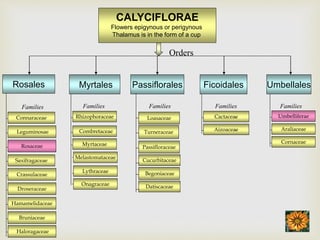
CALYCIFLORAE
Flowers epigynous or perigynous
Thalamus is in the form of a cup
Myrtales
Rhizophoraceae
Combretaceae
Myrtaceae
Families
Passiflorales
Families
Umbellales
Families
Umbelliferae
Araliaceae
Cornaceae
Rosales
Connaraceae
Leguminosae
Rosaceae
Families
Crassulaceae
Droseraceae
Saxifragaceae
Hamamelidaceae
Bruniaceae
Loasaceae
Turneraceae
Passifloraceae
Cucurbitaceae
Ficoidales
Cactaceae
Aizoaceae
Families
Haloragaceae
Melastomataceae
Lythraceae
Onagraceae
Begoniaceae
Datiscaceae
Orders
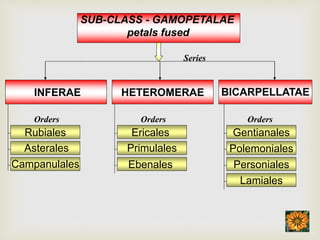
SUB-CLASS - GAMOPETALAE
petals fused
INFERAE HETEROMERAE BICARPELLATAE
Rubiales
Asterales
Campanulales
Ericales
Primulales
Ebenales
Gentianales
Polemoniales
Personiales
Lamiales
Orders Orders Orders
Series
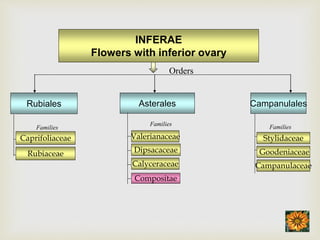
INFERAE
Flowers with inferior ovary
Campanulales
Families
Stylidaceae
Goodeniaceae
Campanulaceae
Asterales
Families
Valerianaceae
Dipsacaceae
Calyceraceae
Compositae
Rubiales
Families
Caprifoliaceae
Rubiaceae
Orders
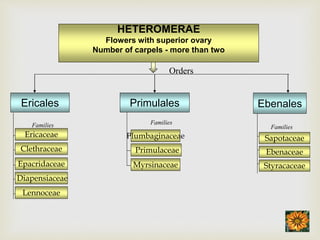
HETEROMERAE
Flowers with superior ovary
Number of carpels - more than two
Ebenales
Families
Sapotaceae
Ebenaceae
Styracaceae
Primulales
Families
Plumbaginaceae
Primulaceae
Myrsinaceae
Ericales
Families
Ericaceae
Clethraceae
Epacridaceae
Diapensiaceae
Lennoceae
Orders
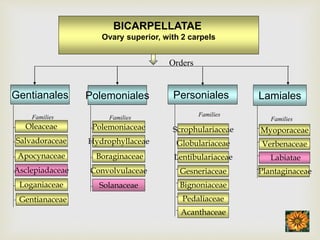
BICARPELLATAE
Ovary superior, with 2 carpels
Lamiales
Families
Myoporaceae
Verbenaceae
Labiatae
Personiales
Families
Gentianales
Families
Oleaceae
Salvadoraceae
Apocynaceae
Asclepiadaceae
Loganiaceae
Polemoniales
Families
Polemoniaceae
Hydrophyllaceae
Boraginaceae
Convolvulaceae
Solanaceae
Gentianaceae
Scrophulariaceae
Globulariaceae
Lentibulariaceae
Gesneriaceae
Bignoniaceae
Pedaliaceae
Acanthaceae
Plantaginaceae
Orders
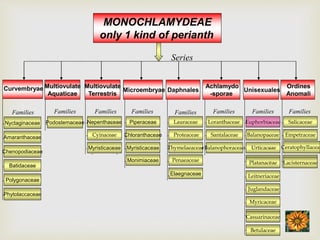
MONOCHLAMYDEAE
only 1 kind of perianth
Curvembryae
Nyctaginaceae
Amaranthaceae
Chenopodiaceae
Families
Multiovulate
Aquaticae
Multiovulate
Terrestris
Podostemaceae Nepenthaceae
Cyinaceae
Myristicaceae
Families Families
Microembryae
Piperaceae
Chloranthaceae
Myristicaceae
Monimiaceae
Families
Achlamydo
-sporae
Unisexuales
Loranthaceae
Santalaceae
Balanophoraceae
Euphorbiaceae
Balanopaceae
Urticaceae
FicoidalesPlatanaceae
Families Families
Ordines
Anomali
Salicaceae
Empetraceae
Ceratophyllaceae
FicoidalesLacisternaceae
Families
Daphnales
Lauraceae
Proteaceae
Thymelaeaceae
Penaeaceae
Families
Batidaceae
Polygonaceae
Phytolaccaceae
Elaegnaceae Leitneriaceae
Juglandaceae
Myricaceae
ficoidalesCasuarinaceae
Betulaceae
Series
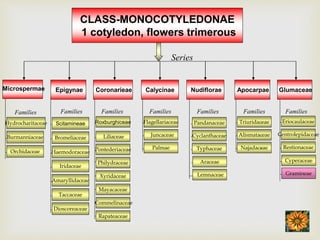
CLASS-MONOCOTYLEDONAE
1 cotyledon, flowers trimerous
Microspermae
Hydrocharitaceae
Burmanniaceae
Orchidaceae
Families
Epigynae
Families
Coronarieae
Roxburghiceae
Liliaceae
Pontederiaceae
Xyridaceae
Families
Nudiflorae Apocarpae
Pandanaceae
Cyclanthaceae
Typhaceae
Triuridaceae
Alismataceae
Najadaceae
Families Families
Glumaceae
Families
Calycinae
Flagellariaceae
Juncaceae
Palmae
Families
Scitamineae
Bromeliaceae
Haemodoraceae
Iridaceae
Amaryllidaceae
Taccaceae
Dioscoreaceae
Philydraceae
Commelinaceae
Mayacaceae
Rapateaceae
Araceae
Lemnaceae
Eriocaulaceae
Centrolepidaceae
Restionaceae
Cyperaceae
Gramineae
Series

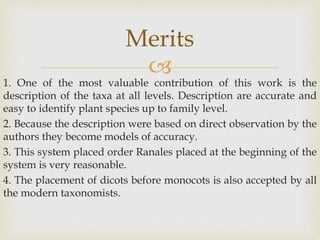
1. One of the most valuable contribution of this work is the
description of the taxa at all levels. Description are accurate and
easy to identify plant species up to family level.
2. Because the description were based on direct observation by the
authors they become models of accuracy.
3. This system placed order Ranales placed at the beginning of the
system is very reasonable.
4. The placement of dicots before monocots is also accepted by all
the modern taxonomists.
Merits

1. Gymnosperms are most primitive than angiosperms and
placing gymnosperms in between dicots and monocots is a
serious error.
2. The introduction of monochlamydeae is another drawback .
Since this group contains advanced and primitive forms.
3. Among the monocot Orchidaceae is placed in the beginning
with all it’s advanced characters.
4. The subdivision of the monocot is based on the position of
ovary and characters of perianth. This may resulted in the
anomalous situation for many families.
Demerits


Bentham and hooker classification

  • 1.
    Dr Manoj Joshi Departmentof Botany Khandelwal College Of Management Science and Technology
  • 2.
      Classification denotesthe arrangement of a single plant or group of plants an distinct category following a system of nomenclature, and in accordance with a particular and well established plan.  Some of the earlier systems of classification of angiosperms were artificial systems, since they used only certain superficial characteristics as the basis.  With more and more detailed study on the morphological, physiological and reproductive aspects of angiosperms, the artificial systems of classifications were replaced by the natural systems of classification. INTRODUCTION
  • 3.
      George Benthamand Joseph Dalton Hooker - Two English taxonomists who were closely associated with the Royal Botanical Garden at Kew, England have given a detailed classification of plant kingdom, particularly the angiosperms.  They gave an outstanding system of classification of phanerogams in their Genera Plantarum which was published in three volumes between the years 1862 to 1883. It is a natural system of classification.  They described 97,205 species of flowering plants grouped into 202 orders (now recognised as families).  The system has the advantage of being the first great natural system of classification, which is very easy to follow. INTRODUCTION
  • 4.
    George Bentham 1800-1884 Joseph DaltonHooke 1817-1911 A taxonomic system, the Bentham & Hooker system for seed plants was published in : G. Bentham & J.D. Hooker (1862–1883). Genera plantarum ad exemplaria imprimis in herbariis kewensibus servata definita (three volumes)
  • 5.
      The systemrecognises the following main groups:  Class DICOTYLEDONES  DICOTYLEDONUM POLYPETALE vol I  Series 1. THALAMIFLORÆSeries 2. DISCIFLORÆSeries 3. CALYCIFLORÆ  DICOTYLEDONES GAMOPETALÆ vol II  Series 1. INFERÆSeries 2. HETEROMERÆSeries 3. BICARPELLATÆ  DICOTYLEDONES MONOCHLAMIDEÆ vol III  Class GYMNOSPERMEÆ vol III (1)  Class MONOCOTYLEDONES vol III (2)
  • 7.
    SUB-CLASS - POLYPETALAE petalsseparate THALAMIFLORAE DISCIFLORAE CALYCIFLORAE Parietales Polygalineae Caryophyllineae Guttiferales Malvales Ranales Geraniales Olacales Celastrales Sapindales Rosales Myrtales Passiflorales Ficoidales Umbellales Series Orders Orders Orders
  • 8.
    THALAMIFLORAE Many stamens inthe androecium. Flower is hypogynous Ranales Ranunculaceae Dilleniaceae Calycanthaceae Families Parietales Families Polygalineae Pittosporaceae Tremandraceae Polygalaceae Families Caryophyllineae Guttiferales Elatinaceae Hypericaceae Guttiferae Families Families Malvales Families Sarraceniaceae Papaveraceae Cruciferae Capparaceae Resedaceae Cistaceae Violaceae Frankeniaceae Caryophyllaceae Portulacaceae Tamaricaceae Malvaceae Sterculiaceae Tiliaceae Annonaceae Menispermaceae Magnoliaceae Berberidaceae Nymphaceae Canellaceae Bixaceae. Theaceae Dipterocarpaceae Sarcolaenaceae Orders
  • 9.
    DISCIFLORAE Hypogynous flowers witha cushion-like disc around or below the ovary Olacales Olacaceae Aquifoliaceae Families Sapindales Families Sapindaceae Meliosmaceae Anacardiaceae Celastrales Families Celastraceae Stackhousiaceae Rhamnaceae Vitaceae Dichapetalaceae Geraniales Families Linaceae Humiriaceae Malpighiaceae Zygophyllaceae Geraniaceae Rutaceae Simaroubaceae Ochnaceae Burseraceae Meliaceae Coriariaceae Moringaceae Orders
  • 10.
    CALYCIFLORAE Flowers epigynous orperigynous Thalamus is in the form of a cup Myrtales Rhizophoraceae Combretaceae Myrtaceae Families Passiflorales Families Umbellales Families Umbelliferae Araliaceae Cornaceae Rosales Connaraceae Leguminosae Rosaceae Families Crassulaceae Droseraceae Saxifragaceae Hamamelidaceae Bruniaceae Loasaceae Turneraceae Passifloraceae Cucurbitaceae Ficoidales Cactaceae Aizoaceae Families Haloragaceae Melastomataceae Lythraceae Onagraceae Begoniaceae Datiscaceae Orders
  • 11.
    SUB-CLASS - GAMOPETALAE petalsfused INFERAE HETEROMERAE BICARPELLATAE Rubiales Asterales Campanulales Ericales Primulales Ebenales Gentianales Polemoniales Personiales Lamiales Orders Orders Orders Series
  • 12.
    INFERAE Flowers with inferiorovary Campanulales Families Stylidaceae Goodeniaceae Campanulaceae Asterales Families Valerianaceae Dipsacaceae Calyceraceae Compositae Rubiales Families Caprifoliaceae Rubiaceae Orders
  • 13.
    HETEROMERAE Flowers with superiorovary Number of carpels - more than two Ebenales Families Sapotaceae Ebenaceae Styracaceae Primulales Families Plumbaginaceae Primulaceae Myrsinaceae Ericales Families Ericaceae Clethraceae Epacridaceae Diapensiaceae Lennoceae Orders
  • 14.
    BICARPELLATAE Ovary superior, with2 carpels Lamiales Families Myoporaceae Verbenaceae Labiatae Personiales Families Gentianales Families Oleaceae Salvadoraceae Apocynaceae Asclepiadaceae Loganiaceae Polemoniales Families Polemoniaceae Hydrophyllaceae Boraginaceae Convolvulaceae Solanaceae Gentianaceae Scrophulariaceae Globulariaceae Lentibulariaceae Gesneriaceae Bignoniaceae Pedaliaceae Acanthaceae Plantaginaceae Orders
  • 15.
    MONOCHLAMYDEAE only 1 kindof perianth Curvembryae Nyctaginaceae Amaranthaceae Chenopodiaceae Families Multiovulate Aquaticae Multiovulate Terrestris Podostemaceae Nepenthaceae Cyinaceae Myristicaceae Families Families Microembryae Piperaceae Chloranthaceae Myristicaceae Monimiaceae Families Achlamydo -sporae Unisexuales Loranthaceae Santalaceae Balanophoraceae Euphorbiaceae Balanopaceae Urticaceae FicoidalesPlatanaceae Families Families Ordines Anomali Salicaceae Empetraceae Ceratophyllaceae FicoidalesLacisternaceae Families Daphnales Lauraceae Proteaceae Thymelaeaceae Penaeaceae Families Batidaceae Polygonaceae Phytolaccaceae Elaegnaceae Leitneriaceae Juglandaceae Myricaceae ficoidalesCasuarinaceae Betulaceae Series
  • 16.
    CLASS-MONOCOTYLEDONAE 1 cotyledon, flowerstrimerous Microspermae Hydrocharitaceae Burmanniaceae Orchidaceae Families Epigynae Families Coronarieae Roxburghiceae Liliaceae Pontederiaceae Xyridaceae Families Nudiflorae Apocarpae Pandanaceae Cyclanthaceae Typhaceae Triuridaceae Alismataceae Najadaceae Families Families Glumaceae Families Calycinae Flagellariaceae Juncaceae Palmae Families Scitamineae Bromeliaceae Haemodoraceae Iridaceae Amaryllidaceae Taccaceae Dioscoreaceae Philydraceae Commelinaceae Mayacaceae Rapateaceae Araceae Lemnaceae Eriocaulaceae Centrolepidaceae Restionaceae Cyperaceae Gramineae Series
  • 17.
     1. One ofthe most valuable contribution of this work is the description of the taxa at all levels. Description are accurate and easy to identify plant species up to family level. 2. Because the description were based on direct observation by the authors they become models of accuracy. 3. This system placed order Ranales placed at the beginning of the system is very reasonable. 4. The placement of dicots before monocots is also accepted by all the modern taxonomists. Merits
  • 18.
     1. Gymnosperms aremost primitive than angiosperms and placing gymnosperms in between dicots and monocots is a serious error. 2. The introduction of monochlamydeae is another drawback . Since this group contains advanced and primitive forms. 3. Among the monocot Orchidaceae is placed in the beginning with all it’s advanced characters. 4. The subdivision of the monocot is based on the position of ovary and characters of perianth. This may resulted in the anomalous situation for many families. Demerits
  • 19.