Cytotaxonomy
Prepared By-
Dr. Sangeeta Das
Assistant Professor
Department of Botany
Bahona College, Jorhat, Assam, India.
Cytotaxonomy
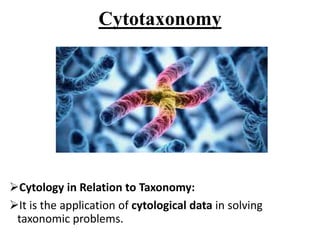
Cytology in Relation to Taxonomy:
It is the application of cytological data in solving
taxonomic problems.
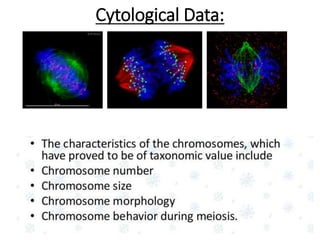
Cytological Data:
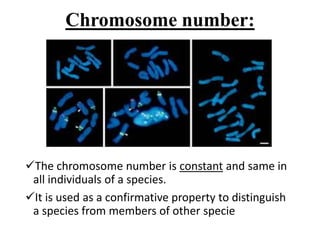
Chromosome number:
The chromosome number is constant and same in
all individuals of a species.
It is used as a confirmative property to distinguish
a species from members of other specie
Example 1:
Separation at species level:
Monotropa hypopitys and Monotropa
hypophegea are two different species looks
like morphologically.
But they are separated on the basis of
chromosome numbers.
M. hypopitys is a hexaploid: 2n = 48
M. hypophegea is a diploid: 2n = 16
Example 2:
Separation at Interspecific level:
There are two cytotypes of the species
Veronica prostrata
On the basis of chromosome number, these
two cytotypes are raised to subspecies level
and named as
V. prostrata prostrata (n=8) and V. prostrata
scheerei (n=16).
Example 3:
Separation at Generic level:
Cicendia filiformis and Microcala pusilla are
placed in genus Cicendia
Separated based on chromosome number C.
filiformis (n =13); M. pusilla (n=10).
All species of the genus Tephrosia in
Fabaceae have 2n = 22, except T. constricta
having 2n = 16.
Therefore, the later is raised to a level of the
genus Sphinctospermum.
Example 4:
In the tribe Boranieae of Rutaceae,
the chromosomal base number
varies from 7 to 19.
Therefore, the members are
rearranged to have a unique system
of classification.
It is usually seen that closely related
plants, like the different species of a
genus, show chromosome numbers
which reveal an arithmetic relation with
one another
For example,
The different species of Piper show chromosome
numbers in multiples of 26, like 2n = 52 in P.
nigrum, 2n = 78 in P. betle, and 2n = 104 in wild
species of Piper (Mathew, 1958).
Separation at Family level:
Families are rearranged on the basis of
number and size of chromosomes.
For example,
Heleboreae and Anemoneae of
Ranunculaceae – chromosome number 7, 8
and 9
Both have large and small chromosome
Therefore, both the genera are rearranged.
Aneuploids:
Aneuploids are plants with basic number of
chromosome with some addition and
deletion of few chromosomes.
Monosomics have 2n – 1,eg., Datura.
Nullisomics have 2n -2, eg., Triticum
Trisomics have 2n + 2.
Tetrasomics have 2n + 2 chromosome.
Chromosome Size:
It has already been discovered that
evolutionary development involves in
addition to alterations in chromosome
number.
For example,
Cytologically Cyclea and Cissampelos are
seen to be based on 12, while Stephania
shows n = 13. It is seen that the number n =
13 is characteristic of the tribe Cocculeae,
which further shows chromosomes of small
size.
Large chromosomes, low
chromosome number and
symmetrical karyotype represent a
primitive status.
While small chromosomes, high
number and extreme asymmetry
indicate advancement.
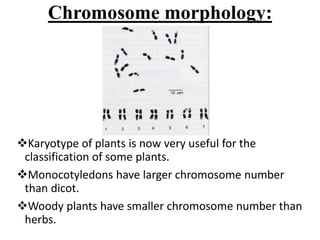
Chromosome morphology:
Karyotype of plants is now very useful for the
classification of some plants.
Monocotyledons have larger chromosome number
than dicot.
Woody plants have smaller chromosome number than
herbs.
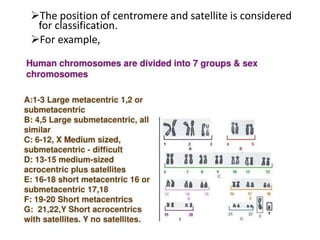
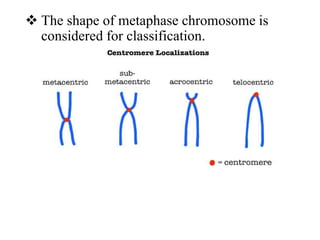
The position of centromere and satellite is considered
for classification.
For example,
 The shape of metaphase chromosome is
considered for classification.
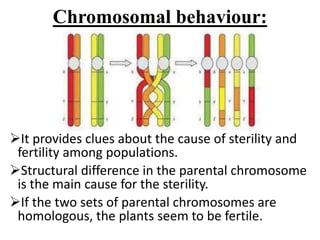
Chromosomal behaviour:
It provides clues about the cause of sterility and
fertility among populations.
Structural difference in the parental chromosome
is the main cause for the sterility.
If the two sets of parental chromosomes are
homologous, the plants seem to be fertile.
Cytotaxonomy plant taxonomy

Cytotaxonomy plant taxonomy

  • 1.
    Cytotaxonomy Prepared By- Dr. SangeetaDas Assistant Professor Department of Botany Bahona College, Jorhat, Assam, India.
  • 2.
    Cytotaxonomy Cytology in Relationto Taxonomy: It is the application of cytological data in solving taxonomic problems.
  • 3.
  • 4.
    Chromosome number: The chromosomenumber is constant and same in all individuals of a species. It is used as a confirmative property to distinguish a species from members of other specie
  • 5.
    Example 1: Separation atspecies level: Monotropa hypopitys and Monotropa hypophegea are two different species looks like morphologically. But they are separated on the basis of chromosome numbers. M. hypopitys is a hexaploid: 2n = 48 M. hypophegea is a diploid: 2n = 16
  • 6.
    Example 2: Separation atInterspecific level: There are two cytotypes of the species Veronica prostrata On the basis of chromosome number, these two cytotypes are raised to subspecies level and named as V. prostrata prostrata (n=8) and V. prostrata scheerei (n=16).
  • 7.
    Example 3: Separation atGeneric level: Cicendia filiformis and Microcala pusilla are placed in genus Cicendia Separated based on chromosome number C. filiformis (n =13); M. pusilla (n=10). All species of the genus Tephrosia in Fabaceae have 2n = 22, except T. constricta having 2n = 16. Therefore, the later is raised to a level of the genus Sphinctospermum.
  • 8.
    Example 4: In thetribe Boranieae of Rutaceae, the chromosomal base number varies from 7 to 19. Therefore, the members are rearranged to have a unique system of classification.
  • 9.
    It is usuallyseen that closely related plants, like the different species of a genus, show chromosome numbers which reveal an arithmetic relation with one another For example, The different species of Piper show chromosome numbers in multiples of 26, like 2n = 52 in P. nigrum, 2n = 78 in P. betle, and 2n = 104 in wild species of Piper (Mathew, 1958).
  • 10.
    Separation at Familylevel: Families are rearranged on the basis of number and size of chromosomes. For example, Heleboreae and Anemoneae of Ranunculaceae – chromosome number 7, 8 and 9 Both have large and small chromosome Therefore, both the genera are rearranged.
  • 11.
    Aneuploids: Aneuploids are plantswith basic number of chromosome with some addition and deletion of few chromosomes. Monosomics have 2n – 1,eg., Datura. Nullisomics have 2n -2, eg., Triticum Trisomics have 2n + 2. Tetrasomics have 2n + 2 chromosome.
  • 12.
    Chromosome Size: It hasalready been discovered that evolutionary development involves in addition to alterations in chromosome number. For example, Cytologically Cyclea and Cissampelos are seen to be based on 12, while Stephania shows n = 13. It is seen that the number n = 13 is characteristic of the tribe Cocculeae, which further shows chromosomes of small size.
  • 13.
    Large chromosomes, low chromosomenumber and symmetrical karyotype represent a primitive status. While small chromosomes, high number and extreme asymmetry indicate advancement.
  • 14.
    Chromosome morphology: Karyotype ofplants is now very useful for the classification of some plants. Monocotyledons have larger chromosome number than dicot. Woody plants have smaller chromosome number than herbs.
  • 15.
    The position ofcentromere and satellite is considered for classification. For example,
  • 16.
     The shapeof metaphase chromosome is considered for classification.
  • 17.
    Chromosomal behaviour: It providesclues about the cause of sterility and fertility among populations. Structural difference in the parental chromosome is the main cause for the sterility. If the two sets of parental chromosomes are homologous, the plants seem to be fertile.

Editor's Notes

  • #17 For example, Acrocentric – centromere at one end Acentric – No centromere Metacentric – centromere at the middle Telocentric – centromere near one end
  • #18 During meiosis.