Design and Implementation of VLSI Systems
                   (EN1600)
        Lecture 20: Combinational Circuit Design (2/3)


S. Reda EN160 SP’08
Let’s get rid of pMOS


         Reduced the capacitance and improved the delay
         Increased static power consumption
       Implementing a large resistive load in CMOS is not readily available

                            [see subsection 2.5.4]
S. Reda EN160 SP’08
2. Pseudo-nMOS circuits
     • Use a pull-up transistor that is always ON
     • Issues:
           – Ratio or relative strength
           – Make pMOS about ¼ effective strength of pulldown network


                            [see subsection 2.5.4]
S. Reda EN160 SP’08
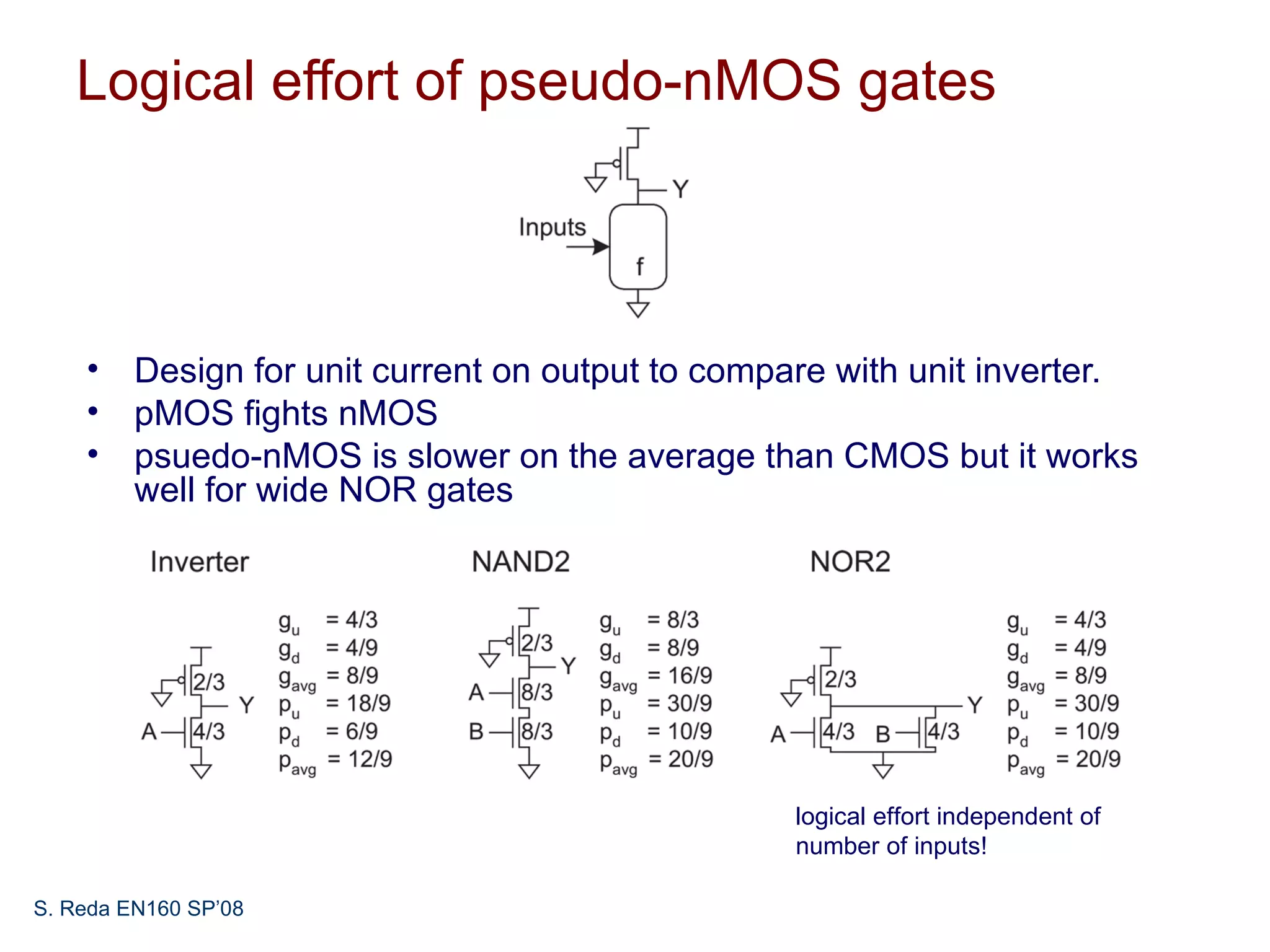
Logical effort of pseudo-nMOS gates


    • Design for unit current on output to compare with unit inverter.
    • pMOS fights nMOS
    • psuedo-nMOS is slower on the average than CMOS but it works
      well for wide NOR gates


                                                logical effort independent of
                                                number of inputs!

S. Reda EN160 SP’08
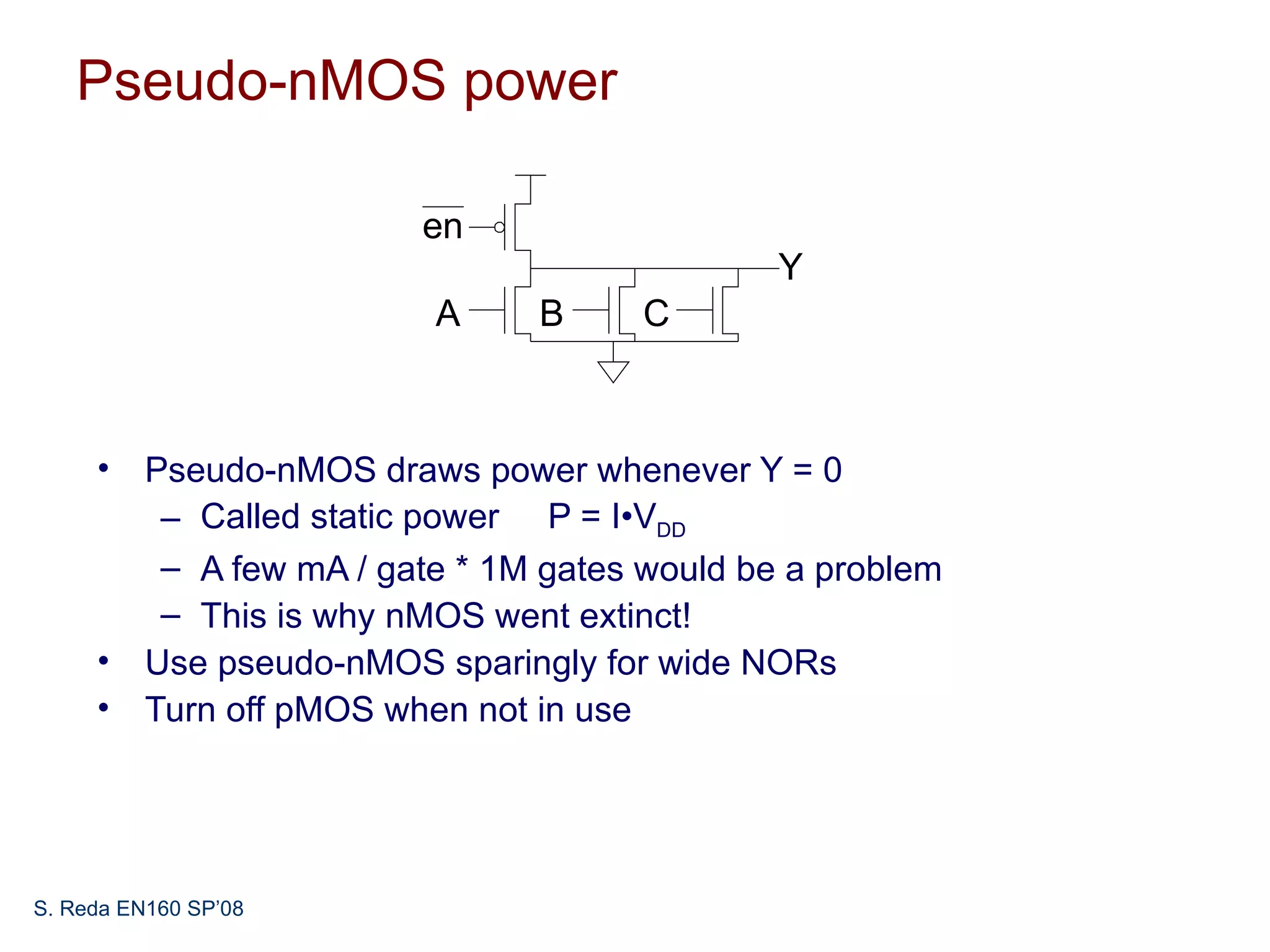
Pseudo-nMOS power

                        en
                                             Y
                         A     B     C


     • Pseudo-nMOS draws power whenever Y = 0
        – Called static power P = I•VDD
        – A few mA / gate * 1M gates would be a problem
        – This is why nMOS went extinct!
     • Use pseudo-nMOS sparingly for wide NORs
     • Turn off pMOS when not in use


S. Reda EN160 SP’08
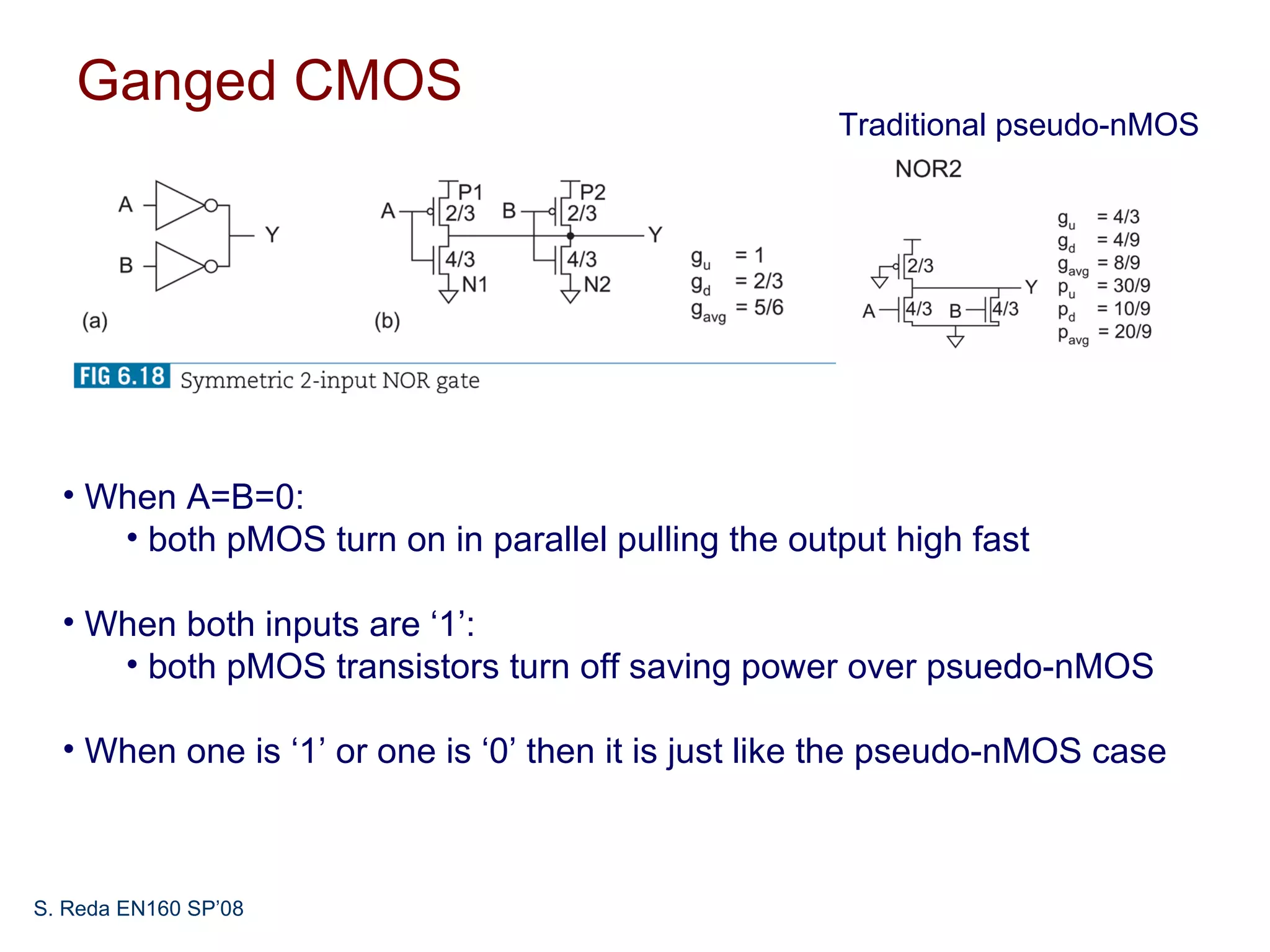
Ganged CMOS
                                                     Traditional pseudo-nMOS


  • When A=B=0:
     • both pMOS turn on in parallel pulling the output high fast

  • When both inputs are ‘1’:
     • both pMOS transistors turn off saving power over psuedo-nMOS

  • When one is ‘1’ or one is ‘0’ then it is just like the pseudo-nMOS case


S. Reda EN160 SP’08
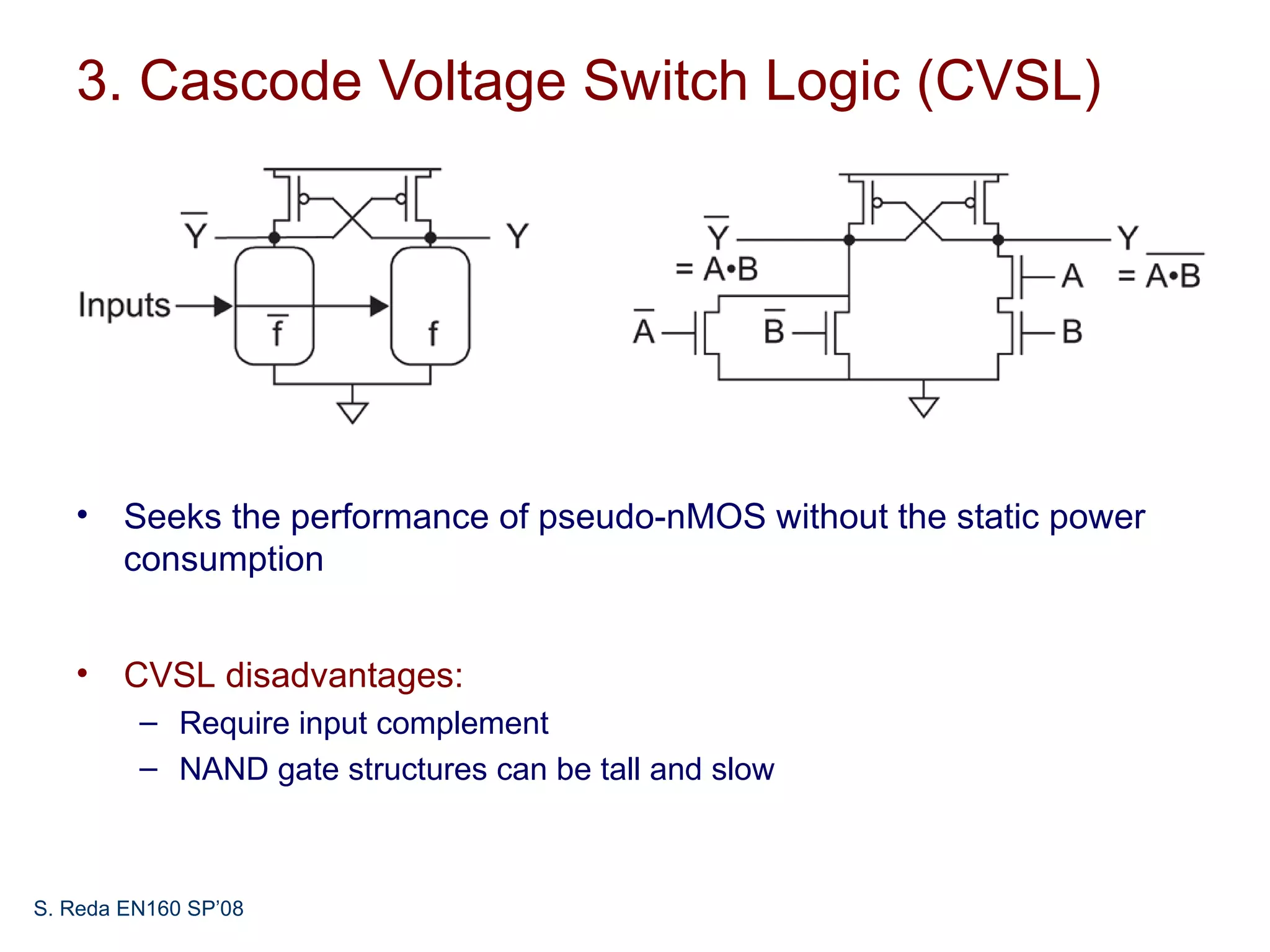
3. Cascode Voltage Switch Logic (CVSL)


   • Seeks the performance of pseudo-nMOS without the static power
     consumption


   • CVSL disadvantages:
         – Require input complement
         – NAND gate structures can be tall and slow


S. Reda EN160 SP’08
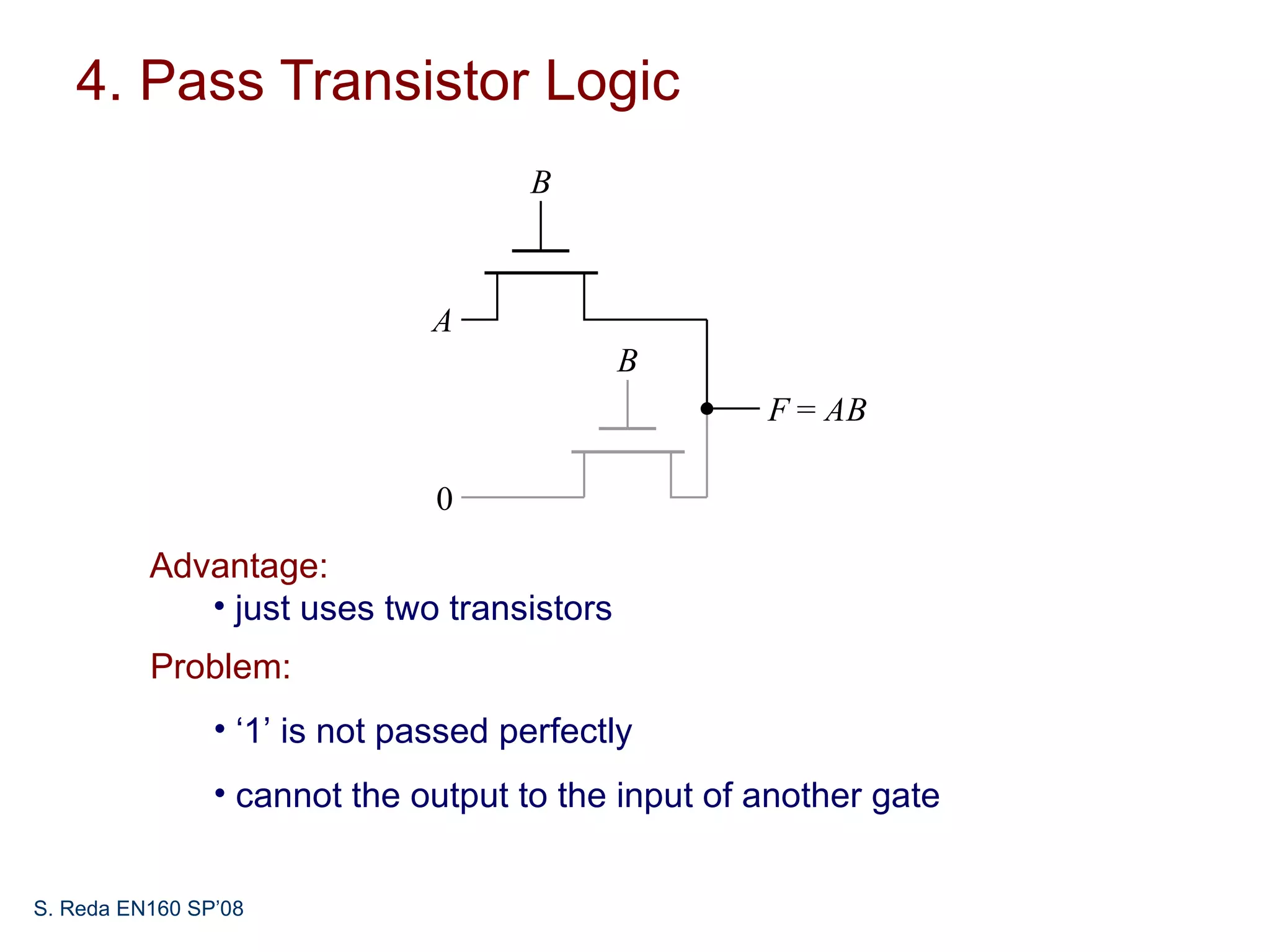
4. Pass Transistor Logic
                                     B


                               A
                                           B
                                                    F = AB

                               0

          Advantage:
             • just uses two transistors
          Problem:
                • ‘1’ is not passed perfectly
                • cannot the output to the input of another gate


S. Reda EN160 SP’08
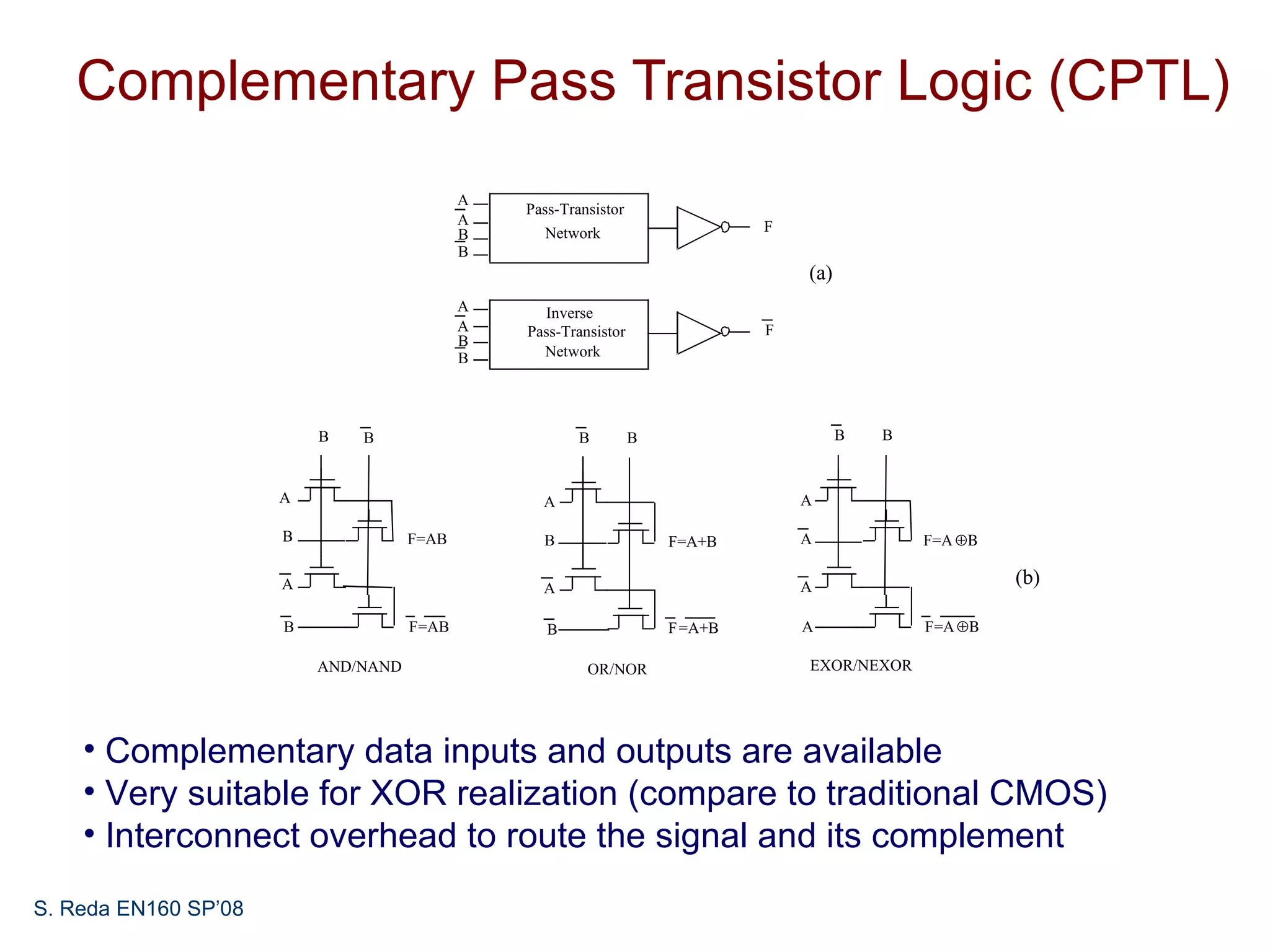
Complementary Pass Transistor Logic (CPTL)
                                            A
                                                Pass-Transistor
                                            A                                  F
                                            B     Network
                                            B
                                                                                   (a)
                                            A     Inverse
                                            A   Pass-Transistor                F
                                            B
                                            B     Network


                          B   B                         B         B                      B   B


                      A                           A                                A

                      B              F=AB         B                   F=A+B        A             F=A ⊕Β

                      A                           A                                A                      (b)

                      B              F=AB          B                  F =A+B       A             F=A ⊕Β

                          AND/NAND                       OR/NOR                    EXOR/NEXOR


    • Complementary data inputs and outputs are available
    • Very suitable for XOR realization (compare to traditional CMOS)
    • Interconnect overhead to route the signal and its complement
S. Reda EN160 SP’08
Possible solution: interface to a CMOS inverter
                                                                            3.0
                                                                                                      In
                 In
                             1.5µ m/0.25 µm                                         Out


                                                              Voltage [V]
                                                                            2.0
        VD D           x                                                                       x
                                               Out
           0.5 µ m/0.25µ m
                                                                            1.0
                             0.5µ m/0.25 µm

                                                                            0.00   0.5     1       1.5     2
                                                                                          Time [ns]

          Threshold voltage loss causes static power consumption
                                                     V DD
                                                                        V DD
                              Level Restorer
                                                     Mr                                   (AKA Lean Integration
                                               B
                                                                            M2            with Pass Transistors
                                A              Mn
                                                          X
                                                                                   Out
                                                                                          - LEAP)
                                                                            M1


               A better design: full swing; reduces static power
S. Reda EN160 SP’08
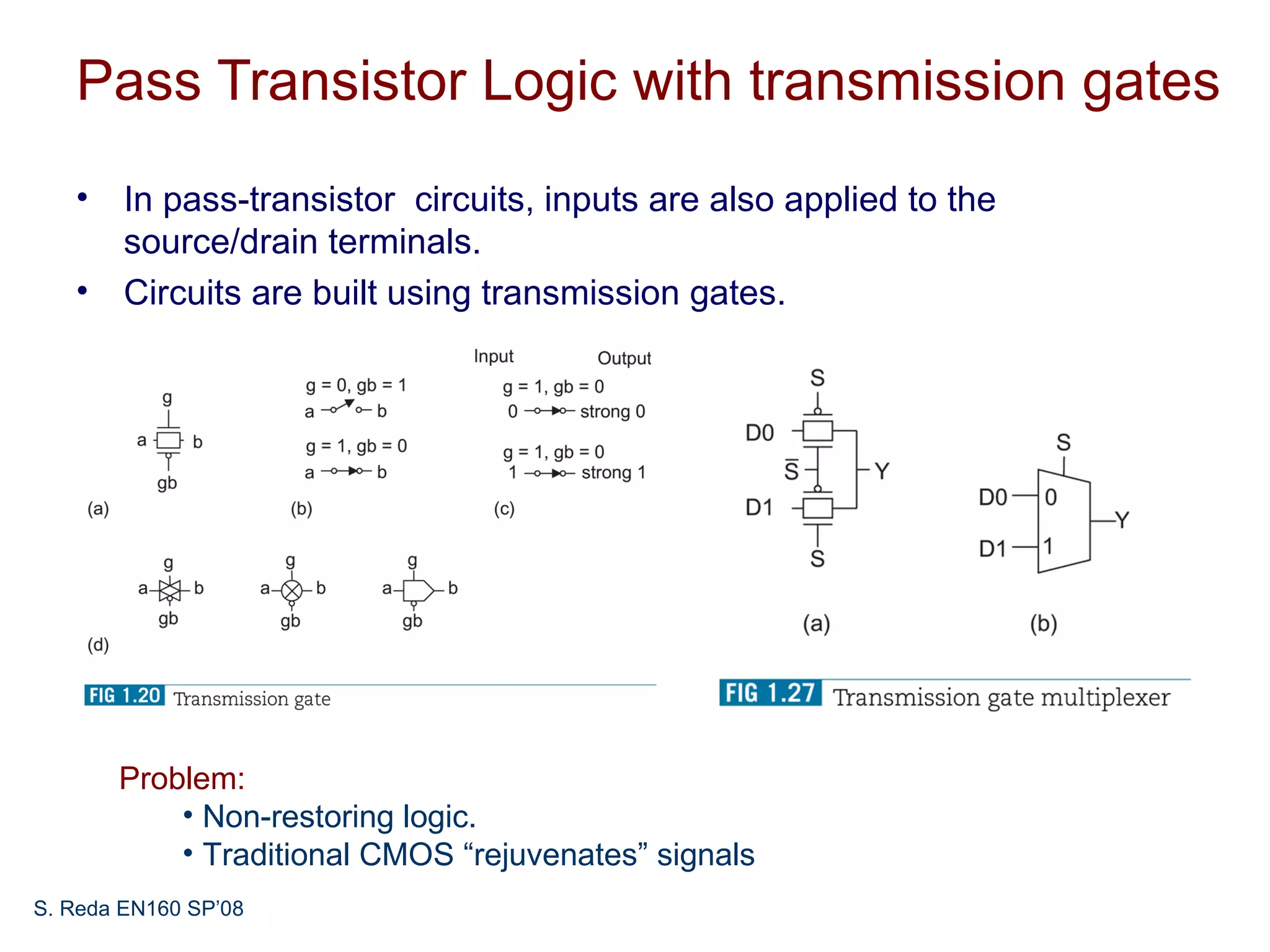
Pass Transistor Logic with transmission gates
   • In pass-transistor circuits, inputs are also applied to the
     source/drain terminals.
   • Circuits are built using transmission gates.


       Problem:
           • Non-restoring logic.
           • Traditional CMOS “rejuvenates” signals
S. Reda EN160 SP’08
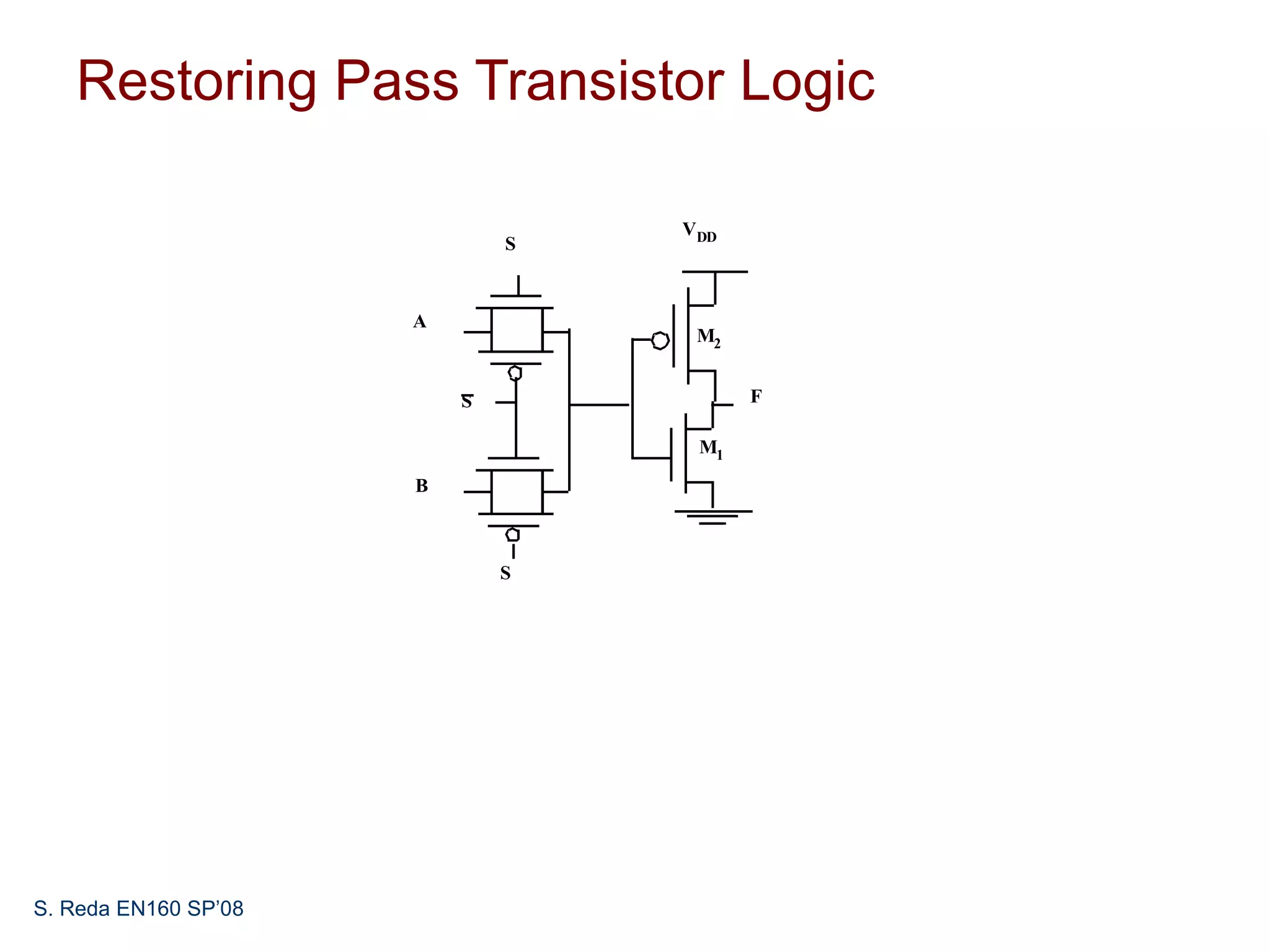
Restoring Pass Transistor Logic

                                  VDD
                              S


                      A
                                   M2


                          S             F

                                   M1
                      B


                              S


S. Reda EN160 SP’08
Circuit Families


       Static CMOS
       Ratioed Circuits
       Cascode Voltage Switch Logic
       Pass-transistor Circuits
       Dynamic Circuits


S. Reda EN160 SP’08

Lecture20

  • 1.
    Design and Implementationof VLSI Systems (EN1600) Lecture 20: Combinational Circuit Design (2/3) S. Reda EN160 SP’08
  • 2.
    Let’s get ridof pMOS  Reduced the capacitance and improved the delay  Increased static power consumption Implementing a large resistive load in CMOS is not readily available [see subsection 2.5.4] S. Reda EN160 SP’08
  • 3.
    2. Pseudo-nMOS circuits • Use a pull-up transistor that is always ON • Issues: – Ratio or relative strength – Make pMOS about ¼ effective strength of pulldown network [see subsection 2.5.4] S. Reda EN160 SP’08
  • 4.
    Logical effort ofpseudo-nMOS gates • Design for unit current on output to compare with unit inverter. • pMOS fights nMOS • psuedo-nMOS is slower on the average than CMOS but it works well for wide NOR gates logical effort independent of number of inputs! S. Reda EN160 SP’08
  • 5.
    Pseudo-nMOS power en Y A B C • Pseudo-nMOS draws power whenever Y = 0 – Called static power P = I•VDD – A few mA / gate * 1M gates would be a problem – This is why nMOS went extinct! • Use pseudo-nMOS sparingly for wide NORs • Turn off pMOS when not in use S. Reda EN160 SP’08
  • 6.
    Ganged CMOS Traditional pseudo-nMOS • When A=B=0: • both pMOS turn on in parallel pulling the output high fast • When both inputs are ‘1’: • both pMOS transistors turn off saving power over psuedo-nMOS • When one is ‘1’ or one is ‘0’ then it is just like the pseudo-nMOS case S. Reda EN160 SP’08
  • 7.
    3. Cascode VoltageSwitch Logic (CVSL) • Seeks the performance of pseudo-nMOS without the static power consumption • CVSL disadvantages: – Require input complement – NAND gate structures can be tall and slow S. Reda EN160 SP’08
  • 8.
    4. Pass TransistorLogic B A B F = AB 0 Advantage: • just uses two transistors Problem: • ‘1’ is not passed perfectly • cannot the output to the input of another gate S. Reda EN160 SP’08
  • 9.
    Complementary Pass TransistorLogic (CPTL) A Pass-Transistor A F B Network B (a) A Inverse A Pass-Transistor F B B Network B B B B B B A A A B F=AB B F=A+B A F=A ⊕Β A A A (b) B F=AB B F =A+B A F=A ⊕Β AND/NAND OR/NOR EXOR/NEXOR • Complementary data inputs and outputs are available • Very suitable for XOR realization (compare to traditional CMOS) • Interconnect overhead to route the signal and its complement S. Reda EN160 SP’08
  • 10.
    Possible solution: interfaceto a CMOS inverter 3.0 In In 1.5µ m/0.25 µm Out Voltage [V] 2.0 VD D x x Out 0.5 µ m/0.25µ m 1.0 0.5µ m/0.25 µm 0.00 0.5 1 1.5 2 Time [ns] Threshold voltage loss causes static power consumption V DD V DD Level Restorer Mr (AKA Lean Integration B M2 with Pass Transistors A Mn X Out - LEAP) M1 A better design: full swing; reduces static power S. Reda EN160 SP’08
  • 11.
    Pass Transistor Logicwith transmission gates • In pass-transistor circuits, inputs are also applied to the source/drain terminals. • Circuits are built using transmission gates. Problem: • Non-restoring logic. • Traditional CMOS “rejuvenates” signals S. Reda EN160 SP’08
  • 12.
    Restoring Pass TransistorLogic VDD S A M2 S F M1 B S S. Reda EN160 SP’08
  • 13.
    Circuit Families  Static CMOS  Ratioed Circuits  Cascode Voltage Switch Logic  Pass-transistor Circuits  Dynamic Circuits S. Reda EN160 SP’08