VLSI-GATE LEVEL DESIGN
-BY N.C.CHANDU PRASANTH
General Logic Circuit
General Logic Circuit:
CMOS STATIC LOGIC
CMOS INVERTER
WORKING OF CMOS INVERTER
Explanation of Working Operation
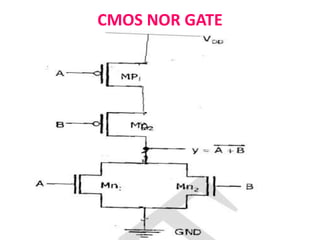
CMOS NOR GATE
Working of CMOS NOR Gate
CMOS NAND GATE
Working of CMOS NAND Gate
Complex Gates in CMOS Logic
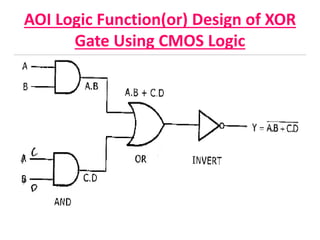
AOI Logic Function(or) Design of XOR
Gate Using CMOS Logic
CMOS Implementation
Steps for CMOS Implementation
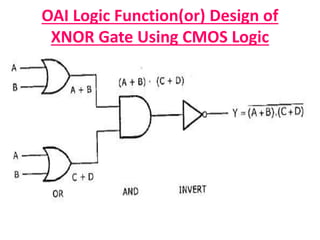
OAI Logic Function(or) Design of
XNOR Gate Using CMOS Logic
CMOS Implementation
Switch Logic
Pass Transistor
Advantages &Disadvantages of Pass
Transistor
Pass Transistor Logic(PTL)
• Only N_MOS Transistors are Used to design the logic.
• Input Signals are Applied to both Gate and
Drain/Source.
When A=1 Upper NMOS is ON, So
o/p is F=B
When A=0 Upper
NMOS is ON, So o/p is F=B
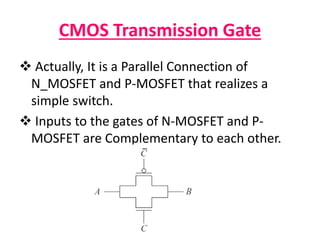
CMOS Transmission Gate
 Actually, It is a Parallel Connection of
N_MOSFET and P-MOSFET that realizes a
simple switch.
 Inputs to the gates of N-MOSFET and P-
MOSFET are Complementary to each other.
Working of CMOS Transmission Gate
Case-1
When C=1 and C^=0
Both NMOS&PMOS--------ON
 Nodes A&B-----------Short Circuited
Input Logic is Transferred to Output
Case-2
When C=10and C^=1
Both NMOS&PMOS--------OFF
 Nodes A&B-----------Open Circuited
Actually ,this is Called High-Impedance State.
Transmission Gate Symbol
Operation of Transmission Gate
Advantages &Disadvantages of
Transmission Gate
2- input Multiplexer using CMOS
Transmission Gates
Working
Alternative Gate Circuits
ALTERNATIVE GATE CIRCUITS
1. Pseudo- NMOS logic
2. Dynamic CMOS logic
(Pseudo –NMOS+NMOS Transistor)
3. Clocked CMOS (C2MOS) logic
4. CMOS domino logic
(Dynamic CMOS + Inveter)
5. n-p CMOS logic
General form of Pseudo- NMOS logic
G
Description
 It is used as a supplement for the CMOS logic circuits.
 In the pseudo-NMOS logic, the PUN is realized by a
single PMOS transistor.
The gate terminal of the PMOS transistor is connected
to the ground.
P-MOS Transistor remains permanently in the ON state
Depending on the input combinations, output goes low
through the PDN.
Only the NMOS logic (Qn) is driven by the input
Voltage
Qp acts as an active load for Qn.
Except for the load device(P-MOS), the Pseudo-NMOS
gate circuit is identical to the pull-down
network(PDN) of the CMOS gate.
Realization of logic circuits using Pseudo-NMOS logic
Advantages & Disadvantages of Pseudo N-MOS Logic
Advantages:
1) Uses less number of transistors as compared to
CMOS logic.
2) Geometrical area and delay gets reduced as it
requires less transistors.
3) Low power dissipation.
Disadvantages
1.The main drawback of using a Pseudo NMOS gate
instead of a CMOS gate is that the always on PMOS
load conducts a steady current when the output
voltage is lower than VDD.
2.Layout problems are critical.
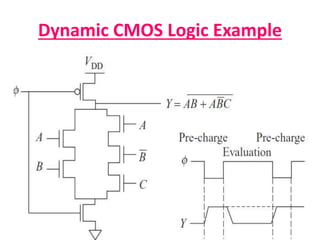
General form of Dynamic CMOS logic
Description
 It is one of the alternate method of reducing
Transistor Count.
It is similar to Pseudo –NMOS Logic except one
additional NMOS Transistor(MN) Connected between
PDN and Ground.
PMOS Transistor in PUN and additional NMOS
Transistor(MN) in PDN are Operated by a Clock Signal
ϕ.
Dynamic Logic Circuit Operates in 2 Phases of Single
Clock Pulse ϕ
Phase-1 (Pre-Charge Phase ϕ =0)
Here, Output is Pre Charged to Logic High Level.
Phase-2 (Evaluation Phase ϕ=1)
Here, Output is evaluated based on applied Input Logic.
Dynamic CMOS Logic Example
Disadvantages of Dynamic CMOS logic
Dynamic CMOS Circuit has a Serious Problem
When they are cascaded.
Advantages of Dynamic CMOS logic
General form of CMOS Domino Logic
(Dynamic Logic + Inverter)
ϕ
Description
 It is a Slightly modified Version of Dynamic CMOS
Logic Circuit.
A Static Inverter is Connected at the Output of
each dynamic CMOS logic blocks.
Addition of Inverter Solves the Problem of
Cascading of dynamic CMOS logic Circuits.
 It is Suitable for only Non-Inverting Logic(the
expression having no complement over whole
expression)
For Inverting the logic the expression must be
reorganized before it can be realized using
Domino CMOS Logic.
Working
Case -1 when ϕ = 0
Output is Pre charged to logic high and O/P of static
Inverter is Low.
Case -2 When ϕ =1
O/P is either 0 (or) 1 Output of static Inverter
can make 0 1 in Evaluation. So, Irrespective of I/P
and O/p of Static Inverter can’t make 1 0 in
Evaluation Phase.
Note:
For, N- Input Logic function we require,
2N Transistors-- Static CMOS
N+2 Transistors- Dynamic CMOS
N+2+2 Transistors Domino CMOS
Example of Domino CMOS Logic
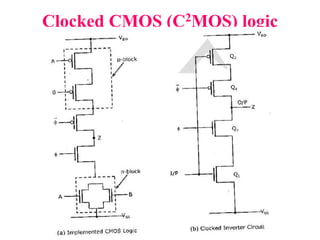
Clocked CMOS (C2MOS) logic
Description
A pull-up p-block and a complementary n-block pull-
down structure represent p and n-transistors
However, the logic in this case is connected to the
output only during the ON period of the clock.
Working
When ø = 1 the circuit acts an inverter , because
transistors Q3 and Q4 are ‘ON’ .
 It is said to be in the “Evaluation mode”. Therefore
the output Z changes its Previous value.
When ø = 0 the circuit is in hold mode, because
transistors Q3 and Q4 ‘OFF’ .
It is said to be in the “Pre Charge mode”. Therefore
the output Z remains its previous value.
n-p CMOS logic (NORA)
Description
In this, logic the actual logic blocks are
alternatively ‘n’ and ‘p’ in a cascaded structure.
The clock ø and ø^ are used alternatively to fed
the Pre Charge and Evaluate transistors.
Disadvantages of N-P CMOS Logic
Here, the P-tree blocks are slower than the
N-tree modules, due to the lower current drive
of the PMOS transistors in the logic network.

Vlsi gate level design

  • 1.
    VLSI-GATE LEVEL DESIGN -BYN.C.CHANDU PRASANTH
  • 2.
  • 3.
  • 5.
  • 6.
  • 7.
  • 8.
  • 9.
  • 10.
  • 11.
    Working of CMOSNAND Gate
  • 12.
    Complex Gates inCMOS Logic
  • 13.
    AOI Logic Function(or)Design of XOR Gate Using CMOS Logic
  • 14.
  • 15.
    Steps for CMOSImplementation
  • 18.
    OAI Logic Function(or)Design of XNOR Gate Using CMOS Logic
  • 19.
  • 20.
  • 21.
  • 23.
  • 24.
    Pass Transistor Logic(PTL) •Only N_MOS Transistors are Used to design the logic. • Input Signals are Applied to both Gate and Drain/Source. When A=1 Upper NMOS is ON, So o/p is F=B When A=0 Upper NMOS is ON, So o/p is F=B
  • 25.
    CMOS Transmission Gate Actually, It is a Parallel Connection of N_MOSFET and P-MOSFET that realizes a simple switch.  Inputs to the gates of N-MOSFET and P- MOSFET are Complementary to each other.
  • 26.
    Working of CMOSTransmission Gate Case-1 When C=1 and C^=0 Both NMOS&PMOS--------ON  Nodes A&B-----------Short Circuited Input Logic is Transferred to Output Case-2 When C=10and C^=1 Both NMOS&PMOS--------OFF  Nodes A&B-----------Open Circuited Actually ,this is Called High-Impedance State.
  • 27.
  • 28.
  • 29.
  • 30.
    2- input Multiplexerusing CMOS Transmission Gates
  • 31.
  • 32.
    ALTERNATIVE GATE CIRCUITS 1.Pseudo- NMOS logic 2. Dynamic CMOS logic (Pseudo –NMOS+NMOS Transistor) 3. Clocked CMOS (C2MOS) logic 4. CMOS domino logic (Dynamic CMOS + Inveter) 5. n-p CMOS logic
  • 33.
    General form ofPseudo- NMOS logic G
  • 34.
    Description  It isused as a supplement for the CMOS logic circuits.  In the pseudo-NMOS logic, the PUN is realized by a single PMOS transistor. The gate terminal of the PMOS transistor is connected to the ground. P-MOS Transistor remains permanently in the ON state Depending on the input combinations, output goes low through the PDN. Only the NMOS logic (Qn) is driven by the input Voltage Qp acts as an active load for Qn. Except for the load device(P-MOS), the Pseudo-NMOS gate circuit is identical to the pull-down network(PDN) of the CMOS gate.
  • 35.
    Realization of logiccircuits using Pseudo-NMOS logic
  • 36.
    Advantages & Disadvantagesof Pseudo N-MOS Logic Advantages: 1) Uses less number of transistors as compared to CMOS logic. 2) Geometrical area and delay gets reduced as it requires less transistors. 3) Low power dissipation. Disadvantages 1.The main drawback of using a Pseudo NMOS gate instead of a CMOS gate is that the always on PMOS load conducts a steady current when the output voltage is lower than VDD. 2.Layout problems are critical.
  • 37.
    General form ofDynamic CMOS logic
  • 38.
    Description  It isone of the alternate method of reducing Transistor Count. It is similar to Pseudo –NMOS Logic except one additional NMOS Transistor(MN) Connected between PDN and Ground. PMOS Transistor in PUN and additional NMOS Transistor(MN) in PDN are Operated by a Clock Signal ϕ. Dynamic Logic Circuit Operates in 2 Phases of Single Clock Pulse ϕ Phase-1 (Pre-Charge Phase ϕ =0) Here, Output is Pre Charged to Logic High Level. Phase-2 (Evaluation Phase ϕ=1) Here, Output is evaluated based on applied Input Logic.
  • 39.
  • 40.
    Disadvantages of DynamicCMOS logic Dynamic CMOS Circuit has a Serious Problem When they are cascaded.
  • 41.
  • 42.
    General form ofCMOS Domino Logic (Dynamic Logic + Inverter) ϕ
  • 43.
    Description  It isa Slightly modified Version of Dynamic CMOS Logic Circuit. A Static Inverter is Connected at the Output of each dynamic CMOS logic blocks. Addition of Inverter Solves the Problem of Cascading of dynamic CMOS logic Circuits.  It is Suitable for only Non-Inverting Logic(the expression having no complement over whole expression) For Inverting the logic the expression must be reorganized before it can be realized using Domino CMOS Logic.
  • 44.
    Working Case -1 whenϕ = 0 Output is Pre charged to logic high and O/P of static Inverter is Low. Case -2 When ϕ =1 O/P is either 0 (or) 1 Output of static Inverter can make 0 1 in Evaluation. So, Irrespective of I/P and O/p of Static Inverter can’t make 1 0 in Evaluation Phase. Note: For, N- Input Logic function we require, 2N Transistors-- Static CMOS N+2 Transistors- Dynamic CMOS N+2+2 Transistors Domino CMOS
  • 45.
  • 46.
  • 47.
    Description A pull-up p-blockand a complementary n-block pull- down structure represent p and n-transistors However, the logic in this case is connected to the output only during the ON period of the clock. Working When ø = 1 the circuit acts an inverter , because transistors Q3 and Q4 are ‘ON’ .  It is said to be in the “Evaluation mode”. Therefore the output Z changes its Previous value. When ø = 0 the circuit is in hold mode, because transistors Q3 and Q4 ‘OFF’ . It is said to be in the “Pre Charge mode”. Therefore the output Z remains its previous value.
  • 48.
  • 49.
    Description In this, logicthe actual logic blocks are alternatively ‘n’ and ‘p’ in a cascaded structure. The clock ø and ø^ are used alternatively to fed the Pre Charge and Evaluate transistors.
  • 50.
    Disadvantages of N-PCMOS Logic Here, the P-tree blocks are slower than the N-tree modules, due to the lower current drive of the PMOS transistors in the logic network.