EE415 VLSI Design
COMBINATIONAL
LOGIC DYNAMICS
[Adapted from Rabaey’s Digital Integrated Circuits, ©2002, J. Rabaey et al.]
EE415 VLSI Design
Fast Complex Gates:
Design Technique 1
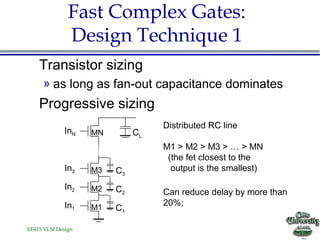
Transistor sizing
» as long as fan-out capacitance dominates
Progressive sizing
InN CL
C3
C2
C1
In1
In2
In3
M1
M2
M3
MN
Distributed RC line
M1 > M2 > M3 > … > MN
(the fet closest to the
output is the smallest)
Can reduce delay by more than
20%;
EE415 VLSI Design
Fast Complex Gates:
Design Technique 2
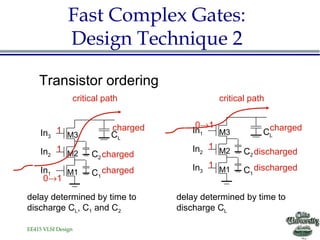
Transistor ordering
C2
C1
In1
In2
In3
M1
M2
M3 CL
C2
C1
In3
In2
In1
M1
M2
M3 CL
critical path critical path
charged
1
0→1
charged
charged1
delay determined by time to
discharge CL, C1 and C2
delay determined by time to
discharge CL
1
1
0→1 charged
discharged
discharged
EE415 VLSI Design
Fast Complex Gates:
Design Technique 3
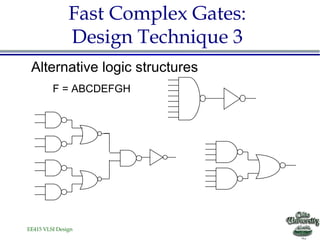
Alternative logic structures
F = ABCDEFGH
EE415 VLSI Design
Fast Complex Gates:
Design Technique 4
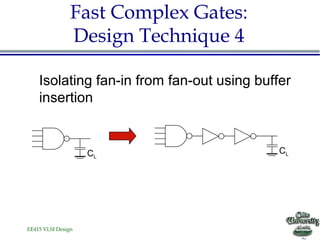
Isolating fan-in from fan-out using buffer
insertion
CL
CL
EE415 VLSI Design
Fast Complex Gates:
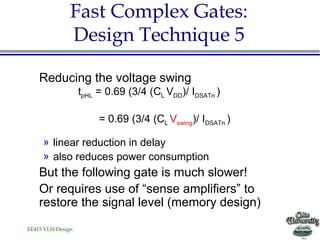
Design Technique 5
Reducing the voltage swing
» linear reduction in delay
» also reduces power consumption
But the following gate is much slower!
Or requires use of “sense amplifiers” to
restore the signal level (memory design)
tpHL = 0.69 (3/4 (CL VDD)/ IDSATn )
= 0.69 (3/4 (CL Vswing)/ IDSATn )
EE415 VLSI Design
Sizing Logic Paths for Speed
Frequently, input capacitance of a logic path
is constrained
Logic also has to drive some capacitance
Example: ALU load in an Intel’s
microprocessor is 0.5pF
How do we size the ALU datapath to achieve
maximum speed?
We have already solved this for the inverter
chain – can we generalize it for any type of
logic?
EE415 VLSI Design
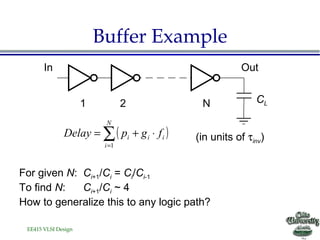
Buffer Example
( )∑=
⋅+=
N
i
iii fgpDelay
1
For given N: Ci+1/Ci = Ci/Ci-1
To find N: Ci+1/Ci ~ 4
How to generalize this to any logic path?
CL
In Out
1 2 N
(in units of τinv)
EE415 VLSI Design
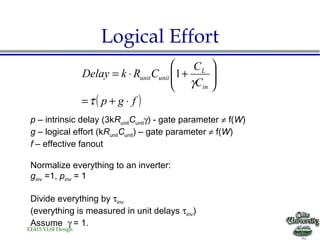
Logical Effort
( )fgp
C
C
CRkDelay
in
L
unitunit
⋅+=






+⋅=
τ
γ
1
p – intrinsic delay (3kRunitCunitγ) - gate parameter ≠ f(W)
g – logical effort (kRunitCunit) – gate parameter ≠ f(W)
f – effective fanout
Normalize everything to an inverter:
ginv =1, pinv = 1
Divide everything by τinv
(everything is measured in unit delays τinv)
Assume γ = 1.
EE415 VLSI Design
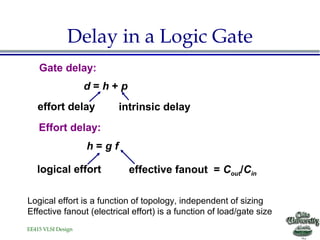
Delay in a Logic Gate
Gate delay:
d = h + p
effort delay intrinsic delay
Effort delay:
h = g f
logical effort effective fanout = Cout/Cin
Logical effort is a function of topology, independent of sizing
Effective fanout (electrical effort) is a function of load/gate size
EE415 VLSI Design
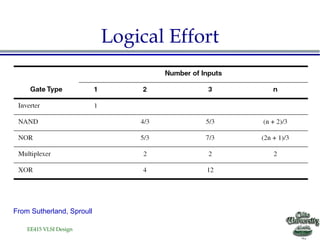
Logical Effort
Inverter has the smallest logical effort and
intrinsic delay of all static CMOS gates
Logical effort of a gate presents the ratio of its
input capacitance to the inverter capacitance
when sized to deliver the same current
Logical effort increases with the gate
complexity
EE415 VLSI Design
Intrinsic Delay
Inverter has the smallest intrinsic delay
and of all static CMOS gates
Intrinsic delay of a gate presents the
ratio of its output capacitance to the
inverter output capacitance when sized
to deliver the same current
Intrinsic delay increases with the gate
complexity
EE415 VLSI Design
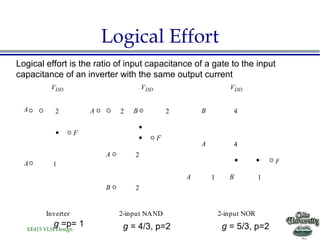
Logical Effort
Logical effort is the ratio of input capacitance of a gate to the input
capacitance of an inverter with the same output current
g =p= 1 g = 4/3, p=2 g = 5/3, p=2
B
A
A B
F
VDDVDD
A B
A
B
F
VDD
A
A
F
1
2 2 2
2
2
1 1
4
4
Inverter 2-input NAND 2-input NOR
EE415 VLSI Design
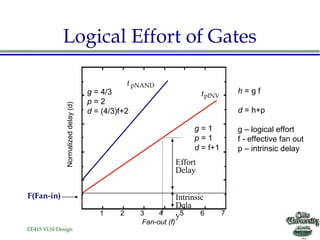
Logical Effort of Gates
Fan-out (f)
Normalizeddelay(d)
t
1 2 3 4 5 6 7
pINV
tpNAND
F(Fan-in)
g = 1
p = 1
d = f+1
g = 4/3
p = 2
d = (4/3)f+2
h = g f
d = h+p
g – logical effort
f - effective fan out
p – intrinsic delay
Intrinsic
Dela
y
Effort
Delay
EE415 VLSI Design
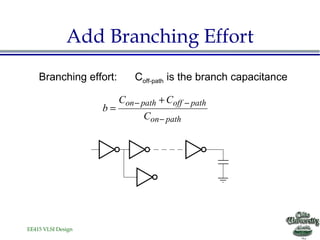
Add Branching Effort
Branching effort: Coff-path is the branch capacitance
pathon
pathoffpathon
C
CC
b
−
−− +
=
EE415 VLSI Design
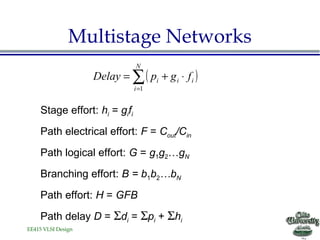
Multistage Networks
Stage effort: hi = gifi
Path electrical effort: F = Cout/Cin
Path logical effort: G = g1g2…gN
Branching effort: B = b1b2…bN
Path effort: H = GFB
Path delay D = Σdi = Σpi + Σhi
( )∑=
⋅+=
N
i
iii fgpDelay
1
EE415 VLSI Design
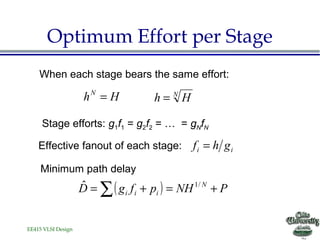
Optimum Effort per Stage
HhN
=
When each stage bears the same effort:
N
Hh =
( ) PNHpfgD N
iii +=+= ∑ /1ˆ
Minimum path delay
Effective fanout of each stage: ii ghf =
Stage efforts: g1f1 = g2f2 = … = gNfN
EE415 VLSI Design
Logical Effort
From Sutherland, Sproull
EE415 VLSI Design
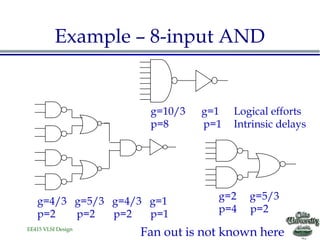
Example – 8-input AND
Logical efforts
Intrinsic delays
Fan out is not known here
g=10/3 g=1
p=8 p=1
g=2 g=5/3
p=4 p=2
g=4/3 g=5/3 g=4/3 g=1
p=2 p=2 p=2 p=1
EE415 VLSI Design
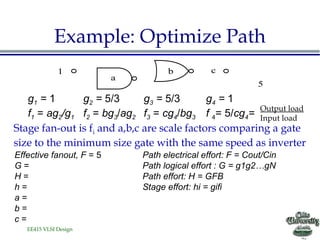
Example: Optimize Path
1
a
b c
5
g1 = 1
f1 = ag2/g1
g2 = 5/3
f2 = bg3/ag2
g3 = 5/3
f3 = cg4/bg3
g4 = 1
f 4= 5/cg4=
Effective fanout, F = 5 Path electrical effort: F = Cout/Cin
G = Path logical effort : G = g1g2…gN
H = Path effort: H = GFB
h = Stage effort: hi = gifi
a =
b =
c =
Stage fan-out is fi and a,b,c are scale factors comparing a gate
size to the minimum size gate with the same speed as inverter
Output load
Input load
EE415 VLSI Design
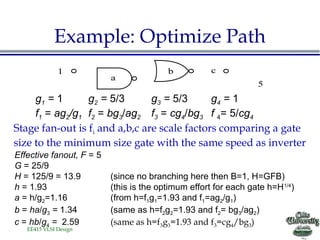
Example: Optimize Path
1
a
b c
5
g1 = 1
f1 = ag2/g1
g2 = 5/3
f2 = bg3/ag2
g3 = 5/3
f3 = cg4/bg3
g4 = 1
f 4= 5/cg4
Effective fanout, F = 5
G = 25/9
H = 125/9 = 13.9 (since no branching here then B=1, H=GFB)
h = 1.93 (this is the optimum effort for each gate h=H1/4
)
a = h/g2=1.16 (from h=f1g1=1.93 and f1=ag2/g1)
b = ha/g3 = 1.34 (same as h=f2g2=1.93 and f2= bg3/ag2)
c = hb/g4 = 2.59 (same as h=f3g3=1.93 and f3=cg4/bg3)
Stage fan-out is fi and a,b,c are scale factors comparing a gate
size to the minimum size gate with the same speed as inverter
EE415 VLSI Design
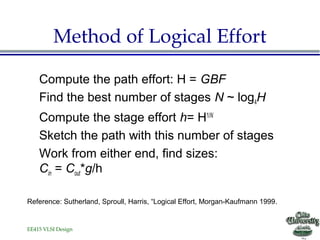
Method of Logical Effort
Compute the path effort: H = GBF
Find the best number of stages N ~ log4H
Compute the stage effort h= H1/N
Sketch the path with this number of stages
Work from either end, find sizes:
Cin = Cout*g/h
Reference: Sutherland, Sproull, Harris, “Logical Effort, Morgan-Kaufmann 1999.
EE415 VLSI Design
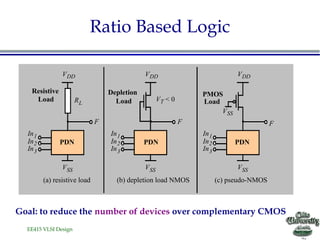
Ratio Based Logic
VDD
VSS
PDN
In1
In2
In3
F
RL
Load
VDD
VSS
In1
In2
In3
F
VDD
VSS
PDN
In1
In2
In3
F
VSS
PDN
Resistive Depletion
Load
PMOS
Load
(a) resistive load (b) depletion load NMOS (c) pseudo-NMOS
VT < 0
Goal: to reduce the number of devices over complementary CMOS
EE415 VLSI Design
Ratio Based Logic
VDD
VSS
PDN
In1
In2
In3
F
RL
Load
Resistive
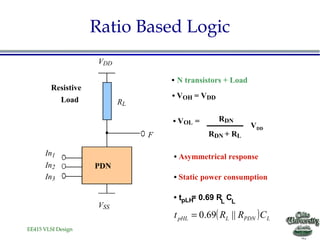
N transistors + Load
• VOH = VDD
• VOL = RDN
RDN + RL
• Asymmetrical response
• Static power consumption
•
• tpLH= 0.69 RL
CL
VDD
( ) LPDNLpHL CRRt ||69.0=
EE415 VLSI Design
Ratio Based Logic Problems
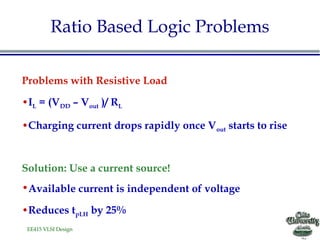
Problems with Resistive Load
•IL = (VDD – Vout )/ RL
•Charging current drops rapidly once Vout starts to rise
Solution: Use a current source!
•Available current is independent of voltage
•Reduces tpLH by 25%
EE415 VLSI Design
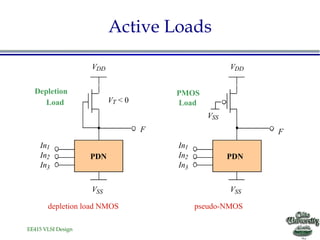
Active Loads
VDD
VSS
In1
In2
In3
F
VDD
VSS
PDN
In1
In2
In3
F
VSS
PDN
Depletion
Load
PMOS
Load
depletion load NMOS pseudo-NMOS
VT < 0
EE415 VLSI Design
Active Loads
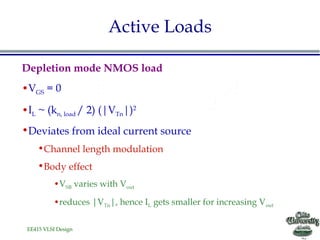
Depletion mode NMOS load
•VGS = 0
•IL ~ (kn, load / 2) (|VTn|)2
•Deviates from ideal current source
•Channel length modulation
•Body effect
•VSB varies with Vout
•reduces |VTn|, hence IL gets smaller for increasing Vout
EE415 VLSI Design
Active Loads
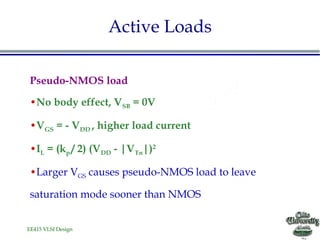
Pseudo-NMOS load
•No body effect, VSB = 0V
•VGS = - VDD , higher load current
•IL = (kp / 2) (VDD - |VTn|)2
•Larger VGS causes pseudo-NMOS load to leave
saturation mode sooner than NMOS
EE415 VLSI Design
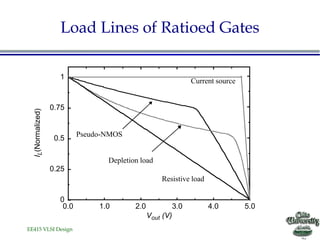
Load Lines of Ratioed Gates
0.0 1.0 2.0 3.0 4.0 5.0
Vout (V)
0
0.25
0.5
0.75
1
IL(Normalized)
Resistive load
Pseudo-NMOS
Depletion load
Current source
EE415 VLSI Design
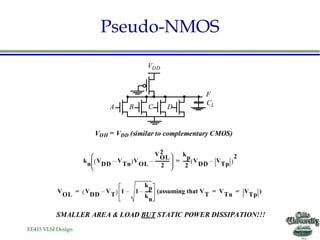
Pseudo-NMOS
VDD
A B C D
F
CL
VOH = VDD (similar to complementary CMOS)
k
n
V
DD
V
Tn
–( )V
OL
VOL
2
2
-------------–
 
 
  kp
2
------ V
DD
V
Tp
–( )
2
=
V
OL
V
DD
V
T
–( ) 1 1
kp
kn
------–– (assuming that V
T
V
Tn
V
Tp
)= = =
SMALLER AREA & LOAD BUT STATIC POWER DISSIPATION!!!
EE415 VLSI Design
Pseudo-NMOS VTC
Noise margin low
is significantly
reduced comparing
to CMOS
0.0 0.5 1.0 1.5 2.0 2.5
0.0
0.5
1.0
1.5
2.0
2.5
3.0
Vin [V]
Vout[V]
W/Lp = 4
W/Lp = 2
W/Lp = 1
W/Lp = 0.25
W/Lp = 0.5
NL
Vin_low
Vin_highVin_low
EE415 VLSI Design
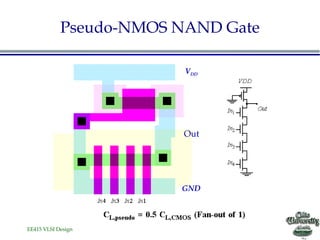
Pseudo-NMOS NAND Gate
VDD
GND
Out
EE415 VLSI Design
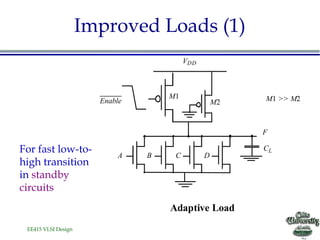
Improved Loads (1)
A B C D
F
CL
M1
M2 M1 >> M2Enable
VDD
Adaptive Load
For fast low-to-
high transition
in standby
circuits
EE415 VLSI Design
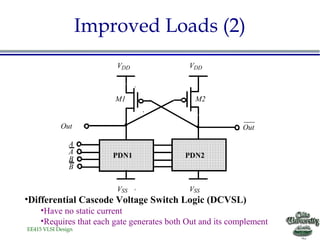
Improved Loads (2)
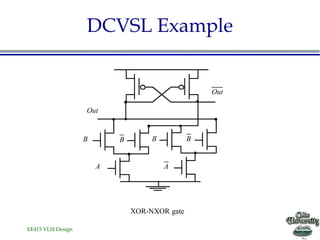
•Differential Cascode Voltage Switch Logic (DCVSL)
•Have no static current
•Requires that each gate generates both Out and its complement
VDD
VSS
PDN1
Out
VDD
VSS
PDN2
Out
A
A
B
B
M1 M2
EE415 VLSI Design
DCVSL Example
B
A A
B B B
Out
Out
XOR-NXOR gate
EE415 VLSI Design
DCVSL Transient Response
0 0.2 0.4 0.6 0.8 1.0-0.5
0.5
1.5
2.5
Time [ns]
Voltage[V]
A B
A B
A,B
A,B
DCVSL transient response of AND/NAND gate
EE415 VLSI Design
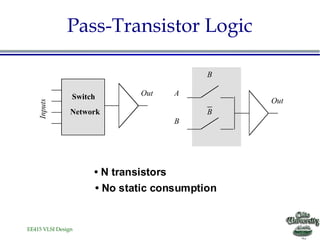
Pass-Transistor Logic
Inputs
Switch
Network
Out
Out
A
B
B
B
• N transistors
• No static consumption
EE415 VLSI Design
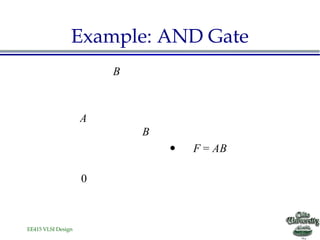
Example: AND Gate
B
B
A
F = AB
0
EE415 VLSI Design
NMOS-Only Logic
VDD
In
Out
x
0.5µm/0.25µm
0.5µm/0.25µm
1.5µm/0.25µm
0 0.5 1 1.5 2
0.0
1.0
2.0
3.0
Time [ns]
Voltage[V]
x
Out
In
EE415 VLSI Design
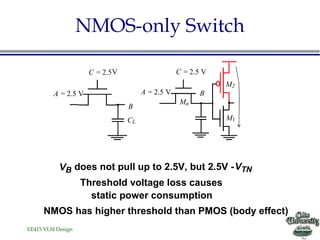
NMOS-only Switch
A = 2.5 V
B
C = 2.5V
CL
A = 2.5 V
C = 2.5 V
B
M2
M1
Mn
Threshold voltage loss causes
static power consumption
VB does not pull up to 2.5V, but 2.5V -VTN
NMOS has higher threshold than PMOS (body effect)
EE415 VLSI Design
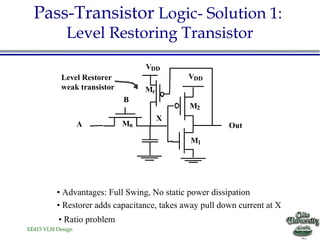
Pass-Transistor Logic- Solution 1:
Level Restoring Transistor
M2
M1
Mn
Mr
OutA
B
VDD
VDDLevel Restorer
weak transistor
X
• Advantages: Full Swing, No static power dissipation
• Restorer adds capacitance, takes away pull down current at X
• Ratio problem
EE415 VLSI Design
Restorer Transistor Sizing
0 100 200 300 400 500
0.0
1.0
2.0
W/Lr
=1.0/0.25 W /Lr
=1.25/0.25
W /Lr
=1.50/0.25
W /Lr
=1.75/0.25
Voltage[V]
Time [ps]
3.0
•Level restoring transistor
cannot be too strong otherwise
it will prevent output from
reaching VDD value
•Upper limit on restorer size
•Pass-transistor pull-down
can have several transistors in
stack
EE415 VLSI Design
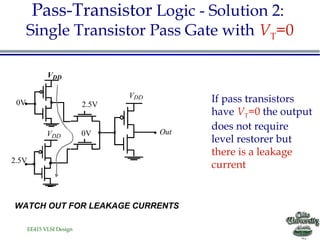
Pass-Transistor Logic - Solution 2:
Single Transistor Pass Gate with VT=0
Out
VDD
VDD
2.5V
VDD
0V 2.5V
0V
WATCH OUT FOR LEAKAGE CURRENTS
If pass transistors
have VT=0 the output
does not require
level restorer but
there is a leakage
current
EE415 VLSI Design
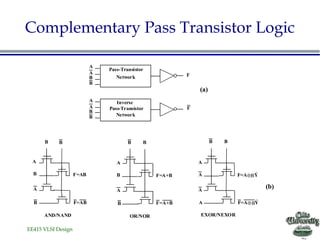
Complementary Pass Transistor Logic
A
B
A
B
B B B B
A
B
A
B
F=AB
F=AB
F=A+B
F=A+B
B B
A
A
A
A
F=A⊕ΒÝ
F=A⊕ΒÝ
OR/NOR EXOR/NEXORAND/NAND
F
F
Pass-Transistor
Network
Pass-Transistor
Network
A
A
B
B
A
A
B
B
Inverse
(a)
(b)
EE415 VLSI Design
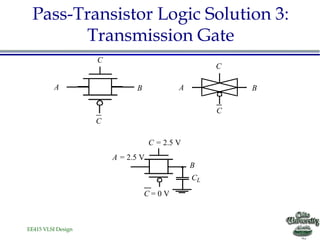
Pass-Transistor Logic Solution 3:
Transmission Gate
A B
C
C
A B
C
C
B
CL
C = 0 V
A = 2.5 V
C = 2.5 V
EE415 VLSI Design
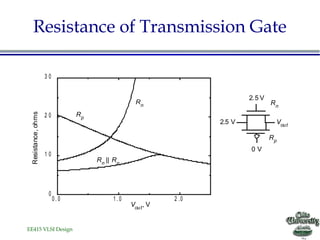
Resistance of Transmission Gate
Vout
0 V
2.5 V
2.5 V
Rn
Rp
0 . 0 1 . 0 2 .0
0
1 0
2 0
3 0
Vout
, V
Resistance,ohms
Rn
Rp
Rn
|| Rp
EE415 VLSI Design
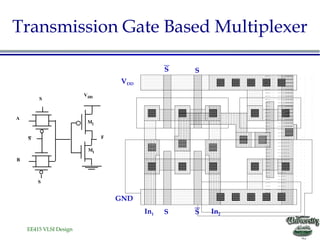
Transmission Gate Based Multiplexer
A
M2
M1
B
S
S
S F
VDD
GND
VDD
In1 In2S S
S S
EE415 VLSI Design
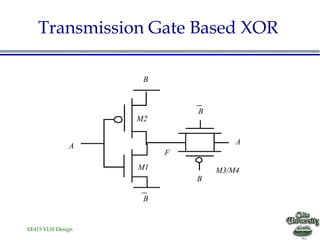
Transmission Gate Based XOR
A
B
F
B
A
B
B
M1
M2
M3/M4
EE415 VLSI Design
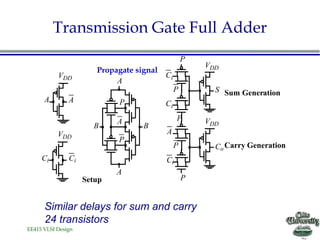
Transmission Gate Full Adder
A
B
P
Ci
VDD
A
A A
VDD
Ci
A
P
A
B
VDD
VDD
Ci
Ci
Co
S
Ci
P
P
P
P
P
Sum Generation
Carry Generation
Setup
Similar delays for sum and carry
24 transistors
Propagate signal
EE415 VLSI Design
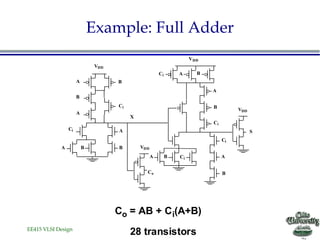
Example: Full Adder
VDD
VDD
VDD
VDD
A B
Ci
S
Co
X
B
A
Ci A
BBA
Ci
A B Ci
Ci
B
A
Ci
A
B
BA
Co = AB + Ci(A+B)
28 transistors
EE415 VLSI Design
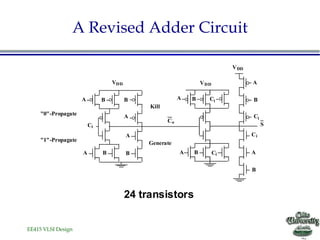
A Revised Adder Circuit
VDD
Ci
A
BBA
B
A
A B
Kill
Generate
"1"-Propagate
"0"-Propagate
VDD
Ci
A B Ci
Ci
B
A
Ci
A
BBA
VDD
S
Co
24 transistors
EE415 VLSI Design
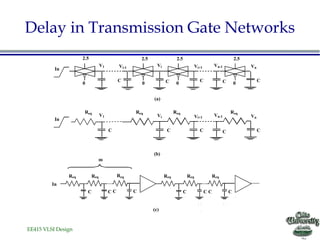
Delay in Transmission Gate Networks
V1 Vi-1
C
2.5 2.5
0 0
Vi Vi+1
CC
2.5
0
Vn-1 Vn
CC
2.5
0
In
V1 Vi Vi+1
C
Vn-1 Vn
CC
In
ReqReq Req Req
CC
(a)
(b)
C
Req Req
C C
Req
C C
Req Req
C C
Req
C
In
m
(c)
EE415 VLSI Design
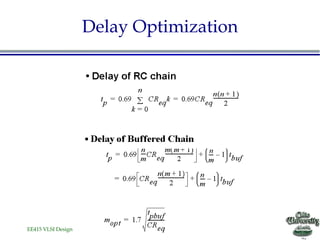
Delay Optimization

Lecture11 combinational logic dynamics

  • 1.
    EE415 VLSI Design COMBINATIONAL LOGICDYNAMICS [Adapted from Rabaey’s Digital Integrated Circuits, ©2002, J. Rabaey et al.]
  • 2.
    EE415 VLSI Design FastComplex Gates: Design Technique 1 Transistor sizing » as long as fan-out capacitance dominates Progressive sizing InN CL C3 C2 C1 In1 In2 In3 M1 M2 M3 MN Distributed RC line M1 > M2 > M3 > … > MN (the fet closest to the output is the smallest) Can reduce delay by more than 20%;
  • 3.
    EE415 VLSI Design FastComplex Gates: Design Technique 2 Transistor ordering C2 C1 In1 In2 In3 M1 M2 M3 CL C2 C1 In3 In2 In1 M1 M2 M3 CL critical path critical path charged 1 0→1 charged charged1 delay determined by time to discharge CL, C1 and C2 delay determined by time to discharge CL 1 1 0→1 charged discharged discharged
  • 4.
    EE415 VLSI Design FastComplex Gates: Design Technique 3 Alternative logic structures F = ABCDEFGH
  • 5.
    EE415 VLSI Design FastComplex Gates: Design Technique 4 Isolating fan-in from fan-out using buffer insertion CL CL
  • 6.
    EE415 VLSI Design FastComplex Gates: Design Technique 5 Reducing the voltage swing » linear reduction in delay » also reduces power consumption But the following gate is much slower! Or requires use of “sense amplifiers” to restore the signal level (memory design) tpHL = 0.69 (3/4 (CL VDD)/ IDSATn ) = 0.69 (3/4 (CL Vswing)/ IDSATn )
  • 7.
    EE415 VLSI Design SizingLogic Paths for Speed Frequently, input capacitance of a logic path is constrained Logic also has to drive some capacitance Example: ALU load in an Intel’s microprocessor is 0.5pF How do we size the ALU datapath to achieve maximum speed? We have already solved this for the inverter chain – can we generalize it for any type of logic?
  • 8.
    EE415 VLSI Design BufferExample ( )∑= ⋅+= N i iii fgpDelay 1 For given N: Ci+1/Ci = Ci/Ci-1 To find N: Ci+1/Ci ~ 4 How to generalize this to any logic path? CL In Out 1 2 N (in units of τinv)
  • 9.
    EE415 VLSI Design LogicalEffort ( )fgp C C CRkDelay in L unitunit ⋅+=       +⋅= τ γ 1 p – intrinsic delay (3kRunitCunitγ) - gate parameter ≠ f(W) g – logical effort (kRunitCunit) – gate parameter ≠ f(W) f – effective fanout Normalize everything to an inverter: ginv =1, pinv = 1 Divide everything by τinv (everything is measured in unit delays τinv) Assume γ = 1.
  • 10.
    EE415 VLSI Design Delayin a Logic Gate Gate delay: d = h + p effort delay intrinsic delay Effort delay: h = g f logical effort effective fanout = Cout/Cin Logical effort is a function of topology, independent of sizing Effective fanout (electrical effort) is a function of load/gate size
  • 11.
    EE415 VLSI Design LogicalEffort Inverter has the smallest logical effort and intrinsic delay of all static CMOS gates Logical effort of a gate presents the ratio of its input capacitance to the inverter capacitance when sized to deliver the same current Logical effort increases with the gate complexity
  • 12.
    EE415 VLSI Design IntrinsicDelay Inverter has the smallest intrinsic delay and of all static CMOS gates Intrinsic delay of a gate presents the ratio of its output capacitance to the inverter output capacitance when sized to deliver the same current Intrinsic delay increases with the gate complexity
  • 13.
    EE415 VLSI Design LogicalEffort Logical effort is the ratio of input capacitance of a gate to the input capacitance of an inverter with the same output current g =p= 1 g = 4/3, p=2 g = 5/3, p=2 B A A B F VDDVDD A B A B F VDD A A F 1 2 2 2 2 2 1 1 4 4 Inverter 2-input NAND 2-input NOR
  • 14.
    EE415 VLSI Design LogicalEffort of Gates Fan-out (f) Normalizeddelay(d) t 1 2 3 4 5 6 7 pINV tpNAND F(Fan-in) g = 1 p = 1 d = f+1 g = 4/3 p = 2 d = (4/3)f+2 h = g f d = h+p g – logical effort f - effective fan out p – intrinsic delay Intrinsic Dela y Effort Delay
  • 15.
    EE415 VLSI Design AddBranching Effort Branching effort: Coff-path is the branch capacitance pathon pathoffpathon C CC b − −− + =
  • 16.
    EE415 VLSI Design MultistageNetworks Stage effort: hi = gifi Path electrical effort: F = Cout/Cin Path logical effort: G = g1g2…gN Branching effort: B = b1b2…bN Path effort: H = GFB Path delay D = Σdi = Σpi + Σhi ( )∑= ⋅+= N i iii fgpDelay 1
  • 17.
    EE415 VLSI Design OptimumEffort per Stage HhN = When each stage bears the same effort: N Hh = ( ) PNHpfgD N iii +=+= ∑ /1ˆ Minimum path delay Effective fanout of each stage: ii ghf = Stage efforts: g1f1 = g2f2 = … = gNfN
  • 18.
    EE415 VLSI Design LogicalEffort From Sutherland, Sproull
  • 19.
    EE415 VLSI Design Example– 8-input AND Logical efforts Intrinsic delays Fan out is not known here g=10/3 g=1 p=8 p=1 g=2 g=5/3 p=4 p=2 g=4/3 g=5/3 g=4/3 g=1 p=2 p=2 p=2 p=1
  • 20.
    EE415 VLSI Design Example:Optimize Path 1 a b c 5 g1 = 1 f1 = ag2/g1 g2 = 5/3 f2 = bg3/ag2 g3 = 5/3 f3 = cg4/bg3 g4 = 1 f 4= 5/cg4= Effective fanout, F = 5 Path electrical effort: F = Cout/Cin G = Path logical effort : G = g1g2…gN H = Path effort: H = GFB h = Stage effort: hi = gifi a = b = c = Stage fan-out is fi and a,b,c are scale factors comparing a gate size to the minimum size gate with the same speed as inverter Output load Input load
  • 21.
    EE415 VLSI Design Example:Optimize Path 1 a b c 5 g1 = 1 f1 = ag2/g1 g2 = 5/3 f2 = bg3/ag2 g3 = 5/3 f3 = cg4/bg3 g4 = 1 f 4= 5/cg4 Effective fanout, F = 5 G = 25/9 H = 125/9 = 13.9 (since no branching here then B=1, H=GFB) h = 1.93 (this is the optimum effort for each gate h=H1/4 ) a = h/g2=1.16 (from h=f1g1=1.93 and f1=ag2/g1) b = ha/g3 = 1.34 (same as h=f2g2=1.93 and f2= bg3/ag2) c = hb/g4 = 2.59 (same as h=f3g3=1.93 and f3=cg4/bg3) Stage fan-out is fi and a,b,c are scale factors comparing a gate size to the minimum size gate with the same speed as inverter
  • 22.
    EE415 VLSI Design Methodof Logical Effort Compute the path effort: H = GBF Find the best number of stages N ~ log4H Compute the stage effort h= H1/N Sketch the path with this number of stages Work from either end, find sizes: Cin = Cout*g/h Reference: Sutherland, Sproull, Harris, “Logical Effort, Morgan-Kaufmann 1999.
  • 23.
    EE415 VLSI Design RatioBased Logic VDD VSS PDN In1 In2 In3 F RL Load VDD VSS In1 In2 In3 F VDD VSS PDN In1 In2 In3 F VSS PDN Resistive Depletion Load PMOS Load (a) resistive load (b) depletion load NMOS (c) pseudo-NMOS VT < 0 Goal: to reduce the number of devices over complementary CMOS
  • 24.
    EE415 VLSI Design RatioBased Logic VDD VSS PDN In1 In2 In3 F RL Load Resistive N transistors + Load • VOH = VDD • VOL = RDN RDN + RL • Asymmetrical response • Static power consumption • • tpLH= 0.69 RL CL VDD ( ) LPDNLpHL CRRt ||69.0=
  • 25.
    EE415 VLSI Design RatioBased Logic Problems Problems with Resistive Load •IL = (VDD – Vout )/ RL •Charging current drops rapidly once Vout starts to rise Solution: Use a current source! •Available current is independent of voltage •Reduces tpLH by 25%
  • 26.
    EE415 VLSI Design ActiveLoads VDD VSS In1 In2 In3 F VDD VSS PDN In1 In2 In3 F VSS PDN Depletion Load PMOS Load depletion load NMOS pseudo-NMOS VT < 0
  • 27.
    EE415 VLSI Design ActiveLoads Depletion mode NMOS load •VGS = 0 •IL ~ (kn, load / 2) (|VTn|)2 •Deviates from ideal current source •Channel length modulation •Body effect •VSB varies with Vout •reduces |VTn|, hence IL gets smaller for increasing Vout
  • 28.
    EE415 VLSI Design ActiveLoads Pseudo-NMOS load •No body effect, VSB = 0V •VGS = - VDD , higher load current •IL = (kp / 2) (VDD - |VTn|)2 •Larger VGS causes pseudo-NMOS load to leave saturation mode sooner than NMOS
  • 29.
    EE415 VLSI Design LoadLines of Ratioed Gates 0.0 1.0 2.0 3.0 4.0 5.0 Vout (V) 0 0.25 0.5 0.75 1 IL(Normalized) Resistive load Pseudo-NMOS Depletion load Current source
  • 30.
    EE415 VLSI Design Pseudo-NMOS VDD AB C D F CL VOH = VDD (similar to complementary CMOS) k n V DD V Tn –( )V OL VOL 2 2 -------------–       kp 2 ------ V DD V Tp –( ) 2 = V OL V DD V T –( ) 1 1 kp kn ------–– (assuming that V T V Tn V Tp )= = = SMALLER AREA & LOAD BUT STATIC POWER DISSIPATION!!!
  • 31.
    EE415 VLSI Design Pseudo-NMOSVTC Noise margin low is significantly reduced comparing to CMOS 0.0 0.5 1.0 1.5 2.0 2.5 0.0 0.5 1.0 1.5 2.0 2.5 3.0 Vin [V] Vout[V] W/Lp = 4 W/Lp = 2 W/Lp = 1 W/Lp = 0.25 W/Lp = 0.5 NL Vin_low Vin_highVin_low
  • 32.
    EE415 VLSI Design Pseudo-NMOSNAND Gate VDD GND Out
  • 33.
    EE415 VLSI Design ImprovedLoads (1) A B C D F CL M1 M2 M1 >> M2Enable VDD Adaptive Load For fast low-to- high transition in standby circuits
  • 34.
    EE415 VLSI Design ImprovedLoads (2) •Differential Cascode Voltage Switch Logic (DCVSL) •Have no static current •Requires that each gate generates both Out and its complement VDD VSS PDN1 Out VDD VSS PDN2 Out A A B B M1 M2
  • 35.
    EE415 VLSI Design DCVSLExample B A A B B B Out Out XOR-NXOR gate
  • 36.
    EE415 VLSI Design DCVSLTransient Response 0 0.2 0.4 0.6 0.8 1.0-0.5 0.5 1.5 2.5 Time [ns] Voltage[V] A B A B A,B A,B DCVSL transient response of AND/NAND gate
  • 37.
    EE415 VLSI Design Pass-TransistorLogic Inputs Switch Network Out Out A B B B • N transistors • No static consumption
  • 38.
    EE415 VLSI Design Example:AND Gate B B A F = AB 0
  • 39.
    EE415 VLSI Design NMOS-OnlyLogic VDD In Out x 0.5µm/0.25µm 0.5µm/0.25µm 1.5µm/0.25µm 0 0.5 1 1.5 2 0.0 1.0 2.0 3.0 Time [ns] Voltage[V] x Out In
  • 40.
    EE415 VLSI Design NMOS-onlySwitch A = 2.5 V B C = 2.5V CL A = 2.5 V C = 2.5 V B M2 M1 Mn Threshold voltage loss causes static power consumption VB does not pull up to 2.5V, but 2.5V -VTN NMOS has higher threshold than PMOS (body effect)
  • 41.
    EE415 VLSI Design Pass-TransistorLogic- Solution 1: Level Restoring Transistor M2 M1 Mn Mr OutA B VDD VDDLevel Restorer weak transistor X • Advantages: Full Swing, No static power dissipation • Restorer adds capacitance, takes away pull down current at X • Ratio problem
  • 42.
    EE415 VLSI Design RestorerTransistor Sizing 0 100 200 300 400 500 0.0 1.0 2.0 W/Lr =1.0/0.25 W /Lr =1.25/0.25 W /Lr =1.50/0.25 W /Lr =1.75/0.25 Voltage[V] Time [ps] 3.0 •Level restoring transistor cannot be too strong otherwise it will prevent output from reaching VDD value •Upper limit on restorer size •Pass-transistor pull-down can have several transistors in stack
  • 43.
    EE415 VLSI Design Pass-TransistorLogic - Solution 2: Single Transistor Pass Gate with VT=0 Out VDD VDD 2.5V VDD 0V 2.5V 0V WATCH OUT FOR LEAKAGE CURRENTS If pass transistors have VT=0 the output does not require level restorer but there is a leakage current
  • 44.
    EE415 VLSI Design ComplementaryPass Transistor Logic A B A B B B B B A B A B F=AB F=AB F=A+B F=A+B B B A A A A F=A⊕ΒÝ F=A⊕ΒÝ OR/NOR EXOR/NEXORAND/NAND F F Pass-Transistor Network Pass-Transistor Network A A B B A A B B Inverse (a) (b)
  • 45.
    EE415 VLSI Design Pass-TransistorLogic Solution 3: Transmission Gate A B C C A B C C B CL C = 0 V A = 2.5 V C = 2.5 V
  • 46.
    EE415 VLSI Design Resistanceof Transmission Gate Vout 0 V 2.5 V 2.5 V Rn Rp 0 . 0 1 . 0 2 .0 0 1 0 2 0 3 0 Vout , V Resistance,ohms Rn Rp Rn || Rp
  • 47.
    EE415 VLSI Design TransmissionGate Based Multiplexer A M2 M1 B S S S F VDD GND VDD In1 In2S S S S
  • 48.
    EE415 VLSI Design TransmissionGate Based XOR A B F B A B B M1 M2 M3/M4
  • 49.
    EE415 VLSI Design TransmissionGate Full Adder A B P Ci VDD A A A VDD Ci A P A B VDD VDD Ci Ci Co S Ci P P P P P Sum Generation Carry Generation Setup Similar delays for sum and carry 24 transistors Propagate signal
  • 50.
    EE415 VLSI Design Example:Full Adder VDD VDD VDD VDD A B Ci S Co X B A Ci A BBA Ci A B Ci Ci B A Ci A B BA Co = AB + Ci(A+B) 28 transistors
  • 51.
    EE415 VLSI Design ARevised Adder Circuit VDD Ci A BBA B A A B Kill Generate "1"-Propagate "0"-Propagate VDD Ci A B Ci Ci B A Ci A BBA VDD S Co 24 transistors
  • 52.
    EE415 VLSI Design Delayin Transmission Gate Networks V1 Vi-1 C 2.5 2.5 0 0 Vi Vi+1 CC 2.5 0 Vn-1 Vn CC 2.5 0 In V1 Vi Vi+1 C Vn-1 Vn CC In ReqReq Req Req CC (a) (b) C Req Req C C Req C C Req Req C C Req C In m (c)
  • 53.

Editor's Notes

  • #3 M1 have to carry the discharge current from M2, M3, … MN and CL so make it the largest MN only has to discharge the current from MN (no internal capacitances)
  • #4 For lecture. Critical input is latest arriving signal Place latest arriving signal (critical path) closest to the output
  • #5 Reduced fan-in -&amp;gt; deeper logic depth Reduction in fan-in offsets, by far, the extra delay incurred by the NOR gate (second configuration). Only simulation will tell which of the last two configurations is faster, lower power
  • #6 Reduce CL on large fan-in gates, especially for large CL, and size the inverters progressively to handle the CL more effectively