Presented by-:
Diwaker Pant
ME ECE Regular
   IntroductIon.

   AdvAntAges of usIng pAss trAnsIstor logIcs As
    compAred to conventIonAl cmos logIc.

   lAb work relAted to pAss trAnsIstor logIc.

   conclusIons.


                               Pass Transistor Logic   October 9, 2012   2
   In electronics pass transistor logic (PTL) describes
    several logic families used in the design of integrated
    circuits.

   It reduces the count of transistors used to make
    different logic gates, by eliminating redundant
    transistors.

   Disadvantage that output levels are always lower than
    the input level.

                                     Pass Transistor Logic   October 9, 2012   3
   In conventional logic families input is applied to gate
    terminal of transistor but in PTL it is also applied to
    source /drain terminal.

   These circuits act as switches use either NMOS
    transistors or parallel pair of NMOS and PMOS
    transistor called Transmission gate.

   Here the width of PMOS is taken equal to NMOS so
    that both transistors can pass the signal
    simultaneously in parallel.
                                    Pass Transistor Logic   October 9, 2012   4
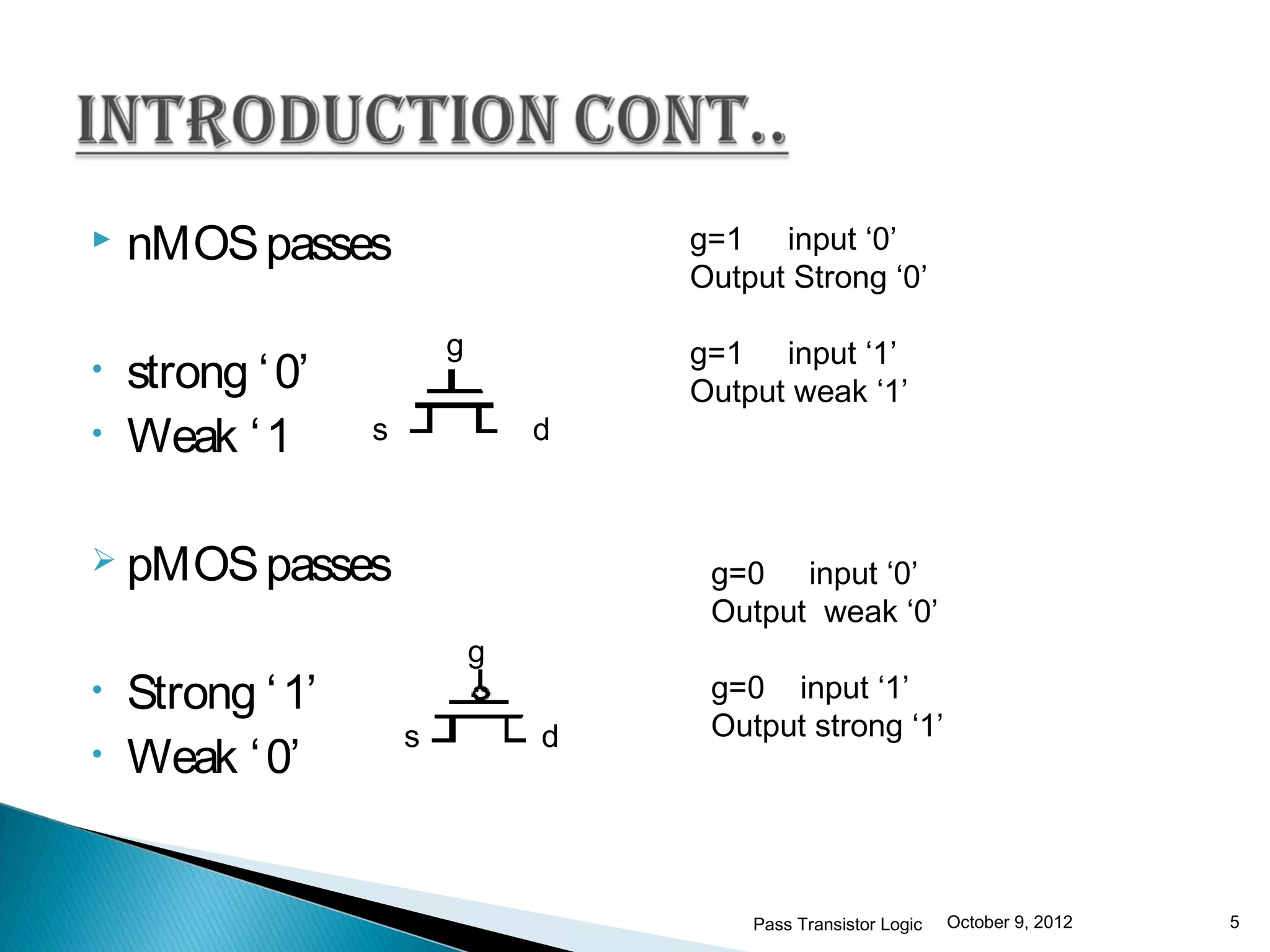
   nMOS passes                       g=1 input ‘0’
                                      Output Strong ‘0’

                          g           g=1 input ‘1’
•   strong ‘ 0’                       Output weak ‘1’
•   Weak ‘ 1      s               d


 pMOS passes                          g=0 input ‘0’
                                       Output weak ‘0’
                              g
•   Strong ‘ 1’                        g=0 input ‘1’
                      s           d    Output strong ‘1’
•   Weak ‘ 0’


                                          Pass Transistor Logic   October 9, 2012   5
   pAss trAnsIstor logIc

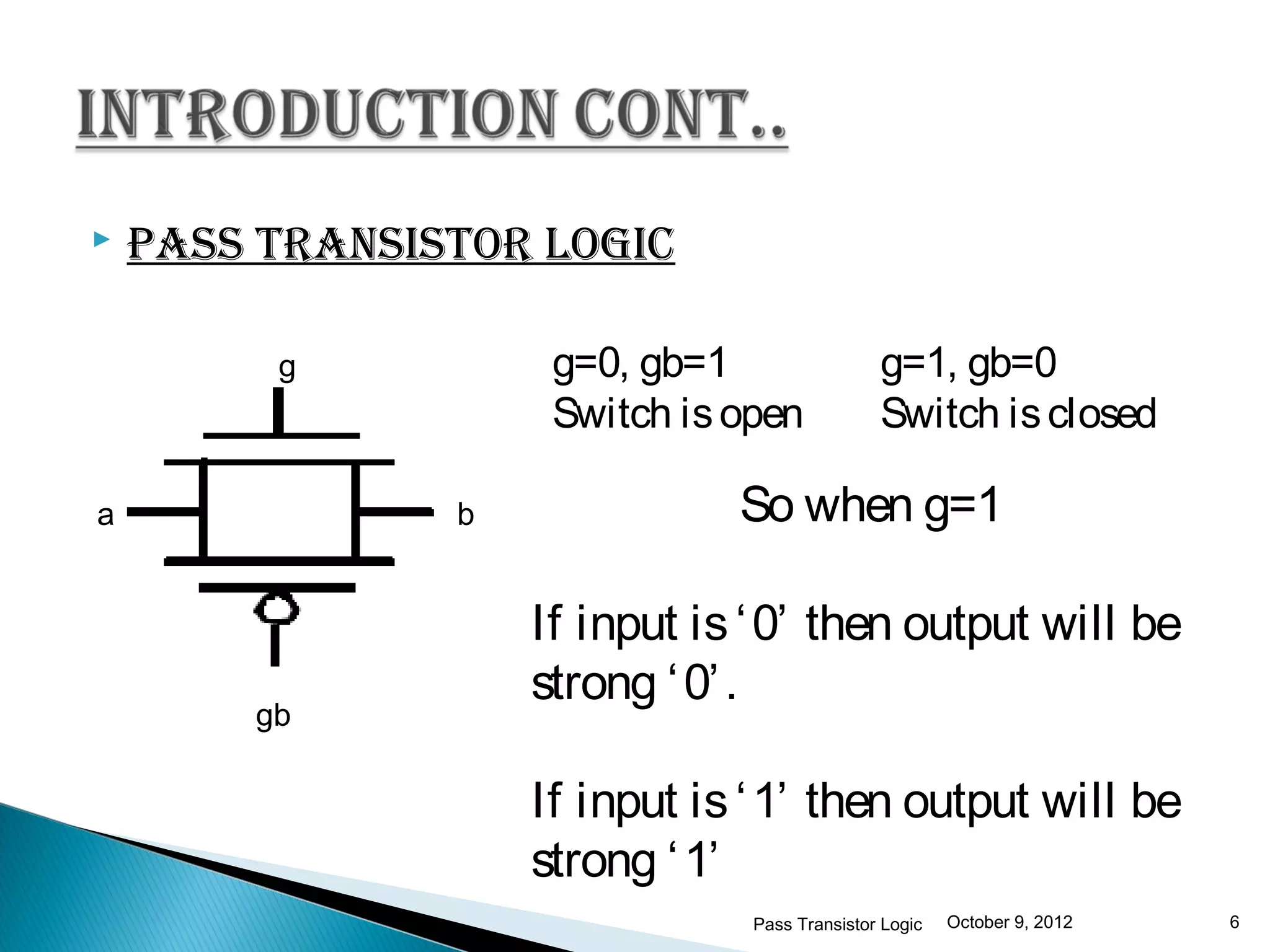
         g           g=0, gb=1                 g=1, gb=0
                     Switch is open            Switch is closed

a               b              So when g=1

                    If input is ‘ 0’ then output will be
                    strong ‘ 0’ .
        gb

                    If input is ‘ 1’ then output will be
                    strong ‘ 1’
                                Pass Transistor Logic   October 9, 2012   6
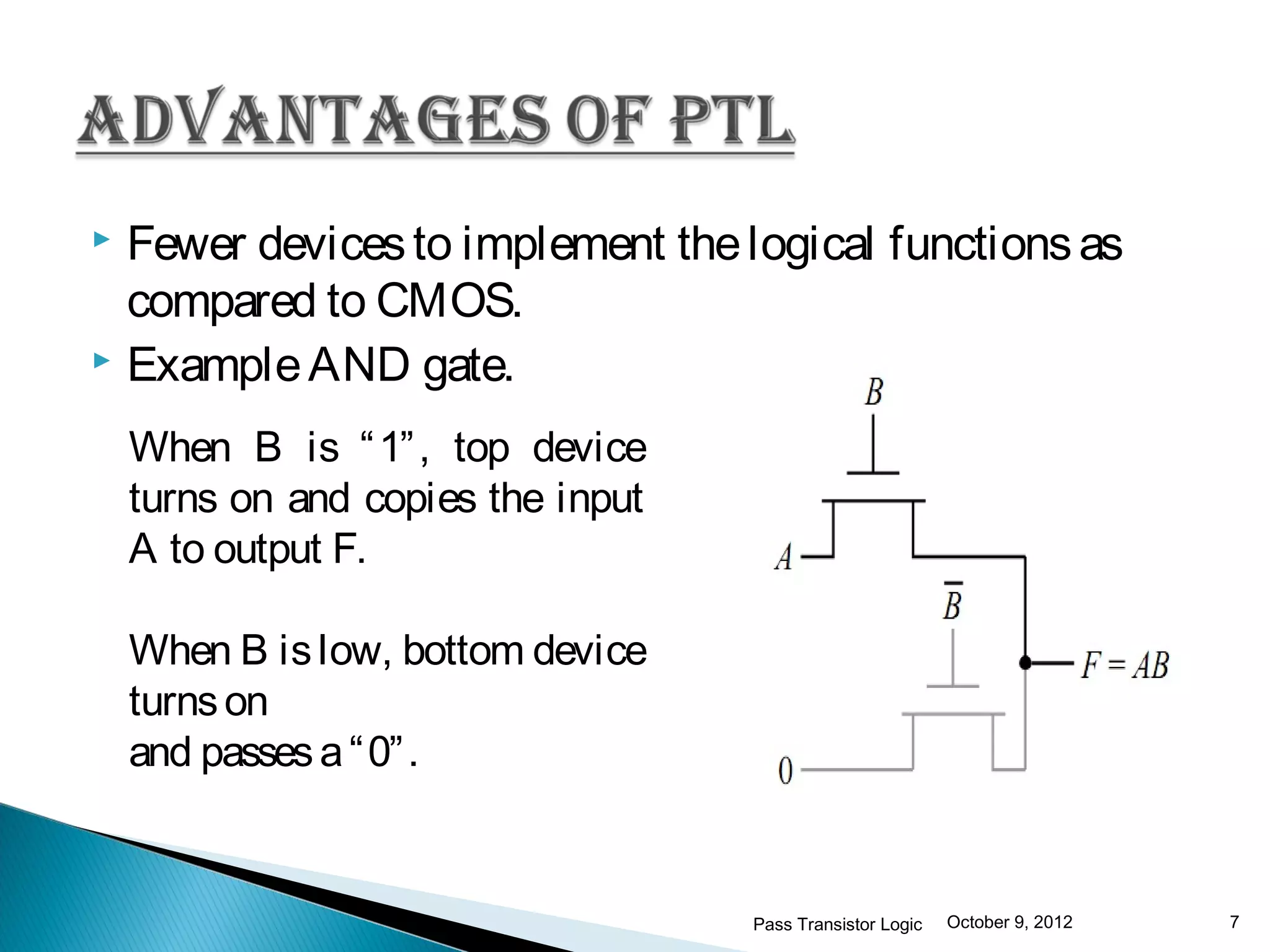
 Fewer devices to implement the logical functions as
  compared to CMOS.
 Example AND gate.

    When B is “ 1” , top device
    turns on and copies the input
    A to output F.

    When B is low, bottom device
    turns on
    and passes a “ 0” .


                                    Pass Transistor Logic   October 9, 2012   7
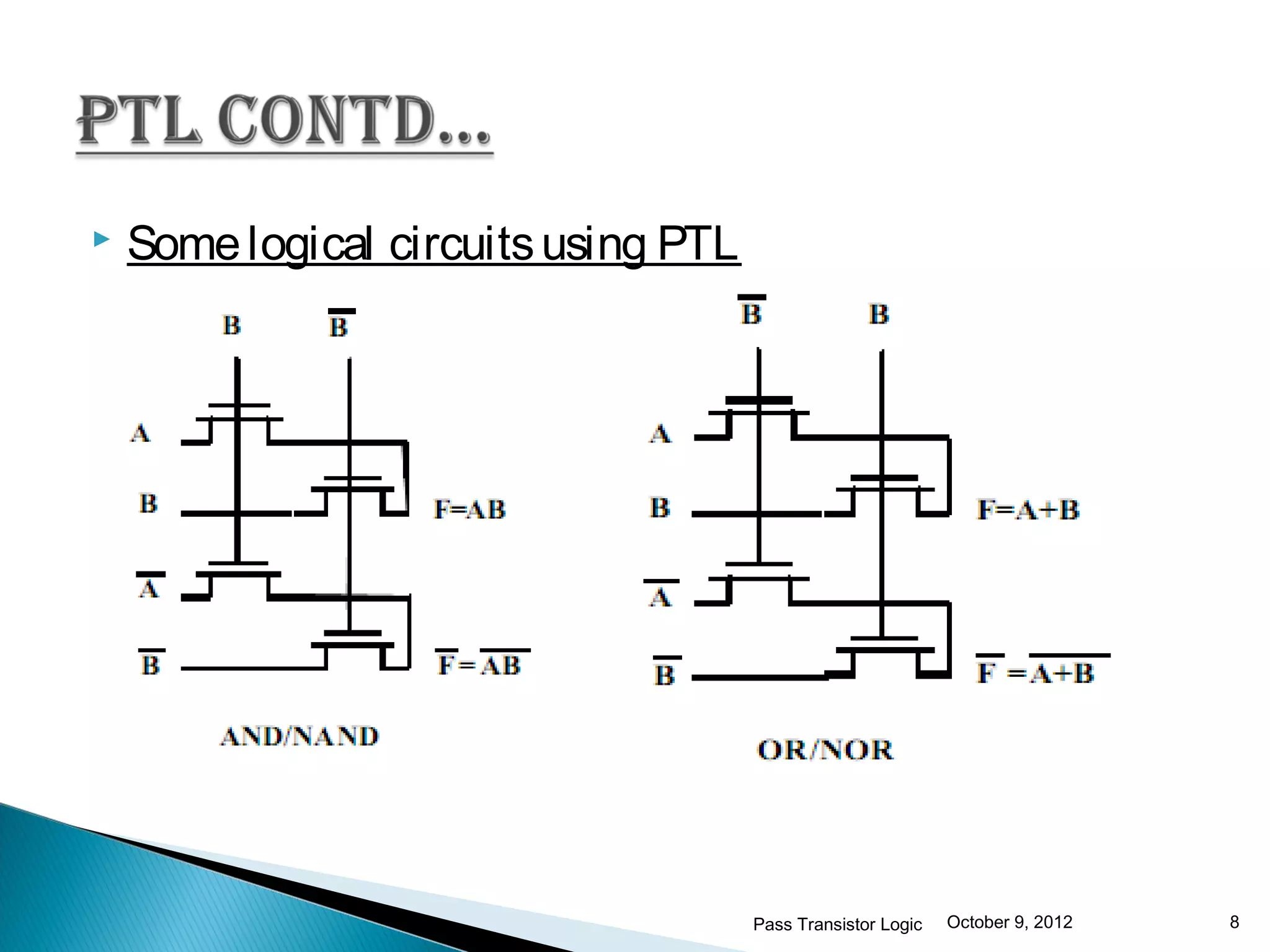
   Some logical circuits using PTL


                                      Pass Transistor Logic   October 9, 2012   8
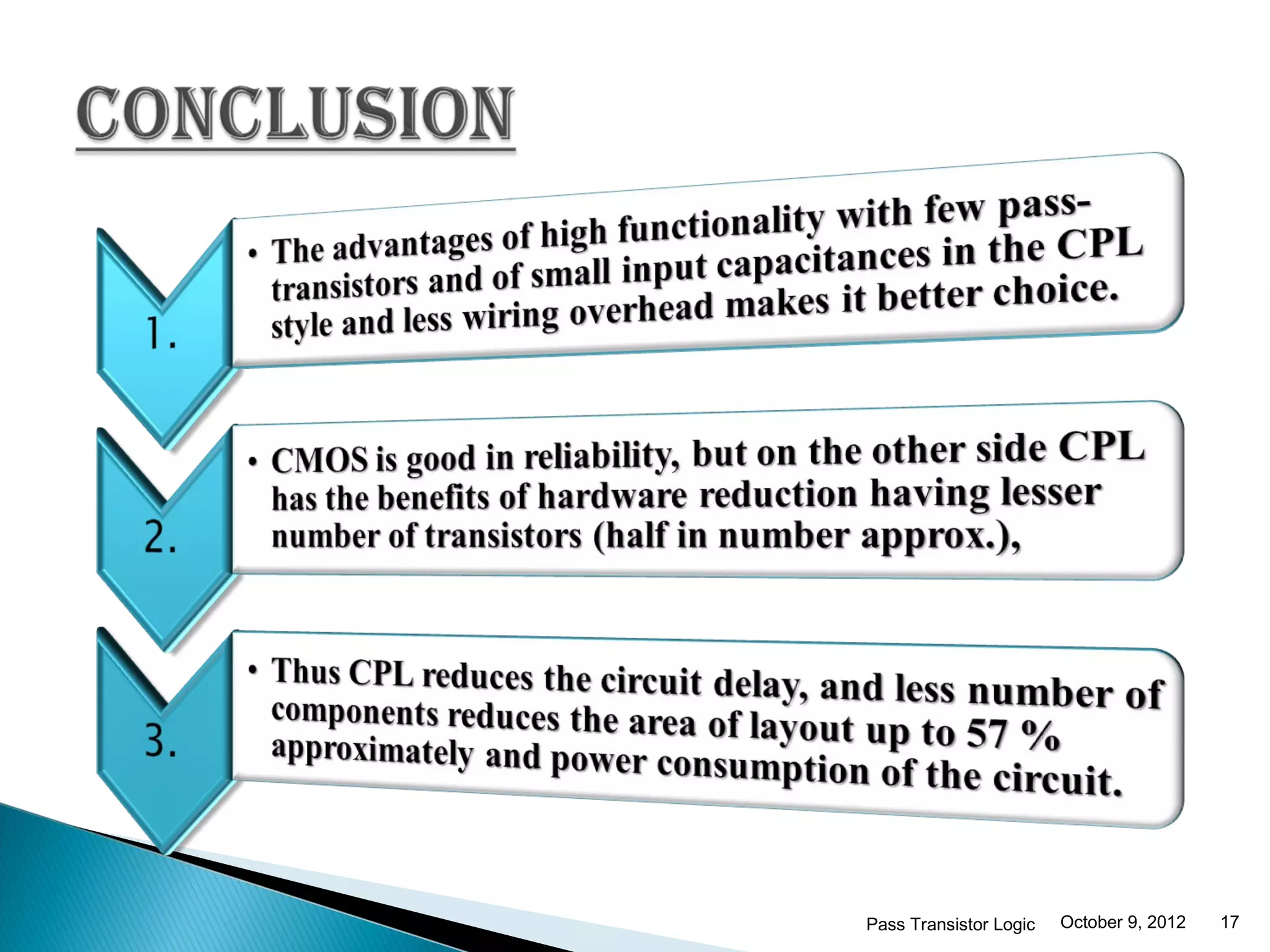
This paper compares the use of complementary pass-transistor
   logic (CPL) as more power-efficient than conventional CMOS
   design. However, new comparisons performed on more efficient
   CMOS circuit realizations and demonstrate CPL to be superior
   to conventional CMOS in most cases with respect to speed,
   area, and power-delay products. This is basically explained by
   the fact that CPL gates uses less transistors, have smaller
   capacitances, and are faster than gates in complementary
   CMOS. In this paper 2:1 Multiplexer is designed using the
   conventional CMOS design and CPL logic design and the
   results are compared using Microwind and DSCH2 CMOS
   layout tools.


October 9, 2012                                       Pass Transistor Logic   10
   VLSI (Very large scale integration) implementation.

      Major problems are heat dissipation and power consumptions.

      Solutions have been proposed to decrease the power supply
       voltage, switching frequency and capacitance of transistor.

      2:1 MUX by using CMOS and CPL on MICROWIND/
       DSCH2.


October 9, 2012                                           Pass Transistor Logic   11
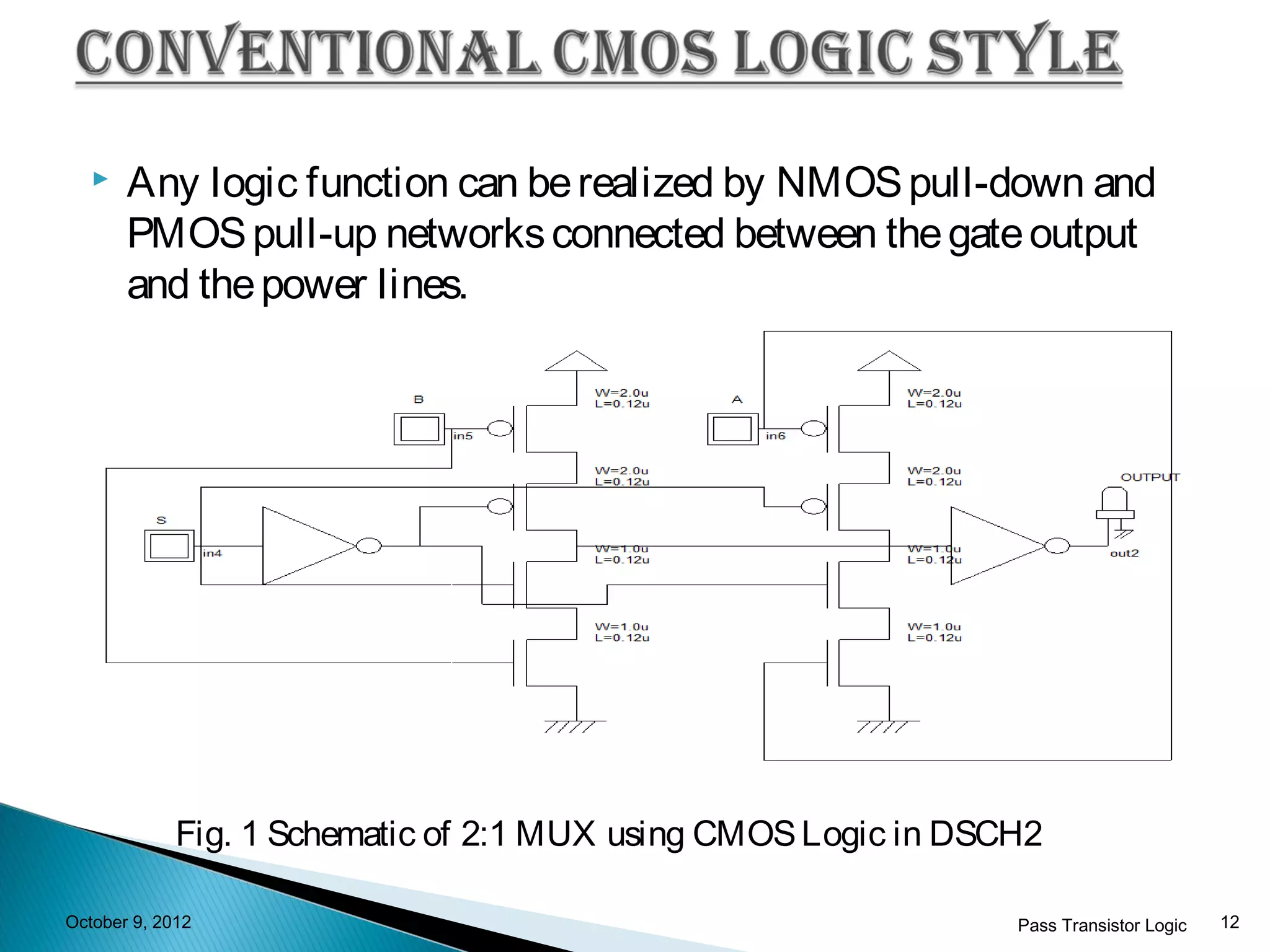
   Any logic function can be realized by NMOS pull-down and
       PMOS pull-up networks connected between the gate output
       and the power lines.


             Fig. 1 Schematic of 2:1 MUX using CMOS Logic in DSCH2

October 9, 2012                                                 Pass Transistor Logic   12
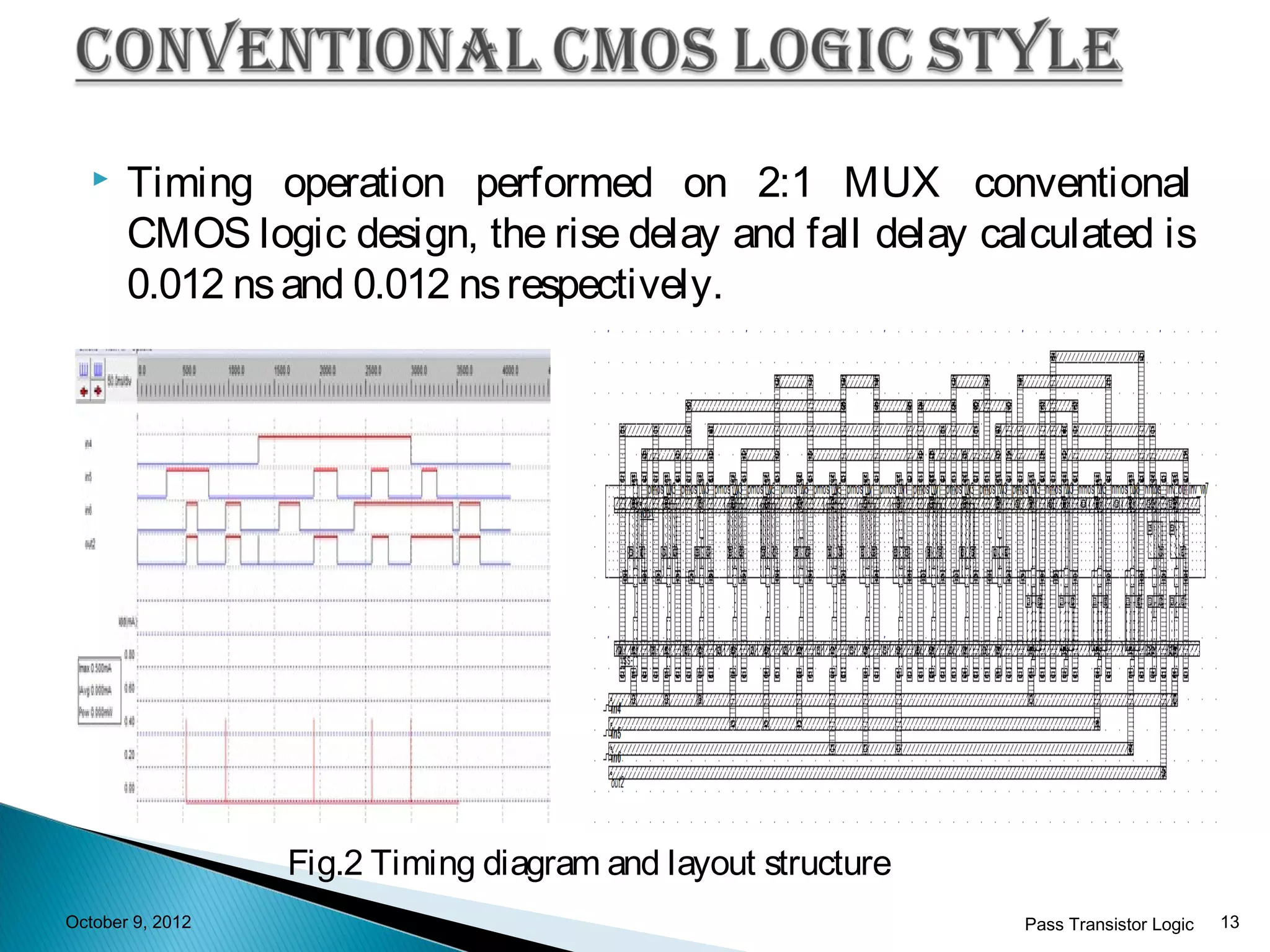
   Timing operation performed on 2:1 MUX conventional
       CMOS logic design, the rise delay and fall delay calculated is
       0.012 ns and 0.012 ns respectively.


                  Fig.2 Timing diagram and layout structure
October 9, 2012                                               Pass Transistor Logic   13
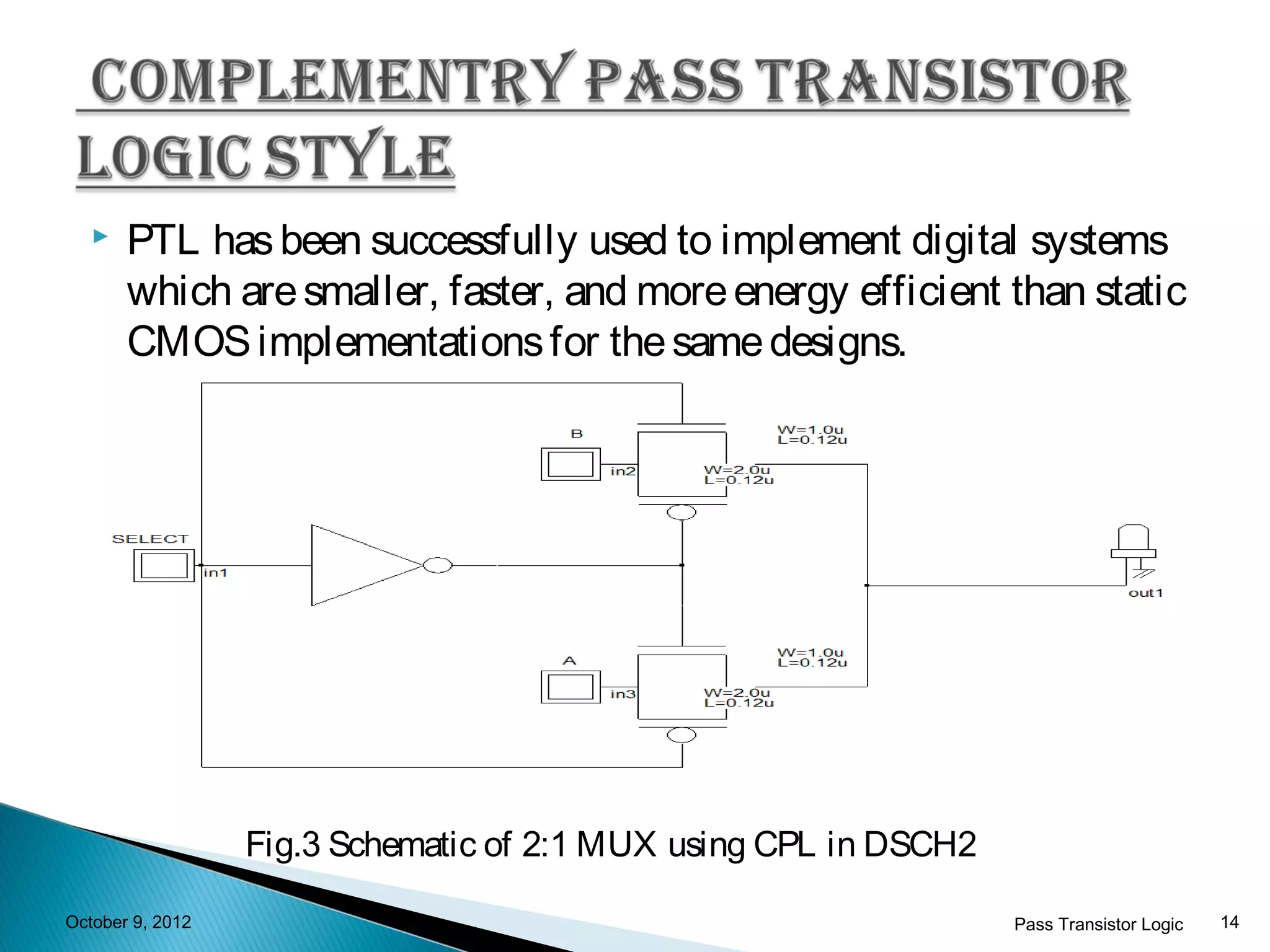
   PTL has been successfully used to implement digital systems
       which are smaller, faster, and more energy efficient than static
       CMOS implementations for the same designs.


                  Fig.3 Schematic of 2:1 MUX using CPL in DSCH2

October 9, 2012                                                   Pass Transistor Logic   14
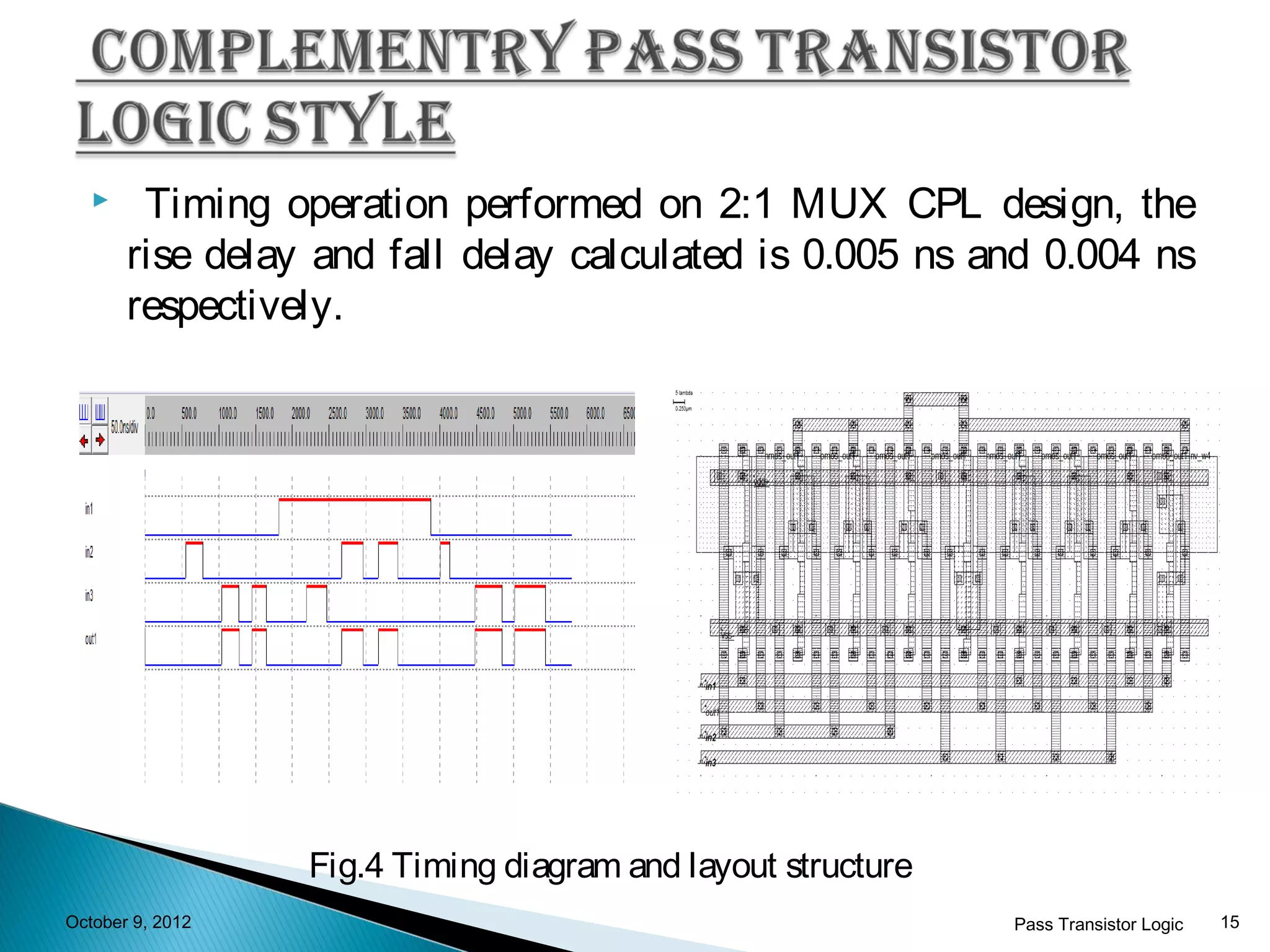
    Timing operation performed on 2:1 MUX CPL design, the
       rise delay and fall delay calculated is 0.005 ns and 0.004 ns
       respectively.


                  Fig.4 Timing diagram and layout structure
October 9, 2012                                               Pass Transistor Logic   15
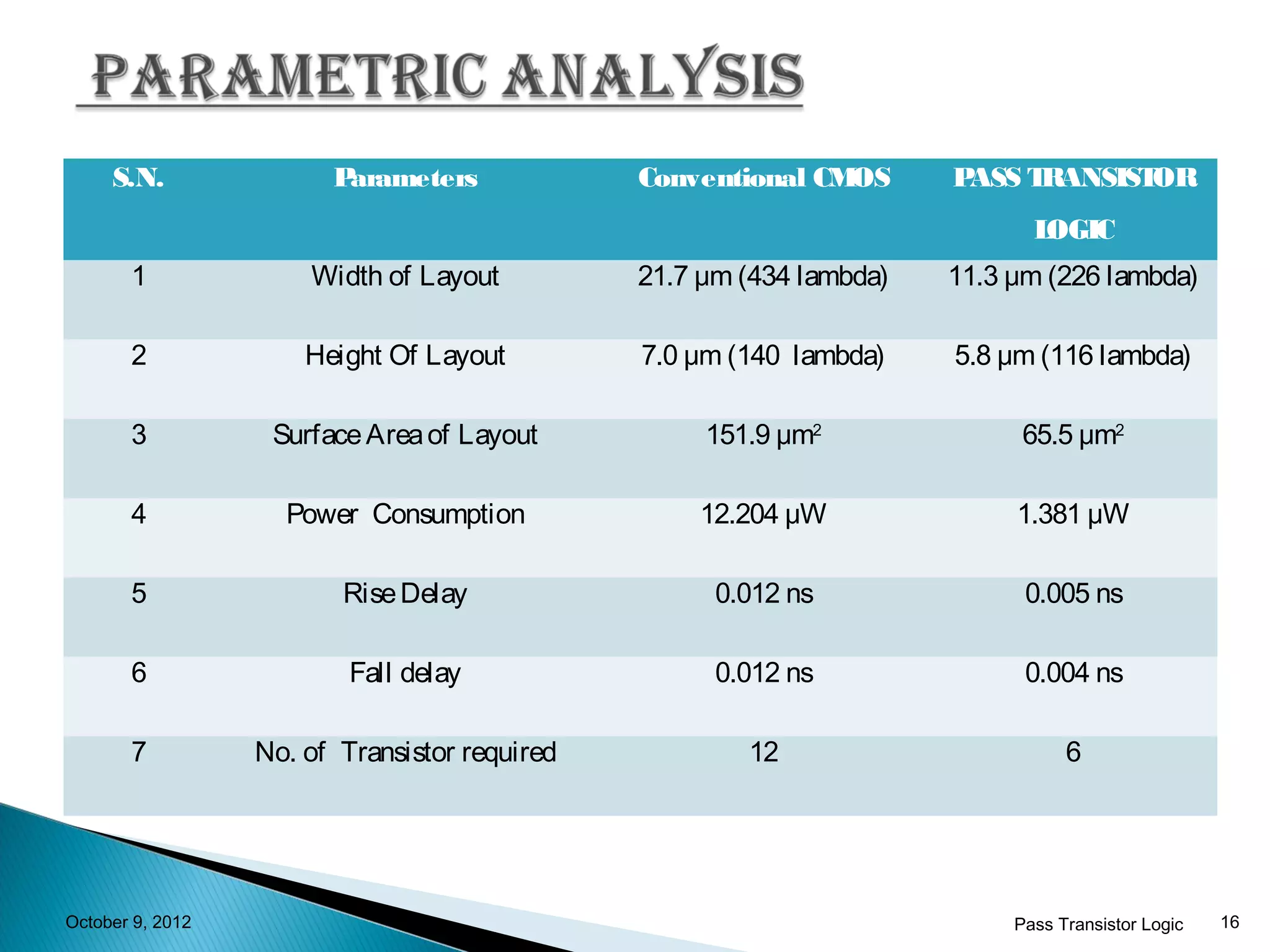
S.N.               Parameters             Conventional CMOS      PASS TRANSISTOR
                                                                             LOGIC
       1              Width of Layout          21.7 μm (434 lambda)   11.3 μm (226 lambda)

       2              Height Of Layout         7.0 μm (140 lambda)    5.8 μm (116 lambda)

       3           Surface Area of Layout           151.9 μm2               65.5 μm2

       4            Power Consumption              12.204 μW               1.381 μW

       5                 Rise Delay                  0.012 ns               0.005 ns

       6                  Fall delay                 0.012 ns               0.004 ns

       7          No. of Transistor required           12                        6


October 9, 2012                                                            Pass Transistor Logic   16
Pass Transistor Logic   October 9, 2012   17
   A. P. Chandrakasan and R. W. Brodersen , “ Low Power Digital CMOS
       Design, Kluwer, Norwell MA. 1995.

      Neil Weste, Harris & Banerjee, CMOS VLSI Design: A Circuits and
       Systems Perspective, 3rd Edition, Pearson Education, Boston, 2005, p1-16.

      Zimmermann, R.; Fichtner, W.; “ Low-Power Logic Styles: CMOS versus
       Pass-Transistor Logic” IEEE Transaction on Solid-State Circuits, Volume
       32, Page(s) 1079-1090, Publication Year: 1997.

      Microwind user manual and DSCH user manual. Retrieved February 2012
       from Microwind commercial website: http://www.microwind.net.

      Zhou, H.; Aziz, A.; “ Buffer Minimization in Pass Transistor Logic” , IEEE
       Transactions on Computer-Aided Design of Integrated Circuits and
       Systems, Volume 20, Page(s ) 693-697, May 2001.

October 9, 2012                                                      Pass Transistor Logic   18
Pass Transistor Logic   October 9, 2012   19
Pass Transistor Logic   October 9, 2012   20

Pass Transistor Logic

  • 1.
  • 2.
    IntroductIon.  AdvAntAges of usIng pAss trAnsIstor logIcs As compAred to conventIonAl cmos logIc.  lAb work relAted to pAss trAnsIstor logIc.  conclusIons. Pass Transistor Logic October 9, 2012 2
  • 3.
    In electronics pass transistor logic (PTL) describes several logic families used in the design of integrated circuits.  It reduces the count of transistors used to make different logic gates, by eliminating redundant transistors.  Disadvantage that output levels are always lower than the input level. Pass Transistor Logic October 9, 2012 3
  • 4.
    In conventional logic families input is applied to gate terminal of transistor but in PTL it is also applied to source /drain terminal.  These circuits act as switches use either NMOS transistors or parallel pair of NMOS and PMOS transistor called Transmission gate.  Here the width of PMOS is taken equal to NMOS so that both transistors can pass the signal simultaneously in parallel. Pass Transistor Logic October 9, 2012 4
  • 5.
    nMOS passes g=1 input ‘0’ Output Strong ‘0’ g g=1 input ‘1’ • strong ‘ 0’ Output weak ‘1’ • Weak ‘ 1 s d  pMOS passes g=0 input ‘0’ Output weak ‘0’ g • Strong ‘ 1’ g=0 input ‘1’ s d Output strong ‘1’ • Weak ‘ 0’ Pass Transistor Logic October 9, 2012 5
  • 6.
    pAss trAnsIstor logIc g g=0, gb=1 g=1, gb=0 Switch is open Switch is closed a b So when g=1 If input is ‘ 0’ then output will be strong ‘ 0’ . gb If input is ‘ 1’ then output will be strong ‘ 1’ Pass Transistor Logic October 9, 2012 6
  • 7.
     Fewer devicesto implement the logical functions as compared to CMOS.  Example AND gate. When B is “ 1” , top device turns on and copies the input A to output F. When B is low, bottom device turns on and passes a “ 0” . Pass Transistor Logic October 9, 2012 7
  • 8.
    Some logical circuits using PTL Pass Transistor Logic October 9, 2012 8
  • 10.
    This paper comparesthe use of complementary pass-transistor logic (CPL) as more power-efficient than conventional CMOS design. However, new comparisons performed on more efficient CMOS circuit realizations and demonstrate CPL to be superior to conventional CMOS in most cases with respect to speed, area, and power-delay products. This is basically explained by the fact that CPL gates uses less transistors, have smaller capacitances, and are faster than gates in complementary CMOS. In this paper 2:1 Multiplexer is designed using the conventional CMOS design and CPL logic design and the results are compared using Microwind and DSCH2 CMOS layout tools. October 9, 2012 Pass Transistor Logic 10
  • 11.
    VLSI (Very large scale integration) implementation.  Major problems are heat dissipation and power consumptions.  Solutions have been proposed to decrease the power supply voltage, switching frequency and capacitance of transistor.  2:1 MUX by using CMOS and CPL on MICROWIND/ DSCH2. October 9, 2012 Pass Transistor Logic 11
  • 12.
    Any logic function can be realized by NMOS pull-down and PMOS pull-up networks connected between the gate output and the power lines. Fig. 1 Schematic of 2:1 MUX using CMOS Logic in DSCH2 October 9, 2012 Pass Transistor Logic 12
  • 13.
    Timing operation performed on 2:1 MUX conventional CMOS logic design, the rise delay and fall delay calculated is 0.012 ns and 0.012 ns respectively. Fig.2 Timing diagram and layout structure October 9, 2012 Pass Transistor Logic 13
  • 14.
    PTL has been successfully used to implement digital systems which are smaller, faster, and more energy efficient than static CMOS implementations for the same designs. Fig.3 Schematic of 2:1 MUX using CPL in DSCH2 October 9, 2012 Pass Transistor Logic 14
  • 15.
    Timing operation performed on 2:1 MUX CPL design, the rise delay and fall delay calculated is 0.005 ns and 0.004 ns respectively. Fig.4 Timing diagram and layout structure October 9, 2012 Pass Transistor Logic 15
  • 16.
    S.N. Parameters Conventional CMOS PASS TRANSISTOR LOGIC 1 Width of Layout 21.7 μm (434 lambda) 11.3 μm (226 lambda) 2 Height Of Layout 7.0 μm (140 lambda) 5.8 μm (116 lambda) 3 Surface Area of Layout 151.9 μm2 65.5 μm2 4 Power Consumption 12.204 μW 1.381 μW 5 Rise Delay 0.012 ns 0.005 ns 6 Fall delay 0.012 ns 0.004 ns 7 No. of Transistor required 12 6 October 9, 2012 Pass Transistor Logic 16
  • 17.
    Pass Transistor Logic October 9, 2012 17
  • 18.
    A. P. Chandrakasan and R. W. Brodersen , “ Low Power Digital CMOS Design, Kluwer, Norwell MA. 1995.  Neil Weste, Harris & Banerjee, CMOS VLSI Design: A Circuits and Systems Perspective, 3rd Edition, Pearson Education, Boston, 2005, p1-16.  Zimmermann, R.; Fichtner, W.; “ Low-Power Logic Styles: CMOS versus Pass-Transistor Logic” IEEE Transaction on Solid-State Circuits, Volume 32, Page(s) 1079-1090, Publication Year: 1997.  Microwind user manual and DSCH user manual. Retrieved February 2012 from Microwind commercial website: http://www.microwind.net.  Zhou, H.; Aziz, A.; “ Buffer Minimization in Pass Transistor Logic” , IEEE Transactions on Computer-Aided Design of Integrated Circuits and Systems, Volume 20, Page(s ) 693-697, May 2001. October 9, 2012 Pass Transistor Logic 18
  • 19.
    Pass Transistor Logic October 9, 2012 19
  • 20.
    Pass Transistor Logic October 9, 2012 20