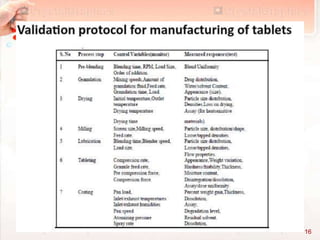
This document discusses validation of solid dosage forms such as tablets. It defines validation as establishing documented evidence that a process will consistently produce products meeting specifications. The major types of validation are prospective, concurrent, and retrospective. Product validation involves validating raw materials, analytical methods, equipment, process parameters, and finished product tests. Validation of tablets includes processes like mixing, wet granulation, drying, lubrication, compression, coating, and in-process and finished product testing. Process parameters that must be validated for each unit operation include equipment, material attributes, times, temperatures, and product quality tests.
Validation of SolidDosage Forms.
1
Supervised by:
Mr. Sourabh Jain
Assistant Professor,
Pharmaceutics
Submitted by:
Sunil Saini
M.pharm(P`ceutics)
Sem-1st
LACHOO MEMORIAL COLLEGE OF SCIENCE AND
TECHNOLOGY (PHARMACY WING)
JODHPUR
JAI NARAYAN VYAS UNIVERSITY, JODHPUR
2.
CONTENTS-
• INTRODUCTION
• TYPESOF PROCESS VALIDATION
• PRODUCT VALIDATION
• PHASES OF VALIDATION
• VALIDATION OF TABLETS
• CONCLUSION
2
3.
• DEFINITION-
• Validationis a key process for effective quality
assurance.
• “Validation is establishing documented evidence which
provides a high degree of assurances that a specific
process or equipment will consistently produce a
product or result meeting its predetermined
specifications and quality attributes.”
3
4.
The major reasonsfor validation are:
• Quality assurance:
Validation checks the accuracy and reliability of a system
or a process to meet the predetermined criteria. A successful
validation provides high degree of assurance that a consistent
level of quality is maintained in each unit of the finished
product from one batch to another batch.
• Economics:
Due to successful validation, there is a decrease in sampling
and testing procedures and there are less number of product
rejections and retesting. This leads to cost-saving benefits.
4
• Prospective validation:
-Conductedprior to market the product.
- Documented evidence which provides a high degree of
assurances that a specific process or equipment will
consistently produce a product meeting its predetermined
specifications and quality attributes.
• Concurrent validation:
Based on information generated during actual implementation
of the process.
Establishing documented evidence that the process is in a
state of control during the actual implementation of the
process. This normally performed by conducing in- process
testing.
Type of Process Validation-
6
7.
• Retrospective validation:
Allthe processes and subsystems should be validated ,which
have been used for the production of batches of numerical data
of both process and the end product testing of which are
included in retrospective validation.
7
8.
8
• Product validationis associated with validation of the full-
scale manufacture of numerous earlier aspects of product
development that are critical to the subsequent phases of the
process.
product validation involves following steps:
• validation of raw materials and excipients.
• analytical methods of validation.
• equipment and facility validation .
• process variables and limits.
PRODUCT VALIDATION
9.
• VALIDATION OFRAW MATERIALS AND EXCIPIENTS
•
validation of raw materials is one of the major causes of product
variation or deviation from specification. The API may represent
the most uncontrollable component in the complete product .
The validation process of solid dosage form begins with the
validation of raw materials ,both API and excipients.
preformulation is one of the critical step to be validated in
product validation
-Physical characters such as drug and particle size can affect
material flow and blend uniformity.
-Chemical characters like impurities can effect stability of drug.
The hygroscopic nature is important in both handling and
reproducibility of the manufacturing process.
9
10.
• VALIDATION OFEXCIPIENTS-
Excipients can represent less then 1% of a tablet formula
Factors to be aware of are
• The grade and source of the excipients
• Particle size and shape characteristics and
• Lot-to-lot variability
Microcrystalline cellulose(MCC) used as diluents shows significant
changes in the chemical composition, crystalinity, particle size b/w
different lots.
Differences in particle size of MCC can effect wet
granulation/blend uniformity of tablet formulation.
In direct compression formulations differences in particle size
distribution b/w lots can result in
• Non uniformity in initial mix
• Materials segregate during compression. 10
11.
EQUIPMENT VALIDATION -
Processequipment used in the development phase is assessed
relative to its suitability for large scale manufacture.
Alternate equipment s identified and evaluated and a final
decision rendered.
This protocol can be divided into
• Design qualification
• Installation qualification
• Operation qualification
• Performance qualification
• Maintaince (calibration, cleaning, repair) qualification
11
12.
• Design qualification(DQ):
Documented verification of the design of equipment and
manufacturing facilities.
• Installation qualification (IQ):
Documented verification of the system design and adherence
to manufacturer’s recommendations.
• Operational qualification (OQ):
Documented verification of equipment or system
performance in the target operating range.
PHASES OF VALIDATION-
12
13.
• Process performancequalification (PQ):
Documented verification that equipment system operates as
expected under routine production conditions. The operation is
reproducible, reliable and in a state of control
13
14.
PROCESS VARIABLES ANDLIMITS-
• Process validation can be defined as means of challenging a
process during devlopment to determine which variables can be
controlled to ensure the consistency production of a product or
intermediate.
• It is based on the concept that the processed employed has been
optimized, so that the data generated through the testing program
may be considered credible and evaluated for consistency as well
as relevance.
14
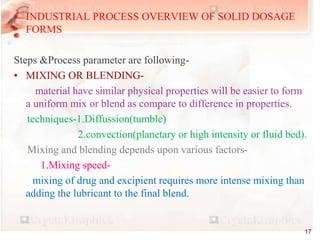
• INDUSTRIAL PROCESSOVERVIEW OF SOLID DOSAGE
FORMS
Steps &Process parameter are following-
• MIXING OR BLENDING-
material have similar physical properties will be easier to form
a uniform mix or blend as compare to difference in properties.
techniques-1.Diffussion(tumble)
2.convection(planetary or high intensity or fluid bed).
Mixing and blending depends upon various factors-
1.Mixing speed-
mixing of drug and excipient requires more intense mixing than
adding the lubricant to the final blend.
17
18.
2.Mixing Time-
depends onmixing technique and speed.
3.drug and excipient uniformity-
handling of material is key in obtaining valid content
uniformity results. Sample should be equivalent to the weight of
a single tablet.
4.equipment capacity -
the bulk density of material will affect the capacity of the
equipment.
18
19.
what type ofwet granulation to be used
LOW SHEAR
HIGH SHEAR
wet granulation parameters are
• Binder addition-
should be added as a granulating solution
• Binder conc-
if the binder conc is high it is not rejected by the spray nozzle
then the binder needs to be diluted
• Amount of binder solution-
too much binder solution can over wet the material and prolonged
drying time.
• Granulation end point-
determined by ammeter and wattmeter equipment.
WET GRANULATION-
19
20.
EQUIPMENTS-
Does the wetgranulation needs to break up the lumps and
enhance the drying of granulation
factors –
• screen size –
should be small enough to de lump the material.
• mill speed-
sufficient speed with out causing any staining to the
equipment.
• feed rate-
is interrelated to screen size, mill size and speed
WET MILLING-
20
21.
equipments
Drying is amost important step in the formulation and
development of pharmaceutical product. It is important to keep
the residual moisture low enough to prevent product
deterioration and ensure free flowing properties.
factors-
• Inlet/outlet temp-
inlet temp is set to high to minize drying with out effecting
physical/chemical parameters.
• Airflow-
insufficient air flow prolongs drying
• Moisture uniformity-
moisture content could vary in the granulation
• Equipment capacity-
high the load high moisture should be removed
DRYING-
21
22.
1.selection of lubricant-
shouldcompatible with other ingredient grade of lubricant
used
2.amount of lubricant-
too much lubrication will from hydrophobic layer resulting
dissolution problems.
3.mixing time-
if not mixed long enough problems like chipping, capping etc.
LUBRICATION-
22
23.
After the preparationof granules (in case of wet
granulation) or sized slugs (in case of dry granulation) or
mixing of ingredients (in case of direct compression), they are
compressed to get final product.
The compression is done either by single punch machine
(stamping press) or by multi station machine (rotary press).
factors-
• compression speed-
range of compression speed to determine the operating range
of the compressor.
• compression or ejection force-
determined optimal compression force to obtain the desired
tablet hardness.
TABLET COMPRESSION-
23
24.
EQUIPMENT
The following in-processtests should be examined during the
compression stage-
• Appearance
• Hardness
• Tablet weight
• Friability-0.5-1%
• Disintegration
• Weight uniformity
24
25.
Many solid pharmaceuticaldosage mediums are produced
with coatings, either on the external surface of tablets, or on
materials dispensed within gelatin capsules.
key areas –
• equipment type-
- coater will need to be selected.
- convectional or perforated pan and fluid bed coaters are
potential.
• pan speed-
interrelated with coating parameter like inlet temp, spray rate.
• spray rate-
too much spray rate leads to over wetting.
THE TABLET COATING PROCESS-
25
26.
APPERANCE TEST FORTABLET COATING-
•cracking or peeling of the tablet
•intagliation fill-in
•color uniformity
•coating efficiency should be determined for the coating
operation
26
27.
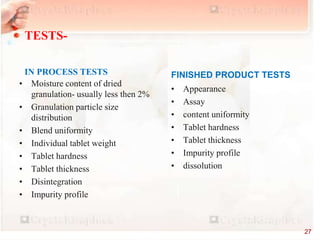
• Moisture contentof dried
granulation- usually less then 2%
• Granulation particle size
distribution
• Blend uniformity
• Individual tablet weight
• Tablet hardness
• Tablet thickness
• Disintegration
• Impurity profile
IN PROCESS TESTS
• Appearance
• Assay
• content uniformity
• Tablet hardness
• Tablet thickness
• Impurity profile
• dissolution
FINISHED PRODUCT TESTS
TESTS-
27