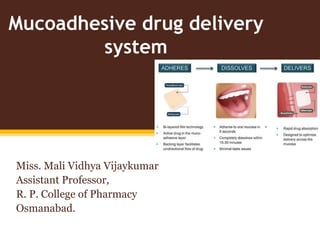

Mucoadhesive drug delivery
system
Miss. Mali Vidhya Vijaykumar
Assistant Professor,
R. P. College of Pharmacy
Osmanabad.
Contents
• Introduction
• What is mucoadhesive DDS
• Basics ,concepts & mucosal membrane.
• Need of mucoadhesive DDS
• Advantages & Disadvantages
• Different routes of mucoadhesion
• Mechanism of mucoadhesion
• Theories mucoadhesion
• Penetration enhancer
• Mucoadhesive polymer
• Factor affecting mucoadhesion
• Mucoadhesive dosage form
• Evaluation Tests
Introduction
• Since the early 1980,the concept of Mucoadhesion has gained
considerable interest in pharmaceutical technology.
• Combine mucoadhesive with enzyme inhibitory & penetration
enhancer properties & improve the patient complaince.
• MDDS have been devloped for buccal ,nasal,rectal & vaginal
routes for both systemic & local effects.
• Hydrophilic high mol. wt. such as peptides that cannot be
administered & poor absorption ,then MDDS is best choice.
What is mucoadhesive drug delivery
system ?
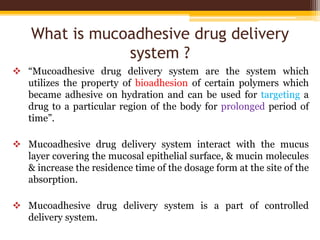
 “Mucoadhesive drug delivery system are the system which
utilizes the property of bioadhesion of certain polymers which
became adhesive on hydration and can be used for targeting a
drug to a particular region of the body for prolonged period of
time”.
 Mucoadhesive drug delivery system interact with the mucus
layer covering the mucosal epithelial surface, & mucin molecules
& increase the residence time of the dosage form at the site of the
absorption.
 Mucoadhesive drug delivery system is a part of controlled
delivery system.
Basics concepts & structure of mucosal
membrane.
Mucoadhesive inner layers called mucosa inner epithelial cell
lining is covered with viscoelasticfluid.
Composed of water and mucin.
Thickness varies from 40 μm to 300 μm.
General composition of mucus
 Water…………………………………..95%
 Glycoprotein and lipids……………..0.5-5%
 Mineral salts……………………………1%
 Free proteins…………………………..0.5-1%
 Protective : Particularly from its hydrophobicity.
 Barrier : In tissue absorption of the drugs and influence the
bioavailability.
 Adhesion : Mucus has strong cohesion properties.
 Lubrication :keep mucosal membrane moist.
Functions of mucus
Need of mucoadhesive DDS
WHY?
Avoidance
of
First pass
Metabolism
Localization
of drug at
given site
Prolong
residence time
Better absorption
of peptide by
penetration
enhancer
Reduction in
fluctuation of
CSS
Target &
localized drug
delivery
Avoidance of
drug degradation
Controlled release
Advantages
› A prolonged residence time at the site of drug action or
absorption.
› An increase in the drug concentration gradient due to the
intense contact of particle with the mucosal.
› Systemic absorption is rapid.
› Targeting & localization of the dosage form at a specific site.
› Painless administration.
› Low enzymatic activity & avoid of first pass metabolism.
› Less dosing frequency.
› Shorter treatment period.
› Increased safety margin of high potency drugs due to better
control of plasma levels.
› Improved patient convenience and compliance due to less
frequent drug administration.
Disadvantages
1. If MDDS are adhere too tightly because it is undesirable to
exert too much force to remove the formulation after use,
otherwise the mucosa could be injured.
2. Some patient suffers unpleasant feeling.
3. Unfortunately ,the lack of standardized techniques often leads
to unclear results.
4. costly drug delivery system.
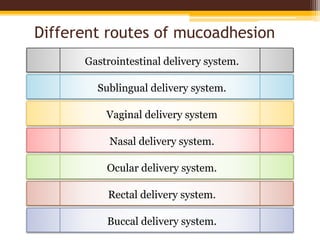
Different routes of mucoadhesion
Nasal delivery system.
Ocular delivery system.
Rectal delivery system.
Buccal delivery system.
Vaginal delivery system
Sublingual delivery system.
Gastrointestinal delivery system.
Mechanism of mucoadhesion
The mechanism responsible in the formation of mucoadhesive
bond include two stages:
1. Contact stage
2. Consolidation stage
Mechanism of mucoadhesion
• Step 1 : Wetting and swelling of the polymer (contact stage).
• Step 2 : Interpenetration between the polymer chains and the
mucosal membrane.
• Step 3 : Formation of bonds between the entangled chains
(consolidation stage).
Step-I
 Wetting and swelling step occurs when polymer spreads over
the surface of mucosal membrane to develop intimate contact.
 Swelling of polymer occur because the components of polymer
have an affinity for water.
• Mucosal surface composed of high
mol. Wt polymer Glycoproteins.
• In this step the interdiffusion and
interpenetration of mucoadhesive
polymer chain and the mucosal
polymer chains occurs and they
entangles to form adhesive bonds.
• Strength of bonds depends upon the
degree of penetration of the two
polymer groups.
Step-II
Step-III
 This step involves formation of weak
chemical bonds between the entangled
polymer chains.
 Bonds includes primary bonds such as
covalent bonds and secondary
interactions such as van der Waals and
hydrogen bonds.
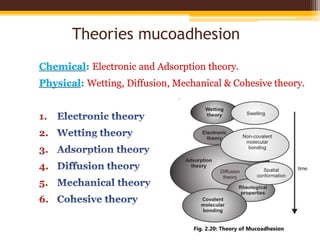
Theories mucoadhesion
Chemical: Electronic and Adsorption theory.
Physical: Wetting, Diffusion, Mechanical & Cohesive theory.
1.
2.
3.
4.
5.
6.
Theories mucoadhesion
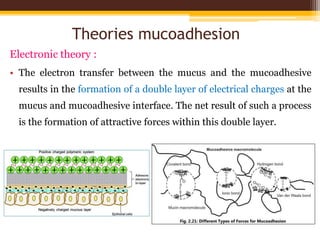
Electronic theory :
• The electron transfer between the mucus and the mucoadhesive
results in the formation of a double layer of electrical charges at the
mucus and mucoadhesive interface. The net result of such a process
is the formation of attractive forces within this double layer.
Wetting theory :
• States that if the contact angle of liquids on the substrate surface is
lower then there is greater affinity for the liquid to the substrate
surface.
• Ability of bioadhesive polymers to spread & develop intimate contact
with the mucous membrane.
Theories mucoadhesion
Adsorption theory :
• Adhesion occurs due to surface forces acting between the atoms
present in two different surfaces.
• Two type of chemical bonds resulting from these forces.
( primary : covalent bond, secondary: ionic bond, hydrogen bond
& van der waals forces).
Theories mucoadhesion
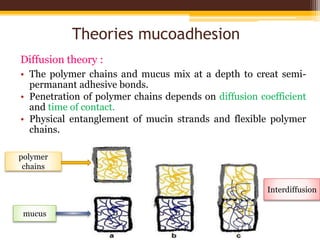
Diffusion theory :
• The polymer chains and mucus mix at a depth to creat semi-
permanant adhesive bonds.
• Penetration of polymer chains depends on diffusion coefficient
and time of contact.
• Physical entanglement of mucin strands and flexible polymer
chains.
polymer
chains
mucus
Interdiffusion
Theories mucoadhesion
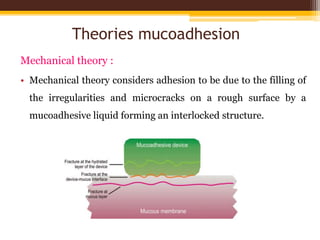
Mechanical theory :
• Mechanical theory considers adhesion to be due to the filling of
the irregularities and microcracks on a rough surface by a
mucoadhesive liquid forming an interlocked structure.
Theories mucoadhesion
Cohesive theory :
• States that process of bioadhesion occurs due to
intermolecular interactions amongst like-molecules within
two different layers.
Penetration enhancer
 Substances that facilitate the permeation through mucosa
are referred as permeation enhancers .
 Safe and non toxic, non irritating and non allergenic
Pharmacologically and chemically inert.
 They should have no pharmacological activity within the
body.
 Eg. Benzalkonium chloride , Dextran sulfate ,Fatty acid ,
Propyleneglycol, Sodium EDTA etc.
Mucoadhesive polymer
They are water soluble and water insoluble polymers which are
swellable networks joined by cross linking agent.
Characteristic of ideal polymer
o Degradation products should be non toxic and non
absorbable from GIT.
o Good spreadibility, wetting, swelling and biodegradable
properties.
o Optimum molecular weight.
o Non irritant to mucous membrane.
o Form a strong non-covalent bond with mucin epithelial cell
surface.
Factor affecting mucoadhesion
A) Polymer related factors:
• Molecular weight
• Conc. of polymer
• Flexibility of polymer chains
• Presence of functional group
• Spatial conformation
• Cross linking density
B) Environment related factors:
• pH of polymer substrate interface
• Applied strength
C) Physiological factors:
• Mucin turn over
• Disease state
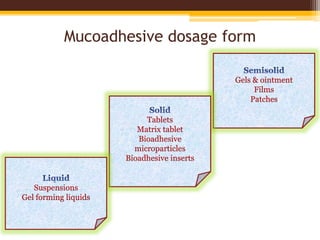
Mucoadhesive dosage form
Gels & ointment
Films
Patches
Tablets
Matrix tablet
Bioadhesive
microparticles
Bioadhesive inserts
Suspensions
Gel forming liquids
Evaluation Tests
A) In vitro/ Ex vivo methods
• Methods determining tensile strength
• Methods determining shear stress
• Adhesion weight method
• Fluorescent probe method
• Flow channel method
• Mechanical spectroscopic method
• Filling liquid film method
• Colloidal gold staining method
• Viscometer method
• Thumb method
• Adhesion number
• Electrical conductance
• Swelling properties
• In vitro drug release studies
• Muco retentability studies
B) In Vivo methods
• Use of radioisotopes
• Use of gamma scintigraphy
• Use of pharmacoscintigraphy
• Use of electron paramagnetic
resonance
•(EPR) oximetry
Applications
 for treatment of diseases like; hepatitis, influenza,
pertussis (whooping cough), ricin toxoid, diphtheria, birth control.
 Microsphere in vaccine delivery have specific application like improved
antigenicity by adjuvant action, modulation of antigen release,
stabilization of antigen.
 of leaky tumour vessels, active targeting of tumour
cells, antigens, by intravenous /intra-arterial application.
 ( an endovascular therapy) involves selective
arterial embolization of tumour along with local delivery of
chemotherapeutic agent.
Applications
 various cells, cell lines, tissues and organs can be
imaged using radio labelled microspheres.
 Release of and peptides over extended
period of time.
 at particular site of action.
 DNA plasmids and also delivery of insulin.

 .
Questions
1. What is mucoadhesive DDS.
2. Write down the reasons behind designing of MDDS.
3. Explain the Singer nicolson model for the mucosal membrane.
4. Write down the general composition and functions of mucosal
membrane
5. Explain the theories of mucoadhesion.
6. Write down the advantages and disadvantages of MDDS.
7. Explain the mechanism of mucoadhesion.
8. Write a short note on mucoadhesive polymers.
9. Enlist the different mucoadhesive dosage forms.
10. Write down the applications of MDDS.
Thank You……!!!

Mucoadhesive drug delivery system Mali vv ppt

  • 1.
    Mucoadhesive drug delivery system Miss.Mali Vidhya Vijaykumar Assistant Professor, R. P. College of Pharmacy Osmanabad.
  • 2.
    Contents • Introduction • Whatis mucoadhesive DDS • Basics ,concepts & mucosal membrane. • Need of mucoadhesive DDS • Advantages & Disadvantages • Different routes of mucoadhesion • Mechanism of mucoadhesion • Theories mucoadhesion • Penetration enhancer • Mucoadhesive polymer • Factor affecting mucoadhesion • Mucoadhesive dosage form • Evaluation Tests
  • 3.
    Introduction • Since theearly 1980,the concept of Mucoadhesion has gained considerable interest in pharmaceutical technology. • Combine mucoadhesive with enzyme inhibitory & penetration enhancer properties & improve the patient complaince. • MDDS have been devloped for buccal ,nasal,rectal & vaginal routes for both systemic & local effects. • Hydrophilic high mol. wt. such as peptides that cannot be administered & poor absorption ,then MDDS is best choice.
  • 4.
    What is mucoadhesivedrug delivery system ?  “Mucoadhesive drug delivery system are the system which utilizes the property of bioadhesion of certain polymers which became adhesive on hydration and can be used for targeting a drug to a particular region of the body for prolonged period of time”.  Mucoadhesive drug delivery system interact with the mucus layer covering the mucosal epithelial surface, & mucin molecules & increase the residence time of the dosage form at the site of the absorption.  Mucoadhesive drug delivery system is a part of controlled delivery system.
  • 5.
    Basics concepts &structure of mucosal membrane. Mucoadhesive inner layers called mucosa inner epithelial cell lining is covered with viscoelasticfluid. Composed of water and mucin. Thickness varies from 40 μm to 300 μm.
  • 6.
    General composition ofmucus  Water…………………………………..95%  Glycoprotein and lipids……………..0.5-5%  Mineral salts……………………………1%  Free proteins…………………………..0.5-1%  Protective : Particularly from its hydrophobicity.  Barrier : In tissue absorption of the drugs and influence the bioavailability.  Adhesion : Mucus has strong cohesion properties.  Lubrication :keep mucosal membrane moist. Functions of mucus
  • 7.
    Need of mucoadhesiveDDS WHY? Avoidance of First pass Metabolism Localization of drug at given site Prolong residence time Better absorption of peptide by penetration enhancer Reduction in fluctuation of CSS Target & localized drug delivery Avoidance of drug degradation Controlled release
  • 8.
    Advantages › A prolongedresidence time at the site of drug action or absorption. › An increase in the drug concentration gradient due to the intense contact of particle with the mucosal. › Systemic absorption is rapid. › Targeting & localization of the dosage form at a specific site. › Painless administration. › Low enzymatic activity & avoid of first pass metabolism. › Less dosing frequency. › Shorter treatment period. › Increased safety margin of high potency drugs due to better control of plasma levels. › Improved patient convenience and compliance due to less frequent drug administration.
  • 9.
    Disadvantages 1. If MDDSare adhere too tightly because it is undesirable to exert too much force to remove the formulation after use, otherwise the mucosa could be injured. 2. Some patient suffers unpleasant feeling. 3. Unfortunately ,the lack of standardized techniques often leads to unclear results. 4. costly drug delivery system.
  • 10.
    Different routes ofmucoadhesion Nasal delivery system. Ocular delivery system. Rectal delivery system. Buccal delivery system. Vaginal delivery system Sublingual delivery system. Gastrointestinal delivery system.
  • 11.
    Mechanism of mucoadhesion Themechanism responsible in the formation of mucoadhesive bond include two stages: 1. Contact stage 2. Consolidation stage
  • 12.
    Mechanism of mucoadhesion •Step 1 : Wetting and swelling of the polymer (contact stage). • Step 2 : Interpenetration between the polymer chains and the mucosal membrane. • Step 3 : Formation of bonds between the entangled chains (consolidation stage).
  • 13.
    Step-I  Wetting andswelling step occurs when polymer spreads over the surface of mucosal membrane to develop intimate contact.  Swelling of polymer occur because the components of polymer have an affinity for water.
  • 14.
    • Mucosal surfacecomposed of high mol. Wt polymer Glycoproteins. • In this step the interdiffusion and interpenetration of mucoadhesive polymer chain and the mucosal polymer chains occurs and they entangles to form adhesive bonds. • Strength of bonds depends upon the degree of penetration of the two polymer groups. Step-II
  • 15.
    Step-III  This stepinvolves formation of weak chemical bonds between the entangled polymer chains.  Bonds includes primary bonds such as covalent bonds and secondary interactions such as van der Waals and hydrogen bonds.
  • 16.
    Theories mucoadhesion Chemical: Electronicand Adsorption theory. Physical: Wetting, Diffusion, Mechanical & Cohesive theory. 1. 2. 3. 4. 5. 6.
  • 17.
    Theories mucoadhesion Electronic theory: • The electron transfer between the mucus and the mucoadhesive results in the formation of a double layer of electrical charges at the mucus and mucoadhesive interface. The net result of such a process is the formation of attractive forces within this double layer.
  • 18.
    Wetting theory : •States that if the contact angle of liquids on the substrate surface is lower then there is greater affinity for the liquid to the substrate surface. • Ability of bioadhesive polymers to spread & develop intimate contact with the mucous membrane. Theories mucoadhesion
  • 19.
    Theories mucoadhesion Adsorption theory: • Adhesion occurs due to surface forces acting between the atoms present in two different surfaces. • Two type of chemical bonds resulting from these forces. ( primary : covalent bond, secondary: ionic bond, hydrogen bond & van der waals forces).
  • 20.
    Theories mucoadhesion Diffusion theory: • The polymer chains and mucus mix at a depth to creat semi- permanant adhesive bonds. • Penetration of polymer chains depends on diffusion coefficient and time of contact. • Physical entanglement of mucin strands and flexible polymer chains. polymer chains mucus Interdiffusion
  • 21.
    Theories mucoadhesion Mechanical theory: • Mechanical theory considers adhesion to be due to the filling of the irregularities and microcracks on a rough surface by a mucoadhesive liquid forming an interlocked structure.
  • 22.
    Theories mucoadhesion Cohesive theory: • States that process of bioadhesion occurs due to intermolecular interactions amongst like-molecules within two different layers.
  • 23.
    Penetration enhancer  Substancesthat facilitate the permeation through mucosa are referred as permeation enhancers .  Safe and non toxic, non irritating and non allergenic Pharmacologically and chemically inert.  They should have no pharmacological activity within the body.  Eg. Benzalkonium chloride , Dextran sulfate ,Fatty acid , Propyleneglycol, Sodium EDTA etc.
  • 24.
    Mucoadhesive polymer They arewater soluble and water insoluble polymers which are swellable networks joined by cross linking agent. Characteristic of ideal polymer o Degradation products should be non toxic and non absorbable from GIT. o Good spreadibility, wetting, swelling and biodegradable properties. o Optimum molecular weight. o Non irritant to mucous membrane. o Form a strong non-covalent bond with mucin epithelial cell surface.
  • 25.
    Factor affecting mucoadhesion A)Polymer related factors: • Molecular weight • Conc. of polymer • Flexibility of polymer chains • Presence of functional group • Spatial conformation • Cross linking density B) Environment related factors: • pH of polymer substrate interface • Applied strength C) Physiological factors: • Mucin turn over • Disease state
  • 26.
    Mucoadhesive dosage form Gels& ointment Films Patches Tablets Matrix tablet Bioadhesive microparticles Bioadhesive inserts Suspensions Gel forming liquids
  • 27.
    Evaluation Tests A) Invitro/ Ex vivo methods • Methods determining tensile strength • Methods determining shear stress • Adhesion weight method • Fluorescent probe method • Flow channel method • Mechanical spectroscopic method • Filling liquid film method • Colloidal gold staining method • Viscometer method • Thumb method • Adhesion number • Electrical conductance • Swelling properties • In vitro drug release studies • Muco retentability studies B) In Vivo methods • Use of radioisotopes • Use of gamma scintigraphy • Use of pharmacoscintigraphy • Use of electron paramagnetic resonance •(EPR) oximetry
  • 28.
    Applications  for treatmentof diseases like; hepatitis, influenza, pertussis (whooping cough), ricin toxoid, diphtheria, birth control.  Microsphere in vaccine delivery have specific application like improved antigenicity by adjuvant action, modulation of antigen release, stabilization of antigen.  of leaky tumour vessels, active targeting of tumour cells, antigens, by intravenous /intra-arterial application.  ( an endovascular therapy) involves selective arterial embolization of tumour along with local delivery of chemotherapeutic agent.
  • 29.
    Applications  various cells,cell lines, tissues and organs can be imaged using radio labelled microspheres.  Release of and peptides over extended period of time.  at particular site of action.  DNA plasmids and also delivery of insulin.   .
  • 30.
    Questions 1. What ismucoadhesive DDS. 2. Write down the reasons behind designing of MDDS. 3. Explain the Singer nicolson model for the mucosal membrane. 4. Write down the general composition and functions of mucosal membrane 5. Explain the theories of mucoadhesion. 6. Write down the advantages and disadvantages of MDDS. 7. Explain the mechanism of mucoadhesion. 8. Write a short note on mucoadhesive polymers. 9. Enlist the different mucoadhesive dosage forms. 10. Write down the applications of MDDS.
  • 31.