LiposomesLiposomes
Supervised by :
Dr. Roshan Isarani
H.O.D of Pharmaceutics
Submitted by:
Sunil
M.pharm(P`ceutics)
Sem-2nd
LACHOO MEMORIAL COLLEGE OF SCIENCE AND
TECHNOLOGY (PHARMACY WING)
JODHPUR
JAI NARAYAN VYAS UNIVERSITY, JODHPUR
1
OUTLINE
• liposomes
• Basic liposome structure.
• Structural Components of Liposomes
• Advantages of liposomes.
• Classification of liposomes.
• Preparation of liposomes.
• Evaluation of liposomes
• Applications
2
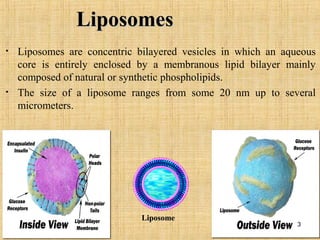
• Liposomes are concentric bilayered vesicles in which an aqueous
core is entirely enclosed by a membranous lipid bilayer mainly
composed of natural or synthetic phospholipids.
• The size of a liposome ranges from some 20 nm up to several
micrometers.
LiposomesLiposomes
LiposomeLiposome
3
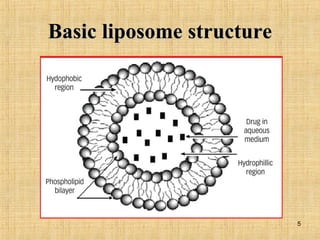
• The lipid molecules are usually phospholipids- amphipathic moieties
with a hydrophilic head group and two hydrophobic tails.
• On addition of excess water, such lipid moieties spontaneously
originate to give the most thermodynamically stable conformation.
• In which polar head groups face outwards into the aqueous medium,
and the lipid chains turns inwards to avoid the water phase, giving rise
to double layer or bilayer lamellar structures.
4
Basic liposome structureBasic liposome structure
5
LamellaLamella
• A Lamella is a flat plate like structure that appears
during the formation of liposomes. The phospholipids
bilayer first exists as a lamella before getting converted into
spheres.
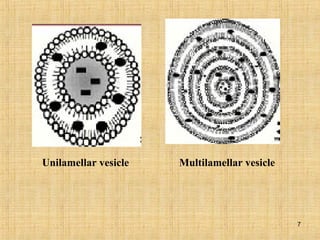
• Several lamella of phospholipids bilayers are stacked
one on top of the other during formation of liposomes
to form a multilamellar structure.
6
Multilamellar vesicleUnilamellar vesicle
7
Structural Components ofStructural Components of
LiposomesLiposomes
• The main components of liposomes are :-
1. Phospholipids
2. Cholesterol
8
PhospholipidsPhospholipids
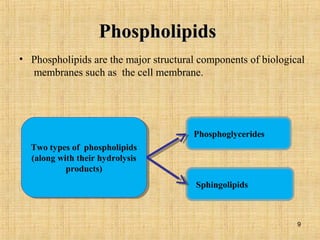
• Phospholipids are the major structural components of biological
membranes such as the cell membrane.
Phosphoglycerides
Two types of phospholipids
(along with their hydrolysis
products)
Two types of phospholipids
(along with their hydrolysis
products)
Sphingolipids
9
PhosphatidylcholinePhosphatidylcholine
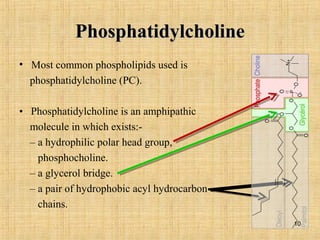
• Most common phospholipids used is
phosphatidylcholine (PC).
• Phosphatidylcholine is an amphipathic
molecule in which exists:-
– a hydrophilic polar head group,
phosphocholine.
– a glycerol bridge.
– a pair of hydrophobic acyl hydrocarbon
chains.
10
Generally phospholipids are
represented as follows:-
11
CholesterolCholesterol
• Cholesterol by itself does not form bilayer structure.
• Cholesterol act as fluidity buffer
• After intercalation with phospholipid molecules alter the
freedom of motion of carbon molecules in the acyl chain
• Restricts the transformations of trans to gauche conformations
• Cholesterol incorporation increases the separation between
choline head group & eliminates normal electrostatic &
hydrogen bonding interactions
12
Advantages of liposomesAdvantages of liposomes
• Provides selective passive targeting to tumor tissues.
• Increased efficacy and therapeutic index.
• Increased stability of encapsulated drug.
• Reduction in toxicity of the encapsulated agent.
• Site avoidance effect (avoids non-target tissues).
• Improved pharmacokinetic effects (reduced elimination 
increased circulation life times).
• Flexibility to couple with site specific ligands to achieve 
active targetting.  
13
DisadvantagesDisadvantages
• Physical/ chemical stability
• Very high production cost
• Drug leakage/ entrapment/ drug fusion
• Sterilization 
• Short  biological activity / t ½
• Oxidation of bilayer phospholipids and low solubility
• Rate of release  and altered bio distribution
• Low therapeutic index and dose effectiveness
• Overcoming resistance
• Extensive clinical and laboratory research to a certain long 
circulating liposomes
• Repeated iv administration problems
14
Classification of liposomesClassification of liposomes
MLV
Multilamellar
Large
vesicles
(>0.5 um)
OLV
oligolamellar
vesicles
(>0.1-1.0 um)
UV Unilamellar
Vesicles (all
size ranges)
MVV
Multivesicular
vesicles
(> 1.0 um)
MUV Medium Unilamellar
Vesicles
GUV Giant Unilamellar Vesicles
>1um
SUV Small Unilamellar
Vesicles
20-100nm
LUV Large Unilamellar
Vesicles
>100nm
Based on structural parameters
15
16
Preparation of liposomesPreparation of liposomes
Methods of liposome
preparation
Passive loading:
Involves loading of
the entrapped agents before or dur
ing the
manufacturing procedure.
Active or remote loading:
Certain types of compounds with
ionisable groups
and those with both manufacturing
procedure lipid and water
solubility can be
introduced into the liposomes
after the
formation of the intact vesicles 17
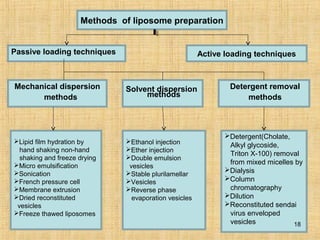
Methods  of liposome preparation
 
Solvent dispersion 
 methods
Ethanol injection
Ether injection
Double emulsion
vesicles
Stable plurilamellar
Vesicles
Reverse phase
evaporation vesicles
 Detergent removal
 methods
 
Passive loading techniques
Detergent(Cholate,
Alkyl glycoside,
Triton X-100) removal
from mixed micelles by
Dialysis
Column
chromatography
Dilution
Reconstituted sendai
virus enveloped
vesicles
Active loading techniques
Lipid film hydration by
hand shaking non-hand
shaking and freeze drying
Micro emulsification
Sonication
French pressure cell
Membrane extrusion
Dried reconstituted
vesicles
Freeze thawed liposomes
Mechanical dispersion
 
   methods
 
18
Evaluation of liposomesEvaluation of liposomes
The liposomes prepared by various techniques are to be evaluated
for their physical properties, has these influence the behavior of
liposomes in vivo.
Physical properties
1. Particle size
Both particle size and particle size distribution of liposomes
influence their physical stability. These can be determined by the
following method.
a) Laser light scattering
b) Transmission electron microscopy
19
2. Surface charge
The positive, negative or neutral charge on the surface of the
liposomes is due to the composition of the head groups.
The surface charge of liposomes governs the kinetic and extent of
distribution in vivo, as well as interaction with the target cells.
The method involved in the measurement of surface charge is
based on free-flow electrophoresis of MLVs.
• It utilizes a cellulose acetate plate dipped in sodium borate buffer
of pH 8.8.
• About 5N moles of lipid samples are applied on to the plate,
which is then subjected to electrophoresis at 4 ͦ c for 30 mins.
• The liposomes get bifurcated depending on their surface charge.
This technique can be used for determining the heterogeneity of
charges in the liposome suspension as well as to detect any
impurities such as fatty acids.
20
3. Percent drug encapsulated.
• Quantity of drug entrapped in the liposomes helps to estimate the
behavior of the drug in biological system
• Liposomes are mixture of encapsulated and unencapsulated drug
fractions
• The % of drug encapsulation is done by first separating the free
drug fraction from encapsulated drug fraction
• The encapsulated fraction is then made to leak off the liposome
into aqueous solution using suitable detergents
• The methods used to separate the free drug from the sample are:
a. Mini column centrifugation method
b. Protamine aggregated method
21
4. Phase behavior
• At transition temperature liposomes undergo reversible phase
transition
• The transition temperature is the indication of stability
permeability and also indicates the region of drug entrapment
• Done by DSC
5. Drug Release Rate
The rate of drug release from the liposomes can be determined
by in vivo assays which helps to predict the pharmacokinetics
and bioavailability of the drug. However in vivo studies are
found to be more complete.
Liposome encapsulating the tracer [ H] insulin are employed forᵌ
the study. This [ H] insulin is preferred, as it is released onlyᵌ
in the ECF and undergoes rapid renal excretion of the face
tracer coupled to the degradation rate constant o the tracer
released from the liposomes. 22
ApplicationsApplications
• Liposomes as drug or protein delivery vehicles.
• Liposome in antimicrobial, antifungal(lung therapeutics) and
antiviral (anti HIV) therapy.
• In tumor therapy.
• In gene therapy.
• In immunology.
• Liposomes as artificial blood surrogates.
• Liposomes as radiopharmaceutical and radio diagnostic
carriers.
• Liposomes in cosmetics and dermatology.
23
24

Liposomes

  • 1.
    LiposomesLiposomes Supervised by : Dr.Roshan Isarani H.O.D of Pharmaceutics Submitted by: Sunil M.pharm(P`ceutics) Sem-2nd LACHOO MEMORIAL COLLEGE OF SCIENCE AND TECHNOLOGY (PHARMACY WING) JODHPUR JAI NARAYAN VYAS UNIVERSITY, JODHPUR 1
  • 2.
    OUTLINE • liposomes • Basicliposome structure. • Structural Components of Liposomes • Advantages of liposomes. • Classification of liposomes. • Preparation of liposomes. • Evaluation of liposomes • Applications 2
  • 3.
    • Liposomes areconcentric bilayered vesicles in which an aqueous core is entirely enclosed by a membranous lipid bilayer mainly composed of natural or synthetic phospholipids. • The size of a liposome ranges from some 20 nm up to several micrometers. LiposomesLiposomes LiposomeLiposome 3
  • 4.
    • The lipidmolecules are usually phospholipids- amphipathic moieties with a hydrophilic head group and two hydrophobic tails. • On addition of excess water, such lipid moieties spontaneously originate to give the most thermodynamically stable conformation. • In which polar head groups face outwards into the aqueous medium, and the lipid chains turns inwards to avoid the water phase, giving rise to double layer or bilayer lamellar structures. 4
  • 5.
    Basic liposome structureBasicliposome structure 5
  • 6.
    LamellaLamella • A Lamellais a flat plate like structure that appears during the formation of liposomes. The phospholipids bilayer first exists as a lamella before getting converted into spheres. • Several lamella of phospholipids bilayers are stacked one on top of the other during formation of liposomes to form a multilamellar structure. 6
  • 7.
  • 8.
    Structural Components ofStructuralComponents of LiposomesLiposomes • The main components of liposomes are :- 1. Phospholipids 2. Cholesterol 8
  • 9.
    PhospholipidsPhospholipids • Phospholipids arethe major structural components of biological membranes such as the cell membrane. Phosphoglycerides Two types of phospholipids (along with their hydrolysis products) Two types of phospholipids (along with their hydrolysis products) Sphingolipids 9
  • 10.
    PhosphatidylcholinePhosphatidylcholine • Most commonphospholipids used is phosphatidylcholine (PC). • Phosphatidylcholine is an amphipathic molecule in which exists:- – a hydrophilic polar head group, phosphocholine. – a glycerol bridge. – a pair of hydrophobic acyl hydrocarbon chains. 10
  • 11.
  • 12.
    CholesterolCholesterol • Cholesterol byitself does not form bilayer structure. • Cholesterol act as fluidity buffer • After intercalation with phospholipid molecules alter the freedom of motion of carbon molecules in the acyl chain • Restricts the transformations of trans to gauche conformations • Cholesterol incorporation increases the separation between choline head group & eliminates normal electrostatic & hydrogen bonding interactions 12
  • 13.
    Advantages of liposomesAdvantagesof liposomes • Provides selective passive targeting to tumor tissues. • Increased efficacy and therapeutic index. • Increased stability of encapsulated drug. • Reduction in toxicity of the encapsulated agent. • Site avoidance effect (avoids non-target tissues). • Improved pharmacokinetic effects (reduced elimination  increased circulation life times). • Flexibility to couple with site specific ligands to achieve  active targetting.   13
  • 14.
    DisadvantagesDisadvantages • Physical/ chemical stability • Very high production cost •Drug leakage/ entrapment/ drug fusion • Sterilization  • Short  biological activity / t ½ • Oxidation of bilayer phospholipids and low solubility • Rate of release  and altered bio distribution • Low therapeutic index and dose effectiveness • Overcoming resistance • Extensive clinical and laboratory research to a certain long  circulating liposomes • Repeated iv administration problems 14
  • 15.
    Classification of liposomesClassificationof liposomes MLV Multilamellar Large vesicles (>0.5 um) OLV oligolamellar vesicles (>0.1-1.0 um) UV Unilamellar Vesicles (all size ranges) MVV Multivesicular vesicles (> 1.0 um) MUV Medium Unilamellar Vesicles GUV Giant Unilamellar Vesicles >1um SUV Small Unilamellar Vesicles 20-100nm LUV Large Unilamellar Vesicles >100nm Based on structural parameters 15
  • 16.
  • 17.
    Preparation of liposomesPreparationof liposomes Methods of liposome preparation Passive loading: Involves loading of the entrapped agents before or dur ing the manufacturing procedure. Active or remote loading: Certain types of compounds with ionisable groups and those with both manufacturing procedure lipid and water solubility can be introduced into the liposomes after the formation of the intact vesicles 17
  • 18.
    Methods  of liposome preparation   Solvent dispersion   methods Ethanol injection Ether injection Doubleemulsion vesicles Stable plurilamellar Vesicles Reverse phase evaporation vesicles  Detergent removal  methods   Passive loading techniques Detergent(Cholate, Alkyl glycoside, Triton X-100) removal from mixed micelles by Dialysis Column chromatography Dilution Reconstituted sendai virus enveloped vesicles Active loading techniques Lipid film hydration by hand shaking non-hand shaking and freeze drying Micro emulsification Sonication French pressure cell Membrane extrusion Dried reconstituted vesicles Freeze thawed liposomes Mechanical dispersion      methods   18
  • 19.
    Evaluation of liposomesEvaluationof liposomes The liposomes prepared by various techniques are to be evaluated for their physical properties, has these influence the behavior of liposomes in vivo. Physical properties 1. Particle size Both particle size and particle size distribution of liposomes influence their physical stability. These can be determined by the following method. a) Laser light scattering b) Transmission electron microscopy 19
  • 20.
    2. Surface charge Thepositive, negative or neutral charge on the surface of the liposomes is due to the composition of the head groups. The surface charge of liposomes governs the kinetic and extent of distribution in vivo, as well as interaction with the target cells. The method involved in the measurement of surface charge is based on free-flow electrophoresis of MLVs. • It utilizes a cellulose acetate plate dipped in sodium borate buffer of pH 8.8. • About 5N moles of lipid samples are applied on to the plate, which is then subjected to electrophoresis at 4 ͦ c for 30 mins. • The liposomes get bifurcated depending on their surface charge. This technique can be used for determining the heterogeneity of charges in the liposome suspension as well as to detect any impurities such as fatty acids. 20
  • 21.
    3. Percent drugencapsulated. • Quantity of drug entrapped in the liposomes helps to estimate the behavior of the drug in biological system • Liposomes are mixture of encapsulated and unencapsulated drug fractions • The % of drug encapsulation is done by first separating the free drug fraction from encapsulated drug fraction • The encapsulated fraction is then made to leak off the liposome into aqueous solution using suitable detergents • The methods used to separate the free drug from the sample are: a. Mini column centrifugation method b. Protamine aggregated method 21
  • 22.
    4. Phase behavior •At transition temperature liposomes undergo reversible phase transition • The transition temperature is the indication of stability permeability and also indicates the region of drug entrapment • Done by DSC 5. Drug Release Rate The rate of drug release from the liposomes can be determined by in vivo assays which helps to predict the pharmacokinetics and bioavailability of the drug. However in vivo studies are found to be more complete. Liposome encapsulating the tracer [ H] insulin are employed forᵌ the study. This [ H] insulin is preferred, as it is released onlyᵌ in the ECF and undergoes rapid renal excretion of the face tracer coupled to the degradation rate constant o the tracer released from the liposomes. 22
  • 23.
    ApplicationsApplications • Liposomes asdrug or protein delivery vehicles. • Liposome in antimicrobial, antifungal(lung therapeutics) and antiviral (anti HIV) therapy. • In tumor therapy. • In gene therapy. • In immunology. • Liposomes as artificial blood surrogates. • Liposomes as radiopharmaceutical and radio diagnostic carriers. • Liposomes in cosmetics and dermatology. 23
  • 24.