www.drugregulations.org 1
Presentation prepared by Drug Regulations – a not for profit
organization. Visit www.drugregulations.org for the latest in
Pharmaceuticals.
 This presentation is compiled from freely
available resource like the website of FDA ,EMA
and ISPE.
 “Drug Regulations” is a non profit organization
which provides free online resource to the
Pharmaceutical Professional.
 Visit http://www.drugregulations.org for latest
information from the world of Pharmaceuticals.
8/10/2015 2
Drug Regulations : Online
Resource for Latest Information
 This presentation will cover
 Scope
 Background
 Risk Based Approach
◦ Assess Product Knowledge
◦ Assess Process Understanding
◦ Assess Process Control strategy
 Factors to be considered for Risk Assessment
 Determination of Residual Risk
www.drugregulations.org 3
 This presentation will cover
 Approaches for Determining Number of PPQ batches
◦ Approach 1 : Based on rationales & Experience
◦ Approach 2 : Target Process Confidence & Target Process
Capability
◦ Approach 3 : Expected Coverage
 Systematic relative Risk Ranking
◦ Evaluation of Product Knowledge
◦ Evaluation of Process understanding
◦ Evaluation of Control Strategy
www.drugregulations.org 4
 Since adoption of ICH Q 9 benefits of QRM are
evident.
 This requires re-examination of well-established practices.
 Validation a one time activity ?
 Are three consecutive batches sufficient to demonstrate
process reproducibility?
 Successful manufacture of three consecutive batches may not
provide assurance of process reproducibility.
5
Drug Regulations : Online Resource for Latest Information
 Revised PV guidance aligns Process Validation with Product
Life Cycle Management.
 PV starts with Process design and spans the entire life cycle
of the marketed product.
 Guidance emphasizes that stage 2 : Process Performance
Qualification should be based on
◦ Well grounded scientific justification
◦ Product & Process Understanding
◦ Adequate demonstration of control.
6
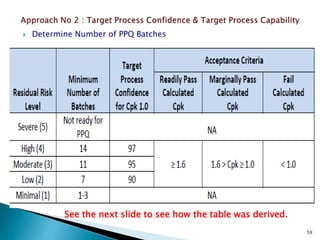
Drug Regulations : Online Resource for Latest Information
 The FDA Guidance does not define
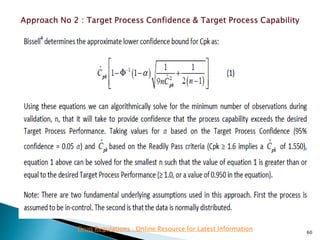
Regulatory Expectation of Number of
Process Qualification Batches.
7
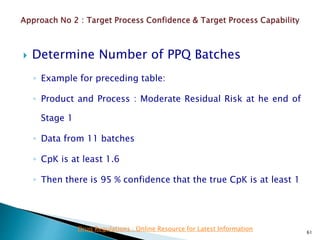
Drug Regulations : Online Resource for Latest Information
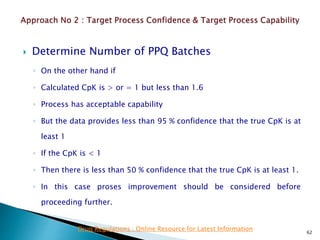
 Expectation
 Rational decision for Number of Batches &
PPQ studies based on
 Product Knowledge
 Process Understanding
8
Drug Regulations : Online Resource for Latest Information
 Expectation
 Sufficient number of batches to
demonstrate
◦ Reproducibility
◦ Between Batch Variation
9
Drug Regulations : Online Resource for Latest Information
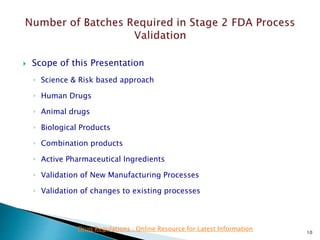
 Scope of this Presentation
◦ Science & Risk based approach
◦ Human Drugs
◦ Animal drugs
◦ Biological Products
◦ Combination products
◦ Active Pharmaceutical Ingredients
◦ Validation of New Manufacturing Processes
◦ Validation of changes to existing processes
10
Drug Regulations : Online Resource for Latest Information
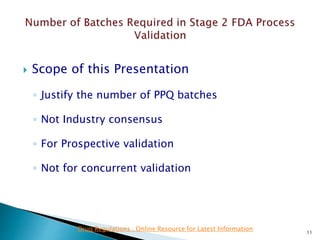
 Scope of this Presentation
◦ Justify the number of PPQ batches
◦ Not Industry consensus
◦ For Prospective validation
◦ Not for concurrent validation
11
Drug Regulations : Online Resource for Latest Information
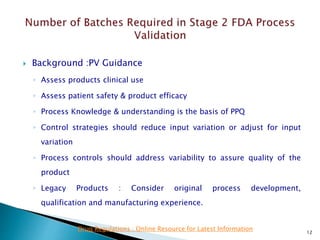
 Background :PV Guidance
◦ Assess products clinical use
◦ Assess patient safety & product efficacy
◦ Process Knowledge & understanding is the basis of PPQ
◦ Control strategies should reduce input variation or adjust for input
variation
◦ Process controls should address variability to assure quality of the
product
◦ Legacy Products : Consider original process development,
qualification and manufacturing experience.
12
Drug Regulations : Online Resource for Latest Information
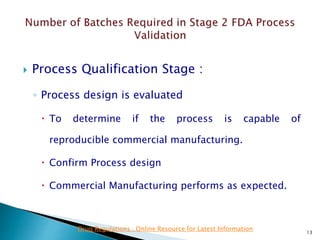
 Process Qualification Stage :
◦ Process design is evaluated
 To determine if the process is capable of
reproducible commercial manufacturing.
 Confirm Process design
 Commercial Manufacturing performs as expected.
13
Drug Regulations : Online Resource for Latest Information
 Process Qualification Stage :
◦ Provide scientific evidence that the process is
reproducible and
◦ Will consistently deliver Quality products
14
Drug Regulations : Online Resource for Latest Information
 Process Qualification Stage :
◦ This raises a question
◦ How many qualification batches are required for
PPQ batches ?
15
Drug Regulations : Online Resource for Latest Information
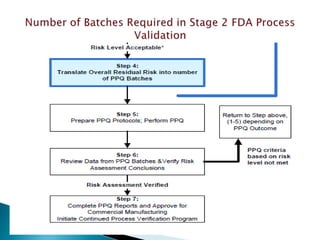
 Risk Based Approach
16
Drug Regulations : Online Resource for Latest Information
17
18
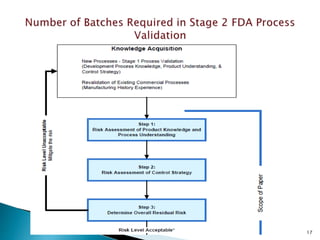
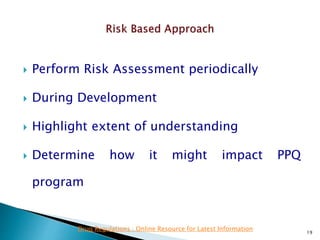
 Perform Risk Assessment periodically
 During Development
 Highlight extent of understanding
 Determine how it might impact PPQ
program
19
Drug Regulations : Online Resource for Latest Information
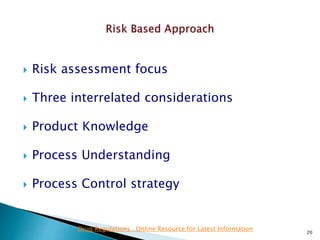
 Risk assessment focus
 Three interrelated considerations
 Product Knowledge
 Process Understanding
 Process Control strategy
20
Drug Regulations : Online Resource for Latest Information
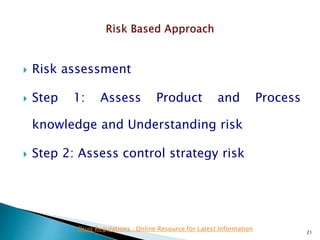
 Risk assessment
 Step 1: Assess Product and Process
knowledge and Understanding risk
 Step 2: Assess control strategy risk
21
Drug Regulations : Online Resource for Latest Information
 Identify
◦ Quality target Product Profile
◦ Critical Quality Attributes
◦ Justify Criticality
◦ Link QTPF to CQA to the DS and DP
◦ Include severity & probability of the variation of identified risk.
 ( Safety , Efficacy & Quality).
 Even if Drug Mechanism of Action is not well understood efforts
should be made to understand CQA’s.
22
Drug Regulations : Online Resource for Latest Information
 Process Understanding Links
◦ Material Attributes
◦ Process Parameters
◦ Critical Quality Attributes
 Process Understanding Helps in estimating variability without
control strategy.
 Difficult to estimate process variability without control strategy
 However separating these considerations will ensure that all
factors are considered.
23
Drug Regulations : Online Resource for Latest Information
 Sources for process understanding & Variability
1. Development Phase :
◦ Stage one of product life cycle
◦ Product & Process Development stage
◦ Important to have sufficient analytical capability
◦ May be lacking for Legacy products or generic
manufacturers
24
Drug Regulations : Online Resource for Latest Information
 Sources for process understanding & Variability
2. Prior Knowledge:
◦ Similar processes
◦ Similar products
◦ Similar platform technologies
◦ Annual Product Review
◦ Deviation Investigation
◦ Complaint Investigation
◦ Change Control Information
25
Drug Regulations : Online Resource for Latest Information
 Sources for process understanding & Variability
3. Degree of Process Understanding / Degree of Unit Operations:
◦ Knowledge gained during development of each unit operation
◦ Depth of understanding of effect of inputs and process parameters on process
results
◦ Effect of variability from personnel
 Equipment set up
 Monitoring of process
 Product Handling
 Selection of Equipment
 Performance of that equipment
 Environmental Conditions
26
Drug Regulations : Online Resource for Latest Information
 Sources for process understanding &
Variability
4. Process Predictability and Modeling
◦ Sophistication of the Lab / small scale model
◦ Ability of the model to predict effects of input
variability on outputs.
27
Drug Regulations : Online Resource for Latest Information
 Sources for process understanding &
Variability
5. Effect of Scale changes
◦ Understanding the effect of changes to the scale
on which the process is run.
28
Drug Regulations : Online Resource for Latest Information
 Process Control Strategy
◦ Evolves through the development of process and product
knowledge ( Stage 1 of Lifecycle)
◦ Purpose
 To control the impact from input variability from , Materials ,
Environment , Operational Practices
 So that
 The output variability of the Product Attributes and Process Performance
is appropriately monitored and controlled.
29
Drug Regulations : Online Resource for Latest Information
 Process Control Strategy
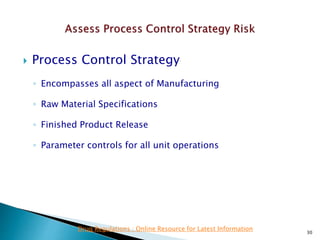
◦ Encompasses all aspect of Manufacturing
◦ Raw Material Specifications
◦ Finished Product Release
◦ Parameter controls for all unit operations
30
Drug Regulations : Online Resource for Latest Information
 Process Control Strategy
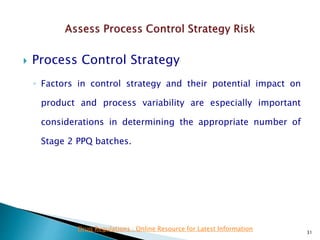
◦ Factors in control strategy and their potential impact on
product and process variability are especially important
considerations in determining the appropriate number of
Stage 2 PPQ batches.
31
Drug Regulations : Online Resource for Latest Information
 Factors to be considered for risk
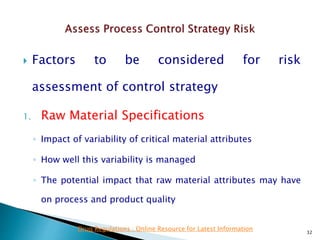
assessment of control strategy
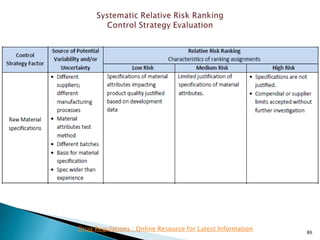
1. Raw Material Specifications
◦ Impact of variability of critical material attributes
◦ How well this variability is managed
◦ The potential impact that raw material attributes may have
on process and product quality
32
Drug Regulations : Online Resource for Latest Information
 Factors to be considered for risk assessment of control strategy
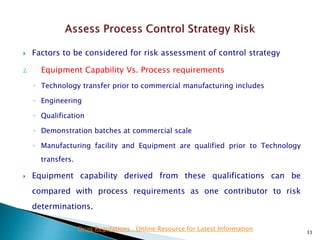
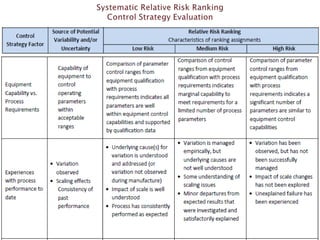
2. Equipment Capability Vs. Process requirements
◦ Technology transfer prior to commercial manufacturing includes
◦ Engineering
◦ Qualification
◦ Demonstration batches at commercial scale
◦ Manufacturing facility and Equipment are qualified prior to Technology
transfers.
 Equipment capability derived from these qualifications can be
compared with process requirements as one contributor to risk
determinations.
33
Drug Regulations : Online Resource for Latest Information
 Factors to be considered for risk assessment of
control strategy
3. Experiences with Process Performance
◦ Managing variability
◦ Appropriate control of scale effects
◦ Comparable process performance
◦ Above can be an indicator that control strategy is sufficient
for reproducible process performance.
34
Drug Regulations : Online Resource for Latest Information
 Factors to be considered for risk assessment of control
strategy
3. Experiences with Process Performance
◦ Consistent success with development batches
◦ Historical performance of legacy products
 No history of recurring / unexplained problems
 Satisfactory resolution of all incidents
◦ Above implies that there is reduced risk for demonstrating
process reproducibility with validation batches.
35
Drug Regulations : Online Resource for Latest Information
 Factors given in earlier slides is only an
example of factors
 A company
◦ can choose a different consideration for risk
assessment
◦ Put more emphasis on control strategy
36
Drug Regulations : Online Resource for Latest Information
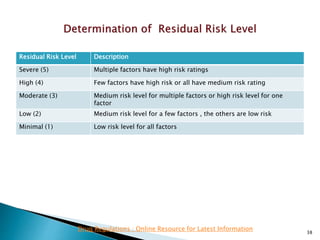
 Determine Residual Risk after Risk Assessment of factors of the Product/ Process and
control strategy understanding
 This residual risk reflects the confidence in the performance of the commercial
process
 Use the residual risk to determine appropriate number of PPQ batches.
 Choosing only to increase the number of PPQ bathes is not a substitute for
insufficient process development or understanding.
 Application of QbD principles to the development of process , product and control
strategy should result in a lower residual risk by improving understanding.
 This would minimize the number of PPQ batches.
 Residual risk should be determined from FMEA or other QRM tools.
 One example of Risk Classification is given in next slide.
37
Drug Regulations : Online Resource for Latest Information
38
Drug Regulations : Online Resource for Latest Information
Residual Risk Level Description
Severe (5) Multiple factors have high risk ratings
High (4) Few factors have high risk or all have medium risk rating
Moderate (3) Medium risk level for multiple factors or high risk level for one
factor
Low (2) Medium risk level for a few factors , the others are low risk
Minimal (1) Low risk level for all factors
 A residual risk level represent the level of
remaining risk revealed form the
assessment of
◦ Product Knowledge
◦ Process Understanding
◦ Control strategy effectiveness.
39
Drug Regulations : Online Resource for Latest Information
 The assessment
 All product CQA’s either in combination or individually
 If done individually the assessment should include the CQA
with the highest associated risk
 The number of validation batches should be commensurate
with the highest residual risk CQA.
 Be performed by a cross functional team
 Provide justification for the evaluation and ranking of each
factor.
40
Drug Regulations : Online Resource for Latest Information
 High residual risk indicates significant gaps in
◦ Knowledge
◦ Control Strategy
 Invest additional efforts in in improving
knowledge and/or control strategy before
planning PPQ batches.
41
Drug Regulations : Online Resource for Latest Information
 Claim for “control of between batch variability” requires comparison
of CQA values from series of batches.
 High degree of assurance will only be available once stage 3 of
Process validation is complete.
 However sponsors may choose different approaches for establishing
high degree of assurance in stage 2 of process validation.
 Subsequent slides will describe three approaches for determining
whether the between variability is appropriate for commercialization
based on small number of PPQ batches.
42
Drug Regulations : Online Resource for Latest Information
 A process having higher residual risk will require more
number of PPQ batches
 A process having low residual risk will require less number of
PPQ batches.
 Connection between the number PPQ batches and the
assurance they provide may be addressed with
◦ A rationale describing why the validation batches chosen is
appropriate or
◦ With statistical considerations
43
Drug Regulations : Online Resource for Latest Information
 Appropriate to include some data from development batches with PPQ batches
 Increases statistical power of the data
 May reduce number of PPQ batches.
 Inclusion of development data should be based on the assessment of differences
between development and PPQ batches.
 Other considerations can also influence the number of PPQ batches
◦ Different dosage strength
◦ Different pack sizes
◦ Different batch sizes
◦ Use of different but similar equipment
◦ Bracketing / Matrixing approaches can be used.
 Statistical treatment used may also affect the number of batches used for PPQ.
44
Drug Regulations : Online Resource for Latest Information
 Extensive sampling and testing of PPQ batches will also
provide data to support the acceptable performance of the
process.
 Number of samples needed for meeting these statistical
acceptance criteria may also influence the number of PPQ
batches.
 For statistical treatments it is assumed that
◦ The results fall within a normal distribution
◦ Parameters being examined are centered to target
 Alternative statistical methods would be needed if these assumptions are
not valid.
45
Drug Regulations : Online Resource for Latest Information
 Assumption:
 For a low risk process the preparation of
three consecutive PPQ batches is
appropriate.
46
Drug Regulations : Online Resource for Latest Information
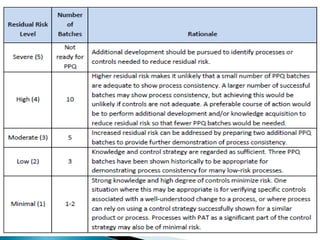
 PPQ Exercise
◦ Assessing the results from the PPQ batches against expectations
◦ To verify that the control strategy for a well understood process is
appropriate for ensuring product quality.
◦ Regulatory authorities in many regions expect that for most situations
a minimum of three PPQ batches will be prepared to show process
reproducibility.
◦ Using a rational based approach one can construct an argument based
on historical success with low risk processes and
◦ An acknowledgement that increased residual risk should be
accompanied by an increased number of PPQ batches.
47
Drug Regulations : Online Resource for Latest Information
48
Drug Regulations : Online Resource for Latest Information
 FDA Guidance sates that
◦ “ Before any batch from the process is commercially
distributed for use by consumers, a manufacturer should
have gained a high degree of assurance in the performance
of the manufacturing process such that it will consistently
produce API’s and Drug Products meeting those attributes
relating to identity, strength, quality, purity and potency”
49
Drug Regulations : Online Resource for Latest Information
 FDA Guidance sates that
◦ This statement poses two questions
1. What is an objective measure that the process will
consistently produce product that meets its
requirements?
2. What is the acceptable high degree of assurance?
50
Drug Regulations : Online Resource for Latest Information
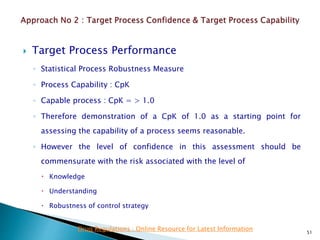
 Target Process Performance
◦ Statistical Process Robustness Measure
◦ Process Capability : CpK
◦ Capable process : CpK = > 1.0
◦ Therefore demonstration of a CpK of 1.0 as a starting point for
assessing the capability of a process seems reasonable.
◦ However the level of confidence in this assessment should be
commensurate with the risk associated with the level of
 Knowledge
 Understanding
 Robustness of control strategy
51
Drug Regulations : Online Resource for Latest Information
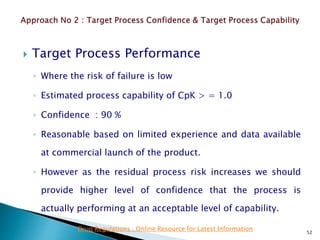
 Target Process Performance
◦ Where the risk of failure is low
◦ Estimated process capability of CpK > = 1.0
◦ Confidence : 90 %
◦ Reasonable based on limited experience and data available
at commercial launch of the product.
◦ However as the residual process risk increases we should
provide higher level of confidence that the process is
actually performing at an acceptable level of capability.
52
Drug Regulations : Online Resource for Latest Information
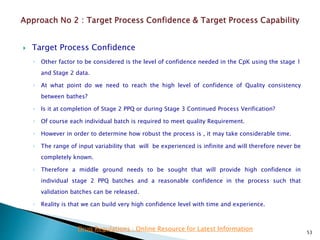
 Target Process Confidence
◦ Other factor to be considered is the level of confidence needed in the CpK using the stage 1
and Stage 2 data.
◦ At what point do we need to reach the high level of confidence of Quality consistency
between bathes?
◦ Is it at completion of Stage 2 PPQ or during Stage 3 Continued Process Verification?
◦ Of course each individual batch is required to meet quality Requirement.
◦ However in order to determine how robust the process is , it may take considerable time.
◦ The range of input variability that will be experienced is infinite and will therefore never be
completely known.
◦ Therefore a middle ground needs to be sought that will provide high confidence in
individual stage 2 PPQ batches and a reasonable confidence in the process such that
validation batches can be released.
◦ Reality is that we can build very high confidence level with time and experience.
53
Drug Regulations : Online Resource for Latest Information
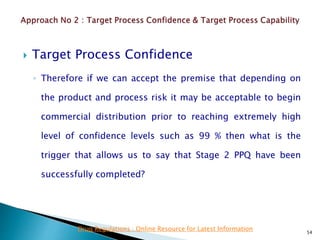
 Target Process Confidence
◦ Therefore if we can accept the premise that depending on
the product and process risk it may be acceptable to begin
commercial distribution prior to reaching extremely high
level of confidence levels such as 99 % then what is the
trigger that allows us to say that Stage 2 PPQ have been
successfully completed?
54
Drug Regulations : Online Resource for Latest Information
 Target Process Confidence
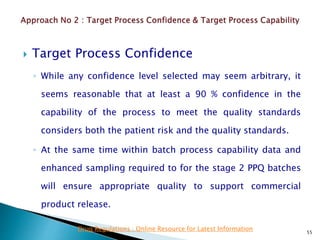
◦ While any confidence level selected may seem arbitrary, it
seems reasonable that at least a 90 % confidence in the
capability of the process to meet the quality standards
considers both the patient risk and the quality standards.
◦ At the same time within batch process capability data and
enhanced sampling required to for the stage 2 PPQ batches
will ensure appropriate quality to support commercial
product release.
55
Drug Regulations : Online Resource for Latest Information
 Target Process Confidence
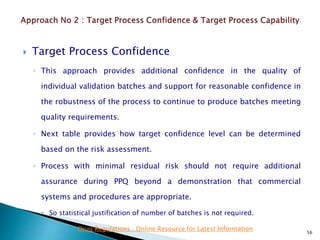
◦ This approach provides additional confidence in the quality of
individual validation batches and support for reasonable confidence in
the robustness of the process to continue to produce batches meeting
quality requirements.
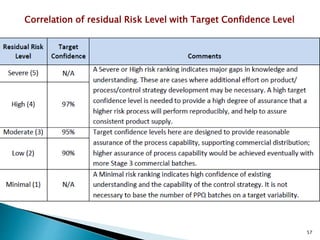
◦ Next table provides how target confidence level can be determined
based on the risk assessment.
◦ Process with minimal residual risk should not require additional
assurance during PPQ beyond a demonstration that commercial
systems and procedures are appropriate.
 So statistical justification of number of batches is not required.
56
Drug Regulations : Online Resource for Latest Information
57
Correlation of residual Risk Level with Target Confidence Level
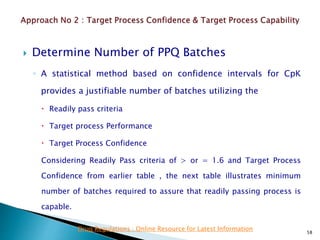
 Determine Number of PPQ Batches
◦ A statistical method based on confidence intervals for CpK
provides a justifiable number of batches utilizing the
 Readily pass criteria
 Target process Performance
 Target Process Confidence
Considering Readily Pass criteria of > or = 1.6 and Target Process
Confidence from earlier table , the next table illustrates minimum
number of batches required to assure that readily passing process is
capable.
58
Drug Regulations : Online Resource for Latest Information
 Determine Number of PPQ Batches
59
See the next slide to see how the table was derived.
60
Drug Regulations : Online Resource for Latest Information
 Determine Number of PPQ Batches
◦ Example for preceding table:
◦ Product and Process : Moderate Residual Risk at he end of
Stage 1
◦ Data from 11 batches
◦ CpK is at least 1.6
◦ Then there is 95 % confidence that the true CpK is at least 1
61
Drug Regulations : Online Resource for Latest Information
 Determine Number of PPQ Batches
◦ On the other hand if
◦ Calculated CpK is > or = 1 but less than 1.6
◦ Process has acceptable capability
◦ But the data provides less than 95 % confidence that the true CpK is at
least 1
◦ If the CpK is < 1
◦ Then there is less than 50 % confidence that the true CpK is at least 1.
◦ In this case proses improvement should be considered before
proceeding further.
62
Drug Regulations : Online Resource for Latest Information
Determine Number of PPQ Batches
 Criteria in earlier table may be interpreted as follows:
◦ PPQ batches meet readily pass criteria.
◦ The Process is qualified & shown to be reproducible
◦ Testing & Sampling for stage 3 may be appropriately adjusted
◦ Enhanced testing & sampling plan may not be needed for
stage 3 –CPV , if the impact of all input variability has already
been verified.
63
Drug Regulations : Online Resource for Latest Information
Determine Number of PPQ Batches
 Criteria in earlier table may be interpreted as follows:
◦ PPQ batches meet Marginally Pass criteria.
◦ Continue full qualification level sampling and testing on those
attributes not meeting “ Readily Pass” until significant
variability estimates are achieved.
◦ Assume the range of input variable values is within the range
characterized as acceptable for the process.
64
Drug Regulations : Online Resource for Latest Information
65
Drug Regulations : Online Resource for Latest Information
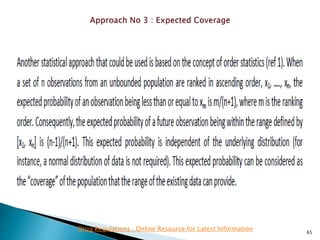
◦ With Increasing no. of PPQ batches probability of failure
increases.
◦ Increasing probability provides increasing coverage
◦ Increasing assurance of the overall process robustness.
◦ Direct connection between between the number of PPQ
batches and the desired assurance can be made.
◦ Low residual risk process does not does not require high
degree of assurance from the PPQ batches alone.
◦ A process with high risk after stage 1 lifecycle would require
high assurance from PPQ batches.
66
Drug Regulations : Online Resource for Latest Information
◦ A high expected coverage for say 95 % or higher for a
severe risk ranking process seems reasonable.
◦ A low expected coverage of 50 % for a low risk ranking
process provides some degree of assurance.
◦ Each form needs to find out appropriate level of expected
coverage that is meaningful for its processes.
◦ Table in subsequent slide provides example of determining
PPQ batches based on risk assessment.
67
Drug Regulations : Online Resource for Latest Information
68
Drug Regulations : Online Resource for Latest Information
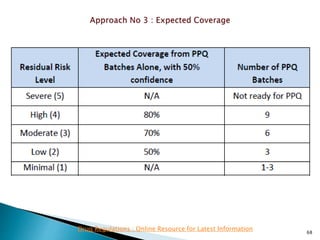
◦ Expected coverage is not given to severe risk rating to be
consistent with previous two approaches.
◦ For each example a passing high risk process would have
50 % confidence that 4 of the 5 values (80%) are within
release limits.
◦ Once the desired PPQ are prepared and evaluated
determine if there is any unexplained between batch
variability.
69
Drug Regulations : Online Resource for Latest Information
 This can be done by statistical techniques which would provide
visual summary of within and between batch summaries.
◦ Box plots
◦ Multivariate charts
◦ Other plots
 PPQ results may also be analyzed by statistical methods that rely
on specific distribution.
 When normal distribution is confirmed CpK method from
approach two can also be used.
 Another example is “Narrow Limit Gauging” or “Pre-Control”.
70
Drug Regulations : Online Resource for Latest Information
 Another example is “Narrow Limit Gauging” or
“Pre-Control”.
 Narrow limit can be set as the middle 50% of the
specification range for CQA with two sided
specification.
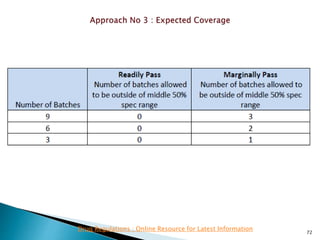
 Table in next slide provides the readily pass and
marginally pass requirements assuming a normal
distribution.
71
Drug Regulations : Online Resource for Latest Information
72
Drug Regulations : Online Resource for Latest Information
 For a normally distributed process
◦ Readily pass Requirement : established that a with a failure
rate of 0.27% or lower would have at least a 50 % chance to
pass the requirement.
◦ Marginally Pass Requirement : established with a failure rate of
1.64 % would have at least a 90 % chance to pass the requirement.
◦ If the PPQ batches do not meet the Marginally pass requirement
further assessment and process improvements are required.
◦ Specifications should be met for all PPQ batches. If not narrow
gauging concept is not applicable.
73
Drug Regulations : Online Resource for Latest Information
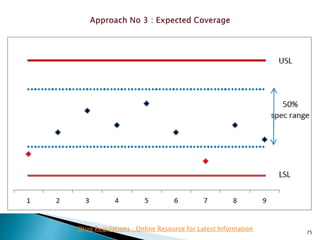
 Concept from last slide is explained with following example:
 PPQ batches manufactured : 9
 All batches were with specification range.
 2 batches were outside of the middle 50 % specification range.
 Rest – 7 batches were within the 50 % of the specification range.
 PPQ batches marginally passed the requirement
 Enhanced monitoring is recommended for this CQA for the stage
3 of the PV Lifecycle.
74
Drug Regulations : Online Resource for Latest Information
75
Drug Regulations : Online Resource for Latest Information
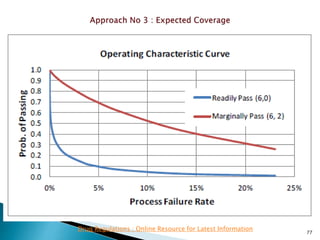
 The relationship between the process capability
and the probability of a such a process meeting the
readily pass requirement is given in next slide.
 The simulation assumes normal distribution
 The plot shows the probability of meeting the
readily pass and marginally pass criteria for 6 PPQ
batches.
76
Drug Regulations : Online Resource for Latest Information
77
Drug Regulations : Online Resource for Latest Information
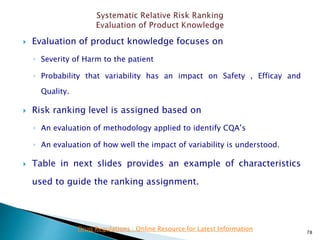
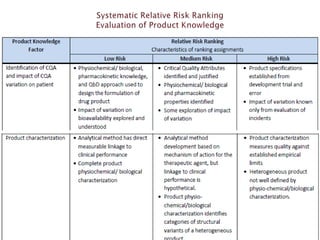
 Evaluation of product knowledge focuses on
◦ Severity of Harm to the patient
◦ Probability that variability has an impact on Safety , Efficay and
Quality.
 Risk ranking level is assigned based on
◦ An evaluation of methodology applied to identify CQA’s
◦ An evaluation of how well the impact of variability is understood.
 Table in next slides provides an example of characteristics
used to guide the ranking assignment.
78
Drug Regulations : Online Resource for Latest Information
79
Drug Regulations : Online Resource for Latest Information
 Most of the Process understanding comes from Product &
Process Development.
 Provides knowledge about impact of Input and process variability
on CQA.
 Predictive models are developed to simulate impact on CQA
 Criticality of process parameters are developed from
development , characterization and manufacturing experience.
 For legacy products full-scale manufacturing data may be useful
in establishing effect of input variations on product attributes.

80
Drug Regulations : Online Resource for Latest Information
 In many cases for new products firms choose platform which is
familiar to them
 This prior knowledge is useful to develop new products
 Inherent process variability can be estimated from prior
knowledge.
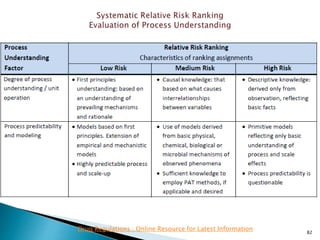
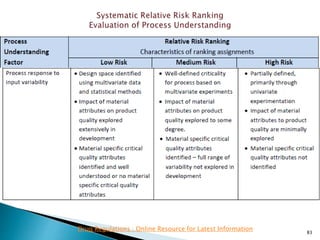
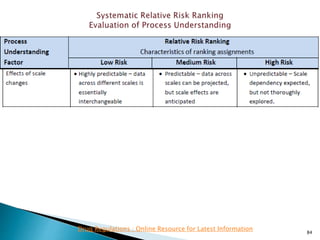
 The risk ranking level is assigned from an evaluation of degree
of process understanding, process predictability and
understanding effect of scale as well as effect of variability on
process output.
 Next slides provides example of characteristics used to guide the
ranking assignment.
81
Drug Regulations : Online Resource for Latest Information
82
Drug Regulations : Online Resource for Latest Information
83
Drug Regulations : Online Resource for Latest Information
84
Drug Regulations : Online Resource for Latest Information
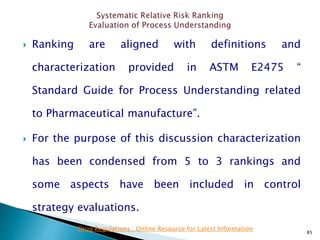
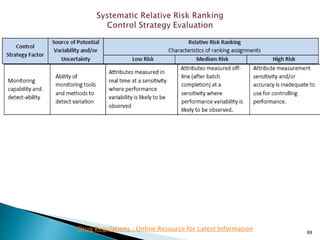
 Ranking are aligned with definitions and
characterization provided in ASTM E2475 “
Standard Guide for Process Understanding related
to Pharmaceutical manufacture”.
 For the purpose of this discussion characterization
has been condensed from 5 to 3 rankings and
some aspects have been included in control
strategy evaluations.
85
Drug Regulations : Online Resource for Latest Information
86
Drug Regulations : Online Resource for Latest Information
87
Drug Regulations : Online Resource for Latest Information
88
Drug Regulations : Online Resource for Latest Information
 This presentation is compiled from freely
available resource like the website of EMA.
“Drug Regulations” is a non profit
organization which provides free online
resource to the Pharmaceutical Professional.
 Visit http://www.drugregulations.org for
latest information from the world of
Pharmaceuticals.
8/10/2015 89
Drug Regulations : Online
Resource for Latest Information

US FDA Process Validation Stage 2 : No. Of Batches Required for Process Performance Qualification.

  • 1.
    www.drugregulations.org 1 Presentation preparedby Drug Regulations – a not for profit organization. Visit www.drugregulations.org for the latest in Pharmaceuticals.
  • 2.
     This presentationis compiled from freely available resource like the website of FDA ,EMA and ISPE.  “Drug Regulations” is a non profit organization which provides free online resource to the Pharmaceutical Professional.  Visit http://www.drugregulations.org for latest information from the world of Pharmaceuticals. 8/10/2015 2 Drug Regulations : Online Resource for Latest Information
  • 3.
     This presentationwill cover  Scope  Background  Risk Based Approach ◦ Assess Product Knowledge ◦ Assess Process Understanding ◦ Assess Process Control strategy  Factors to be considered for Risk Assessment  Determination of Residual Risk www.drugregulations.org 3
  • 4.
     This presentationwill cover  Approaches for Determining Number of PPQ batches ◦ Approach 1 : Based on rationales & Experience ◦ Approach 2 : Target Process Confidence & Target Process Capability ◦ Approach 3 : Expected Coverage  Systematic relative Risk Ranking ◦ Evaluation of Product Knowledge ◦ Evaluation of Process understanding ◦ Evaluation of Control Strategy www.drugregulations.org 4
  • 5.
     Since adoptionof ICH Q 9 benefits of QRM are evident.  This requires re-examination of well-established practices.  Validation a one time activity ?  Are three consecutive batches sufficient to demonstrate process reproducibility?  Successful manufacture of three consecutive batches may not provide assurance of process reproducibility. 5 Drug Regulations : Online Resource for Latest Information
  • 6.
     Revised PVguidance aligns Process Validation with Product Life Cycle Management.  PV starts with Process design and spans the entire life cycle of the marketed product.  Guidance emphasizes that stage 2 : Process Performance Qualification should be based on ◦ Well grounded scientific justification ◦ Product & Process Understanding ◦ Adequate demonstration of control. 6 Drug Regulations : Online Resource for Latest Information
  • 7.
     The FDAGuidance does not define Regulatory Expectation of Number of Process Qualification Batches. 7 Drug Regulations : Online Resource for Latest Information
  • 8.
     Expectation  Rationaldecision for Number of Batches & PPQ studies based on  Product Knowledge  Process Understanding 8 Drug Regulations : Online Resource for Latest Information
  • 9.
     Expectation  Sufficientnumber of batches to demonstrate ◦ Reproducibility ◦ Between Batch Variation 9 Drug Regulations : Online Resource for Latest Information
  • 10.
     Scope ofthis Presentation ◦ Science & Risk based approach ◦ Human Drugs ◦ Animal drugs ◦ Biological Products ◦ Combination products ◦ Active Pharmaceutical Ingredients ◦ Validation of New Manufacturing Processes ◦ Validation of changes to existing processes 10 Drug Regulations : Online Resource for Latest Information
  • 11.
     Scope ofthis Presentation ◦ Justify the number of PPQ batches ◦ Not Industry consensus ◦ For Prospective validation ◦ Not for concurrent validation 11 Drug Regulations : Online Resource for Latest Information
  • 12.
     Background :PVGuidance ◦ Assess products clinical use ◦ Assess patient safety & product efficacy ◦ Process Knowledge & understanding is the basis of PPQ ◦ Control strategies should reduce input variation or adjust for input variation ◦ Process controls should address variability to assure quality of the product ◦ Legacy Products : Consider original process development, qualification and manufacturing experience. 12 Drug Regulations : Online Resource for Latest Information
  • 13.
     Process QualificationStage : ◦ Process design is evaluated  To determine if the process is capable of reproducible commercial manufacturing.  Confirm Process design  Commercial Manufacturing performs as expected. 13 Drug Regulations : Online Resource for Latest Information
  • 14.
     Process QualificationStage : ◦ Provide scientific evidence that the process is reproducible and ◦ Will consistently deliver Quality products 14 Drug Regulations : Online Resource for Latest Information
  • 15.
     Process QualificationStage : ◦ This raises a question ◦ How many qualification batches are required for PPQ batches ? 15 Drug Regulations : Online Resource for Latest Information
  • 16.
     Risk BasedApproach 16 Drug Regulations : Online Resource for Latest Information
  • 17.
  • 18.
  • 19.
     Perform RiskAssessment periodically  During Development  Highlight extent of understanding  Determine how it might impact PPQ program 19 Drug Regulations : Online Resource for Latest Information
  • 20.
     Risk assessmentfocus  Three interrelated considerations  Product Knowledge  Process Understanding  Process Control strategy 20 Drug Regulations : Online Resource for Latest Information
  • 21.
     Risk assessment Step 1: Assess Product and Process knowledge and Understanding risk  Step 2: Assess control strategy risk 21 Drug Regulations : Online Resource for Latest Information
  • 22.
     Identify ◦ Qualitytarget Product Profile ◦ Critical Quality Attributes ◦ Justify Criticality ◦ Link QTPF to CQA to the DS and DP ◦ Include severity & probability of the variation of identified risk.  ( Safety , Efficacy & Quality).  Even if Drug Mechanism of Action is not well understood efforts should be made to understand CQA’s. 22 Drug Regulations : Online Resource for Latest Information
  • 23.
     Process UnderstandingLinks ◦ Material Attributes ◦ Process Parameters ◦ Critical Quality Attributes  Process Understanding Helps in estimating variability without control strategy.  Difficult to estimate process variability without control strategy  However separating these considerations will ensure that all factors are considered. 23 Drug Regulations : Online Resource for Latest Information
  • 24.
     Sources forprocess understanding & Variability 1. Development Phase : ◦ Stage one of product life cycle ◦ Product & Process Development stage ◦ Important to have sufficient analytical capability ◦ May be lacking for Legacy products or generic manufacturers 24 Drug Regulations : Online Resource for Latest Information
  • 25.
     Sources forprocess understanding & Variability 2. Prior Knowledge: ◦ Similar processes ◦ Similar products ◦ Similar platform technologies ◦ Annual Product Review ◦ Deviation Investigation ◦ Complaint Investigation ◦ Change Control Information 25 Drug Regulations : Online Resource for Latest Information
  • 26.
     Sources forprocess understanding & Variability 3. Degree of Process Understanding / Degree of Unit Operations: ◦ Knowledge gained during development of each unit operation ◦ Depth of understanding of effect of inputs and process parameters on process results ◦ Effect of variability from personnel  Equipment set up  Monitoring of process  Product Handling  Selection of Equipment  Performance of that equipment  Environmental Conditions 26 Drug Regulations : Online Resource for Latest Information
  • 27.
     Sources forprocess understanding & Variability 4. Process Predictability and Modeling ◦ Sophistication of the Lab / small scale model ◦ Ability of the model to predict effects of input variability on outputs. 27 Drug Regulations : Online Resource for Latest Information
  • 28.
     Sources forprocess understanding & Variability 5. Effect of Scale changes ◦ Understanding the effect of changes to the scale on which the process is run. 28 Drug Regulations : Online Resource for Latest Information
  • 29.
     Process ControlStrategy ◦ Evolves through the development of process and product knowledge ( Stage 1 of Lifecycle) ◦ Purpose  To control the impact from input variability from , Materials , Environment , Operational Practices  So that  The output variability of the Product Attributes and Process Performance is appropriately monitored and controlled. 29 Drug Regulations : Online Resource for Latest Information
  • 30.
     Process ControlStrategy ◦ Encompasses all aspect of Manufacturing ◦ Raw Material Specifications ◦ Finished Product Release ◦ Parameter controls for all unit operations 30 Drug Regulations : Online Resource for Latest Information
  • 31.
     Process ControlStrategy ◦ Factors in control strategy and their potential impact on product and process variability are especially important considerations in determining the appropriate number of Stage 2 PPQ batches. 31 Drug Regulations : Online Resource for Latest Information
  • 32.
     Factors tobe considered for risk assessment of control strategy 1. Raw Material Specifications ◦ Impact of variability of critical material attributes ◦ How well this variability is managed ◦ The potential impact that raw material attributes may have on process and product quality 32 Drug Regulations : Online Resource for Latest Information
  • 33.
     Factors tobe considered for risk assessment of control strategy 2. Equipment Capability Vs. Process requirements ◦ Technology transfer prior to commercial manufacturing includes ◦ Engineering ◦ Qualification ◦ Demonstration batches at commercial scale ◦ Manufacturing facility and Equipment are qualified prior to Technology transfers.  Equipment capability derived from these qualifications can be compared with process requirements as one contributor to risk determinations. 33 Drug Regulations : Online Resource for Latest Information
  • 34.
     Factors tobe considered for risk assessment of control strategy 3. Experiences with Process Performance ◦ Managing variability ◦ Appropriate control of scale effects ◦ Comparable process performance ◦ Above can be an indicator that control strategy is sufficient for reproducible process performance. 34 Drug Regulations : Online Resource for Latest Information
  • 35.
     Factors tobe considered for risk assessment of control strategy 3. Experiences with Process Performance ◦ Consistent success with development batches ◦ Historical performance of legacy products  No history of recurring / unexplained problems  Satisfactory resolution of all incidents ◦ Above implies that there is reduced risk for demonstrating process reproducibility with validation batches. 35 Drug Regulations : Online Resource for Latest Information
  • 36.
     Factors givenin earlier slides is only an example of factors  A company ◦ can choose a different consideration for risk assessment ◦ Put more emphasis on control strategy 36 Drug Regulations : Online Resource for Latest Information
  • 37.
     Determine ResidualRisk after Risk Assessment of factors of the Product/ Process and control strategy understanding  This residual risk reflects the confidence in the performance of the commercial process  Use the residual risk to determine appropriate number of PPQ batches.  Choosing only to increase the number of PPQ bathes is not a substitute for insufficient process development or understanding.  Application of QbD principles to the development of process , product and control strategy should result in a lower residual risk by improving understanding.  This would minimize the number of PPQ batches.  Residual risk should be determined from FMEA or other QRM tools.  One example of Risk Classification is given in next slide. 37 Drug Regulations : Online Resource for Latest Information
  • 38.
    38 Drug Regulations :Online Resource for Latest Information Residual Risk Level Description Severe (5) Multiple factors have high risk ratings High (4) Few factors have high risk or all have medium risk rating Moderate (3) Medium risk level for multiple factors or high risk level for one factor Low (2) Medium risk level for a few factors , the others are low risk Minimal (1) Low risk level for all factors
  • 39.
     A residualrisk level represent the level of remaining risk revealed form the assessment of ◦ Product Knowledge ◦ Process Understanding ◦ Control strategy effectiveness. 39 Drug Regulations : Online Resource for Latest Information
  • 40.
     The assessment All product CQA’s either in combination or individually  If done individually the assessment should include the CQA with the highest associated risk  The number of validation batches should be commensurate with the highest residual risk CQA.  Be performed by a cross functional team  Provide justification for the evaluation and ranking of each factor. 40 Drug Regulations : Online Resource for Latest Information
  • 41.
     High residualrisk indicates significant gaps in ◦ Knowledge ◦ Control Strategy  Invest additional efforts in in improving knowledge and/or control strategy before planning PPQ batches. 41 Drug Regulations : Online Resource for Latest Information
  • 42.
     Claim for“control of between batch variability” requires comparison of CQA values from series of batches.  High degree of assurance will only be available once stage 3 of Process validation is complete.  However sponsors may choose different approaches for establishing high degree of assurance in stage 2 of process validation.  Subsequent slides will describe three approaches for determining whether the between variability is appropriate for commercialization based on small number of PPQ batches. 42 Drug Regulations : Online Resource for Latest Information
  • 43.
     A processhaving higher residual risk will require more number of PPQ batches  A process having low residual risk will require less number of PPQ batches.  Connection between the number PPQ batches and the assurance they provide may be addressed with ◦ A rationale describing why the validation batches chosen is appropriate or ◦ With statistical considerations 43 Drug Regulations : Online Resource for Latest Information
  • 44.
     Appropriate toinclude some data from development batches with PPQ batches  Increases statistical power of the data  May reduce number of PPQ batches.  Inclusion of development data should be based on the assessment of differences between development and PPQ batches.  Other considerations can also influence the number of PPQ batches ◦ Different dosage strength ◦ Different pack sizes ◦ Different batch sizes ◦ Use of different but similar equipment ◦ Bracketing / Matrixing approaches can be used.  Statistical treatment used may also affect the number of batches used for PPQ. 44 Drug Regulations : Online Resource for Latest Information
  • 45.
     Extensive samplingand testing of PPQ batches will also provide data to support the acceptable performance of the process.  Number of samples needed for meeting these statistical acceptance criteria may also influence the number of PPQ batches.  For statistical treatments it is assumed that ◦ The results fall within a normal distribution ◦ Parameters being examined are centered to target  Alternative statistical methods would be needed if these assumptions are not valid. 45 Drug Regulations : Online Resource for Latest Information
  • 46.
     Assumption:  Fora low risk process the preparation of three consecutive PPQ batches is appropriate. 46 Drug Regulations : Online Resource for Latest Information
  • 47.
     PPQ Exercise ◦Assessing the results from the PPQ batches against expectations ◦ To verify that the control strategy for a well understood process is appropriate for ensuring product quality. ◦ Regulatory authorities in many regions expect that for most situations a minimum of three PPQ batches will be prepared to show process reproducibility. ◦ Using a rational based approach one can construct an argument based on historical success with low risk processes and ◦ An acknowledgement that increased residual risk should be accompanied by an increased number of PPQ batches. 47 Drug Regulations : Online Resource for Latest Information
  • 48.
    48 Drug Regulations :Online Resource for Latest Information
  • 49.
     FDA Guidancesates that ◦ “ Before any batch from the process is commercially distributed for use by consumers, a manufacturer should have gained a high degree of assurance in the performance of the manufacturing process such that it will consistently produce API’s and Drug Products meeting those attributes relating to identity, strength, quality, purity and potency” 49 Drug Regulations : Online Resource for Latest Information
  • 50.
     FDA Guidancesates that ◦ This statement poses two questions 1. What is an objective measure that the process will consistently produce product that meets its requirements? 2. What is the acceptable high degree of assurance? 50 Drug Regulations : Online Resource for Latest Information
  • 51.
     Target ProcessPerformance ◦ Statistical Process Robustness Measure ◦ Process Capability : CpK ◦ Capable process : CpK = > 1.0 ◦ Therefore demonstration of a CpK of 1.0 as a starting point for assessing the capability of a process seems reasonable. ◦ However the level of confidence in this assessment should be commensurate with the risk associated with the level of  Knowledge  Understanding  Robustness of control strategy 51 Drug Regulations : Online Resource for Latest Information
  • 52.
     Target ProcessPerformance ◦ Where the risk of failure is low ◦ Estimated process capability of CpK > = 1.0 ◦ Confidence : 90 % ◦ Reasonable based on limited experience and data available at commercial launch of the product. ◦ However as the residual process risk increases we should provide higher level of confidence that the process is actually performing at an acceptable level of capability. 52 Drug Regulations : Online Resource for Latest Information
  • 53.
     Target ProcessConfidence ◦ Other factor to be considered is the level of confidence needed in the CpK using the stage 1 and Stage 2 data. ◦ At what point do we need to reach the high level of confidence of Quality consistency between bathes? ◦ Is it at completion of Stage 2 PPQ or during Stage 3 Continued Process Verification? ◦ Of course each individual batch is required to meet quality Requirement. ◦ However in order to determine how robust the process is , it may take considerable time. ◦ The range of input variability that will be experienced is infinite and will therefore never be completely known. ◦ Therefore a middle ground needs to be sought that will provide high confidence in individual stage 2 PPQ batches and a reasonable confidence in the process such that validation batches can be released. ◦ Reality is that we can build very high confidence level with time and experience. 53 Drug Regulations : Online Resource for Latest Information
  • 54.
     Target ProcessConfidence ◦ Therefore if we can accept the premise that depending on the product and process risk it may be acceptable to begin commercial distribution prior to reaching extremely high level of confidence levels such as 99 % then what is the trigger that allows us to say that Stage 2 PPQ have been successfully completed? 54 Drug Regulations : Online Resource for Latest Information
  • 55.
     Target ProcessConfidence ◦ While any confidence level selected may seem arbitrary, it seems reasonable that at least a 90 % confidence in the capability of the process to meet the quality standards considers both the patient risk and the quality standards. ◦ At the same time within batch process capability data and enhanced sampling required to for the stage 2 PPQ batches will ensure appropriate quality to support commercial product release. 55 Drug Regulations : Online Resource for Latest Information
  • 56.
     Target ProcessConfidence ◦ This approach provides additional confidence in the quality of individual validation batches and support for reasonable confidence in the robustness of the process to continue to produce batches meeting quality requirements. ◦ Next table provides how target confidence level can be determined based on the risk assessment. ◦ Process with minimal residual risk should not require additional assurance during PPQ beyond a demonstration that commercial systems and procedures are appropriate.  So statistical justification of number of batches is not required. 56 Drug Regulations : Online Resource for Latest Information
  • 57.
    57 Correlation of residualRisk Level with Target Confidence Level
  • 58.
     Determine Numberof PPQ Batches ◦ A statistical method based on confidence intervals for CpK provides a justifiable number of batches utilizing the  Readily pass criteria  Target process Performance  Target Process Confidence Considering Readily Pass criteria of > or = 1.6 and Target Process Confidence from earlier table , the next table illustrates minimum number of batches required to assure that readily passing process is capable. 58 Drug Regulations : Online Resource for Latest Information
  • 59.
     Determine Numberof PPQ Batches 59 See the next slide to see how the table was derived.
  • 60.
    60 Drug Regulations :Online Resource for Latest Information
  • 61.
     Determine Numberof PPQ Batches ◦ Example for preceding table: ◦ Product and Process : Moderate Residual Risk at he end of Stage 1 ◦ Data from 11 batches ◦ CpK is at least 1.6 ◦ Then there is 95 % confidence that the true CpK is at least 1 61 Drug Regulations : Online Resource for Latest Information
  • 62.
     Determine Numberof PPQ Batches ◦ On the other hand if ◦ Calculated CpK is > or = 1 but less than 1.6 ◦ Process has acceptable capability ◦ But the data provides less than 95 % confidence that the true CpK is at least 1 ◦ If the CpK is < 1 ◦ Then there is less than 50 % confidence that the true CpK is at least 1. ◦ In this case proses improvement should be considered before proceeding further. 62 Drug Regulations : Online Resource for Latest Information
  • 63.
    Determine Number ofPPQ Batches  Criteria in earlier table may be interpreted as follows: ◦ PPQ batches meet readily pass criteria. ◦ The Process is qualified & shown to be reproducible ◦ Testing & Sampling for stage 3 may be appropriately adjusted ◦ Enhanced testing & sampling plan may not be needed for stage 3 –CPV , if the impact of all input variability has already been verified. 63 Drug Regulations : Online Resource for Latest Information
  • 64.
    Determine Number ofPPQ Batches  Criteria in earlier table may be interpreted as follows: ◦ PPQ batches meet Marginally Pass criteria. ◦ Continue full qualification level sampling and testing on those attributes not meeting “ Readily Pass” until significant variability estimates are achieved. ◦ Assume the range of input variable values is within the range characterized as acceptable for the process. 64 Drug Regulations : Online Resource for Latest Information
  • 65.
    65 Drug Regulations :Online Resource for Latest Information
  • 66.
    ◦ With Increasingno. of PPQ batches probability of failure increases. ◦ Increasing probability provides increasing coverage ◦ Increasing assurance of the overall process robustness. ◦ Direct connection between between the number of PPQ batches and the desired assurance can be made. ◦ Low residual risk process does not does not require high degree of assurance from the PPQ batches alone. ◦ A process with high risk after stage 1 lifecycle would require high assurance from PPQ batches. 66 Drug Regulations : Online Resource for Latest Information
  • 67.
    ◦ A highexpected coverage for say 95 % or higher for a severe risk ranking process seems reasonable. ◦ A low expected coverage of 50 % for a low risk ranking process provides some degree of assurance. ◦ Each form needs to find out appropriate level of expected coverage that is meaningful for its processes. ◦ Table in subsequent slide provides example of determining PPQ batches based on risk assessment. 67 Drug Regulations : Online Resource for Latest Information
  • 68.
    68 Drug Regulations :Online Resource for Latest Information
  • 69.
    ◦ Expected coverageis not given to severe risk rating to be consistent with previous two approaches. ◦ For each example a passing high risk process would have 50 % confidence that 4 of the 5 values (80%) are within release limits. ◦ Once the desired PPQ are prepared and evaluated determine if there is any unexplained between batch variability. 69 Drug Regulations : Online Resource for Latest Information
  • 70.
     This canbe done by statistical techniques which would provide visual summary of within and between batch summaries. ◦ Box plots ◦ Multivariate charts ◦ Other plots  PPQ results may also be analyzed by statistical methods that rely on specific distribution.  When normal distribution is confirmed CpK method from approach two can also be used.  Another example is “Narrow Limit Gauging” or “Pre-Control”. 70 Drug Regulations : Online Resource for Latest Information
  • 71.
     Another exampleis “Narrow Limit Gauging” or “Pre-Control”.  Narrow limit can be set as the middle 50% of the specification range for CQA with two sided specification.  Table in next slide provides the readily pass and marginally pass requirements assuming a normal distribution. 71 Drug Regulations : Online Resource for Latest Information
  • 72.
    72 Drug Regulations :Online Resource for Latest Information
  • 73.
     For anormally distributed process ◦ Readily pass Requirement : established that a with a failure rate of 0.27% or lower would have at least a 50 % chance to pass the requirement. ◦ Marginally Pass Requirement : established with a failure rate of 1.64 % would have at least a 90 % chance to pass the requirement. ◦ If the PPQ batches do not meet the Marginally pass requirement further assessment and process improvements are required. ◦ Specifications should be met for all PPQ batches. If not narrow gauging concept is not applicable. 73 Drug Regulations : Online Resource for Latest Information
  • 74.
     Concept fromlast slide is explained with following example:  PPQ batches manufactured : 9  All batches were with specification range.  2 batches were outside of the middle 50 % specification range.  Rest – 7 batches were within the 50 % of the specification range.  PPQ batches marginally passed the requirement  Enhanced monitoring is recommended for this CQA for the stage 3 of the PV Lifecycle. 74 Drug Regulations : Online Resource for Latest Information
  • 75.
    75 Drug Regulations :Online Resource for Latest Information
  • 76.
     The relationshipbetween the process capability and the probability of a such a process meeting the readily pass requirement is given in next slide.  The simulation assumes normal distribution  The plot shows the probability of meeting the readily pass and marginally pass criteria for 6 PPQ batches. 76 Drug Regulations : Online Resource for Latest Information
  • 77.
    77 Drug Regulations :Online Resource for Latest Information
  • 78.
     Evaluation ofproduct knowledge focuses on ◦ Severity of Harm to the patient ◦ Probability that variability has an impact on Safety , Efficay and Quality.  Risk ranking level is assigned based on ◦ An evaluation of methodology applied to identify CQA’s ◦ An evaluation of how well the impact of variability is understood.  Table in next slides provides an example of characteristics used to guide the ranking assignment. 78 Drug Regulations : Online Resource for Latest Information
  • 79.
    79 Drug Regulations :Online Resource for Latest Information
  • 80.
     Most ofthe Process understanding comes from Product & Process Development.  Provides knowledge about impact of Input and process variability on CQA.  Predictive models are developed to simulate impact on CQA  Criticality of process parameters are developed from development , characterization and manufacturing experience.  For legacy products full-scale manufacturing data may be useful in establishing effect of input variations on product attributes.  80 Drug Regulations : Online Resource for Latest Information
  • 81.
     In manycases for new products firms choose platform which is familiar to them  This prior knowledge is useful to develop new products  Inherent process variability can be estimated from prior knowledge.  The risk ranking level is assigned from an evaluation of degree of process understanding, process predictability and understanding effect of scale as well as effect of variability on process output.  Next slides provides example of characteristics used to guide the ranking assignment. 81 Drug Regulations : Online Resource for Latest Information
  • 82.
    82 Drug Regulations :Online Resource for Latest Information
  • 83.
    83 Drug Regulations :Online Resource for Latest Information
  • 84.
    84 Drug Regulations :Online Resource for Latest Information
  • 85.
     Ranking arealigned with definitions and characterization provided in ASTM E2475 “ Standard Guide for Process Understanding related to Pharmaceutical manufacture”.  For the purpose of this discussion characterization has been condensed from 5 to 3 rankings and some aspects have been included in control strategy evaluations. 85 Drug Regulations : Online Resource for Latest Information
  • 86.
    86 Drug Regulations :Online Resource for Latest Information
  • 87.
    87 Drug Regulations :Online Resource for Latest Information
  • 88.
    88 Drug Regulations :Online Resource for Latest Information
  • 89.
     This presentationis compiled from freely available resource like the website of EMA. “Drug Regulations” is a non profit organization which provides free online resource to the Pharmaceutical Professional.  Visit http://www.drugregulations.org for latest information from the world of Pharmaceuticals. 8/10/2015 89 Drug Regulations : Online Resource for Latest Information