Validation of cone blender, mixer
granulator and tablet compression
machine
Presented by Ms. Mayuri Ghavate
(M.Pharm Pharmaceutics)
MAIN TOPICS
POINTS TO TALK ABOUT
To understand validation of equipments.
Validation of powder blenders mixers
granulators
tablet compression machine
Validation is the process of establishing documentary evidence
demonstrating that a procedure, process, or activity carried out in testing
and then production maintains the desired level of compliance at all
stage.
The validation concept was first proposed by the Food and Drug Administration
(FDA) in the mid-1970s to improve the quality of pharmaceutical products
EQUIPMENT VALIDATION
The process of equipment validation is based on the principle
that equipment must be designed, constructed, maintained, and
adapted to perform the operations which are to be carried out.
Equipment validation is Vital for-
• Safety.
• Fewer interruptions of work.
• Reduction of variation in results.
• Greater confidence in the reliability of results.
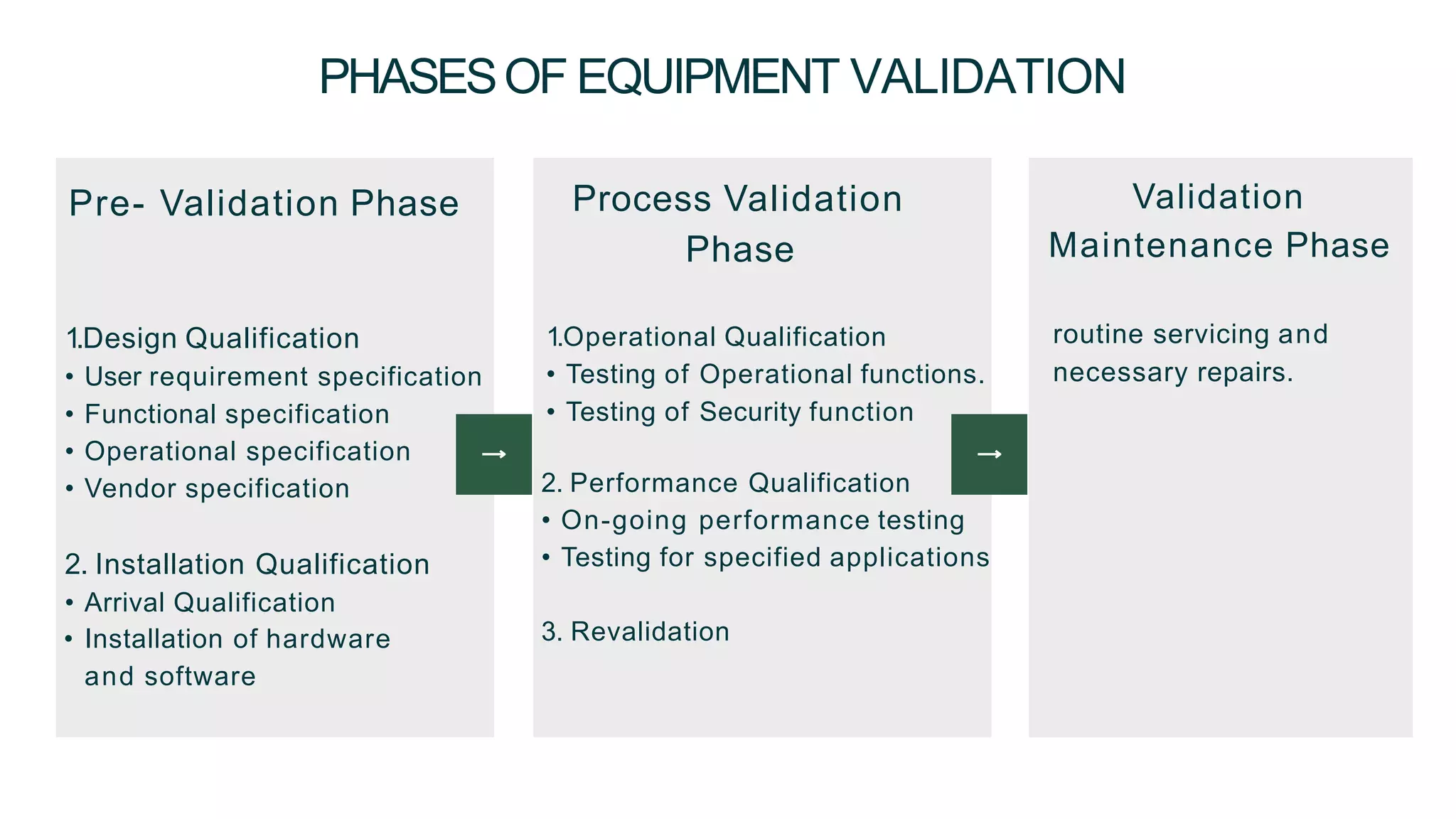
PHASESOF EQUIPMENT VALIDATION
1.Design Qualification
• User requirement specification
• Functional specification
• Operational specification
• Vendor specification
2. Installation Qualification
• Arrival Qualification
• Installation of hardware
and software
Pre- Validation Phase Process Validation
Phase
1.Operational Qualification
• Testing of Operational functions.
• Testing of Security function
2. Performance Qualification
• On-going performance testing
• Testing for specified applications
3. Revalidation
Validation
Maintenance Phase
routine servicing and
necessary repairs.
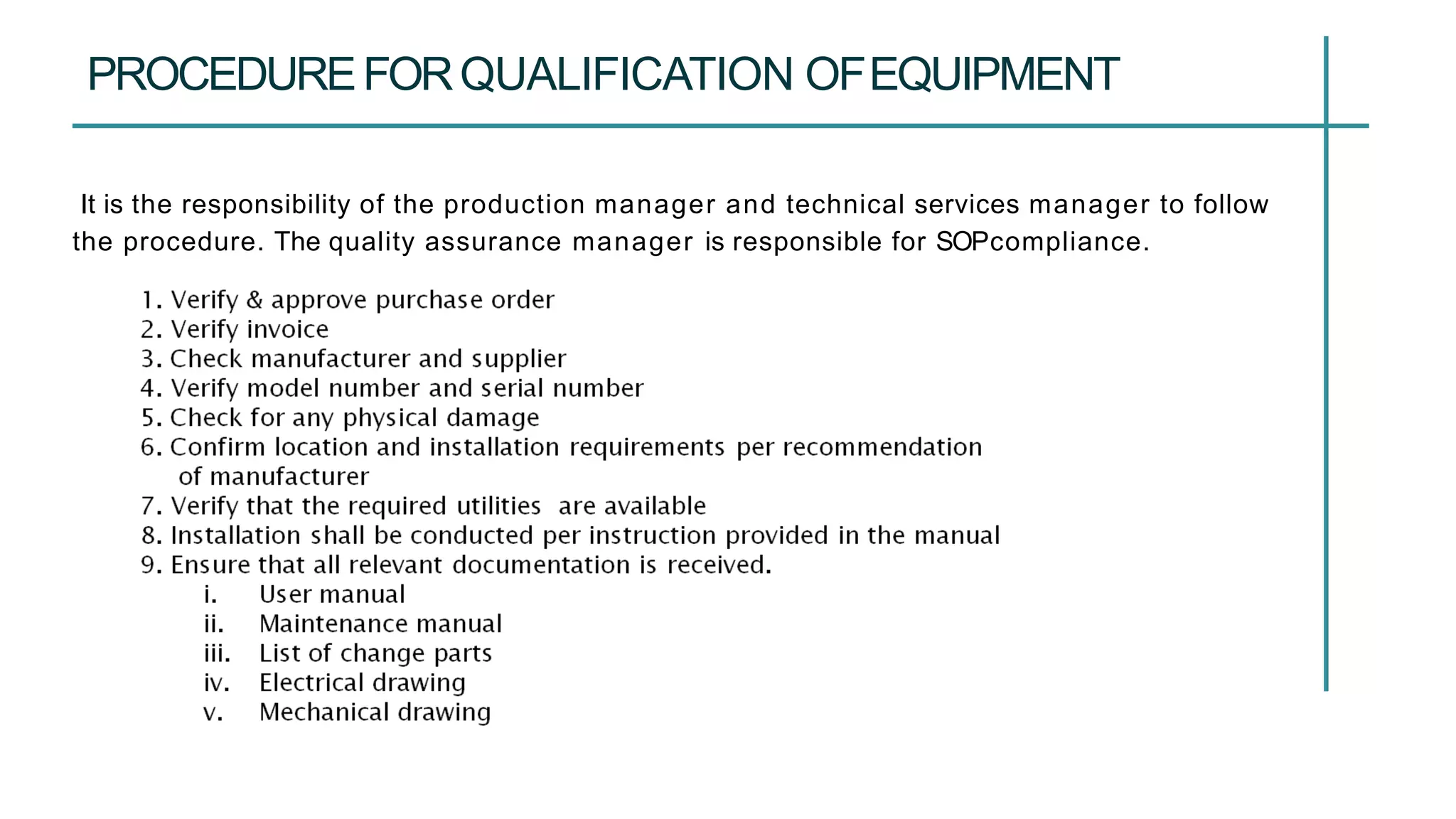
It is the responsibility of the production manager and technical services manager to follow
the procedure. The quality assurance manager is responsible for SOPcompliance.
PROCEDUREFORQUALIFICATION OFEQUIPMENT
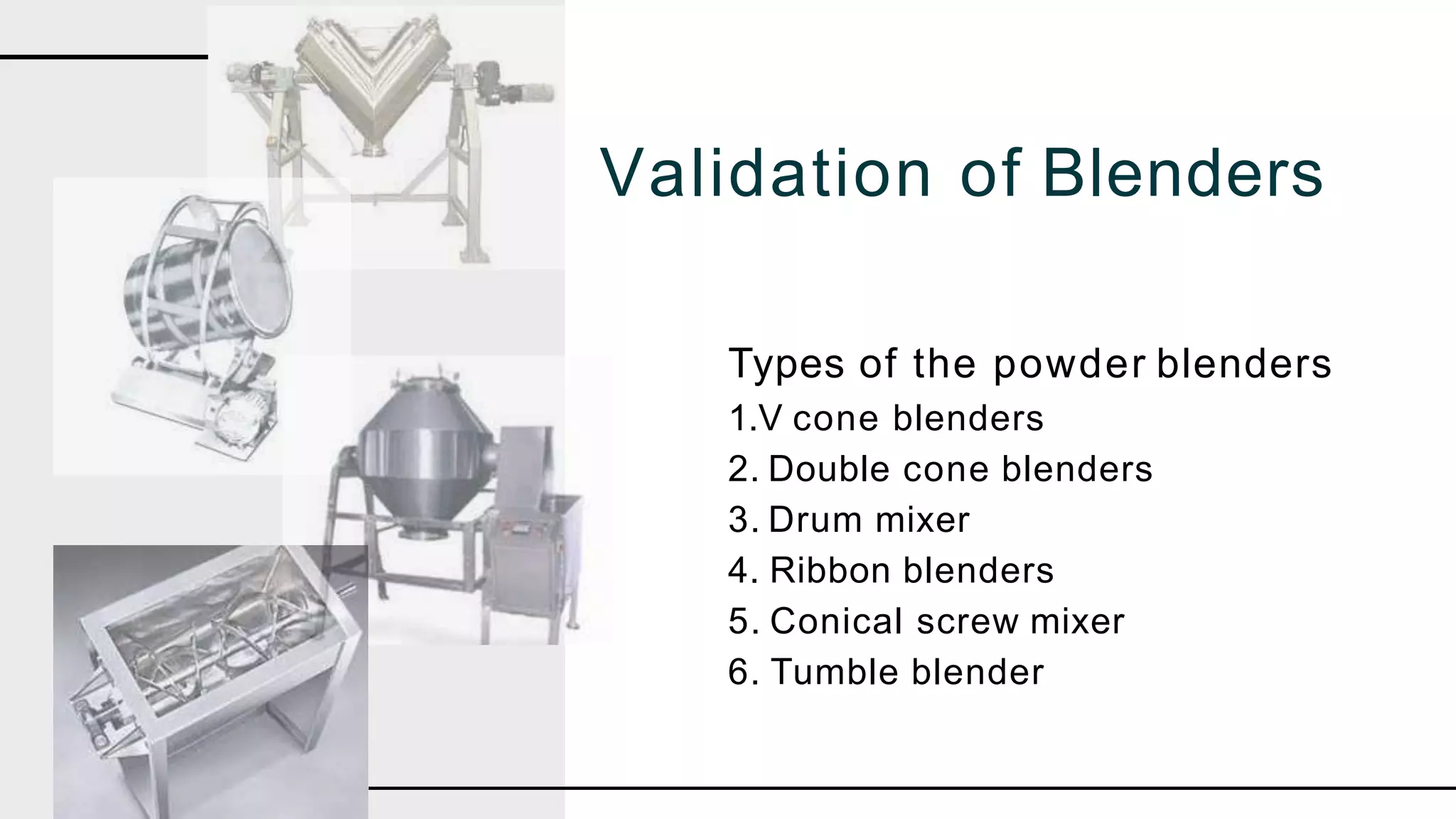
Types of the powder blenders
1.V cone blenders
2. Double cone blenders
3. Drum mixer
4. Ribbon blenders
5. Conical screw mixer
6. Tumble blender
Validation of Blenders
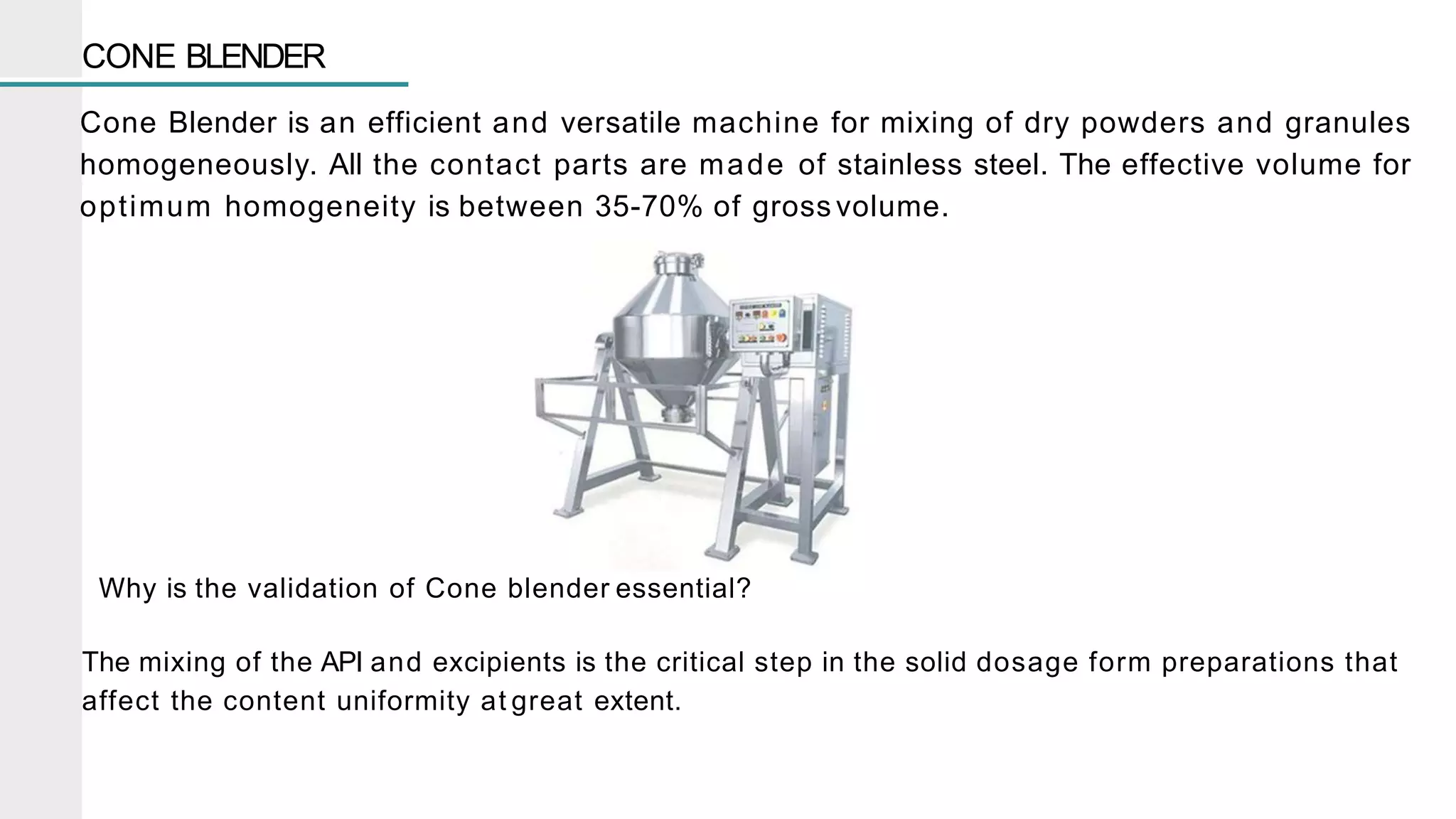
CONE BLENDER
Cone Blender is an efficient and versatile machine for mixing of dry powders and granules
homogeneously. All the contact parts are made of stainless steel. The effective volume for
optimum homogeneity is between 35-70% of gross volume.
Why is the validation of Cone blender essential?
The mixing of the API and excipients is the critical step in the solid dosage form preparations that
affect the content uniformity at great extent.
URSfor the powder Blender
Operating criteria must be adequate
Spares should be available
Easy maintenance
Equipment should not disseminate dust
Low cost
Non reactive surface
Capacity
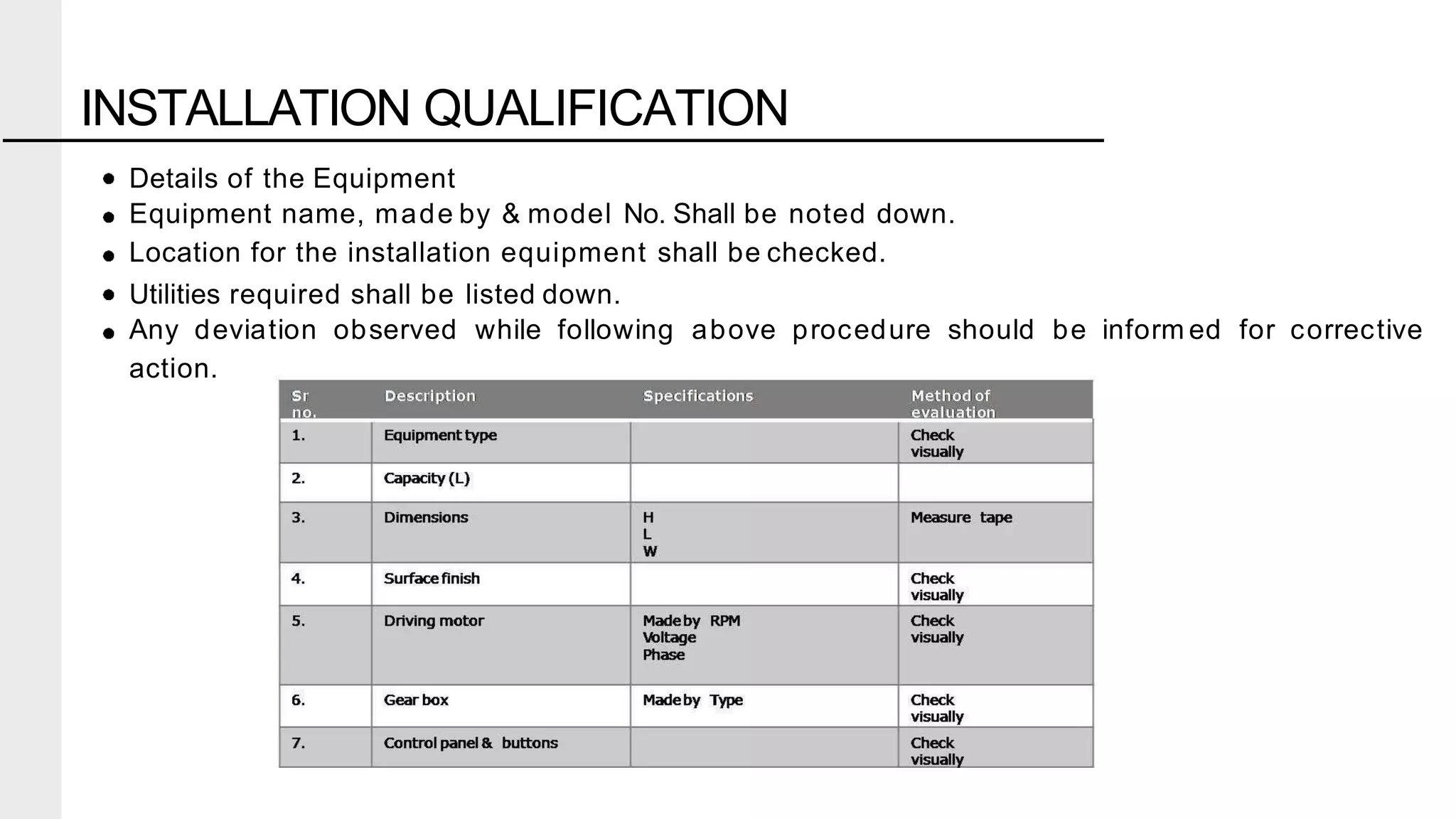
INSTALLATION QUALIFICATION
Details of the Equipment
Equipment name, made by & model No. Shall be noted down.
Location for the installation equipment shall be checked.
Utilities required shall be listed down.
Any deviation observed while following above procedure should be inform ed for corrective
action.
Operational qualification
After completions of successful installation qualification initiate the
actual operation of to ensure that machine is operating within
specification.
Check the operation qualification parameters against their
specifications.
Document the deviation details.
The Quality head and the department head shall decide whether
deviation is acceptable or not.
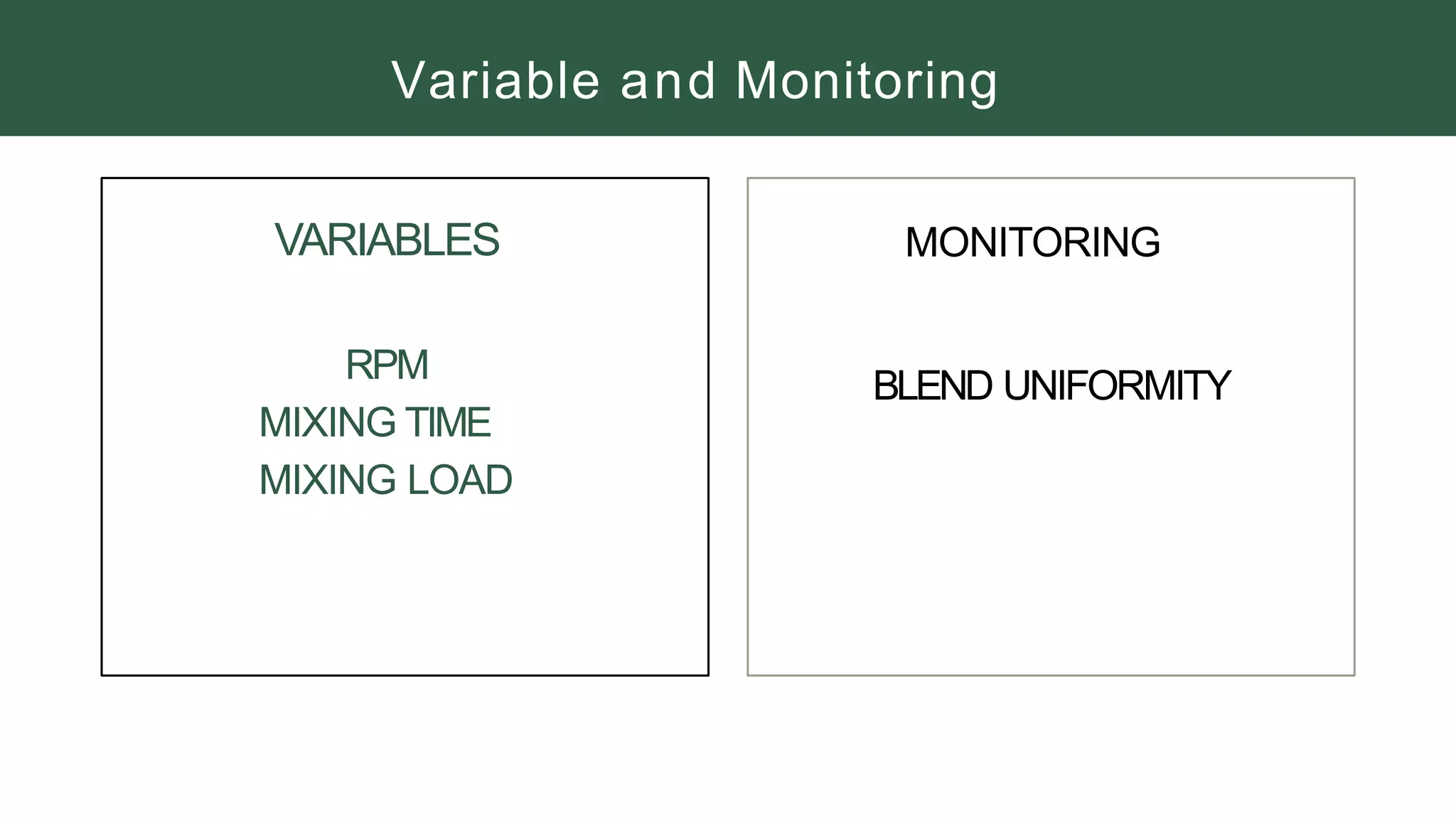
Variable and Monitoring
VARIABLES
RPM
MIXING TIME
MIXING LOAD
MONITORING
BLEND UNIFORMITY
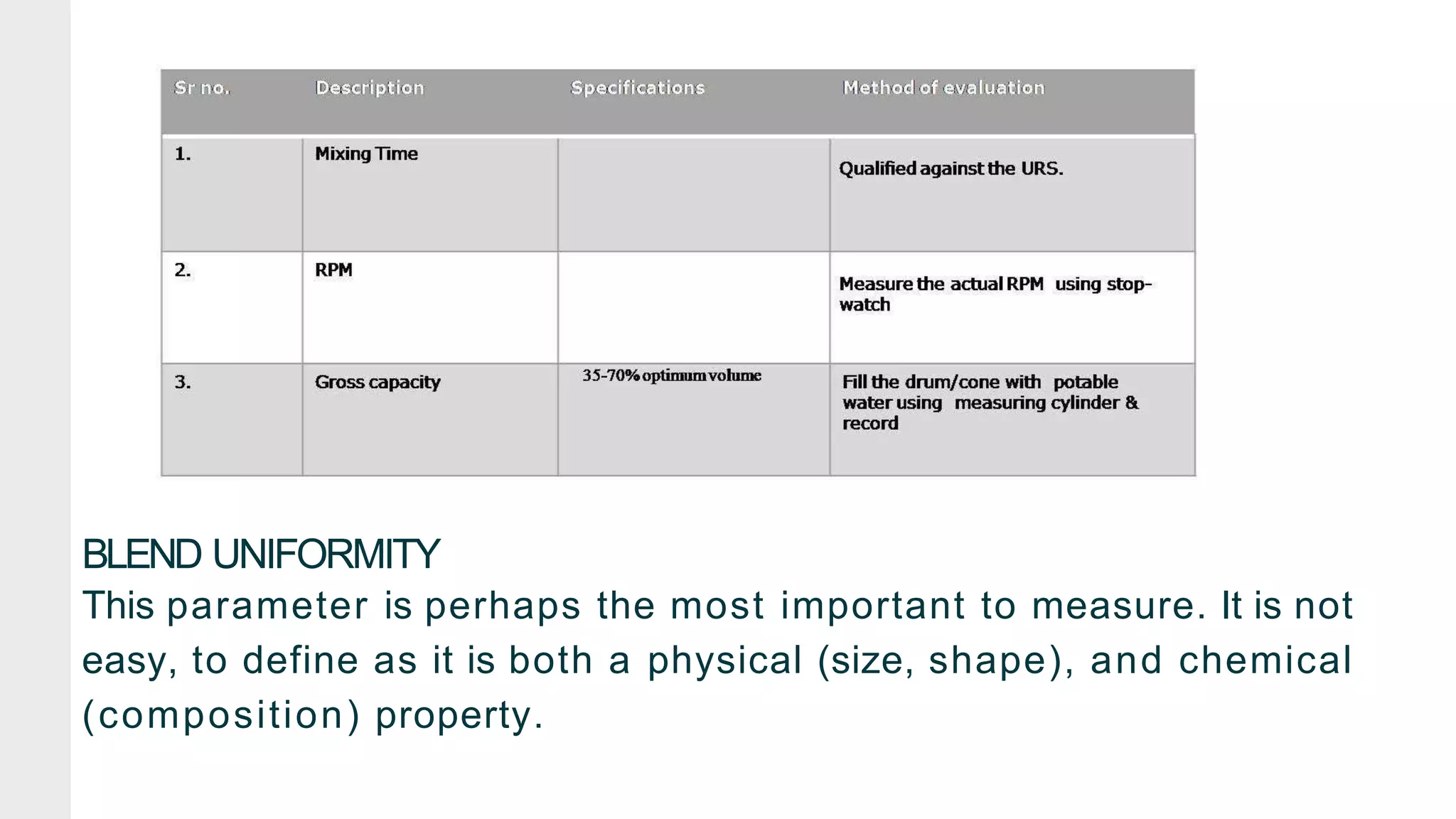
BLEND UNIFORMITY
This parameter is perhaps the most important to measure. It is not
easy, to define as it is both a physical (size, shape), and chemical
(composition) property.
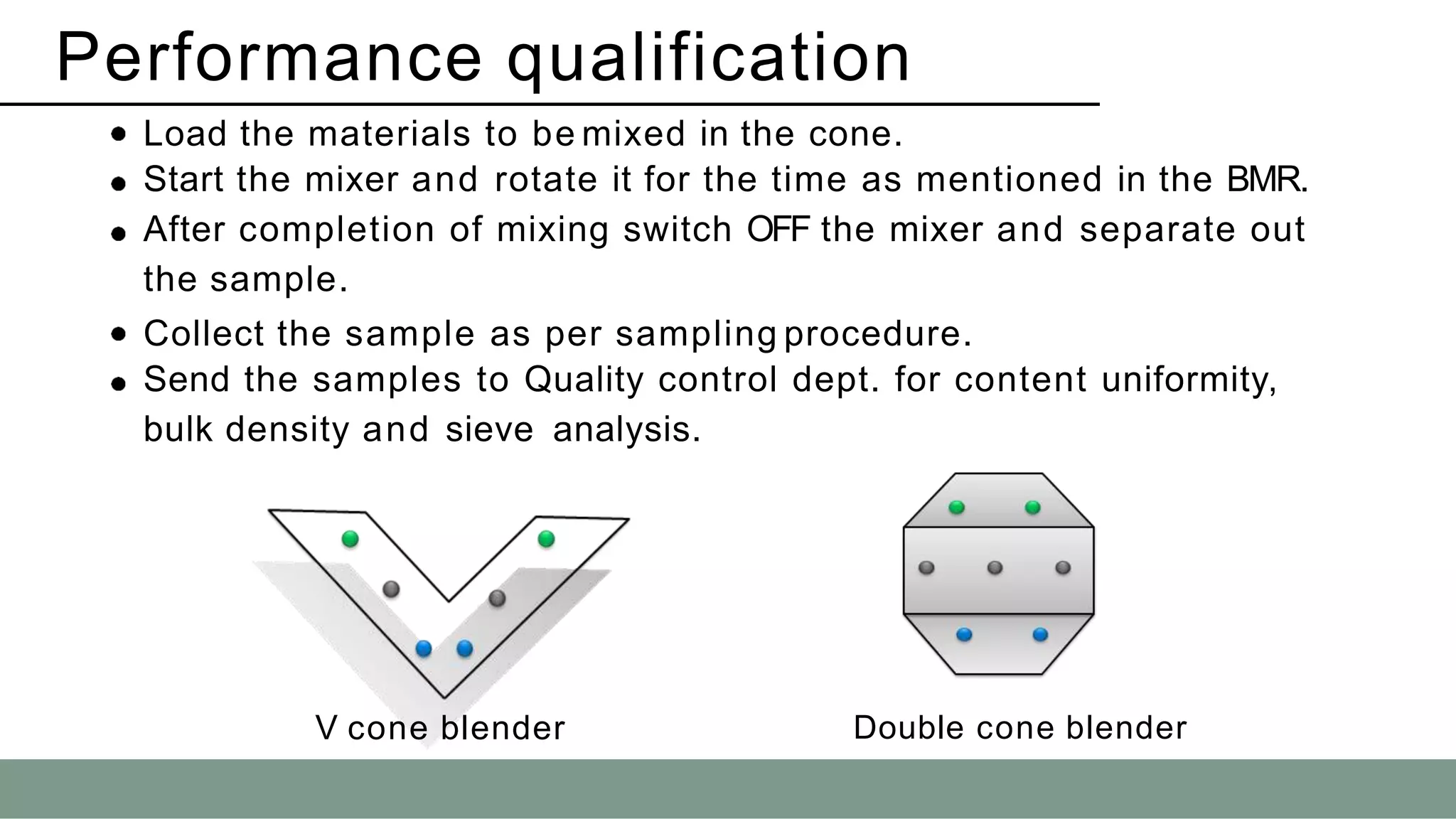
Performance qualification
Load the materials to be mixed in the cone.
Start the mixer and rotate it for the time as mentioned in the BMR.
After completion of mixing switch OFF the mixer and separate out
the sample.
Collect the sample as per sampling procedure.
Send the samples to Quality control dept. for content uniformity,
bulk density and sieve analysis.
V cone blender Double cone blender
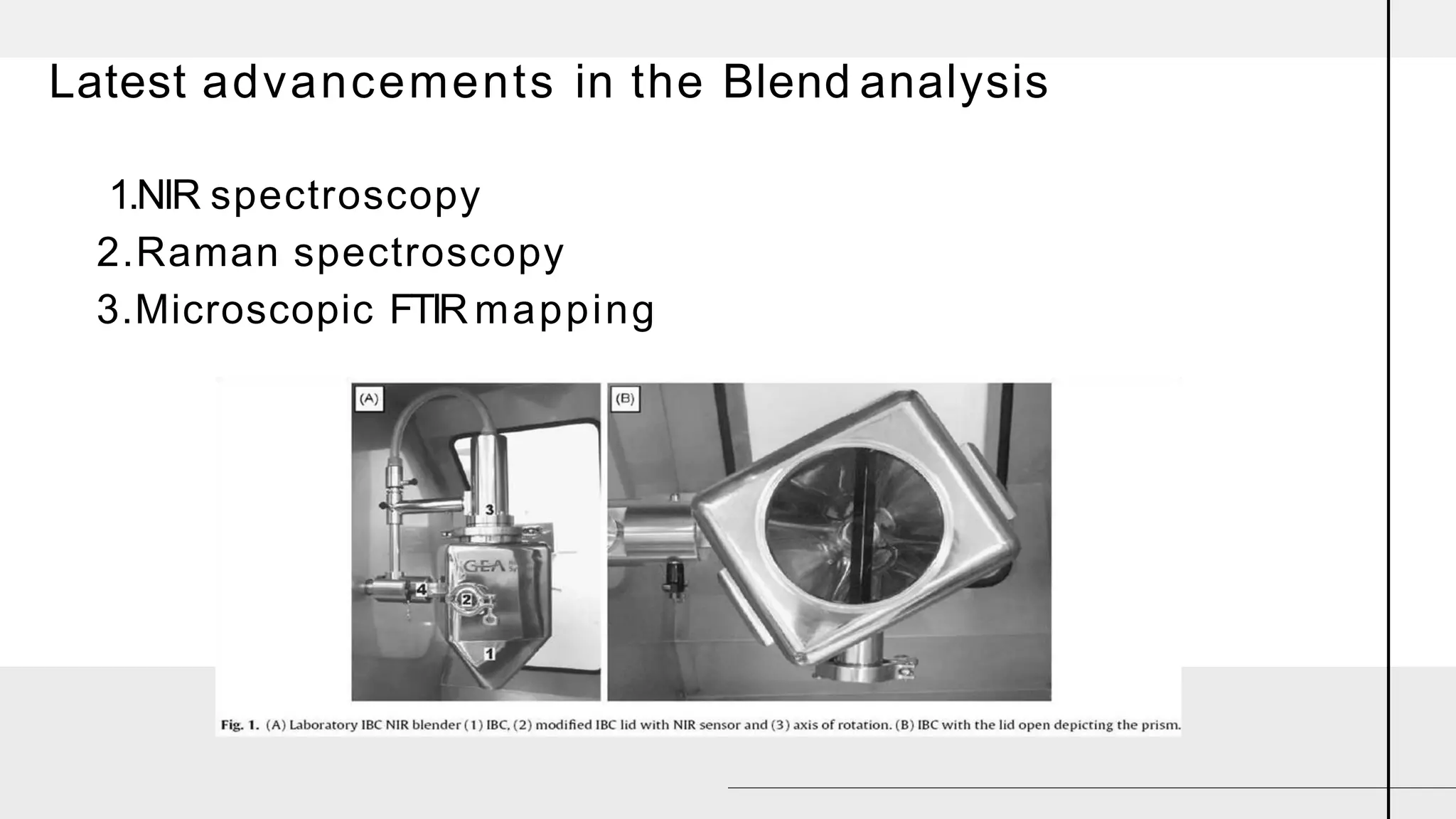
Latest advancements in the Blend analysis
1.NIR spectroscopy
2.Raman spectroscopy
3.Microscopic FTIR mapping
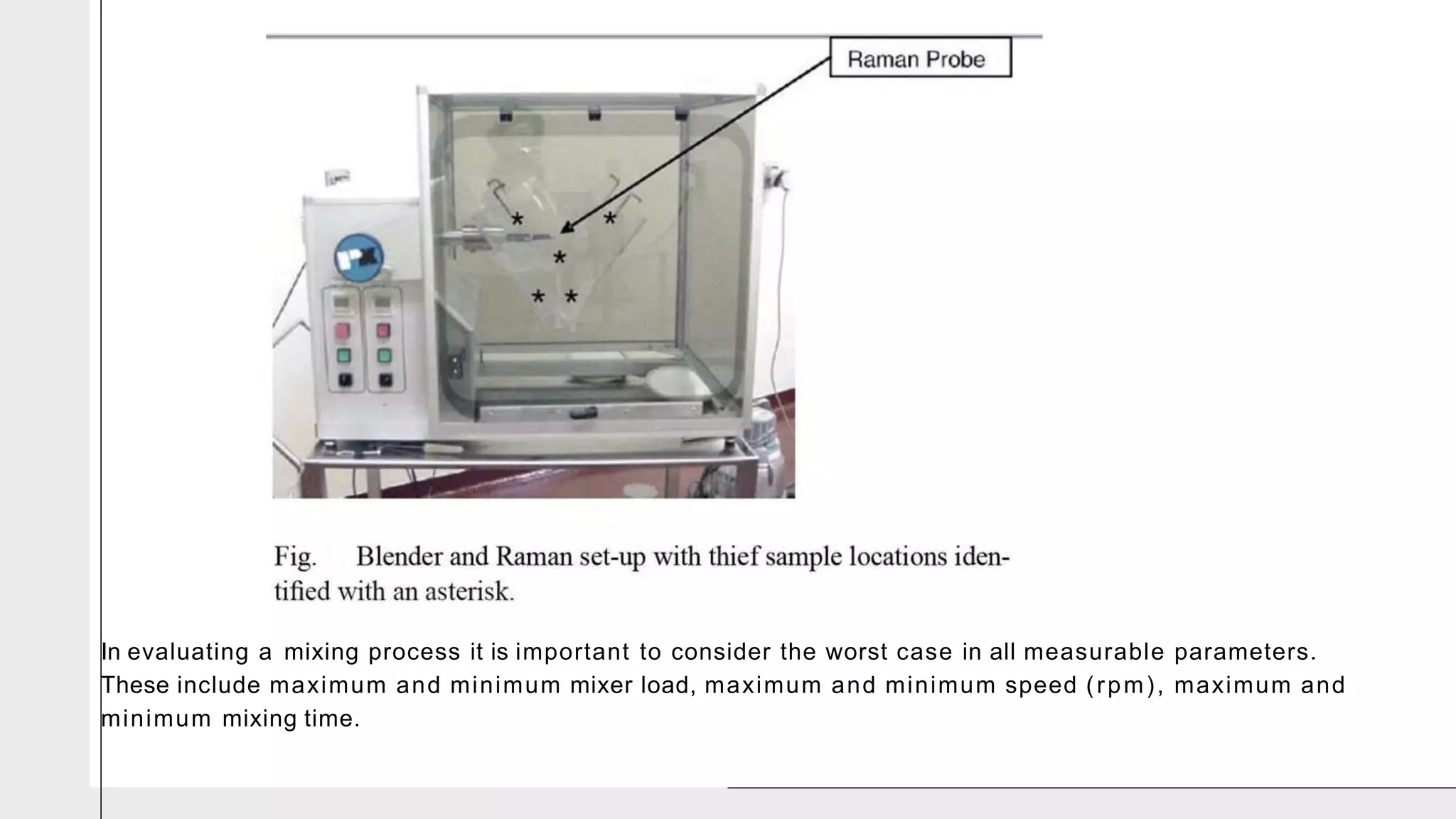
In evaluating a mixing process it is important to consider the worst case in all measurable parameters.
These include maximum and minimum mixer load, maximum and minimum speed (rpm), maximum and
minimum mixing time.
Revalidation Qualification:
Re-validation process is carried out in pharmaceutical industry at
periodic intervals and it is mandatory especially when the company
made any change in the formulas, procedures, manufacturing
systems, packaging, and support system such as electricity/ power
supply, water supply, and steam.
Revalidation criteria
Location of the equipment is changed.
There is change of spare/ parts that have a direct effect on
the performance of the equipment
At normal revalidation schedule.
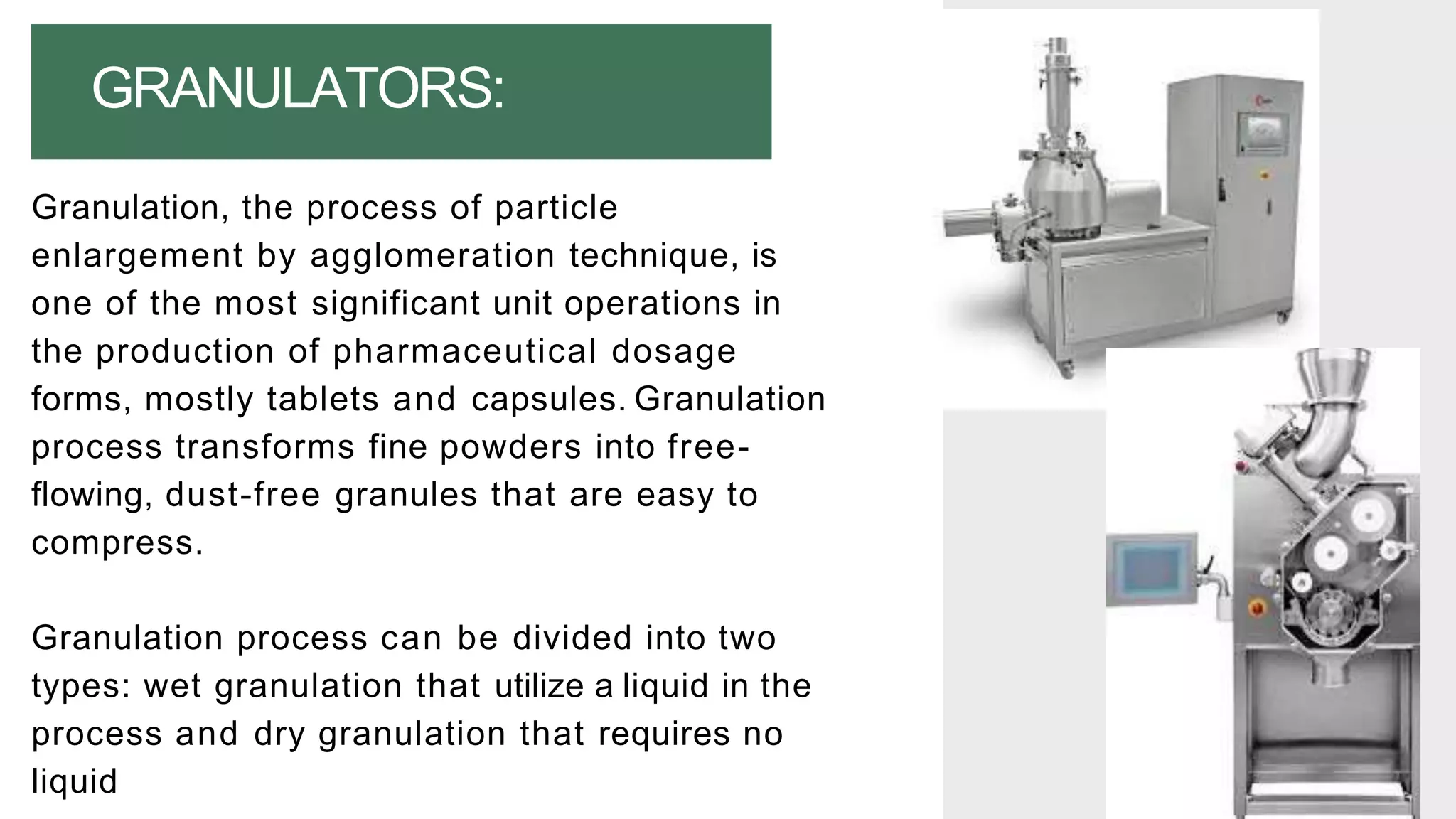
Granulation, the process of particle
enlargement by agglomeration technique, is
one of the most significant unit operations in
the production of pharmaceutical dosage
forms, mostly tablets and capsules. Granulation
process transforms fine powders into free-
flowing, dust-free granules that are easy to
compress.
Granulation process can be divided into two
types: wet granulation that utilize a liquid in the
process and dry granulation that requires no
liquid
GRANULATORS:
Dry granulator
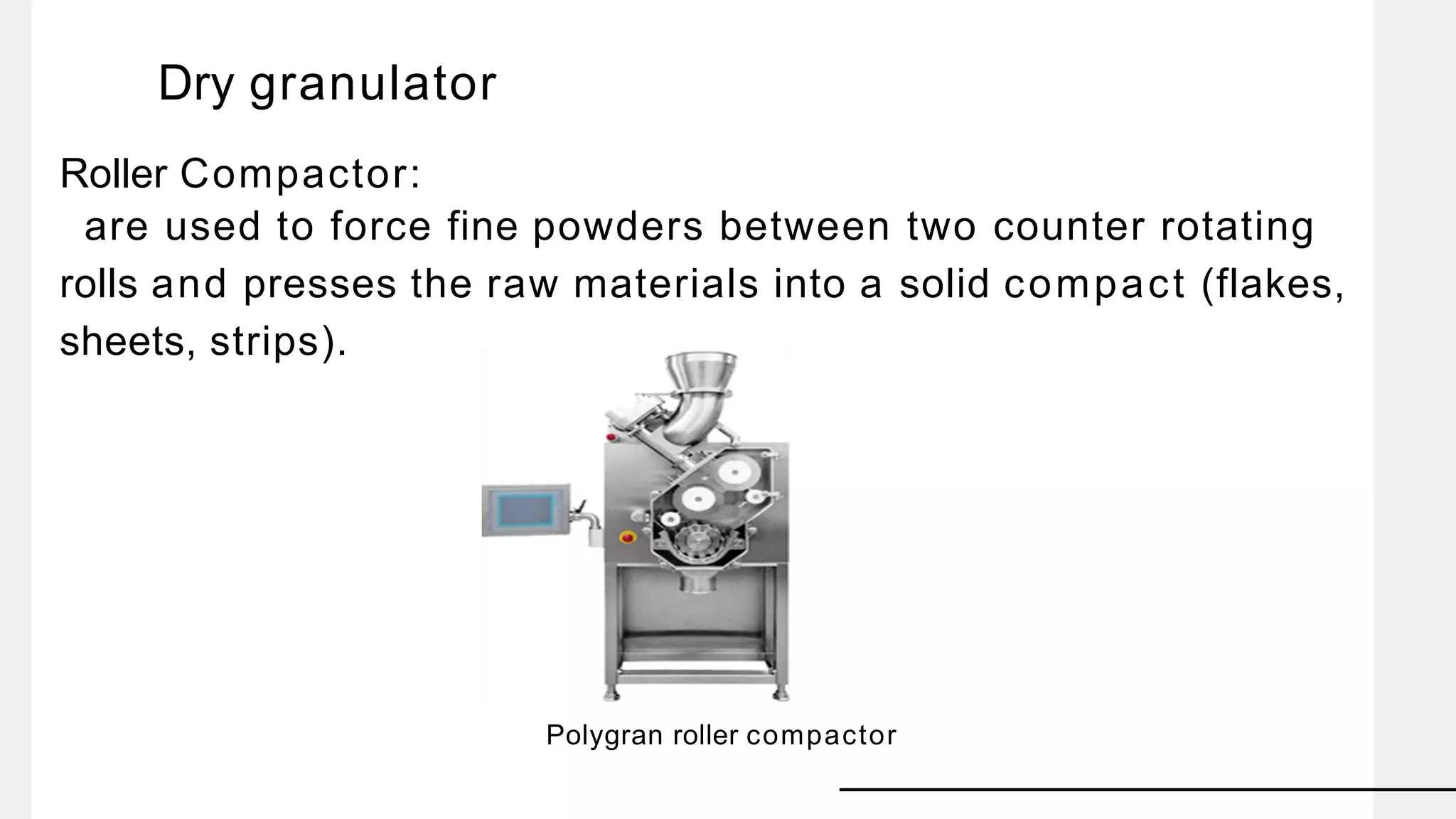
Roller Compactor:
are used to force fine powders between two counter rotating
rolls and presses the raw materials into a solid compact (flakes,
sheets, strips).
Polygran roller compactor
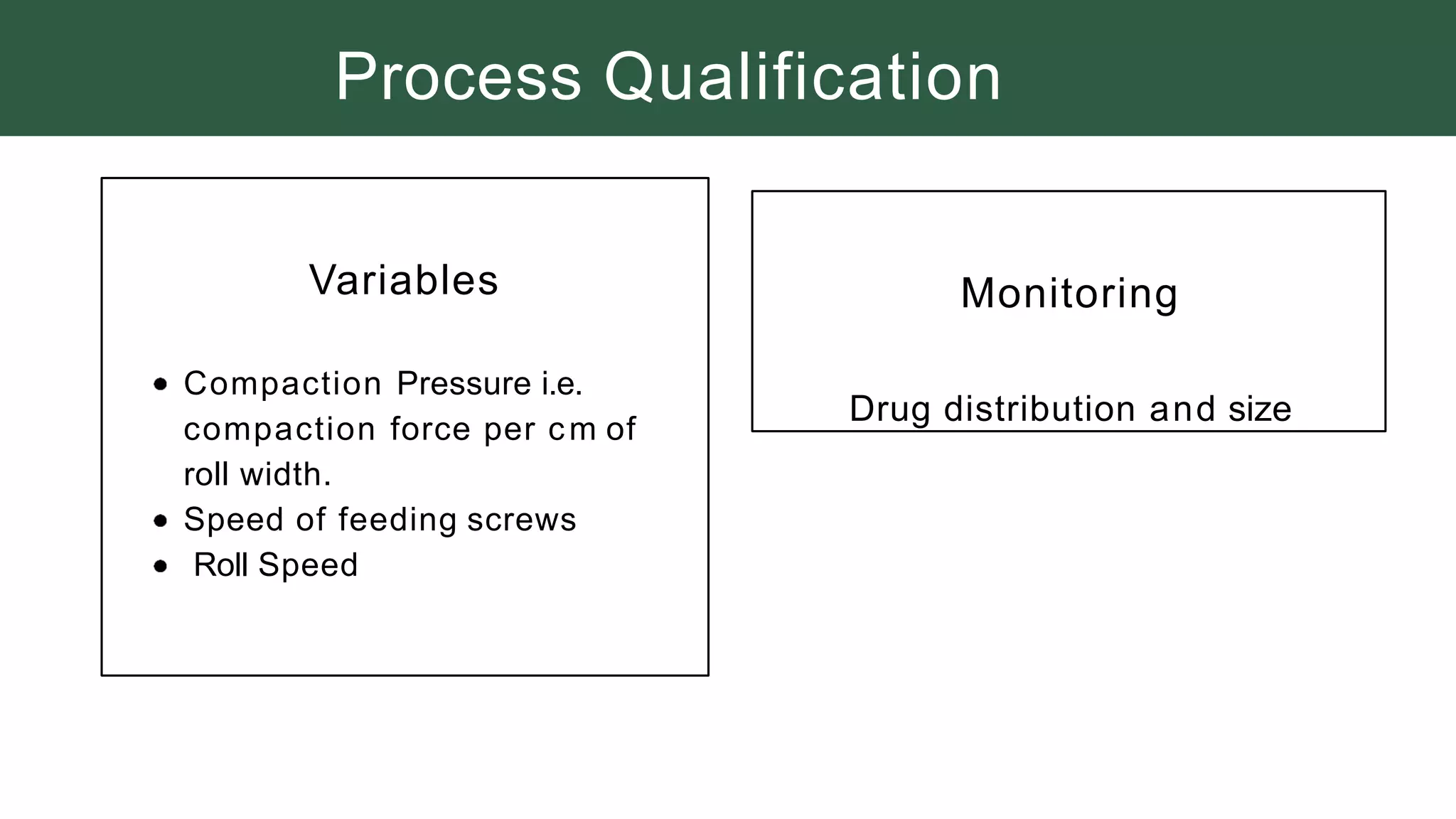
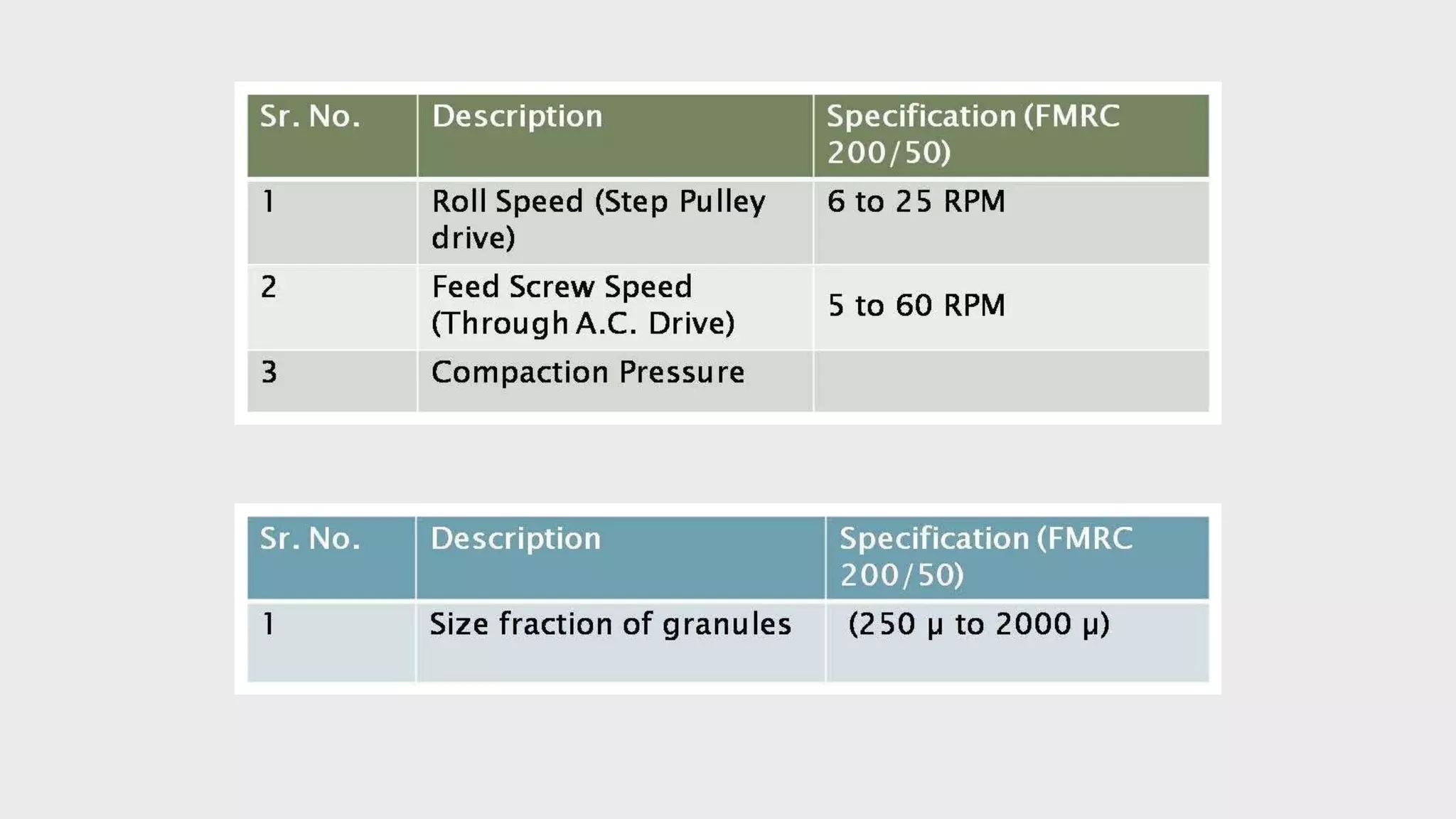
Process Qualification
Variables
Compaction Pressure i.e.
compaction force per cm of
roll width.
Speed of feeding screws
Roll Speed
Monitoring
Drug distribution and size
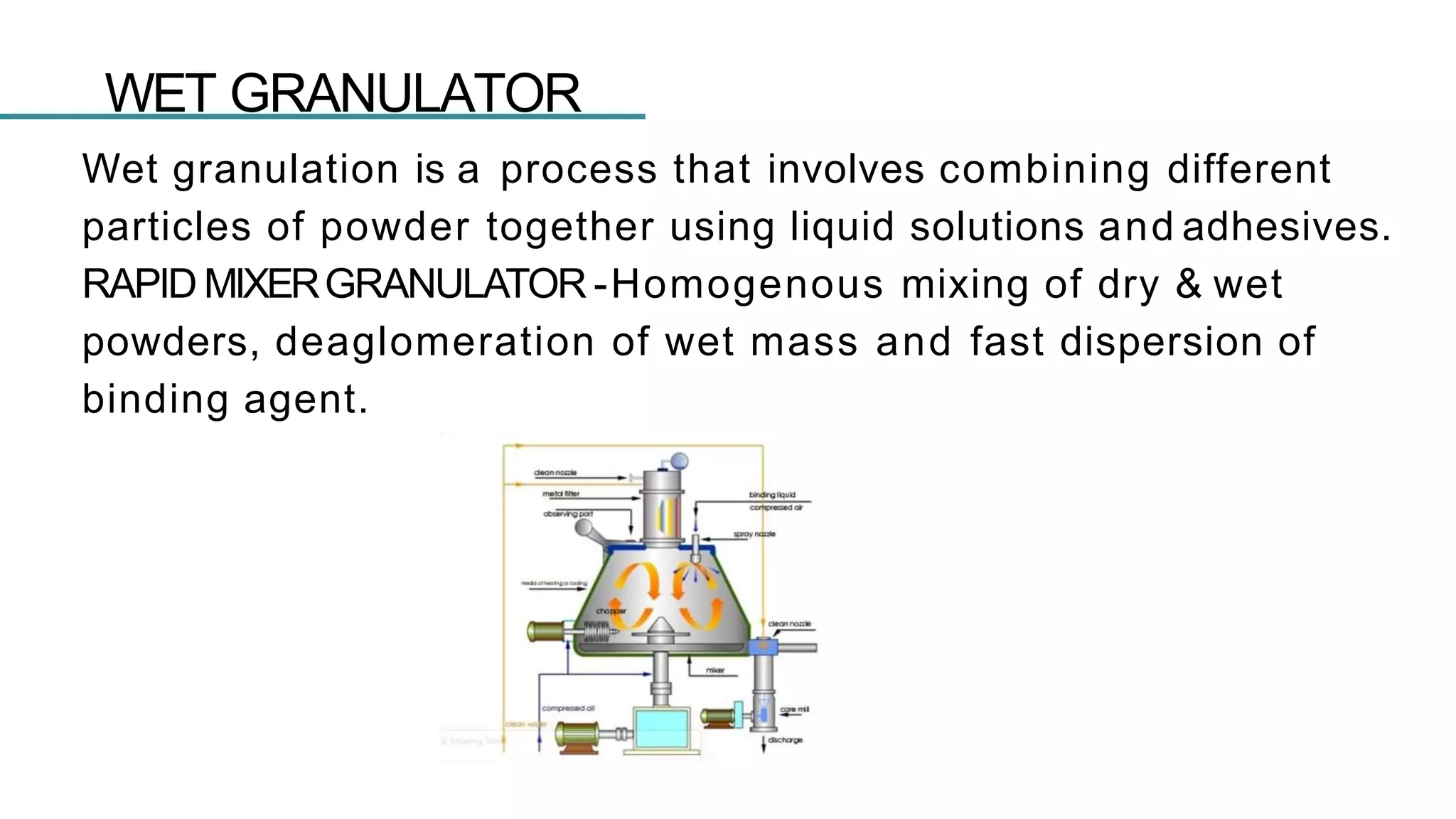
WET GRANULATOR
Wet granulation is a process that involves combining different
particles of powder together using liquid solutions and adhesives.
RAPID MIXERGRANULATOR -Homogenous mixing of dry & wet
powders, deaglomeration of wet mass and fast dispersion of
binding agent.
The installation must meet the manufacturer's specified
guidelines, along with design changes at installation. Also the
supporting electrical utilities must meet all electrical codes.
Equipment identification: Record the equipment identification
number, with equipment manufacturer, purchase order, model
number, and equipment number.
Required Documentation: The manufacturers operation and
maintenance manual and SOPs that coverthe set up.
Utility requirements Power, Water, Compressed air, spraying,
impeller movement, pneumatic discharge port.
Installation Qualification:
Operational Qualification:
Regulators, discharge port opening, spraying button.
Calibration requirements for temp, timer, pressure gauges,
ammeter.
Equipment control functions: Impeller, timer, bowl on/off &
slow/fast buttons.
Emergency, discharge port on/off Alarm, wash down walls
on/off.
Process Qualification
Variables
Mixing speed, Amount of
granulating fluid, Feed
rate
granulation time, Load.
Monitoring
Drug distribution, water
content,
size
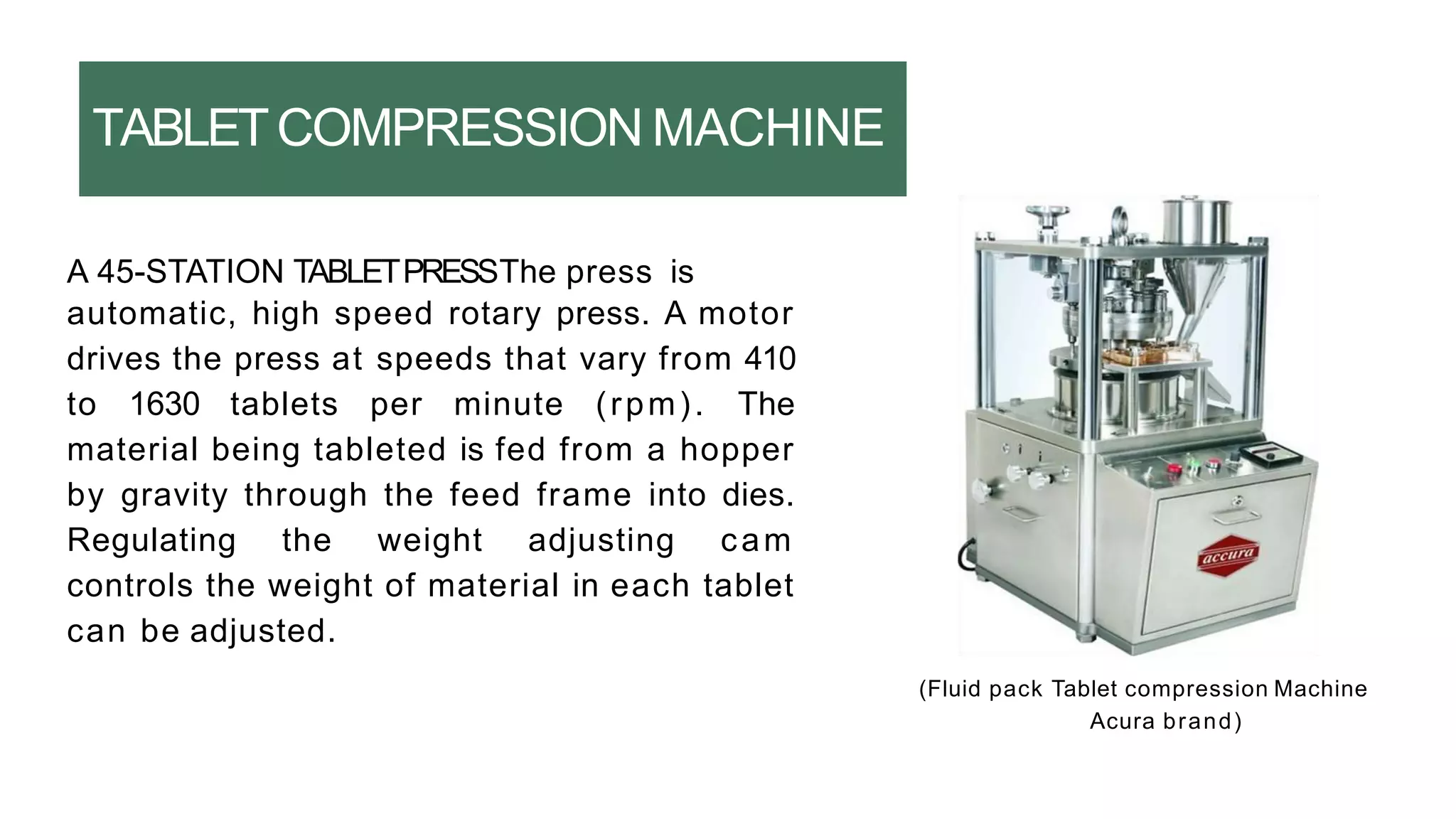
TABLETCOMPRESSION MACHINE
A 45-STATION TABLETPRESSThe press is
automatic, high speed rotary press. A motor
drives the press at speeds that vary from 410
to 1630 tablets per minute (rpm). The
material being tableted is fed from a hopper
by gravity through the feed frame into dies.
Regulating the weight adjusting cam
controls the weight of material in each tablet
can be adjusted.
(Fluid pack Tablet compression Machine
Acura brand)
The supporting electrical utilities must meet all electrical codes.The
information required for an IQ evaluation is
equipment identification
required documentation
equipment utility requirements
major component specifications
component material, lubricants
equipment safety features.
INSTALLATION QUALIFICATION
competitive, w
s
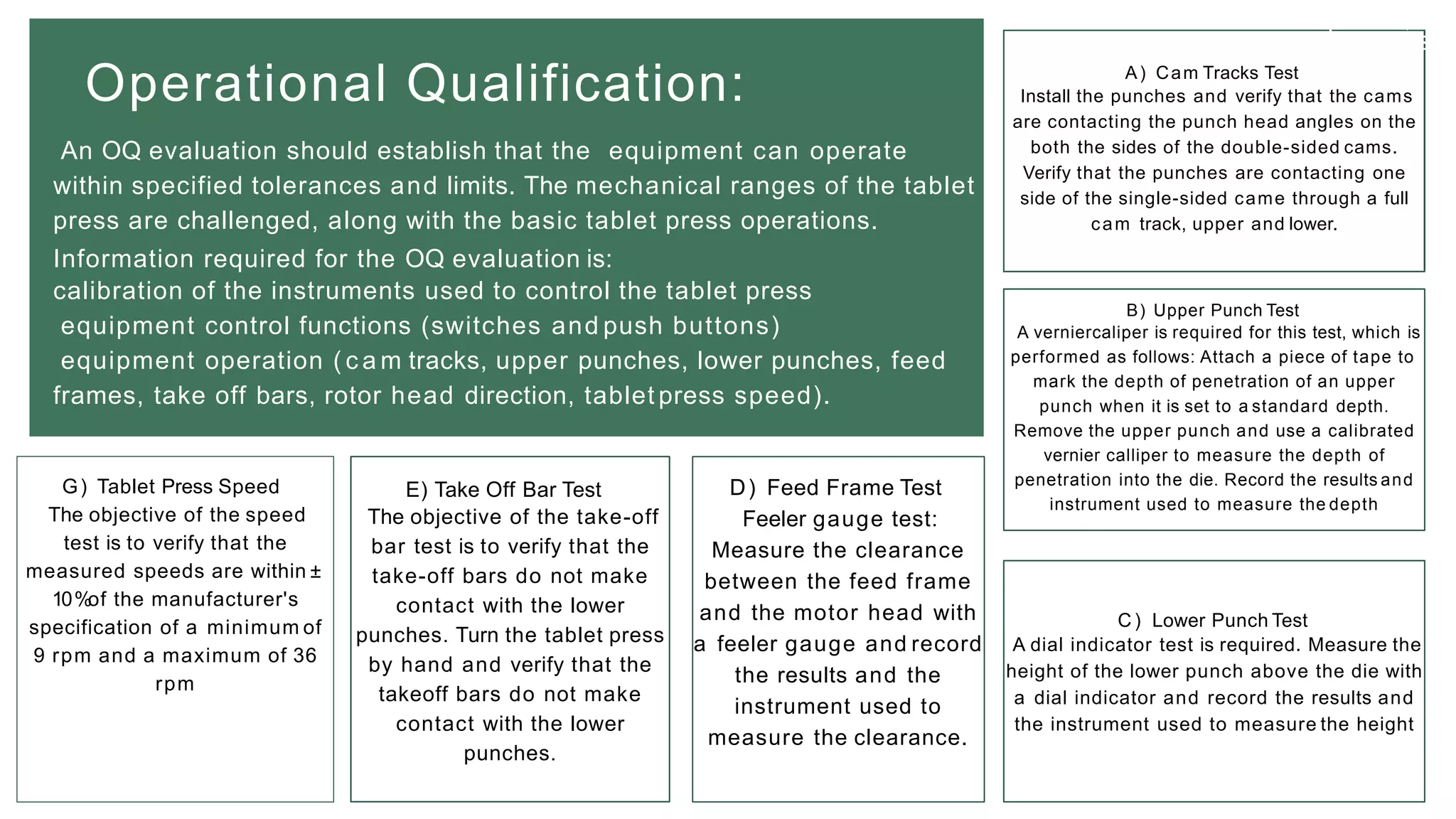
Operational Qualification:
An OQ evaluation should establish that the equipment can operate
within specified tolerances and limits. The mechanical ranges of the tablet
press are challenged, along with the basic tablet press operations.
Information required for the OQ evaluation is:
calibration of the instruments used to control the tablet press
equipment control functions (switches and push buttons)
equipment operation ( c a m tracks, upper punches, lower punches, feed
frames, take off bars, rotor head direction, tablet press speed).
A) Cam Tracks Test
Install the punches and verify that the cams
are contacting the punch head angles on the
both the sides of the double-sided cams.
Verify that the punches are contacting one
side of the single-sided came through a full
cam track, upper and lower.
C) Lower Punch Test
A dial indicator test is required. Measure the
height of the lower punch above the die with
a dial indicator and record the results and
the instrument used to measure the height
B) Upper Punch Test
A verniercaliper is required for this test, which is
performed as follows: Attach a piece of tape to
mark the depth of penetration of an upper
punch when it is set to a standard depth.
Remove the upper punch and use a calibrated
vernier calliper to measure the depth of
penetration into the die. Record the results and
instrument used to measure the depth
D) Feed Frame Test
Feeler gauge test:
Measure the clearance
between the feed frame
and the motor head with
a feeler gauge and record
the results and the
instrument used to
measure the clearance.
E) Take Off Bar Test
The objective of the take-off
bar test is to verify that the
take-off bars do not make
contact with the lower
punches. Turn the tablet press
by hand and verify that the
takeoff bars do not make
contact with the lower
punches.
G) Tablet Press Speed
The objective of the speed
test is to verify that the
measured speeds are within ±
10%
of the manufacturer's
specification of a minimum of
9 rpm and a maximum of 36
rpm
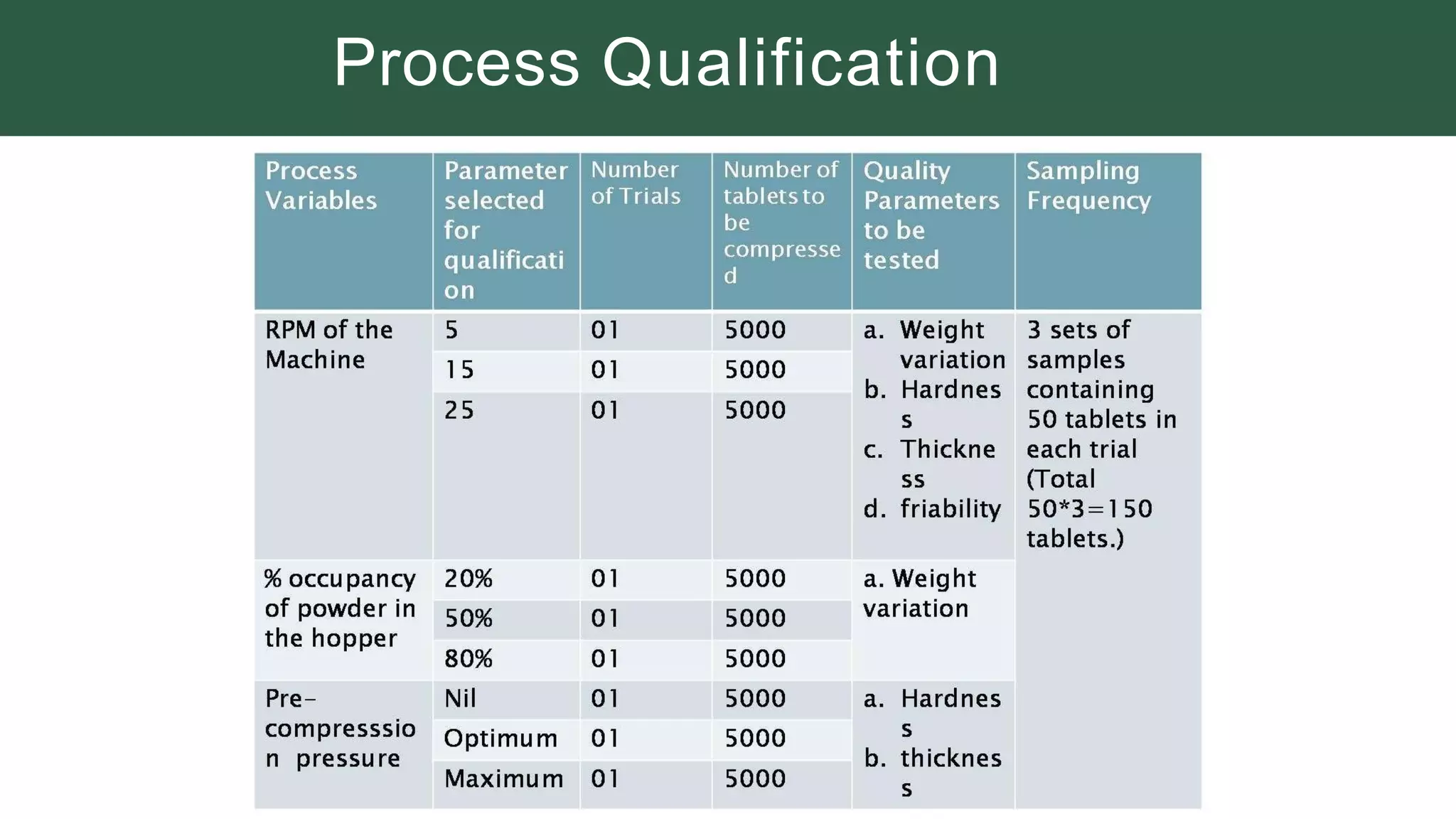
Process Qualification
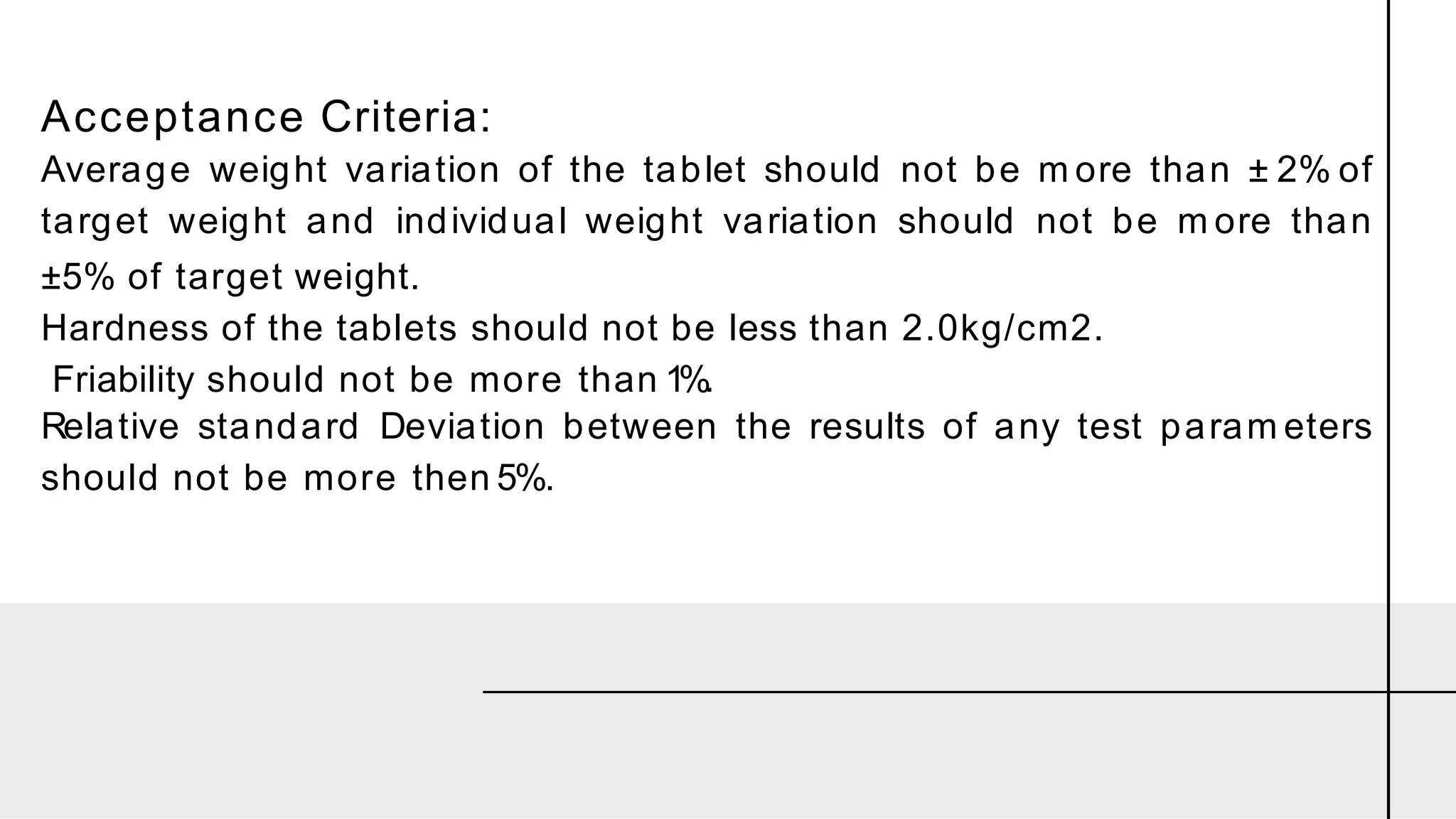
Acceptance Criteria:
Average weight variation of the tablet should not be m ore than ± 2% of
target weight and individual weight variation should not be m ore than
±5% of target weight.
Hardness of the tablets should not be less than 2.0kg/cm2.
Friability should not be more than 1%.
Relative standard Deviation between the results of any test param eters
should not be more then 5%.
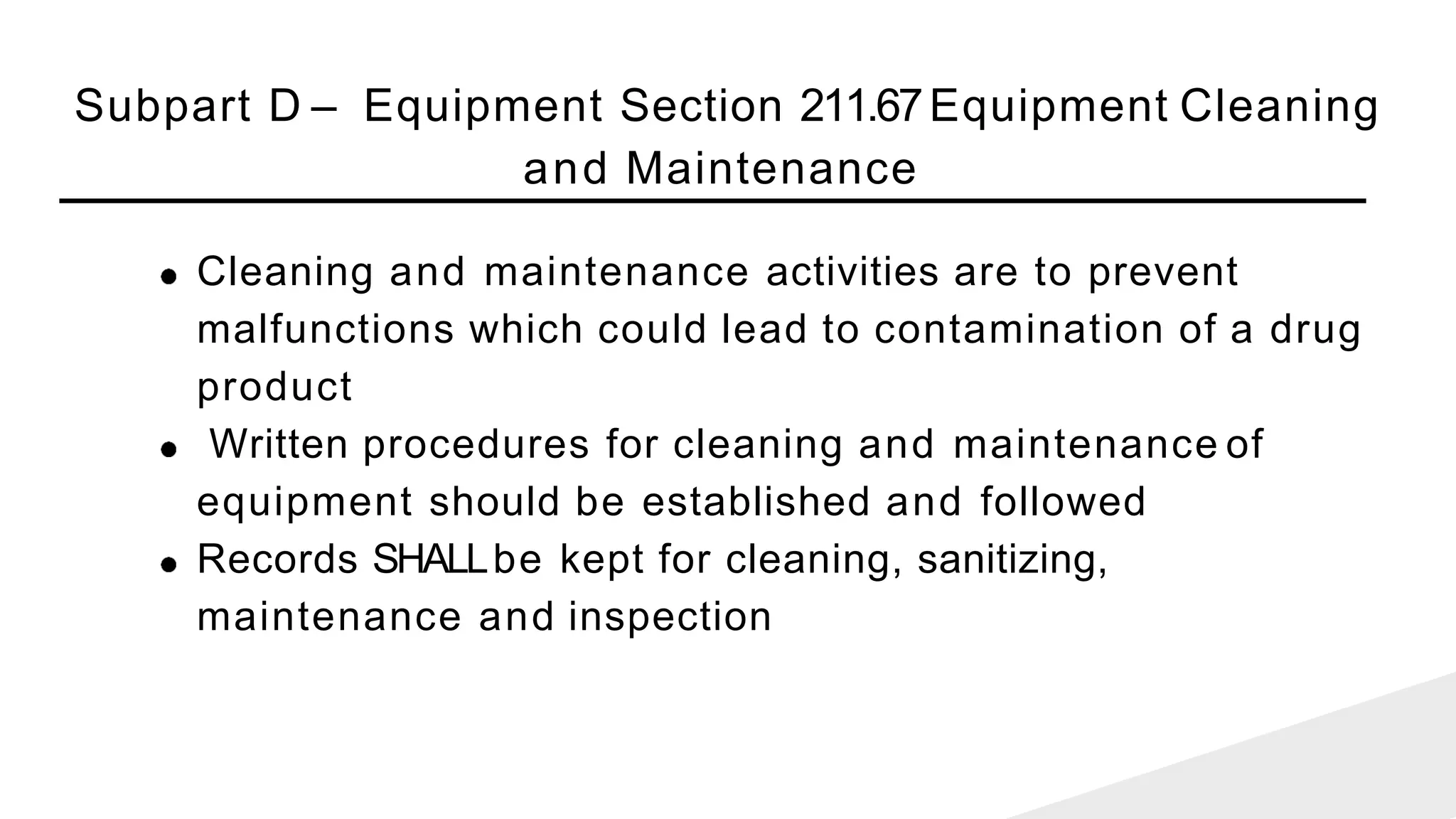
Subpart D – Equipment Section 211.67Equipment Cleaning
and Maintenance
Cleaning and maintenance activities are to prevent
malfunctions which could lead to contamination of a drug
product
Written procedures for cleaning and maintenance of
equipment should be established and followed
Records SHALLbe kept for cleaning, sanitizing,
maintenance and inspection
Increased throughput
Reduction in rejections and reworking
Reduction in utility costs
Avoidance of capital expenditures
Fewer complaints about process-related failures
Reduced testing in-process and in finished goods
More rapid and reliable start-up of new equipment
Easier scale-up from development work
Easier maintenance of equipment
Improved employee awareness of processes
More rapid automation
Application of Validation of equipments
Validation is an important process to ensure the safety,
reproducibility and purity of a substance.
Equipment Validation helps in obtaining reproducible results
as well as optimisation.
Equipment validation mainly operates in 4 parts DESIGN
VALIDATION, INSTALLATION VALIDATION, OPERATIONAL
VALIDATION and PERFORMANCE VALIDATION.
SUMMARY
THANK YOU

Validation of cone blender, mixer granulator and tablet compression machine.

  • 1.
    Validation of coneblender, mixer granulator and tablet compression machine Presented by Ms. Mayuri Ghavate (M.Pharm Pharmaceutics)
  • 2.
    MAIN TOPICS POINTS TOTALK ABOUT To understand validation of equipments. Validation of powder blenders mixers granulators tablet compression machine
  • 3.
    Validation is theprocess of establishing documentary evidence demonstrating that a procedure, process, or activity carried out in testing and then production maintains the desired level of compliance at all stage. The validation concept was first proposed by the Food and Drug Administration (FDA) in the mid-1970s to improve the quality of pharmaceutical products
  • 4.
    EQUIPMENT VALIDATION The processof equipment validation is based on the principle that equipment must be designed, constructed, maintained, and adapted to perform the operations which are to be carried out. Equipment validation is Vital for- • Safety. • Fewer interruptions of work. • Reduction of variation in results. • Greater confidence in the reliability of results.
  • 5.
    PHASESOF EQUIPMENT VALIDATION 1.DesignQualification • User requirement specification • Functional specification • Operational specification • Vendor specification 2. Installation Qualification • Arrival Qualification • Installation of hardware and software Pre- Validation Phase Process Validation Phase 1.Operational Qualification • Testing of Operational functions. • Testing of Security function 2. Performance Qualification • On-going performance testing • Testing for specified applications 3. Revalidation Validation Maintenance Phase routine servicing and necessary repairs.
  • 6.
    It is theresponsibility of the production manager and technical services manager to follow the procedure. The quality assurance manager is responsible for SOPcompliance. PROCEDUREFORQUALIFICATION OFEQUIPMENT
  • 7.
    Types of thepowder blenders 1.V cone blenders 2. Double cone blenders 3. Drum mixer 4. Ribbon blenders 5. Conical screw mixer 6. Tumble blender Validation of Blenders
  • 8.
    CONE BLENDER Cone Blenderis an efficient and versatile machine for mixing of dry powders and granules homogeneously. All the contact parts are made of stainless steel. The effective volume for optimum homogeneity is between 35-70% of gross volume. Why is the validation of Cone blender essential? The mixing of the API and excipients is the critical step in the solid dosage form preparations that affect the content uniformity at great extent.
  • 9.
    URSfor the powderBlender Operating criteria must be adequate Spares should be available Easy maintenance Equipment should not disseminate dust Low cost Non reactive surface Capacity
  • 10.
    INSTALLATION QUALIFICATION Details ofthe Equipment Equipment name, made by & model No. Shall be noted down. Location for the installation equipment shall be checked. Utilities required shall be listed down. Any deviation observed while following above procedure should be inform ed for corrective action.
  • 11.
    Operational qualification After completionsof successful installation qualification initiate the actual operation of to ensure that machine is operating within specification. Check the operation qualification parameters against their specifications. Document the deviation details. The Quality head and the department head shall decide whether deviation is acceptable or not.
  • 12.
    Variable and Monitoring VARIABLES RPM MIXINGTIME MIXING LOAD MONITORING BLEND UNIFORMITY
  • 13.
    BLEND UNIFORMITY This parameteris perhaps the most important to measure. It is not easy, to define as it is both a physical (size, shape), and chemical (composition) property.
  • 14.
    Performance qualification Load thematerials to be mixed in the cone. Start the mixer and rotate it for the time as mentioned in the BMR. After completion of mixing switch OFF the mixer and separate out the sample. Collect the sample as per sampling procedure. Send the samples to Quality control dept. for content uniformity, bulk density and sieve analysis. V cone blender Double cone blender
  • 15.
    Latest advancements inthe Blend analysis 1.NIR spectroscopy 2.Raman spectroscopy 3.Microscopic FTIR mapping
  • 16.
    In evaluating amixing process it is important to consider the worst case in all measurable parameters. These include maximum and minimum mixer load, maximum and minimum speed (rpm), maximum and minimum mixing time.
  • 17.
    Revalidation Qualification: Re-validation processis carried out in pharmaceutical industry at periodic intervals and it is mandatory especially when the company made any change in the formulas, procedures, manufacturing systems, packaging, and support system such as electricity/ power supply, water supply, and steam. Revalidation criteria Location of the equipment is changed. There is change of spare/ parts that have a direct effect on the performance of the equipment At normal revalidation schedule.
  • 18.
    Granulation, the processof particle enlargement by agglomeration technique, is one of the most significant unit operations in the production of pharmaceutical dosage forms, mostly tablets and capsules. Granulation process transforms fine powders into free- flowing, dust-free granules that are easy to compress. Granulation process can be divided into two types: wet granulation that utilize a liquid in the process and dry granulation that requires no liquid GRANULATORS:
  • 19.
    Dry granulator Roller Compactor: areused to force fine powders between two counter rotating rolls and presses the raw materials into a solid compact (flakes, sheets, strips). Polygran roller compactor
  • 20.
    Process Qualification Variables Compaction Pressurei.e. compaction force per cm of roll width. Speed of feeding screws Roll Speed Monitoring Drug distribution and size
  • 22.
    WET GRANULATOR Wet granulationis a process that involves combining different particles of powder together using liquid solutions and adhesives. RAPID MIXERGRANULATOR -Homogenous mixing of dry & wet powders, deaglomeration of wet mass and fast dispersion of binding agent.
  • 23.
    The installation mustmeet the manufacturer's specified guidelines, along with design changes at installation. Also the supporting electrical utilities must meet all electrical codes. Equipment identification: Record the equipment identification number, with equipment manufacturer, purchase order, model number, and equipment number. Required Documentation: The manufacturers operation and maintenance manual and SOPs that coverthe set up. Utility requirements Power, Water, Compressed air, spraying, impeller movement, pneumatic discharge port. Installation Qualification:
  • 24.
    Operational Qualification: Regulators, dischargeport opening, spraying button. Calibration requirements for temp, timer, pressure gauges, ammeter. Equipment control functions: Impeller, timer, bowl on/off & slow/fast buttons. Emergency, discharge port on/off Alarm, wash down walls on/off.
  • 25.
    Process Qualification Variables Mixing speed,Amount of granulating fluid, Feed rate granulation time, Load. Monitoring Drug distribution, water content, size
  • 26.
    TABLETCOMPRESSION MACHINE A 45-STATIONTABLETPRESSThe press is automatic, high speed rotary press. A motor drives the press at speeds that vary from 410 to 1630 tablets per minute (rpm). The material being tableted is fed from a hopper by gravity through the feed frame into dies. Regulating the weight adjusting cam controls the weight of material in each tablet can be adjusted. (Fluid pack Tablet compression Machine Acura brand)
  • 27.
    The supporting electricalutilities must meet all electrical codes.The information required for an IQ evaluation is equipment identification required documentation equipment utility requirements major component specifications component material, lubricants equipment safety features. INSTALLATION QUALIFICATION
  • 28.
    competitive, w s Operational Qualification: AnOQ evaluation should establish that the equipment can operate within specified tolerances and limits. The mechanical ranges of the tablet press are challenged, along with the basic tablet press operations. Information required for the OQ evaluation is: calibration of the instruments used to control the tablet press equipment control functions (switches and push buttons) equipment operation ( c a m tracks, upper punches, lower punches, feed frames, take off bars, rotor head direction, tablet press speed). A) Cam Tracks Test Install the punches and verify that the cams are contacting the punch head angles on the both the sides of the double-sided cams. Verify that the punches are contacting one side of the single-sided came through a full cam track, upper and lower. C) Lower Punch Test A dial indicator test is required. Measure the height of the lower punch above the die with a dial indicator and record the results and the instrument used to measure the height B) Upper Punch Test A verniercaliper is required for this test, which is performed as follows: Attach a piece of tape to mark the depth of penetration of an upper punch when it is set to a standard depth. Remove the upper punch and use a calibrated vernier calliper to measure the depth of penetration into the die. Record the results and instrument used to measure the depth D) Feed Frame Test Feeler gauge test: Measure the clearance between the feed frame and the motor head with a feeler gauge and record the results and the instrument used to measure the clearance. E) Take Off Bar Test The objective of the take-off bar test is to verify that the take-off bars do not make contact with the lower punches. Turn the tablet press by hand and verify that the takeoff bars do not make contact with the lower punches. G) Tablet Press Speed The objective of the speed test is to verify that the measured speeds are within ± 10% of the manufacturer's specification of a minimum of 9 rpm and a maximum of 36 rpm
  • 29.
  • 30.
    Acceptance Criteria: Average weightvariation of the tablet should not be m ore than ± 2% of target weight and individual weight variation should not be m ore than ±5% of target weight. Hardness of the tablets should not be less than 2.0kg/cm2. Friability should not be more than 1%. Relative standard Deviation between the results of any test param eters should not be more then 5%.
  • 31.
    Subpart D –Equipment Section 211.67Equipment Cleaning and Maintenance Cleaning and maintenance activities are to prevent malfunctions which could lead to contamination of a drug product Written procedures for cleaning and maintenance of equipment should be established and followed Records SHALLbe kept for cleaning, sanitizing, maintenance and inspection
  • 32.
    Increased throughput Reduction inrejections and reworking Reduction in utility costs Avoidance of capital expenditures Fewer complaints about process-related failures Reduced testing in-process and in finished goods More rapid and reliable start-up of new equipment Easier scale-up from development work Easier maintenance of equipment Improved employee awareness of processes More rapid automation Application of Validation of equipments
  • 33.
    Validation is animportant process to ensure the safety, reproducibility and purity of a substance. Equipment Validation helps in obtaining reproducible results as well as optimisation. Equipment validation mainly operates in 4 parts DESIGN VALIDATION, INSTALLATION VALIDATION, OPERATIONAL VALIDATION and PERFORMANCE VALIDATION. SUMMARY
  • 34.