Process Validation of oral solid dosage form
(Tablet)1
PROCESS VALIDATION OF
ORAL SOLID DOSAGE FORM
(TABLET)
PREPARED BY :-
BHASKAR DEWANGAN
B. Pharmacy
Institute Of Pharmacy
Pt. R. S. University,
Raipur(C.G.)
DEFINITION
Process Validation of oral solid dosage form
(Tablet)2
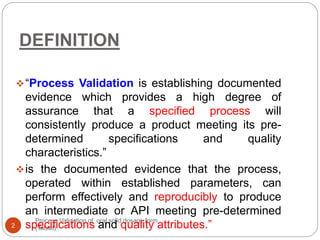
“Process Validation is establishing documented
evidence which provides a high degree of
assurance that a specified process will
consistently produce a product meeting its pre-
determined specifications and quality
characteristics.”
is the documented evidence that the process,
operated within established parameters, can
perform effectively and reproducibly to produce
an intermediate or API meeting pre-determined
specifications and quality attributes.”
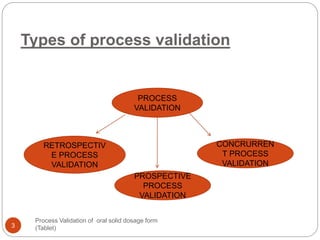
Types of process validation
Process Validation of oral solid dosage form
(Tablet)3
PROCESS
VALIDATION
RETROSPECTIV
E PROCESS
VALIDATION
PROSPECTIVE
PROCESS
VALIDATION
CONCRURREN
T PROCESS
VALIDATION
Definitions
Process Validation of oral solid dosage form
(Tablet)4
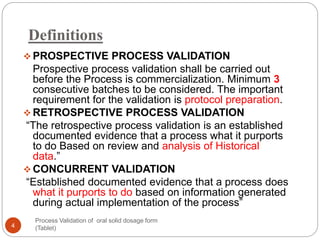
 PROSPECTIVE PROCESS VALIDATION
Prospective process validation shall be carried out
before the Process is commercialization. Minimum 3
consecutive batches to be considered. The important
requirement for the validation is protocol preparation.
 RETROSPECTIVE PROCESS VALIDATION
“The retrospective process validation is an established
documented evidence that a process what it purports
to do Based on review and analysis of Historical
data.”
 CONCURRENT VALIDATION
“Established documented evidence that a process does
what it purports to do based on information generated
during actual implementation of the process”
Validation Protocol
Process Validation of oral solid dosage form
(Tablet)5
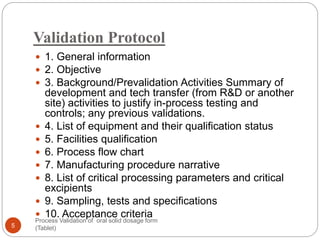
 1. General information
 2. Objective
 3. Background/Prevalidation Activities Summary of
development and tech transfer (from R&D or another
site) activities to justify in-process testing and
controls; any previous validations.
 4. List of equipment and their qualification status
 5. Facilities qualification
 6. Process flow chart
 7. Manufacturing procedure narrative
 8. List of critical processing parameters and critical
excipients
 9. Sampling, tests and specifications
 10. Acceptance criteria
Qualification And Process Validation
Process Validation of oral solid dosage form
(Tablet)6
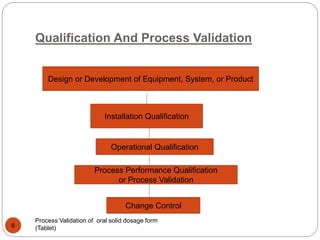
Design or Development of Equipment, System, or Product
Installation Qualification
Operational Qualification
Process Performance Qualification
or Process Validation
Change Control
Validation Process flow chart
Process Validation of oral solid dosage form
(Tablet)7
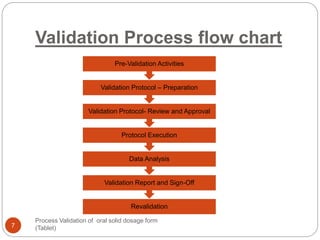
Revalidation
Validation Report and Sign-Off
Data Analysis
Protocol Execution
Validation Protocol- Review and Approval
Validation Protocol – Preparation
Pre-Validation Activities
Some Common Variables In The
Manufacture Of Tablet Products
Process Validation of oral solid dosage form
(Tablet)8
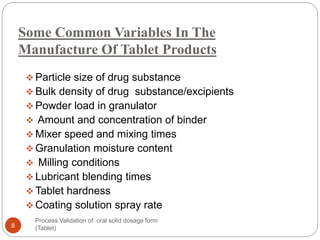
 Particle size of drug substance
 Bulk density of drug substance/excipients
 Powder load in granulator
 Amount and concentration of binder
 Mixer speed and mixing times
 Granulation moisture content
 Milling conditions
 Lubricant blending times
 Tablet hardness
 Coating solution spray rate
Process Validation of oral solid dosage form
(Tablet)9
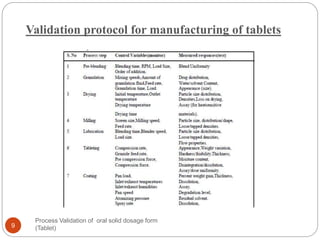
Validation protocol for manufacturing of tablets
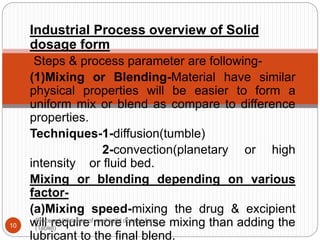
Industrial Process overview of Solid
dosage form
•Steps & process parameter are following-
(1)Mixing or Blending-Material have similar
physical properties will be easier to form a
uniform mix or blend as compare to difference
properties.
Techniques-1-diffusion(tumble)
2-convection(planetary or high
intensity or fluid bed.
Mixing or blending depending on various
factor-
(a)Mixing speed-mixing the drug & excipient
will require more intense mixing than adding the
lubricant to the final blend.
Process Validation of oral solid dosage form
(Tablet)10
Process Validation of oral solid dosage form
(Tablet)11
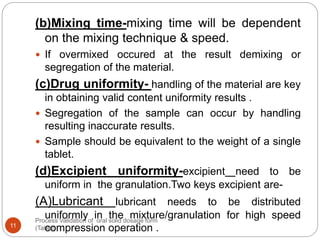
(b)Mixing time-mixing time will be dependent
on the mixing technique & speed.
 If overmixed occured at the result demixing or
segregation of the material.
(c)Drug uniformity- handling of the material are key
in obtaining valid content uniformity results .
 Segregation of the sample can occur by handling
resulting inaccurate results.
 Sample should be equivalent to the weight of a single
tablet.
(d)Excipient uniformity-excipient need to be
uniform in the granulation.Two keys excipient are-
(A)Lubricant lubricant needs to be distributed
uniformly in the mixture/granulation for high speed
compression operation .
Process Validation of oral solid dosage form
(Tablet)12
 Uneven distribution of the lubricant can result in
picking & sticking problem during compresion.
(B)Color evenly distributed in the mixture so the
tablets have a uniform appreance (color,hue &
intensity)
 Uniform dispersed in the blend prior to compression
to avoid shading(molting).
(e)Equipment capacity/load the bulk density of
material will affect the capacity of the equipment .
 Undercharging or overcharging a blender can result in
poor drug or tablet lubricant distribution.
Process Validation of oral solid dosage form
(Tablet)13
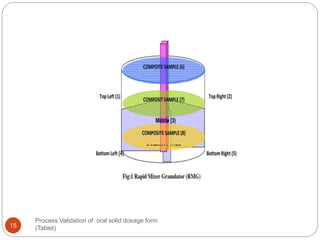
(2)Wet granulation- what type of wet granulation
technique will be used?
 Will it be of- low shear (hobart)
- high shear rate (diosna )or fluid bed (glatt)
 Wet granulation parameters to be processing during
development &validation are-
(a)Binder addition-should be added as a granulating
solution or dry like other excipients.
 Adding the binder dry avoids the need to determine
the optimal binder conc.
(b)Binder conc.- if the binder conc. are high they are
not ejected by spray nozzle then the binder needs to
be dilute enough so that it can be pumped through the
spray nozzle.
Process Validation of oral solid dosage form
(Tablet)14
(c)Amount of binder solution /granulating solvent-too
much binder or solvent solution will over wet the
material &prolong the drying time.
 Amount of binder solution is related to the binder
conc.
(d)Mixing time—
(e)Granulation end point –how is the granulation end
point determined? is it determined by granulation end
point equipment(eg-ammeter or wattmeter)
(3)wet milling does the wet granulation need to
be milled to break up the lumps & enhance drying of
the granulation
FACTORS-(a)Equipment size & capacity-mill should
be enough large to delump the entire batch within a
resonable time period to min.manufacturing time.
Process Validation of oral solid dosage form
(Tablet)15
Process Validation of oral solid dosage form
(Tablet)16
(b)Screen size screen needs to be small enough to
delump the material but not too small to cause
excesssive heating of the mill at the result drying of
granulation occurred.
(c)Mill speedsufficient speed without causing staining
the equipment.
(d)Feed rateof the wet granulation is interelated to
screen size ,mill size & speed
(4)Drying type of drying technique
(a)tray dryer
(b)fluid bed
(c) microwave
Changing dryer techniques could affect such tablet
properties such as hardness, disintegration
Process Validation of oral solid dosage form
(Tablet)17
 High moisture content can result in-
(1)Tablet picking or sticking to tablet punch surfaces
2)Poor chemical properties as a result of hydrolysis .
 An over dried granulation could result in poor
hardness &fraibility.
Moisture content are analysed by following method –
(1)near I.R
(2)loss of drying
(3)karl fischer
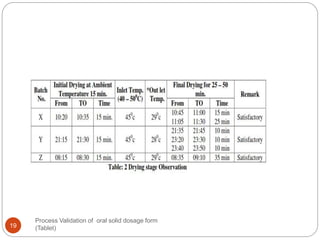
FACTORS-(A)Inlet/outlet temp.The inlet temp. is
the temp.of the incoming air to dryer ,while the outlet
temp.is the temp.leaving the unit.
Process Validation of oral solid dosage form
(Tablet)18
 Inlet temp.should be set high enough to maximinise
drying without affecting the physical/chemical stability.
 The outlet temp.is an indicator is an of the
granulation temp.&will increase toward the inlet
temp.as the moisture content of the granulation
decreases (evaporization rate).
(B)Air flowinsufficient air flow could prolong drying
&affect the chemical stability.
(C)Moisture uniformitymoisture content could vary
within the granulation
 Drying is also affect the moisture in the granulation.
(D)Equipment capability/capacity
Process Validation of oral solid dosage form
(Tablet)19
Process Validation of oral solid dosage form
(Tablet)20
(5)Milling milling operation will reduce the particle
size of the dried granulation.
 An optimal particle size/size distribution for the
formulation will need to determined .
FACTORS-
(a)Mill typewhat mill type should be used(impact or
screen)?
(b)Screen sizeA smaller screen size will produce a
small particle size & a greater number of fines.
(c)Mill speedwhat is the optimal mill speed?
 Higher speed will result in a smaller particle size &
possilbly a wider particle size distribution.
Process Validation of oral solid dosage form
(Tablet)21
(D)Feed rateis dependent on the mill capacity ,screen
size,mill speed
(6)Lubrication
(a) Selection of lubricantwhat kind of lubricant
should be used?
 Grade of lubricant used
 Compatibility with other ingredient.
(b)Amount of lubricanthow much amount lubricant
is required?
 Too much lubricant will form hyrophobic layer on the
tablet resulting dissolution problem.
(c)Mixing timehow much should the material is
mixed to ensure proper formation?
Process Validation of oral solid dosage form
(Tablet)22
 Should mixing stop after the addition of the lubricant
or should additional mixing be required ?
 If not mixed long enough from problems like chipping
,capping etc.
(7)Tablet compressionthe material should
readily flow from the hopper onto the feed frame &
into the dies.
 Inadequate flow can result in ‘RAT HOLING’in the
hopper.this can cause tablet weight &uniformity
problem.
FACTORS(A)TollingThe size ,shape &concavity of
the tooling should be examined based formulation
properties &commercial specification.
Process Validation of oral solid dosage form
(Tablet)23
(B)Compression speedrange of compression speed to
determine the operating range of the compressor.
 The adequacy of the material’sflow into the dies will be
determined by examining the tablet weights.
 Is a force feeder required to ensure that sufficient
material feed into the dies.
(C)Compression or ejection forcedetermined optimal
compression force to obtain the desired tablet hardness.
Process Validation of oral solid dosage form
(Tablet)24
 The following in-process tests should be examined
during the compression stage
 Appearance
 Hardness
 Tablet weight
 Friability
 Disintegration
 Weight uniformity
Process Validation of oral solid dosage form
(Tablet)25
Process Validation of oral solid dosage form
(Tablet)26
 In process tests-
1. Moisture content of dried granulation
2. Granulation particle size distribution
3. Blend uniformity
4. Individual tablet/capsule weight
5. Tablet hardness
6. Tablet thickness
7. Disintegration
8. Impurity profile
Process Validation of oral solid dosage form
(Tablet)27
(8)Tablet coatingtablet coating can occur by different
techniques(eg-sugar,film or compression)
 Key area to consider for tablet coating include the
following-
(a)Tablet properties –the tablet needs to be enough to
withstand the coating process.
 If tablet attrition occurs ,the tablets will have rough
surface appearance
 Round shape easily coated than multiple sides.
(b) Equipment type- coater will need to be selected.
 Conventional or perforated pan & fluid bed coaters are
potential.
(c)Coater load-what is the acceptance tablet load range of
the equipment?
Process Validation of oral solid dosage form
(Tablet)28
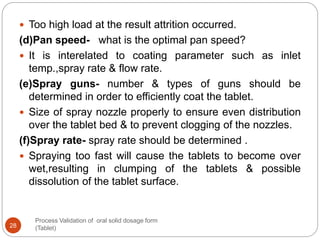
 Too high load at the result attrition occurred.
(d)Pan speed- what is the optimal pan speed?
 It is interelated to coating parameter such as inlet
temp.,spray rate & flow rate.
(e)Spray guns- number & types of guns should be
determined in order to efficiently coat the tablet.
 Size of spray nozzle properly to ensure even distribution
over the tablet bed & to prevent clogging of the nozzles.
(f)Spray rate- spray rate should be determined .
 Spraying too fast will cause the tablets to become over
wet,resulting in clumping of the tablets & possible
dissolution of the tablet surface.
Process Validation of oral solid dosage form
(Tablet)29
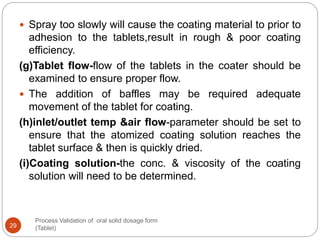
 Spray too slowly will cause the coating material to prior to
adhesion to the tablets,result in rough & poor coating
efficiency.
(g)Tablet flow-flow of the tablets in the coater should be
examined to ensure proper flow.
 The addition of baffles may be required adequate
movement of the tablet for coating.
(h)inlet/outlet temp &air flow-parameter should be set to
ensure that the atomized coating solution reaches the
tablet surface & then is quickly dried.
(i)Coating solution-the conc. & viscosity of the coating
solution will need to be determined.
Process Validation of oral solid dosage form
(Tablet)30
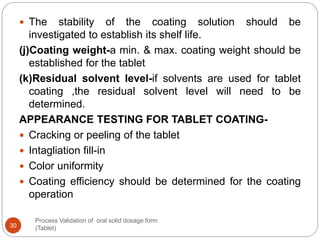
 The stability of the coating solution should be
investigated to establish its shelf life.
(j)Coating weight-a min. & max. coating weight should be
established for the tablet
(k)Residual solvent level-if solvents are used for tablet
coating ,the residual solvent level will need to be
determined.
APPEARANCE TESTING FOR TABLET COATING-
 Cracking or peeling of the tablet
 Intagliation fill-in
 Color uniformity
 Coating efficiency should be determined for the coating
operation
Process Validation of oral solid dosage form
(Tablet)31
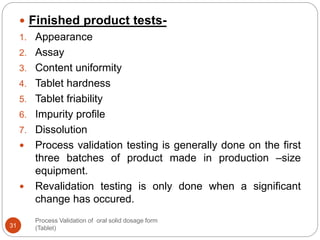
 Finished product tests-
1. Appearance
2. Assay
3. Content uniformity
4. Tablet hardness
5. Tablet friability
6. Impurity profile
7. Dissolution
 Process validation testing is generally done on the first
three batches of product made in production –size
equipment.
 Revalidation testing is only done when a significant
change has occured.
Process Validation of oral solid dosage form
(Tablet)32
Conclusion
 Tablet dosage form validation should be part of a
comprehensive validation program within an industry.
 The multidisciplinary validation team must identified the
product & process characteristics that must be studied &
incorporate specific validation tests to ensure that
product will meet all quality , manufacturing & regulatory
requirements.
 Continuous awareness of validation will produce
reproducibility .
Process Validation of oral solid dosage form
(Tablet)33

Validation of solid dosage form

  • 1.
    Process Validation oforal solid dosage form (Tablet)1 PROCESS VALIDATION OF ORAL SOLID DOSAGE FORM (TABLET) PREPARED BY :- BHASKAR DEWANGAN B. Pharmacy Institute Of Pharmacy Pt. R. S. University, Raipur(C.G.)
  • 2.
    DEFINITION Process Validation oforal solid dosage form (Tablet)2 “Process Validation is establishing documented evidence which provides a high degree of assurance that a specified process will consistently produce a product meeting its pre- determined specifications and quality characteristics.” is the documented evidence that the process, operated within established parameters, can perform effectively and reproducibly to produce an intermediate or API meeting pre-determined specifications and quality attributes.”
  • 3.
    Types of processvalidation Process Validation of oral solid dosage form (Tablet)3 PROCESS VALIDATION RETROSPECTIV E PROCESS VALIDATION PROSPECTIVE PROCESS VALIDATION CONCRURREN T PROCESS VALIDATION
  • 4.
    Definitions Process Validation oforal solid dosage form (Tablet)4  PROSPECTIVE PROCESS VALIDATION Prospective process validation shall be carried out before the Process is commercialization. Minimum 3 consecutive batches to be considered. The important requirement for the validation is protocol preparation.  RETROSPECTIVE PROCESS VALIDATION “The retrospective process validation is an established documented evidence that a process what it purports to do Based on review and analysis of Historical data.”  CONCURRENT VALIDATION “Established documented evidence that a process does what it purports to do based on information generated during actual implementation of the process”
  • 5.
    Validation Protocol Process Validationof oral solid dosage form (Tablet)5  1. General information  2. Objective  3. Background/Prevalidation Activities Summary of development and tech transfer (from R&D or another site) activities to justify in-process testing and controls; any previous validations.  4. List of equipment and their qualification status  5. Facilities qualification  6. Process flow chart  7. Manufacturing procedure narrative  8. List of critical processing parameters and critical excipients  9. Sampling, tests and specifications  10. Acceptance criteria
  • 6.
    Qualification And ProcessValidation Process Validation of oral solid dosage form (Tablet)6 Design or Development of Equipment, System, or Product Installation Qualification Operational Qualification Process Performance Qualification or Process Validation Change Control
  • 7.
    Validation Process flowchart Process Validation of oral solid dosage form (Tablet)7 Revalidation Validation Report and Sign-Off Data Analysis Protocol Execution Validation Protocol- Review and Approval Validation Protocol – Preparation Pre-Validation Activities
  • 8.
    Some Common VariablesIn The Manufacture Of Tablet Products Process Validation of oral solid dosage form (Tablet)8  Particle size of drug substance  Bulk density of drug substance/excipients  Powder load in granulator  Amount and concentration of binder  Mixer speed and mixing times  Granulation moisture content  Milling conditions  Lubricant blending times  Tablet hardness  Coating solution spray rate
  • 9.
    Process Validation oforal solid dosage form (Tablet)9 Validation protocol for manufacturing of tablets
  • 10.
    Industrial Process overviewof Solid dosage form •Steps & process parameter are following- (1)Mixing or Blending-Material have similar physical properties will be easier to form a uniform mix or blend as compare to difference properties. Techniques-1-diffusion(tumble) 2-convection(planetary or high intensity or fluid bed. Mixing or blending depending on various factor- (a)Mixing speed-mixing the drug & excipient will require more intense mixing than adding the lubricant to the final blend. Process Validation of oral solid dosage form (Tablet)10
  • 11.
    Process Validation oforal solid dosage form (Tablet)11 (b)Mixing time-mixing time will be dependent on the mixing technique & speed.  If overmixed occured at the result demixing or segregation of the material. (c)Drug uniformity- handling of the material are key in obtaining valid content uniformity results .  Segregation of the sample can occur by handling resulting inaccurate results.  Sample should be equivalent to the weight of a single tablet. (d)Excipient uniformity-excipient need to be uniform in the granulation.Two keys excipient are- (A)Lubricant lubricant needs to be distributed uniformly in the mixture/granulation for high speed compression operation .
  • 12.
    Process Validation oforal solid dosage form (Tablet)12  Uneven distribution of the lubricant can result in picking & sticking problem during compresion. (B)Color evenly distributed in the mixture so the tablets have a uniform appreance (color,hue & intensity)  Uniform dispersed in the blend prior to compression to avoid shading(molting). (e)Equipment capacity/load the bulk density of material will affect the capacity of the equipment .  Undercharging or overcharging a blender can result in poor drug or tablet lubricant distribution.
  • 13.
    Process Validation oforal solid dosage form (Tablet)13 (2)Wet granulation- what type of wet granulation technique will be used?  Will it be of- low shear (hobart) - high shear rate (diosna )or fluid bed (glatt)  Wet granulation parameters to be processing during development &validation are- (a)Binder addition-should be added as a granulating solution or dry like other excipients.  Adding the binder dry avoids the need to determine the optimal binder conc. (b)Binder conc.- if the binder conc. are high they are not ejected by spray nozzle then the binder needs to be dilute enough so that it can be pumped through the spray nozzle.
  • 14.
    Process Validation oforal solid dosage form (Tablet)14 (c)Amount of binder solution /granulating solvent-too much binder or solvent solution will over wet the material &prolong the drying time.  Amount of binder solution is related to the binder conc. (d)Mixing time— (e)Granulation end point –how is the granulation end point determined? is it determined by granulation end point equipment(eg-ammeter or wattmeter) (3)wet milling does the wet granulation need to be milled to break up the lumps & enhance drying of the granulation FACTORS-(a)Equipment size & capacity-mill should be enough large to delump the entire batch within a resonable time period to min.manufacturing time.
  • 15.
    Process Validation oforal solid dosage form (Tablet)15
  • 16.
    Process Validation oforal solid dosage form (Tablet)16 (b)Screen size screen needs to be small enough to delump the material but not too small to cause excesssive heating of the mill at the result drying of granulation occurred. (c)Mill speedsufficient speed without causing staining the equipment. (d)Feed rateof the wet granulation is interelated to screen size ,mill size & speed (4)Drying type of drying technique (a)tray dryer (b)fluid bed (c) microwave Changing dryer techniques could affect such tablet properties such as hardness, disintegration
  • 17.
    Process Validation oforal solid dosage form (Tablet)17  High moisture content can result in- (1)Tablet picking or sticking to tablet punch surfaces 2)Poor chemical properties as a result of hydrolysis .  An over dried granulation could result in poor hardness &fraibility. Moisture content are analysed by following method – (1)near I.R (2)loss of drying (3)karl fischer FACTORS-(A)Inlet/outlet temp.The inlet temp. is the temp.of the incoming air to dryer ,while the outlet temp.is the temp.leaving the unit.
  • 18.
    Process Validation oforal solid dosage form (Tablet)18  Inlet temp.should be set high enough to maximinise drying without affecting the physical/chemical stability.  The outlet temp.is an indicator is an of the granulation temp.&will increase toward the inlet temp.as the moisture content of the granulation decreases (evaporization rate). (B)Air flowinsufficient air flow could prolong drying &affect the chemical stability. (C)Moisture uniformitymoisture content could vary within the granulation  Drying is also affect the moisture in the granulation. (D)Equipment capability/capacity
  • 19.
    Process Validation oforal solid dosage form (Tablet)19
  • 20.
    Process Validation oforal solid dosage form (Tablet)20 (5)Milling milling operation will reduce the particle size of the dried granulation.  An optimal particle size/size distribution for the formulation will need to determined . FACTORS- (a)Mill typewhat mill type should be used(impact or screen)? (b)Screen sizeA smaller screen size will produce a small particle size & a greater number of fines. (c)Mill speedwhat is the optimal mill speed?  Higher speed will result in a smaller particle size & possilbly a wider particle size distribution.
  • 21.
    Process Validation oforal solid dosage form (Tablet)21 (D)Feed rateis dependent on the mill capacity ,screen size,mill speed (6)Lubrication (a) Selection of lubricantwhat kind of lubricant should be used?  Grade of lubricant used  Compatibility with other ingredient. (b)Amount of lubricanthow much amount lubricant is required?  Too much lubricant will form hyrophobic layer on the tablet resulting dissolution problem. (c)Mixing timehow much should the material is mixed to ensure proper formation?
  • 22.
    Process Validation oforal solid dosage form (Tablet)22  Should mixing stop after the addition of the lubricant or should additional mixing be required ?  If not mixed long enough from problems like chipping ,capping etc. (7)Tablet compressionthe material should readily flow from the hopper onto the feed frame & into the dies.  Inadequate flow can result in ‘RAT HOLING’in the hopper.this can cause tablet weight &uniformity problem. FACTORS(A)TollingThe size ,shape &concavity of the tooling should be examined based formulation properties &commercial specification.
  • 23.
    Process Validation oforal solid dosage form (Tablet)23 (B)Compression speedrange of compression speed to determine the operating range of the compressor.  The adequacy of the material’sflow into the dies will be determined by examining the tablet weights.  Is a force feeder required to ensure that sufficient material feed into the dies. (C)Compression or ejection forcedetermined optimal compression force to obtain the desired tablet hardness.
  • 24.
    Process Validation oforal solid dosage form (Tablet)24  The following in-process tests should be examined during the compression stage  Appearance  Hardness  Tablet weight  Friability  Disintegration  Weight uniformity
  • 25.
    Process Validation oforal solid dosage form (Tablet)25
  • 26.
    Process Validation oforal solid dosage form (Tablet)26  In process tests- 1. Moisture content of dried granulation 2. Granulation particle size distribution 3. Blend uniformity 4. Individual tablet/capsule weight 5. Tablet hardness 6. Tablet thickness 7. Disintegration 8. Impurity profile
  • 27.
    Process Validation oforal solid dosage form (Tablet)27 (8)Tablet coatingtablet coating can occur by different techniques(eg-sugar,film or compression)  Key area to consider for tablet coating include the following- (a)Tablet properties –the tablet needs to be enough to withstand the coating process.  If tablet attrition occurs ,the tablets will have rough surface appearance  Round shape easily coated than multiple sides. (b) Equipment type- coater will need to be selected.  Conventional or perforated pan & fluid bed coaters are potential. (c)Coater load-what is the acceptance tablet load range of the equipment?
  • 28.
    Process Validation oforal solid dosage form (Tablet)28  Too high load at the result attrition occurred. (d)Pan speed- what is the optimal pan speed?  It is interelated to coating parameter such as inlet temp.,spray rate & flow rate. (e)Spray guns- number & types of guns should be determined in order to efficiently coat the tablet.  Size of spray nozzle properly to ensure even distribution over the tablet bed & to prevent clogging of the nozzles. (f)Spray rate- spray rate should be determined .  Spraying too fast will cause the tablets to become over wet,resulting in clumping of the tablets & possible dissolution of the tablet surface.
  • 29.
    Process Validation oforal solid dosage form (Tablet)29  Spray too slowly will cause the coating material to prior to adhesion to the tablets,result in rough & poor coating efficiency. (g)Tablet flow-flow of the tablets in the coater should be examined to ensure proper flow.  The addition of baffles may be required adequate movement of the tablet for coating. (h)inlet/outlet temp &air flow-parameter should be set to ensure that the atomized coating solution reaches the tablet surface & then is quickly dried. (i)Coating solution-the conc. & viscosity of the coating solution will need to be determined.
  • 30.
    Process Validation oforal solid dosage form (Tablet)30  The stability of the coating solution should be investigated to establish its shelf life. (j)Coating weight-a min. & max. coating weight should be established for the tablet (k)Residual solvent level-if solvents are used for tablet coating ,the residual solvent level will need to be determined. APPEARANCE TESTING FOR TABLET COATING-  Cracking or peeling of the tablet  Intagliation fill-in  Color uniformity  Coating efficiency should be determined for the coating operation
  • 31.
    Process Validation oforal solid dosage form (Tablet)31  Finished product tests- 1. Appearance 2. Assay 3. Content uniformity 4. Tablet hardness 5. Tablet friability 6. Impurity profile 7. Dissolution  Process validation testing is generally done on the first three batches of product made in production –size equipment.  Revalidation testing is only done when a significant change has occured.
  • 32.
    Process Validation oforal solid dosage form (Tablet)32 Conclusion  Tablet dosage form validation should be part of a comprehensive validation program within an industry.  The multidisciplinary validation team must identified the product & process characteristics that must be studied & incorporate specific validation tests to ensure that product will meet all quality , manufacturing & regulatory requirements.  Continuous awareness of validation will produce reproducibility .
  • 33.
    Process Validation oforal solid dosage form (Tablet)33