All pharmaceutical scientists, whether in
development, quality assurance, production, or
regulatory affairs, are familiar with the axiom
that quality is not tested into a product but
rather is built in.
 Product Validation is a systematic approach to
identifying, measuring, evaluating,
documenting, and re-evaluating a series of
critical steps in the manufacturing process that
require control to ensure a reproducible final
product.
Four key elements that form the basis of a prospective process validation
program.
1. Definition of the desirable attributes of the drug product or components
thereof as well as those characteristics that are not desired
2. Establishment of limitations or constraint for these attributes
3. Determination of the controls or testing parameters that will be measured or
tested
4. Initiation of studies to establish control or boundary limits for those key
attributes that influence the product, process, quality, and performance
These criteria represent a logical progression of activities encompassing the
development of a pharmaceutical product.
1. Manufacturers are required by law to conform
to CGMP regulations.
2. Good business dictates that a manufacturer
avoid the possibility of rejected or recalled
batches.
3. Validation helps to ensure product uniformity,
reproducibility, and quality.
 The validation process of a solid dosage form
begins with a validation of the raw materials, both
active pharmaceutical ingredients (APIs) and
excipients.
 The preformulation program initiated during the
early exploratory phase of product development is
more critical steps in the development cycle.
 The particle size, shape, and density of the drug
can affect material flow and blend uniformity.
Excipients can represent less than 1% of a tablet
formula or as much as 99%.
It is no less important to validate the critical
characteristics of the 1% material than of an
excipient used in larger quantities.
Factors to be considered are
(1) the grade and source of the excipients,
(2) Particle size and shape characteristics, and
(3) lot-to-lot variability
Each raw material should be validated by performing checks on several
batches (at least three) from the primary supplier as well as the
alternate supplier.
The steps involved in the validation of a raw material or excipient
1. Depending on the susceptibility of the raw material to aging,
physical,
chemical, and/or microbiological stability should be assessed.
2. Once the samples of raw materials have been selected as having
fallen
into an established, acceptable range of specifications and stability,
it should be used to manufacture a batch of the final dosage form
and evaluate for effect of small change in concentration of excipients
on product quality.
3. The final step of raw material validation should involve an on-site
inspection of the supplier to review the vendor’s manufacturing
operations and control procedures.
 Unless a suitable analytical method or series of
methods is available to assess the quality and
performance of a solid dosage form, the
validation program will have limited value
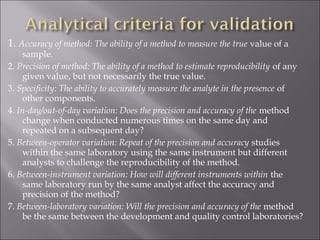
1. Accuracy of method: The ability of a method to measure the true value of a
sample.
2. Precision of method: The ability of a method to estimate reproducibility of any
given value, but not necessarily the true value.
3. Specificity: The ability to accurately measure the analyte in the presence of
other components.
4. In-day/out-of-day variation: Does the precision and accuracy of the method
change when conducted numerous times on the same day and
repeated on a subsequent day?
5. Between-operator variation: Repeat of the precision and accuracy studies
within the same laboratory using the same instrument but different
analysts to challenge the reproducibility of the method.
6. Between-instrument variation: How will different instruments within the
same laboratory run by the same analyst affect the accuracy and
precision of the method?
7. Between-laboratory variation: Will the precision and accuracy of the method
be the same between the development and quality control laboratories?
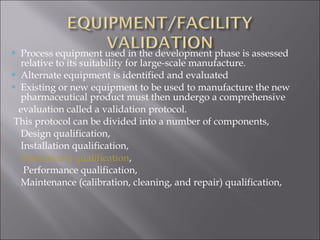
 Process equipment used in the development phase is assessed
relative to its suitability for large-scale manufacture.
 Alternate equipment is identified and evaluated
 Existing or new equipment to be used to manufacture the new
pharmaceutical product must then undergo a comprehensive
evaluation called a validation protocol.
This protocol can be divided into a number of components,
 Design qualification,
 Installation qualification,
 Operational qualification,
 Performance qualification,
 Maintenance (calibration, cleaning, and repair) qualification,
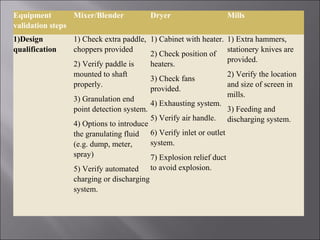
Equipment
validation steps
Mixer/Blender Dryer Mills
1)Design
qualification
1) Check extra paddle,
choppers provided
2) Verify paddle is
mounted to shaft
properly.
3) Granulation end
point detection system.
4) Options to introduce
the granulating fluid
(e.g. dump, meter,
spray)
5) Verify automated
charging or discharging
system.
1) Cabinet with heater.
2) Check position of
heaters.
3) Check fans
provided.
4) Exhausting system.
5) Verify air handle.
6) Verify inlet or outlet
system.
7) Explosion relief duct
to avoid explosion.
1) Extra hammers,
stationery knives are
provided.
2) Verify the location
and size of screen in
mills.
3) Feeding and
discharging system.
Equipment validation
steps
Mixer/Blender Dryer Mills
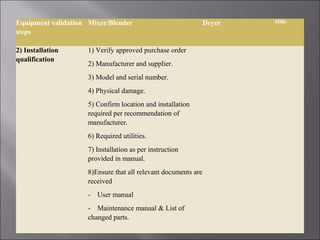
2) Installation
qualification
1) Verify approved purchase order
2) Manufacturer and supplier.
3) Model and serial number.
4) Physical damage.
5) Confirm location and installation
required per recommendation of
manufacturer.
6) Required utilities.
7) Installation as per instruction
provided in manual.
8)Ensure that all relevant documents are
received
- User manual
- Maintenance manual & List of
changed parts.
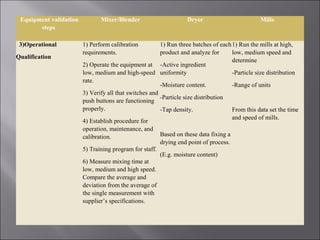
Equipment validation
steps
Mixer/Blender Dryer Mills
3)Operational
Qualification
1) Perform calibration
requirements.
2) Operate the equipment at
low, medium and high-speed
rate.
3) Verify all that switches and
push buttons are functioning
properly.
4) Establish procedure for
operation, maintenance, and
calibration.
5) Training program for staff.
6) Measure mixing time at
low, medium and high speed.
Compare the average and
deviation from the average of
the single measurement with
supplier’s specifications.
1) Run three batches of each
product and analyze for
-Active ingredient
uniformity
-Moisture content.
-Particle size distribution
-Tap density.
Based on these data fixing a
drying end point of process.
(E.g. moisture content)
1) Run the mills at high,
low, medium speed and
determine
-Particle size distribution
-Range of units
From this data set the time
and speed of mills.
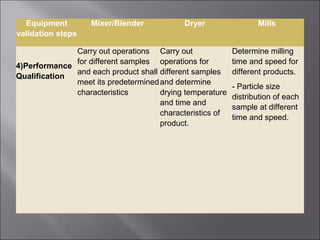
Equipment
validation steps
Mixer/Blender Dryer Mills
4)Performance
Qualification
Carry out operations
for different samples
and each product shall
meet its predetermined
characteristics
Carry out
operations for
different samples
and determine
drying temperature
and time and
characteristics of
product.
Determine milling
time and speed for
different products.
- Particle size
distribution of each
sample at different
time and speed.
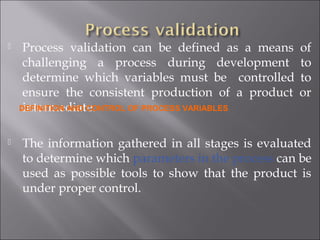
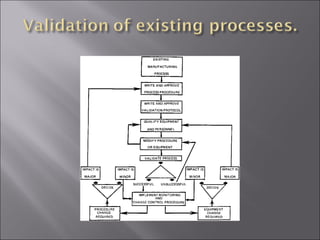
 Process validation can be defined as a means of
challenging a process during development to
determine which variables must be controlled to
ensure the consistent production of a product or
intermediate.
 The information gathered in all stages is evaluated
to determine which parameters in the process can be
used as possible tools to show that the product is
under proper control.
DEFINITION AND CONTROL OF PROCESS VARIABLES
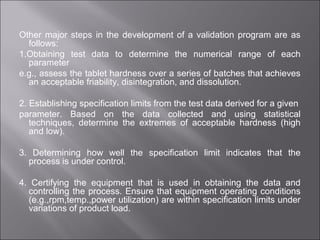
Other major steps in the development of a validation program are as
follows:
1.Obtaining test data to determine the numerical range of each
parameter
e.g., assess the tablet hardness over a series of batches that achieves
an acceptable friability, disintegration, and dissolution.
2. Establishing specification limits from the test data derived for a given
parameter. Based on the data collected and using statistical
techniques, determine the extremes of acceptable hardness (high
and low).
3. Determining how well the specification limit indicates that the
process is under control.
4. Certifying the equipment that is used in obtaining the data and
controlling the process. Ensure that equipment operating conditions
(e.g.,rpm,temp.,power utilization) are within specification limits under
variations of product load.
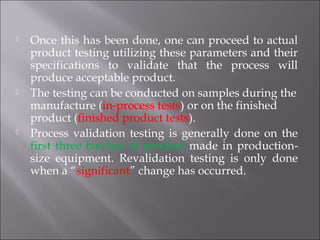
 Once this has been done, one can proceed to actual
product testing utilizing these parameters and their
specifications to validate that the process will
produce acceptable product.
 The testing can be conducted on samples during the
manufacture (in-process tests) or on the finished
product (finished product tests).
 Process validation testing is generally done on the
first three batches of product made in production-
size equipment. Revalidation testing is only done
when a “significant” change has occurred.
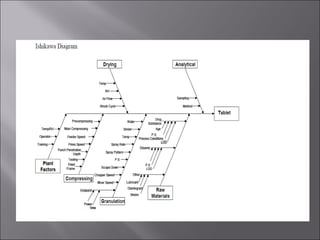
 Numerous factors should be considered when
developing and validating solid dosage forms
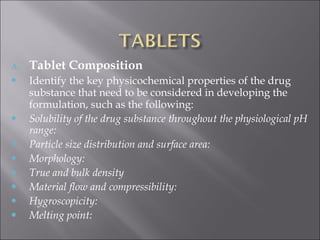
A. Tablet Composition
 Identify the key physicochemical properties of the drug
substance that need to be considered in developing the
formulation, such as the following:
 Solubility of the drug substance throughout the physiological pH
range:
 Particle size distribution and surface area:
 Morphology:
 True and bulk density
 Material flow and compressibility:
 Hygroscopicity:
 Melting point:
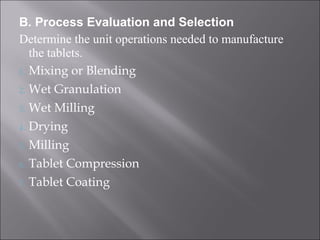
B. Process Evaluation and Selection
Determine the unit operations needed to manufacture
the tablets.
1. Mixing or Blending
2. Wet Granulation
3. Wet Milling
4. Drying
5. Milling
6. Tablet Compression
7. Tablet Coating
C. Equipment Evaluation
The following items should be considered when evaluating equipment for the
manufacture of the tablet dosage forms.
1. Mixer/granulator
2. Blender
3. Dryer
4. Mills
5. Tablet compressor
6. Tablet Coater
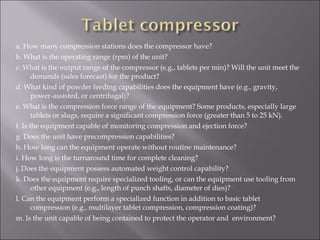
a. How many compression stations does the compressor have?
b. What is the operating range (rpm) of the unit?
c. What is the output range of the compressor (e.g., tablets per min)? Will the unit meet the
demands (sales forecast) for the product?
d. What kind of powder feeding capabilities does the equipment have (e.g., gravity,
power-assisted, or centrifugal)?
e. What is the compression force range of the equipment? Some products, especially large
tablets or slugs, require a significant compression force (greater than 5 to 25 kN).
f. Is the equipment capable of monitoring compression and ejection force?
g. Does the unit have precompression capabilities?
h. How long can the equipment operate without routine maintenance?
i. How long is the turnaround time for complete cleaning?
j. Does the equipment possess automated weight control capability?
k. Does the equipment require specialized tooling, or can the equipment use tooling from
other equipment (e.g., length of punch shafts, diameter of dies)?
l. Can the equipment perform a specialized function in addition to basic tablet
compression (e.g., multilayer tablet compression, compression coating)?
m. Is the unit capable of being contained to protect the operator and environment?
 Solid dosage form validation should be part of a
comprehensive validation program within a
company.
 The total program should begin with validation of
the API characteristics so that this material will be
uniform batch after batch, providing a solid footing
upon which the dosage form will be built.
 Analytical methods validation is a critical
component of the entire company validation
program.
 Validation of a new or existing product involves the
efforts of scientists at various stages of the product
development life cycle.

Dosage form validation

  • 2.
    All pharmaceutical scientists,whether in development, quality assurance, production, or regulatory affairs, are familiar with the axiom that quality is not tested into a product but rather is built in.  Product Validation is a systematic approach to identifying, measuring, evaluating, documenting, and re-evaluating a series of critical steps in the manufacturing process that require control to ensure a reproducible final product.
  • 3.
    Four key elementsthat form the basis of a prospective process validation program. 1. Definition of the desirable attributes of the drug product or components thereof as well as those characteristics that are not desired 2. Establishment of limitations or constraint for these attributes 3. Determination of the controls or testing parameters that will be measured or tested 4. Initiation of studies to establish control or boundary limits for those key attributes that influence the product, process, quality, and performance These criteria represent a logical progression of activities encompassing the development of a pharmaceutical product.
  • 4.
    1. Manufacturers arerequired by law to conform to CGMP regulations. 2. Good business dictates that a manufacturer avoid the possibility of rejected or recalled batches. 3. Validation helps to ensure product uniformity, reproducibility, and quality.
  • 5.
     The validationprocess of a solid dosage form begins with a validation of the raw materials, both active pharmaceutical ingredients (APIs) and excipients.  The preformulation program initiated during the early exploratory phase of product development is more critical steps in the development cycle.  The particle size, shape, and density of the drug can affect material flow and blend uniformity.
  • 6.
    Excipients can representless than 1% of a tablet formula or as much as 99%. It is no less important to validate the critical characteristics of the 1% material than of an excipient used in larger quantities. Factors to be considered are (1) the grade and source of the excipients, (2) Particle size and shape characteristics, and (3) lot-to-lot variability
  • 7.
    Each raw materialshould be validated by performing checks on several batches (at least three) from the primary supplier as well as the alternate supplier. The steps involved in the validation of a raw material or excipient 1. Depending on the susceptibility of the raw material to aging, physical, chemical, and/or microbiological stability should be assessed. 2. Once the samples of raw materials have been selected as having fallen into an established, acceptable range of specifications and stability, it should be used to manufacture a batch of the final dosage form and evaluate for effect of small change in concentration of excipients on product quality. 3. The final step of raw material validation should involve an on-site inspection of the supplier to review the vendor’s manufacturing operations and control procedures.
  • 8.
     Unless asuitable analytical method or series of methods is available to assess the quality and performance of a solid dosage form, the validation program will have limited value
  • 9.
    1. Accuracy ofmethod: The ability of a method to measure the true value of a sample. 2. Precision of method: The ability of a method to estimate reproducibility of any given value, but not necessarily the true value. 3. Specificity: The ability to accurately measure the analyte in the presence of other components. 4. In-day/out-of-day variation: Does the precision and accuracy of the method change when conducted numerous times on the same day and repeated on a subsequent day? 5. Between-operator variation: Repeat of the precision and accuracy studies within the same laboratory using the same instrument but different analysts to challenge the reproducibility of the method. 6. Between-instrument variation: How will different instruments within the same laboratory run by the same analyst affect the accuracy and precision of the method? 7. Between-laboratory variation: Will the precision and accuracy of the method be the same between the development and quality control laboratories?
  • 10.
     Process equipmentused in the development phase is assessed relative to its suitability for large-scale manufacture.  Alternate equipment is identified and evaluated  Existing or new equipment to be used to manufacture the new pharmaceutical product must then undergo a comprehensive evaluation called a validation protocol. This protocol can be divided into a number of components,  Design qualification,  Installation qualification,  Operational qualification,  Performance qualification,  Maintenance (calibration, cleaning, and repair) qualification,
  • 11.
    Equipment validation steps Mixer/Blender DryerMills 1)Design qualification 1) Check extra paddle, choppers provided 2) Verify paddle is mounted to shaft properly. 3) Granulation end point detection system. 4) Options to introduce the granulating fluid (e.g. dump, meter, spray) 5) Verify automated charging or discharging system. 1) Cabinet with heater. 2) Check position of heaters. 3) Check fans provided. 4) Exhausting system. 5) Verify air handle. 6) Verify inlet or outlet system. 7) Explosion relief duct to avoid explosion. 1) Extra hammers, stationery knives are provided. 2) Verify the location and size of screen in mills. 3) Feeding and discharging system.
  • 12.
    Equipment validation steps Mixer/Blender DryerMills 2) Installation qualification 1) Verify approved purchase order 2) Manufacturer and supplier. 3) Model and serial number. 4) Physical damage. 5) Confirm location and installation required per recommendation of manufacturer. 6) Required utilities. 7) Installation as per instruction provided in manual. 8)Ensure that all relevant documents are received - User manual - Maintenance manual & List of changed parts.
  • 13.
    Equipment validation steps Mixer/Blender DryerMills 3)Operational Qualification 1) Perform calibration requirements. 2) Operate the equipment at low, medium and high-speed rate. 3) Verify all that switches and push buttons are functioning properly. 4) Establish procedure for operation, maintenance, and calibration. 5) Training program for staff. 6) Measure mixing time at low, medium and high speed. Compare the average and deviation from the average of the single measurement with supplier’s specifications. 1) Run three batches of each product and analyze for -Active ingredient uniformity -Moisture content. -Particle size distribution -Tap density. Based on these data fixing a drying end point of process. (E.g. moisture content) 1) Run the mills at high, low, medium speed and determine -Particle size distribution -Range of units From this data set the time and speed of mills.
  • 14.
    Equipment validation steps Mixer/Blender DryerMills 4)Performance Qualification Carry out operations for different samples and each product shall meet its predetermined characteristics Carry out operations for different samples and determine drying temperature and time and characteristics of product. Determine milling time and speed for different products. - Particle size distribution of each sample at different time and speed.
  • 15.
     Process validationcan be defined as a means of challenging a process during development to determine which variables must be controlled to ensure the consistent production of a product or intermediate.  The information gathered in all stages is evaluated to determine which parameters in the process can be used as possible tools to show that the product is under proper control. DEFINITION AND CONTROL OF PROCESS VARIABLES
  • 16.
    Other major stepsin the development of a validation program are as follows: 1.Obtaining test data to determine the numerical range of each parameter e.g., assess the tablet hardness over a series of batches that achieves an acceptable friability, disintegration, and dissolution. 2. Establishing specification limits from the test data derived for a given parameter. Based on the data collected and using statistical techniques, determine the extremes of acceptable hardness (high and low). 3. Determining how well the specification limit indicates that the process is under control. 4. Certifying the equipment that is used in obtaining the data and controlling the process. Ensure that equipment operating conditions (e.g.,rpm,temp.,power utilization) are within specification limits under variations of product load.
  • 17.
     Once thishas been done, one can proceed to actual product testing utilizing these parameters and their specifications to validate that the process will produce acceptable product.  The testing can be conducted on samples during the manufacture (in-process tests) or on the finished product (finished product tests).  Process validation testing is generally done on the first three batches of product made in production- size equipment. Revalidation testing is only done when a “significant” change has occurred.
  • 18.
     Numerous factorsshould be considered when developing and validating solid dosage forms
  • 22.
    A. Tablet Composition Identify the key physicochemical properties of the drug substance that need to be considered in developing the formulation, such as the following:  Solubility of the drug substance throughout the physiological pH range:  Particle size distribution and surface area:  Morphology:  True and bulk density  Material flow and compressibility:  Hygroscopicity:  Melting point:
  • 23.
    B. Process Evaluationand Selection Determine the unit operations needed to manufacture the tablets. 1. Mixing or Blending 2. Wet Granulation 3. Wet Milling 4. Drying 5. Milling 6. Tablet Compression 7. Tablet Coating
  • 24.
    C. Equipment Evaluation Thefollowing items should be considered when evaluating equipment for the manufacture of the tablet dosage forms. 1. Mixer/granulator 2. Blender 3. Dryer 4. Mills 5. Tablet compressor 6. Tablet Coater
  • 25.
    a. How manycompression stations does the compressor have? b. What is the operating range (rpm) of the unit? c. What is the output range of the compressor (e.g., tablets per min)? Will the unit meet the demands (sales forecast) for the product? d. What kind of powder feeding capabilities does the equipment have (e.g., gravity, power-assisted, or centrifugal)? e. What is the compression force range of the equipment? Some products, especially large tablets or slugs, require a significant compression force (greater than 5 to 25 kN). f. Is the equipment capable of monitoring compression and ejection force? g. Does the unit have precompression capabilities? h. How long can the equipment operate without routine maintenance? i. How long is the turnaround time for complete cleaning? j. Does the equipment possess automated weight control capability? k. Does the equipment require specialized tooling, or can the equipment use tooling from other equipment (e.g., length of punch shafts, diameter of dies)? l. Can the equipment perform a specialized function in addition to basic tablet compression (e.g., multilayer tablet compression, compression coating)? m. Is the unit capable of being contained to protect the operator and environment?
  • 26.
     Solid dosageform validation should be part of a comprehensive validation program within a company.  The total program should begin with validation of the API characteristics so that this material will be uniform batch after batch, providing a solid footing upon which the dosage form will be built.  Analytical methods validation is a critical component of the entire company validation program.  Validation of a new or existing product involves the efforts of scientists at various stages of the product development life cycle.

Editor's Notes

  • #8 The steps involved in the validation of a raw material or excipient follow those cited in the CGMPs and in the formal written documentation of those procedures and methods used. 1. Each raw material should be validated by performing checks on several batches (at least three) from the primary supplier as well as the alternate supplier. The batches chosen should be selected to represent the range of acceptable specifications, both high and low. 2. Depending on the susceptibility of the raw material to aging, physical, chemical, and/or microbiological stability should be assessed. This is especially true for liquid or semisolid ingredients, in which interaction with the container or permeability of the container to air and moisture could have a detrimental effect on the raw material. 3. Once the samples of raw materials have been selected as having fallen into an established, acceptable range of specifications and stability, it should be used to manufacture a batch of the final dosage form. It may be appropriate to manufacture several lots of final product with raw material at the low and high ends of the specification limit. Such testing would be especially useful when it is known that the product may be sensitive to small changes in the characteristics of the excipients or active ingredient. 4. The final step of raw material validation should involve an on-site inspection of the supplier to review the vendor’s manufacturing operations and control procedures. The reliability of each vendor and how well each conforms to regulatory requirements must also be determined