Validation is a process of establishing documentary evidence
demonstrating that a procedure, process, or activity carried out in
production or testing maintains the desired level of compliance at all
stages.
Qualification is action of proving that any premises, systems and
items of equipment work correctly and actually lead to the expected
results.
DEFINITION
PURPOSE OF DOCUMENTATION
• Prevents errors that may arise in
oral communication.
• To obtain consistent, reliable &
accurate data
• It provides assurance that quality
related activities are carried out
exactly the way they have been
planned and approved.
• To achieve conformity and quality
improvement
• Design qualification (DQ)
• Installation qualification (IQ)
• Operational qualification (OQ)
• Performance Qualification (PQ)
WHAT DOES VALIDATION DOCUMENTS INCLUDE
VALIDATION MASTER PLAN
All validation activities are planned using the ‘V Model’ approach as
follows to identify the relationship between the development and
testing phases of the project ensuring that appropriate quality
assurance and testing takes place throughout the project lifecycle
VALIDATION MASTER PLAN
• User Requirement Specifications (URS) : defines what user
wants from the system and makes sure that requirement is met
• Functional Specifications: defines or creates a document in user
understandable format based on URS.
• Design Qualification DQ:will verify the requirements of the user,
especially GMP relevant requirements, are met by the system.
STEPS OF SYSTEM QUALIFICATION
Installation Qualification IQ: provides documented evidence that
the system, as installed or modified, comply with the approved design
and the manufacturers recommendations..
Operational Qualification (OQ) provides documented evidence that
the systems and sub-systems are capable of consistently operating
within established limits and tolerances.
Performance Qualification (PQ) is conducted to demonstrate
compliance with all requirements under actual process conditions.
STEPS OF SYSTEM QUALIFICATION
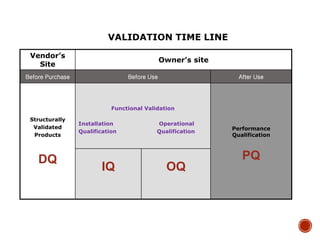
VALIDATION TIME LINE
Vendor’s
Site
Owner’s site
Before Purchase Before Use After Use
Structurally
Validated
Products
DQ
Functional Validation
Installation Operational
Qualification Qualification
Performance
Qualification
PQ
IQ OQ
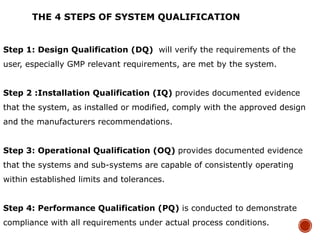
THE 4 STEPS OF SYSTEM QUALIFICATION
Step 1: Design Qualification (DQ) will verify the requirements of the
user, especially GMP relevant requirements, are met by the system.
Step 2 :Installation Qualification (IQ) provides documented evidence
that the system, as installed or modified, comply with the approved design
and the manufacturers recommendations.
Step 3: Operational Qualification (OQ) provides documented evidence
that the systems and sub-systems are capable of consistently operating
within established limits and tolerances.
Step 4: Performance Qualification (PQ) is conducted to demonstrate
compliance with all requirements under actual process conditions.
• Design Qualification (DQ) defines the functional and operational
specifications of the equipment/system and details the conscious
decisions made in the selection of the supplier.
• DQ should ensure that equipment/system have all the necessary
functions and performance criteria that will enable them to be
successfully implemented for the intended application and to meet
user requirements.
DESIGN QUALIFICATION (DQ)
The Design qualification includes documents i.e
• Datasheets
• DQ protocol
• Bill of material (BOM)
• Panel documents (I/O list & writeup)
• Standard operating procedure (SOP)
• Test reports & welding protocols
• Utility & spare part specification
• Piping and instrumentation diagram (P &ID)
INSTALLATION QUALIFICATION (IQ)
• Installation qualification (IQ) is the process of checking the
installation, to ensure that the equipment meets the approved
specification and are installed correctly, and to see how that
information is recorded.
• The purpose is to ensure that all aspects of the facility or equipment
are installed correctly and comply with the original design.
• All of the components are identified and checked against the
manufacturer’s component listing.
• The working environment conditions are documented and checked to
ensure that they are suitable for the operation of the equipment.
OPERATIONAL QUALIFICATION (OQ)
• Operational qualification (OQ) is the process of testing to ensure
that the individual and combined systems function to meet agreed
performance criteria and to check how the result of testing is
recorded.
• The purpose is to ensure that all the dynamic attributes comply
with the original design.
• Each of the equipment function are checked to ensure that they
conform to the manufacturer’s specifications.
PERFORMANCE QUALIFICATION (PQ)
• Establishing confidence through appropriate testing that the
finished product or process produced by a specified process meets
all release requirements for functionality and safety and that
procedures are effective and reproducible.
• In practice, the performance qualification is the executed test
protocol documenting that a system meets the defined
requirements to function in the production environment.
Validation documents

Validation documents

  • 2.
    Validation is aprocess of establishing documentary evidence demonstrating that a procedure, process, or activity carried out in production or testing maintains the desired level of compliance at all stages. Qualification is action of proving that any premises, systems and items of equipment work correctly and actually lead to the expected results. DEFINITION
  • 3.
    PURPOSE OF DOCUMENTATION •Prevents errors that may arise in oral communication. • To obtain consistent, reliable & accurate data • It provides assurance that quality related activities are carried out exactly the way they have been planned and approved. • To achieve conformity and quality improvement
  • 4.
    • Design qualification(DQ) • Installation qualification (IQ) • Operational qualification (OQ) • Performance Qualification (PQ) WHAT DOES VALIDATION DOCUMENTS INCLUDE
  • 5.
    VALIDATION MASTER PLAN Allvalidation activities are planned using the ‘V Model’ approach as follows to identify the relationship between the development and testing phases of the project ensuring that appropriate quality assurance and testing takes place throughout the project lifecycle
  • 6.
  • 7.
    • User RequirementSpecifications (URS) : defines what user wants from the system and makes sure that requirement is met • Functional Specifications: defines or creates a document in user understandable format based on URS. • Design Qualification DQ:will verify the requirements of the user, especially GMP relevant requirements, are met by the system. STEPS OF SYSTEM QUALIFICATION
  • 8.
    Installation Qualification IQ:provides documented evidence that the system, as installed or modified, comply with the approved design and the manufacturers recommendations.. Operational Qualification (OQ) provides documented evidence that the systems and sub-systems are capable of consistently operating within established limits and tolerances. Performance Qualification (PQ) is conducted to demonstrate compliance with all requirements under actual process conditions. STEPS OF SYSTEM QUALIFICATION
  • 9.
    VALIDATION TIME LINE Vendor’s Site Owner’ssite Before Purchase Before Use After Use Structurally Validated Products DQ Functional Validation Installation Operational Qualification Qualification Performance Qualification PQ IQ OQ
  • 10.
    THE 4 STEPSOF SYSTEM QUALIFICATION Step 1: Design Qualification (DQ) will verify the requirements of the user, especially GMP relevant requirements, are met by the system. Step 2 :Installation Qualification (IQ) provides documented evidence that the system, as installed or modified, comply with the approved design and the manufacturers recommendations. Step 3: Operational Qualification (OQ) provides documented evidence that the systems and sub-systems are capable of consistently operating within established limits and tolerances. Step 4: Performance Qualification (PQ) is conducted to demonstrate compliance with all requirements under actual process conditions.
  • 11.
    • Design Qualification(DQ) defines the functional and operational specifications of the equipment/system and details the conscious decisions made in the selection of the supplier. • DQ should ensure that equipment/system have all the necessary functions and performance criteria that will enable them to be successfully implemented for the intended application and to meet user requirements. DESIGN QUALIFICATION (DQ)
  • 12.
    DESIGN QUALIFICATION (DQ) TheDesign qualification includes documents i.e • Datasheets • DQ protocol • Bill of material (BOM) • Panel documents (I/O list & writeup) • Standard operating procedure (SOP) • Test reports & welding protocols • Utility & spare part specification • Piping and instrumentation diagram (P &ID)
  • 13.
    INSTALLATION QUALIFICATION (IQ) •Installation qualification (IQ) is the process of checking the installation, to ensure that the equipment meets the approved specification and are installed correctly, and to see how that information is recorded. • The purpose is to ensure that all aspects of the facility or equipment are installed correctly and comply with the original design. • All of the components are identified and checked against the manufacturer’s component listing. • The working environment conditions are documented and checked to ensure that they are suitable for the operation of the equipment.
  • 14.
    OPERATIONAL QUALIFICATION (OQ) •Operational qualification (OQ) is the process of testing to ensure that the individual and combined systems function to meet agreed performance criteria and to check how the result of testing is recorded. • The purpose is to ensure that all the dynamic attributes comply with the original design. • Each of the equipment function are checked to ensure that they conform to the manufacturer’s specifications.
  • 15.
    PERFORMANCE QUALIFICATION (PQ) •Establishing confidence through appropriate testing that the finished product or process produced by a specified process meets all release requirements for functionality and safety and that procedures are effective and reproducible. • In practice, the performance qualification is the executed test protocol documenting that a system meets the defined requirements to function in the production environment.