TYPES OF PROCESS VALIDATION AND PROCESS VALIDATION OF TABLET
AND CAPSULE FORMULATION.
PRESENTED BY, GUIDED BY,
TANVI KUMBHAR, DR. SONALI MAHAPARALE,
ROLL NO: 526, HOD CHEMISTRY DEPARTMENT
FY.MPHARM SEM II DR.D.Y.PATIL COLLEG PHARMACY
QAT DEPARTMENT AKURDI, PUNE .
CONTENTS
o Validation.
o Process validation.
o Types of process validation.
o Perspective validation.
o Retrospective validation.
o Concurrent validation.
o Revalidation.
o Validation protocol.
o Process validation of tablet and capsule dosage forms.
o References.
2
VALIDATION:
• Validation is necessary part of quality assurance plan and is fundamental to an efficient
production operation.
• Word “validation” means assessment of validity or action proving effectiveness .
• This concept pioneered by 2 FDA officials –TED BYERS and BUD LOFTUS in 1970.
REASON FORVALIDATION:
 It is to guarantee that all processes and machinery in the pharmaceutical manufacturing
process are being used in a way , which will ensure safety, integrity , quality and strength
of a dosage form.
 Validation is very important if there is significant change that may affect the quality of the
product directly or indirectly .
3
• FDA defines assurance of product quality is derived from 3 important factors.
I. Selection of quality components and materials.
II. Adequate product and process design.
III. Control of process through in-process and end-process testing.
• Thus, it is important to carefully design and validation of both the process and its control
systems so as to achieve quality attributes .
• Conventional quality control procedures involved the finished product testing which
encompassed the establishment of :
I. Specifications and performance characteristics.
II. Selection of appropriate methology.
III. Equipment and instruments to ensure that product meets the specifications.
4
• However the validation concept includes:
I. Qualification of processing facility and its equipment.
II. Qualification of manufacturing process.
III. In-process testing.
IV. Finished product testing.
V. Auditing, monitoring, sampling, challenging the key steps in the process.
VI. Revalidation if any change is to be validated in product or manufacturing process.
5
PROCESS VALIDATION:
• According to USFDA the process validation is defined as :
“Process validation is establishing document evidence which provides a high degree of
assurance that a specific process ( such as manufacture of pharmaceutical dosage forms)
will consistently produce meeting its predetermined specifications and quality
characteristics”.
• The process validation is derived from the fact that the specific exercise of process
validation should never fail.
• Failure in carrying out the process validation is often the result of incomplete or faulty
understanding of the process’s capability, in other words , what the process can and cannot
do under a given set of operational circumstances.
• Process validation is performed by individuals with necessary training and experience to
carry out the assignment.
6
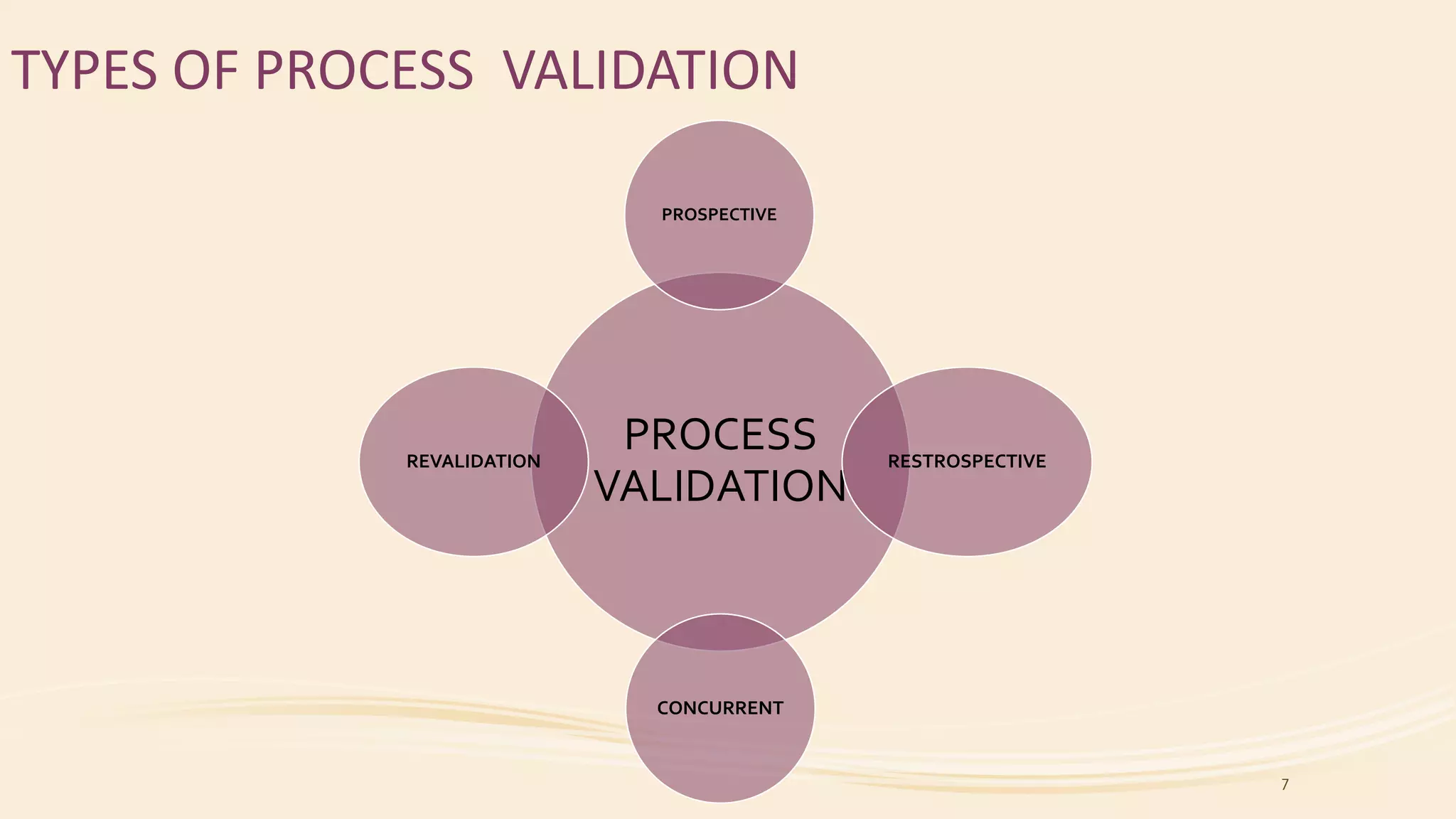
TYPES OF PROCESS VALIDATION
PROCESS
VALIDATION
PROSPECTIVE
RESTROSPECTIVE
CONCURRENT
REVALIDATION
7
PROSPECTIVE VALIDATION:
• Here an experimental plan called as theValidation Protocol is executed before the process is put
into commercial use.
• This type of validation is normally carried out in connection with the introduction of new drug
products and their manufacturing processes.
• It is defined as “ established documented evidence that a system does what it purpots to do
based on a preplanned protocol”.
• Objective:
Is to prove or demonstrate that the process will work in accordance with a validation master plan .
• Before conducting prospective validation following operations and procedures must be completed
satisfactorily.
 cGMP requirements must be completed by the facilities and equipments in which process
validation is to be completed.
8
Training should be given to operators and supervising personnel.
The design , selection and optimization of the formula must be completed from product
development department.
The product and the manufacturing processes detailed information along with quality and
stability of product have been provided.
Finally, at least one qualification trial of a pilot-production batch has been made and shows
no deviations were seen from the expected performance of process.
9
RETROSPECTIVE VALIDATION:
• It is chosen for the established products whose manufacturing processes are considered
stable.
• Prior to undertaking retrospective validation, equipments , facilities, and subsystems used
in connection with the manufacturing process must be qualified in conformance with
cGMP requirements.
• It is defined as “ the established documented evidence that a system does what it
purports to do an review and analysis of historical information and data available of
process or product during manufacturing”.
• This type of validation can may be conducted on the data available in computer based
system or data recorded by manual methods.
• Some basic considerations before performing retrospective validation are as follows:
10
 Gathering of the numerical data from the completed batch record which might includes all
tests carried out as per pharmacopeia.
 Organize these data in a chronological sequence according to batch manufacturing data
using uniform format.
 Select sufficient batches, to include data.
 Elimination of data from non-critical processing steps and deletion of all unnecessary
numerical information and subject the resultant data to statistical analysis and evaluation.
 From the statistical analysis draw conclusions.
 Final step includes issuing a report of findings from retrospective validation as documented
evidence that process is validated.
Eg. Soft gelatin capsules:
1. Content uniformity after mixing.
2. Weight variation for soft gelatin capsules.
11
3. Coat thickness of soft gelatin capsules.
4. Moisture content of soft gelatin capsules.
5.Dissolution time.
Semisolid and liquid dosage forms:
1. pH
2. Viscosity
3. Color or clarity
4. Average particle size
5. Grittiness
6. Spreadability.
12
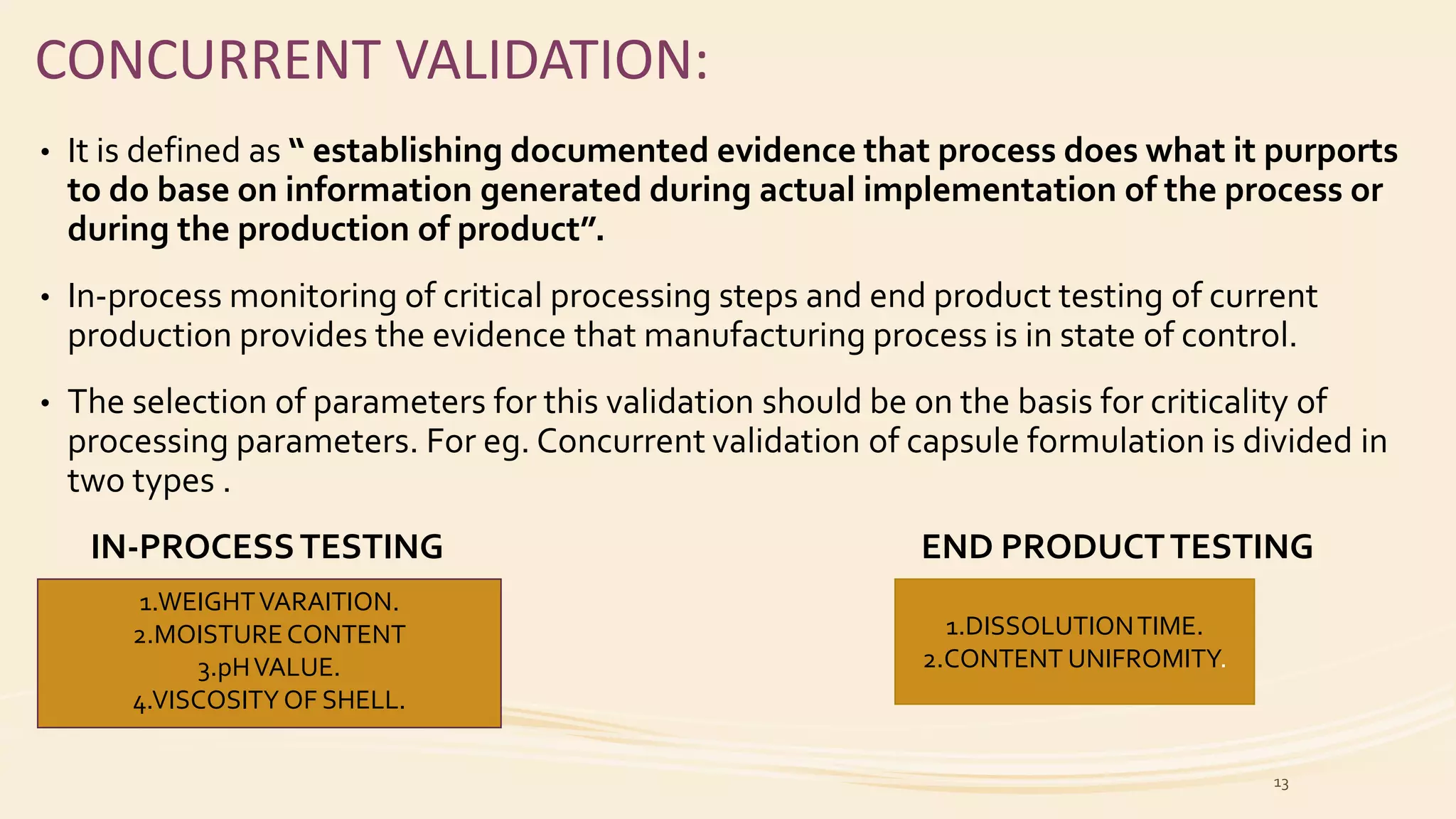
CONCURRENT VALIDATION:
• It is defined as “ establishing documented evidence that process does what it purports
to do base on information generated during actual implementation of the process or
during the production of product”.
• In-process monitoring of critical processing steps and end product testing of current
production provides the evidence that manufacturing process is in state of control.
• The selection of parameters for this validation should be on the basis for criticality of
processing parameters. For eg. Concurrent validation of capsule formulation is divided in
two types .
IN-PROCESSTESTING END PRODUCTTESTING
1.WEIGHTVARAITION.
2.MOISTURECONTENT
3.pHVALUE.
4.VISCOSITY OF SHELL.
1.DISSOLUTIONTIME.
2.CONTENT UNIFROMITY.
13
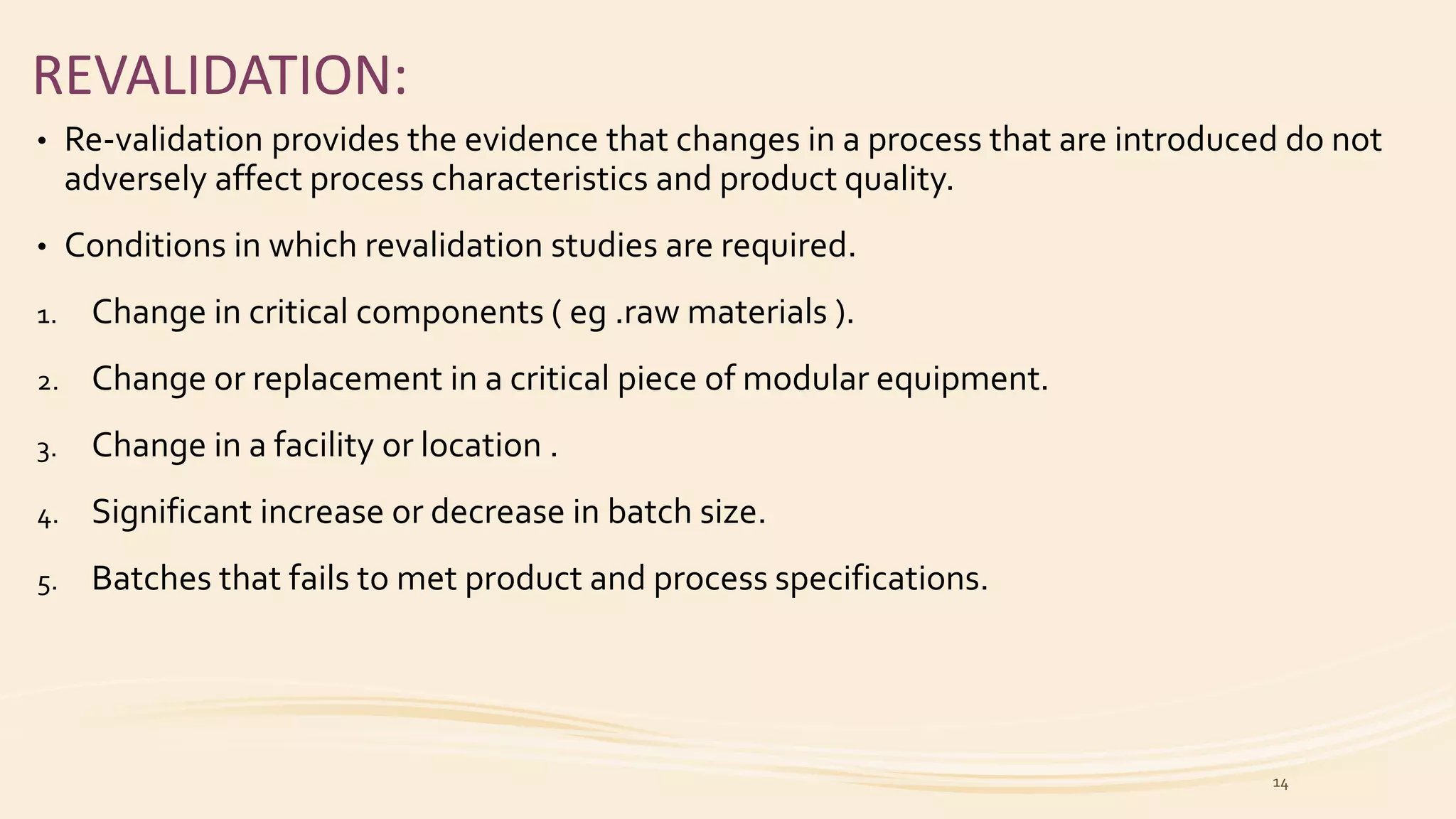
REVALIDATION:
• Re-validation provides the evidence that changes in a process that are introduced do not
adversely affect process characteristics and product quality.
• Conditions in which revalidation studies are required.
1. Change in critical components ( eg .raw materials ).
2. Change or replacement in a critical piece of modular equipment.
3. Change in a facility or location .
4. Significant increase or decrease in batch size.
5. Batches that fails to met product and process specifications.
14
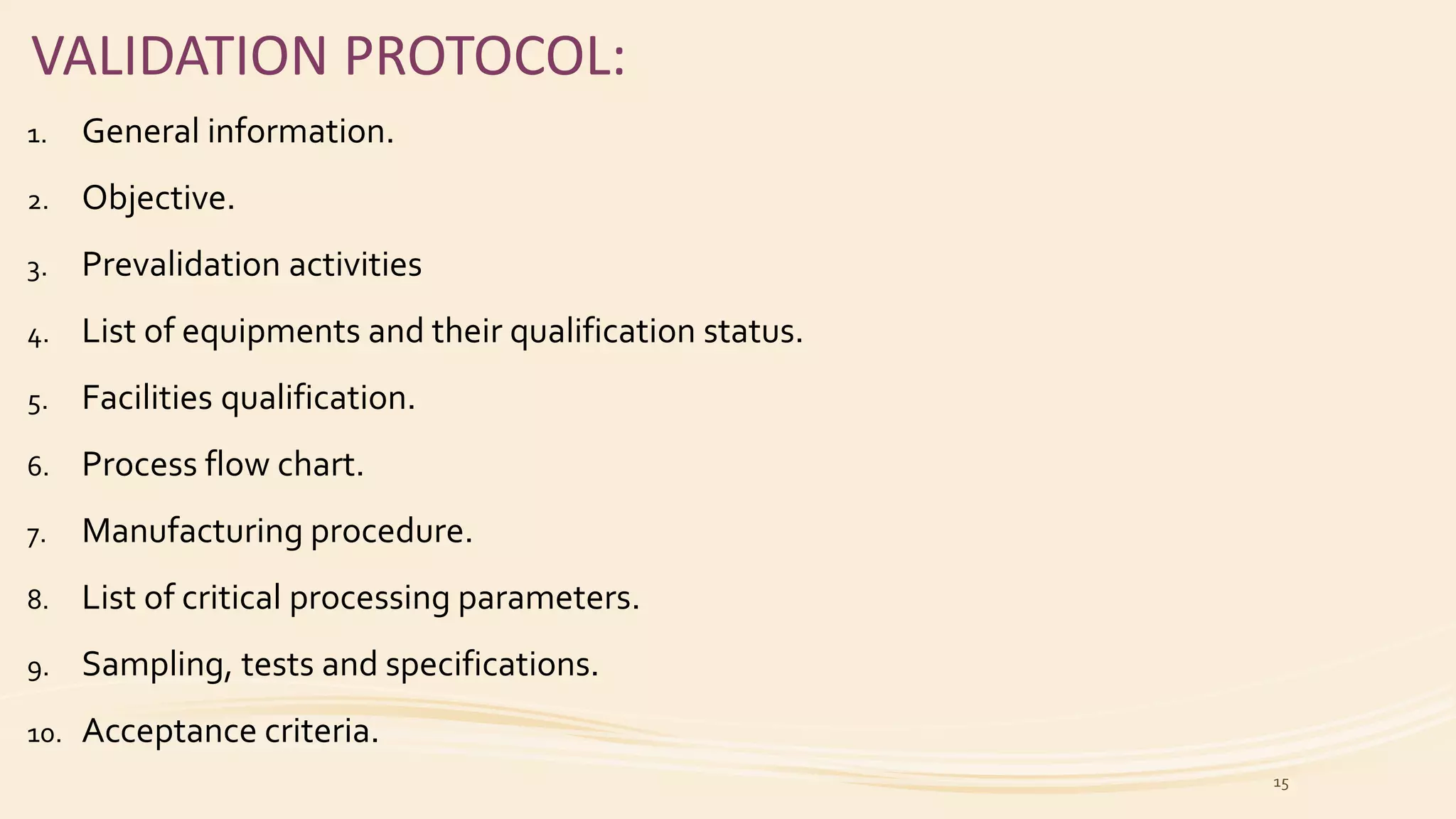
VALIDATION PROTOCOL:
1. General information.
2. Objective.
3. Prevalidation activities
4. List of equipments and their qualification status.
5. Facilities qualification.
6. Process flow chart.
7. Manufacturing procedure.
8. List of critical processing parameters.
9. Sampling, tests and specifications.
10. Acceptance criteria.
15
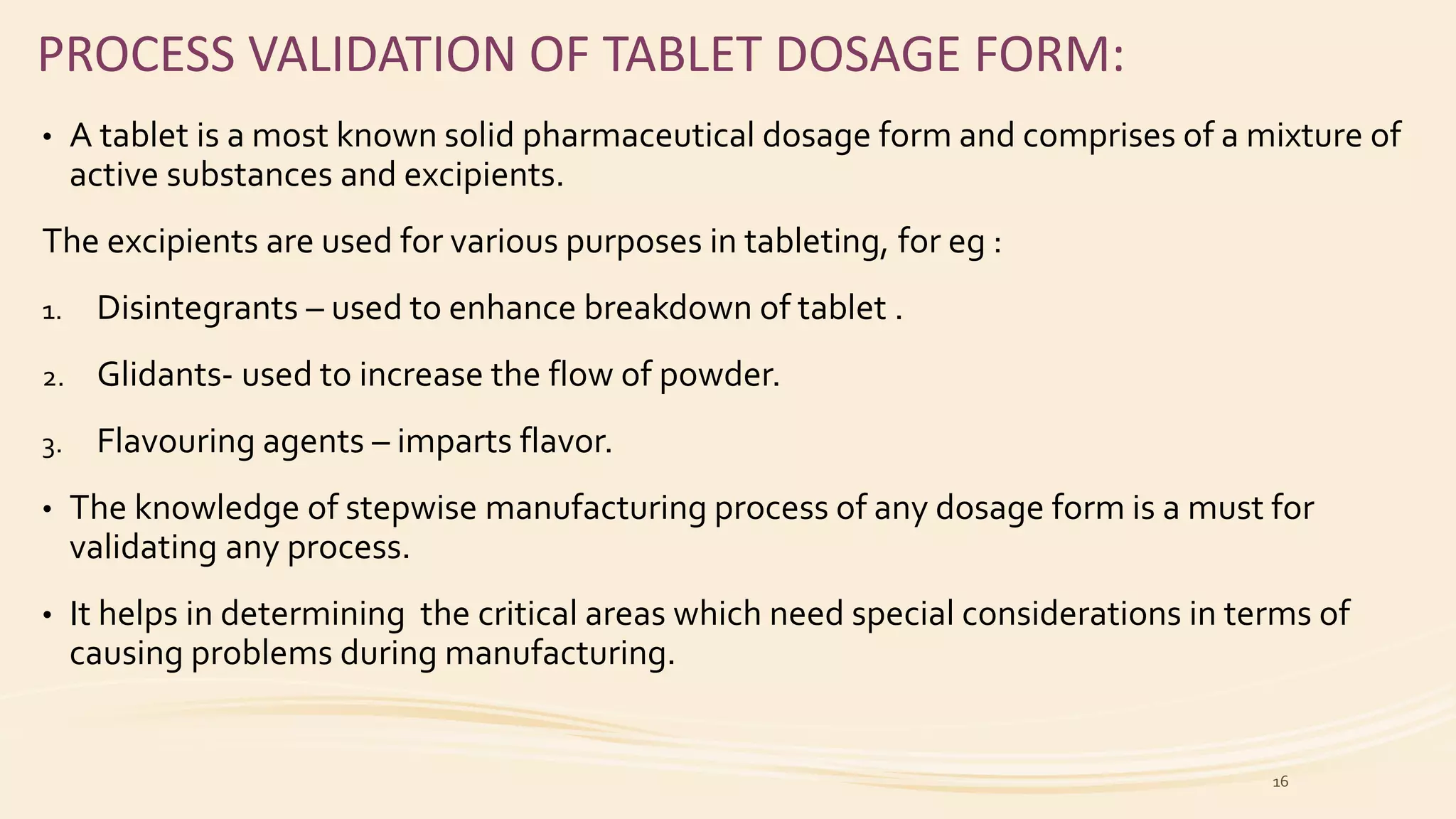
PROCESS VALIDATION OF TABLET DOSAGE FORM:
• A tablet is a most known solid pharmaceutical dosage form and comprises of a mixture of
active substances and excipients.
The excipients are used for various purposes in tableting, for eg :
1. Disintegrants – used to enhance breakdown of tablet .
2. Glidants- used to increase the flow of powder.
3. Flavouring agents – imparts flavor.
• The knowledge of stepwise manufacturing process of any dosage form is a must for
validating any process.
• It helps in determining the critical areas which need special considerations in terms of
causing problems during manufacturing.
16
• Following are the process parsmeters:
A) TABLET COMPOSITION:
Identify the key physiochemical properties of the drug substances that need to be
considered in developing the formulation, such as following.
I. Solubility of drug substance throughout the physiological pH range : depending upon
the solubility of the drug , a surfactant may be needed to enhance dissolution.
II. Particle size distribution and surface area : the particle size distribution of the drug may
determine what grade of an excipient to use eg. Microcystalline cellulose.
III. Morphology: drug amorphous then more solubility and if present in different
polymorphs then certain excipients can be used to prevent conversion of drug to other
physical forms.
IV. Hygroscopicity : special environment needed.
V. Melting point : if drug has low M.P then direct compression is suitable .
17
B) PROCESS EVALUATION AND SELECTION:
1. Mixing or blending.
The mixing or blending unit operation may occur once or several times during the tablet
manufacture.
Some of the physical properties of drug and excipients that affects the creating of uniform
mix or blend :
I. Bulk density.
II. Particle shape.
III. Particle size distribution.
IV. Surface area.
Material having similar physical properties will be easier to form a uniform blend and will not
segregate .
18
i. Mixing or blending technique: diffusion ( tumble) , convection ( planetary ) or pneumatic
techniques ( fluid bed ) can be used to mix or blend materials. Determine the technique
which is required. It may be different , depending upon the mixing of drug and excipient
for a direct compression formulation or adding the lubricant to granulation.
ii. Mixing or blending speed :determine the intensity ( high/low shear ) and or speed ( rpm)
in blending . Mixing of the drug and excipient requires more intense mixing.
iii. Mixing or blending time : this time will depend on the mixing or blending technique and
speed. Experiments should be carried out to determine overnixing, demixing or
segregation . Demixing occurs due to the physical property change ( eg. drug is
micronized and excipients are in granular state ).
iv. Drug uniformity : generally performed to determine the uniformity of drug throughout
the mix or blend. Representative samples should be taken throughout the mix or blend.
Segregation can occur by over handling, resulting inaccurate results.
v. Excipient uniformity : the excipients should be uniform in the granulation or blend .Two
key excipients are :
19
a. Lubricant: it needs to be distributed uniformly in the mixture for the high speed
compression operation . Uneven distribution results in problem of sticking and picking
and also lead to tablet performance problems ( low dissolution due to excess lubrication).
b. color: it needs to distributed uniformly so that tablets have uniform appearance . It is
should be pre-screened or uniformly dispersed in blend prior to compression to avoid
shading of the color.
2.Wet Granulation.
Following parameters should be considered during development of formulation by the wet
granulation technique.
I. Binder addition : adding the binder in dry state avoids the need to determine the optimal
binder concentration and a separate manufacture for binder solution.
II. Binder concentration: optimal concentration should be determined. If binder solution to
be sprayed out then it should be diluted enough that it gets pumped through spray
nozzle. It should be sufficient to form granules without over wetting them.
20
iii. Amount of binder solution/ granulating solvent : too much binder overwets the materials
and prolongs the drying time. Amount of binder solution is related to binder concentration.
iv. Mixing time : granulation that are not mixed long enough can form incomplete or weak
granules.These granules have poor flow and compression properties.overmixing leads to
harder granules and lower disintegration rate.
v. Binder solution rate: determine the required rate.
• 3.Drying time:The type of drying technique (e.g., tray, fluid bed, microwave) required for
the formulation needs to be determined and justified. High moisture content can result in
(1) tablet picking or sticking to tablet punch surfaces and
(2) poor chemical stability as a result of hydrolysis.
• An overdried granulation could result in poor hardness and friability.
21
Parameters to be considered are:
• Inlet/outlet temperature:The inlet temperature is the temperature of the incoming air to
the dryer, while the outlet temperature is the temperature leaving the unit.
• Airflow: There should be sufficient airflow to ensure removal of moisture laden air from
the wet granulation. Insufficient airflow could prolong drying and affect the chemical
stability of the drug.
• Moisture uniformity:The moisture content could vary within the granulation.
• Equipment capability/capacity: The load that can be efficiently dried within the unit needs
to be known. A larger load will require more moisture to be removed on drying and will
affect the drying time.
• 4. Milling: The milling operation will reduce the particle size of the dried granulation.The
resultant particle size distribution will affect such material properties as flow,
compressibility, disintegration, and dissolution.
Factors to consider in milling are:
22
a. Mill type: Each has several variants, depending on the means to reduce the particles.The
type of mill can generate a different particle size/size distribution. Particle size testing
will need to be conducted and the results examined when substituting mill types.
b. Screen size:The selected screen size will affect the particle size. A smaller screen size will
produce a smaller particle size and a greater number of fines.
c. Mill speed: A higher mill speed will result in a smaller particle size and possibly a wider
particle size distribution. It can also generate more heat to the product, depending on the
screen size and feed rate, which could affect the stability of the product.
d. Feed rate:The feed rate is dependent on the mill capacity, screen size,and mill speed.
5.Tablet Compression:
Compression is a critical step in the production of a tablet dosage form.The materials being
compressed will need to have adequate flow and compression properties.The material
should readily flow from the hopper onto the feed frame and into the dies.
Factors to consider during compression are as follows:
23
I. Compression speed:The formulation should be compressed at a wide range of
compression speeds to determine the operating range of the compressor.The adequacy
of the material’s flow into the dies will be determined by examining the tablet weights
II. Compression/ejection force:The compression profile for the tablet formulation will
need to be determined to establish the optimal compression force to obtain the desired
tablet hardness.
The following in-process tests (as discussed in Sec.V) should be examined during the
compression stage:
• Appearance
• Hardness
• Tablet weight
• Friability
• Disintegration
• Weight uniformity 24
6.Tablet Coating:
• Tablet coating can occur by different techniques (e.g., sugar, film, or compression). Film
coating has been the most common technique over recent years and will be the focus of
this section.
Key areas to consider for tablet coating include the following:
• Tablet properties:Tablet properties such as hardness, shap eare important to obtain a good
film-coated tablet.The tablet needs to be hard enough to withstand the coating process. If
tablet attrition occurs, the tablets will have a rough surface appearance
• Equipment type:The type of coater will need to be selected. Conventional or perforated
pan and fluid bed coaters are potential options.
• Spray guns:The number and types of guns should be determined in order to efficiently
coat the tablets.The spray nozzles should be sized properly to ensure even distribution
over the tablet bed and to prevent clogging of the nozzles.
• Application/spray rate: Spraying too fast will cause the tablets to become over wet,
resulting in clumping of tablets and possible dissolution of the tablet surface. 25
• Inlet/outlet temperature and airflow:These parameters are interrelated and should be set
to ensure that the atomized coating solution reaches the tablet surface and then is quickly
dried.
• Coating solution:The concentration and viscosity of the coating solution will need to be
determined.The solution will need to be sufficiently diluted in order to spray the material
on the tablets.The concentration of the coating solution will also determine the amount
and volume of solution to be applied to the tablets.
• C. Equipment Evaluation
• In an ideal situation, the equipment used to manufacture tablet dosage forms would be
selected based on such factors as formulation, safety requirements, handling/production
efficiencies, and commercial demands.
• Cleaning procedures should also be available to ensure that cross-contamination does not
occur.The equipment design, operating principles, and capacity should be investigated.
26
PROCESS VALIDATION FOR CAPSULES
HARD GELATIN CAPSULES
• Many of properties and processes for hard gelatin capsules are the same as with tablet
dosage forms.
A. Capsule Composition: The composition of the capsule contents would be similar to that
presented in the tablet composition section.The capsule shell and the interactions of the
shell and the contents will be discussed further.
1. Capsule Shell:
• Provide the reason for the presence of each ingredient in the capsule formula.
• Justify the level and grade of each ingredient.
• Explain the selection of the capsule size and shape.
• Discuss the need for capsule identification (e.g., color or imprinting).
27
2.Capsule Shell Contents:
• Establish the compatibility of the capsule shell and the capsule contents.
• Determine the hygroscopic nature of the capsule formulation. For example, a hygroscopic
formulation (active ingredient and/or excipients) can pull water from the capsule shell,
which could affect the Active ingredient—stability issues such as degradation and
morphology changes. Capsule shell—more brittle.
• B. Process Evaluation and Selection
The process to manufacture the contents of a hard gelatin capsule is the same as a tablet. It
may required only a blending step, such as a direct compression tablet, or several unit
operations, such as a wet granulation tablet In either case, the materials are then
encapsulated in a capsule shell.
C. Encapsulation
• Encapsulation is a critical step in the production of capsules, similar to the compression
step for tablet dosage forms.The materials to be encapsulated will need to have good flow
properties and a consistent density. 28
• Factors to consider during encapsulation are:
Encapsulation type:The type of encapsulation technique (e.g., auger, vacuum, dosator) required for the
formulation needs to be determined and justified. Examples are
I. Auger: CapsugelType B or Elanco No. 8
II. Vacuum: Perry
III. Vibratory: Osaka
• The type of technique may be dependent on such factorsas drug or formulation properties and equipment
availability.
Encapsulation speed:The formulation should be encapsulated at a wide range of speeds to determine the
operating range of the encapsulator. By examining the capsule weights, the adequacy of the material’s flow will
be determined.The following in-process tests should be examined during the encapsulation step:
• Appearance
• Capsule weight
• Disintegration
• Weight uniformity
29
REFERENCES:
Robert.A.Nash , Alfred.H.Wachter ; Pharmaceutical ProcessValidation ;An International
Third Edition ;Volume number -129; Marcel and Deckker Inc, Pg no- 159-170.
Dr.Sohan.S.Chitlange,Dr. Pravin.D.Chaudhari, Mr. Ajinath .E.Shirsat; Pharmaceutical
Validation ;Pharmtree publication, Pg no – 1-50.
Goyal Anju , Priyambada Pandey ; ProcessValidation Of Pharmaceutical Dosage forms – A
Review; Biomedical Journel of scientific andTechnical Research, vol- 1(5).
30
THANKYOU !!!!!
31

validation of tablet and capsule formulation8

  • 1.
    TYPES OF PROCESSVALIDATION AND PROCESS VALIDATION OF TABLET AND CAPSULE FORMULATION. PRESENTED BY, GUIDED BY, TANVI KUMBHAR, DR. SONALI MAHAPARALE, ROLL NO: 526, HOD CHEMISTRY DEPARTMENT FY.MPHARM SEM II DR.D.Y.PATIL COLLEG PHARMACY QAT DEPARTMENT AKURDI, PUNE .
  • 2.
    CONTENTS o Validation. o Processvalidation. o Types of process validation. o Perspective validation. o Retrospective validation. o Concurrent validation. o Revalidation. o Validation protocol. o Process validation of tablet and capsule dosage forms. o References. 2
  • 3.
    VALIDATION: • Validation isnecessary part of quality assurance plan and is fundamental to an efficient production operation. • Word “validation” means assessment of validity or action proving effectiveness . • This concept pioneered by 2 FDA officials –TED BYERS and BUD LOFTUS in 1970. REASON FORVALIDATION:  It is to guarantee that all processes and machinery in the pharmaceutical manufacturing process are being used in a way , which will ensure safety, integrity , quality and strength of a dosage form.  Validation is very important if there is significant change that may affect the quality of the product directly or indirectly . 3
  • 4.
    • FDA definesassurance of product quality is derived from 3 important factors. I. Selection of quality components and materials. II. Adequate product and process design. III. Control of process through in-process and end-process testing. • Thus, it is important to carefully design and validation of both the process and its control systems so as to achieve quality attributes . • Conventional quality control procedures involved the finished product testing which encompassed the establishment of : I. Specifications and performance characteristics. II. Selection of appropriate methology. III. Equipment and instruments to ensure that product meets the specifications. 4
  • 5.
    • However thevalidation concept includes: I. Qualification of processing facility and its equipment. II. Qualification of manufacturing process. III. In-process testing. IV. Finished product testing. V. Auditing, monitoring, sampling, challenging the key steps in the process. VI. Revalidation if any change is to be validated in product or manufacturing process. 5
  • 6.
    PROCESS VALIDATION: • Accordingto USFDA the process validation is defined as : “Process validation is establishing document evidence which provides a high degree of assurance that a specific process ( such as manufacture of pharmaceutical dosage forms) will consistently produce meeting its predetermined specifications and quality characteristics”. • The process validation is derived from the fact that the specific exercise of process validation should never fail. • Failure in carrying out the process validation is often the result of incomplete or faulty understanding of the process’s capability, in other words , what the process can and cannot do under a given set of operational circumstances. • Process validation is performed by individuals with necessary training and experience to carry out the assignment. 6
  • 7.
    TYPES OF PROCESSVALIDATION PROCESS VALIDATION PROSPECTIVE RESTROSPECTIVE CONCURRENT REVALIDATION 7
  • 8.
    PROSPECTIVE VALIDATION: • Herean experimental plan called as theValidation Protocol is executed before the process is put into commercial use. • This type of validation is normally carried out in connection with the introduction of new drug products and their manufacturing processes. • It is defined as “ established documented evidence that a system does what it purpots to do based on a preplanned protocol”. • Objective: Is to prove or demonstrate that the process will work in accordance with a validation master plan . • Before conducting prospective validation following operations and procedures must be completed satisfactorily.  cGMP requirements must be completed by the facilities and equipments in which process validation is to be completed. 8
  • 9.
    Training should begiven to operators and supervising personnel. The design , selection and optimization of the formula must be completed from product development department. The product and the manufacturing processes detailed information along with quality and stability of product have been provided. Finally, at least one qualification trial of a pilot-production batch has been made and shows no deviations were seen from the expected performance of process. 9
  • 10.
    RETROSPECTIVE VALIDATION: • Itis chosen for the established products whose manufacturing processes are considered stable. • Prior to undertaking retrospective validation, equipments , facilities, and subsystems used in connection with the manufacturing process must be qualified in conformance with cGMP requirements. • It is defined as “ the established documented evidence that a system does what it purports to do an review and analysis of historical information and data available of process or product during manufacturing”. • This type of validation can may be conducted on the data available in computer based system or data recorded by manual methods. • Some basic considerations before performing retrospective validation are as follows: 10
  • 11.
     Gathering ofthe numerical data from the completed batch record which might includes all tests carried out as per pharmacopeia.  Organize these data in a chronological sequence according to batch manufacturing data using uniform format.  Select sufficient batches, to include data.  Elimination of data from non-critical processing steps and deletion of all unnecessary numerical information and subject the resultant data to statistical analysis and evaluation.  From the statistical analysis draw conclusions.  Final step includes issuing a report of findings from retrospective validation as documented evidence that process is validated. Eg. Soft gelatin capsules: 1. Content uniformity after mixing. 2. Weight variation for soft gelatin capsules. 11
  • 12.
    3. Coat thicknessof soft gelatin capsules. 4. Moisture content of soft gelatin capsules. 5.Dissolution time. Semisolid and liquid dosage forms: 1. pH 2. Viscosity 3. Color or clarity 4. Average particle size 5. Grittiness 6. Spreadability. 12
  • 13.
    CONCURRENT VALIDATION: • Itis defined as “ establishing documented evidence that process does what it purports to do base on information generated during actual implementation of the process or during the production of product”. • In-process monitoring of critical processing steps and end product testing of current production provides the evidence that manufacturing process is in state of control. • The selection of parameters for this validation should be on the basis for criticality of processing parameters. For eg. Concurrent validation of capsule formulation is divided in two types . IN-PROCESSTESTING END PRODUCTTESTING 1.WEIGHTVARAITION. 2.MOISTURECONTENT 3.pHVALUE. 4.VISCOSITY OF SHELL. 1.DISSOLUTIONTIME. 2.CONTENT UNIFROMITY. 13
  • 14.
    REVALIDATION: • Re-validation providesthe evidence that changes in a process that are introduced do not adversely affect process characteristics and product quality. • Conditions in which revalidation studies are required. 1. Change in critical components ( eg .raw materials ). 2. Change or replacement in a critical piece of modular equipment. 3. Change in a facility or location . 4. Significant increase or decrease in batch size. 5. Batches that fails to met product and process specifications. 14
  • 15.
    VALIDATION PROTOCOL: 1. Generalinformation. 2. Objective. 3. Prevalidation activities 4. List of equipments and their qualification status. 5. Facilities qualification. 6. Process flow chart. 7. Manufacturing procedure. 8. List of critical processing parameters. 9. Sampling, tests and specifications. 10. Acceptance criteria. 15
  • 16.
    PROCESS VALIDATION OFTABLET DOSAGE FORM: • A tablet is a most known solid pharmaceutical dosage form and comprises of a mixture of active substances and excipients. The excipients are used for various purposes in tableting, for eg : 1. Disintegrants – used to enhance breakdown of tablet . 2. Glidants- used to increase the flow of powder. 3. Flavouring agents – imparts flavor. • The knowledge of stepwise manufacturing process of any dosage form is a must for validating any process. • It helps in determining the critical areas which need special considerations in terms of causing problems during manufacturing. 16
  • 17.
    • Following arethe process parsmeters: A) TABLET COMPOSITION: Identify the key physiochemical properties of the drug substances that need to be considered in developing the formulation, such as following. I. Solubility of drug substance throughout the physiological pH range : depending upon the solubility of the drug , a surfactant may be needed to enhance dissolution. II. Particle size distribution and surface area : the particle size distribution of the drug may determine what grade of an excipient to use eg. Microcystalline cellulose. III. Morphology: drug amorphous then more solubility and if present in different polymorphs then certain excipients can be used to prevent conversion of drug to other physical forms. IV. Hygroscopicity : special environment needed. V. Melting point : if drug has low M.P then direct compression is suitable . 17
  • 18.
    B) PROCESS EVALUATIONAND SELECTION: 1. Mixing or blending. The mixing or blending unit operation may occur once or several times during the tablet manufacture. Some of the physical properties of drug and excipients that affects the creating of uniform mix or blend : I. Bulk density. II. Particle shape. III. Particle size distribution. IV. Surface area. Material having similar physical properties will be easier to form a uniform blend and will not segregate . 18
  • 19.
    i. Mixing orblending technique: diffusion ( tumble) , convection ( planetary ) or pneumatic techniques ( fluid bed ) can be used to mix or blend materials. Determine the technique which is required. It may be different , depending upon the mixing of drug and excipient for a direct compression formulation or adding the lubricant to granulation. ii. Mixing or blending speed :determine the intensity ( high/low shear ) and or speed ( rpm) in blending . Mixing of the drug and excipient requires more intense mixing. iii. Mixing or blending time : this time will depend on the mixing or blending technique and speed. Experiments should be carried out to determine overnixing, demixing or segregation . Demixing occurs due to the physical property change ( eg. drug is micronized and excipients are in granular state ). iv. Drug uniformity : generally performed to determine the uniformity of drug throughout the mix or blend. Representative samples should be taken throughout the mix or blend. Segregation can occur by over handling, resulting inaccurate results. v. Excipient uniformity : the excipients should be uniform in the granulation or blend .Two key excipients are : 19
  • 20.
    a. Lubricant: itneeds to be distributed uniformly in the mixture for the high speed compression operation . Uneven distribution results in problem of sticking and picking and also lead to tablet performance problems ( low dissolution due to excess lubrication). b. color: it needs to distributed uniformly so that tablets have uniform appearance . It is should be pre-screened or uniformly dispersed in blend prior to compression to avoid shading of the color. 2.Wet Granulation. Following parameters should be considered during development of formulation by the wet granulation technique. I. Binder addition : adding the binder in dry state avoids the need to determine the optimal binder concentration and a separate manufacture for binder solution. II. Binder concentration: optimal concentration should be determined. If binder solution to be sprayed out then it should be diluted enough that it gets pumped through spray nozzle. It should be sufficient to form granules without over wetting them. 20
  • 21.
    iii. Amount ofbinder solution/ granulating solvent : too much binder overwets the materials and prolongs the drying time. Amount of binder solution is related to binder concentration. iv. Mixing time : granulation that are not mixed long enough can form incomplete or weak granules.These granules have poor flow and compression properties.overmixing leads to harder granules and lower disintegration rate. v. Binder solution rate: determine the required rate. • 3.Drying time:The type of drying technique (e.g., tray, fluid bed, microwave) required for the formulation needs to be determined and justified. High moisture content can result in (1) tablet picking or sticking to tablet punch surfaces and (2) poor chemical stability as a result of hydrolysis. • An overdried granulation could result in poor hardness and friability. 21
  • 22.
    Parameters to beconsidered are: • Inlet/outlet temperature:The inlet temperature is the temperature of the incoming air to the dryer, while the outlet temperature is the temperature leaving the unit. • Airflow: There should be sufficient airflow to ensure removal of moisture laden air from the wet granulation. Insufficient airflow could prolong drying and affect the chemical stability of the drug. • Moisture uniformity:The moisture content could vary within the granulation. • Equipment capability/capacity: The load that can be efficiently dried within the unit needs to be known. A larger load will require more moisture to be removed on drying and will affect the drying time. • 4. Milling: The milling operation will reduce the particle size of the dried granulation.The resultant particle size distribution will affect such material properties as flow, compressibility, disintegration, and dissolution. Factors to consider in milling are: 22
  • 23.
    a. Mill type:Each has several variants, depending on the means to reduce the particles.The type of mill can generate a different particle size/size distribution. Particle size testing will need to be conducted and the results examined when substituting mill types. b. Screen size:The selected screen size will affect the particle size. A smaller screen size will produce a smaller particle size and a greater number of fines. c. Mill speed: A higher mill speed will result in a smaller particle size and possibly a wider particle size distribution. It can also generate more heat to the product, depending on the screen size and feed rate, which could affect the stability of the product. d. Feed rate:The feed rate is dependent on the mill capacity, screen size,and mill speed. 5.Tablet Compression: Compression is a critical step in the production of a tablet dosage form.The materials being compressed will need to have adequate flow and compression properties.The material should readily flow from the hopper onto the feed frame and into the dies. Factors to consider during compression are as follows: 23
  • 24.
    I. Compression speed:Theformulation should be compressed at a wide range of compression speeds to determine the operating range of the compressor.The adequacy of the material’s flow into the dies will be determined by examining the tablet weights II. Compression/ejection force:The compression profile for the tablet formulation will need to be determined to establish the optimal compression force to obtain the desired tablet hardness. The following in-process tests (as discussed in Sec.V) should be examined during the compression stage: • Appearance • Hardness • Tablet weight • Friability • Disintegration • Weight uniformity 24
  • 25.
    6.Tablet Coating: • Tabletcoating can occur by different techniques (e.g., sugar, film, or compression). Film coating has been the most common technique over recent years and will be the focus of this section. Key areas to consider for tablet coating include the following: • Tablet properties:Tablet properties such as hardness, shap eare important to obtain a good film-coated tablet.The tablet needs to be hard enough to withstand the coating process. If tablet attrition occurs, the tablets will have a rough surface appearance • Equipment type:The type of coater will need to be selected. Conventional or perforated pan and fluid bed coaters are potential options. • Spray guns:The number and types of guns should be determined in order to efficiently coat the tablets.The spray nozzles should be sized properly to ensure even distribution over the tablet bed and to prevent clogging of the nozzles. • Application/spray rate: Spraying too fast will cause the tablets to become over wet, resulting in clumping of tablets and possible dissolution of the tablet surface. 25
  • 26.
    • Inlet/outlet temperatureand airflow:These parameters are interrelated and should be set to ensure that the atomized coating solution reaches the tablet surface and then is quickly dried. • Coating solution:The concentration and viscosity of the coating solution will need to be determined.The solution will need to be sufficiently diluted in order to spray the material on the tablets.The concentration of the coating solution will also determine the amount and volume of solution to be applied to the tablets. • C. Equipment Evaluation • In an ideal situation, the equipment used to manufacture tablet dosage forms would be selected based on such factors as formulation, safety requirements, handling/production efficiencies, and commercial demands. • Cleaning procedures should also be available to ensure that cross-contamination does not occur.The equipment design, operating principles, and capacity should be investigated. 26
  • 27.
    PROCESS VALIDATION FORCAPSULES HARD GELATIN CAPSULES • Many of properties and processes for hard gelatin capsules are the same as with tablet dosage forms. A. Capsule Composition: The composition of the capsule contents would be similar to that presented in the tablet composition section.The capsule shell and the interactions of the shell and the contents will be discussed further. 1. Capsule Shell: • Provide the reason for the presence of each ingredient in the capsule formula. • Justify the level and grade of each ingredient. • Explain the selection of the capsule size and shape. • Discuss the need for capsule identification (e.g., color or imprinting). 27
  • 28.
    2.Capsule Shell Contents: •Establish the compatibility of the capsule shell and the capsule contents. • Determine the hygroscopic nature of the capsule formulation. For example, a hygroscopic formulation (active ingredient and/or excipients) can pull water from the capsule shell, which could affect the Active ingredient—stability issues such as degradation and morphology changes. Capsule shell—more brittle. • B. Process Evaluation and Selection The process to manufacture the contents of a hard gelatin capsule is the same as a tablet. It may required only a blending step, such as a direct compression tablet, or several unit operations, such as a wet granulation tablet In either case, the materials are then encapsulated in a capsule shell. C. Encapsulation • Encapsulation is a critical step in the production of capsules, similar to the compression step for tablet dosage forms.The materials to be encapsulated will need to have good flow properties and a consistent density. 28
  • 29.
    • Factors toconsider during encapsulation are: Encapsulation type:The type of encapsulation technique (e.g., auger, vacuum, dosator) required for the formulation needs to be determined and justified. Examples are I. Auger: CapsugelType B or Elanco No. 8 II. Vacuum: Perry III. Vibratory: Osaka • The type of technique may be dependent on such factorsas drug or formulation properties and equipment availability. Encapsulation speed:The formulation should be encapsulated at a wide range of speeds to determine the operating range of the encapsulator. By examining the capsule weights, the adequacy of the material’s flow will be determined.The following in-process tests should be examined during the encapsulation step: • Appearance • Capsule weight • Disintegration • Weight uniformity 29
  • 30.
    REFERENCES: Robert.A.Nash , Alfred.H.Wachter; Pharmaceutical ProcessValidation ;An International Third Edition ;Volume number -129; Marcel and Deckker Inc, Pg no- 159-170. Dr.Sohan.S.Chitlange,Dr. Pravin.D.Chaudhari, Mr. Ajinath .E.Shirsat; Pharmaceutical Validation ;Pharmtree publication, Pg no – 1-50. Goyal Anju , Priyambada Pandey ; ProcessValidation Of Pharmaceutical Dosage forms – A Review; Biomedical Journel of scientific andTechnical Research, vol- 1(5). 30
  • 31.