NIOSOMES
Supervised by :
Dr. Roshan Isarani
H.O.D of Pharmaceutics
Submitted by:
Sunil Saini
M.pharm(P`ceutics) Sem-2nd
LACHOO MEMORIAL COLLEGE OF SCIENCE AND TECHNOLOGY
JODHPUR
Introduction
Methods of Preparation
Evaluation of Niosomes
Applications of Niosomes
2
NIOSOMES
 Niosomes are a novel drug delivery system, in which the
medication is encapsulated in a vesicle composed of a bilayer
of non-ionic surface active agents .
 These are very small, and microscopic in size that lies in the
nanometric scale. Although structurally similar to liposomes,
they offer several advantages over them.
 Niosomes have recently been shown to greatly increase
transdermal drug delivery and also in targeted drug delivery.
3
 Used for a variety of drugs : includes hydrophilic, lipophilic as
well as amphiphilic moieties.
 Act as a depot to release the drug slowly and offer a controlled
release.
 Osmotically active and stable.
 Increase the stability of the entrapped drug.
 Handling and storage of surfactants do not require any special
conditions
 Enhance the skin penetration of drugs.
4
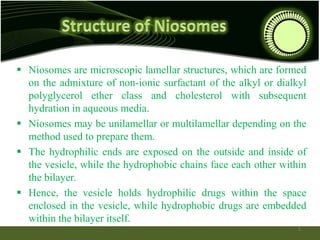
 Niosomes are microscopic lamellar structures, which are formed
on the admixture of non-ionic surfactant of the alkyl or dialkyl
polyglycerol ether class and cholesterol with subsequent
hydration in aqueous media.
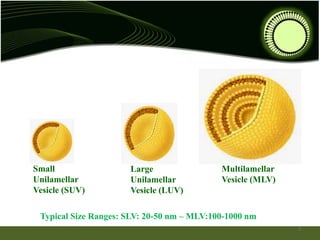
 Niosomes may be unilamellar or multilamellar depending on the
method used to prepare them.
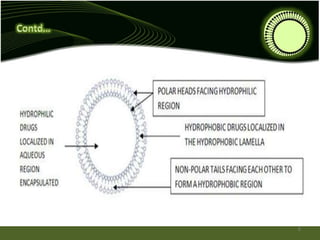
 The hydrophilic ends are exposed on the outside and inside of
the vesicle, while the hydrophobic chains face each other within
the bilayer.
 Hence, the vesicle holds hydrophilic drugs within the space
enclosed in the vesicle, while hydrophobic drugs are embedded
within the bilayer itself.
5
6
Small
Unilamellar
Vesicle (SUV)
Large
Unilamellar
Vesicle (LUV)
Multilamellar
Vesicle (MLV)
Typical Size Ranges: SLV: 20-50 nm – MLV:100-1000 nm
7
 In both basic unit of assembly is Amphiphiles, but they
phospholipids in liposomes and nonionic surfactants in niosomes.
 Both can entrap hydrophilic and lipophilic drugs.
 Both have same physical properties but differ in their chemical
composition.
 Niosomes has higher chemical stability than liposomes.
 Niosomes made of uncharged single chain surfactant molecules
 Liposomes made of neutral or charged double chain phospholipids.
8
• Ester bonds of phospholipids are easily hydrolyzed, this can lead
to phosphoryl migration at low PH.
• Peroxidation of unsaturated phospholipids.
• As liposomes have purified phospholipids they are to be stored
and handled at inert(N2) atmospheres where as Niosomes are
made of non ionic surfactants and are easy to handle and store.
• Phospholipid raw materials are naturally occurring substances
and as such require extensive purification thus making them
costly.
9
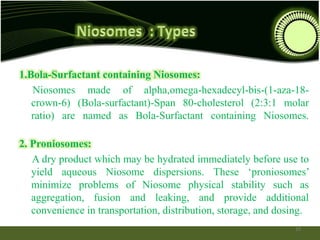
1.Bola-Surfactant containing Niosomes:
Niosomes made of alpha,omega-hexadecyl-bis-(1-aza-18-
crown-6) (Bola-surfactant)-Span 80-cholesterol (2:3:1 molar
ratio) are named as Bola-Surfactant containing Niosomes.
2. Proniosomes:
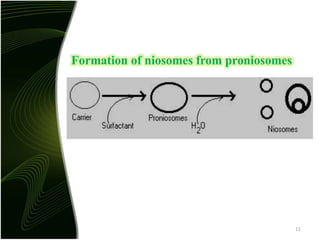
A dry product which may be hydrated immediately before use to
yield aqueous Niosome dispersions. These ‘proniosomes’
minimize problems of Niosome physical stability such as
aggregation, fusion and leaking, and provide additional
convenience in transportation, distribution, storage, and dosing.
10
Formation of niosomes from proniosomes
11
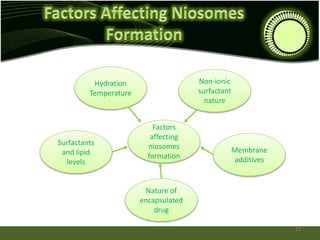
Factors
affecting
niosomes
formation
Non-ionic
surfactant
nature
Membrane
additives
Nature of
encapsulated
drug
Surfactants
and lipid
levels
Hydration
Temperature
12
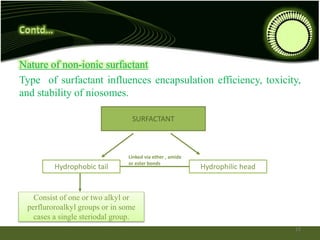
Nature of non-ionic surfactant
Type of surfactant influences encapsulation efficiency, toxicity,
and stability of niosomes.
SURFACTANT
Hydrophobic tail Hydrophilic head
Linked via ether , amide
or ester bonds
Consist of one or two alkyl or
perfluroroalkyl groups or in some
cases a single steriodal group.
13
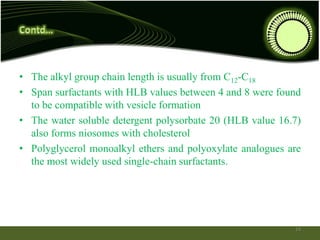
• The alkyl group chain length is usually from C12-C18
• Span surfactants with HLB values between 4 and 8 were found
to be compatible with vesicle formation
• The water soluble detergent polysorbate 20 (HLB value 16.7)
also forms niosomes with cholesterol
• Polyglycerol monoalkyl ethers and polyoxylate analogues are
the most widely used single-chain surfactants.
14
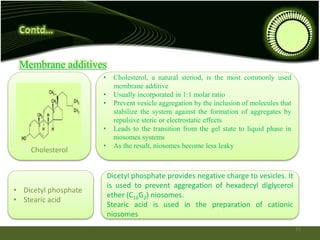
Membrane additives
• Cholesterol, a natural steriod, is the most commonly used
membrane additive
• Usually incorporated in 1:1 molar ratio
• Prevent vesicle aggregation by the inclusion of molecules that
stabilize the system against the formation of aggregates by
repulsive steric or electrostatic effects
• Leads to the transition from the gel state to liquid phase in
niosomes systems
• As the result, niosomes become less leaky
Cholesterol
Dicetyl phosphate provides negative charge to vesicles. It
is used to prevent aggregation of hexadecyl diglycerol
ether (C16G2) niosomes.
Stearic acid is used in the preparation of cationic
niosomes
• Dicetyl phosphate
• Stearic acid
15
Surfactant and lipid levels
• The surfactant/lipid ratio is generally 1:1
• If the level of surfactant/lipid is too high, increasing the
surfactant/lipid level increases the total amount of drug
encapsulated.
Hydration temperature
• The hydrating temperatures used to make niosomes should
usually be above the gel to liquid phase transition temperature
of the system
16
• Ether injection method
• Film method
• Sonication
• Reverse phase evaporation
• The “Bubble” method
• Micro fluidization.
17
Ether injection method
• Slow injection of an ether solution of niosomal ingredients into
an aqueous medium at high temperature
• A mixture of surfactant and cholesterol (150 μmol) is
dissolved in ether (20 ml) and injected into an aqueous phase
(4 ml) using a 14- gauge needle syringe
• Temperature of the system is maintained at 60oC during the
process
• Niosomes in the form of large unilamellar vesicles (LUV) are
formed.
18
Film method
• The mixture of surfactant and cholesterol is dissolved in an
organic solvent (e.g. diethyl ether, chloroform, etc.) in a
round-bottomed flask
• The organic solvent is removed by low pressure/vacuum at
room temperature
• The resultant dry surfactant film is hydrated by agitation at 50-
60oC
• Multilamellar vesicles (MLV) are formed.
19
Sonication
• The aqueous phase is added into the mixture of surfactant and
cholesterol in a scintillation vial
• Homogenized using a sonic probe
• The resultant vesicles are of small unilamellar (SUV) type
niosomes
• The SUV type niosomes are larger than SUV liposomes
• It is possible to obtain SUV niosomes by sonication of MLV
type vesicles.
20
Reverse phase evaporation
• Surface-active agents are dissolved in chlorofom, and 0.25
volume of phosphate saline buffer (PBS) is emulsified to get
w/o emulsion
• The mixture is sonicated and subsequently chloroform is
evaporated under reduced pressure
• The surfactant first forms a gel and then hydrates to form
niosomal vesicles
• The vesicles formed are unilamellar and 0.5 μ in diameter.
21
The “Bubble” method
 It is novel technique for the one step preparation of liposomes
and niosomes without the use of organic solvents
 The bubbling unit consists of round-bottomed flask with three
necks positioned in water bath to control the temperature
 Water-cooled reflux and thermometer are positioned in the first
and second neck and nitrogen supply through the third neck
 Cholesterol and surfactant are dispersed together in the buffer
(pH 7.4) at 70°C, the dispersion mixed for 15 secs with high
shear homogenizer and immediately afterwards “bubbled” at
70°C using nitrogen gas.
22
Micro fluidization
 This is a recent technique to prepare small MLVS
 A microfludizer is used to pump the fluid at a very high
pressure (10,000 psi) through a 5 pm screen
 It is then forced along defined micro channels, which direct
two streams of fluid to collide together at right angles, thereby
affecting a very efficient transfer of energy
 The lipids/surfactants can be introduced into the fluidizer
 The fluid collected can be recycled until spherical vesicles are
obtained
 Uniform and small sized vesicles are obtained
23
• Optical microscopy
• Particle size determination
• Removal of unentrapped drug
• Percentage drug entrapment
• Drug content analysis
• Invitro release study
• Stability studies
• Partition coefficient
24
Entrapment efficiency
 Depend on the method of preparation
 Niosomes prepared by ether injection method have better
entrapment efficiency than those prepared by the film or
sonication
 Addition of cholesterol to non-ionic surfactants with single- or
dialkyl-chain significantly alters the entrapment efficiency
 Surfactants of glycerol type lead to reduction in entrapment
capacity as the amount of cholesterol increases
 Niosomes in the form of liquid crystals possess better
entrapment efficiency than gel type vesicles
25
 Entrapment efficiency (EF)=(Amount entrapped/total amount) x100
 Niosomes, similar to liposomes, assume spherical shape and so their
diameter can be determined using light microscopy, photon
correlation microscopy and freeze fracture electron microscopy.
 Freeze thawing (keeping vesicles suspension at –20°C for 24 hrs
and then heating to ambient temperature) of niosomes increases the
vesicle diameter, which might be attributed to fusion of vesicles
during the cycle.
26
In-vitro release
 A method of in-vitro release rate study includes the use of dialysis
tubing.
 A dialysis sac is washed and soaked in distilled water. The vesicle
suspension is pipetted into a bag made up of the tubing and sealed.
The bag containing the vesicles is placed in 200 ml of buffer
solution in a 250 ml beaker with constant shaking at 25°C or
37°C.
 At various time intervals, the buffer is analyzed for the drug
content by an appropriate assay method of vesicles during the
cycle.
27
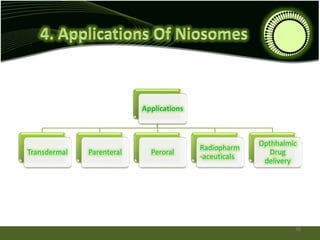
Applications
Transdermal Parenteral Peroral
Radiopharm
-aceuticals
Opthhalmic
Drug
delivery
28
29

NIOSOMES

  • 1.
    NIOSOMES Supervised by : Dr.Roshan Isarani H.O.D of Pharmaceutics Submitted by: Sunil Saini M.pharm(P`ceutics) Sem-2nd LACHOO MEMORIAL COLLEGE OF SCIENCE AND TECHNOLOGY JODHPUR
  • 2.
    Introduction Methods of Preparation Evaluationof Niosomes Applications of Niosomes 2
  • 3.
    NIOSOMES  Niosomes area novel drug delivery system, in which the medication is encapsulated in a vesicle composed of a bilayer of non-ionic surface active agents .  These are very small, and microscopic in size that lies in the nanometric scale. Although structurally similar to liposomes, they offer several advantages over them.  Niosomes have recently been shown to greatly increase transdermal drug delivery and also in targeted drug delivery. 3
  • 4.
     Used fora variety of drugs : includes hydrophilic, lipophilic as well as amphiphilic moieties.  Act as a depot to release the drug slowly and offer a controlled release.  Osmotically active and stable.  Increase the stability of the entrapped drug.  Handling and storage of surfactants do not require any special conditions  Enhance the skin penetration of drugs. 4
  • 5.
     Niosomes aremicroscopic lamellar structures, which are formed on the admixture of non-ionic surfactant of the alkyl or dialkyl polyglycerol ether class and cholesterol with subsequent hydration in aqueous media.  Niosomes may be unilamellar or multilamellar depending on the method used to prepare them.  The hydrophilic ends are exposed on the outside and inside of the vesicle, while the hydrophobic chains face each other within the bilayer.  Hence, the vesicle holds hydrophilic drugs within the space enclosed in the vesicle, while hydrophobic drugs are embedded within the bilayer itself. 5
  • 6.
  • 7.
    Small Unilamellar Vesicle (SUV) Large Unilamellar Vesicle (LUV) Multilamellar Vesicle(MLV) Typical Size Ranges: SLV: 20-50 nm – MLV:100-1000 nm 7
  • 8.
     In bothbasic unit of assembly is Amphiphiles, but they phospholipids in liposomes and nonionic surfactants in niosomes.  Both can entrap hydrophilic and lipophilic drugs.  Both have same physical properties but differ in their chemical composition.  Niosomes has higher chemical stability than liposomes.  Niosomes made of uncharged single chain surfactant molecules  Liposomes made of neutral or charged double chain phospholipids. 8
  • 9.
    • Ester bondsof phospholipids are easily hydrolyzed, this can lead to phosphoryl migration at low PH. • Peroxidation of unsaturated phospholipids. • As liposomes have purified phospholipids they are to be stored and handled at inert(N2) atmospheres where as Niosomes are made of non ionic surfactants and are easy to handle and store. • Phospholipid raw materials are naturally occurring substances and as such require extensive purification thus making them costly. 9
  • 10.
    1.Bola-Surfactant containing Niosomes: Niosomesmade of alpha,omega-hexadecyl-bis-(1-aza-18- crown-6) (Bola-surfactant)-Span 80-cholesterol (2:3:1 molar ratio) are named as Bola-Surfactant containing Niosomes. 2. Proniosomes: A dry product which may be hydrated immediately before use to yield aqueous Niosome dispersions. These ‘proniosomes’ minimize problems of Niosome physical stability such as aggregation, fusion and leaking, and provide additional convenience in transportation, distribution, storage, and dosing. 10
  • 11.
    Formation of niosomesfrom proniosomes 11
  • 12.
  • 13.
    Nature of non-ionicsurfactant Type of surfactant influences encapsulation efficiency, toxicity, and stability of niosomes. SURFACTANT Hydrophobic tail Hydrophilic head Linked via ether , amide or ester bonds Consist of one or two alkyl or perfluroroalkyl groups or in some cases a single steriodal group. 13
  • 14.
    • The alkylgroup chain length is usually from C12-C18 • Span surfactants with HLB values between 4 and 8 were found to be compatible with vesicle formation • The water soluble detergent polysorbate 20 (HLB value 16.7) also forms niosomes with cholesterol • Polyglycerol monoalkyl ethers and polyoxylate analogues are the most widely used single-chain surfactants. 14
  • 15.
    Membrane additives • Cholesterol,a natural steriod, is the most commonly used membrane additive • Usually incorporated in 1:1 molar ratio • Prevent vesicle aggregation by the inclusion of molecules that stabilize the system against the formation of aggregates by repulsive steric or electrostatic effects • Leads to the transition from the gel state to liquid phase in niosomes systems • As the result, niosomes become less leaky Cholesterol Dicetyl phosphate provides negative charge to vesicles. It is used to prevent aggregation of hexadecyl diglycerol ether (C16G2) niosomes. Stearic acid is used in the preparation of cationic niosomes • Dicetyl phosphate • Stearic acid 15
  • 16.
    Surfactant and lipidlevels • The surfactant/lipid ratio is generally 1:1 • If the level of surfactant/lipid is too high, increasing the surfactant/lipid level increases the total amount of drug encapsulated. Hydration temperature • The hydrating temperatures used to make niosomes should usually be above the gel to liquid phase transition temperature of the system 16
  • 17.
    • Ether injectionmethod • Film method • Sonication • Reverse phase evaporation • The “Bubble” method • Micro fluidization. 17
  • 18.
    Ether injection method •Slow injection of an ether solution of niosomal ingredients into an aqueous medium at high temperature • A mixture of surfactant and cholesterol (150 μmol) is dissolved in ether (20 ml) and injected into an aqueous phase (4 ml) using a 14- gauge needle syringe • Temperature of the system is maintained at 60oC during the process • Niosomes in the form of large unilamellar vesicles (LUV) are formed. 18
  • 19.
    Film method • Themixture of surfactant and cholesterol is dissolved in an organic solvent (e.g. diethyl ether, chloroform, etc.) in a round-bottomed flask • The organic solvent is removed by low pressure/vacuum at room temperature • The resultant dry surfactant film is hydrated by agitation at 50- 60oC • Multilamellar vesicles (MLV) are formed. 19
  • 20.
    Sonication • The aqueousphase is added into the mixture of surfactant and cholesterol in a scintillation vial • Homogenized using a sonic probe • The resultant vesicles are of small unilamellar (SUV) type niosomes • The SUV type niosomes are larger than SUV liposomes • It is possible to obtain SUV niosomes by sonication of MLV type vesicles. 20
  • 21.
    Reverse phase evaporation •Surface-active agents are dissolved in chlorofom, and 0.25 volume of phosphate saline buffer (PBS) is emulsified to get w/o emulsion • The mixture is sonicated and subsequently chloroform is evaporated under reduced pressure • The surfactant first forms a gel and then hydrates to form niosomal vesicles • The vesicles formed are unilamellar and 0.5 μ in diameter. 21
  • 22.
    The “Bubble” method It is novel technique for the one step preparation of liposomes and niosomes without the use of organic solvents  The bubbling unit consists of round-bottomed flask with three necks positioned in water bath to control the temperature  Water-cooled reflux and thermometer are positioned in the first and second neck and nitrogen supply through the third neck  Cholesterol and surfactant are dispersed together in the buffer (pH 7.4) at 70°C, the dispersion mixed for 15 secs with high shear homogenizer and immediately afterwards “bubbled” at 70°C using nitrogen gas. 22
  • 23.
    Micro fluidization  Thisis a recent technique to prepare small MLVS  A microfludizer is used to pump the fluid at a very high pressure (10,000 psi) through a 5 pm screen  It is then forced along defined micro channels, which direct two streams of fluid to collide together at right angles, thereby affecting a very efficient transfer of energy  The lipids/surfactants can be introduced into the fluidizer  The fluid collected can be recycled until spherical vesicles are obtained  Uniform and small sized vesicles are obtained 23
  • 24.
    • Optical microscopy •Particle size determination • Removal of unentrapped drug • Percentage drug entrapment • Drug content analysis • Invitro release study • Stability studies • Partition coefficient 24
  • 25.
    Entrapment efficiency  Dependon the method of preparation  Niosomes prepared by ether injection method have better entrapment efficiency than those prepared by the film or sonication  Addition of cholesterol to non-ionic surfactants with single- or dialkyl-chain significantly alters the entrapment efficiency  Surfactants of glycerol type lead to reduction in entrapment capacity as the amount of cholesterol increases  Niosomes in the form of liquid crystals possess better entrapment efficiency than gel type vesicles 25
  • 26.
     Entrapment efficiency(EF)=(Amount entrapped/total amount) x100  Niosomes, similar to liposomes, assume spherical shape and so their diameter can be determined using light microscopy, photon correlation microscopy and freeze fracture electron microscopy.  Freeze thawing (keeping vesicles suspension at –20°C for 24 hrs and then heating to ambient temperature) of niosomes increases the vesicle diameter, which might be attributed to fusion of vesicles during the cycle. 26
  • 27.
    In-vitro release  Amethod of in-vitro release rate study includes the use of dialysis tubing.  A dialysis sac is washed and soaked in distilled water. The vesicle suspension is pipetted into a bag made up of the tubing and sealed. The bag containing the vesicles is placed in 200 ml of buffer solution in a 250 ml beaker with constant shaking at 25°C or 37°C.  At various time intervals, the buffer is analyzed for the drug content by an appropriate assay method of vesicles during the cycle. 27
  • 28.
  • 29.