PROCESS VALIDATION
Ravish Yadav
RAW MATERIAL VALIDATION
Process validation
of
specific process
is
Established documented evidence
Which give
high degree of assurance
of
Consistently
&
quality characteristics
(At Pre-determined Specifications )
systematic approach :
• identifying,
• measuring,
• evaluating,
• Documenting
• re-evaluating
a series of critical steps
in the manufacturing process that require control
to ensure
reproducible final product
basics:
• For assurance of product quality
• Selection of quality components and materials
• adequate product and process design
• control (statistical) of the process
 in-process testing..
 end-product testing
FDA’s
Current Good Manufacturing Practices (CGMPs)
21CFR 211.110
• For avoiding Variability
• Controlling of
monitor output
validating
process performance
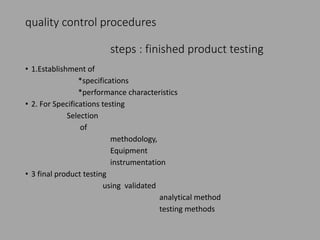
quality control procedures
steps : finished product testing
• 1.Establishment of
*specifications
*performance characteristics
• 2. For Specifications testing
Selection
of
methodology,
Equipment
instrumentation
• 3 final product testing
using validated
analytical method
testing methods
new addition
• 4 Qualification
processing facility and its equipment
• 5 Qualification and validation
manufacturing process
• 6 Auditing, monitoring, sampling, or challenging
the key for conformation of specification
• 7 Revalidation if significant change in process
four keys
• 1 Definition---desirable attributes & undesired
• 2 . Establishment of limitations or constraints for
attributes
• 3. Determination of the controls or testing parameters used for
measuring or testing
• 4.Initiation of studies to establish
control or boundary limits
for
key attributes
that influence
product,
process,
quality,
performance
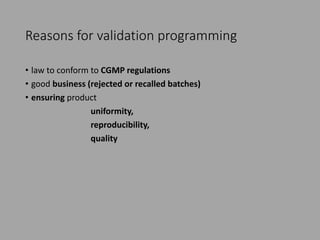
Reasons for validation programming
• law to conform to CGMP regulations
• good business (rejected or recalled batches)
• ensuring product
uniformity,
reproducibility,
quality
VALIDATION OF RAW MATERIALS
• Validation begins with the raw materials,
active pharmaceutical ingredients (APIs)
excipients
• raw materials, major causes of product variation or deviation from
specification
• API most uncontrollable component in the complete product/process
validation scheme
because
morphology
particle size/surface area
not be completely defined this early
• Also when synthesis of the new API is not finalized
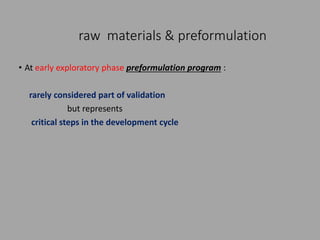
raw materials & preformulation
• At early exploratory phase preformulation program :
rarely considered part of validation
but represents
critical steps in the development cycle
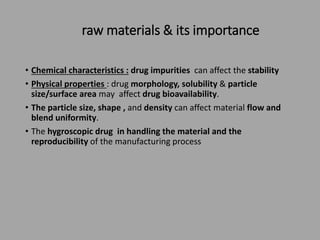
raw materials & its importance
• Chemical characteristics : drug impurities can affect the stability
• Physical properties : drug morphology, solubility & particle
size/surface area may affect drug bioavailability.
• The particle size, shape , and density can affect material flow and
blend uniformity.
• The hygroscopic drug in handling the material and the
reproducibility of the manufacturing process
Particle size & its effects
• water-insoluble drug milled or micronized for
rapid dissolution
& in-vitro availability
•Particle size directly alter processing variables. Eg
flow,
blend uniformity,
granulation solution
binder uptake,
compressibility,
& lubricant efficiency
random distribution
Segregation or sedimentation
Stability
Wet granulation / direct compression process variables
• Factors critical for uniform blending
or (reproducible particle size distribution)
or (content uniformity)
 compatibility issues with others
 particle size,
 density,
 and shape
volume of granulating solution or binder
fine particles v/s coarser particles
particle size/surface area ratio must be considered.
• certification/validation of excipients (1%or 99%) is extremely important.
and attributes Important are :
(1) the grade and source of the excipients,
(2) particle size and shape characteristics,
(3) lot-to-lot variability.
• Magnesium stearate (lubricant) causes hydrophobic coating , so the disintegration and
dissolution hindered
• aluminum lake in geometric addition or preblend approach ;if not as fine powder the
mottling defects common there
steps for raw materials validation
:CGMPs formal written documentation
• Each raw material validated by testing at least 3 batches from primary &
alternate supplier ; representing the ranges, both high and low.
• Depending on the susceptibility aging, physical, chemical, and/or
microbiological stability should be assessed
• If under acceptable range, especially for materials sensitive to small
changes; then appropriate to use several lots of raw material with low and
high ends of the specification
• The final step of raw material validation should involve an on-site
inspection of the vendors to review the manufacturing operations,
controlling & conforming to regulatory requirements.
Analytical method validation
• Prior to any validation program analytical criteria must be assessed are
• Accuracy of method: true value
• Precision of method: estimate reproducibility
• Specificity: accurately measure a SPECIFIC analyte in the presence of other
components.
• In-day/out-of-day variation:
• Between-operator variation
• Between-instrument variation
• Between-laboratory variation
CONTROL OF PROCESS VARIABLES
Process validation :is for consistent Production ;by challenging a process
during development to determine variables to be controlled
(for as quality means & specification compliance)
• credible data (Pertinent data from preformulation stage & additional inputs
during formulation ,evaluation, process development, and full-scale
manufacture) of the testing programs are evaluated for consistence as well
as relevance
(process pre-optimized)
• all four stages informations i.e. parameters is evaluated for its use as
possible tools for ensuring product is under control
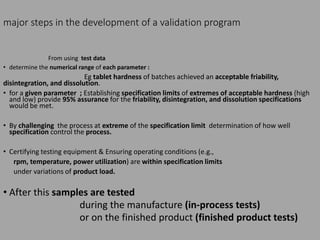
major steps in the development of a validation program
From using test data
• determine the numerical range of each parameter :
Eg tablet hardness of batches achieved an acceptable friability,
disintegration, and dissolution.
• for a given parameter ; Establishing specification limits of extremes of acceptable hardness (high
and low) provide 95% assurance for the friability, disintegration, and dissolution specifications
would be met.
• By challenging the process at extreme of the specification limit determination of how well
specification control the process.
• Certifying testing equipment & Ensuring operating conditions (e.g.,
rpm, temperature, power utilization) are within specification limits
under variations of product load.
• After this samples are tested
during the manufacture (in-process tests)
or on the finished product (finished product tests)
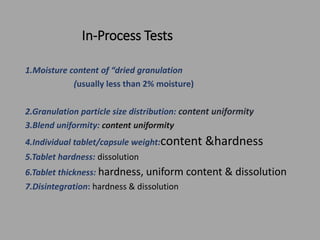
In-Process Tests
1.Moisture content of “dried granulation
(usually less than 2% moisture)
2.Granulation particle size distribution: content uniformity
3.Blend uniformity: content uniformity
4.Individual tablet/capsule weight:content &hardness
5.Tablet hardness: dissolution
6.Tablet thickness: hardness, uniform content & dissolution
7.Disintegration: hardness & dissolution
Finished Product Tests
1. Appearance
2. Assay:
3. Content uniformity
4. Tablet hardness
5. Tablet friability:
6. Dissolution
key test parameters which are the major processing variables in solid
dosage forms are evaluated------
1. Mixing time and speed in blenders and granulators
2. Solvent addition rates in granulators
3. Time, temperature, and airflow conditions in dryers and coaters
4. Screen size, feed rate, and milling speed in mills
5. Machine speed and compression force in tablet presses
6. Machine speed and fill volume in encapsulators.
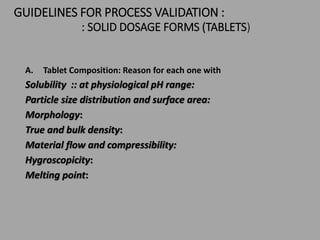
GUIDELINES FOR PROCESS VALIDATION :
: SOLID DOSAGE FORMS (TABLETS)
A. Tablet Composition: Reason for each one with
Solubility :: at physiological pH range:
Particle size distribution and surface area:
Morphology:
True and bulk density:
Material flow and compressibility:
Hygroscopicity:
Melting point:
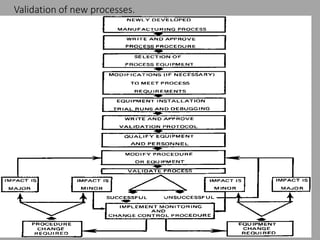
Validation of new processes.
(AstraZeneca Pharmaceuticals LP, Wilmington, Delaware.)
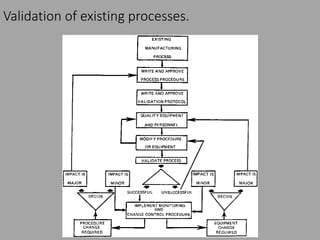
Validation of existing processes.
Process Evaluation and Selection
• 1. Mixing or Blending
physical properties which are factors in creating a uniform mix or blend
Bulk density
Particle shape
Particle size distribution
Surface area
Mixing or blending technique
Diffusion (tumble) ,
convection (planetary or high intensity),
or pneumatic (fluid bed) techniques .
Mixing or blending speed:
Mixing or blending time:
Equipment capacity/load:
Drug uniformity:
Excipient uniformity (color & lubricant):
2. Wet Granulation
1. Binder addition:
2. Binder concentration:
3. Amount of binder solution/granulating solvent:
4. Binder solution/granulating solvent addition rate:
5. Mixing time:
6. Granulation end point:
3. Wet Milling
1. Equipment size and capacity:
2. Screen size
3. Mill speed
4. Feed rate
4. Drying
Various drying technique used
tray,
fluid bed,
microwaver
•Moisture content by: loss-on-drying techniques
near infrared (NIR) spectroscopy
Parameters affecting drying:
1. Inlet/outlet temperature
2. Airflow:
3. Moisture uniformity
4. Equipment capability/capacity:
5. Milling
• 1.Mill type:
impact or screen
• 2.Screen size:
• 3.Mill speed:
• 4.Feed rate:
6. Tablet Compression
• Tooling:
• Compression speed:
• Compression/ejection force:
in-process tests:
1. Appearance
2. Hardness
3. Tablet weight
4. Friability
5. Disintegration
6. Weight uniformity
7. Tablet Coating
coting improves the---
1. Stability
2. Taste masking
3. Controlled release
4. Product identification
5. Aesthetics
6. Safety–material handling
different techniques may used
sugar,
film,
Compression
• Key parameters :
1. Tablet properties
2. Equipment type:
3. Coater load
4. Pan speed:
5. Spray guns:
6. Application/spray rate:
7. Tablet flow:
8. Inlet/outlet temperature and airflow:
9. Coating solution:
10. Coating weight:
11. Residual solvent level:
Appearance testing of coating:
1) Cracking or peeling
2) Intagliation fill-in
3) Surface roughness
4) Color uniformity
Equipment Evaluation:
Selection:
1. formulation, ?
2. safety requirements,?
3. handling/production efficiencies, and ?
4. commercial demands.?
1. Mixer/granulator:
1. types ?
2. method of mixing?
3. capable of providing low and/or high shear?
4. mixing rate controle?
5. monitoring system?
6. working load range and capacity?
7. Way material charged and discharged?
8. granulating fluid introduction facility?
2. Blender:
1. Types?
2. positioning of the axis rotation (slant or horizontal)?
3. working load range and capacity?
4. Features automation , charging, discharging ?
5. Sampling ease?
6. dead spots (inefficient mixing areas)?
7. easily cleaned?
8. heat the powder blend if needed?
• 3. Dryer
1. operating principle?
2. wet material be static (e.g., tray) or fluid (e.g., fluid bed)?
3. working load range and capacity?
4. heating range and airflow capabil?ities
5. heat distribution?
6. pulling a vacuum?
7. handling different types of filter bags?
8. filter bag shaking mechanism?
4. Mills
1. mill type (e.g., impact or screen)?
2. configuration of the mill?
3. type or size hammers or pin/disc
4. impeller position?
5. size screens or plates?
6. speed on the impeller/screen variable?
7. throughput range?
8. type of feed system?
9. wet- and/or dry-mill materials?
10. generate a significant amount of heat?
11. portable?
5. Tablet compressor:
1. compression stations no.?
2. operating range (rpm)?
3. output range of the compressor?
4. powder feeding capabilities?
5. compression force range?
6. monitoring compression and ejection force?
7. Pre compression capabilities?
8. without routine maintenance running time?
9. turnaround time for complete cleaning?
10. automated weight control capability?
11. require specialized tooling,?
12. perform a specialized function addition of?
13. protect the operator and environment?
6. Tablet Coater:
1. coater type (e.g., pan or fluid bed)?
2. pan perforated?
3. accommodate different size pans?
4. working capacity range of the coater
5. “variable drive” capability? achieve proper tablet mixing?
6. angle of the pan’s pitch?
7. air input (volume and temperature) and vacuum drag-off?
spray system
1. utilize the equipment for various coating?
2. modify the pan with the installation of baffles?
3. various solvents (ethanol)
4. require a specialized room condition (e.g.,being explosion-
proof)?
CAPSULES
A. Capsule Composition:
1. Capsule Shell:
• reason for the presence of each ingredient
• Justify the level and grade of each ingredient.
• selection of the capsule size and shape.
•need for capsule identification (e.g., color or imprinting).
2. Capsule Shell Contents:
Compatibility
hygroscopic nature of the capsule formulation
B. Process Evaluation and Selection
C. Encapsulation
encapsulated materials have to be good flow properties, compressible and a
consistent density.
Factors to consider
Encapsulation type
Auger: Capsugel Type B or Elanco No. 8
Vacuum: Perry
Vibratory: Osaka
Dosing disk: H&K
Dosator: MG2 or Zanasi
type of technique
Encapsulation speed:
in-process tests
1.Appearance
2.Capsule weight
3.Disintegration
4.Weight uniformity
Equipment Evaluation of encapsulation
1. encapsulation mechanism (e.g., auger, dosing disk, dosator)?
2. encapsulation stations?
3. operating range of the unit?
4. output range of the encapsulator (i.e., capsules per min)?
5. powder feeding capabilities?
6. pecialized function in ad dition to basic encapsulation .
(e.g., tablet in capsules with excipient backfill)?
7. equipment operate without routine maintenance?
8. turnaround time for complete cleaning?
9. protect the operator and environment?
10. automated weight control capability?

Raw material validation- process validation

  • 1.
  • 2.
    Process validation of specific process is Establisheddocumented evidence Which give high degree of assurance of Consistently & quality characteristics (At Pre-determined Specifications )
  • 3.
    systematic approach : •identifying, • measuring, • evaluating, • Documenting • re-evaluating a series of critical steps in the manufacturing process that require control to ensure reproducible final product
  • 4.
    basics: • For assuranceof product quality • Selection of quality components and materials • adequate product and process design • control (statistical) of the process  in-process testing..  end-product testing
  • 5.
    FDA’s Current Good ManufacturingPractices (CGMPs) 21CFR 211.110 • For avoiding Variability • Controlling of monitor output validating process performance
  • 6.
    quality control procedures steps: finished product testing • 1.Establishment of *specifications *performance characteristics • 2. For Specifications testing Selection of methodology, Equipment instrumentation • 3 final product testing using validated analytical method testing methods
  • 7.
    new addition • 4Qualification processing facility and its equipment • 5 Qualification and validation manufacturing process • 6 Auditing, monitoring, sampling, or challenging the key for conformation of specification • 7 Revalidation if significant change in process
  • 8.
    four keys • 1Definition---desirable attributes & undesired • 2 . Establishment of limitations or constraints for attributes • 3. Determination of the controls or testing parameters used for measuring or testing • 4.Initiation of studies to establish control or boundary limits for key attributes that influence product, process, quality, performance
  • 9.
    Reasons for validationprogramming • law to conform to CGMP regulations • good business (rejected or recalled batches) • ensuring product uniformity, reproducibility, quality
  • 10.
    VALIDATION OF RAWMATERIALS • Validation begins with the raw materials, active pharmaceutical ingredients (APIs) excipients • raw materials, major causes of product variation or deviation from specification • API most uncontrollable component in the complete product/process validation scheme because morphology particle size/surface area not be completely defined this early • Also when synthesis of the new API is not finalized
  • 11.
    raw materials &preformulation • At early exploratory phase preformulation program : rarely considered part of validation but represents critical steps in the development cycle
  • 12.
    raw materials &its importance • Chemical characteristics : drug impurities can affect the stability • Physical properties : drug morphology, solubility & particle size/surface area may affect drug bioavailability. • The particle size, shape , and density can affect material flow and blend uniformity. • The hygroscopic drug in handling the material and the reproducibility of the manufacturing process
  • 13.
    Particle size &its effects • water-insoluble drug milled or micronized for rapid dissolution & in-vitro availability •Particle size directly alter processing variables. Eg flow, blend uniformity, granulation solution binder uptake, compressibility, & lubricant efficiency random distribution Segregation or sedimentation Stability
  • 14.
    Wet granulation /direct compression process variables • Factors critical for uniform blending or (reproducible particle size distribution) or (content uniformity)  compatibility issues with others  particle size,  density,  and shape volume of granulating solution or binder fine particles v/s coarser particles particle size/surface area ratio must be considered. • certification/validation of excipients (1%or 99%) is extremely important. and attributes Important are : (1) the grade and source of the excipients, (2) particle size and shape characteristics, (3) lot-to-lot variability. • Magnesium stearate (lubricant) causes hydrophobic coating , so the disintegration and dissolution hindered • aluminum lake in geometric addition or preblend approach ;if not as fine powder the mottling defects common there
  • 15.
    steps for rawmaterials validation :CGMPs formal written documentation • Each raw material validated by testing at least 3 batches from primary & alternate supplier ; representing the ranges, both high and low. • Depending on the susceptibility aging, physical, chemical, and/or microbiological stability should be assessed • If under acceptable range, especially for materials sensitive to small changes; then appropriate to use several lots of raw material with low and high ends of the specification • The final step of raw material validation should involve an on-site inspection of the vendors to review the manufacturing operations, controlling & conforming to regulatory requirements.
  • 16.
    Analytical method validation •Prior to any validation program analytical criteria must be assessed are • Accuracy of method: true value • Precision of method: estimate reproducibility • Specificity: accurately measure a SPECIFIC analyte in the presence of other components. • In-day/out-of-day variation: • Between-operator variation • Between-instrument variation • Between-laboratory variation
  • 17.
    CONTROL OF PROCESSVARIABLES Process validation :is for consistent Production ;by challenging a process during development to determine variables to be controlled (for as quality means & specification compliance) • credible data (Pertinent data from preformulation stage & additional inputs during formulation ,evaluation, process development, and full-scale manufacture) of the testing programs are evaluated for consistence as well as relevance (process pre-optimized) • all four stages informations i.e. parameters is evaluated for its use as possible tools for ensuring product is under control
  • 18.
    major steps inthe development of a validation program From using test data • determine the numerical range of each parameter : Eg tablet hardness of batches achieved an acceptable friability, disintegration, and dissolution. • for a given parameter ; Establishing specification limits of extremes of acceptable hardness (high and low) provide 95% assurance for the friability, disintegration, and dissolution specifications would be met. • By challenging the process at extreme of the specification limit determination of how well specification control the process. • Certifying testing equipment & Ensuring operating conditions (e.g., rpm, temperature, power utilization) are within specification limits under variations of product load. • After this samples are tested during the manufacture (in-process tests) or on the finished product (finished product tests)
  • 19.
    In-Process Tests 1.Moisture contentof “dried granulation (usually less than 2% moisture) 2.Granulation particle size distribution: content uniformity 3.Blend uniformity: content uniformity 4.Individual tablet/capsule weight:content &hardness 5.Tablet hardness: dissolution 6.Tablet thickness: hardness, uniform content & dissolution 7.Disintegration: hardness & dissolution
  • 20.
    Finished Product Tests 1.Appearance 2. Assay: 3. Content uniformity 4. Tablet hardness 5. Tablet friability: 6. Dissolution key test parameters which are the major processing variables in solid dosage forms are evaluated------ 1. Mixing time and speed in blenders and granulators 2. Solvent addition rates in granulators 3. Time, temperature, and airflow conditions in dryers and coaters 4. Screen size, feed rate, and milling speed in mills 5. Machine speed and compression force in tablet presses 6. Machine speed and fill volume in encapsulators.
  • 21.
    GUIDELINES FOR PROCESSVALIDATION : : SOLID DOSAGE FORMS (TABLETS) A. Tablet Composition: Reason for each one with Solubility :: at physiological pH range: Particle size distribution and surface area: Morphology: True and bulk density: Material flow and compressibility: Hygroscopicity: Melting point:
  • 22.
    Validation of newprocesses. (AstraZeneca Pharmaceuticals LP, Wilmington, Delaware.)
  • 23.
  • 24.
    Process Evaluation andSelection • 1. Mixing or Blending physical properties which are factors in creating a uniform mix or blend Bulk density Particle shape Particle size distribution Surface area Mixing or blending technique Diffusion (tumble) , convection (planetary or high intensity), or pneumatic (fluid bed) techniques . Mixing or blending speed: Mixing or blending time: Equipment capacity/load: Drug uniformity: Excipient uniformity (color & lubricant):
  • 25.
    2. Wet Granulation 1.Binder addition: 2. Binder concentration: 3. Amount of binder solution/granulating solvent: 4. Binder solution/granulating solvent addition rate: 5. Mixing time: 6. Granulation end point: 3. Wet Milling 1. Equipment size and capacity: 2. Screen size 3. Mill speed 4. Feed rate
  • 26.
    4. Drying Various dryingtechnique used tray, fluid bed, microwaver •Moisture content by: loss-on-drying techniques near infrared (NIR) spectroscopy Parameters affecting drying: 1. Inlet/outlet temperature 2. Airflow: 3. Moisture uniformity 4. Equipment capability/capacity:
  • 27.
    5. Milling • 1.Milltype: impact or screen • 2.Screen size: • 3.Mill speed: • 4.Feed rate:
  • 28.
    6. Tablet Compression •Tooling: • Compression speed: • Compression/ejection force: in-process tests: 1. Appearance 2. Hardness 3. Tablet weight 4. Friability 5. Disintegration 6. Weight uniformity
  • 29.
    7. Tablet Coating cotingimproves the--- 1. Stability 2. Taste masking 3. Controlled release 4. Product identification 5. Aesthetics 6. Safety–material handling different techniques may used sugar, film, Compression
  • 30.
    • Key parameters: 1. Tablet properties 2. Equipment type: 3. Coater load 4. Pan speed: 5. Spray guns: 6. Application/spray rate: 7. Tablet flow: 8. Inlet/outlet temperature and airflow: 9. Coating solution: 10. Coating weight: 11. Residual solvent level: Appearance testing of coating: 1) Cracking or peeling 2) Intagliation fill-in 3) Surface roughness 4) Color uniformity
  • 31.
    Equipment Evaluation: Selection: 1. formulation,? 2. safety requirements,? 3. handling/production efficiencies, and ? 4. commercial demands.? 1. Mixer/granulator: 1. types ? 2. method of mixing? 3. capable of providing low and/or high shear? 4. mixing rate controle? 5. monitoring system? 6. working load range and capacity? 7. Way material charged and discharged? 8. granulating fluid introduction facility? 2. Blender: 1. Types? 2. positioning of the axis rotation (slant or horizontal)? 3. working load range and capacity? 4. Features automation , charging, discharging ? 5. Sampling ease? 6. dead spots (inefficient mixing areas)? 7. easily cleaned? 8. heat the powder blend if needed?
  • 32.
    • 3. Dryer 1.operating principle? 2. wet material be static (e.g., tray) or fluid (e.g., fluid bed)? 3. working load range and capacity? 4. heating range and airflow capabil?ities 5. heat distribution? 6. pulling a vacuum? 7. handling different types of filter bags? 8. filter bag shaking mechanism? 4. Mills 1. mill type (e.g., impact or screen)? 2. configuration of the mill? 3. type or size hammers or pin/disc 4. impeller position? 5. size screens or plates? 6. speed on the impeller/screen variable? 7. throughput range? 8. type of feed system? 9. wet- and/or dry-mill materials? 10. generate a significant amount of heat? 11. portable?
  • 33.
    5. Tablet compressor: 1.compression stations no.? 2. operating range (rpm)? 3. output range of the compressor? 4. powder feeding capabilities? 5. compression force range? 6. monitoring compression and ejection force? 7. Pre compression capabilities? 8. without routine maintenance running time? 9. turnaround time for complete cleaning? 10. automated weight control capability? 11. require specialized tooling,? 12. perform a specialized function addition of? 13. protect the operator and environment?
  • 34.
    6. Tablet Coater: 1.coater type (e.g., pan or fluid bed)? 2. pan perforated? 3. accommodate different size pans? 4. working capacity range of the coater 5. “variable drive” capability? achieve proper tablet mixing? 6. angle of the pan’s pitch? 7. air input (volume and temperature) and vacuum drag-off? spray system 1. utilize the equipment for various coating? 2. modify the pan with the installation of baffles? 3. various solvents (ethanol) 4. require a specialized room condition (e.g.,being explosion- proof)?
  • 35.
    CAPSULES A. Capsule Composition: 1.Capsule Shell: • reason for the presence of each ingredient • Justify the level and grade of each ingredient. • selection of the capsule size and shape. •need for capsule identification (e.g., color or imprinting). 2. Capsule Shell Contents: Compatibility hygroscopic nature of the capsule formulation B. Process Evaluation and Selection
  • 36.
    C. Encapsulation encapsulated materialshave to be good flow properties, compressible and a consistent density. Factors to consider Encapsulation type Auger: Capsugel Type B or Elanco No. 8 Vacuum: Perry Vibratory: Osaka Dosing disk: H&K Dosator: MG2 or Zanasi type of technique Encapsulation speed: in-process tests 1.Appearance 2.Capsule weight 3.Disintegration 4.Weight uniformity
  • 37.
    Equipment Evaluation ofencapsulation 1. encapsulation mechanism (e.g., auger, dosing disk, dosator)? 2. encapsulation stations? 3. operating range of the unit? 4. output range of the encapsulator (i.e., capsules per min)? 5. powder feeding capabilities? 6. pecialized function in ad dition to basic encapsulation . (e.g., tablet in capsules with excipient backfill)? 7. equipment operate without routine maintenance? 8. turnaround time for complete cleaning? 9. protect the operator and environment? 10. automated weight control capability?

Editor's Notes

  • #28 Feed rate:
  • #33 wet material be static (e.g. handle different types of filter bags, tray) or fluid (e.g., fluid bed)