5/6/2015
Organization and functions of
WHO
Supervised by:
Mr. Vipin Mathur
Assistant Professor,
Department of Pharmaceutical
Management and Regulatory Affairs
Submitted by:
Sunil Saini
M.pharm II-Sem. 2015
LACHOO MEMORIAL COLLEGE OF SCIENCE AND TECHNOLOGY
(PHARMACY WING)
JODHPUR
JAI NARAYAN VYAS UNIVERSITY,
JODHPUR
M. Pharm. II-Sem. Organization and functions of WHO
Lachoo Memorial College of Science and Technology, Pharmacy Wing, Jodhpur. 1 of 6
Contents:
S. No. Title Page No.
1. Introduction 2
2. Organization 2-4
3. Function 5-6
4. References 6
M. Pharm. II-Sem. Organization and functions of WHO
Lachoo Memorial College of Science and Technology, Pharmacy Wing, Jodhpur. 2 of 6
1. Introduction
The World Health Organization (WHO) is a specialized agency of the United Nations (UN)
that is concerned with international public health. It was established on 7 April 1948,
headquartered in Geneva, Switzerland. The WHO is a member of the United Nations
Development Group. Its predecessor, the Health Organization, was an agency of the
League of Nations. The constitution of the World Health Organization had been signed by
61 countries on 22 July 1946, with the first meeting of the World Health Assembly finishing
on 24 July 1948. Since its creation, it has played a leading role in the eradication of
smallpox. Its current priorities include communicable diseases, in particular HIV/AIDS,
Ebola, malaria and tuberculosis; the mitigation of the effects of non-communicable
diseases; sexual and reproductive health, development, and aging; nutrition, food security
and healthy eating; occupational health; substance abuse; and driving the development
of reporting, publications, and networking. The WHO is responsible for the World Health
Report, a leading international publication on health, the worldwide World Health Survey,
and World Health Day (7 April of every year). The head of WHO is Margaret Chan.
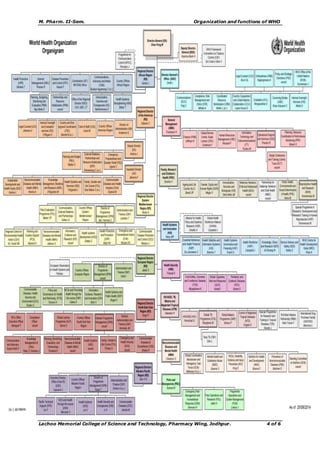
2. Organization
More than 7000 people from more than 150 countries work for the Organization in 150
WHO offices in countries, territories and areas, six regional offices, at the Global Service
Centre in Malaysia and at the headquarters in Geneva, Switzerland.
In addition to medical doctors, public health specialists, scientists and epidemiologists,
WHO staff include people trained to manage administrative, financial, and information
systems, as well as experts in the fields of health statistics, economics and emergenc y
relief.
2.1 Dr Margaret Chan
Dr Margaret Chan is the Director-General of WHO, appointed by the World Health Assembly
on 9 November 2006. The Assembly appointed Dr Chan for a second five-year term at its
sixty-fifth session in May 2012. Dr Chan's new term will begin on 1 July 2012 and continue
until 30 June 2017.
Before being elected Director-General, Dr Chan was WHO Assistant Director-General for
Communicable Diseases as well as Representative of the Director-General for Pandemic
Influenza.
Prior to joining WHO, she was Director of Health in Hong Kong. During her nine-year tenure
as director, Dr Chan confronted the first human outbreak of H5N1 avian influenza in 1997.
She successfully defeated the spate of severe acute respiratory syndrome (SARS) in Hong
M. Pharm. II-Sem. Organization and functions of WHO
Lachoo Memorial College of Science and Technology, Pharmacy Wing, Jodhpur. 3 of 6
Kong in 2003. She also launched new services to prevent disease and promote better
health.
2.2 Regional offices:
1. WHO African Region
2. WHO Region of the Americas
3. WHO South-East Asia Region
4. WHO European Region
5. WHO Eastern Mediterranean Region
6. WHO Western Pacific Region
7. Global Service Centre, liaison and other offices
2.3 Countries:
All countries which are Members of the United Nations may become members of WHO by
accepting its Constitution. Other countries may be admitted as members when their
application has been approved by a simple majority vote of the World Health Assembly.
Territories which are not responsible for the conduct of their international relations may
be admitted as Associate Members upon application made on their behalf by the Member
or other authority responsible for their international relations. Members of WHO are
grouped according to regional distribution (194 Member States).
M. Pharm. II-Sem. Organization and functions of WHO
Lachoo Memorial College of Science and Technology, Pharmacy Wing, Jodhpur. 4 of 6
M. Pharm. II-Sem. Organization and functions of WHO
Lachoo Memorial College of Science and Technology, Pharmacy Wing, Jodhpur. 5 of 6
3. Function
WHO is the directing and coordinating authority on international health within the United
Nations’ system.
WHO do this by:
1. Providing leadership on matters critical to health and engaging in partnerships where
joint action is needed;
2. Shaping the research agenda and stimulating the generation, translation and
dissemination of valuable knowledge;
3. Setting norms and standards and promoting and monitoring their implementation;
4. Articulating ethical and evidence-based policy options;
5. Providing technical support, catalysing change, and building sustainable institutional
capacity; and
6. Monitoring the health situation and assessing health trends.
3.1 These are the areas in which WHO work
1. Health systems
WHO’s priority in the area of health systems is moving towards universal health coverage.
WHO works together with policy-makers, global health partners, civil society, academia
and the private sector to support countries to develop, implement and monitor solid
national health plans. In addition, WHO supports countries to assure the availability of
equitable integrated people-centred health services at an affordable price; facilitate access
to affordable, safe and effective health technologies; and to strengthen health information
systems and evidence-based policy-making.
2. Noncommunicable diseases
Noncommunicable diseases (NCDs), including heart disease, stroke, cancer, DIABET ES
and chronic lung disease, and mental health conditions - together with violence and
injuries - are collectively responsible for more than 70% of all deaths worldwide. Eight out
of 10 of these deaths occur in low- and middle-income countries. The consequences of
these diseases reach beyond the health sector and solutions require more than a system
that prevents and treats disease.
3. Promoting health through the life-course
Promoting good health through the life-course cuts across all work done by WHO, and
takes into account the need to address environment risks and social determinants of
health, as well as gender, equity and human rights. The work in this biennium has a crucial
M. Pharm. II-Sem. Organization and functions of WHO
Lachoo Memorial College of Science and Technology, Pharmacy Wing, Jodhpur. 6 of 6
focus on finishing the agenda of the Millennium Development Goals and reducing
disparities between and within countries.
4. Communicable diseases
WHO is working with countries to increase and sustain access to prevention, treatment
and care for HIV, tuberculosis,malaria and neglected tropical diseases and to reduce
vaccine-preventable diseases. MDG 6 (combat HIV/AIDS,malaria and other diseases) has
driven remarkable progress but much work remains.
5. Preparedness, surveillance and response
During emergencies, WHO’s operational role includes leading and coordinating the health
response in support of countries, undertaking risk assessments, identifying priorities and
setting strategies, providing critical technical guidance, supplies and FINANCIAL resources
as well as monitoring the health situation. WHO also helps countries to strengthen their
national core capacities for emergency risk management to prevent, prepare for, respond
to, and recover from emergencies due to any hazard that pose a threat to human health
security.
6. Corporate services
Corporate services provide the enabling functions, tools and resources that makes all of
this work possible. For example, corporate services encompasses governing bodies
convening Member States for policymaking, the legal team advising during the
development of international treaties, communications staff helping disseminate health
information, human resources bringing in some of the world’s best public health experts
or building services providing the space and the tools for around 7000 staff to perform
their work in 1 of WHO’s more than 150 offices.
4. References
1. www.who.int/ accessed on 5/5/2015
2. en.wikipedia.org/wiki/World_Health_Organization accessed on 5/5/2015

WHO

  • 1.
    5/6/2015 Organization and functionsof WHO Supervised by: Mr. Vipin Mathur Assistant Professor, Department of Pharmaceutical Management and Regulatory Affairs Submitted by: Sunil Saini M.pharm II-Sem. 2015 LACHOO MEMORIAL COLLEGE OF SCIENCE AND TECHNOLOGY (PHARMACY WING) JODHPUR JAI NARAYAN VYAS UNIVERSITY, JODHPUR
  • 2.
    M. Pharm. II-Sem.Organization and functions of WHO Lachoo Memorial College of Science and Technology, Pharmacy Wing, Jodhpur. 1 of 6 Contents: S. No. Title Page No. 1. Introduction 2 2. Organization 2-4 3. Function 5-6 4. References 6
  • 3.
    M. Pharm. II-Sem.Organization and functions of WHO Lachoo Memorial College of Science and Technology, Pharmacy Wing, Jodhpur. 2 of 6 1. Introduction The World Health Organization (WHO) is a specialized agency of the United Nations (UN) that is concerned with international public health. It was established on 7 April 1948, headquartered in Geneva, Switzerland. The WHO is a member of the United Nations Development Group. Its predecessor, the Health Organization, was an agency of the League of Nations. The constitution of the World Health Organization had been signed by 61 countries on 22 July 1946, with the first meeting of the World Health Assembly finishing on 24 July 1948. Since its creation, it has played a leading role in the eradication of smallpox. Its current priorities include communicable diseases, in particular HIV/AIDS, Ebola, malaria and tuberculosis; the mitigation of the effects of non-communicable diseases; sexual and reproductive health, development, and aging; nutrition, food security and healthy eating; occupational health; substance abuse; and driving the development of reporting, publications, and networking. The WHO is responsible for the World Health Report, a leading international publication on health, the worldwide World Health Survey, and World Health Day (7 April of every year). The head of WHO is Margaret Chan. 2. Organization More than 7000 people from more than 150 countries work for the Organization in 150 WHO offices in countries, territories and areas, six regional offices, at the Global Service Centre in Malaysia and at the headquarters in Geneva, Switzerland. In addition to medical doctors, public health specialists, scientists and epidemiologists, WHO staff include people trained to manage administrative, financial, and information systems, as well as experts in the fields of health statistics, economics and emergenc y relief. 2.1 Dr Margaret Chan Dr Margaret Chan is the Director-General of WHO, appointed by the World Health Assembly on 9 November 2006. The Assembly appointed Dr Chan for a second five-year term at its sixty-fifth session in May 2012. Dr Chan's new term will begin on 1 July 2012 and continue until 30 June 2017. Before being elected Director-General, Dr Chan was WHO Assistant Director-General for Communicable Diseases as well as Representative of the Director-General for Pandemic Influenza. Prior to joining WHO, she was Director of Health in Hong Kong. During her nine-year tenure as director, Dr Chan confronted the first human outbreak of H5N1 avian influenza in 1997. She successfully defeated the spate of severe acute respiratory syndrome (SARS) in Hong
  • 4.
    M. Pharm. II-Sem.Organization and functions of WHO Lachoo Memorial College of Science and Technology, Pharmacy Wing, Jodhpur. 3 of 6 Kong in 2003. She also launched new services to prevent disease and promote better health. 2.2 Regional offices: 1. WHO African Region 2. WHO Region of the Americas 3. WHO South-East Asia Region 4. WHO European Region 5. WHO Eastern Mediterranean Region 6. WHO Western Pacific Region 7. Global Service Centre, liaison and other offices 2.3 Countries: All countries which are Members of the United Nations may become members of WHO by accepting its Constitution. Other countries may be admitted as members when their application has been approved by a simple majority vote of the World Health Assembly. Territories which are not responsible for the conduct of their international relations may be admitted as Associate Members upon application made on their behalf by the Member or other authority responsible for their international relations. Members of WHO are grouped according to regional distribution (194 Member States).
  • 5.
    M. Pharm. II-Sem.Organization and functions of WHO Lachoo Memorial College of Science and Technology, Pharmacy Wing, Jodhpur. 4 of 6
  • 6.
    M. Pharm. II-Sem.Organization and functions of WHO Lachoo Memorial College of Science and Technology, Pharmacy Wing, Jodhpur. 5 of 6 3. Function WHO is the directing and coordinating authority on international health within the United Nations’ system. WHO do this by: 1. Providing leadership on matters critical to health and engaging in partnerships where joint action is needed; 2. Shaping the research agenda and stimulating the generation, translation and dissemination of valuable knowledge; 3. Setting norms and standards and promoting and monitoring their implementation; 4. Articulating ethical and evidence-based policy options; 5. Providing technical support, catalysing change, and building sustainable institutional capacity; and 6. Monitoring the health situation and assessing health trends. 3.1 These are the areas in which WHO work 1. Health systems WHO’s priority in the area of health systems is moving towards universal health coverage. WHO works together with policy-makers, global health partners, civil society, academia and the private sector to support countries to develop, implement and monitor solid national health plans. In addition, WHO supports countries to assure the availability of equitable integrated people-centred health services at an affordable price; facilitate access to affordable, safe and effective health technologies; and to strengthen health information systems and evidence-based policy-making. 2. Noncommunicable diseases Noncommunicable diseases (NCDs), including heart disease, stroke, cancer, DIABET ES and chronic lung disease, and mental health conditions - together with violence and injuries - are collectively responsible for more than 70% of all deaths worldwide. Eight out of 10 of these deaths occur in low- and middle-income countries. The consequences of these diseases reach beyond the health sector and solutions require more than a system that prevents and treats disease. 3. Promoting health through the life-course Promoting good health through the life-course cuts across all work done by WHO, and takes into account the need to address environment risks and social determinants of health, as well as gender, equity and human rights. The work in this biennium has a crucial
  • 7.
    M. Pharm. II-Sem.Organization and functions of WHO Lachoo Memorial College of Science and Technology, Pharmacy Wing, Jodhpur. 6 of 6 focus on finishing the agenda of the Millennium Development Goals and reducing disparities between and within countries. 4. Communicable diseases WHO is working with countries to increase and sustain access to prevention, treatment and care for HIV, tuberculosis,malaria and neglected tropical diseases and to reduce vaccine-preventable diseases. MDG 6 (combat HIV/AIDS,malaria and other diseases) has driven remarkable progress but much work remains. 5. Preparedness, surveillance and response During emergencies, WHO’s operational role includes leading and coordinating the health response in support of countries, undertaking risk assessments, identifying priorities and setting strategies, providing critical technical guidance, supplies and FINANCIAL resources as well as monitoring the health situation. WHO also helps countries to strengthen their national core capacities for emergency risk management to prevent, prepare for, respond to, and recover from emergencies due to any hazard that pose a threat to human health security. 6. Corporate services Corporate services provide the enabling functions, tools and resources that makes all of this work possible. For example, corporate services encompasses governing bodies convening Member States for policymaking, the legal team advising during the development of international treaties, communications staff helping disseminate health information, human resources bringing in some of the world’s best public health experts or building services providing the space and the tools for around 7000 staff to perform their work in 1 of WHO’s more than 150 offices. 4. References 1. www.who.int/ accessed on 5/5/2015 2. en.wikipedia.org/wiki/World_Health_Organization accessed on 5/5/2015