VALIDATION OF TABLET PROCESS
PRESENTED BY GUIDED BY
PRADNYA SHIRUDE Prof.Dr. M.R. Bhalekar
AISSMS COLLEGE OF PHARMACY
What is validation?
 Establishing documented evidence that provides a high degree of assurance
that a specific process will consistently produce a product meeting its
predetermined specifications and quality attributes.
 The field of validation is divided into a number of subsections
 Equipment validation
 Cleaning validation
 HVAC system validation
 Process validation
 Analytical method validation
2
Process Validation
Types of process
validation
• Retrospective process
validation
• Prospective process validation
• Concurrent process validation
STAGES OF PROCESS VALIDATION
1.Process design or pre-qualification
Stage based on the knowledge gained through development and scale up
activities
2.Process qualification
Capable of reproducible commercial manufacturing
3.Continued process verification
Ongoing assurance is gained during routine production that the process remains
in state of control.
PHASES OF PROCESS VALIDATION
1.Pre-validation phase
Example: formulation, pilot batch studies, scale up studies
2.Process validation phase
To verify that all established limits of the critical process parameters
are valid
3.Validation maintenance phase
Monitoring and improving control and reducing product and process
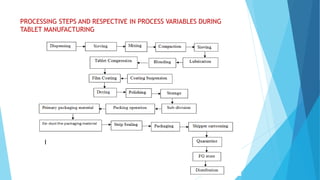
PROCESSING STEPS AND RESPECTIVE IN PROCESS VARIABLES DURING
TABLET MANUFACTURING
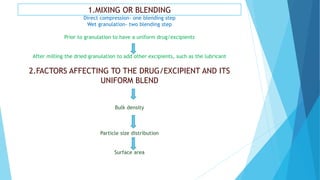
1.MIXING OR BLENDING
Direct compression- one blending step
Wet granulation- two blending step
Prior to granulation to have a uniform drug/excipients
After milling the dried granulation to add other excipients, such as the lubricant
2.FACTORS AFFECTING TO THE DRUG/EXCIPIENT AND ITS
UNIFORM BLEND
Bulk density
Particle size distribution
Surface area
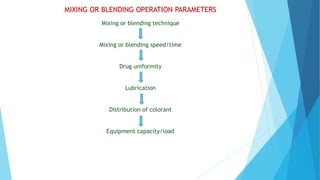
MIXING OR BLENDING OPERATION PARAMETERS
Mixing or blending technique
Mixing or blending speed/time
Drug uniformity
Lubrication
Distribution of colorant
Equipment capacity/load
WET GRANUATION
Low shear-e.g.Hobart
High shear-e.g.Diosna GEI-Collette
Fluid bed-e.g.-Glatt,fluid air
WET MASSING(FOR UNIFORM WEIGHT MASS)
Binder addition
Binder concentration
Amount of binder solution/granulation solvent
Binder solution/solvent addition rate
Mixing time
Granulation end point
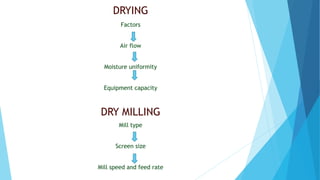
DRYING
Factors
Air flow
Moisture uniformity
Equipment capacity
DRY MILLING
Mill type
Screen size
Mill speed and feed rate
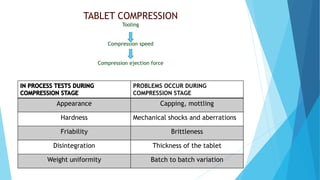
TABLET COMPRESSION
Tooling
Compression speed
Compression ejection force
PROBLEMS OCCUR DURING
COMPRESSION STAGE
Appearance Capping, mottling
Hardness Mechanical shocks and aberrations
Friability Brittleness
Disintegration Thickness of the tablet
Weight uniformity Batch to batch variation
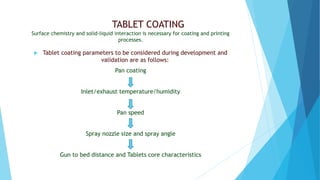
TABLET COATING
Surface chemistry and solid-liquid interaction is necessary for coating and printing
processes.
 Tablet coating parameters to be considered during development and
validation are as follows:
Pan coating
Inlet/exhaust temperature/humidity
Pan speed
Spray nozzle size and spray angle
Gun to bed distance and Tablets core characteristics
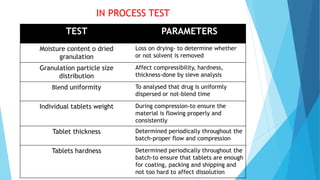
IN PROCESS TEST
TEST PARAMETERS
Moisture content o dried
granulation
Loss on drying- to determine whether
or not solvent is removed
Granulation particle size
distribution
Affect compressibility, hardness,
thickness-done by sieve analysis
Blend uniformity To analysed that drug is uniformly
dispersed or not-blend time
Individual tablets weight During compression-to ensure the
material is flowing properly and
consistently
Tablet thickness Determined periodically throughout the
batch-proper flow and compression
Tablets hardness Determined periodically throughout the
batch-to ensure that tablets are enough
for coating, packing and shipping and
not too hard to affect dissolution
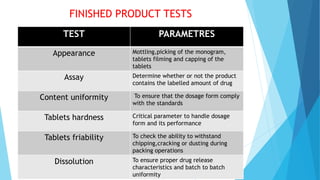
FINISHED PRODUCT TESTS
TEST PARAMETRES
Appearance Mottling,picking of the monogram,
tablets filming and capping of the
tablets
Assay Determine whether or not the product
contains the labelled amount of drug
Content uniformity To ensure that the dosage form comply
with the standards
Tablets hardness Critical parameter to handle dosage
form and its performance
Tablets friability To check the ability to withstand
chipping,cracking or dusting during
packing operations
Dissolution To ensure proper drug release
characteristics and batch to batch
uniformity
ADVANTAGES OF VALIDATION
 Validation makes good business sense.
 Reduction in rejections and networks
 Reduction in utility cost
 Avoidance of capital expenditure
 Reduced testing process and finished goods
 Easier maintenance of process
 More rapid automation
REFERANCES
 Functional overview of process validation of tablets-A
critical review, Manasa S Reddy, Chandramouli R, Journal
of pharmaceutical research volume 16, issue 3Jul-sep
2017-268
 The theory and practice of industrial pharmacy by Leon
Lachamn, H. Liberman, J. Kanig, published by Varghese
publishing house, third edition, pg no.293-373
 http://www.researchgate.net
 www.vtu.com/ms&t/biotech
THANK YOU!

Validation of tablet process

  • 1.
    VALIDATION OF TABLETPROCESS PRESENTED BY GUIDED BY PRADNYA SHIRUDE Prof.Dr. M.R. Bhalekar AISSMS COLLEGE OF PHARMACY
  • 2.
    What is validation? Establishing documented evidence that provides a high degree of assurance that a specific process will consistently produce a product meeting its predetermined specifications and quality attributes.  The field of validation is divided into a number of subsections  Equipment validation  Cleaning validation  HVAC system validation  Process validation  Analytical method validation 2
  • 3.
    Process Validation Types ofprocess validation • Retrospective process validation • Prospective process validation • Concurrent process validation
  • 4.
    STAGES OF PROCESSVALIDATION 1.Process design or pre-qualification Stage based on the knowledge gained through development and scale up activities 2.Process qualification Capable of reproducible commercial manufacturing 3.Continued process verification Ongoing assurance is gained during routine production that the process remains in state of control. PHASES OF PROCESS VALIDATION 1.Pre-validation phase Example: formulation, pilot batch studies, scale up studies 2.Process validation phase To verify that all established limits of the critical process parameters are valid 3.Validation maintenance phase Monitoring and improving control and reducing product and process
  • 5.
    PROCESSING STEPS ANDRESPECTIVE IN PROCESS VARIABLES DURING TABLET MANUFACTURING
  • 6.
    1.MIXING OR BLENDING Directcompression- one blending step Wet granulation- two blending step Prior to granulation to have a uniform drug/excipients After milling the dried granulation to add other excipients, such as the lubricant 2.FACTORS AFFECTING TO THE DRUG/EXCIPIENT AND ITS UNIFORM BLEND Bulk density Particle size distribution Surface area
  • 7.
    MIXING OR BLENDINGOPERATION PARAMETERS Mixing or blending technique Mixing or blending speed/time Drug uniformity Lubrication Distribution of colorant Equipment capacity/load
  • 8.
    WET GRANUATION Low shear-e.g.Hobart Highshear-e.g.Diosna GEI-Collette Fluid bed-e.g.-Glatt,fluid air WET MASSING(FOR UNIFORM WEIGHT MASS) Binder addition Binder concentration Amount of binder solution/granulation solvent Binder solution/solvent addition rate Mixing time Granulation end point
  • 9.
    DRYING Factors Air flow Moisture uniformity Equipmentcapacity DRY MILLING Mill type Screen size Mill speed and feed rate
  • 10.
    TABLET COMPRESSION Tooling Compression speed Compressionejection force PROBLEMS OCCUR DURING COMPRESSION STAGE Appearance Capping, mottling Hardness Mechanical shocks and aberrations Friability Brittleness Disintegration Thickness of the tablet Weight uniformity Batch to batch variation
  • 11.
    TABLET COATING Surface chemistryand solid-liquid interaction is necessary for coating and printing processes.  Tablet coating parameters to be considered during development and validation are as follows: Pan coating Inlet/exhaust temperature/humidity Pan speed Spray nozzle size and spray angle Gun to bed distance and Tablets core characteristics
  • 12.
    IN PROCESS TEST TESTPARAMETERS Moisture content o dried granulation Loss on drying- to determine whether or not solvent is removed Granulation particle size distribution Affect compressibility, hardness, thickness-done by sieve analysis Blend uniformity To analysed that drug is uniformly dispersed or not-blend time Individual tablets weight During compression-to ensure the material is flowing properly and consistently Tablet thickness Determined periodically throughout the batch-proper flow and compression Tablets hardness Determined periodically throughout the batch-to ensure that tablets are enough for coating, packing and shipping and not too hard to affect dissolution
  • 13.
    FINISHED PRODUCT TESTS TESTPARAMETRES Appearance Mottling,picking of the monogram, tablets filming and capping of the tablets Assay Determine whether or not the product contains the labelled amount of drug Content uniformity To ensure that the dosage form comply with the standards Tablets hardness Critical parameter to handle dosage form and its performance Tablets friability To check the ability to withstand chipping,cracking or dusting during packing operations Dissolution To ensure proper drug release characteristics and batch to batch uniformity
  • 14.
    ADVANTAGES OF VALIDATION Validation makes good business sense.  Reduction in rejections and networks  Reduction in utility cost  Avoidance of capital expenditure  Reduced testing process and finished goods  Easier maintenance of process  More rapid automation
  • 15.
    REFERANCES  Functional overviewof process validation of tablets-A critical review, Manasa S Reddy, Chandramouli R, Journal of pharmaceutical research volume 16, issue 3Jul-sep 2017-268  The theory and practice of industrial pharmacy by Leon Lachamn, H. Liberman, J. Kanig, published by Varghese publishing house, third edition, pg no.293-373  http://www.researchgate.net  www.vtu.com/ms&t/biotech
  • 16.