Center for Research and Application for Satellite Remote Sensing
Yamaguchi University
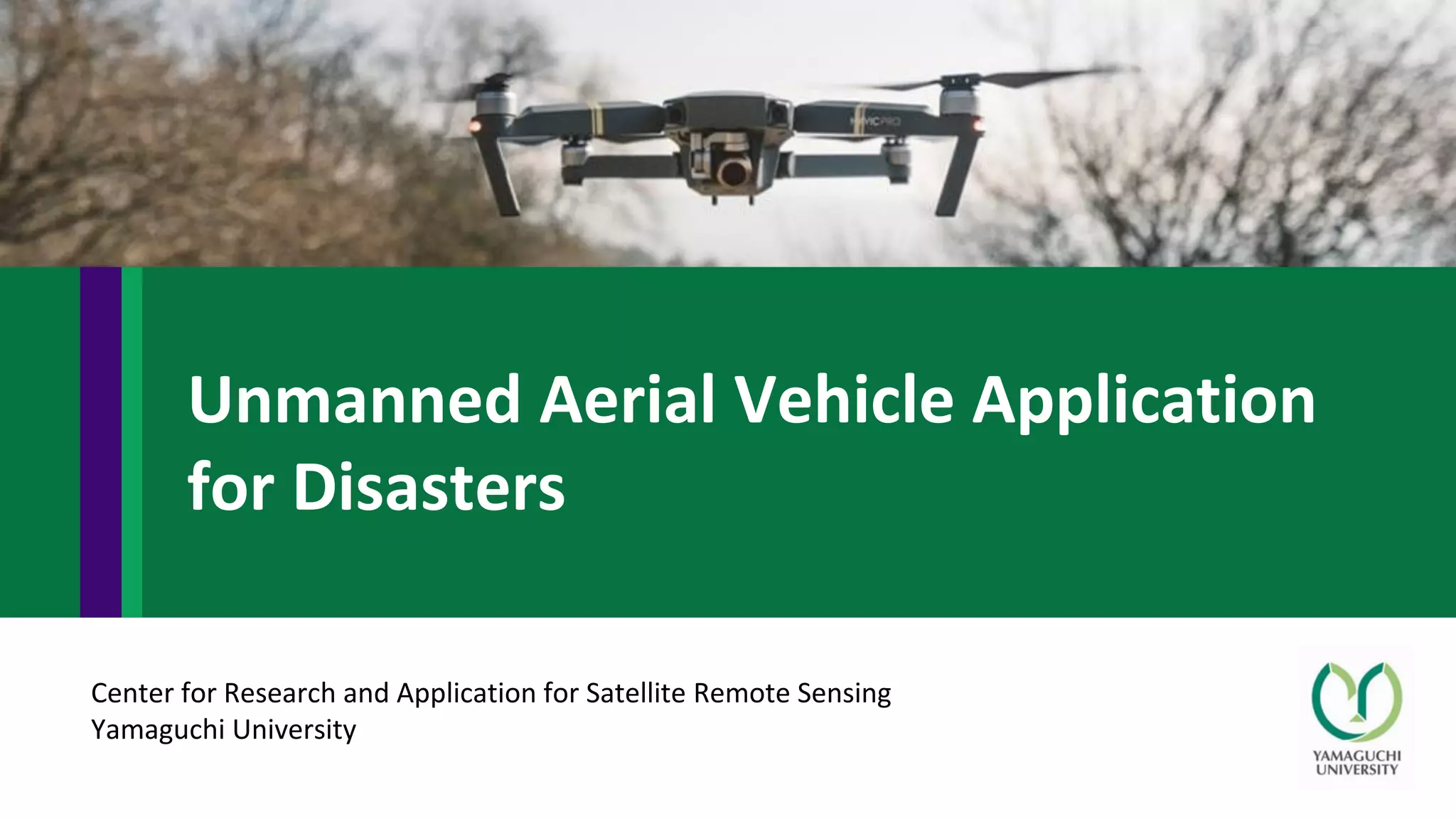
Unmanned Aerial Vehicle Application
for Disasters
Mobile mapping systems can quickly and accurately acquire geo-data
at a high level of detail.
A mobile mapping system consists basically of a vehicle equipped
with positioning sensors, measuring sensors and their fusion.
Mobile Mapping
2
Elements of Mobile Mapping
1. Platform
2. Positioning Sensor
3. Measurement Sensor
3
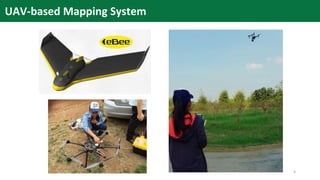
UAV-based Mapping System
4
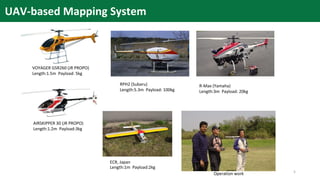
VOYAGER GSR260 (JR PROPO)
Length:1.5m Payload: 5kg
AIRSKIPPER 30 (JR PROPO)
Length:1.2m Payload:3kg
ECR, Japan
Length:1m Payload:2kg
RPH2 (Subaru)
Length:5.3m Payload: 100kg
R-Max (Yamaha)
Length:3m Payload: 20kg
Operation work
UAV-based Mapping System
5
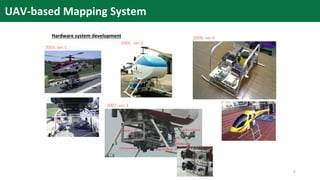
Hardware system development
2003, ver.1
2004, ver.2
2007, ver.3
2009, ver.4
UAV-based Mapping System
6
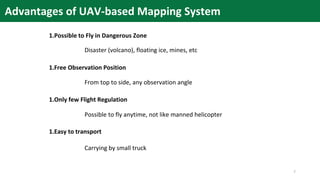
1.Possible to Fly in Dangerous Zone
1.Free Observation Position
1.Only few Flight Regulation
1.Easy to transport
Disaster (volcano), floating ice, mines, etc
From top to side, any observation angle
Possible to fly anytime, not like manned helicopter
Carrying by small truck
Advantages of UAV-based Mapping System
7
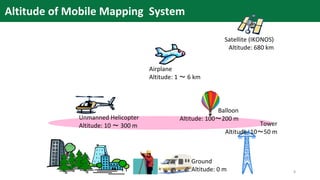
Unmanned Helicopter
Altitude: 10 ~ 300 m
Satellite (IKONOS)
Altitude: 680 km
Airplane
Altitude: 1 ~ 6 km
Ground
Altitude: 0 m
Tower
Altitude: 10~50 m
Balloon
Altitude: 100~200 m
Altitude of Mobile Mapping System
8
Application of UAV-based Mapping System
1. Search & Rescue
2. Surveillance
3. Law Enforcement
4. Inspection
5. Aerial Mapping
9
Search & Rescue
• UAV based Mapping Systems can quickly search a very large area to locate
victims of an accident or a natural disaster.
• They can then visually lock on to objects at the site or stranded victims to guide
rescue forces to the site.
• They can help search and rescue crews to the rescue operation instead of the
time consuming.
• They can work in weather conditions which would normally prevent human
piloted search and rescue.
• They can fly in very dangerous conditions to save human lives such as forest
fire, flood, etc.
10
Surveillance
• UAV based Mapping Systems can patrol large area and report unusual activity.
• They can perform a variety of surveillance operations for potential danger area.
• They can keep watch automatically landing from ground stations in or near the area.
• They can automatically locate and identify suspicious activity and visually lock-on to
objects or persons.
11
Law Enforcement
• UAV based Mapping Systems can fly to support police activity such high-speed
chases or criminal search operations.
• Stationed on top of buildings in urban areas, they can be dispatched in seconds
to takeoff and relay images from trouble spots.
• This real time imagery is acquired.
12
Inspection
• UAV based Mapping System can inspect dangerous structure such as high voltage
electrical lines in remote locations.
• UAV based Mapping System can inspect large structures such as bridges and dams
cost effectively.
• They can quickly inspect buildings and roads for potential damage after disasters.
• They can find illegal dumping in waste sites by providing aerial imagery to human
experts or by automatically identifying waste.
13
Aerial Mapping
• UAV based Mapping System can construct very high resolution and accurate
topological maps than conventional aircraft at a substantial cost savings.
• Unlike airplanes, they can fly close to the ground while carrying cameras to
build high resolution 3D maps.
• They can fly in smaller and more constrained areas to build highly detailed
elevation maps.
14
2. UAV-based Landslide Mapping system:
Surveying of the landslides
in the Mid Niigata Prefecture Earthquake
15
16
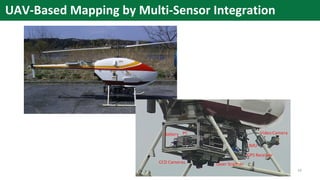
UAV-Based Mapping by Multi-Sensor Integration
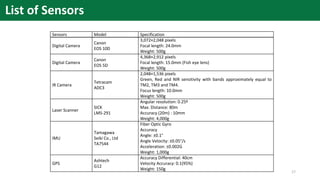
List of Sensors
Sensors Model Specification
Digital Camera
Canon
EOS 10D
3,072×2,048 pixels
Focal length: 24.0mm
Weight: 500g
Digital Camera
Canon
EOS 5D
4,368×2,912 pixels
Focal length: 15.0mm (Fish eye lens)
Weight: 500g
IR Camera
Tetracam
ADC3
2,048×1,536 pixels
Green, Red and NIR sensitivity with bands approximately equal to
TM2, TM3 and TM4.
Focus length: 10.0mm
Weight: 500g
Laser Scanner
SICK
LMS-291
Angular resolution: 0.25º
Max. Distance: 80m
Accuracy (20m) : 10mm
Weight: 4,000g
IMU
Tamagawa
Seiki Co., Ltd
TA7544
Fiber Optic Gyro
Accuracy
Angle: ±0.1°
Angle Velocity: ±0.05°/s
Acceleration: ±0.002G
Weight: 1,000g
GPS
Ashtech
G12
Accuracy Differential: 40cm
Velocity Accuracy: 0.1(95%)
Weight: 150g
17
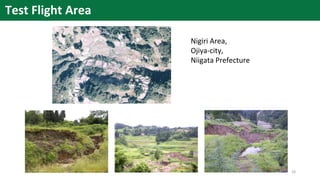
Test Flight Area
Nigiri Area,
Ojiya-city,
Niigata Prefecture
18
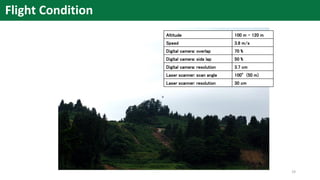
Flight Condition
Altitude 100 m – 120 m
Speed 3.8 m/s
Digital camera: overlap 70 %
Digital camera: side lap 50 %
Digital camera: resolution 3.7 cm
Laser scanner: scan angle 100°(50 m)
Laser scanner: resolution 30 cm
19
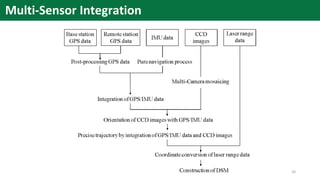
Multi-Sensor Integration
20
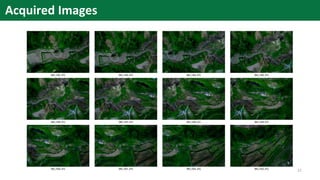
Acquired Images
21
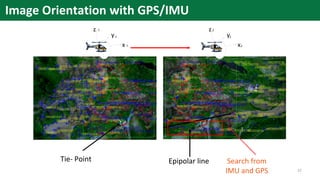
Image Orientation with GPS/IMU
Tie- Point Epipolar line Search from
IMU and GPS
z
y
x
z
y
x
1
1
1
2
2
2
22
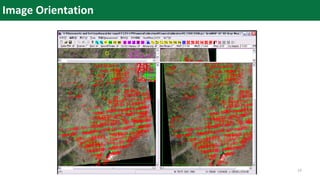
Image Orientation
23
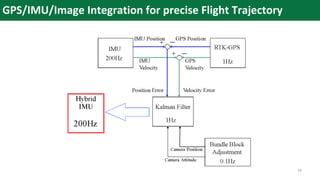
GPS/IMU/Image Integration for precise Flight Trajectory
24
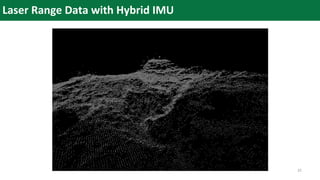
Laser Range Data with Hybrid IMU
25
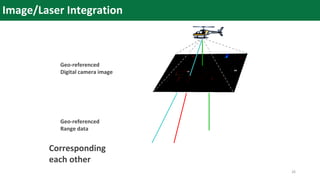
Image/Laser Integration
Geo-referenced
Digital camera image
Geo-referenced
Range data
Corresponding
each other
26
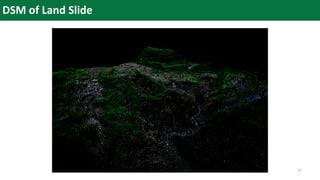
DSM of Land Slide
27
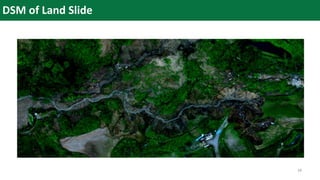
DSM of Land Slide
28
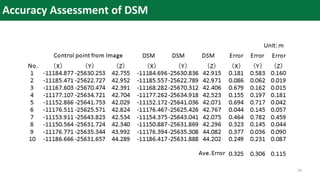
Accuracy Assessment of DSM
29
3. UAV-Based Flood Mapping
30
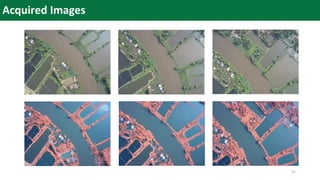
Acquired Images
31
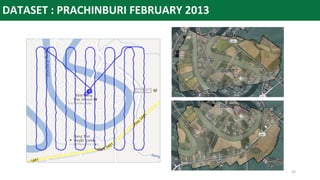
DATASET : PRACHINBURI FEBRUARY 2013
32
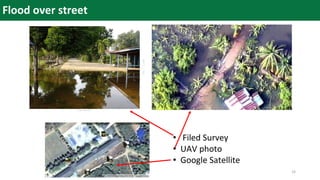
Flood over street
• Filed Survey
• UAV photo
• Google Satellite
33
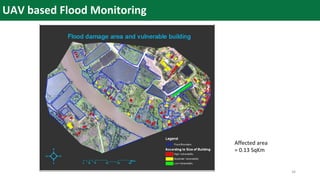
UAV based Flood Monitoring
Affected area
= 0.13 SqKm
34
UAV-based Mapping System
1. Introduction of UAV-based Mapping System
1. UAV-based Landslide Mapping system:
Surveying of the landslides in the Mid Niigata
Prefecture Earthquake
1. UAV-Based Flood Mapping
35 35

Unmanned Aerial Vehicle Application

  • 1.
    Center for Researchand Application for Satellite Remote Sensing Yamaguchi University Unmanned Aerial Vehicle Application for Disasters
  • 2.
    Mobile mapping systemscan quickly and accurately acquire geo-data at a high level of detail. A mobile mapping system consists basically of a vehicle equipped with positioning sensors, measuring sensors and their fusion. Mobile Mapping 2
  • 3.
    Elements of MobileMapping 1. Platform 2. Positioning Sensor 3. Measurement Sensor 3
  • 4.
  • 5.
    VOYAGER GSR260 (JRPROPO) Length:1.5m Payload: 5kg AIRSKIPPER 30 (JR PROPO) Length:1.2m Payload:3kg ECR, Japan Length:1m Payload:2kg RPH2 (Subaru) Length:5.3m Payload: 100kg R-Max (Yamaha) Length:3m Payload: 20kg Operation work UAV-based Mapping System 5
  • 6.
    Hardware system development 2003,ver.1 2004, ver.2 2007, ver.3 2009, ver.4 UAV-based Mapping System 6
  • 7.
    1.Possible to Flyin Dangerous Zone 1.Free Observation Position 1.Only few Flight Regulation 1.Easy to transport Disaster (volcano), floating ice, mines, etc From top to side, any observation angle Possible to fly anytime, not like manned helicopter Carrying by small truck Advantages of UAV-based Mapping System 7
  • 8.
    Unmanned Helicopter Altitude: 10~ 300 m Satellite (IKONOS) Altitude: 680 km Airplane Altitude: 1 ~ 6 km Ground Altitude: 0 m Tower Altitude: 10~50 m Balloon Altitude: 100~200 m Altitude of Mobile Mapping System 8
  • 9.
    Application of UAV-basedMapping System 1. Search & Rescue 2. Surveillance 3. Law Enforcement 4. Inspection 5. Aerial Mapping 9
  • 10.
    Search & Rescue •UAV based Mapping Systems can quickly search a very large area to locate victims of an accident or a natural disaster. • They can then visually lock on to objects at the site or stranded victims to guide rescue forces to the site. • They can help search and rescue crews to the rescue operation instead of the time consuming. • They can work in weather conditions which would normally prevent human piloted search and rescue. • They can fly in very dangerous conditions to save human lives such as forest fire, flood, etc. 10
  • 11.
    Surveillance • UAV basedMapping Systems can patrol large area and report unusual activity. • They can perform a variety of surveillance operations for potential danger area. • They can keep watch automatically landing from ground stations in or near the area. • They can automatically locate and identify suspicious activity and visually lock-on to objects or persons. 11
  • 12.
    Law Enforcement • UAVbased Mapping Systems can fly to support police activity such high-speed chases or criminal search operations. • Stationed on top of buildings in urban areas, they can be dispatched in seconds to takeoff and relay images from trouble spots. • This real time imagery is acquired. 12
  • 13.
    Inspection • UAV basedMapping System can inspect dangerous structure such as high voltage electrical lines in remote locations. • UAV based Mapping System can inspect large structures such as bridges and dams cost effectively. • They can quickly inspect buildings and roads for potential damage after disasters. • They can find illegal dumping in waste sites by providing aerial imagery to human experts or by automatically identifying waste. 13
  • 14.
    Aerial Mapping • UAVbased Mapping System can construct very high resolution and accurate topological maps than conventional aircraft at a substantial cost savings. • Unlike airplanes, they can fly close to the ground while carrying cameras to build high resolution 3D maps. • They can fly in smaller and more constrained areas to build highly detailed elevation maps. 14
  • 15.
    2. UAV-based LandslideMapping system: Surveying of the landslides in the Mid Niigata Prefecture Earthquake 15
  • 16.
    16 UAV-Based Mapping byMulti-Sensor Integration
  • 17.
    List of Sensors SensorsModel Specification Digital Camera Canon EOS 10D 3,072×2,048 pixels Focal length: 24.0mm Weight: 500g Digital Camera Canon EOS 5D 4,368×2,912 pixels Focal length: 15.0mm (Fish eye lens) Weight: 500g IR Camera Tetracam ADC3 2,048×1,536 pixels Green, Red and NIR sensitivity with bands approximately equal to TM2, TM3 and TM4. Focus length: 10.0mm Weight: 500g Laser Scanner SICK LMS-291 Angular resolution: 0.25º Max. Distance: 80m Accuracy (20m) : 10mm Weight: 4,000g IMU Tamagawa Seiki Co., Ltd TA7544 Fiber Optic Gyro Accuracy Angle: ±0.1° Angle Velocity: ±0.05°/s Acceleration: ±0.002G Weight: 1,000g GPS Ashtech G12 Accuracy Differential: 40cm Velocity Accuracy: 0.1(95%) Weight: 150g 17
  • 18.
    Test Flight Area NigiriArea, Ojiya-city, Niigata Prefecture 18
  • 19.
    Flight Condition Altitude 100m – 120 m Speed 3.8 m/s Digital camera: overlap 70 % Digital camera: side lap 50 % Digital camera: resolution 3.7 cm Laser scanner: scan angle 100°(50 m) Laser scanner: resolution 30 cm 19
  • 20.
  • 21.
  • 22.
    Image Orientation withGPS/IMU Tie- Point Epipolar line Search from IMU and GPS z y x z y x 1 1 1 2 2 2 22
  • 23.
  • 24.
    GPS/IMU/Image Integration forprecise Flight Trajectory 24
  • 25.
    Laser Range Datawith Hybrid IMU 25
  • 26.
    Image/Laser Integration Geo-referenced Digital cameraimage Geo-referenced Range data Corresponding each other 26
  • 27.
    DSM of LandSlide 27
  • 28.
    DSM of LandSlide 28
  • 29.
  • 30.
  • 31.
  • 32.
    DATASET : PRACHINBURIFEBRUARY 2013 32
  • 33.
    Flood over street •Filed Survey • UAV photo • Google Satellite 33
  • 34.
    UAV based FloodMonitoring Affected area = 0.13 SqKm 34
  • 35.
    UAV-based Mapping System 1.Introduction of UAV-based Mapping System 1. UAV-based Landslide Mapping system: Surveying of the landslides in the Mid Niigata Prefecture Earthquake 1. UAV-Based Flood Mapping 35 35