Elements of Analytical
Photogrammetry
content
1. Coordinate Systems.
1.1 Pixel Coordinate System
1.2 Image Coordinate System
1.3 Image Space Coordinate System
1.4 Ground Coordinate System
2. Two dimensional coordinate transformation
2.1 conformal
2.2 affine
3. Interior and Exterior orientation parameters
1. Coordinate Systems
Conceptually, photogrammetry involves establishing the
relationship between the camera or sensor used to capture
the imagery, the imagery itself, and the ground.
In order to understand and define this relationship, each of
the three variables associated with the relationship must be
defined with respect to a coordinate space and coordinate
system.
1.1 Pixel Coordinate System:
pixel coordinate system is usually a
coordinate system with its origin in the
upper-left corner of the image, the x-
axis pointing to the right, the y-axis
pointing downward, and the units in
pixels, as shown by axes c and r .These
coordinates (c, r) can also be thought of
as the pixel column and row number,
respectively.
1.2 Image Coordinate System
An image coordinate system or an image plane coordinate system is usually
defined as a two-dimensional (2D) coordinate system occurring on the image
plane with its origin at the image center. The origin of the image coordinate
system is also referred to as the principal point. Image coordinate units are
usually millimeters or microns.
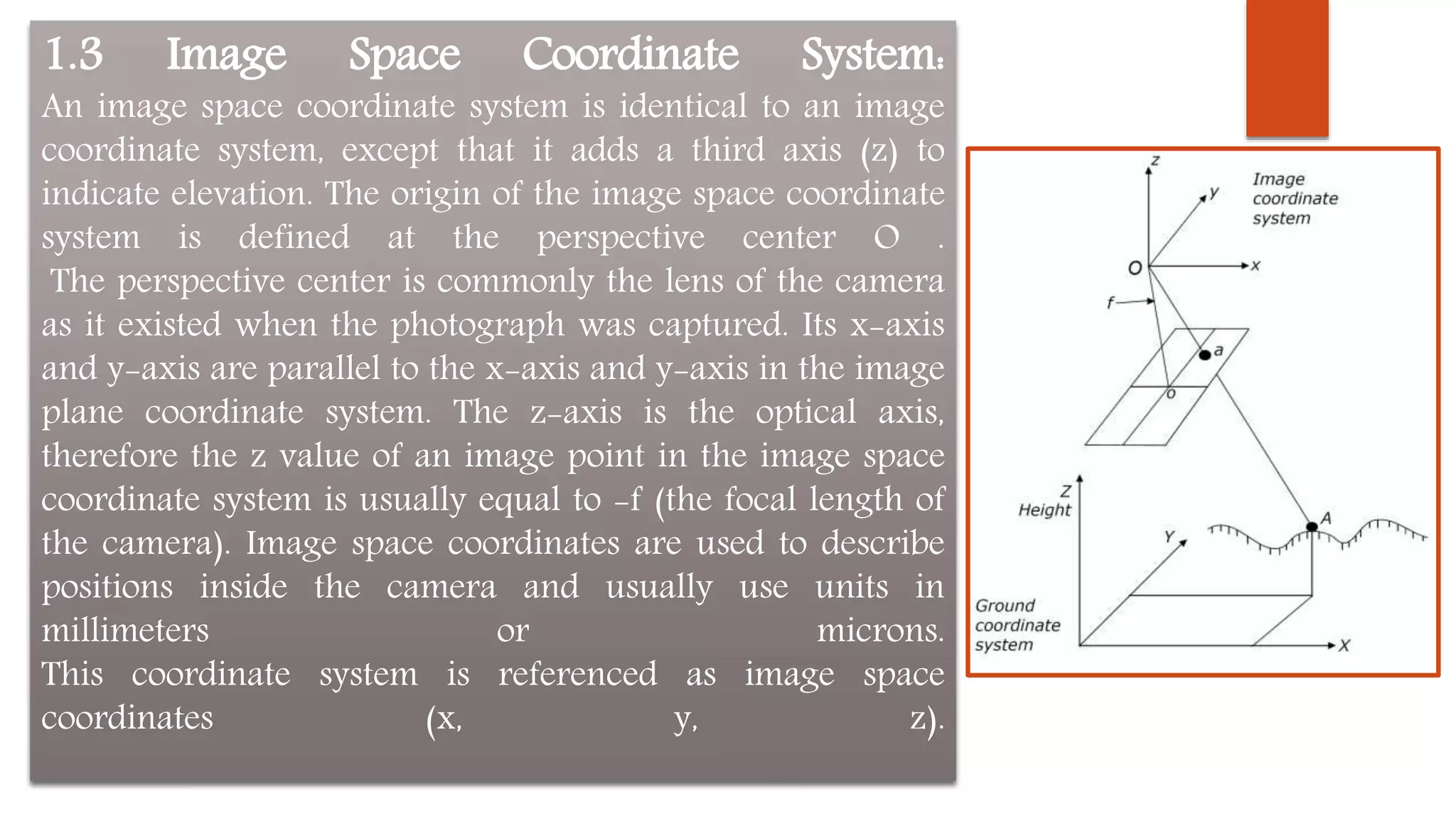
1.3 Image Space Coordinate System:
An image space coordinate system is identical to an image
coordinate system, except that it adds a third axis (z) to
indicate elevation. The origin of the image space coordinate
system is defined at the perspective center O .
The perspective center is commonly the lens of the camera
as it existed when the photograph was captured. Its x-axis
and y-axis are parallel to the x-axis and y-axis in the image
plane coordinate system. The z-axis is the optical axis,
therefore the z value of an image point in the image space
coordinate system is usually equal to -f (the focal length of
the camera). Image space coordinates are used to describe
positions inside the camera and usually use units in
millimeters or microns.
This coordinate system is referenced as image space
coordinates (x, y, z).
A ground coordinate system is usually defined as a 3D
coordinate system that utilizes a known geographic
map projection. Ground coordinates (X,Y,Z) are
usually expressed in feet or meters. The Z value is
elevation above mean sea level for a given vertical
datum. This coordinate system is referenced as ground
coordinates (X,Y,Z).
1.4 Ground Coordinate System
2. Two dimensional coordinate transformation:
2.1 conformal coordinate transformation
The term two-dimensional means that the coordinate systems lie on
plane surfaces. A conformal transformation is one in which true
shape is preserved after transformation. To perform a two-
dimensional conformal coordinate transformation, it is necessary that
coordinates of at least two points be known in both the arbitrary and
final coordinate systems.
Accuracy in the transformation is improved by choosing the two
points as far apart as possible. If more than two control points are
available, an improved solution may be obtained by applying the
method of least squares.
b) Rotation between 2D right handed coordinate system.
2.2 Affine Transformation
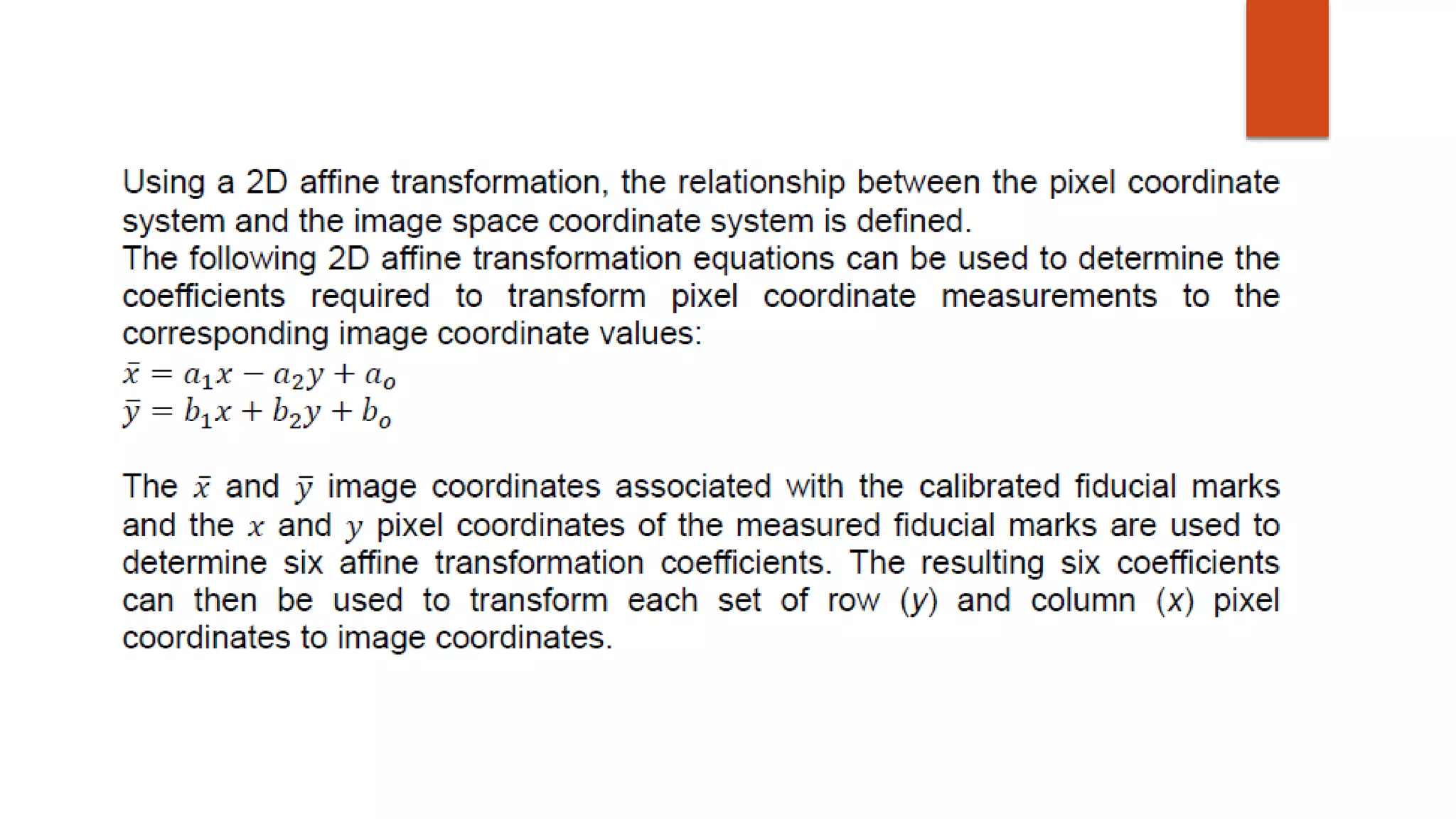
Two dimensional affine coordinate transformation
The two-dimensional affine coordinate transformation is only a
slight modification of the two-dimensional conformal
transformation, to include different scale factors in the x and y
directions and to compensate for non orthogonality (non
perpendicularity) of the axis system. The affine transformation
achieves these additional features by including two additional
unknown parameters for a total of six. As will be shown, the
derivation of the transformation equations depends on the
measurement characteristics of the arbitrary coordinate system.
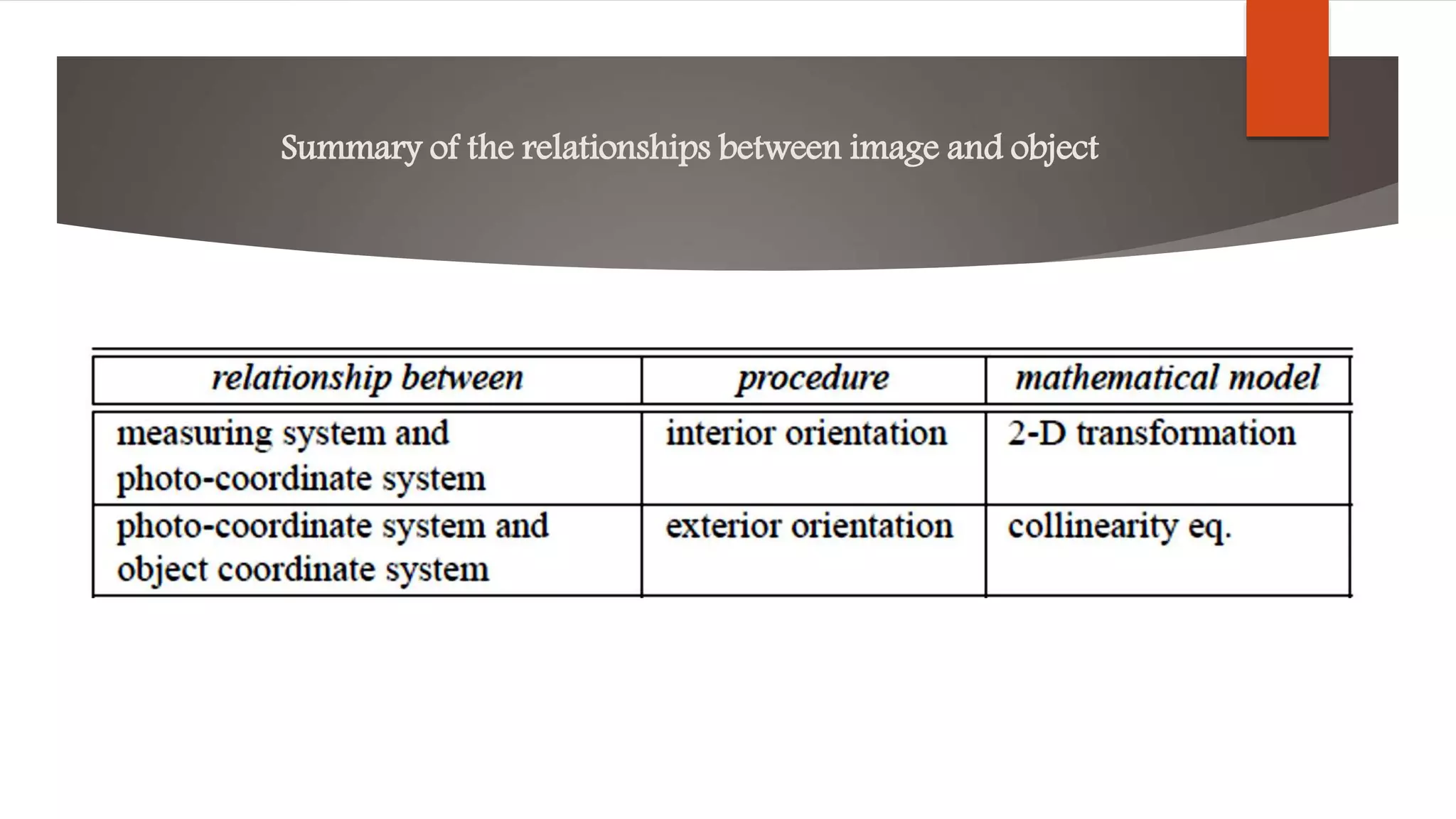
Summary of Computing Photo-Coordinates
The main steps necessary to determine photo-coordinates:
1. Insert the diapositive into the measuring system (e.g. comparator, analytical
plotter) and measure the fiducial marks in the machine coordinate system.
Compute the transformation parameters with a conformal or affine
transformation. The transformation establishes a relationship between the
measuring system and the fiducial coordinate system.
2. Translate the fiducial system to the photo-coordinate system.
3. Correct photo-coordinates for radial distortion.
Interior and Exterior orientation
parameters
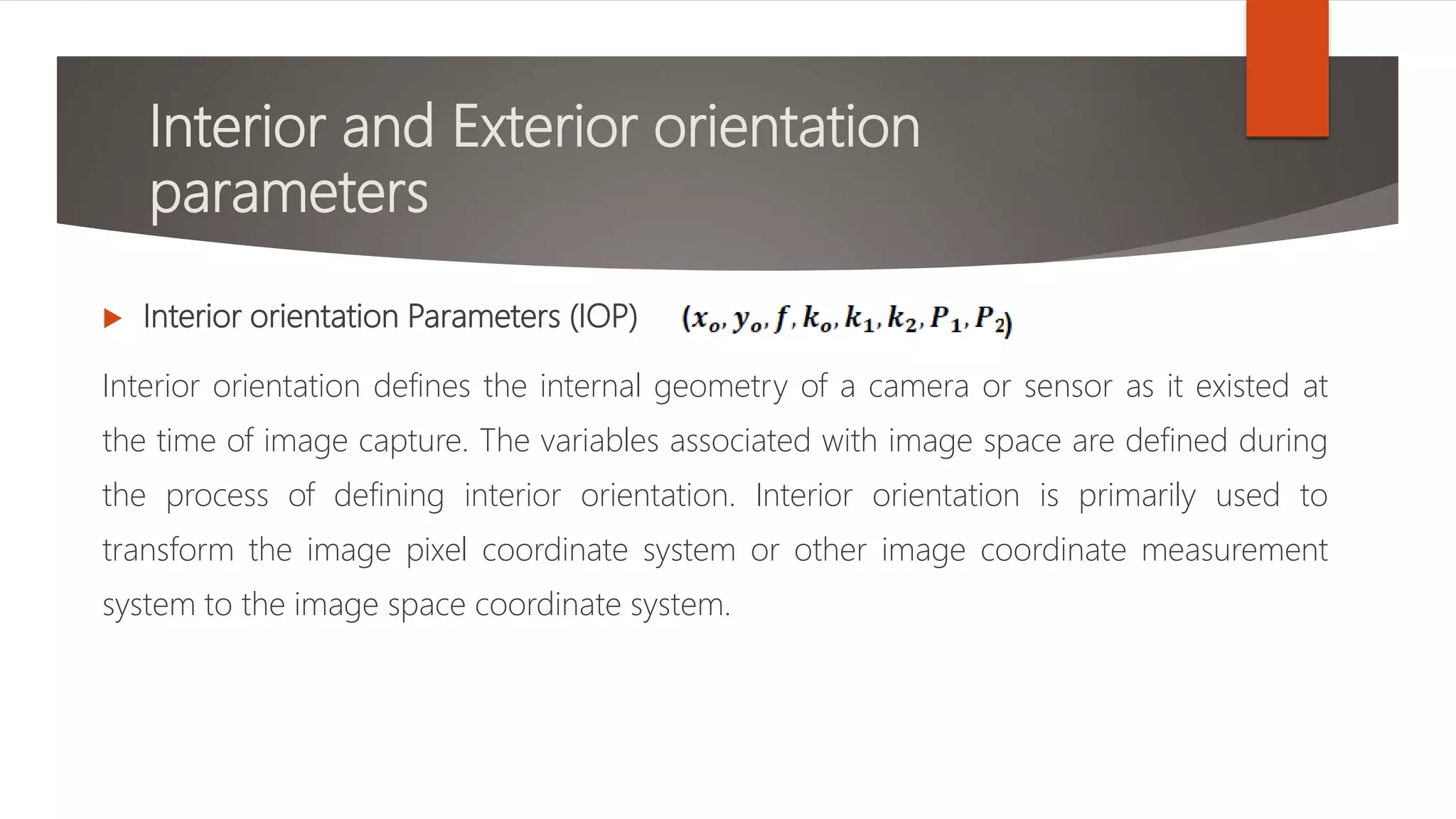
 Interior orientation Parameters (IOP)
Interior orientation defines the internal geometry of a camera or sensor as it existed at
the time of image capture. The variables associated with image space are defined during
the process of defining interior orientation. Interior orientation is primarily used to
transform the image pixel coordinate system or other image coordinate measurement
system to the image space coordinate system.
Summary of the relationships between image and object
Principal Point and Focal Length
The principal point is mathematically defined as the intersection of the
perpendicular line through the perspective center of the image plane.
length from the principal point to the perspective center is called the focal
length.
Fiducial Marks
One of the steps associated with calculating interior orientation involves
determining the image position of the principal point for each image in the
project. Therefore, the image positions of the fiducial marks are measured
on the image, and then compared to the calibrated coordinates of each
fiducial mark.
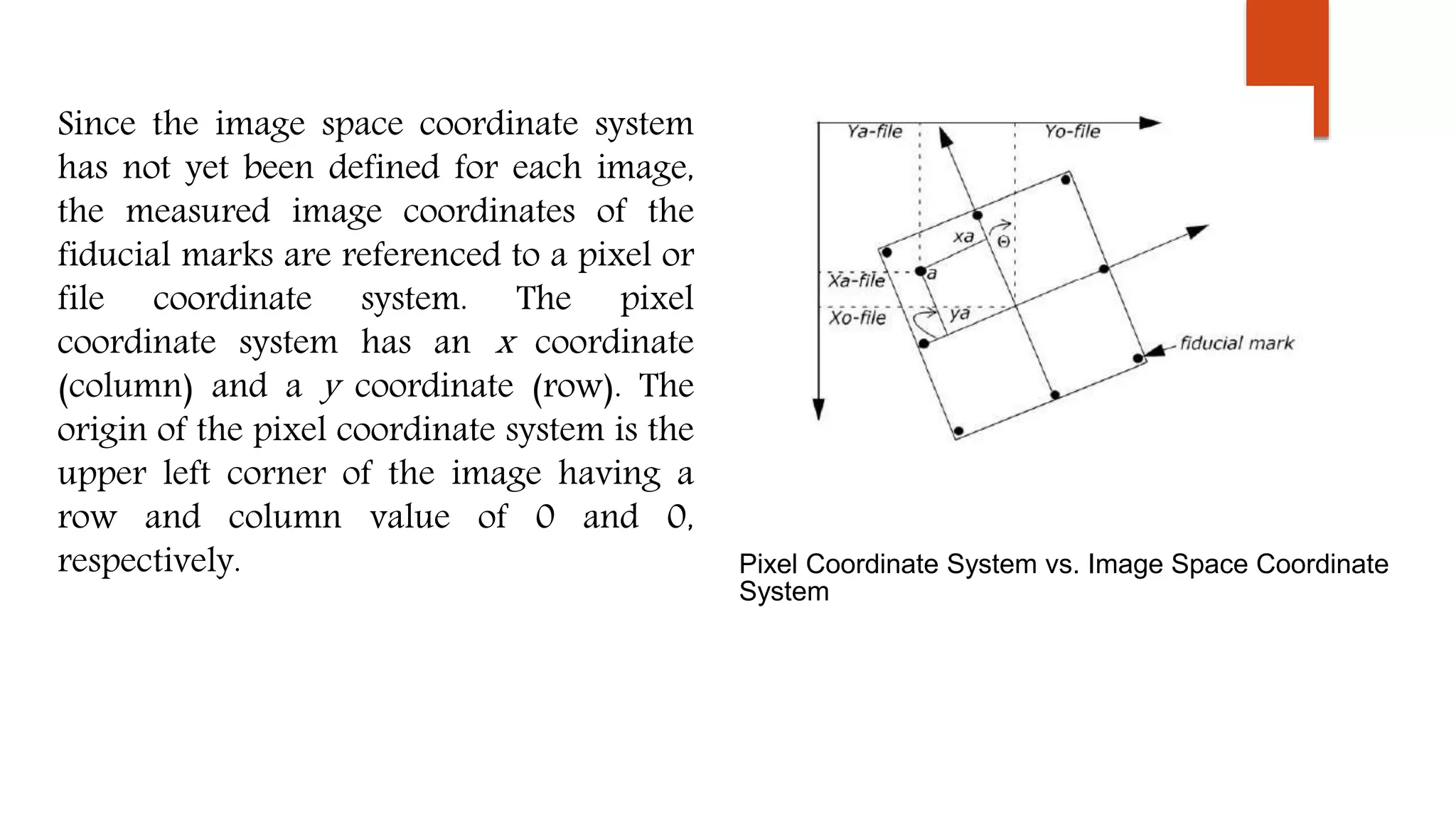
Since the image space coordinate system
has not yet been defined for each image,
the measured image coordinates of the
fiducial marks are referenced to a pixel or
file coordinate system. The pixel
coordinate system has an x coordinate
(column) and a y coordinate (row). The
origin of the pixel coordinate system is the
upper left corner of the image having a
row and column value of 0 and 0,
respectively. Pixel Coordinate System vs. Image Space Coordinate
System
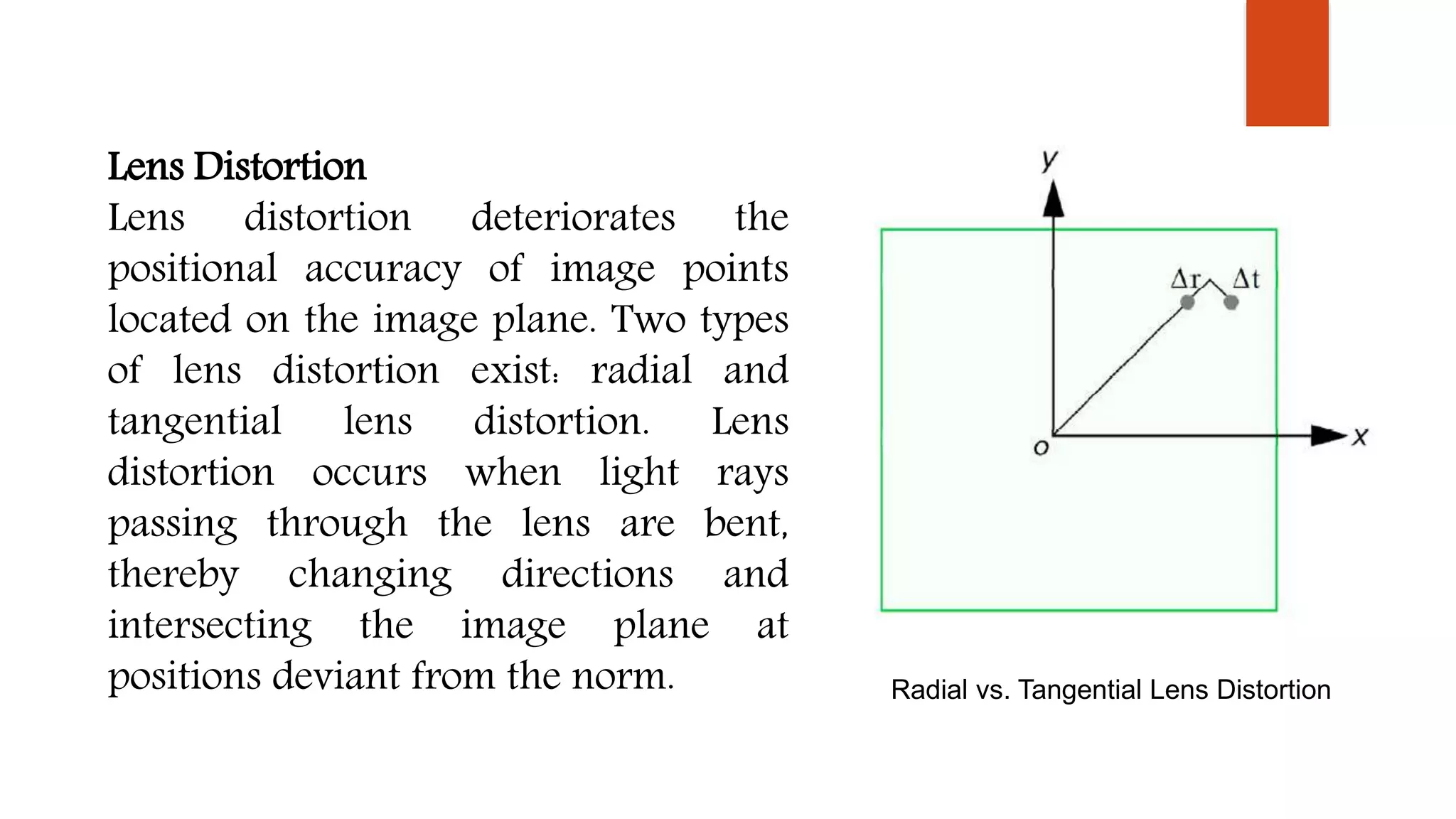
Lens Distortion
Lens distortion deteriorates the
positional accuracy of image points
located on the image plane. Two types
of lens distortion exist: radial and
tangential lens distortion. Lens
distortion occurs when light rays
passing through the lens are bent,
thereby changing directions and
intersecting the image plane at
positions deviant from the norm. Radial vs. Tangential Lens Distortion
Exterior Orientation Parameters (EOP)
Exterior orientation defines the position and angular orientation of the camera that
captured an image. The variables defining the position and orientation of an image
are referred to as the elements of exterior orientation. The elements of exterior
orientation define the characteristics associated with an image at the time of
exposure or capture. The positional elements of exterior orientation include Xo,
Yo, and Zo. They define the position of the perspective center (O) with respect to
the ground space coordinate system (X, Y, and Z). Zo is commonly referred to as
the height of the camera above sea level, which is commonly defined by a datum.
The angular or rotational elements of exterior orientation describe the relationship
between the ground space coordinate system (X, Y, and Z) and the image space
coordinate system (x, y, and z). Three rotation angles are commonly used to define
angular orientation. They are omega (ω), phi and kappa (κ).
Elements of Exterior Orientation
Omega, Phi, and Kappa
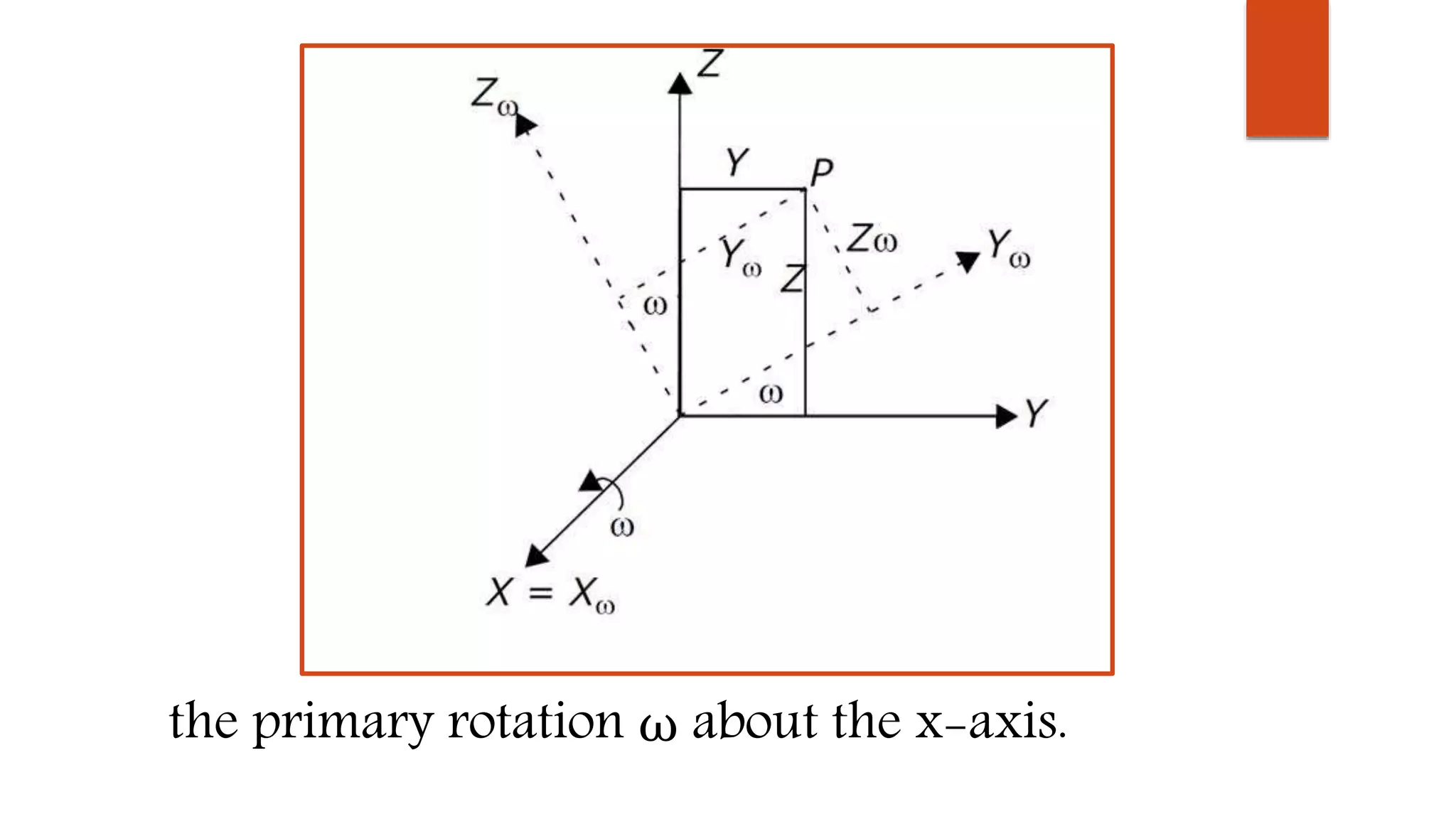
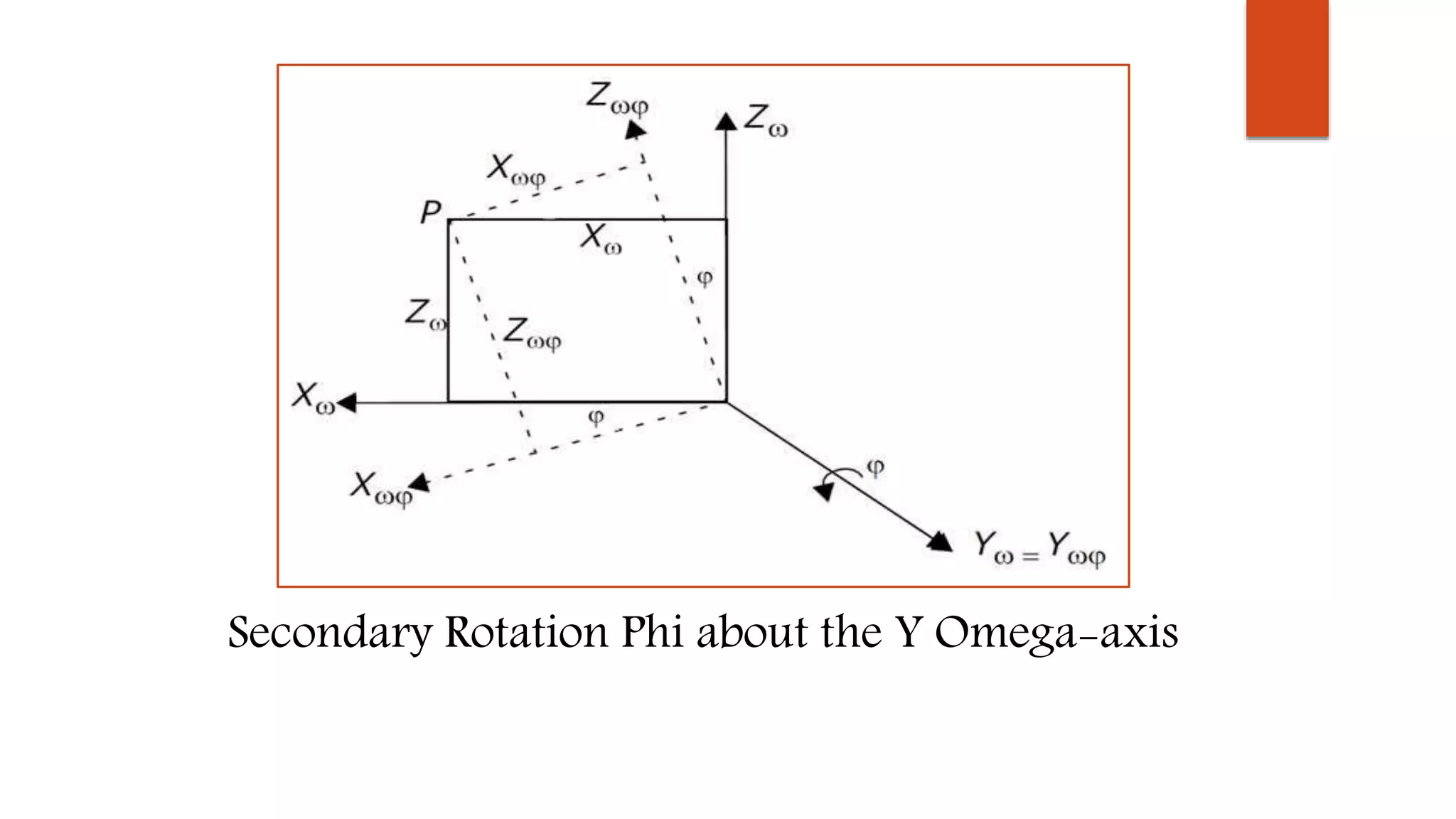
Omega is a rotation about the photographic x-axis, phi is a
rotation about the photographic y-axis, and kappa is a rotation
about the photographic z-axis.
Rotations are defined as being positive if they are
counterclockwise when viewed from the positive end of their
respective axis. The photographic z-axis is equivalent to the
optical axis (focal length). The x’, y’, and z’ coordinates are
parallel to the ground space coordinate system.
Using the three rotation angles, the relationship between the image
space coordinate system (x, y, and z) and ground space coordinate
system (X, Y, and Z; or x’, y’, and z’) can be determined. A 3 × 3 matrix
defining the relationship between the two systems is used. This is
referred to as the orientation or rotation matrix, M.
The rotation matrix is derived by applying a sequential rotation of
omega about the x-axis, phi about the y-axis, and kappa about the z-
axis.
Rotation Matrix
To derive the rotation matrix M, three rotations are
performed sequentially: a primary rotation ω around the x-
axis, followed by a secondary rotation phi around the y-axis,
and a tertiary rotation κ around the z-axis.
Derivation of the Rotation Matrix
the primary rotation ω about the x-axis.
Secondary Rotation Phi about the Y Omega-axis
Tertiary Rotation Kappa About the Z Omega Phi axis
The final effect of all the three rotations is then expressed by
the rotation matrix (M) in which M is the sequential rotation
or orientation matrix. Performing the Multiplication
gives
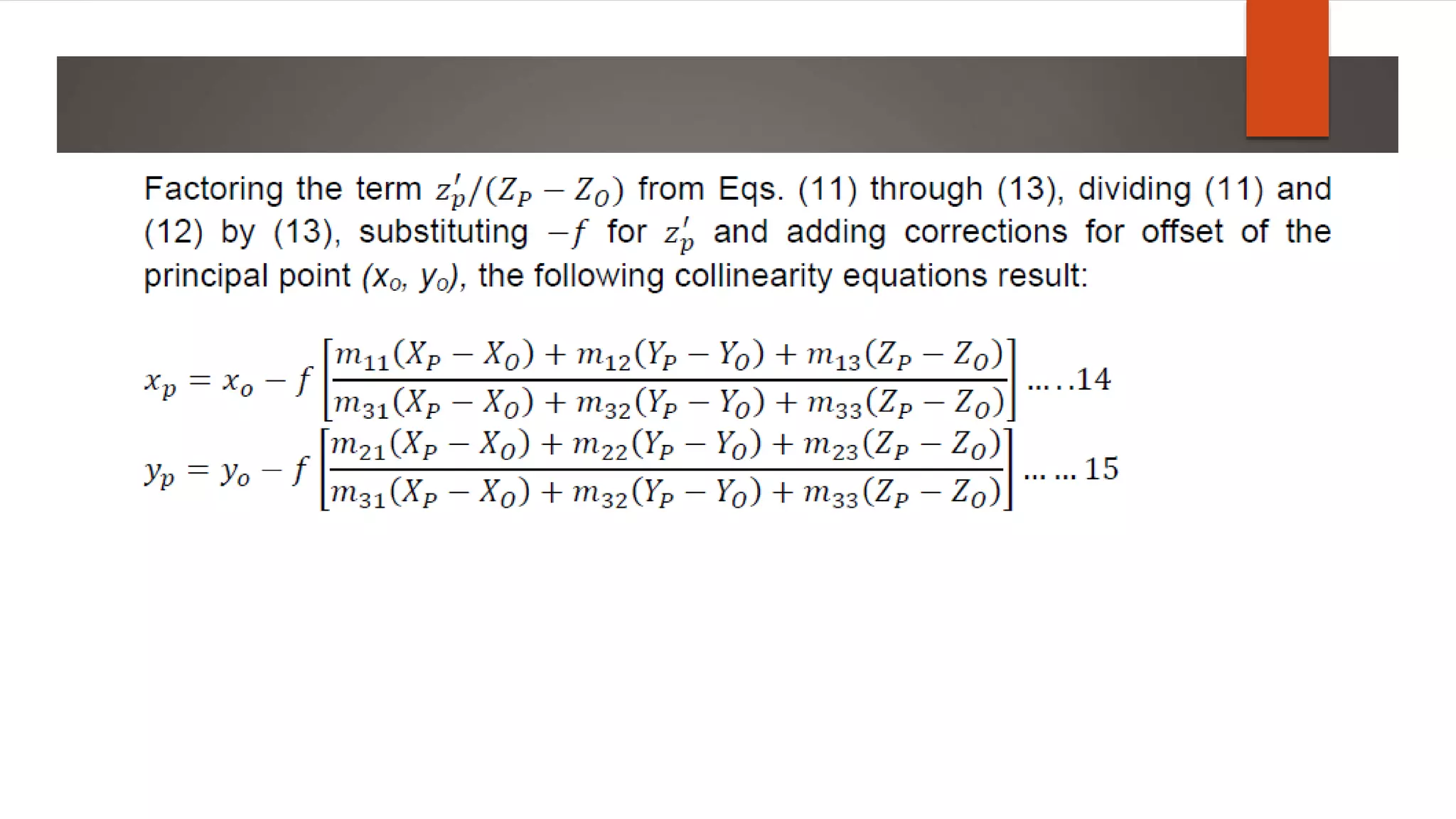
DEVELOPMENT OF COLLINEARITY CONDITION EQUATIONS
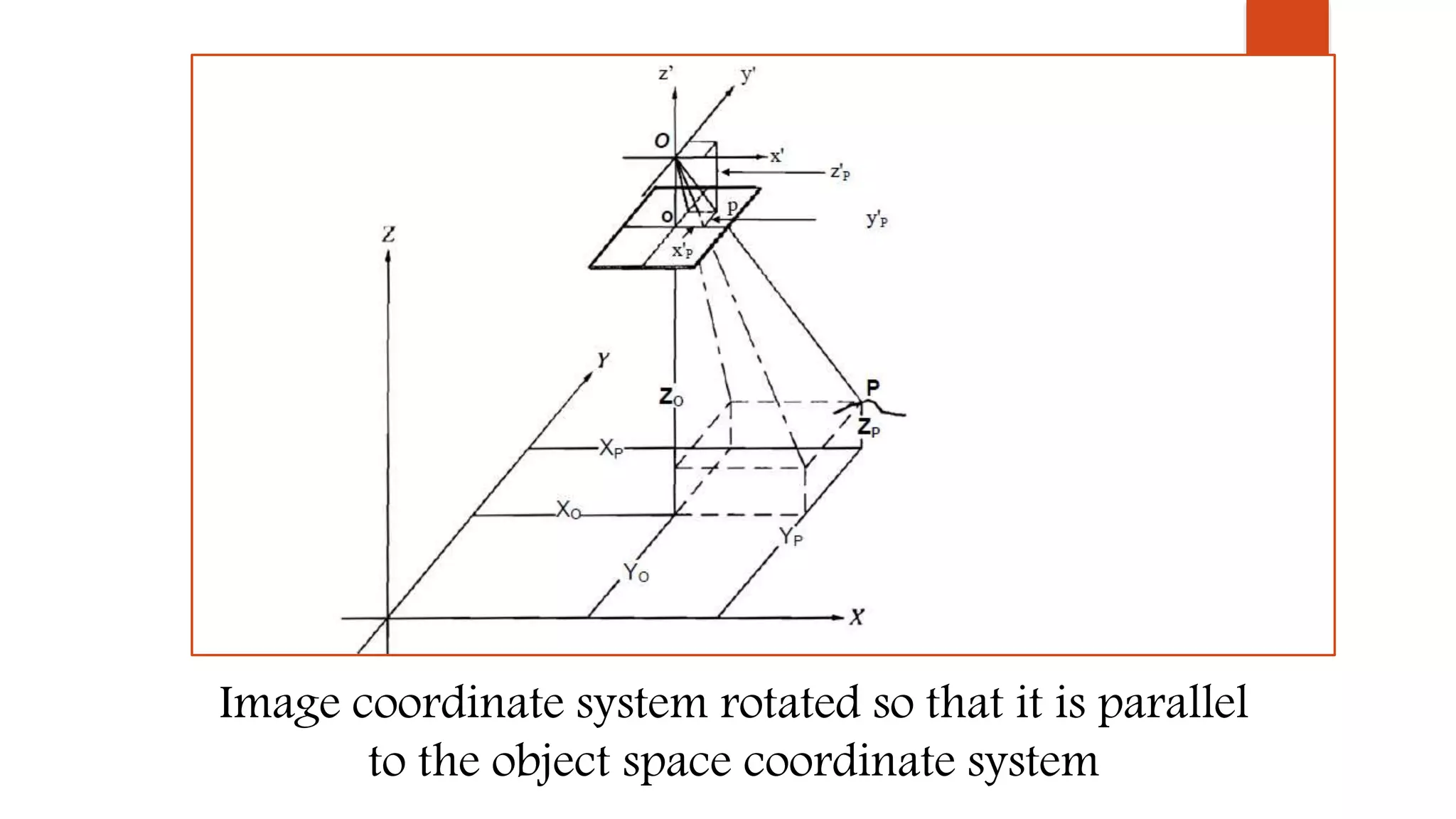
Collinearity is the condition in which the exposure station of any
photograph, an object point, and its photo image all lie on a straight
line. The equations expressing this condition are called the collinearity
condition equations. They are perhaps the most useful of all equations
to the photogrammetrist.
Image coordinate system rotated so that it is parallel
to the object space coordinate system
Elements of Analytical Photogrammetry

Elements of Analytical Photogrammetry

  • 1.
  • 2.
    content 1. Coordinate Systems. 1.1Pixel Coordinate System 1.2 Image Coordinate System 1.3 Image Space Coordinate System 1.4 Ground Coordinate System 2. Two dimensional coordinate transformation 2.1 conformal 2.2 affine 3. Interior and Exterior orientation parameters
  • 3.
    1. Coordinate Systems Conceptually,photogrammetry involves establishing the relationship between the camera or sensor used to capture the imagery, the imagery itself, and the ground. In order to understand and define this relationship, each of the three variables associated with the relationship must be defined with respect to a coordinate space and coordinate system.
  • 4.
    1.1 Pixel CoordinateSystem: pixel coordinate system is usually a coordinate system with its origin in the upper-left corner of the image, the x- axis pointing to the right, the y-axis pointing downward, and the units in pixels, as shown by axes c and r .These coordinates (c, r) can also be thought of as the pixel column and row number, respectively.
  • 5.
    1.2 Image CoordinateSystem An image coordinate system or an image plane coordinate system is usually defined as a two-dimensional (2D) coordinate system occurring on the image plane with its origin at the image center. The origin of the image coordinate system is also referred to as the principal point. Image coordinate units are usually millimeters or microns.
  • 6.
    1.3 Image SpaceCoordinate System: An image space coordinate system is identical to an image coordinate system, except that it adds a third axis (z) to indicate elevation. The origin of the image space coordinate system is defined at the perspective center O . The perspective center is commonly the lens of the camera as it existed when the photograph was captured. Its x-axis and y-axis are parallel to the x-axis and y-axis in the image plane coordinate system. The z-axis is the optical axis, therefore the z value of an image point in the image space coordinate system is usually equal to -f (the focal length of the camera). Image space coordinates are used to describe positions inside the camera and usually use units in millimeters or microns. This coordinate system is referenced as image space coordinates (x, y, z).
  • 7.
    A ground coordinatesystem is usually defined as a 3D coordinate system that utilizes a known geographic map projection. Ground coordinates (X,Y,Z) are usually expressed in feet or meters. The Z value is elevation above mean sea level for a given vertical datum. This coordinate system is referenced as ground coordinates (X,Y,Z). 1.4 Ground Coordinate System
  • 8.
    2. Two dimensionalcoordinate transformation: 2.1 conformal coordinate transformation The term two-dimensional means that the coordinate systems lie on plane surfaces. A conformal transformation is one in which true shape is preserved after transformation. To perform a two- dimensional conformal coordinate transformation, it is necessary that coordinates of at least two points be known in both the arbitrary and final coordinate systems. Accuracy in the transformation is improved by choosing the two points as far apart as possible. If more than two control points are available, an improved solution may be obtained by applying the method of least squares.
  • 10.
    b) Rotation between2D right handed coordinate system.
  • 14.
    2.2 Affine Transformation Twodimensional affine coordinate transformation The two-dimensional affine coordinate transformation is only a slight modification of the two-dimensional conformal transformation, to include different scale factors in the x and y directions and to compensate for non orthogonality (non perpendicularity) of the axis system. The affine transformation achieves these additional features by including two additional unknown parameters for a total of six. As will be shown, the derivation of the transformation equations depends on the measurement characteristics of the arbitrary coordinate system.
  • 16.
    Summary of ComputingPhoto-Coordinates The main steps necessary to determine photo-coordinates: 1. Insert the diapositive into the measuring system (e.g. comparator, analytical plotter) and measure the fiducial marks in the machine coordinate system. Compute the transformation parameters with a conformal or affine transformation. The transformation establishes a relationship between the measuring system and the fiducial coordinate system. 2. Translate the fiducial system to the photo-coordinate system. 3. Correct photo-coordinates for radial distortion.
  • 17.
    Interior and Exteriororientation parameters  Interior orientation Parameters (IOP) Interior orientation defines the internal geometry of a camera or sensor as it existed at the time of image capture. The variables associated with image space are defined during the process of defining interior orientation. Interior orientation is primarily used to transform the image pixel coordinate system or other image coordinate measurement system to the image space coordinate system.
  • 18.
    Summary of therelationships between image and object
  • 19.
    Principal Point andFocal Length The principal point is mathematically defined as the intersection of the perpendicular line through the perspective center of the image plane. length from the principal point to the perspective center is called the focal length. Fiducial Marks One of the steps associated with calculating interior orientation involves determining the image position of the principal point for each image in the project. Therefore, the image positions of the fiducial marks are measured on the image, and then compared to the calibrated coordinates of each fiducial mark.
  • 20.
    Since the imagespace coordinate system has not yet been defined for each image, the measured image coordinates of the fiducial marks are referenced to a pixel or file coordinate system. The pixel coordinate system has an x coordinate (column) and a y coordinate (row). The origin of the pixel coordinate system is the upper left corner of the image having a row and column value of 0 and 0, respectively. Pixel Coordinate System vs. Image Space Coordinate System
  • 22.
    Lens Distortion Lens distortiondeteriorates the positional accuracy of image points located on the image plane. Two types of lens distortion exist: radial and tangential lens distortion. Lens distortion occurs when light rays passing through the lens are bent, thereby changing directions and intersecting the image plane at positions deviant from the norm. Radial vs. Tangential Lens Distortion
  • 23.
    Exterior Orientation Parameters(EOP) Exterior orientation defines the position and angular orientation of the camera that captured an image. The variables defining the position and orientation of an image are referred to as the elements of exterior orientation. The elements of exterior orientation define the characteristics associated with an image at the time of exposure or capture. The positional elements of exterior orientation include Xo, Yo, and Zo. They define the position of the perspective center (O) with respect to the ground space coordinate system (X, Y, and Z). Zo is commonly referred to as the height of the camera above sea level, which is commonly defined by a datum. The angular or rotational elements of exterior orientation describe the relationship between the ground space coordinate system (X, Y, and Z) and the image space coordinate system (x, y, and z). Three rotation angles are commonly used to define angular orientation. They are omega (ω), phi and kappa (κ).
  • 24.
  • 25.
  • 26.
    Omega is arotation about the photographic x-axis, phi is a rotation about the photographic y-axis, and kappa is a rotation about the photographic z-axis. Rotations are defined as being positive if they are counterclockwise when viewed from the positive end of their respective axis. The photographic z-axis is equivalent to the optical axis (focal length). The x’, y’, and z’ coordinates are parallel to the ground space coordinate system.
  • 27.
    Using the threerotation angles, the relationship between the image space coordinate system (x, y, and z) and ground space coordinate system (X, Y, and Z; or x’, y’, and z’) can be determined. A 3 × 3 matrix defining the relationship between the two systems is used. This is referred to as the orientation or rotation matrix, M. The rotation matrix is derived by applying a sequential rotation of omega about the x-axis, phi about the y-axis, and kappa about the z- axis. Rotation Matrix
  • 28.
    To derive therotation matrix M, three rotations are performed sequentially: a primary rotation ω around the x- axis, followed by a secondary rotation phi around the y-axis, and a tertiary rotation κ around the z-axis. Derivation of the Rotation Matrix
  • 29.
    the primary rotationω about the x-axis.
  • 31.
    Secondary Rotation Phiabout the Y Omega-axis
  • 33.
    Tertiary Rotation KappaAbout the Z Omega Phi axis
  • 35.
    The final effectof all the three rotations is then expressed by the rotation matrix (M) in which M is the sequential rotation or orientation matrix. Performing the Multiplication gives
  • 36.
    DEVELOPMENT OF COLLINEARITYCONDITION EQUATIONS Collinearity is the condition in which the exposure station of any photograph, an object point, and its photo image all lie on a straight line. The equations expressing this condition are called the collinearity condition equations. They are perhaps the most useful of all equations to the photogrammetrist.
  • 38.
    Image coordinate systemrotated so that it is parallel to the object space coordinate system