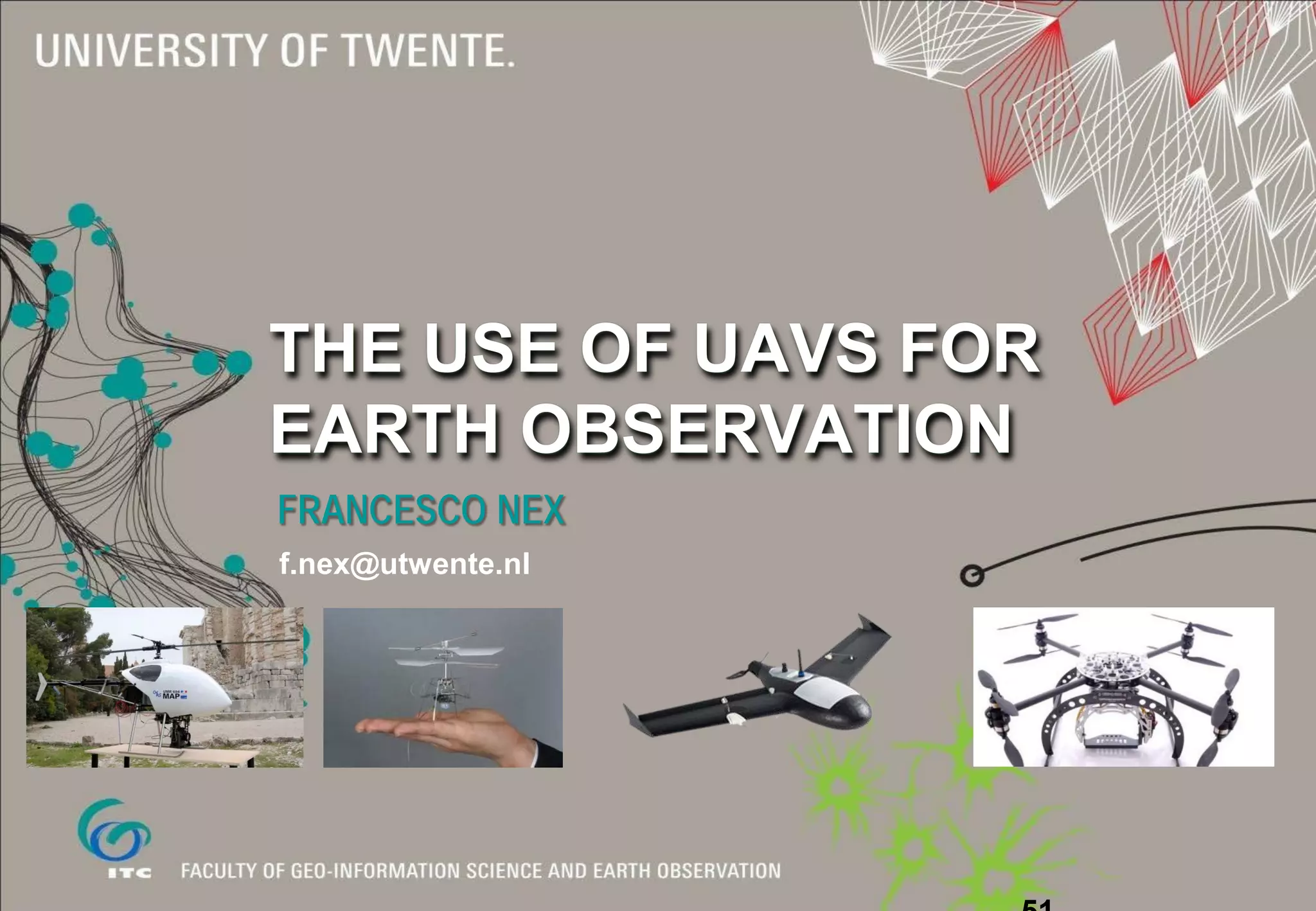
THE USE OF UAVS FOR
EARTH OBSERVATION
FRANCESCO NEX
f.nex@utwente.nl
Overview
 Why UAVs for Earth Observation?
 Unmanned Aerial Vehicles classification
 Photogrammetric pipeline with UAVs
 Current applications
 Conclusions and open issues
UAV diffusion
 In the last years, drones are
becoming new and popular
devices for many civil
applications
 The marked of drones has increased
in the last years and the outlook is
very bright
 Among all the civil applications of
drones, Earth Observation is one of
the most relevant
 Drones were initially conceived for military
applications
UAV for Earth Observation
 The potential of UAV for earth observation is obvious in terms of cost, handiness
and flexibility
 Contribution from different communities: photogrammetry, robotics, computer
vision, artificial intelligence, space domain, electronics, navigation, etc.
 Data processing is a combination of terrestrial & aerial techniques
 Possibility to extract 2D and 3D information from acquired images
[Neubronner, 1903] [Wester-Ebbinghaus, 1980][Whittlesley, 1970] [Eisenbeiss, 2004]
UAV for Earth Observation
 More common applications:
Urban monitoring (heat losses, change detection, city modelling, etc.)
General surveying and mapping
Environmental monitoring (fires, energy fluxes, natural hazards, etc.)
Archaeological documentation
Agriculture / forestry inventories and monitoring
 Some pros and cons:
 Possibility to fly everywhere and every time (regulation under creation)
 Flexibility in the installed sensors on board
 Reduced costs compared to traditional devices
 Technological and legislative problems and limitations are still existing…
after (Boehler, 2001)
0.1 m 1 m 10 m 100 m 1 km 10 km 100 km 1000 km
10 Mil
1 Mil
100 000
10 000
1 000
100
10
1
Object/SceneComplexity[points/object]
Object / Scene Size
Close-range
photogrammetry
and
terrestrial laser scanners
Aerial
photogrammetry
and LiDAR
Satellite
Remote Sensing
Tactile / CMM
Hand
measurements
Total stations
GNSS
UAV for 3D Data Recording
UAV
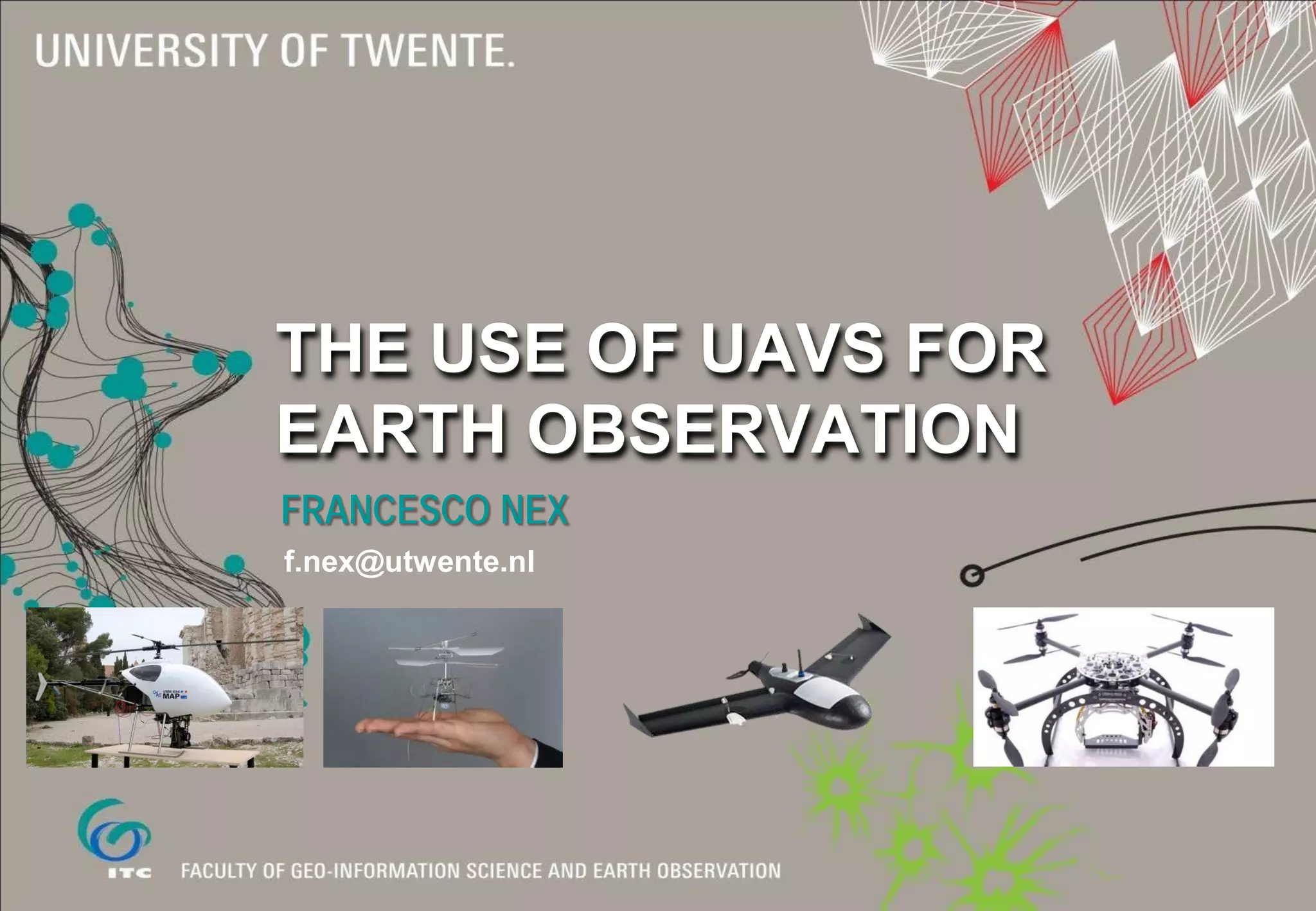
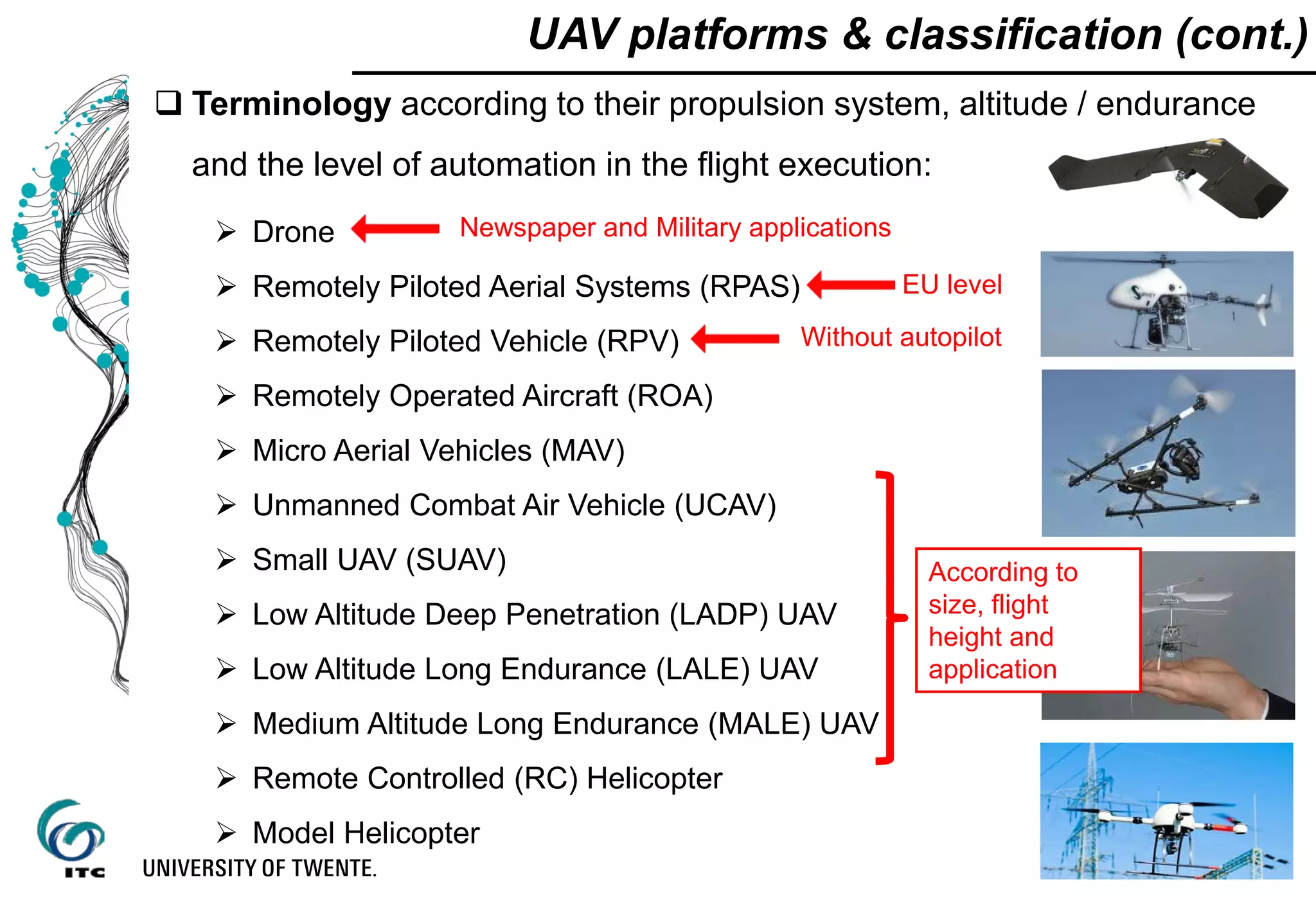
 Terminology according to their propulsion system, altitude / endurance
and the level of automation in the flight execution:
 Drone
 Remotely Piloted Aerial Systems (RPAS)
 Remotely Piloted Vehicle (RPV)
 Remotely Operated Aircraft (ROA)
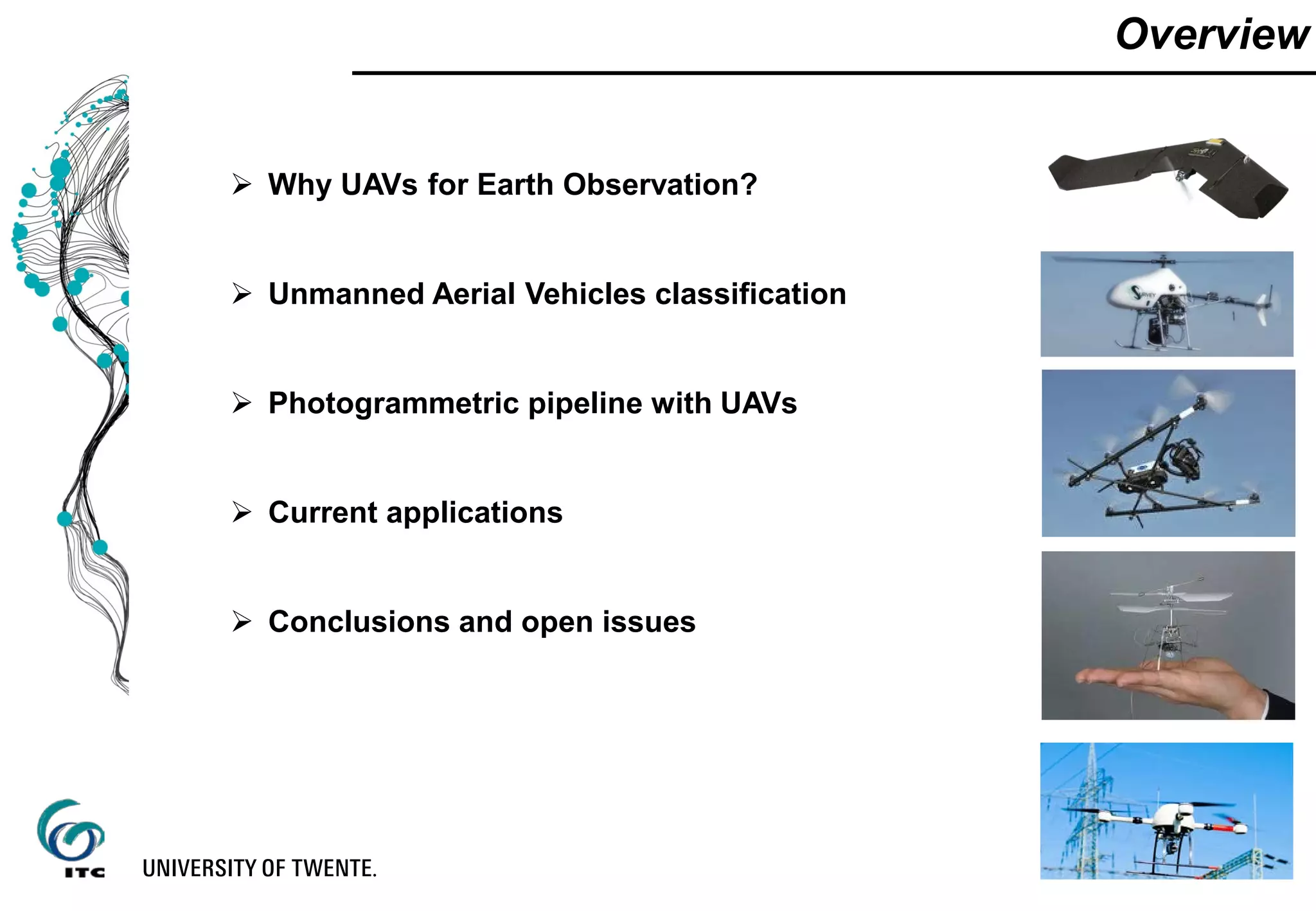
 Micro Aerial Vehicles (MAV)
 Unmanned Combat Air Vehicle (UCAV)
 Small UAV (SUAV)
 Low Altitude Deep Penetration (LADP) UAV
 Low Altitude Long Endurance (LALE) UAV
 Medium Altitude Long Endurance (MALE) UAV
 Remote Controlled (RC) Helicopter
 Model Helicopter
UAV platforms & classification (cont.)
EU level
Newspaper and Military applications
According to
size, flight
height and
application
Without autopilot
UAV platforms & classification (cont.)
Range [km]
Altitude[m]
1 10 100 1000 5000
100
1000
5000
10000
Micro
Mini
Close-range
Short-range
Low altitude endurance
Medium altitude
long endurance
High altitude
long endurance
[after Blyenburg, 1999]
UAV platforms & classification (cont.)
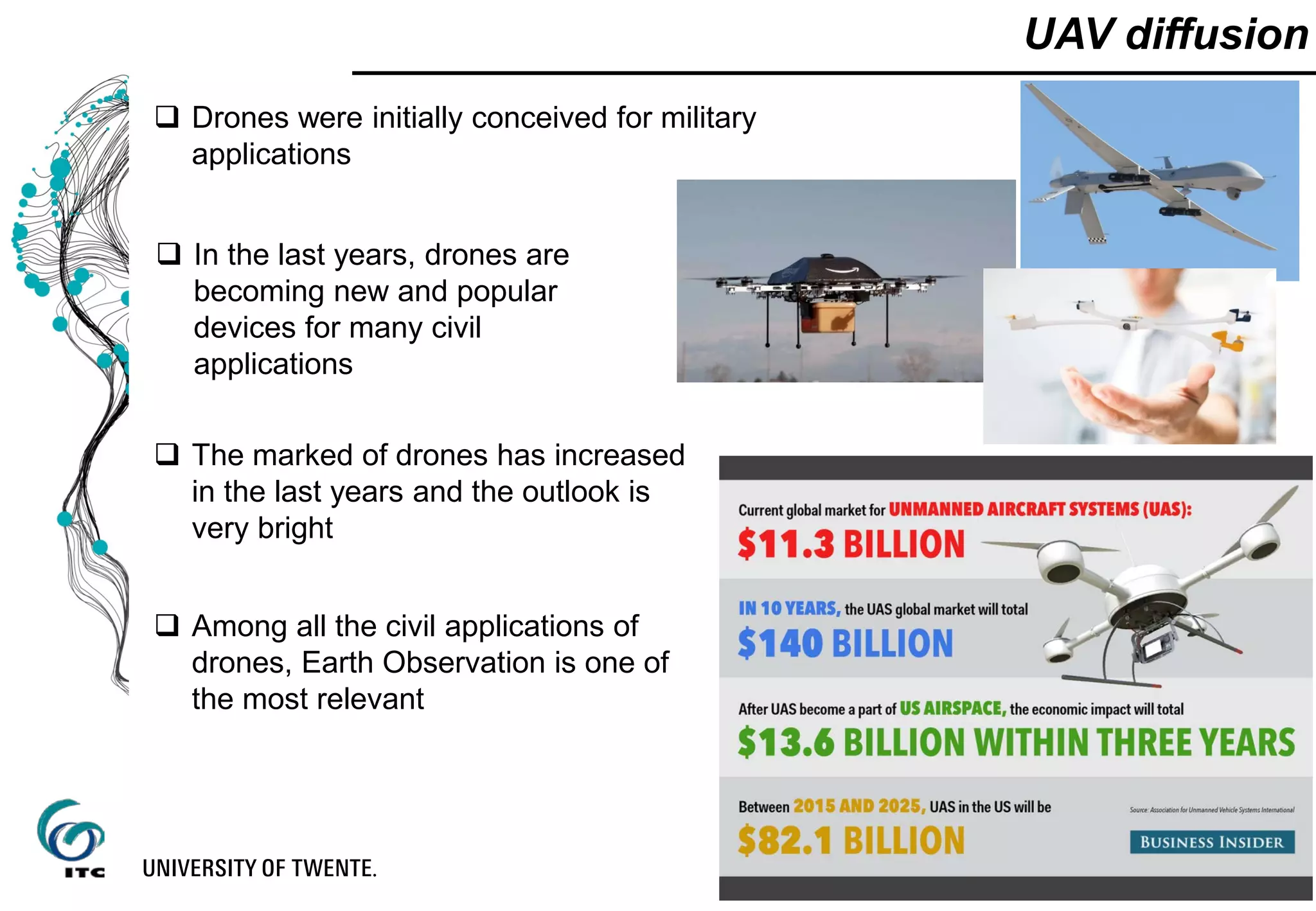
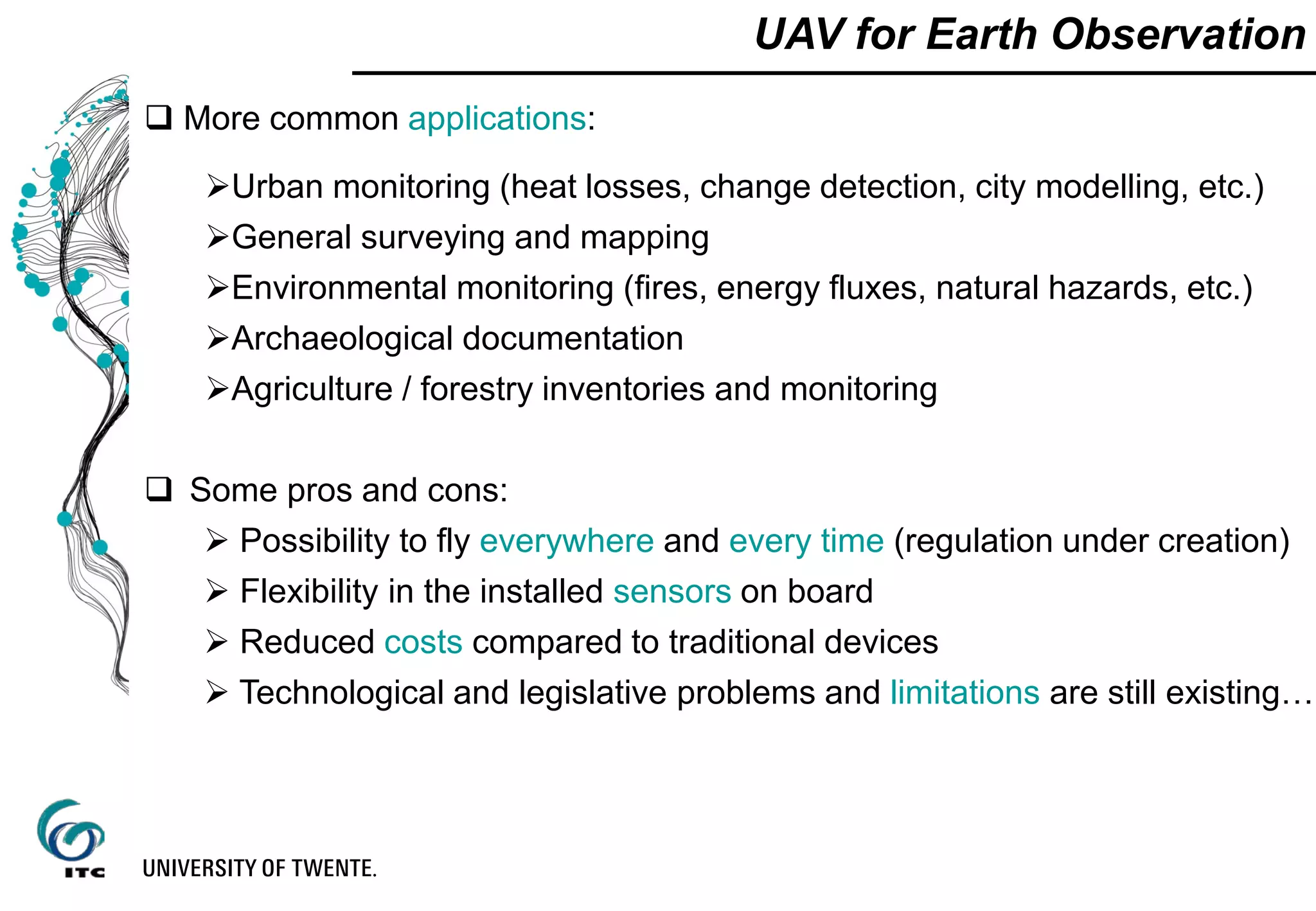
 For EO applications, UAV could be classified according to:
 Engine / propulsion:
 unpowered platforms, e.g. balloon, kite, glider, paraglide;
 powered platforms, e.g. airship, glider, propeller, electric, combustion
engine.
 Aerodynamic and “physical” features:
 lighter-than-air, e.g. balloon, airship
 rotary wing, either electric or with combustion engine, e.g. single-rotor,
coaxial, quadcopter, multi-rotor
 fixed wing, either unpowered, electric or with combustion engine, e.g.
glider or high wing
 Platforms equipped with navigation units on board, digital camera or
active sensors (laser scanner, Kinect, etc.)
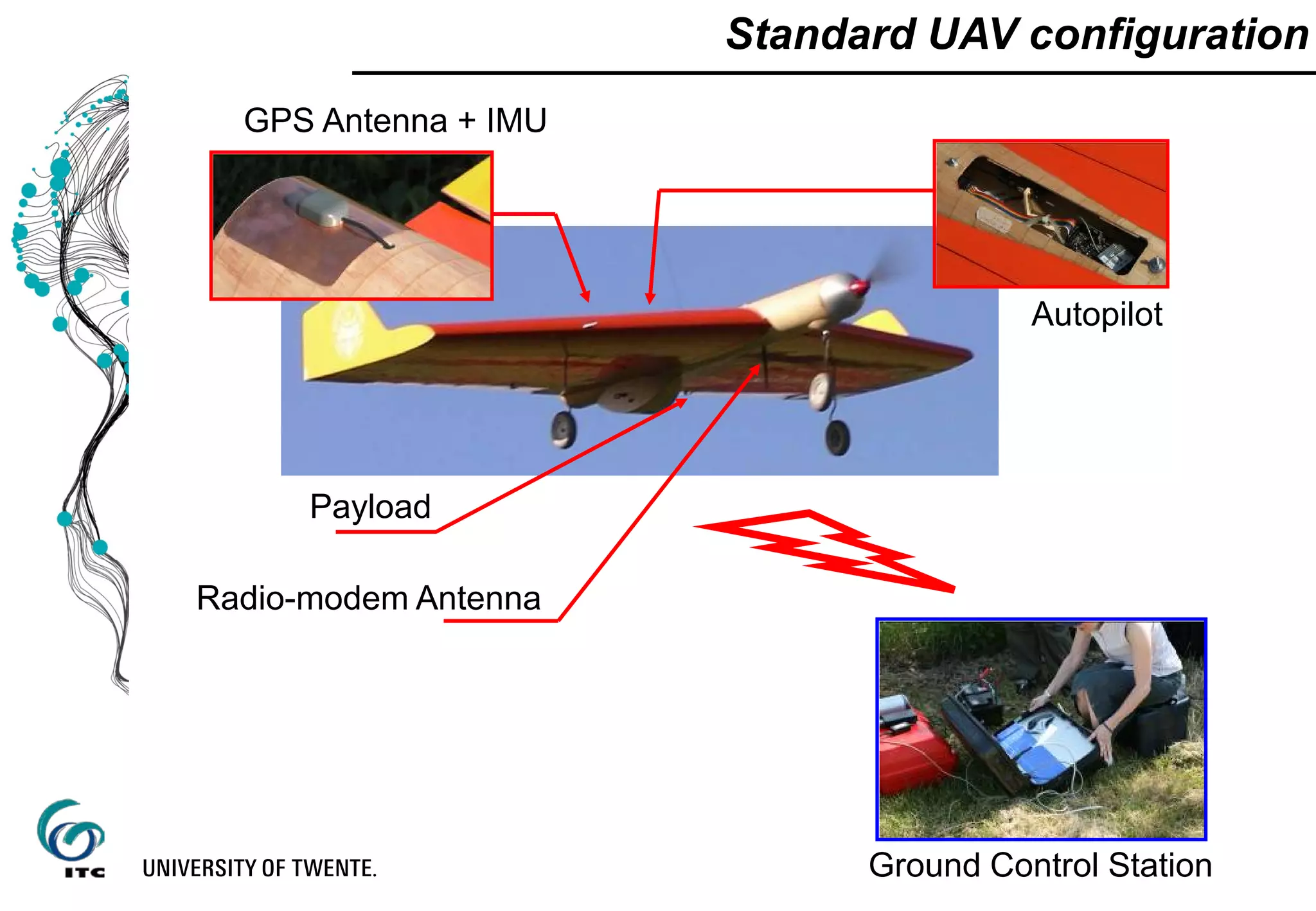
Autopilot
GPS Antenna + IMU
Radio-modem Antenna
Payload
Standard UAV configuration
Ground Control Station
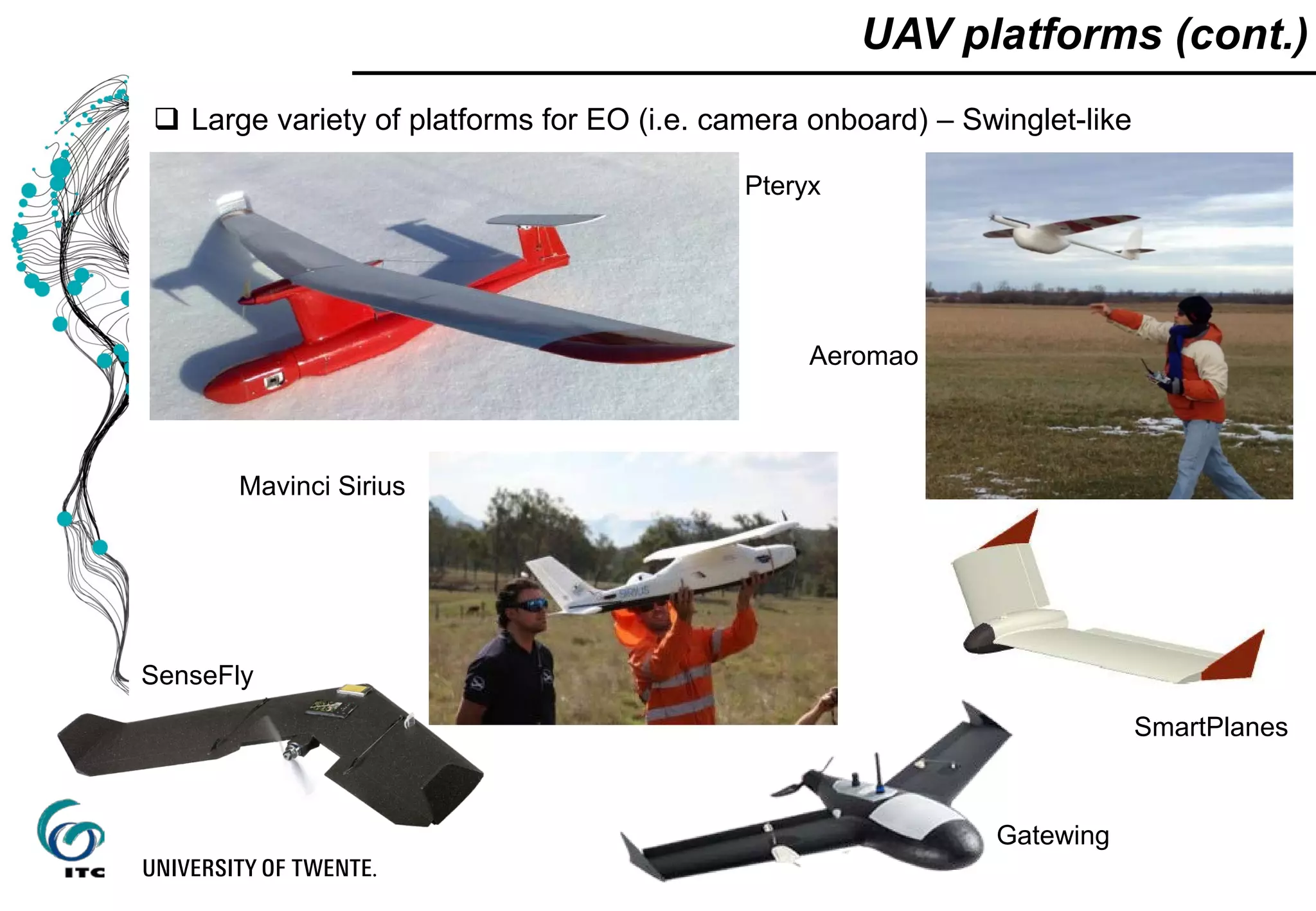
 Large variety of platforms for EO (i.e. camera onboard) – Swinglet-like
Aeromao
Pteryx
Gatewing
SenseFly
UAV platforms (cont.)
SmartPlanes
Mavinci Sirius
UAV platforms (cont.)
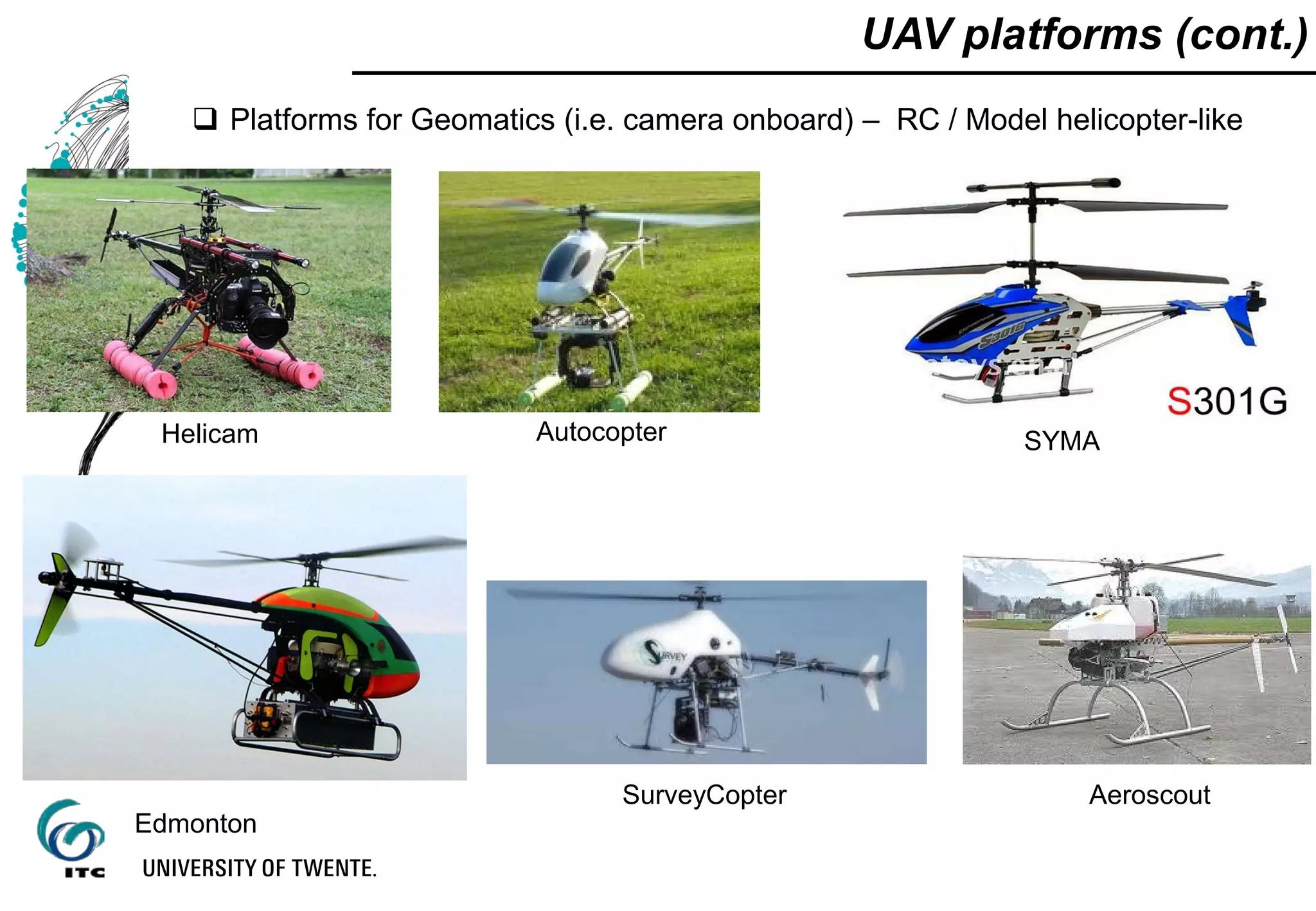
 Platforms for Geomatics (i.e. camera onboard) – RC / Model helicopter-like
Helicam Autocopter
Edmonton
SYMA
SurveyCopter Aeroscout
UAV platforms (cont.)
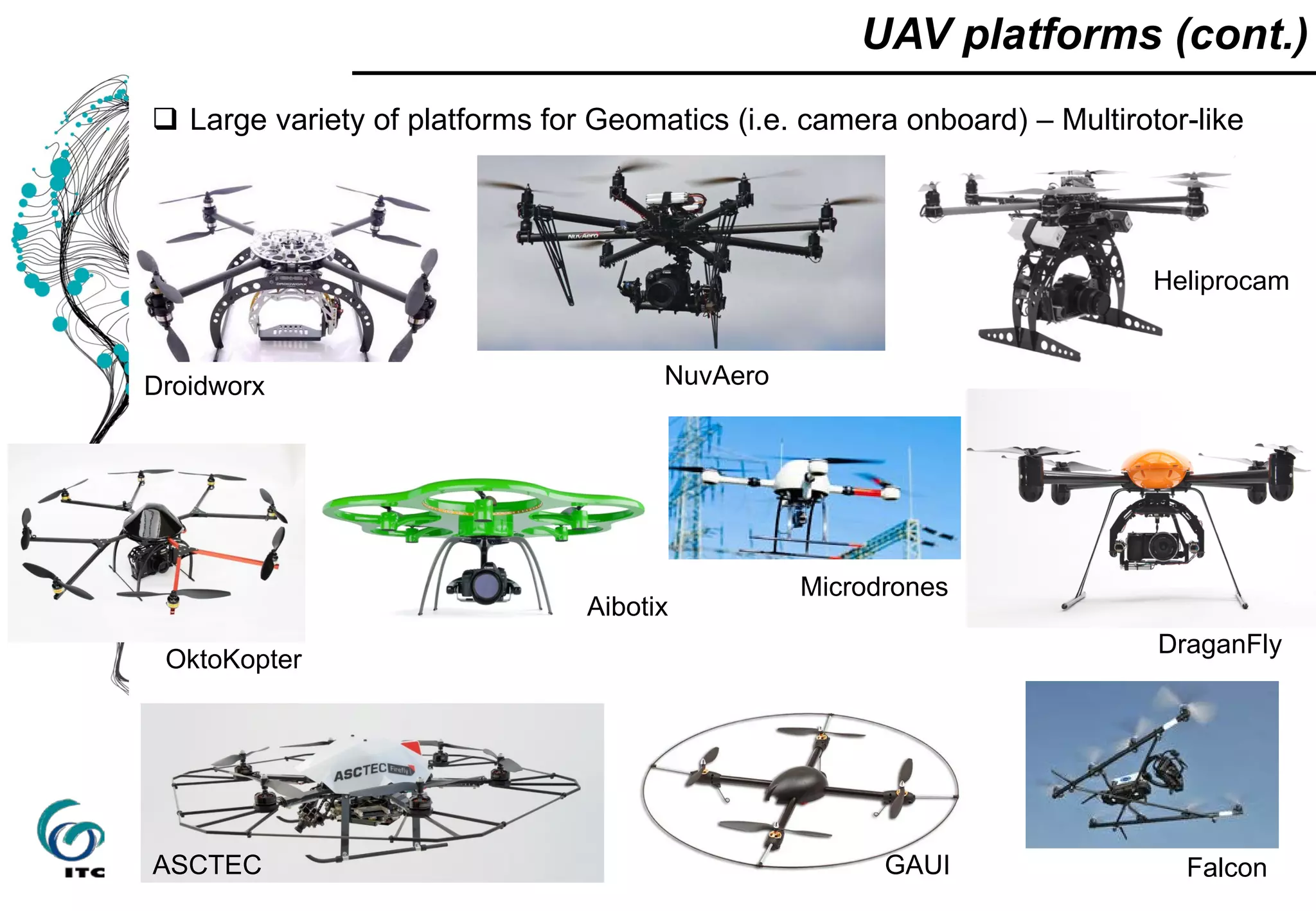
Droidworx
 Large variety of platforms for Geomatics (i.e. camera onboard) – Multirotor-like
DraganFly
OktoKopter
Aibotix
Heliprocam
NuvAero
GAUIASCTEC Falcon
Microdrones
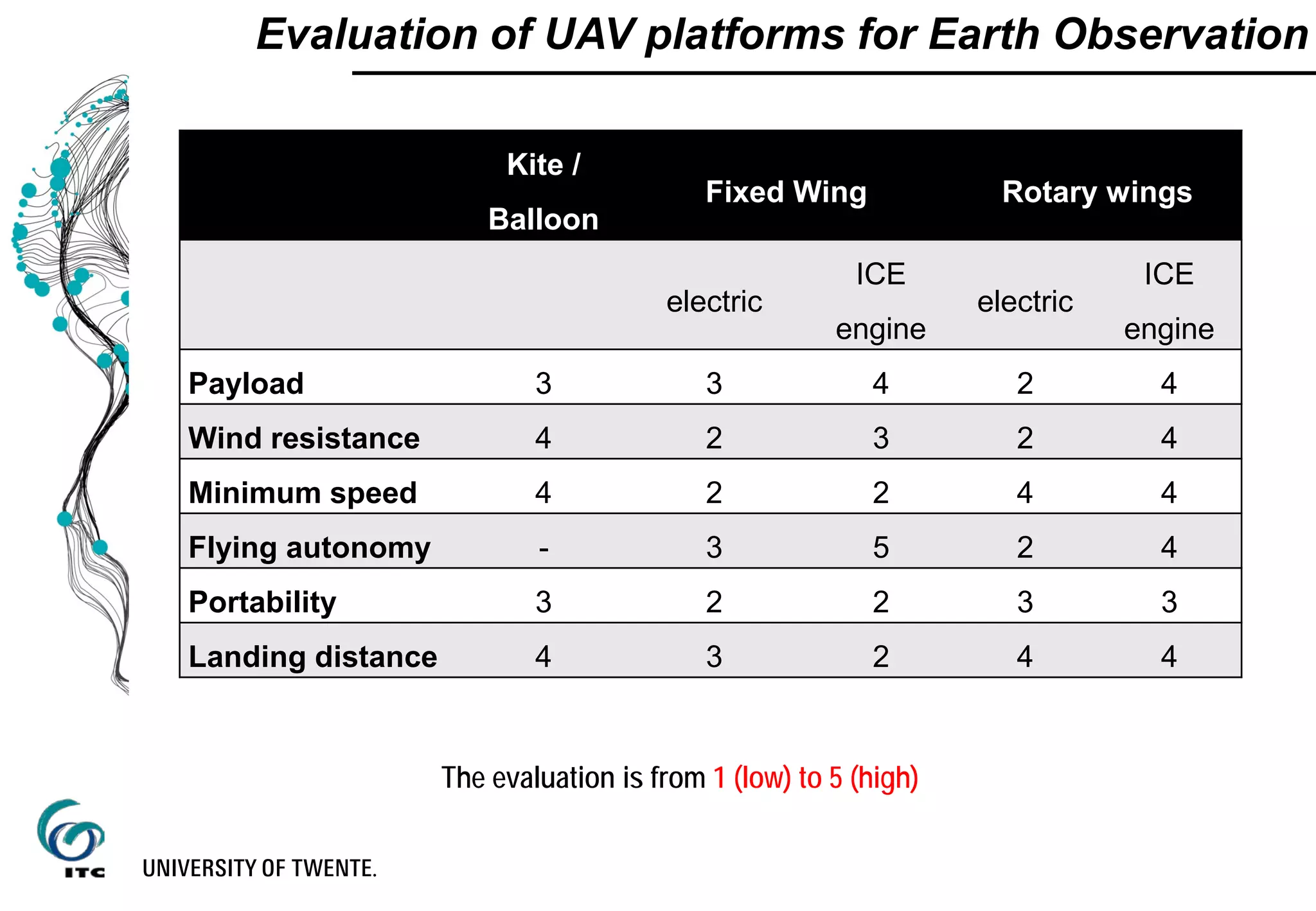
The evaluation is from 1 (low) to 5 (high)
Kite /
Balloon
Fixed Wing Rotary wings
electric
ICE
engine
electric
ICE
engine
Payload 3 3 4 2 4
Wind resistance 4 2 3 2 4
Minimum speed 4 2 2 4 4
Flying autonomy - 3 5 2 4
Portability 3 2 2 3 3
Landing distance 4 3 2 4 4
Evaluation of UAV platforms for Earth Observation
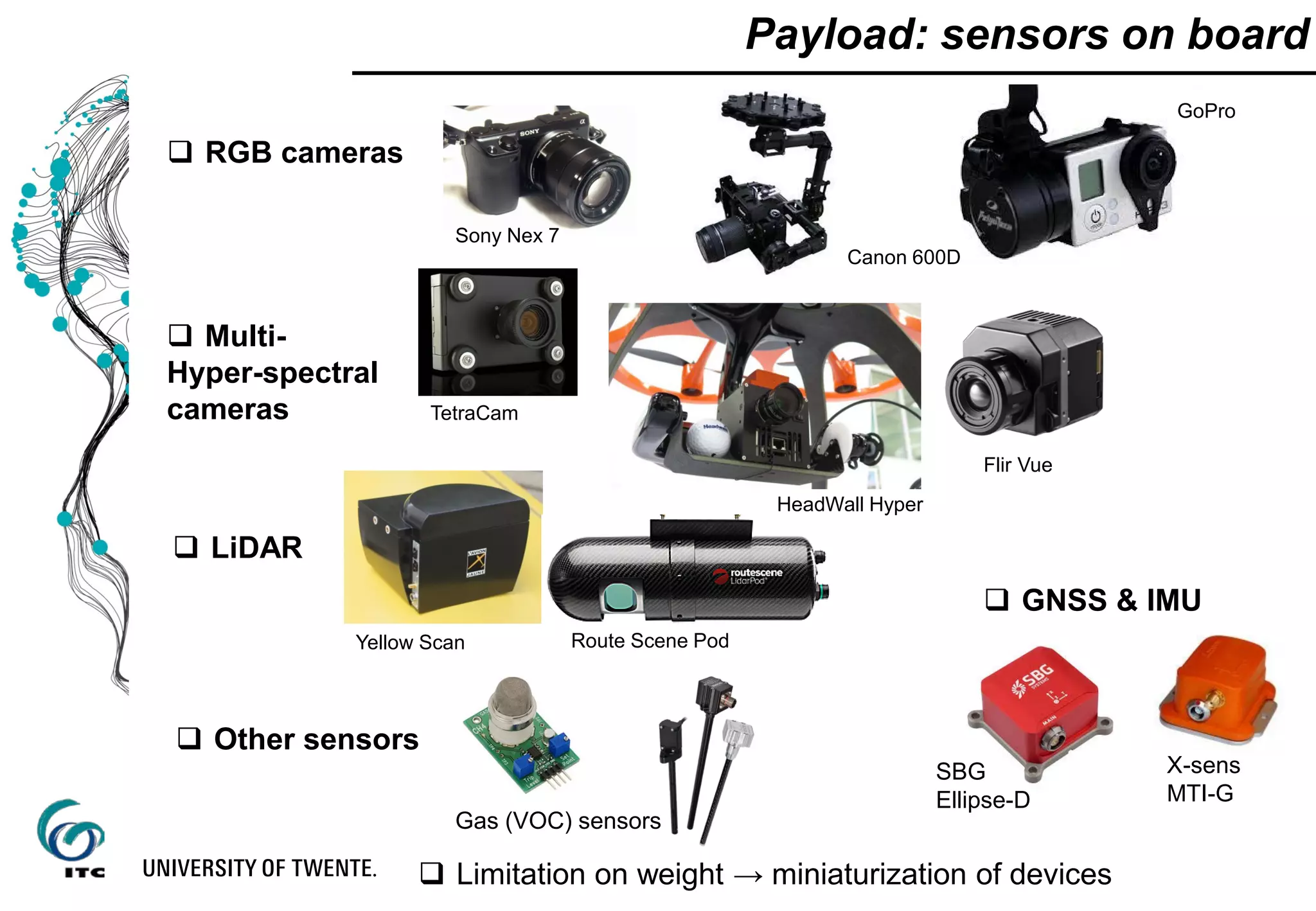
Payload: sensors on board
 RGB cameras
 Multi-
Hyper-spectral
cameras
 LiDAR
 Other sensors
Sony Nex 7
Canon 600D
GoPro
TetraCam
HeadWall Hyper
Flir Vue
Yellow Scan Route Scene Pod
Gas (VOC) sensors
 Limitation on weight → miniaturization of devices
 GNSS & IMU
SBG
Ellipse-D
X-sens
MTI-G
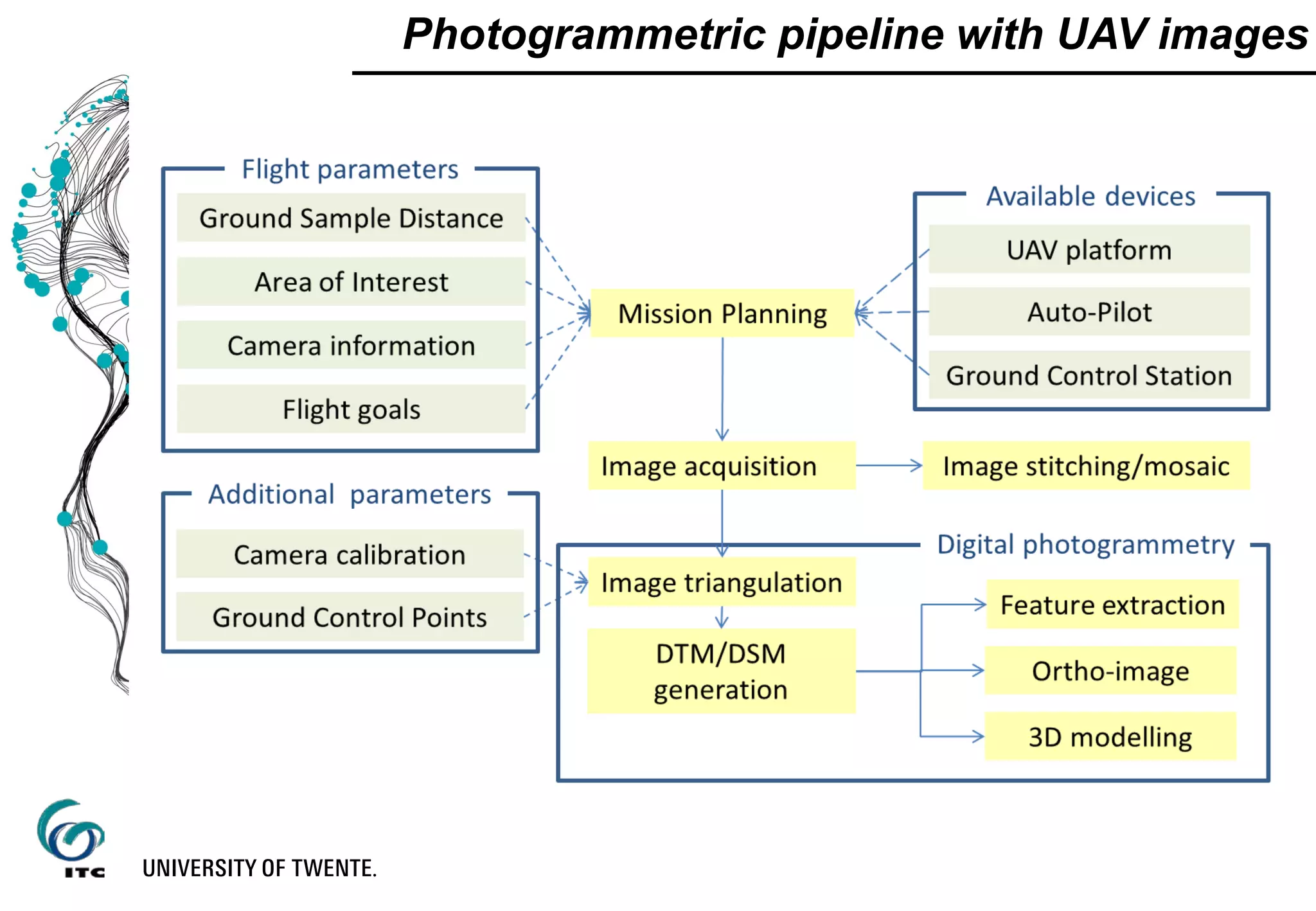
Photogrammetric pipeline with UAV images
 Flight planning (designing, requirements, system performances, etc.)
 Image acquisition (autonomous, manual, GSM-based, waypoint
navigation, etc.)
 Image triangulation & geo-referencing
 Dense point cloud and Digital Surface Model generation
 Ortho-image generation
 Feature extraction
[Architectural Image-based Modeling web portal - http://www.map.archi.fr/aibm/]
Photogrammetric pipeline with UAV images
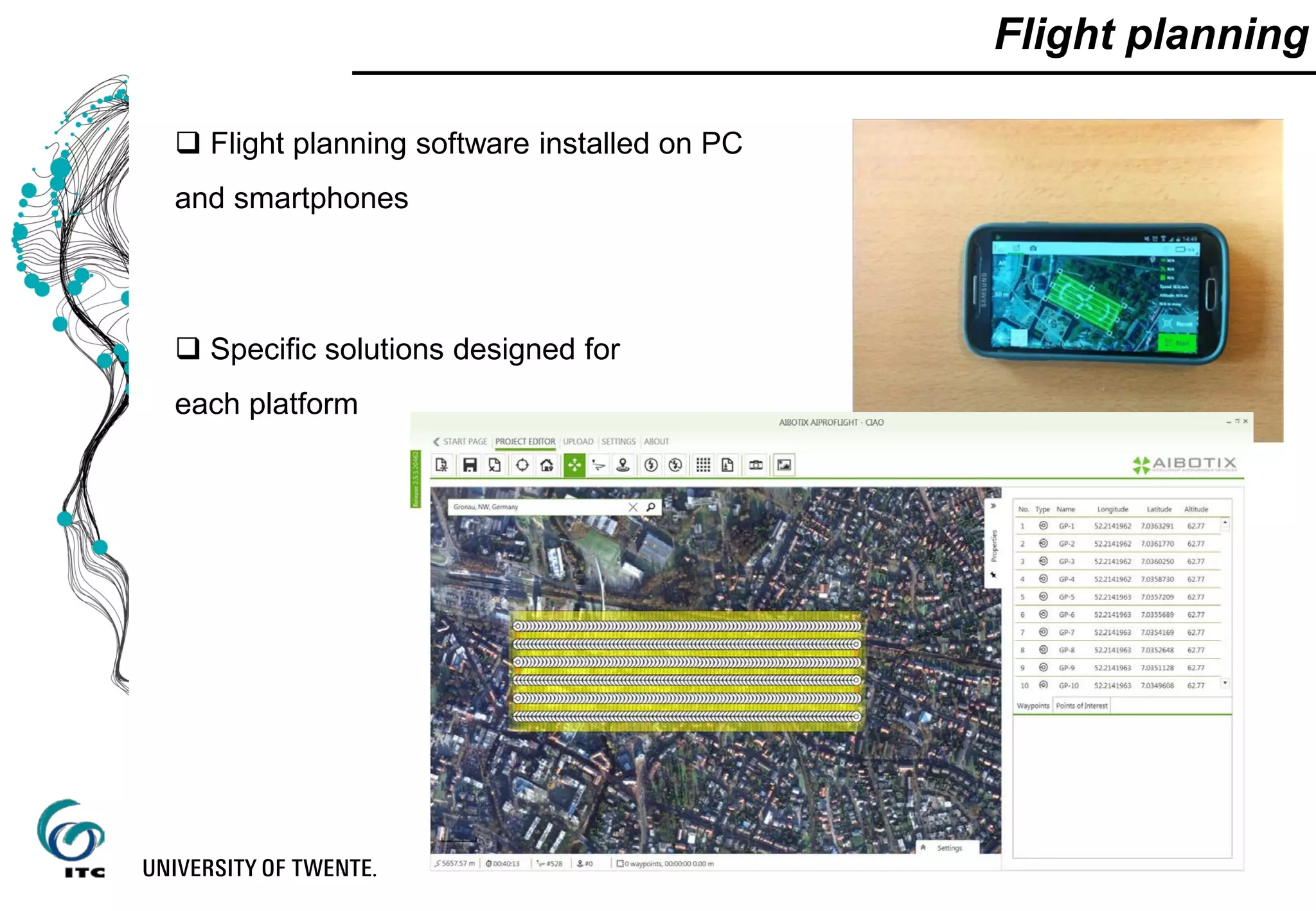
Flight planning
 Flight planning software installed on PC
and smartphones
 Specific solutions designed for
each platform
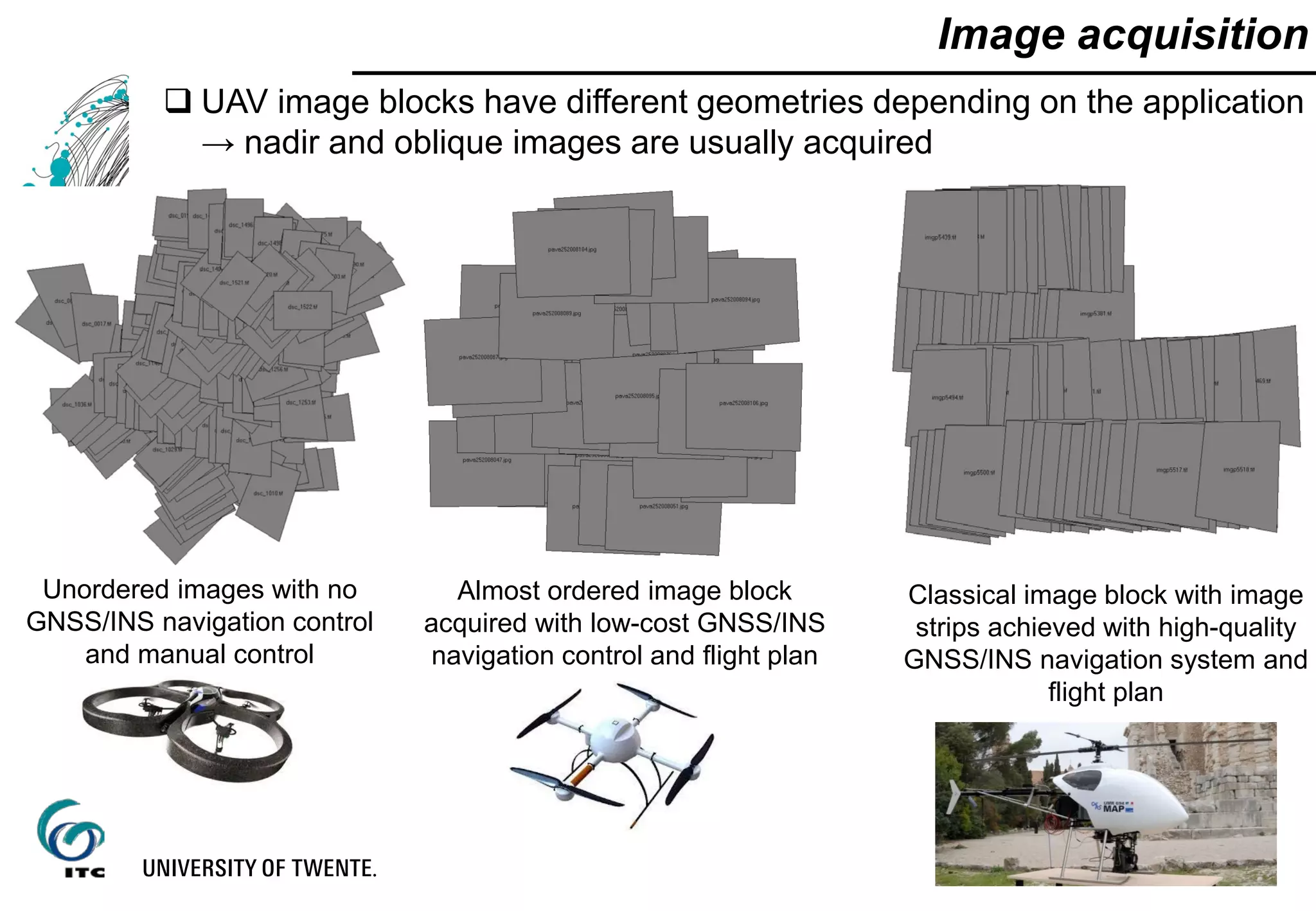
 UAV image blocks have different geometries depending on the application
→ nadir and oblique images are usually acquired
Image acquisition
Unordered images with no
GNSS/INS navigation control
and manual control
Almost ordered image block
acquired with low-cost GNSS/INS
navigation control and flight plan
Classical image block with image
strips achieved with high-quality
GNSS/INS navigation system and
flight plan
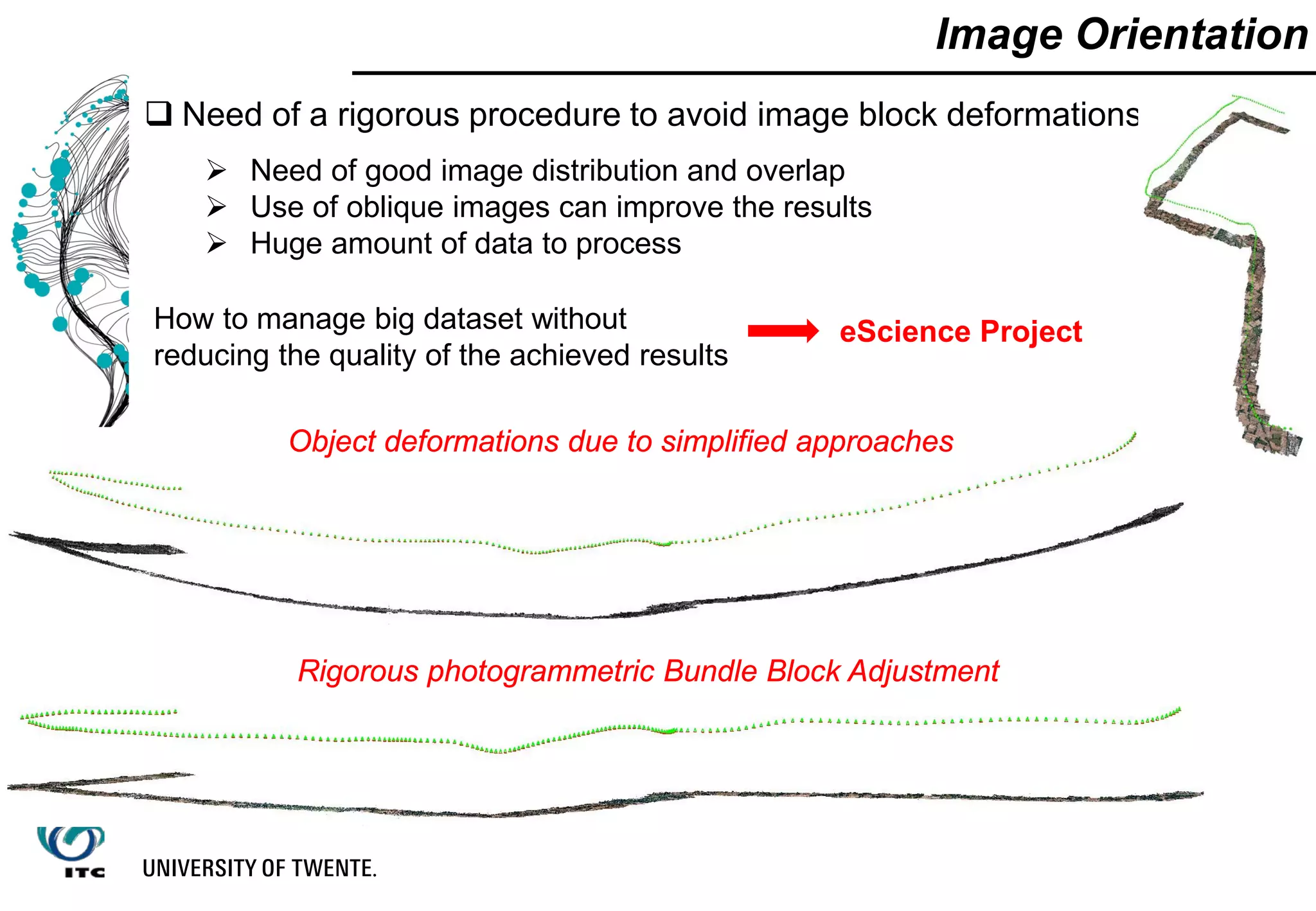
 Need of a rigorous procedure to avoid image block deformations
 Need of good image distribution and overlap
 Use of oblique images can improve the results
 Huge amount of data to process
Image Orientation
Object deformations due to simplified approaches
Rigorous photogrammetric Bundle Block Adjustment
How to manage big dataset without
reducing the quality of the achieved results
eScience Project
 Direct geo-referencing
 Need very good GNSS/INS observations
 High-cost navigation sensors needed
 Not sufficient with very high resolution images (<1 cm)
 Possible use of GNSS or total station to track / follow the
UAV [Blaha, 2011]
Image orientation - georeferencing
 GNSS / INS observations
 Helpful to assist the identification of
homologous points [Barazzetti el al., 2011]
 Can provide a first scale and georeferencing
image
connection
 Ground control points (GCP)
 When high accuracy is needed
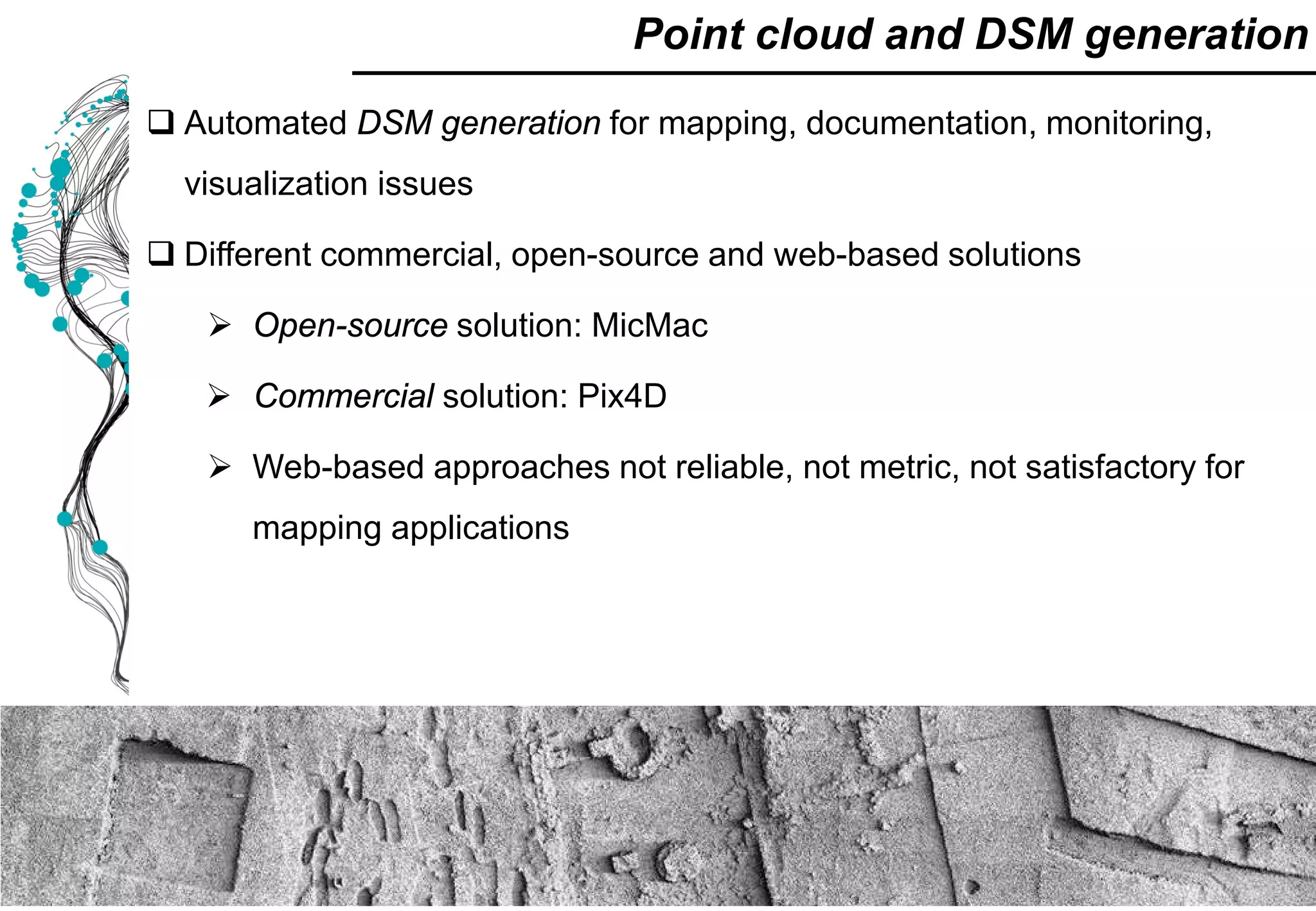
 Automated DSM generation for mapping, documentation, monitoring,
visualization issues
 Different commercial, open-source and web-based solutions
 Open-source solution: MicMac
 Commercial solution: Pix4D
 Web-based approaches not reliable, not metric, not satisfactory for
mapping applications
Point cloud and DSM generation
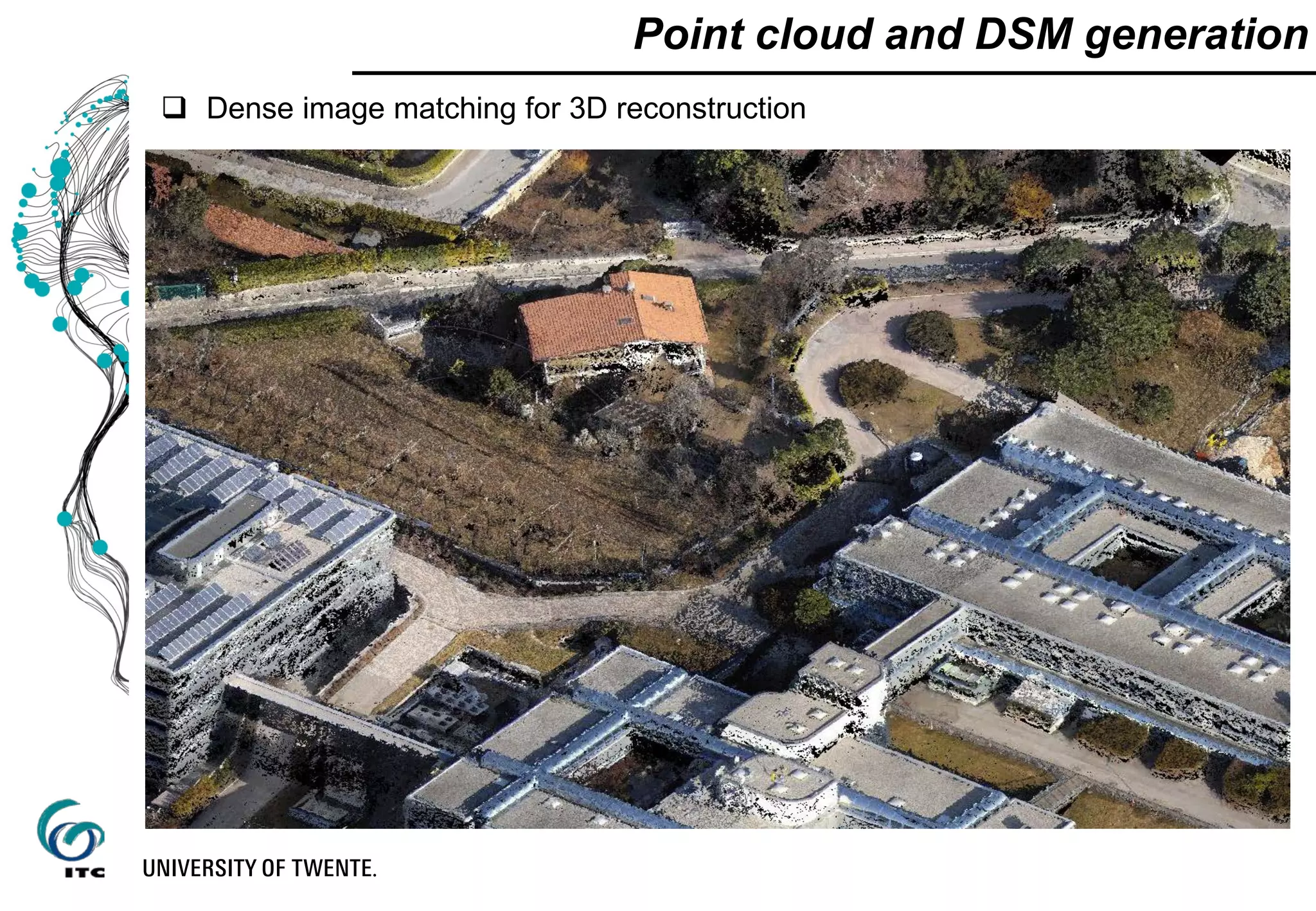
 Dense image matching for 3D reconstruction
Urban applications - TrentoPoint cloud and DSM generation
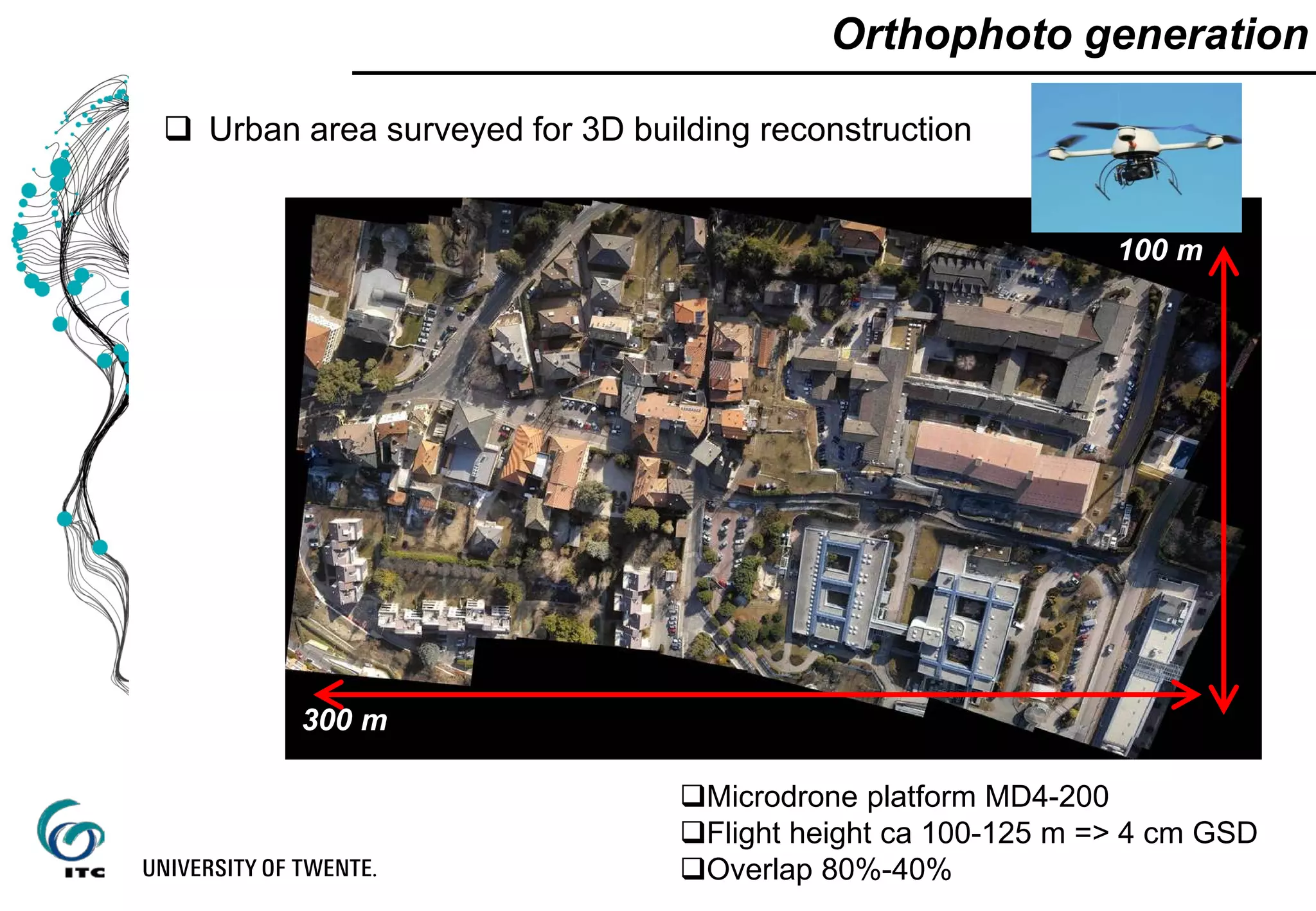
100 m
300 m
 Urban area surveyed for 3D building reconstruction
Urban applications - TrentoOrthophoto generation
Microdrone platform MD4-200
Flight height ca 100-125 m => 4 cm GSD
Overlap 80%-40%
Time effort in UAV-based photogrammetric workflow
[Nex and Remondino, 2014]
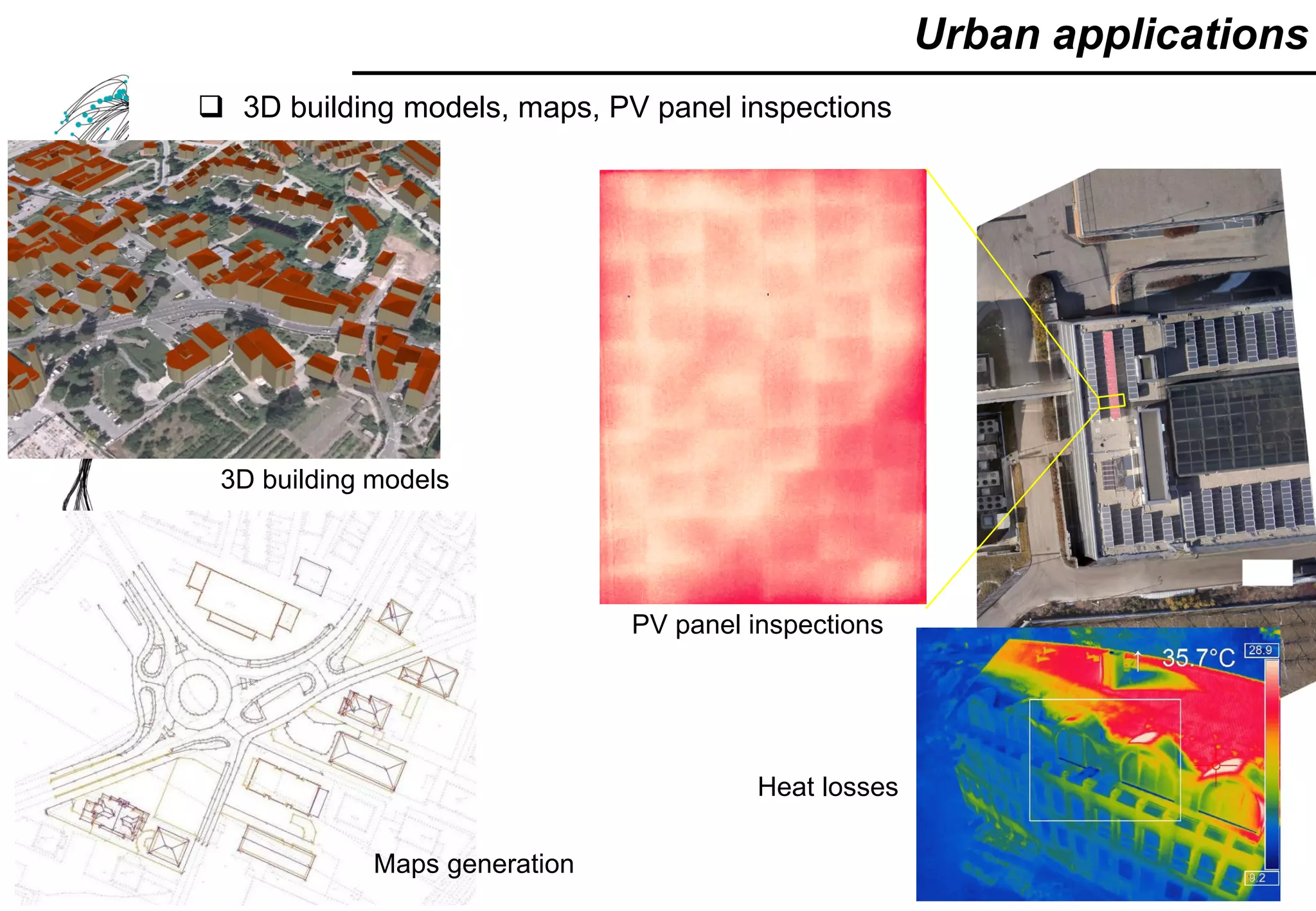
Urban applications
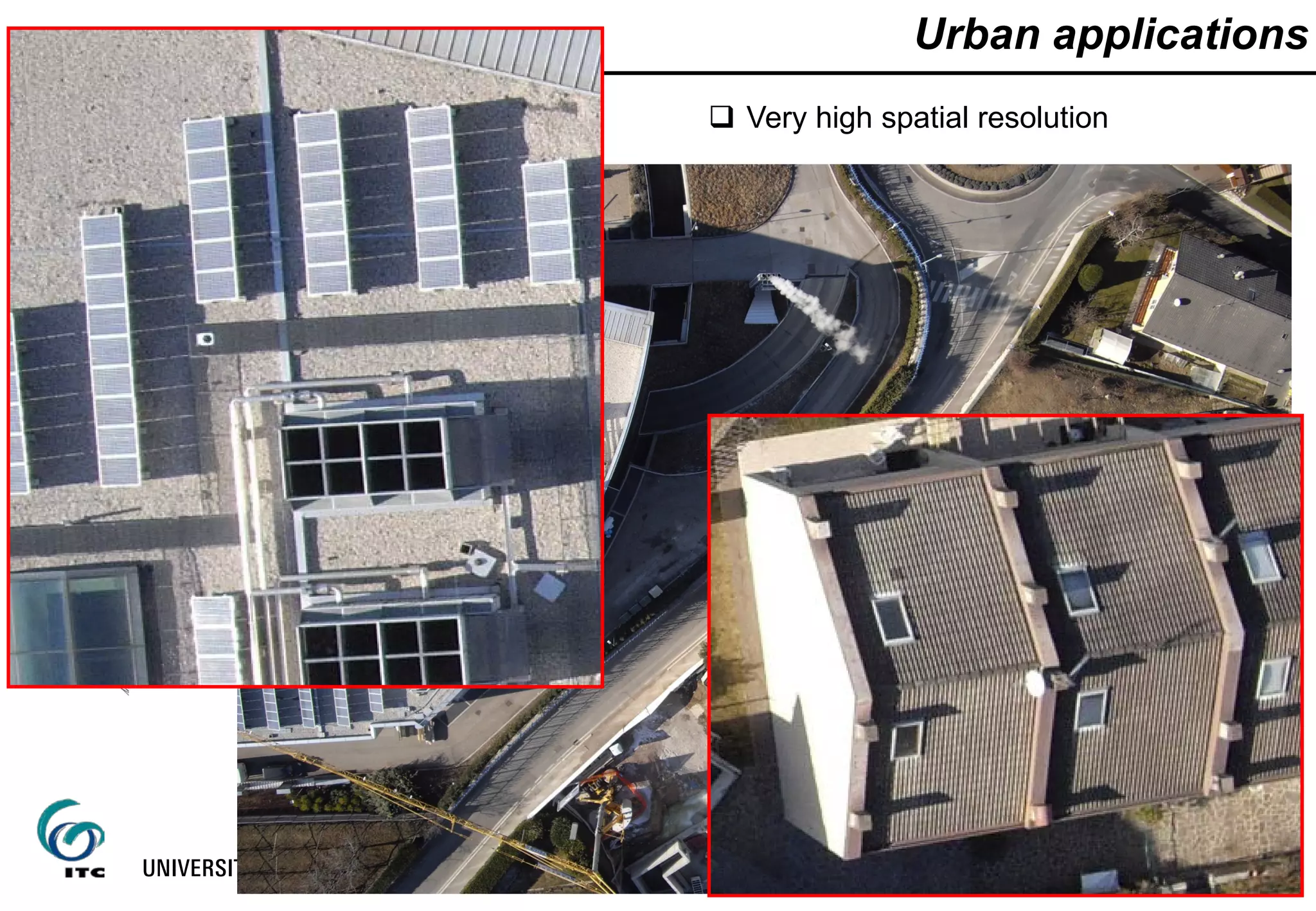
 Very high spatial resolution
 3D building models, maps, PV panel inspections
Urban applications
PV panel inspections
3D building models
Maps generation
Heat losses
 Interactive system to check the PV potential of building roofs
 High resolution → reconstruction of building installations (i.e. chimneys, etc.)
Urban applications – Solar potential
[Nex et al., 2013]
Quick map generation and updating
Large UAV block (Kigali, Rwanda)
 18000 UAV images
 3 cm GSD resolution
 80% along track overlap
 40% across track overlap
[source: Gevaert – UT, ITC]
Improving Open-Source
Photogrammetric Workflows for
Processing Big Datasets
eScience Project
Quick map generation and updating
 Change detection and map updating in new built areas
Semi-automated
methodologies to reduce field
work and map generation
[Muneza, 2015 – UT, ITC Master Thesis]
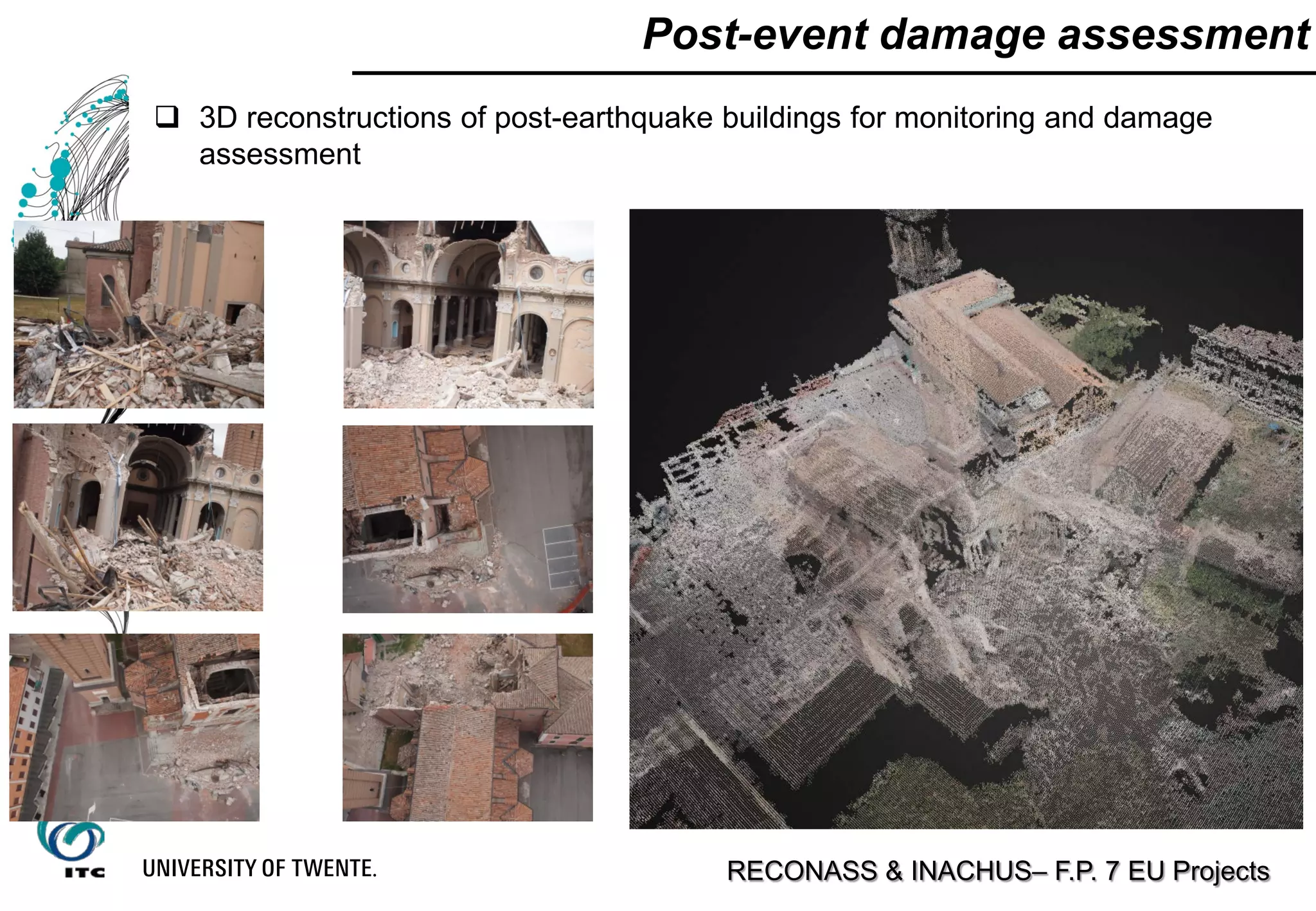
 3D reconstructions of post-earthquake buildings for monitoring and damage
assessment
Post-event damage assessment
RECONASS & INACHUS– F.P. 7 EU Projects
Post-event damage assessment
RECONASS & INACHUS– F.P. 7 EU Projects
 3D reconstructions of post-earthquake buildings for monitoring and damage
assessment
 Automated damage
assessment
[Vetrivel et al., 2015]
Post-event damage assessment
DSM
ORTHOPHOTO
SEGMENTATION
URBAN CLASSIFICATION
[Nex et al., 2014]
 Damage assessment on large urban areas
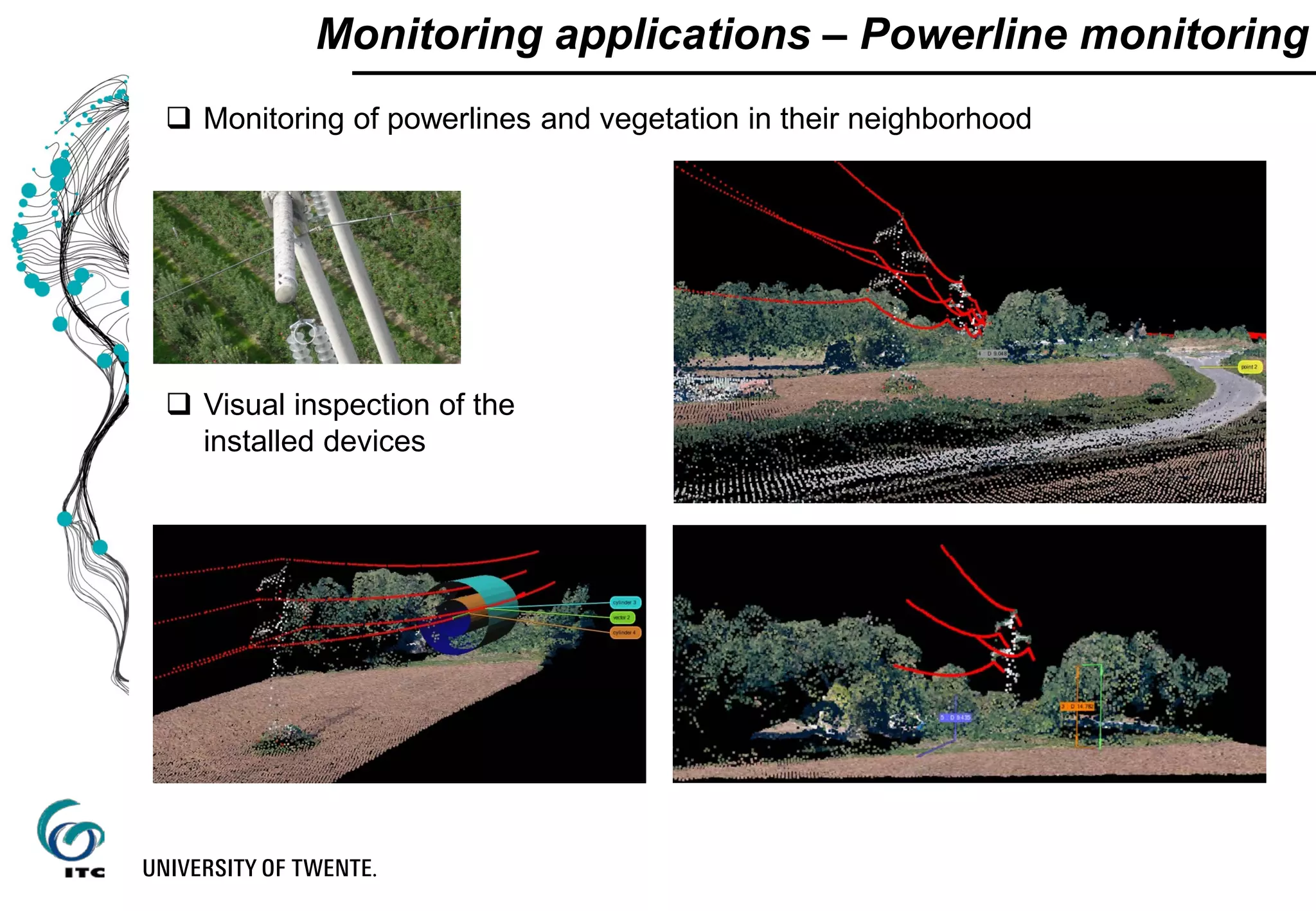
Monitoring applications – Powerline monitoring
 Monitoring of powerlines and vegetation in their neighborhood
 Visual inspection of the
installed devices
[Tournandre et al., 2015]
Monitoring applications - Dykes monitoring
 Accurate monitoring of surface changes every year
Monitoring applications - Construction sites
 Multi-temporal data acquisition to
monitor the construction site
progresses
 Acquired image blocks can be
automatically co-registered together
 Very high dense DSM are generated
for each flight
[Nyapwere, 2015 – UT, ITC Master thesis]
 Multi-temporal data acquisition to
monitor the construction site
progresses
 Generated DSMs can be
automatically aligned together
 Very high dense DSM can be
generated from each flight
 An orthophoto and a 3D mesh
can be automatically generated
using the same dataset
Monitoring applications - Construction site
[Nyapwere, 2015 – UT, ITC Master thesis]
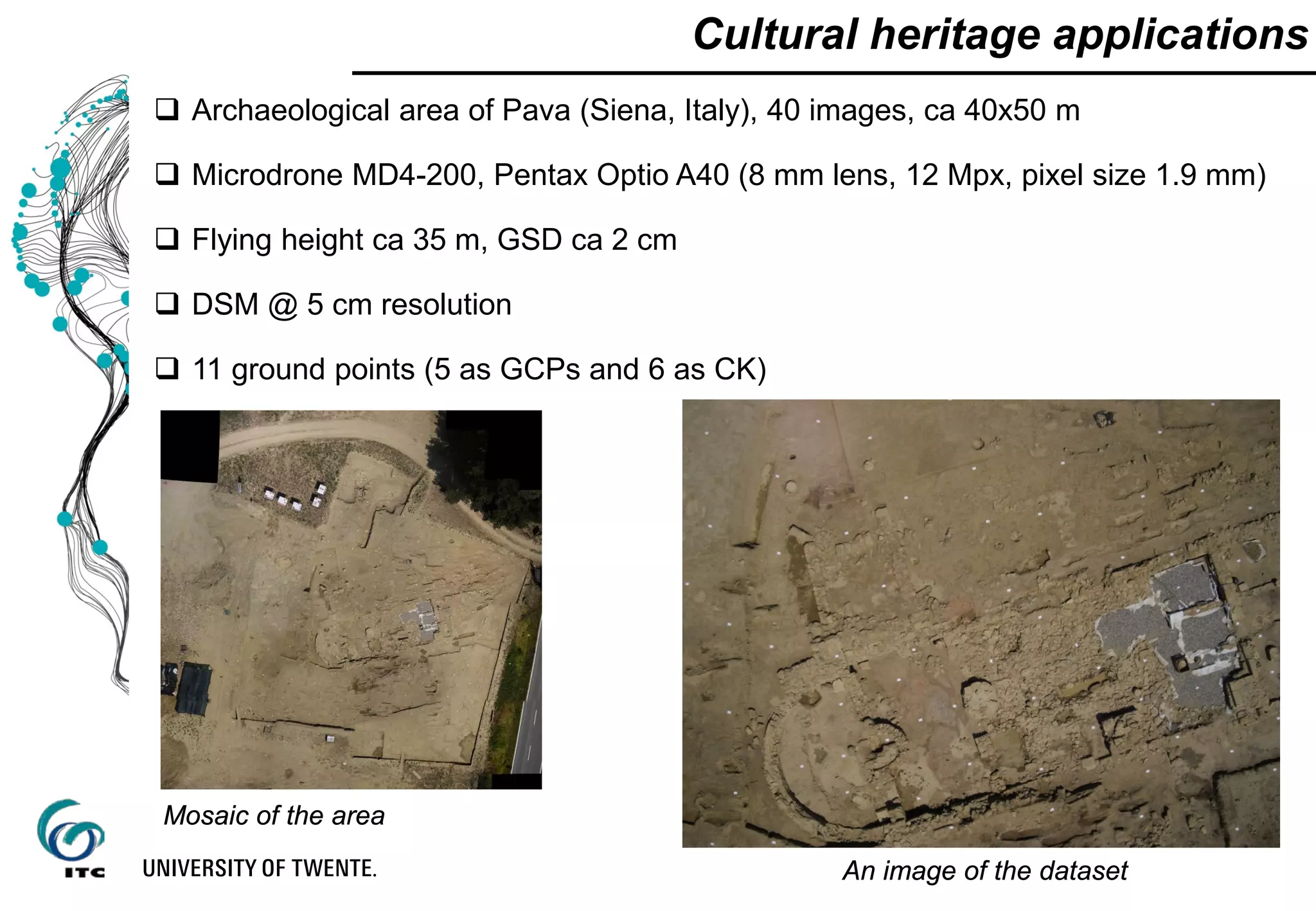
 Archaeological area of Pava (Siena, Italy), 40 images, ca 40x50 m
 Microdrone MD4-200, Pentax Optio A40 (8 mm lens, 12 Mpx, pixel size 1.9 mm)
 Flying height ca 35 m, GSD ca 2 cm
 DSM @ 5 cm resolution
 11 ground points (5 as GCPs and 6 as CK)
Cultural heritage applications
Mosaic of the area
An image of the dataset
Cultural Heritage applications – multi-temporal
 Multi-temporal flights over the area – DSM comparisons to map / compute
excavation volumes
[Nex and Remondino, 2014]
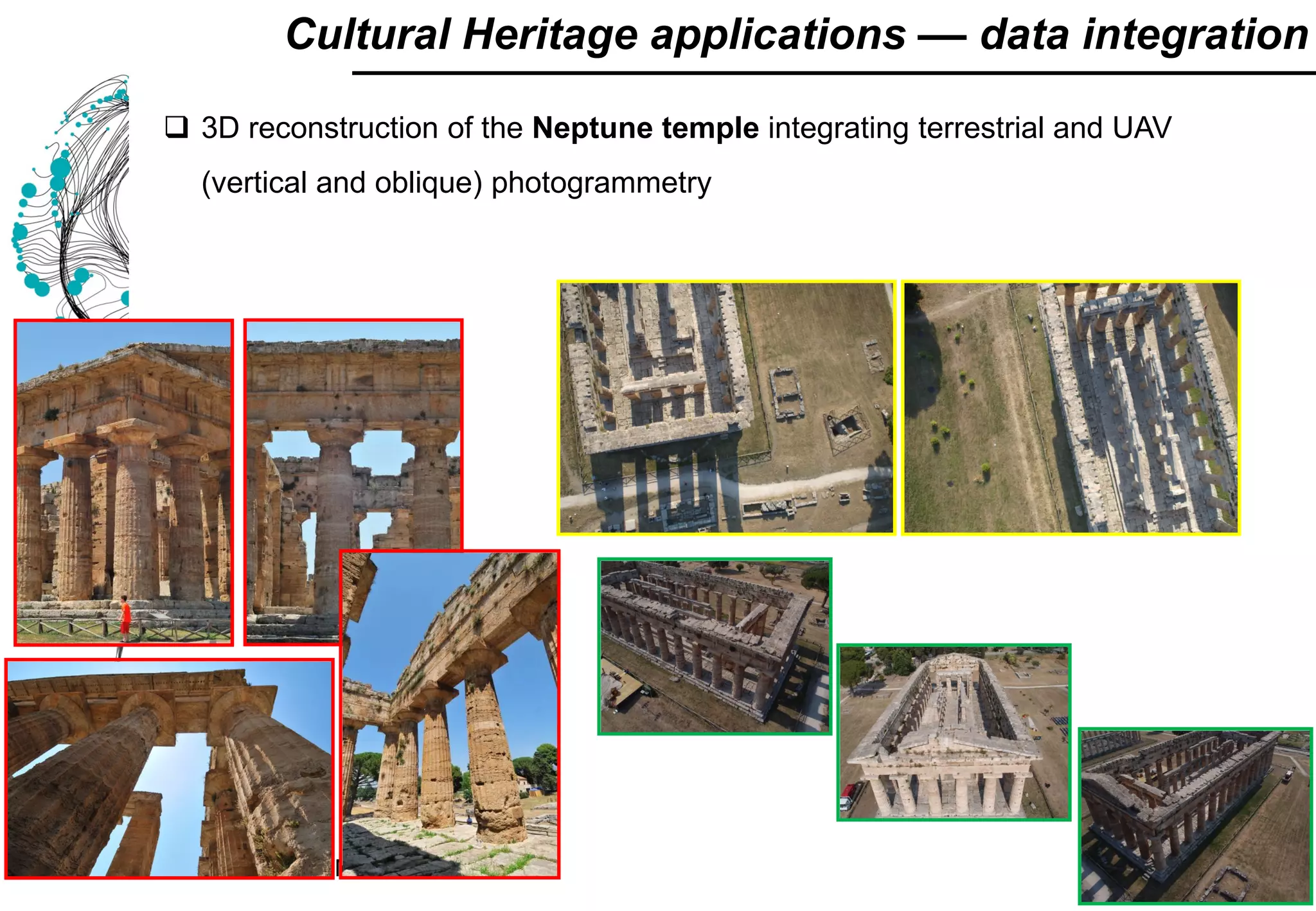
 3D reconstruction of the Neptune temple integrating terrestrial and UAV
(vertical and oblique) photogrammetry
Cultural Heritage applications –– data integration
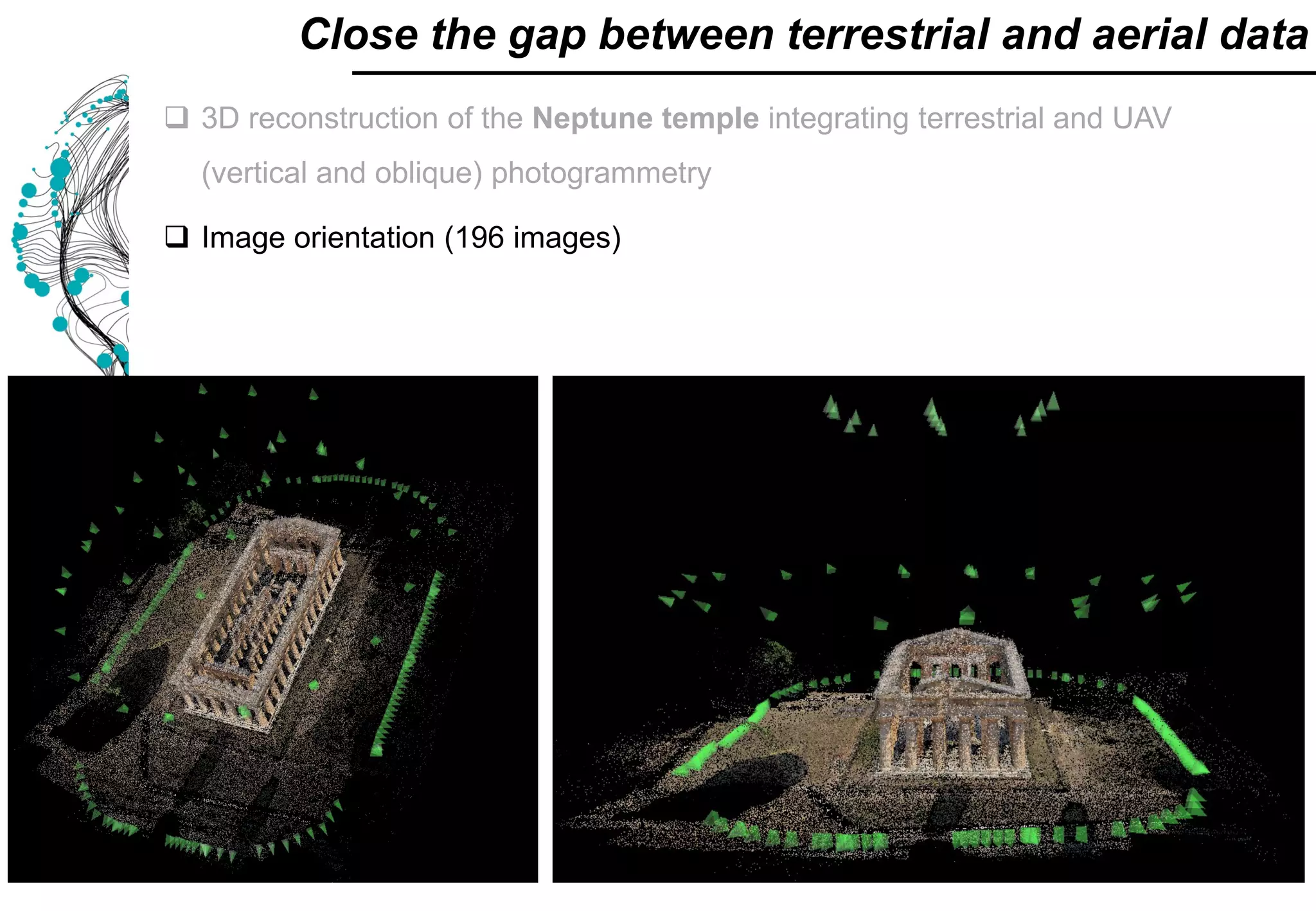
 3D reconstruction of the Neptune temple integrating terrestrial and UAV
(vertical and oblique) photogrammetry
 Image orientation (196 images)
Close the gap between terrestrial and aerial data
 3D reconstruction of the Neptune temple integrating terrestrial terrestrial and
UAV (vertical and oblique) photogrammetry
 Image orientation (196 images)
 3D model generation
Close the gap between terrestrial and aerial data
[Nex and Remondino, 2014]
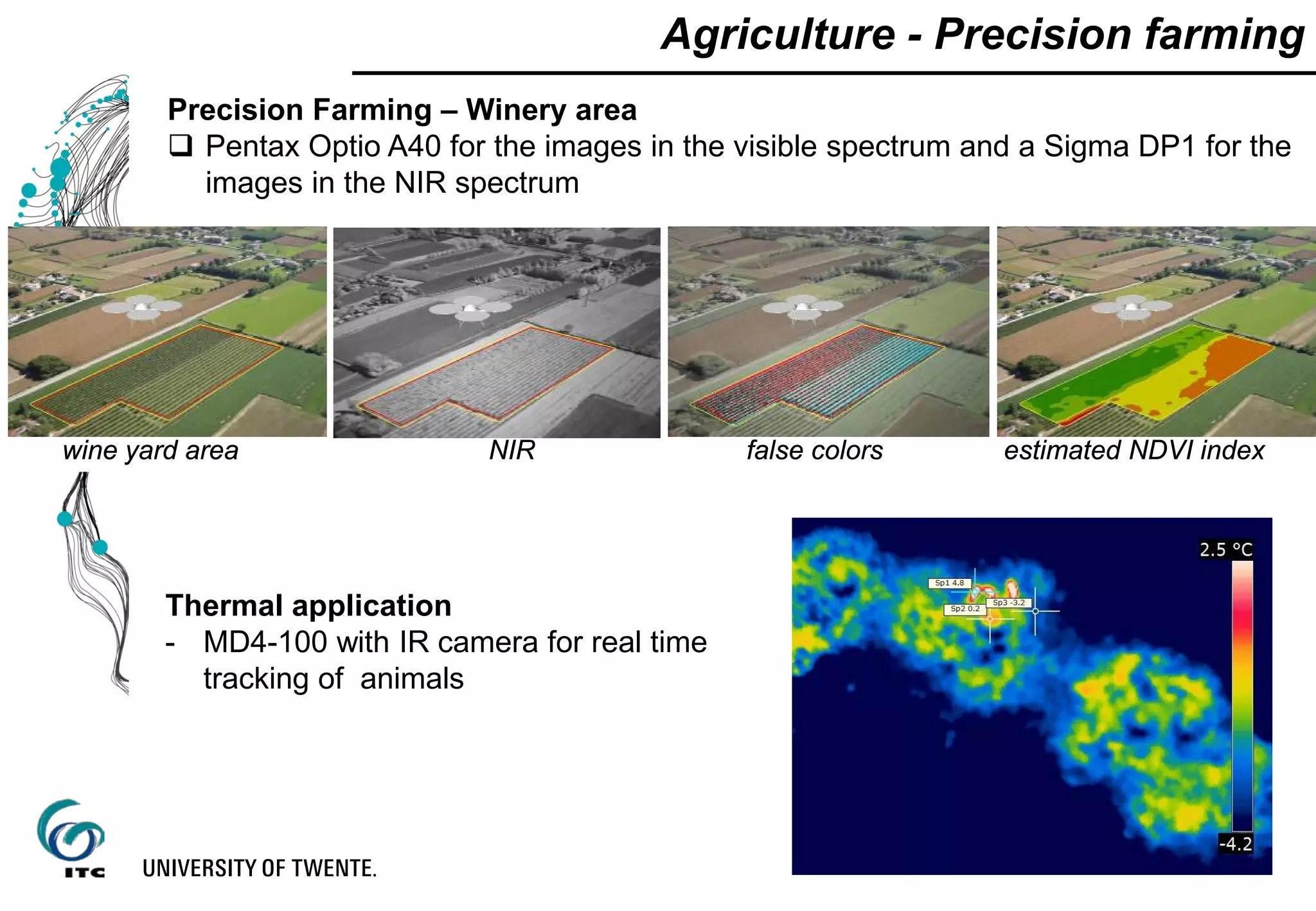
Agriculture - Precision farming
Precision Farming – Winery area
 Pentax Optio A40 for the images in the visible spectrum and a Sigma DP1 for the
images in the NIR spectrum
NIRwine yard area false colors estimated NDVI index
Thermal application
- MD4-100 with IR camera for real time
tracking of animals
 Biomass estimation
Forestry
 Forest inventory
[source GreenValley and Aibotix]
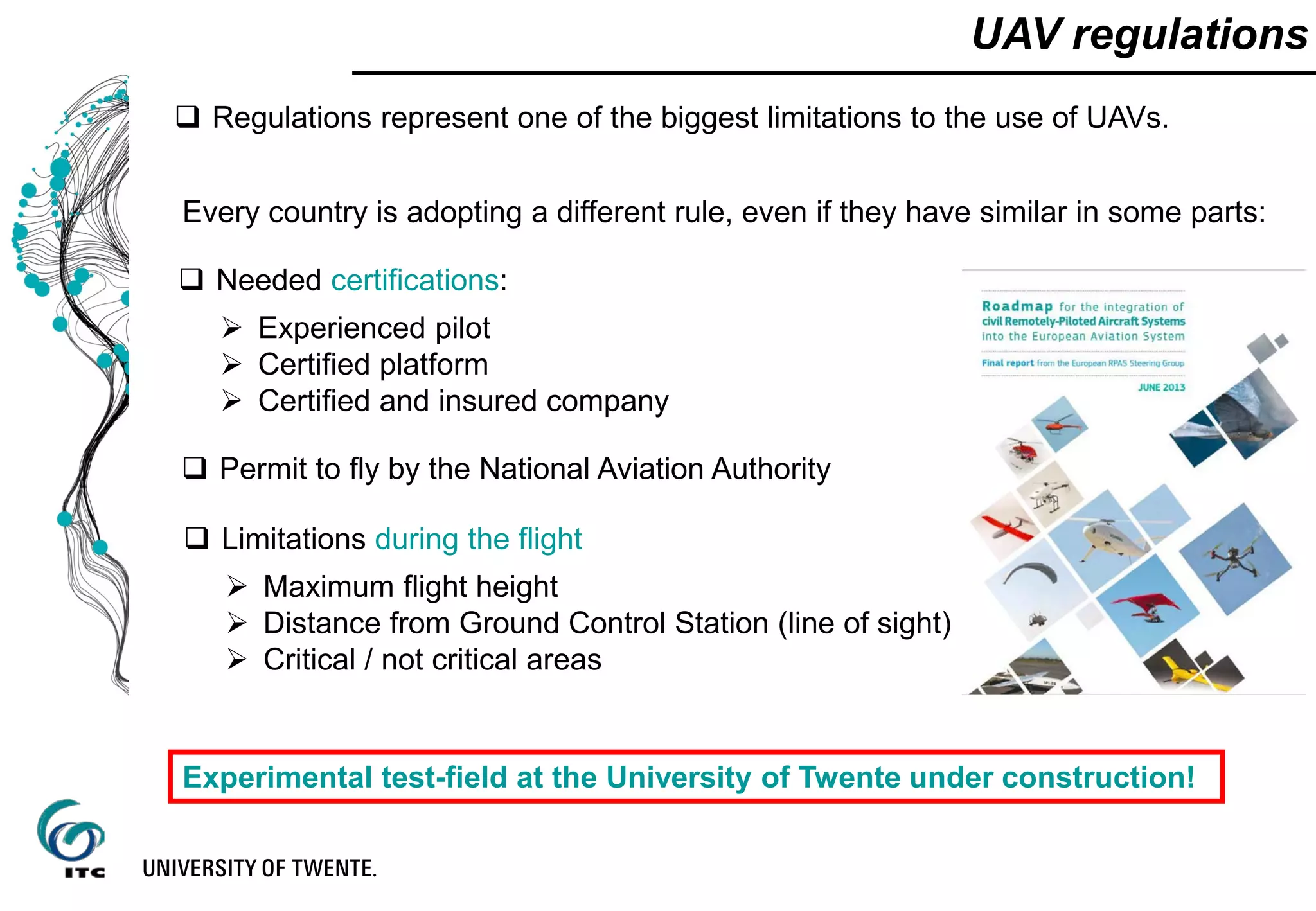
UAV regulations
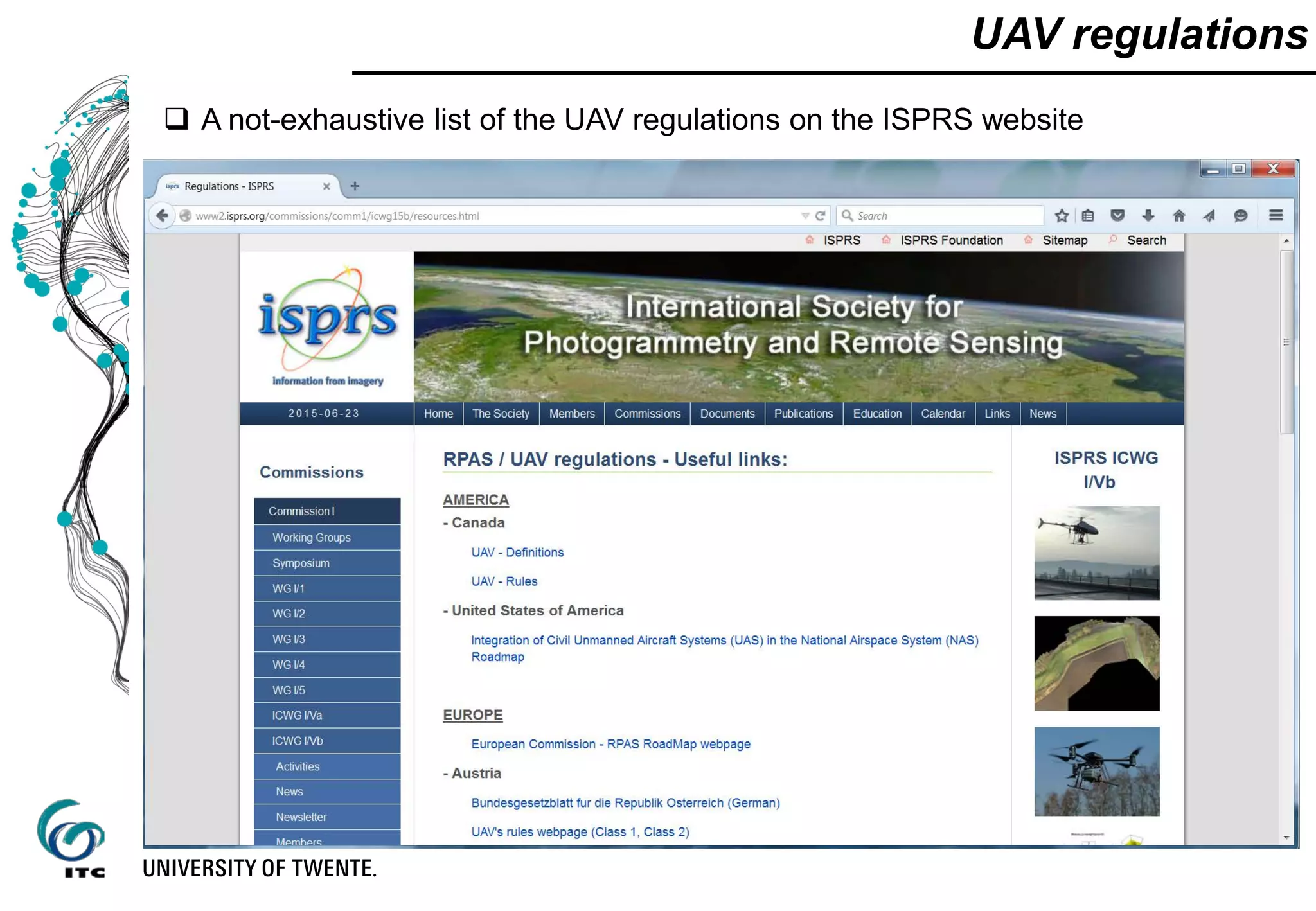
 Regulations represent one of the biggest limitations to the use of UAVs.
Every country is adopting a different rule, even if they have similar in some parts:
 Needed certifications:
 Maximum flight height
 Distance from Ground Control Station (line of sight)
 Critical / not critical areas
 Permit to fly by the National Aviation Authority
 Limitations during the flight
 Experienced pilot
 Certified platform
 Certified and insured company
Experimental test-field at the University of Twente under construction!
UAV regulations
 A not-exhaustive list of the UAV regulations on the ISPRS website
Conclusions and remarks
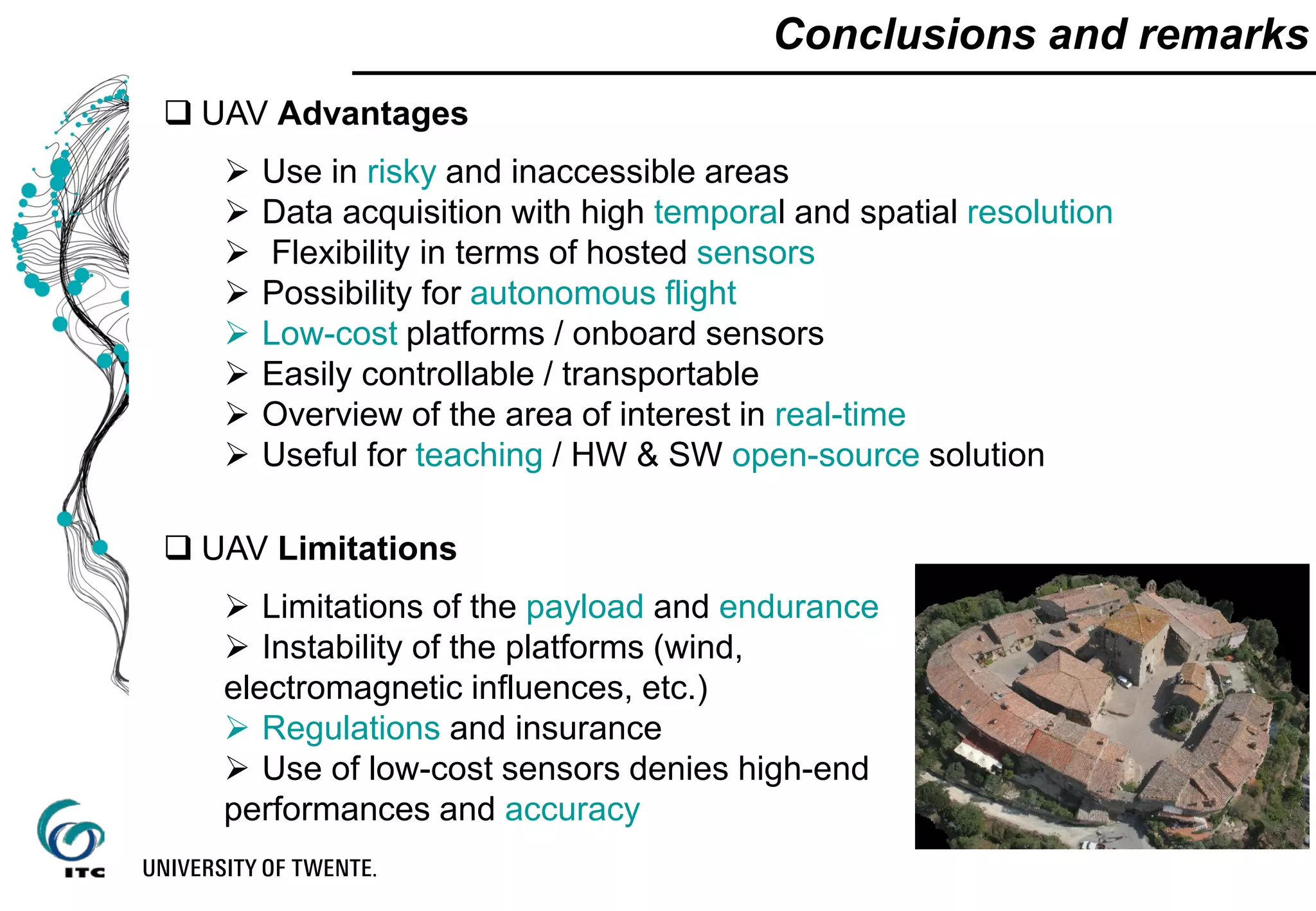
 UAV Advantages
 Use in risky and inaccessible areas
 Data acquisition with high temporal and spatial resolution
 Flexibility in terms of hosted sensors
 Possibility for autonomous flight
 Low-cost platforms / onboard sensors
 Easily controllable / transportable
 Overview of the area of interest in real-time
 Useful for teaching / HW & SW open-source solution
 UAV Limitations
 Limitations of the payload and endurance
 Instability of the platforms (wind,
electromagnetic influences, etc.)
 Regulations and insurance
 Use of low-cost sensors denies high-end
performances and accuracy
Conclusions and remarks
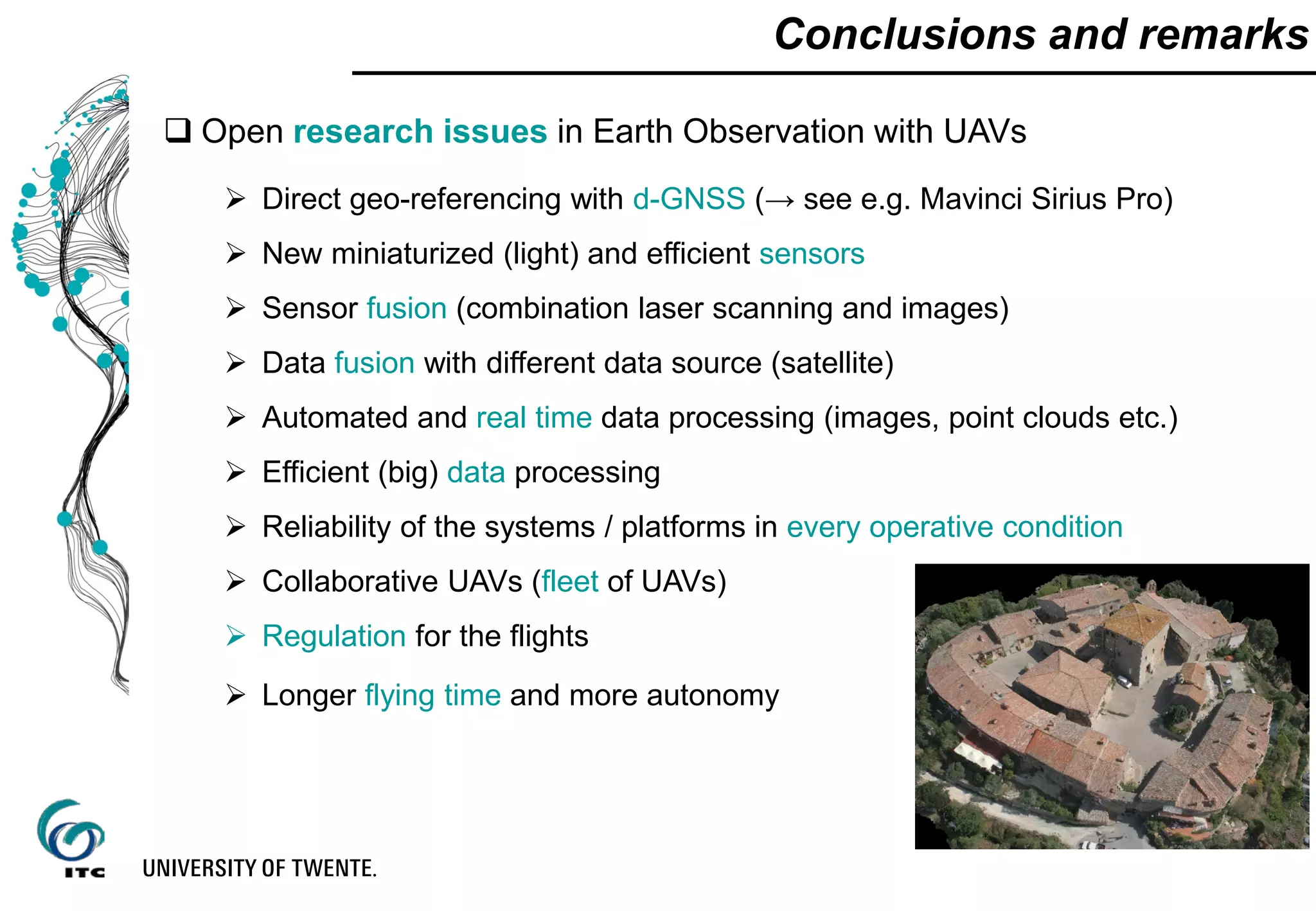
 Open research issues in Earth Observation with UAVs
 Direct geo-referencing with d-GNSS (→ see e.g. Mavinci Sirius Pro)
 New miniaturized (light) and efficient sensors
 Sensor fusion (combination laser scanning and images)
 Data fusion with different data source (satellite)
 Automated and real time data processing (images, point clouds etc.)
 Efficient (big) data processing
 Reliability of the systems / platforms in every operative condition
 Collaborative UAVs (fleet of UAVs)
 Regulation for the flights
 Longer flying time and more autonomy
UAV-based point
cloud
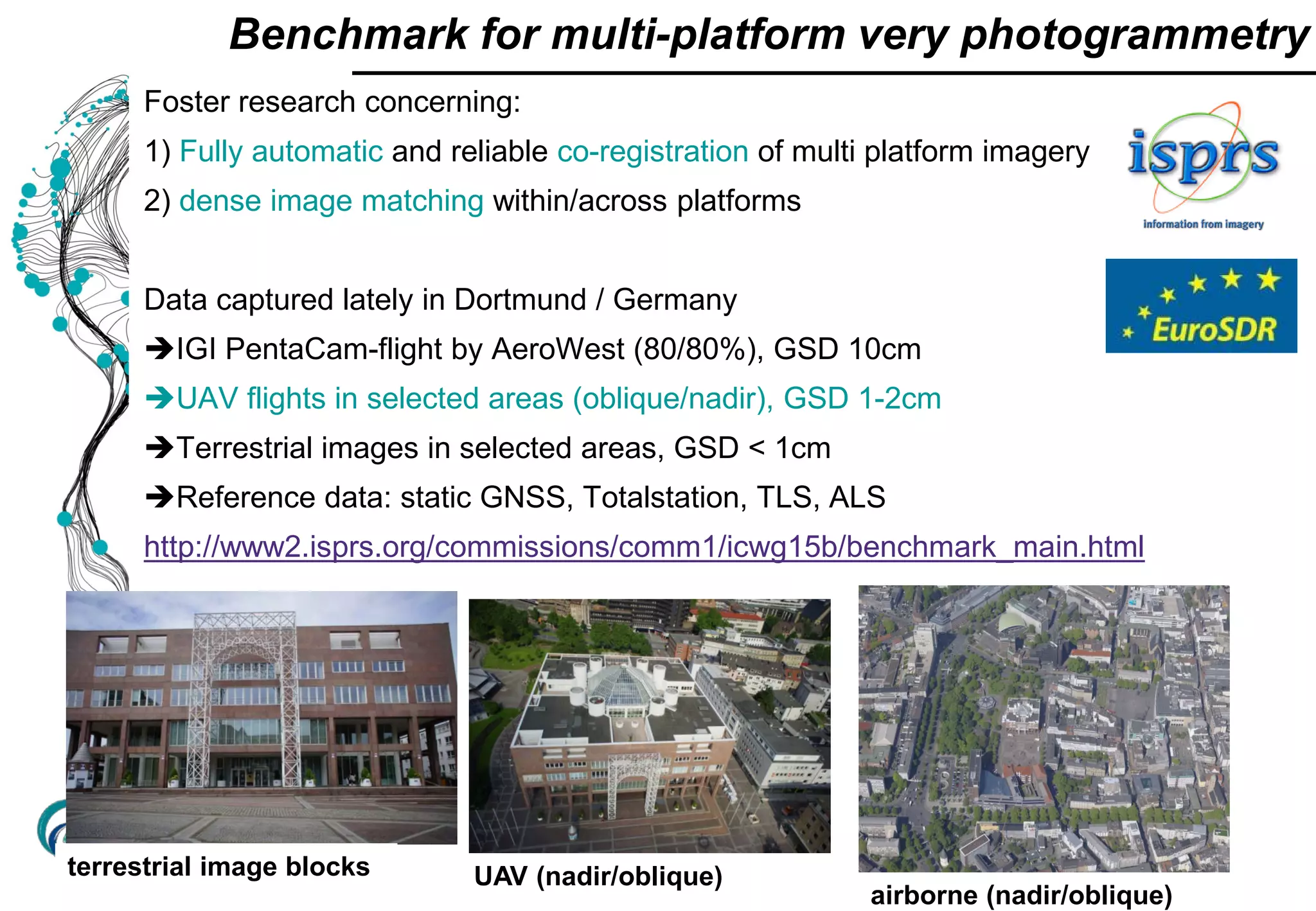
Foster research concerning:
1) Fully automatic and reliable co-registration of multi platform imagery
2) dense image matching within/across platforms
Data captured lately in Dortmund / Germany
IGI PentaCam-flight by AeroWest (80/80%), GSD 10cm
UAV flights in selected areas (oblique/nadir), GSD 1-2cm
Terrestrial images in selected areas, GSD < 1cm
Reference data: static GNSS, Totalstation, TLS, ALS
http://www2.isprs.org/commissions/comm1/icwg15b/benchmark_main.html
Benchmark for multi-platform very photogrammetry
terrestrial image blocks UAV (nadir/oblique)
airborne (nadir/oblique)
• 6th GEOBIA conference – 14-16 September 2016
• Hosted by ITC/ University Twente (Enschede, the Netherlands)
• Abstract deadline: 1 March 2016
• Full paper / extended abstracts: 1 July 2016
• www.geobia2016.com
THE USE OF UAVS FOR
EARTH OBSERVATION
FRANCESCO NEX
f.nex@utwente.nl

DSD-INT 2015 - Photogrammetric workflows and use of UA VS, Francesco nex, E-science center Utwente

  • 1.
    THE USE OFUAVS FOR EARTH OBSERVATION FRANCESCO NEX f.nex@utwente.nl
  • 2.
    Overview  Why UAVsfor Earth Observation?  Unmanned Aerial Vehicles classification  Photogrammetric pipeline with UAVs  Current applications  Conclusions and open issues
  • 3.
    UAV diffusion  Inthe last years, drones are becoming new and popular devices for many civil applications  The marked of drones has increased in the last years and the outlook is very bright  Among all the civil applications of drones, Earth Observation is one of the most relevant  Drones were initially conceived for military applications
  • 4.
    UAV for EarthObservation  The potential of UAV for earth observation is obvious in terms of cost, handiness and flexibility  Contribution from different communities: photogrammetry, robotics, computer vision, artificial intelligence, space domain, electronics, navigation, etc.  Data processing is a combination of terrestrial & aerial techniques  Possibility to extract 2D and 3D information from acquired images [Neubronner, 1903] [Wester-Ebbinghaus, 1980][Whittlesley, 1970] [Eisenbeiss, 2004]
  • 5.
    UAV for EarthObservation  More common applications: Urban monitoring (heat losses, change detection, city modelling, etc.) General surveying and mapping Environmental monitoring (fires, energy fluxes, natural hazards, etc.) Archaeological documentation Agriculture / forestry inventories and monitoring  Some pros and cons:  Possibility to fly everywhere and every time (regulation under creation)  Flexibility in the installed sensors on board  Reduced costs compared to traditional devices  Technological and legislative problems and limitations are still existing…
  • 6.
    after (Boehler, 2001) 0.1m 1 m 10 m 100 m 1 km 10 km 100 km 1000 km 10 Mil 1 Mil 100 000 10 000 1 000 100 10 1 Object/SceneComplexity[points/object] Object / Scene Size Close-range photogrammetry and terrestrial laser scanners Aerial photogrammetry and LiDAR Satellite Remote Sensing Tactile / CMM Hand measurements Total stations GNSS UAV for 3D Data Recording UAV
  • 7.
     Terminology accordingto their propulsion system, altitude / endurance and the level of automation in the flight execution:  Drone  Remotely Piloted Aerial Systems (RPAS)  Remotely Piloted Vehicle (RPV)  Remotely Operated Aircraft (ROA)  Micro Aerial Vehicles (MAV)  Unmanned Combat Air Vehicle (UCAV)  Small UAV (SUAV)  Low Altitude Deep Penetration (LADP) UAV  Low Altitude Long Endurance (LALE) UAV  Medium Altitude Long Endurance (MALE) UAV  Remote Controlled (RC) Helicopter  Model Helicopter UAV platforms & classification (cont.) EU level Newspaper and Military applications According to size, flight height and application Without autopilot
  • 8.
    UAV platforms &classification (cont.) Range [km] Altitude[m] 1 10 100 1000 5000 100 1000 5000 10000 Micro Mini Close-range Short-range Low altitude endurance Medium altitude long endurance High altitude long endurance [after Blyenburg, 1999]
  • 9.
    UAV platforms &classification (cont.)  For EO applications, UAV could be classified according to:  Engine / propulsion:  unpowered platforms, e.g. balloon, kite, glider, paraglide;  powered platforms, e.g. airship, glider, propeller, electric, combustion engine.  Aerodynamic and “physical” features:  lighter-than-air, e.g. balloon, airship  rotary wing, either electric or with combustion engine, e.g. single-rotor, coaxial, quadcopter, multi-rotor  fixed wing, either unpowered, electric or with combustion engine, e.g. glider or high wing  Platforms equipped with navigation units on board, digital camera or active sensors (laser scanner, Kinect, etc.)
  • 10.
    Autopilot GPS Antenna +IMU Radio-modem Antenna Payload Standard UAV configuration Ground Control Station
  • 11.
     Large varietyof platforms for EO (i.e. camera onboard) – Swinglet-like Aeromao Pteryx Gatewing SenseFly UAV platforms (cont.) SmartPlanes Mavinci Sirius
  • 12.
    UAV platforms (cont.) Platforms for Geomatics (i.e. camera onboard) – RC / Model helicopter-like Helicam Autocopter Edmonton SYMA SurveyCopter Aeroscout
  • 13.
    UAV platforms (cont.) Droidworx Large variety of platforms for Geomatics (i.e. camera onboard) – Multirotor-like DraganFly OktoKopter Aibotix Heliprocam NuvAero GAUIASCTEC Falcon Microdrones
  • 14.
    The evaluation isfrom 1 (low) to 5 (high) Kite / Balloon Fixed Wing Rotary wings electric ICE engine electric ICE engine Payload 3 3 4 2 4 Wind resistance 4 2 3 2 4 Minimum speed 4 2 2 4 4 Flying autonomy - 3 5 2 4 Portability 3 2 2 3 3 Landing distance 4 3 2 4 4 Evaluation of UAV platforms for Earth Observation
  • 15.
    Payload: sensors onboard  RGB cameras  Multi- Hyper-spectral cameras  LiDAR  Other sensors Sony Nex 7 Canon 600D GoPro TetraCam HeadWall Hyper Flir Vue Yellow Scan Route Scene Pod Gas (VOC) sensors  Limitation on weight → miniaturization of devices  GNSS & IMU SBG Ellipse-D X-sens MTI-G
  • 16.
    Photogrammetric pipeline withUAV images  Flight planning (designing, requirements, system performances, etc.)  Image acquisition (autonomous, manual, GSM-based, waypoint navigation, etc.)  Image triangulation & geo-referencing  Dense point cloud and Digital Surface Model generation  Ortho-image generation  Feature extraction [Architectural Image-based Modeling web portal - http://www.map.archi.fr/aibm/]
  • 17.
  • 18.
    Flight planning  Flightplanning software installed on PC and smartphones  Specific solutions designed for each platform
  • 19.
     UAV imageblocks have different geometries depending on the application → nadir and oblique images are usually acquired Image acquisition Unordered images with no GNSS/INS navigation control and manual control Almost ordered image block acquired with low-cost GNSS/INS navigation control and flight plan Classical image block with image strips achieved with high-quality GNSS/INS navigation system and flight plan
  • 20.
     Need ofa rigorous procedure to avoid image block deformations  Need of good image distribution and overlap  Use of oblique images can improve the results  Huge amount of data to process Image Orientation Object deformations due to simplified approaches Rigorous photogrammetric Bundle Block Adjustment How to manage big dataset without reducing the quality of the achieved results eScience Project
  • 21.
     Direct geo-referencing Need very good GNSS/INS observations  High-cost navigation sensors needed  Not sufficient with very high resolution images (<1 cm)  Possible use of GNSS or total station to track / follow the UAV [Blaha, 2011] Image orientation - georeferencing  GNSS / INS observations  Helpful to assist the identification of homologous points [Barazzetti el al., 2011]  Can provide a first scale and georeferencing image connection  Ground control points (GCP)  When high accuracy is needed
  • 22.
     Automated DSMgeneration for mapping, documentation, monitoring, visualization issues  Different commercial, open-source and web-based solutions  Open-source solution: MicMac  Commercial solution: Pix4D  Web-based approaches not reliable, not metric, not satisfactory for mapping applications Point cloud and DSM generation
  • 23.
     Dense imagematching for 3D reconstruction Urban applications - TrentoPoint cloud and DSM generation
  • 24.
    100 m 300 m Urban area surveyed for 3D building reconstruction Urban applications - TrentoOrthophoto generation Microdrone platform MD4-200 Flight height ca 100-125 m => 4 cm GSD Overlap 80%-40%
  • 25.
    Time effort inUAV-based photogrammetric workflow [Nex and Remondino, 2014]
  • 26.
    Urban applications  Veryhigh spatial resolution
  • 27.
     3D buildingmodels, maps, PV panel inspections Urban applications PV panel inspections 3D building models Maps generation Heat losses
  • 28.
     Interactive systemto check the PV potential of building roofs  High resolution → reconstruction of building installations (i.e. chimneys, etc.) Urban applications – Solar potential [Nex et al., 2013]
  • 29.
    Quick map generationand updating Large UAV block (Kigali, Rwanda)  18000 UAV images  3 cm GSD resolution  80% along track overlap  40% across track overlap [source: Gevaert – UT, ITC] Improving Open-Source Photogrammetric Workflows for Processing Big Datasets eScience Project
  • 30.
    Quick map generationand updating  Change detection and map updating in new built areas Semi-automated methodologies to reduce field work and map generation [Muneza, 2015 – UT, ITC Master Thesis]
  • 31.
     3D reconstructionsof post-earthquake buildings for monitoring and damage assessment Post-event damage assessment RECONASS & INACHUS– F.P. 7 EU Projects
  • 32.
    Post-event damage assessment RECONASS& INACHUS– F.P. 7 EU Projects  3D reconstructions of post-earthquake buildings for monitoring and damage assessment  Automated damage assessment [Vetrivel et al., 2015]
  • 33.
    Post-event damage assessment DSM ORTHOPHOTO SEGMENTATION URBANCLASSIFICATION [Nex et al., 2014]  Damage assessment on large urban areas
  • 34.
    Monitoring applications –Powerline monitoring  Monitoring of powerlines and vegetation in their neighborhood  Visual inspection of the installed devices
  • 35.
    [Tournandre et al.,2015] Monitoring applications - Dykes monitoring  Accurate monitoring of surface changes every year
  • 36.
    Monitoring applications -Construction sites  Multi-temporal data acquisition to monitor the construction site progresses  Acquired image blocks can be automatically co-registered together  Very high dense DSM are generated for each flight [Nyapwere, 2015 – UT, ITC Master thesis]
  • 37.
     Multi-temporal dataacquisition to monitor the construction site progresses  Generated DSMs can be automatically aligned together  Very high dense DSM can be generated from each flight  An orthophoto and a 3D mesh can be automatically generated using the same dataset Monitoring applications - Construction site [Nyapwere, 2015 – UT, ITC Master thesis]
  • 38.
     Archaeological areaof Pava (Siena, Italy), 40 images, ca 40x50 m  Microdrone MD4-200, Pentax Optio A40 (8 mm lens, 12 Mpx, pixel size 1.9 mm)  Flying height ca 35 m, GSD ca 2 cm  DSM @ 5 cm resolution  11 ground points (5 as GCPs and 6 as CK) Cultural heritage applications Mosaic of the area An image of the dataset
  • 39.
    Cultural Heritage applications– multi-temporal  Multi-temporal flights over the area – DSM comparisons to map / compute excavation volumes [Nex and Remondino, 2014]
  • 40.
     3D reconstructionof the Neptune temple integrating terrestrial and UAV (vertical and oblique) photogrammetry Cultural Heritage applications –– data integration
  • 41.
     3D reconstructionof the Neptune temple integrating terrestrial and UAV (vertical and oblique) photogrammetry  Image orientation (196 images) Close the gap between terrestrial and aerial data
  • 42.
     3D reconstructionof the Neptune temple integrating terrestrial terrestrial and UAV (vertical and oblique) photogrammetry  Image orientation (196 images)  3D model generation Close the gap between terrestrial and aerial data [Nex and Remondino, 2014]
  • 43.
    Agriculture - Precisionfarming Precision Farming – Winery area  Pentax Optio A40 for the images in the visible spectrum and a Sigma DP1 for the images in the NIR spectrum NIRwine yard area false colors estimated NDVI index Thermal application - MD4-100 with IR camera for real time tracking of animals
  • 44.
     Biomass estimation Forestry Forest inventory [source GreenValley and Aibotix]
  • 45.
    UAV regulations  Regulationsrepresent one of the biggest limitations to the use of UAVs. Every country is adopting a different rule, even if they have similar in some parts:  Needed certifications:  Maximum flight height  Distance from Ground Control Station (line of sight)  Critical / not critical areas  Permit to fly by the National Aviation Authority  Limitations during the flight  Experienced pilot  Certified platform  Certified and insured company Experimental test-field at the University of Twente under construction!
  • 46.
    UAV regulations  Anot-exhaustive list of the UAV regulations on the ISPRS website
  • 47.
    Conclusions and remarks UAV Advantages  Use in risky and inaccessible areas  Data acquisition with high temporal and spatial resolution  Flexibility in terms of hosted sensors  Possibility for autonomous flight  Low-cost platforms / onboard sensors  Easily controllable / transportable  Overview of the area of interest in real-time  Useful for teaching / HW & SW open-source solution  UAV Limitations  Limitations of the payload and endurance  Instability of the platforms (wind, electromagnetic influences, etc.)  Regulations and insurance  Use of low-cost sensors denies high-end performances and accuracy
  • 48.
    Conclusions and remarks Open research issues in Earth Observation with UAVs  Direct geo-referencing with d-GNSS (→ see e.g. Mavinci Sirius Pro)  New miniaturized (light) and efficient sensors  Sensor fusion (combination laser scanning and images)  Data fusion with different data source (satellite)  Automated and real time data processing (images, point clouds etc.)  Efficient (big) data processing  Reliability of the systems / platforms in every operative condition  Collaborative UAVs (fleet of UAVs)  Regulation for the flights  Longer flying time and more autonomy
  • 49.
    UAV-based point cloud Foster researchconcerning: 1) Fully automatic and reliable co-registration of multi platform imagery 2) dense image matching within/across platforms Data captured lately in Dortmund / Germany IGI PentaCam-flight by AeroWest (80/80%), GSD 10cm UAV flights in selected areas (oblique/nadir), GSD 1-2cm Terrestrial images in selected areas, GSD < 1cm Reference data: static GNSS, Totalstation, TLS, ALS http://www2.isprs.org/commissions/comm1/icwg15b/benchmark_main.html Benchmark for multi-platform very photogrammetry terrestrial image blocks UAV (nadir/oblique) airborne (nadir/oblique)
  • 50.
    • 6th GEOBIAconference – 14-16 September 2016 • Hosted by ITC/ University Twente (Enschede, the Netherlands) • Abstract deadline: 1 March 2016 • Full paper / extended abstracts: 1 July 2016 • www.geobia2016.com
  • 51.
    THE USE OFUAVS FOR EARTH OBSERVATION FRANCESCO NEX f.nex@utwente.nl