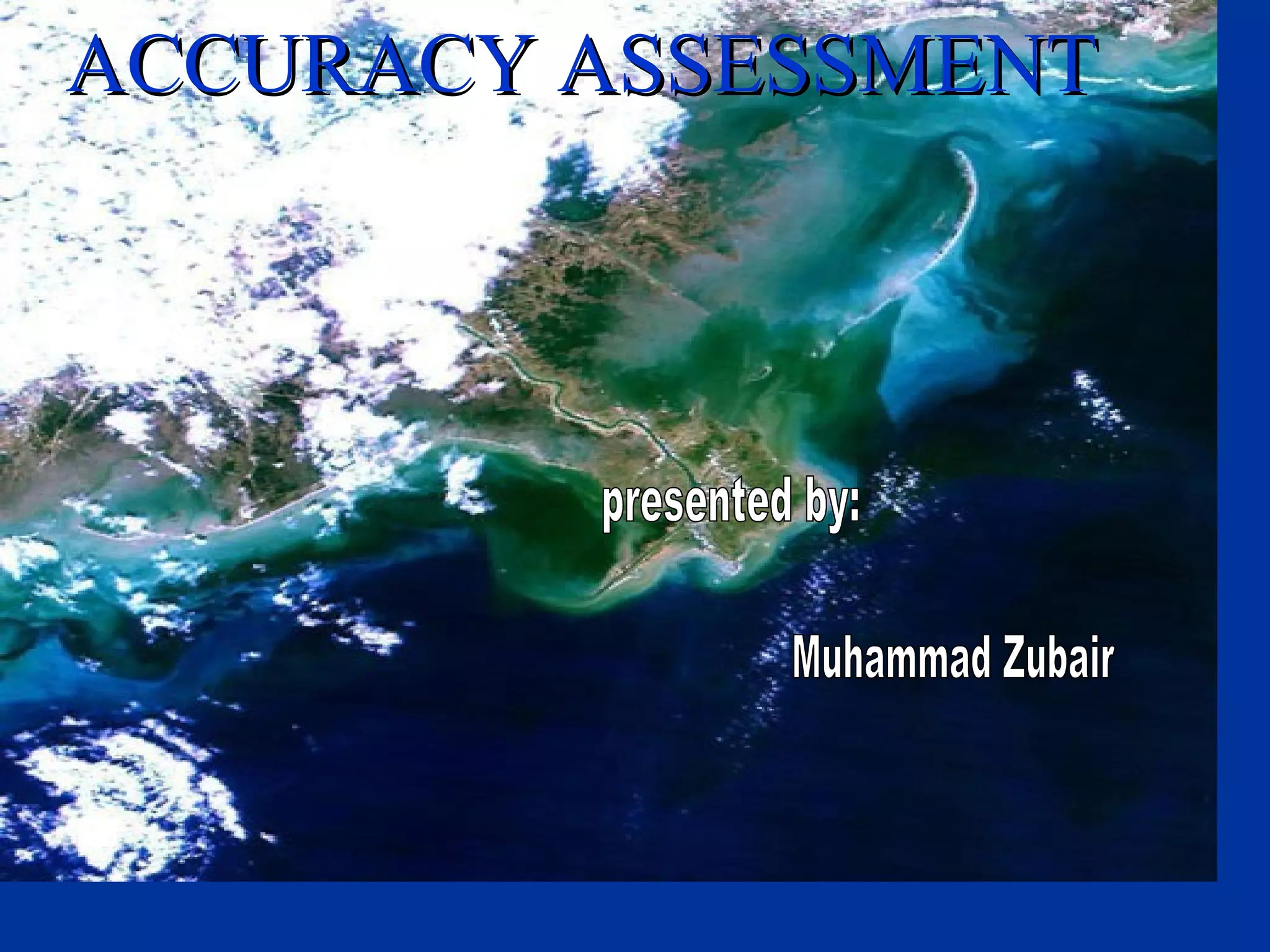
ACCURACY ASSESSMENTACCURACY ASSESSMENT
ACCURACY ASSESSMENT
– Assess accuracy of a remote sensing output is
one of the most important steps in any
classification exercise!!
– Without an accuracy assessment the output or
results is of little value
Goals:
Assess how well a classification worked
Understand how to interpret the usefulness of
someone else’s classification
Nature of Classification
1) Class definition problems
2) Inappropriate class labels
3) Mislabeling of classes
Accuracy Assessment
 Overview
 Collect reference data: “ground truth”
Determination of class types at specific locations
 Compare reference to classified map
Does class type on classified map = class type
determined from reference data?
Reference Data
Some possible sources
Aerial photo interpretation
Ground truth with GPS
GIS layers
Reference Data
Issue 1: Choosing reference source
Make sure you can actually extract from the reference
source the information that you need for the
classification scheme
I.e. Aerial photos may not be good reference data if your
classification scheme distinguishes four species of grass. You
may need GPS’d ground data.
Reference data
Issue 2: Determining size of reference plots
Match spatial scale of reference plots and
remotely-sensed data
I.e. GPS’d ground plots 5 meters on a side may not be
useful if remotely-sensed cells are 1km on a side. You
may need aerial photos or even other satellite images.
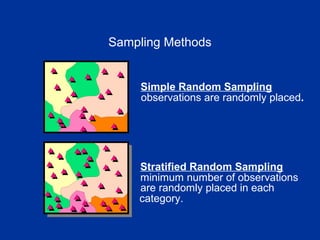
Sampling Methods
Simple Random Sampling:
observations are randomly placed.
Stratified Random Sampling
minimum number of observations
are randomly placed in each
category.
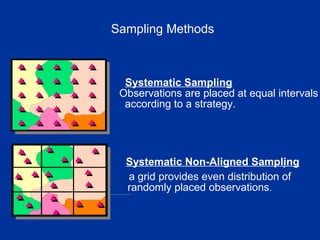
Sampling Methods
Systematic Sampling
Observations are placed at equal intervals
according to a strategy.
Systematic Non-Aligned Sampling:
a grid provides even distribution of
randomly placed observations.
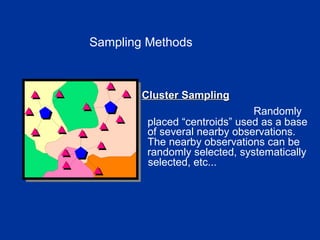
Sampling Methods
Cluster SamplingCluster Sampling
Randomly
placed “centroids” used as a base
of several nearby observations.
The nearby observations can be
randomly selected, systematically
selected, etc...
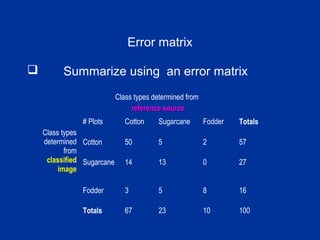
Error matrix
 Summarize using an error matrix
Class types determined from
reference sourcereference source
Class types
determined
from
classified
image
# Plots Cotton Sugarcane Fodder Totals
Cotton 50 5 2 57
Sugarcane 14 13 0 27
Fodder 3 5 8 16
Totals 67 23 10 100
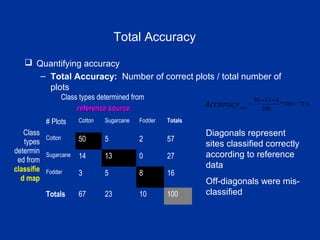
Total Accuracy
 Quantifying accuracy
– Total Accuracy: Number of correct plots / total number of
plots
Class types determined from
reference sourcereference source
Class
types
determin
ed from
classifie
d map
# Plots Cotton Sugarcane Fodder Totals
Cotton 50 5 2 57
Sugarcane 14 13 0 27
Fodder 3 5 8 16
Totals 67 23 10 100
%71100*
100
81350
=
++
=AccuracyTotal
Diagonals represent
sites classified correctly
according to reference
data
Off-diagonals were mis-
classified
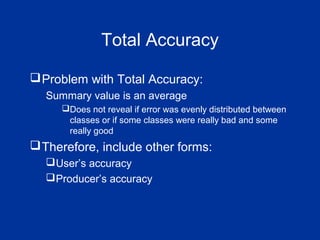
Total Accuracy
Problem with Total Accuracy:
Summary value is an average
Does not reveal if error was evenly distributed between
classes or if some classes were really bad and some
really good
Therefore, include other forms:
User’s accuracy
Producer’s accuracy
User’s and producer’s accuracy
and types of error
User’s accuracy corresponds to error of
commission (inclusion):
Producer’s accuracy corresponds to error of
omission (exclusion):
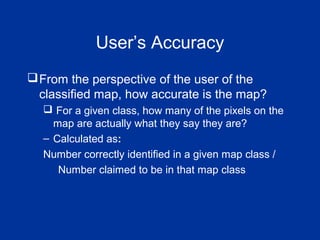
User’s Accuracy
From the perspective of the user of the
classified map, how accurate is the map?
 For a given class, how many of the pixels on the
map are actually what they say they are?
– Calculated as:
Number correctly identified in a given map class /
Number claimed to be in that map class
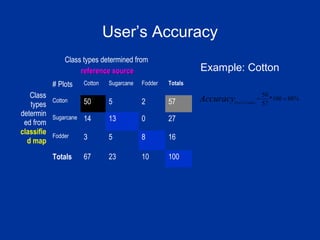
User’s Accuracy
Class types determined from
reference sourcereference source
Class
types
determin
ed from
classifie
d map
# Plots Cotton Sugarcane Fodder Totals
Cotton 50 5 2 57
Sugarcane 14 13 0 27
Fodder 3 5 8 16
Totals 67 23 10 100
%88100*
57
50
,'
==Accuracy CottonsUser
Example: Cotton
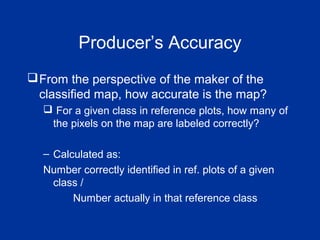
Producer’s Accuracy
From the perspective of the maker of the
classified map, how accurate is the map?
 For a given class in reference plots, how many of
the pixels on the map are labeled correctly?
– Calculated as:
Number correctly identified in ref. plots of a given
class /
Number actually in that reference class
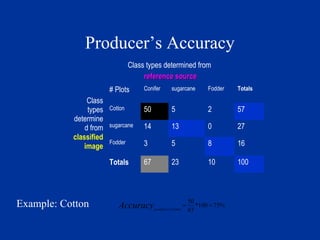
Producer’s Accuracy
Class types determined from
reference sourcereference source
Class
types
determine
d from
classified
image
# Plots Conifer sugarcane Fodder Totals
Cotton 50 5 2 57
sugarcane 14 13 0 27
Fodder 3 5 8 16
Totals 67 23 10 100
%75100*
67
50
'
==Accuracy s,Cottonproducer
Example: Cotton
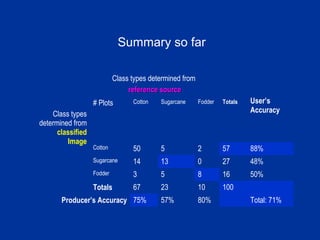
Summary so far
Class types determined from
reference sourcereference source
User’s
AccuracyClass types
determined from
classified
Image
# Plots Cotton Sugarcane Fodder Totals
Cotton 50 5 2 57 88%
Sugarcane 14 13 0 27 48%
Fodder 3 5 8 16 50%
Totals 67 23 10 100
Producer’s Accuracy 75% 57% 80% Total: 71%
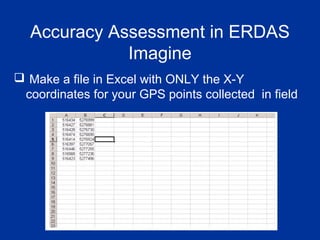
Accuracy Assessment in ERDAS
Imagine
 Make a file in Excel with ONLY the X-Y
coordinates for your GPS points collected in field
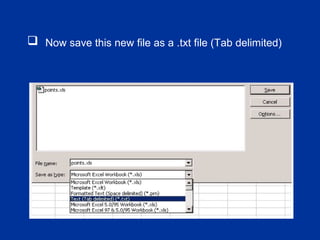
 Now save this new file as a .txt file (Tab delimited)
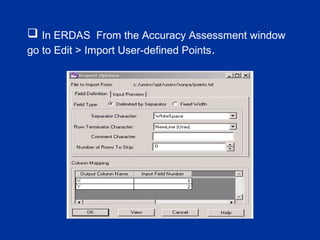
 In ERDAS From the Accuracy Assessment window
go to Edit > Import User-defined Points.
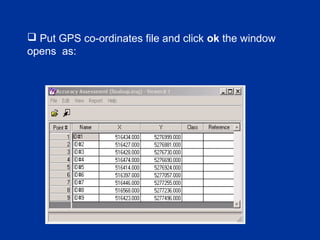
 Put GPS co-ordinates file and click ok the window
opens as:
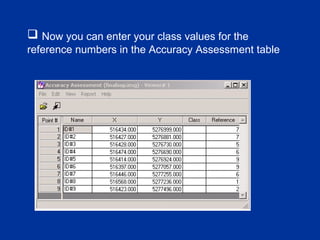
 Now you can enter your class values for the
reference numbers in the Accuracy Assessment table
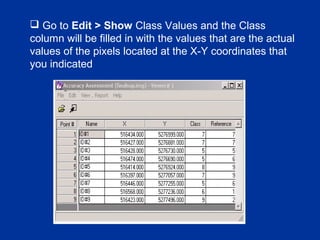
 Go to Edit > Show Class Values and the Class
column will be filled in with the values that are the actual
values of the pixels located at the X-Y coordinates that
you indicated
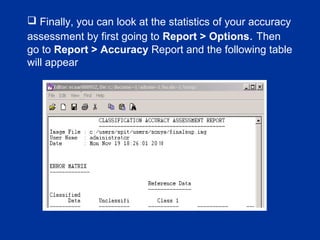
 Finally, you can look at the statistics of your accuracy
assessment by first going to Report > Options. Then
go to Report > Accuracy Report and the following table
will appear
References
• Lillesand and Kiefer, Chapter 7
• Congalton, R. G. and K. Green. 1999. Assessing the
accuracy of remotely sensed data: Principles and
practices. Lewis Publishers, Boca Raton.
• Congalton, R.G. 1991. A review of assessing the
accuracy of classification of remotely sensed data.
Remote Sensing of Environment 37:35-46
• ERDAS, (2005). ERDAS 9.1, Field Guide. Geospatial
Imaging, LLC Norcross, Georgia.
• Van Neil, T.G. and McVicar, T.R., (2004) Current and
potential uses of optical remote sensing in rice based
irrigation systems: A review, Australian Journal of
Agricultural Research, 55, 155-85, CSIRO

Accuracy assessment of Remote Sensing Data

  • 1.
  • 2.
    ACCURACY ASSESSMENT – Assessaccuracy of a remote sensing output is one of the most important steps in any classification exercise!! – Without an accuracy assessment the output or results is of little value
  • 3.
    Goals: Assess how wella classification worked Understand how to interpret the usefulness of someone else’s classification
  • 4.
    Nature of Classification 1)Class definition problems 2) Inappropriate class labels 3) Mislabeling of classes
  • 5.
    Accuracy Assessment  Overview Collect reference data: “ground truth” Determination of class types at specific locations  Compare reference to classified map Does class type on classified map = class type determined from reference data?
  • 6.
    Reference Data Some possiblesources Aerial photo interpretation Ground truth with GPS GIS layers
  • 7.
    Reference Data Issue 1:Choosing reference source Make sure you can actually extract from the reference source the information that you need for the classification scheme I.e. Aerial photos may not be good reference data if your classification scheme distinguishes four species of grass. You may need GPS’d ground data.
  • 8.
    Reference data Issue 2:Determining size of reference plots Match spatial scale of reference plots and remotely-sensed data I.e. GPS’d ground plots 5 meters on a side may not be useful if remotely-sensed cells are 1km on a side. You may need aerial photos or even other satellite images.
  • 9.
    Sampling Methods Simple RandomSampling: observations are randomly placed. Stratified Random Sampling minimum number of observations are randomly placed in each category.
  • 10.
    Sampling Methods Systematic Sampling Observationsare placed at equal intervals according to a strategy. Systematic Non-Aligned Sampling: a grid provides even distribution of randomly placed observations.
  • 11.
    Sampling Methods Cluster SamplingClusterSampling Randomly placed “centroids” used as a base of several nearby observations. The nearby observations can be randomly selected, systematically selected, etc...
  • 12.
    Error matrix  Summarizeusing an error matrix Class types determined from reference sourcereference source Class types determined from classified image # Plots Cotton Sugarcane Fodder Totals Cotton 50 5 2 57 Sugarcane 14 13 0 27 Fodder 3 5 8 16 Totals 67 23 10 100
  • 13.
    Total Accuracy  Quantifyingaccuracy – Total Accuracy: Number of correct plots / total number of plots Class types determined from reference sourcereference source Class types determin ed from classifie d map # Plots Cotton Sugarcane Fodder Totals Cotton 50 5 2 57 Sugarcane 14 13 0 27 Fodder 3 5 8 16 Totals 67 23 10 100 %71100* 100 81350 = ++ =AccuracyTotal Diagonals represent sites classified correctly according to reference data Off-diagonals were mis- classified
  • 14.
    Total Accuracy Problem withTotal Accuracy: Summary value is an average Does not reveal if error was evenly distributed between classes or if some classes were really bad and some really good Therefore, include other forms: User’s accuracy Producer’s accuracy
  • 15.
    User’s and producer’saccuracy and types of error User’s accuracy corresponds to error of commission (inclusion): Producer’s accuracy corresponds to error of omission (exclusion):
  • 16.
    User’s Accuracy From theperspective of the user of the classified map, how accurate is the map?  For a given class, how many of the pixels on the map are actually what they say they are? – Calculated as: Number correctly identified in a given map class / Number claimed to be in that map class
  • 17.
    User’s Accuracy Class typesdetermined from reference sourcereference source Class types determin ed from classifie d map # Plots Cotton Sugarcane Fodder Totals Cotton 50 5 2 57 Sugarcane 14 13 0 27 Fodder 3 5 8 16 Totals 67 23 10 100 %88100* 57 50 ,' ==Accuracy CottonsUser Example: Cotton
  • 18.
    Producer’s Accuracy From theperspective of the maker of the classified map, how accurate is the map?  For a given class in reference plots, how many of the pixels on the map are labeled correctly? – Calculated as: Number correctly identified in ref. plots of a given class / Number actually in that reference class
  • 19.
    Producer’s Accuracy Class typesdetermined from reference sourcereference source Class types determine d from classified image # Plots Conifer sugarcane Fodder Totals Cotton 50 5 2 57 sugarcane 14 13 0 27 Fodder 3 5 8 16 Totals 67 23 10 100 %75100* 67 50 ' ==Accuracy s,Cottonproducer Example: Cotton
  • 20.
    Summary so far Classtypes determined from reference sourcereference source User’s AccuracyClass types determined from classified Image # Plots Cotton Sugarcane Fodder Totals Cotton 50 5 2 57 88% Sugarcane 14 13 0 27 48% Fodder 3 5 8 16 50% Totals 67 23 10 100 Producer’s Accuracy 75% 57% 80% Total: 71%
  • 21.
    Accuracy Assessment inERDAS Imagine  Make a file in Excel with ONLY the X-Y coordinates for your GPS points collected in field
  • 22.
     Now savethis new file as a .txt file (Tab delimited)
  • 23.
     In ERDASFrom the Accuracy Assessment window go to Edit > Import User-defined Points.
  • 24.
     Put GPSco-ordinates file and click ok the window opens as:
  • 25.
     Now youcan enter your class values for the reference numbers in the Accuracy Assessment table
  • 26.
     Go toEdit > Show Class Values and the Class column will be filled in with the values that are the actual values of the pixels located at the X-Y coordinates that you indicated
  • 27.
     Finally, youcan look at the statistics of your accuracy assessment by first going to Report > Options. Then go to Report > Accuracy Report and the following table will appear
  • 28.
    References • Lillesand andKiefer, Chapter 7 • Congalton, R. G. and K. Green. 1999. Assessing the accuracy of remotely sensed data: Principles and practices. Lewis Publishers, Boca Raton. • Congalton, R.G. 1991. A review of assessing the accuracy of classification of remotely sensed data. Remote Sensing of Environment 37:35-46 • ERDAS, (2005). ERDAS 9.1, Field Guide. Geospatial Imaging, LLC Norcross, Georgia. • Van Neil, T.G. and McVicar, T.R., (2004) Current and potential uses of optical remote sensing in rice based irrigation systems: A review, Australian Journal of Agricultural Research, 55, 155-85, CSIRO