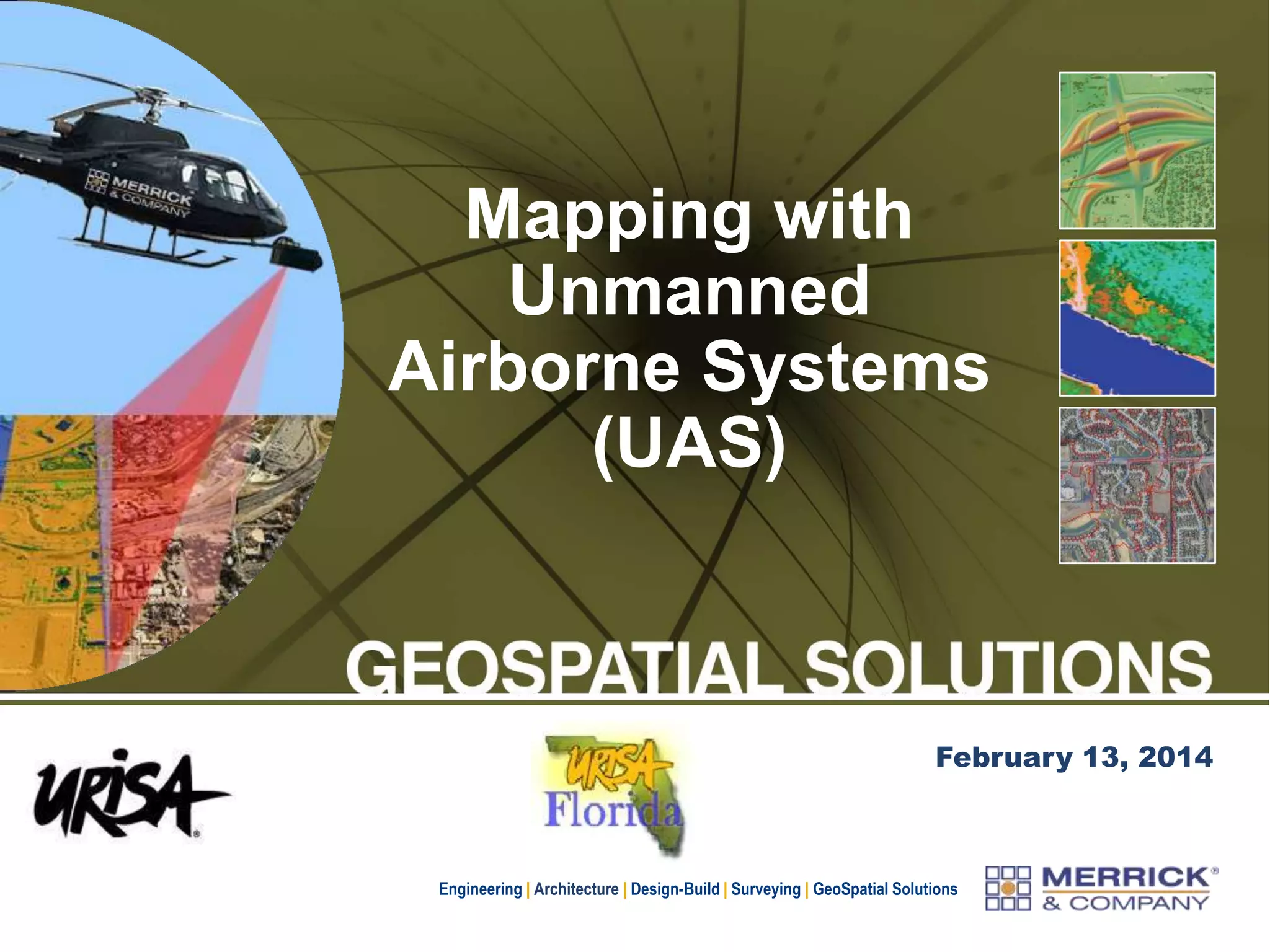
Mapping with
Unmanned
Airborne Systems
(UAS)

February 13, 2014

Engineering | Architecture | Design-Build | Surveying | GeoSpatial Solutions
Today’s Agenda
 Introductions
 Current

/ Objectives

UAS Regulations (FAA)

 UAS

Components & Types

 UAS

Navigation

 Sensor
 UAS

Payloads

Software

 Inspection

/ Surveillance vs. Mapping

 UAS

Outdoor Mapping Deliverables

 UAS

Indoor Mapping

 Industry

PREXXXX 2
Copyright © 2010 Merrick & Company All rights reserved.

Forecast / Future Trends
Today’s Objective

Provide an objective and practical review
of current unmanned airborne mapping
capabilities

PREXXXX 3
Copyright © 2010 Merrick & Company All rights reserved.
Corporate Overview
 Corporate

headquarters: Greenwood Village, Colorado
 Founded in 1955; employee-owned
 $110M annual revenue (FY13)
 > 480 employees at 15 domestic + 4 international offices
 Market Focus


Energy



National Security



Life Sciences



Sustainable Infrastructure

 Market

Sector Teams



Infrastructure (Geospatial, Survey, Water & Civil Engineering)



High Performance Facilities

Energy



Life Sciences

Nuclear Services & Technology

PREXXXX 4
Copyright © 2010 Merrick & Company All rights reserved.
Presenter Bio – Bill Emison
•

Senior Account Manager (Commercial Accounts) for the
Geospatial Solutions (GSS) team
• Also provide support as Corporate Communications
Specialist for Sustainable Infrastructure team; MARS®
Product Manager
• Geospatial professional since 1993 with experience in
solutions consulting; software & service sales; technical
marketing and communications
• Employed by Merrick’s GSS team since January 2006.

PREXXXX 5
Copyright © 2010 Merrick & Company All rights reserved.
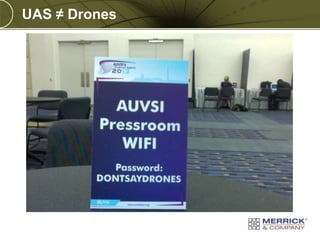
UAS ≠ Drones

PREXXXX 6
Copyright © 2010 Merrick & Company All rights reserved.
Jackass ALERT!!!

FAA warns public against shooting guns at drones
"Shooting at an unmanned aircraft could result in
criminal or civil liability, just as would firing at a
manned airplane."
PREXXXX 7
Copyright © 2010 Merrick & Company All rights reserved.
Current US (FAA) UAS Regulations


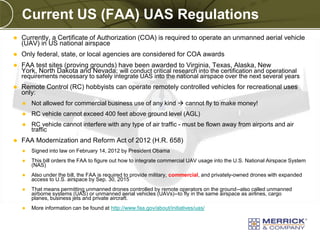
Currently, a Certificate of Authorization (COA) is required to operate an unmanned aerial vehicle
(UAV) in US national airspace



Only federal, state, or local agencies are considered for COA awards



FAA test sites (proving grounds) have been awarded to Virginia, Texas, Alaska, New
York, North Dakota and Nevada; will conduct critical research into the certification and operational

requirements necessary to safely integrate UAS into the national airspace over the next several years


Remote Control (RC) hobbyists can operate remotely controlled vehicles for recreational uses
only:



RC vehicle cannot exceed 400 feet above ground level (AGL)





Not allowed for commercial business use of any kind  cannot fly to make money!
RC vehicle cannot interfere with any type of air traffic - must be flown away from airports and air
traffic

FAA Modernization and Reform Act of 2012 (H.R. 658)


Signed into law on February 14, 2012 by President Obama



This bill orders the FAA to figure out how to integrate commercial UAV usage into the U.S. National Airspace System
(NAS)



Also under the bill, the FAA is required to provide military, commercial, and privately-owned drones with expanded
access to U.S. airspace by Sep. 30, 2015



That means permitting unmanned drones controlled by remote operators on the ground--also called unmanned
airborne systems (UAS) or unmanned aerial vehicles (UAVs)--to fly in the same airspace as airlines, cargo
planes, business jets and private aircraft.



More information can be found at http://www.faa.gov/about/initiatives/uas/

PREXXXX 8
Copyright © 2010 Merrick & Company All rights reserved.
UAS Components

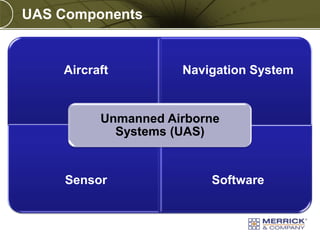
Aircraft

Navigation System

Unmanned Airborne
Systems (UAS)

Sensor

PREXXXX 9
Copyright © 2010 Merrick & Company All rights reserved.

Software
UAS Types
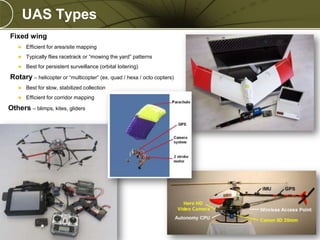
Fixed wing


Efficient for area/site mapping



Typically flies racetrack or “mowing the yard” patterns



Best for persistent surveillance (orbital loitering)

Rotary – helicopter or “multicopter” (ex. quad / hexa / octo copters)


Best for slow, stabilized collection



Efficient for corridor mapping

Others – blimps, kites, gliders

PREXXXX 10
Copyright © 2010 Merrick & Company All rights reserved.
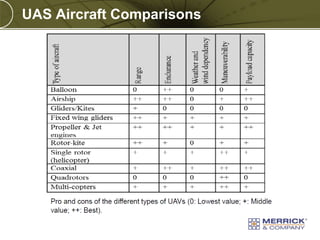
UAS Aircraft Comparisons

PREXXXX 11
Copyright © 2010 Merrick & Company All rights reserved.
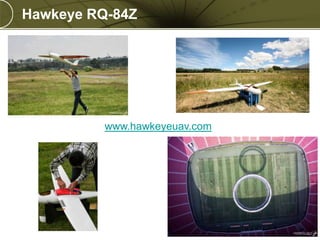
Hawkeye RQ-84Z

www.hawkeyeuav.com

PREXXXX 12
Copyright © 2010 Merrick & Company All rights reserved.
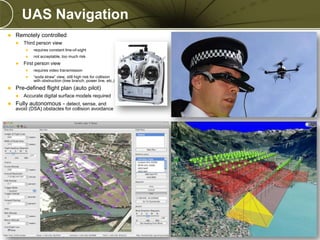
UAS Navigation


Remotely controlled


Third person view





requires constant line-of-sight
not acceptable, too much risk

First person view




“soda straw” view, still high risk for collision
with obstruction (tree branch, power line, etc.)

Pre-defined flight plan (auto pilot)




requires video transmission



Accurate digital surface models required

Fully autonomous - detect, sense, and
avoid (DSA) obstacles for collision avoidance

PREXXXX 13
Copyright © 2010 Merrick & Company All rights reserved.
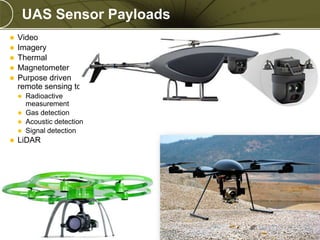
UAS Sensor Payloads






Video
Imagery
Thermal
Magnetometer
Purpose driven
remote sensing tools


Radioactive
measurement
 Gas detection
 Acoustic detection
 Signal detection


LiDAR

PREXXXX 14
Copyright © 2010 Merrick & Company All rights reserved.
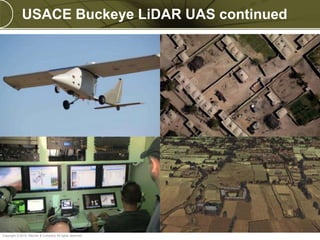
USACE Buckeye LiDAR UAS continued

PREXXXX 15
Copyright © 2010 Merrick & Company All rights reserved.
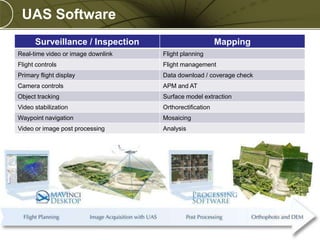
UAS Software
Surveillance / Inspection

Mapping

Real-time video or image downlink

Flight planning

Flight controls

Flight management

Primary flight display

Data download / coverage check

Camera controls

APM and AT

Object tracking

Surface model extraction

Video stabilization

Orthorectification

Waypoint navigation

Mosaicing

Video or image post processing

Analysis

PREXXXX 16
Copyright © 2010 Merrick & Company All rights reserved.
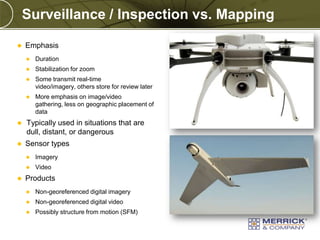
Surveillance / Inspection vs. Mapping


Emphasis


Duration



Stabilization for zoom



Some transmit real-time
video/imagery, others store for review later



More emphasis on image/video
gathering, less on geographic placement of
data



Typically used in situations that are
dull, distant, or dangerous



Sensor types





Imagery
Video

Products


Non-georeferenced digital imagery



Non-georeferenced digital video



Possibly structure from motion (SFM)

PREXXXX 17
Copyright © 2010 Merrick & Company All rights reserved.
Surveillance / Inspection Examples

PREXXXX 18
Copyright © 2010 Merrick & Company All rights reserved.
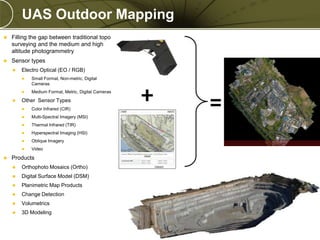
UAS Outdoor Mapping


Filling the gap between traditional topo
surveying and the medium and high
altitude photogrammetry



Sensor types


Electro Optical (EO / RGB)






Small Format, Non-metric, Digital
Cameras
Medium Format, Metric, Digital Cameras

Other Sensor Types



Multi-Spectral Imagery (MSI)



Thermal Infrared (TIR)



Hyperspectral Imaging (HSI)



Oblique Imagery





Color Infrared (CIR)

Video

Products


Orthophoto Mosaics (Ortho)



Digital Surface Model (DSM)



Planimetric Map Products



Change Detection



Volumetrics



3D Modeling

PREXXXX 19
Copyright © 2010 Merrick & Company All rights reserved.
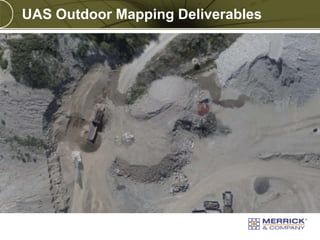
UAS Outdoor Mapping Deliverables

PREXXXX 20
Copyright © 2010 Merrick & Company All rights reserved.
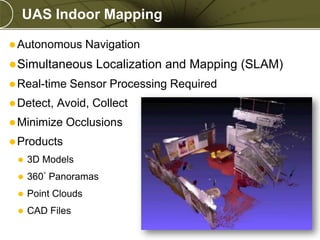
UAS Indoor Mapping
 Autonomous

Navigation

 Simultaneous
 Real-time
 Detect,

Localization and Mapping (SLAM)

Sensor Processing Required

Avoid, Collect

 Minimize

Occlusions

 Products


3D Models



360° Panoramas



Point Clouds



CAD Files

PREXXXX 21
Copyright © 2010 Merrick & Company All rights reserved.
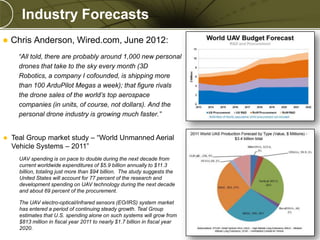
Industry Forecasts


Chris Anderson, Wired.com, June 2012:
“All told, there are probably around 1,000 new personal
drones that take to the sky every month (3D
Robotics, a company I cofounded, is shipping more
than 100 ArduPilot Megas a week); that figure rivals
the drone sales of the world’s top aerospace
companies (in units, of course, not dollars). And the
personal drone industry is growing much faster.”



Teal Group market study – “World Unmanned Aerial
Vehicle Systems – 2011”
UAV spending is on pace to double during the next decade from
current worldwide expenditures of $5.9 billion annually to $11.3
billion, totaling just more than $94 billion. The study suggests the
United States will account for 77 percent of the research and
development spending on UAV technology during the next decade
and about 69 percent of the procurement.

PREXXXX

The UAV electro-optical/infrared sensors (EO/IRS) system market
has entered a period of continuing steady growth. Teal Group
estimates that U.S. spending alone on such systems will grow from
$813 million in fiscal year 2011 to nearly $1.7 billion in fiscal year
2020.
22

Copyright © 2010 Merrick & Company All rights reserved.
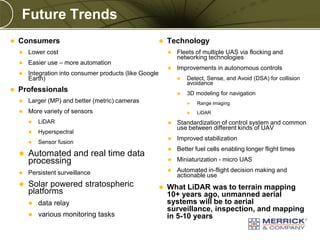
Future Trends


Consumers


Easier use – more automation





Lower cost





Integration into consumer products (like Google
Earth)

Technology


Fleets of multiple UAS via flocking and
networking technologies



Improvements in autonomous controls




Professionals

Detect, Sense, and Avoid (DSA) for collision
avoidance

3D modeling for navigation



Larger (MP) and better (metric) cameras



Range imaging



More variety of sensors



LiDAR



LiDAR



Hyperspectral



Sensor fusion





Solar powered stratospheric
platforms


data relay



various monitoring tasks

PREXXXX 23
Copyright © 2010 Merrick & Company All rights reserved.

Better fuel cells enabling longer flight times



Miniaturization - micro UAS





Improved stabilization



Persistent surveillance

Standardization of control system and common
use between different kinds of UAV



Automated and real time data
processing





Automated in-flight decision making and
actionable use

What LiDAR was to terrain mapping
10+ years ago, unmanned aerial
systems will be to aerial
surveillance, inspection, and mapping
in 5-10 years
Contact Information
Merrick & Company: www.merrick.com
Unmanned Airborne Services: www.merrick.com/uas
Bill Emison, Senior Account Manager
E-mail:

bill.emison@merrick.com

Tel:

(303) 353-3634

Twitter:

@Merrick_Geo

PREXXXX 24
Copyright © 2010 Merrick & Company All rights reserved.

Mapping with Unmanned Airborne Systems (UAS)

  • 1.
    Mapping with Unmanned Airborne Systems (UAS) February13, 2014 Engineering | Architecture | Design-Build | Surveying | GeoSpatial Solutions
  • 2.
    Today’s Agenda  Introductions Current / Objectives UAS Regulations (FAA)  UAS Components & Types  UAS Navigation  Sensor  UAS Payloads Software  Inspection / Surveillance vs. Mapping  UAS Outdoor Mapping Deliverables  UAS Indoor Mapping  Industry PREXXXX 2 Copyright © 2010 Merrick & Company All rights reserved. Forecast / Future Trends
  • 3.
    Today’s Objective Provide anobjective and practical review of current unmanned airborne mapping capabilities PREXXXX 3 Copyright © 2010 Merrick & Company All rights reserved.
  • 4.
    Corporate Overview  Corporate headquarters:Greenwood Village, Colorado  Founded in 1955; employee-owned  $110M annual revenue (FY13)  > 480 employees at 15 domestic + 4 international offices  Market Focus  Energy  National Security  Life Sciences  Sustainable Infrastructure  Market Sector Teams  Infrastructure (Geospatial, Survey, Water & Civil Engineering)  High Performance Facilities Energy  Life Sciences Nuclear Services & Technology PREXXXX 4 Copyright © 2010 Merrick & Company All rights reserved.
  • 5.
    Presenter Bio –Bill Emison • Senior Account Manager (Commercial Accounts) for the Geospatial Solutions (GSS) team • Also provide support as Corporate Communications Specialist for Sustainable Infrastructure team; MARS® Product Manager • Geospatial professional since 1993 with experience in solutions consulting; software & service sales; technical marketing and communications • Employed by Merrick’s GSS team since January 2006. PREXXXX 5 Copyright © 2010 Merrick & Company All rights reserved.
  • 6.
    UAS ≠ Drones PREXXXX6 Copyright © 2010 Merrick & Company All rights reserved.
  • 7.
    Jackass ALERT!!! FAA warnspublic against shooting guns at drones "Shooting at an unmanned aircraft could result in criminal or civil liability, just as would firing at a manned airplane." PREXXXX 7 Copyright © 2010 Merrick & Company All rights reserved.
  • 8.
    Current US (FAA)UAS Regulations  Currently, a Certificate of Authorization (COA) is required to operate an unmanned aerial vehicle (UAV) in US national airspace  Only federal, state, or local agencies are considered for COA awards  FAA test sites (proving grounds) have been awarded to Virginia, Texas, Alaska, New York, North Dakota and Nevada; will conduct critical research into the certification and operational requirements necessary to safely integrate UAS into the national airspace over the next several years  Remote Control (RC) hobbyists can operate remotely controlled vehicles for recreational uses only:   RC vehicle cannot exceed 400 feet above ground level (AGL)   Not allowed for commercial business use of any kind  cannot fly to make money! RC vehicle cannot interfere with any type of air traffic - must be flown away from airports and air traffic FAA Modernization and Reform Act of 2012 (H.R. 658)  Signed into law on February 14, 2012 by President Obama  This bill orders the FAA to figure out how to integrate commercial UAV usage into the U.S. National Airspace System (NAS)  Also under the bill, the FAA is required to provide military, commercial, and privately-owned drones with expanded access to U.S. airspace by Sep. 30, 2015  That means permitting unmanned drones controlled by remote operators on the ground--also called unmanned airborne systems (UAS) or unmanned aerial vehicles (UAVs)--to fly in the same airspace as airlines, cargo planes, business jets and private aircraft.  More information can be found at http://www.faa.gov/about/initiatives/uas/ PREXXXX 8 Copyright © 2010 Merrick & Company All rights reserved.
  • 9.
    UAS Components Aircraft Navigation System UnmannedAirborne Systems (UAS) Sensor PREXXXX 9 Copyright © 2010 Merrick & Company All rights reserved. Software
  • 10.
    UAS Types Fixed wing  Efficientfor area/site mapping  Typically flies racetrack or “mowing the yard” patterns  Best for persistent surveillance (orbital loitering) Rotary – helicopter or “multicopter” (ex. quad / hexa / octo copters)  Best for slow, stabilized collection  Efficient for corridor mapping Others – blimps, kites, gliders PREXXXX 10 Copyright © 2010 Merrick & Company All rights reserved.
  • 11.
    UAS Aircraft Comparisons PREXXXX11 Copyright © 2010 Merrick & Company All rights reserved.
  • 12.
    Hawkeye RQ-84Z www.hawkeyeuav.com PREXXXX 12 Copyright© 2010 Merrick & Company All rights reserved.
  • 13.
    UAS Navigation  Remotely controlled  Thirdperson view    requires constant line-of-sight not acceptable, too much risk First person view   “soda straw” view, still high risk for collision with obstruction (tree branch, power line, etc.) Pre-defined flight plan (auto pilot)   requires video transmission  Accurate digital surface models required Fully autonomous - detect, sense, and avoid (DSA) obstacles for collision avoidance PREXXXX 13 Copyright © 2010 Merrick & Company All rights reserved.
  • 14.
    UAS Sensor Payloads      Video Imagery Thermal Magnetometer Purposedriven remote sensing tools  Radioactive measurement  Gas detection  Acoustic detection  Signal detection  LiDAR PREXXXX 14 Copyright © 2010 Merrick & Company All rights reserved.
  • 15.
    USACE Buckeye LiDARUAS continued PREXXXX 15 Copyright © 2010 Merrick & Company All rights reserved.
  • 16.
    UAS Software Surveillance /Inspection Mapping Real-time video or image downlink Flight planning Flight controls Flight management Primary flight display Data download / coverage check Camera controls APM and AT Object tracking Surface model extraction Video stabilization Orthorectification Waypoint navigation Mosaicing Video or image post processing Analysis PREXXXX 16 Copyright © 2010 Merrick & Company All rights reserved.
  • 17.
    Surveillance / Inspectionvs. Mapping  Emphasis  Duration  Stabilization for zoom  Some transmit real-time video/imagery, others store for review later  More emphasis on image/video gathering, less on geographic placement of data  Typically used in situations that are dull, distant, or dangerous  Sensor types    Imagery Video Products  Non-georeferenced digital imagery  Non-georeferenced digital video  Possibly structure from motion (SFM) PREXXXX 17 Copyright © 2010 Merrick & Company All rights reserved.
  • 18.
    Surveillance / InspectionExamples PREXXXX 18 Copyright © 2010 Merrick & Company All rights reserved.
  • 19.
    UAS Outdoor Mapping  Fillingthe gap between traditional topo surveying and the medium and high altitude photogrammetry  Sensor types  Electro Optical (EO / RGB)    Small Format, Non-metric, Digital Cameras Medium Format, Metric, Digital Cameras Other Sensor Types   Multi-Spectral Imagery (MSI)  Thermal Infrared (TIR)  Hyperspectral Imaging (HSI)  Oblique Imagery   Color Infrared (CIR) Video Products  Orthophoto Mosaics (Ortho)  Digital Surface Model (DSM)  Planimetric Map Products  Change Detection  Volumetrics  3D Modeling PREXXXX 19 Copyright © 2010 Merrick & Company All rights reserved.
  • 20.
    UAS Outdoor MappingDeliverables PREXXXX 20 Copyright © 2010 Merrick & Company All rights reserved.
  • 21.
    UAS Indoor Mapping Autonomous Navigation  Simultaneous  Real-time  Detect, Localization and Mapping (SLAM) Sensor Processing Required Avoid, Collect  Minimize Occlusions  Products  3D Models  360° Panoramas  Point Clouds  CAD Files PREXXXX 21 Copyright © 2010 Merrick & Company All rights reserved.
  • 22.
    Industry Forecasts  Chris Anderson,Wired.com, June 2012: “All told, there are probably around 1,000 new personal drones that take to the sky every month (3D Robotics, a company I cofounded, is shipping more than 100 ArduPilot Megas a week); that figure rivals the drone sales of the world’s top aerospace companies (in units, of course, not dollars). And the personal drone industry is growing much faster.”  Teal Group market study – “World Unmanned Aerial Vehicle Systems – 2011” UAV spending is on pace to double during the next decade from current worldwide expenditures of $5.9 billion annually to $11.3 billion, totaling just more than $94 billion. The study suggests the United States will account for 77 percent of the research and development spending on UAV technology during the next decade and about 69 percent of the procurement. PREXXXX The UAV electro-optical/infrared sensors (EO/IRS) system market has entered a period of continuing steady growth. Teal Group estimates that U.S. spending alone on such systems will grow from $813 million in fiscal year 2011 to nearly $1.7 billion in fiscal year 2020. 22 Copyright © 2010 Merrick & Company All rights reserved.
  • 23.
    Future Trends  Consumers  Easier use– more automation   Lower cost   Integration into consumer products (like Google Earth) Technology  Fleets of multiple UAS via flocking and networking technologies  Improvements in autonomous controls   Professionals Detect, Sense, and Avoid (DSA) for collision avoidance 3D modeling for navigation  Larger (MP) and better (metric) cameras  Range imaging  More variety of sensors  LiDAR  LiDAR  Hyperspectral  Sensor fusion   Solar powered stratospheric platforms  data relay  various monitoring tasks PREXXXX 23 Copyright © 2010 Merrick & Company All rights reserved. Better fuel cells enabling longer flight times  Miniaturization - micro UAS   Improved stabilization  Persistent surveillance Standardization of control system and common use between different kinds of UAV  Automated and real time data processing   Automated in-flight decision making and actionable use What LiDAR was to terrain mapping 10+ years ago, unmanned aerial systems will be to aerial surveillance, inspection, and mapping in 5-10 years
  • 24.
    Contact Information Merrick &Company: www.merrick.com Unmanned Airborne Services: www.merrick.com/uas Bill Emison, Senior Account Manager E-mail: bill.emison@merrick.com Tel: (303) 353-3634 Twitter: @Merrick_Geo PREXXXX 24 Copyright © 2010 Merrick & Company All rights reserved.