aerial-photography-for-aerial-mapping
https://www.highexposure.com.au/aerial-photography-for-aerial-mapping/
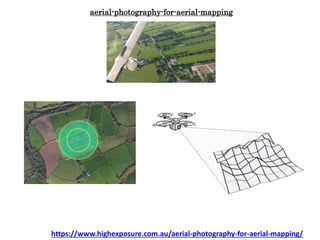
Aerial survey is a method of collecting geomatics or other imagery by
using airplanes, helicopters, UAVs, balloons or other aerial methods. Typical types of data
collected include aerial photography, Lidar, remote sensing (using various visible and invisible
bands of the electromagnetic spectrum, such as infrared, gamma, or ultraviolet) and also
geophysical data (such as aeromagnetic surveys and gravity. It can also refer to the chart or
map made by analysing a region from the air. Aerial survey should be distinguished
from satellite imagery technologies because of its better resolution, quality
and atmospheric conditions (which can negatively impact and obscure satellite observation).
Today, aerial survey is sometimes recognized as a synonym for aerophotogrammetry, part
of photogrammetry where the camera is placed in the air. Measurements on aerial images
are provided by photogrammetric technologies and methods.[1]
https://www.highexposure.com.au/aerial-photography-for-aerial-mapping/
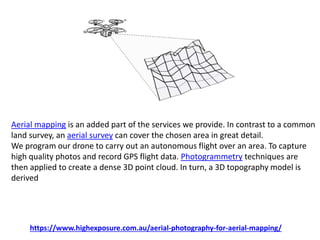
Aerial mapping is an added part of the services we provide. In contrast to a common
land survey, an aerial survey can cover the chosen area in great detail.
We program our drone to carry out an autonomous flight over an area. To capture
high quality photos and record GPS flight data. Photogrammetry techniques are
then applied to create a dense 3D point cloud. In turn, a 3D topography model is
derived
https://www.highexposure.com.au/aerial-photography-for-aerial-mapping/
Using drones to map an area is cost effective, providing high quality data for use in numerous
Geographical Information Systems (GIS), CAD software, planning and surveying tools.
The data can provide Orthophotos and Orthomosaic images (rectified images to align with
maps), 3D models as wireframe or textured, Digital Elevation Models and Digital Surface
Models, and Contour Maps produced to exact requirements. The data can be exported into a
wide range of formats for use in business.
Aerial Mapping Benefits
Aerial mapping using drones and photogrammetry provide access to the latest technology,
bringing together high resolution, GPS precision, ground control, precise distance, area and
volume measurements, 2D orthomaps that can be imported into a range of CAD and GIS
systems, 3D models for visualisation, and huge cost savings compared to outdated methods.
https://www.highexposure.com.au/aerial-photography-for-aerial-mapping/

Aerial photography-for-aerial-mapping

  • 1.
  • 2.
    Aerial survey isa method of collecting geomatics or other imagery by using airplanes, helicopters, UAVs, balloons or other aerial methods. Typical types of data collected include aerial photography, Lidar, remote sensing (using various visible and invisible bands of the electromagnetic spectrum, such as infrared, gamma, or ultraviolet) and also geophysical data (such as aeromagnetic surveys and gravity. It can also refer to the chart or map made by analysing a region from the air. Aerial survey should be distinguished from satellite imagery technologies because of its better resolution, quality and atmospheric conditions (which can negatively impact and obscure satellite observation). Today, aerial survey is sometimes recognized as a synonym for aerophotogrammetry, part of photogrammetry where the camera is placed in the air. Measurements on aerial images are provided by photogrammetric technologies and methods.[1] https://www.highexposure.com.au/aerial-photography-for-aerial-mapping/
  • 3.
    Aerial mapping isan added part of the services we provide. In contrast to a common land survey, an aerial survey can cover the chosen area in great detail. We program our drone to carry out an autonomous flight over an area. To capture high quality photos and record GPS flight data. Photogrammetry techniques are then applied to create a dense 3D point cloud. In turn, a 3D topography model is derived https://www.highexposure.com.au/aerial-photography-for-aerial-mapping/
  • 4.
    Using drones tomap an area is cost effective, providing high quality data for use in numerous Geographical Information Systems (GIS), CAD software, planning and surveying tools. The data can provide Orthophotos and Orthomosaic images (rectified images to align with maps), 3D models as wireframe or textured, Digital Elevation Models and Digital Surface Models, and Contour Maps produced to exact requirements. The data can be exported into a wide range of formats for use in business. Aerial Mapping Benefits Aerial mapping using drones and photogrammetry provide access to the latest technology, bringing together high resolution, GPS precision, ground control, precise distance, area and volume measurements, 2D orthomaps that can be imported into a range of CAD and GIS systems, 3D models for visualisation, and huge cost savings compared to outdated methods. https://www.highexposure.com.au/aerial-photography-for-aerial-mapping/