P.1 
Real 
Numbers 
Copyright © 2011 Pearson, Inc.
What you’ll learn about 
 Representing Real Numbers 
 Order and Interval Notation 
 Basic Properties of Algebra 
 Integer Exponents 
 Scientific Notation 
… and why 
These topics are fundamental in the study of 
mathematics and science. 
Copyright © 2011 Pearson, Inc. Slide P.1 - 2
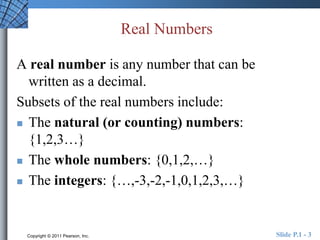
Real Numbers 
A real number is any number that can be 
written as a decimal. 
Subsets of the real numbers include: 
 The natural (or counting) numbers: 
{1,2,3…} 
 The whole numbers: {0,1,2,…} 
 The integers: {…,-3,-2,-1,0,1,2,3,…} 
Copyright © 2011 Pearson, Inc. Slide P.1 - 3
Rational Numbers 
Rational numbers can be represented as a ratio a/b 
where a and b are integers and b ≠ 0. We can describe 
rational numbers using set-builder notation: 
 a 
 
 a , b are integers, and b 
 0 
 
 b 
 
The decimal form of a rational number either 
terminates or is indefinitely repeating. 
A number is irrational if it is not rational. The decimal 
form of an irrational number is infinitely nonrepeating. 
Copyright © 2011 Pearson, Inc. Slide P.1 - 4
The Real Number Line 
Copyright © 2011 Pearson, Inc. Slide P.1 - 5
Order of Real Numbers 
Let a and b be any two real numbers. 
Symbol Definition Read 
a > b a – b is positive a is greater than b 
a < b a – b is negative a is less than b 
a ≥ b a – b is positive or zero a is greater than or 
equal to b 
a ≤ b a – b is negative or zero a is less than or 
equal to b 
The symbols >, <, ≥, and ≤ are inequality symbols. 
Copyright © 2011 Pearson, Inc. Slide P.1 - 6
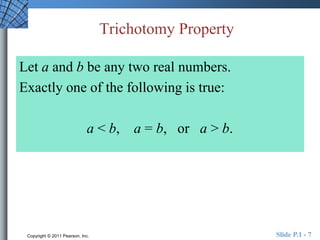
Trichotomy Property 
Let a and b be any two real numbers. 
Exactly one of the following is true: 
a < b, a = b, or a > b. 
Copyright © 2011 Pearson, Inc. Slide P.1 - 7
Example Interpreting Inequalities 
Describe and graph the interval of real numbers 
for –3 ≤ x < 5. 
Copyright © 2011 Pearson, Inc. Slide P.1 - 8
Example Interpreting Inequalities 
Describe and graph the interval of real numbers 
for –3 ≤ x < 5. 
The double inequality represents all real 
numbers between –3 and 5, including –3 
and excluding 5. 
Copyright © 2011 Pearson, Inc. Slide P.1 - 9
Bounded Intervals of Real Numbers 
Let a and b be real numbers with a < b. 
Interval Inequality Graph 
Notation Notation 
[a, b] a ≤ x ≤ b 
(a, b) a < x < b 
[a, b) a ≤ x < b 
(a, b] a < x ≤ b 
The numbers a and b are the endpoints of each interval. 
Copyright © 2011 Pearson, Inc. Slide P.1 - 10
Unbounded Intervals of Real Numbers 
Let a and b be real numbers. 
Interval Inequality Graph 
Notation Notation 
[a, ∞) x ≥ a 
(a, ∞) x > a 
(-∞, b] x ≤ b 
(-∞, b) x < b 
Each of these intervals has exactly one endpoint, 
namely a or b. 
Copyright © 2011 Pearson, Inc. Slide P.1 - 11
Properties of Algebra 
u v w 
Let , , and be real numbers, variables, or algebraic expressions. 
1. Communative Property 
u v v u 
Addition: 
Multiplication 
   
uv  
vu 
2. Associative Property 
u v w u v w 
Addition: (  )    (  
) 
Multiplication: ( uv ) 
w  
u 
( vw 
) 
3. Identity Property 
u u 
Addition: 0 
Multiplication: 1 
  
u   
u 
Copyright © 2011 Pearson, Inc. Slide P.1 - 12
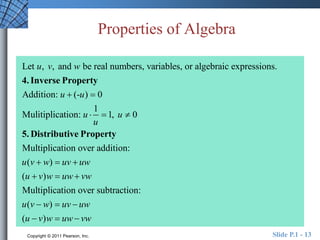
Properties of Algebra 
u v w 
Let , , and be real numbers, variables, or algebraic expressions. 
4. Inverse Property 
u u 
Addition: (- ) 0 
  
1 
u u 
Mulitiplication:   1,  
0 
u 
5. Distributive Property 
Multiplication over addition: 
( ) 
u v  w  uv  
uw 
u v w uw vw 
(  ) 
  
Multiplication over subtraction: 
( ) 
( ) 
u v  w  uv  
uw 
u  v w  uw  
vw 
Copyright © 2011 Pearson, Inc. Slide P.1 - 13
Example Using the Distributive 
Property 
Write the expanded form of (x + 3y)x . 
Write the factored form of 4z2 + 20z . 
Copyright © 2011 Pearson, Inc. Slide P.1 - 14
Example Using the Distributive 
Property 
Write the expanded form of (x + 3y)x . 
(x + 3y)x = x • x + 3y • x = x2 + 3xy 
Write the factored form of 4z2 + 20z . 
4z2 + 20z = 4z(z + 5) 
Copyright © 2011 Pearson, Inc. Slide P.1 - 15
Properties of the Additive Inverse 
u v w 
Let , , and be real numbers, variables, or algebraic expressions. 
Property Example 
u u 
u v u v uv 
1.  (  )   (  3)  
3 
2. (  )  (  )   (  4)3  4(  3)   
12 
u v uv 
u u 
u v u v 
3. (  )(  )  (  6)(  7)  
42 
4. (  1)   (  1)5   
5 
5.  (  )  (  )  (  )  (7  9)  (  7)  (  9)   
16 
Copyright © 2011 Pearson, Inc. Slide P.1 - 16
Exponential Notation 
a n 
Let be a real number, variable, or algebraic expression and 
a positive integer. Then where is the 
a n 
     
a a a a 
... , 
n factors 
n 
a a 
n 
, is the , and is the , 
exponent base nth power of a 
a 
read as " to 
the nth power." 
Copyright © 2011 Pearson, Inc. Slide P.1 - 17
Properties of Exponents 
Let u and v be a real numbers, variables, or algebraic expressions 
and m and n be integers. All bases are assumed to be nonzero. 
Property Example 
1. umun  um n 53 54  534  57 
2. 
um 
un 
 um n 
x9 
x4 
 x94  x5 
3. u0  1 80  1 
4. u- n  
1 
un 
y-3  
1 
y3 
5. (uv)m  umvm (2z)5  25 z5  32z5 
6. (um )n  umn (x2 )3  x23  x6 
7. 
u 
v 
 
  
 
  
m 
 
um 
vm 
a 
b 
 
  
 
  
7 
 
a7 
b7 
Copyright © 2011 Pearson, Inc. Slide P.1 - 18
Example Simplifying Expressions 
Involving Powers 
Simplify 
u2v3 
u1v2 . 
Copyright © 2011 Pearson, Inc. Slide P.1 - 19
Example Simplifying Expressions 
Involving Powers 
Simplify 
u2v3 
u1v2  
u2v3 
u1v2 . 
u2u1 
v2v3  
u3 
v5 
Copyright © 2011 Pearson, Inc. Slide P.1 - 20
Scientific Notation 
Any positive number can be written in scientific 
notation. 
c  10m , where 1 ≤ c < 10 and m is an integer. 
Copyright © 2011 Pearson, Inc. Slide P.1 - 21
Example Converting to Scientific 
Notation 
Convert 0.0000345 to scientific notation. 
Copyright © 2011 Pearson, Inc. Slide P.1 - 22
Example Converting to Scientific 
Notation 
Convert 0.0000345 to scientific notation. 
0.0000345  3.4510-5 
Copyright © 2011 Pearson, Inc. Slide P.1 - 23
Example Converting from Scientific 
Notation 
Convert 1.23 × 10⁵ from scientific notation. 
Copyright © 2011 Pearson, Inc. Slide P.1 - 24
Example Converting from Scientific 
Notation 
Convert 1.23 × 10⁵ from scientific notation. 
123,000 
Copyright © 2011 Pearson, Inc. Slide P.1 - 25
Quick Review 
1. List the positive integers between -4 and 4. 
2. List all negative integers greater than -4. 
3. Use a calculator to evaluate the expression 
2 4.5 3 
  
. Round the value to two decimal places. 
 
2.3  
4.5 
4. Eva 
luate the algebraic expression for the given values 
x 3 
x x 
of the variable. 2 1, 1,1.5 
5. List the possible remainders when the positive integer 
is divided by 6. 
Copyright © 2011 Pearson, Inc. Slide P.1 - 26 
n 
   
Quick Review Solutions 
  
  
1. List the positive integers between -4 and 4. 
2. List all negative integers greater than -4. 
3. Use a calculator to evaluate the expression 
2 4.5 3 
  
. Round the value to two deci 
 
2.3 4. 
1 
5 
,2,3 
-3,-2,-1 
 
mal places. 
2.73 
4. Evaluate the algebraic expression for the given values 
of the variable. x 3 
2 x 1, x 
1,1.5 
 -4, 
5.375 
 5. List the possible remainders when the positive integer 
i 
s divid 
ed by 6. 1,2, 
Copyright © 2011 Pearson, Inc. Slide P.1 - 27 
n 
 
 
   
3,4,5

P

  • 1.
    P.1 Real Numbers Copyright © 2011 Pearson, Inc.
  • 2.
    What you’ll learnabout  Representing Real Numbers  Order and Interval Notation  Basic Properties of Algebra  Integer Exponents  Scientific Notation … and why These topics are fundamental in the study of mathematics and science. Copyright © 2011 Pearson, Inc. Slide P.1 - 2
  • 3.
    Real Numbers Areal number is any number that can be written as a decimal. Subsets of the real numbers include:  The natural (or counting) numbers: {1,2,3…}  The whole numbers: {0,1,2,…}  The integers: {…,-3,-2,-1,0,1,2,3,…} Copyright © 2011 Pearson, Inc. Slide P.1 - 3
  • 4.
    Rational Numbers Rationalnumbers can be represented as a ratio a/b where a and b are integers and b ≠ 0. We can describe rational numbers using set-builder notation:  a   a , b are integers, and b  0   b  The decimal form of a rational number either terminates or is indefinitely repeating. A number is irrational if it is not rational. The decimal form of an irrational number is infinitely nonrepeating. Copyright © 2011 Pearson, Inc. Slide P.1 - 4
  • 5.
    The Real NumberLine Copyright © 2011 Pearson, Inc. Slide P.1 - 5
  • 6.
    Order of RealNumbers Let a and b be any two real numbers. Symbol Definition Read a > b a – b is positive a is greater than b a < b a – b is negative a is less than b a ≥ b a – b is positive or zero a is greater than or equal to b a ≤ b a – b is negative or zero a is less than or equal to b The symbols >, <, ≥, and ≤ are inequality symbols. Copyright © 2011 Pearson, Inc. Slide P.1 - 6
  • 7.
    Trichotomy Property Leta and b be any two real numbers. Exactly one of the following is true: a < b, a = b, or a > b. Copyright © 2011 Pearson, Inc. Slide P.1 - 7
  • 8.
    Example Interpreting Inequalities Describe and graph the interval of real numbers for –3 ≤ x < 5. Copyright © 2011 Pearson, Inc. Slide P.1 - 8
  • 9.
    Example Interpreting Inequalities Describe and graph the interval of real numbers for –3 ≤ x < 5. The double inequality represents all real numbers between –3 and 5, including –3 and excluding 5. Copyright © 2011 Pearson, Inc. Slide P.1 - 9
  • 10.
    Bounded Intervals ofReal Numbers Let a and b be real numbers with a < b. Interval Inequality Graph Notation Notation [a, b] a ≤ x ≤ b (a, b) a < x < b [a, b) a ≤ x < b (a, b] a < x ≤ b The numbers a and b are the endpoints of each interval. Copyright © 2011 Pearson, Inc. Slide P.1 - 10
  • 11.
    Unbounded Intervals ofReal Numbers Let a and b be real numbers. Interval Inequality Graph Notation Notation [a, ∞) x ≥ a (a, ∞) x > a (-∞, b] x ≤ b (-∞, b) x < b Each of these intervals has exactly one endpoint, namely a or b. Copyright © 2011 Pearson, Inc. Slide P.1 - 11
  • 12.
    Properties of Algebra u v w Let , , and be real numbers, variables, or algebraic expressions. 1. Communative Property u v v u Addition: Multiplication    uv  vu 2. Associative Property u v w u v w Addition: (  )    (  ) Multiplication: ( uv ) w  u ( vw ) 3. Identity Property u u Addition: 0 Multiplication: 1   u   u Copyright © 2011 Pearson, Inc. Slide P.1 - 12
  • 13.
    Properties of Algebra u v w Let , , and be real numbers, variables, or algebraic expressions. 4. Inverse Property u u Addition: (- ) 0   1 u u Mulitiplication:   1,  0 u 5. Distributive Property Multiplication over addition: ( ) u v  w  uv  uw u v w uw vw (  )   Multiplication over subtraction: ( ) ( ) u v  w  uv  uw u  v w  uw  vw Copyright © 2011 Pearson, Inc. Slide P.1 - 13
  • 14.
    Example Using theDistributive Property Write the expanded form of (x + 3y)x . Write the factored form of 4z2 + 20z . Copyright © 2011 Pearson, Inc. Slide P.1 - 14
  • 15.
    Example Using theDistributive Property Write the expanded form of (x + 3y)x . (x + 3y)x = x • x + 3y • x = x2 + 3xy Write the factored form of 4z2 + 20z . 4z2 + 20z = 4z(z + 5) Copyright © 2011 Pearson, Inc. Slide P.1 - 15
  • 16.
    Properties of theAdditive Inverse u v w Let , , and be real numbers, variables, or algebraic expressions. Property Example u u u v u v uv 1.  (  )   (  3)  3 2. (  )  (  )   (  4)3  4(  3)   12 u v uv u u u v u v 3. (  )(  )  (  6)(  7)  42 4. (  1)   (  1)5   5 5.  (  )  (  )  (  )  (7  9)  (  7)  (  9)   16 Copyright © 2011 Pearson, Inc. Slide P.1 - 16
  • 17.
    Exponential Notation an Let be a real number, variable, or algebraic expression and a positive integer. Then where is the a n      a a a a ... , n factors n a a n , is the , and is the , exponent base nth power of a a read as " to the nth power." Copyright © 2011 Pearson, Inc. Slide P.1 - 17
  • 18.
    Properties of Exponents Let u and v be a real numbers, variables, or algebraic expressions and m and n be integers. All bases are assumed to be nonzero. Property Example 1. umun  um n 53 54  534  57 2. um un  um n x9 x4  x94  x5 3. u0  1 80  1 4. u- n  1 un y-3  1 y3 5. (uv)m  umvm (2z)5  25 z5  32z5 6. (um )n  umn (x2 )3  x23  x6 7. u v       m  um vm a b       7  a7 b7 Copyright © 2011 Pearson, Inc. Slide P.1 - 18
  • 19.
    Example Simplifying Expressions Involving Powers Simplify u2v3 u1v2 . Copyright © 2011 Pearson, Inc. Slide P.1 - 19
  • 20.
    Example Simplifying Expressions Involving Powers Simplify u2v3 u1v2  u2v3 u1v2 . u2u1 v2v3  u3 v5 Copyright © 2011 Pearson, Inc. Slide P.1 - 20
  • 21.
    Scientific Notation Anypositive number can be written in scientific notation. c  10m , where 1 ≤ c < 10 and m is an integer. Copyright © 2011 Pearson, Inc. Slide P.1 - 21
  • 22.
    Example Converting toScientific Notation Convert 0.0000345 to scientific notation. Copyright © 2011 Pearson, Inc. Slide P.1 - 22
  • 23.
    Example Converting toScientific Notation Convert 0.0000345 to scientific notation. 0.0000345  3.4510-5 Copyright © 2011 Pearson, Inc. Slide P.1 - 23
  • 24.
    Example Converting fromScientific Notation Convert 1.23 × 10⁵ from scientific notation. Copyright © 2011 Pearson, Inc. Slide P.1 - 24
  • 25.
    Example Converting fromScientific Notation Convert 1.23 × 10⁵ from scientific notation. 123,000 Copyright © 2011 Pearson, Inc. Slide P.1 - 25
  • 26.
    Quick Review 1.List the positive integers between -4 and 4. 2. List all negative integers greater than -4. 3. Use a calculator to evaluate the expression 2 4.5 3   . Round the value to two decimal places.  2.3  4.5 4. Eva luate the algebraic expression for the given values x 3 x x of the variable. 2 1, 1,1.5 5. List the possible remainders when the positive integer is divided by 6. Copyright © 2011 Pearson, Inc. Slide P.1 - 26 n    
  • 27.
    Quick Review Solutions     1. List the positive integers between -4 and 4. 2. List all negative integers greater than -4. 3. Use a calculator to evaluate the expression 2 4.5 3   . Round the value to two deci  2.3 4. 1 5 ,2,3 -3,-2,-1  mal places. 2.73 4. Evaluate the algebraic expression for the given values of the variable. x 3 2 x 1, x 1,1.5  -4, 5.375  5. List the possible remainders when the positive integer i s divid ed by 6. 1,2, Copyright © 2011 Pearson, Inc. Slide P.1 - 27 n      3,4,5