Polynomials
Prepared by:
Pankaj Gahlot
PGT- MATHS
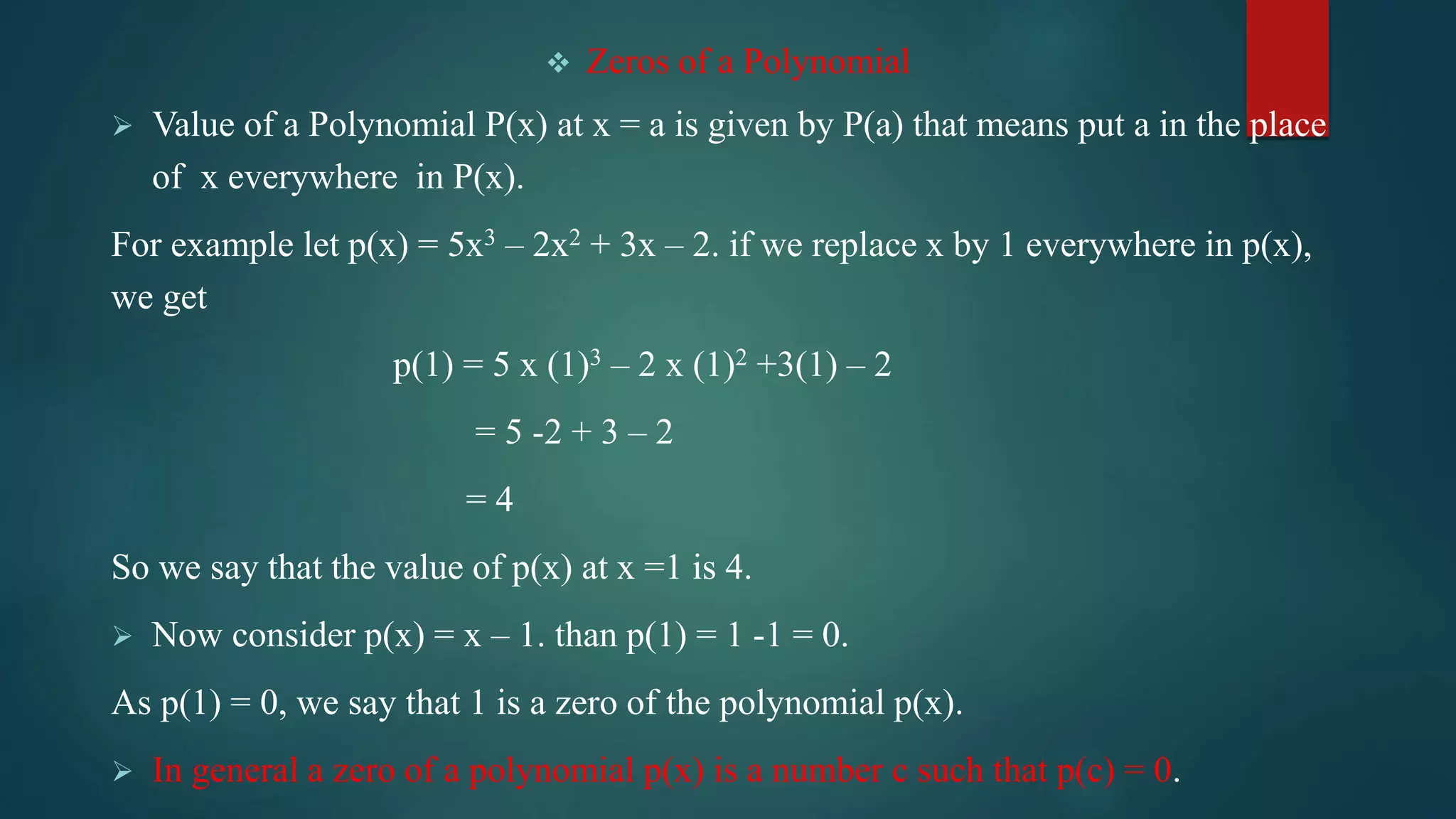
 Zeros of a Polynomial
 Value of a Polynomial P(x) at x = a is given by P(a) that means put a in the place
of x everywhere in P(x).
For example let p(x) = 5x3 – 2x2 + 3x – 2. if we replace x by 1 everywhere in p(x),
we get
p(1) = 5 x (1)3 – 2 x (1)2 +3(1) – 2
= 5 -2 + 3 – 2
= 4
So we say that the value of p(x) at x =1 is 4.
 Now consider p(x) = x – 1. than p(1) = 1 -1 = 0.
As p(1) = 0, we say that 1 is a zero of the polynomial p(x).
 In general a zero of a polynomial p(x) is a number c such that p(c) = 0.
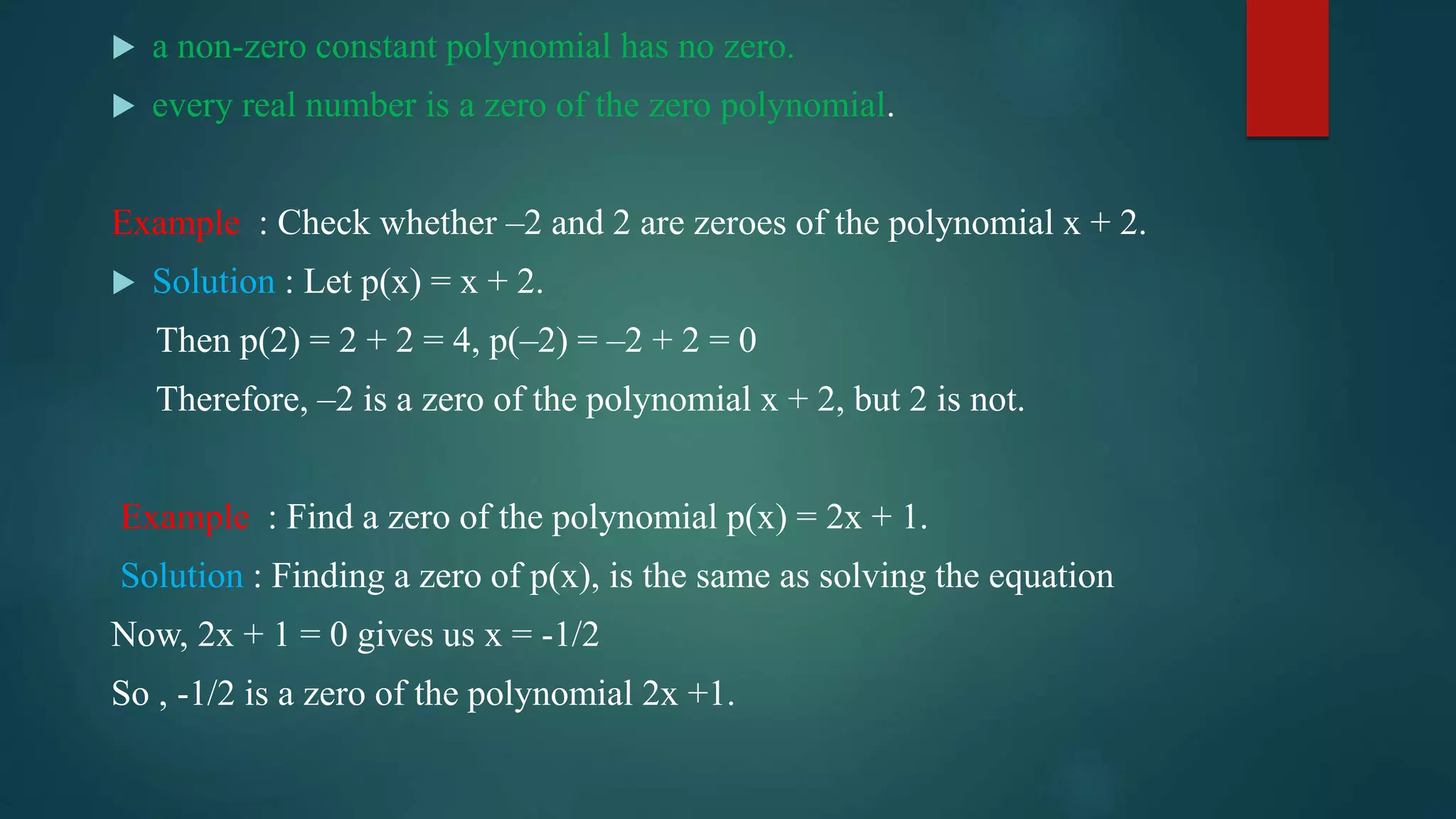
 a non-zero constant polynomial has no zero.
 every real number is a zero of the zero polynomial.
Example : Check whether –2 and 2 are zeroes of the polynomial x + 2.
 Solution : Let p(x) = x + 2.
Then p(2) = 2 + 2 = 4, p(–2) = –2 + 2 = 0
Therefore, –2 is a zero of the polynomial x + 2, but 2 is not.
Example : Find a zero of the polynomial p(x) = 2x + 1.
Solution : Finding a zero of p(x), is the same as solving the equation
Now, 2x + 1 = 0 gives us x = -1/2
So , -1/2 is a zero of the polynomial 2x +1.
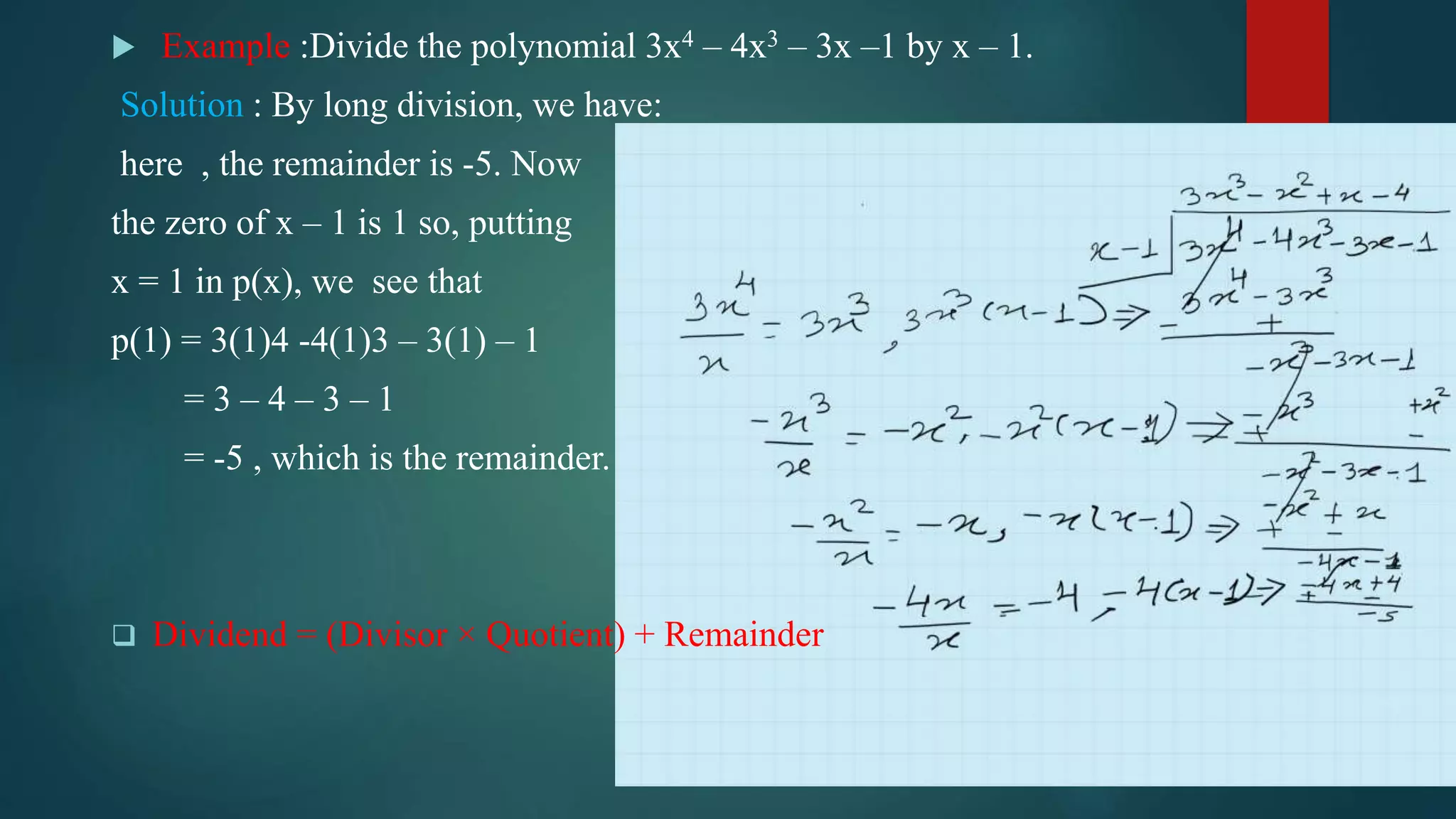
 Example :Divide the polynomial 3x4 – 4x3 – 3x –1 by x – 1.
Solution : By long division, we have:
here , the remainder is -5. Now
the zero of x – 1 is 1 so, putting
x = 1 in p(x), we see that
p(1) = 3(1)4 -4(1)3 – 3(1) – 1
= 3 – 4 – 3 – 1
= -5 , which is the remainder.
 Dividend = (Divisor × Quotient) + Remainder
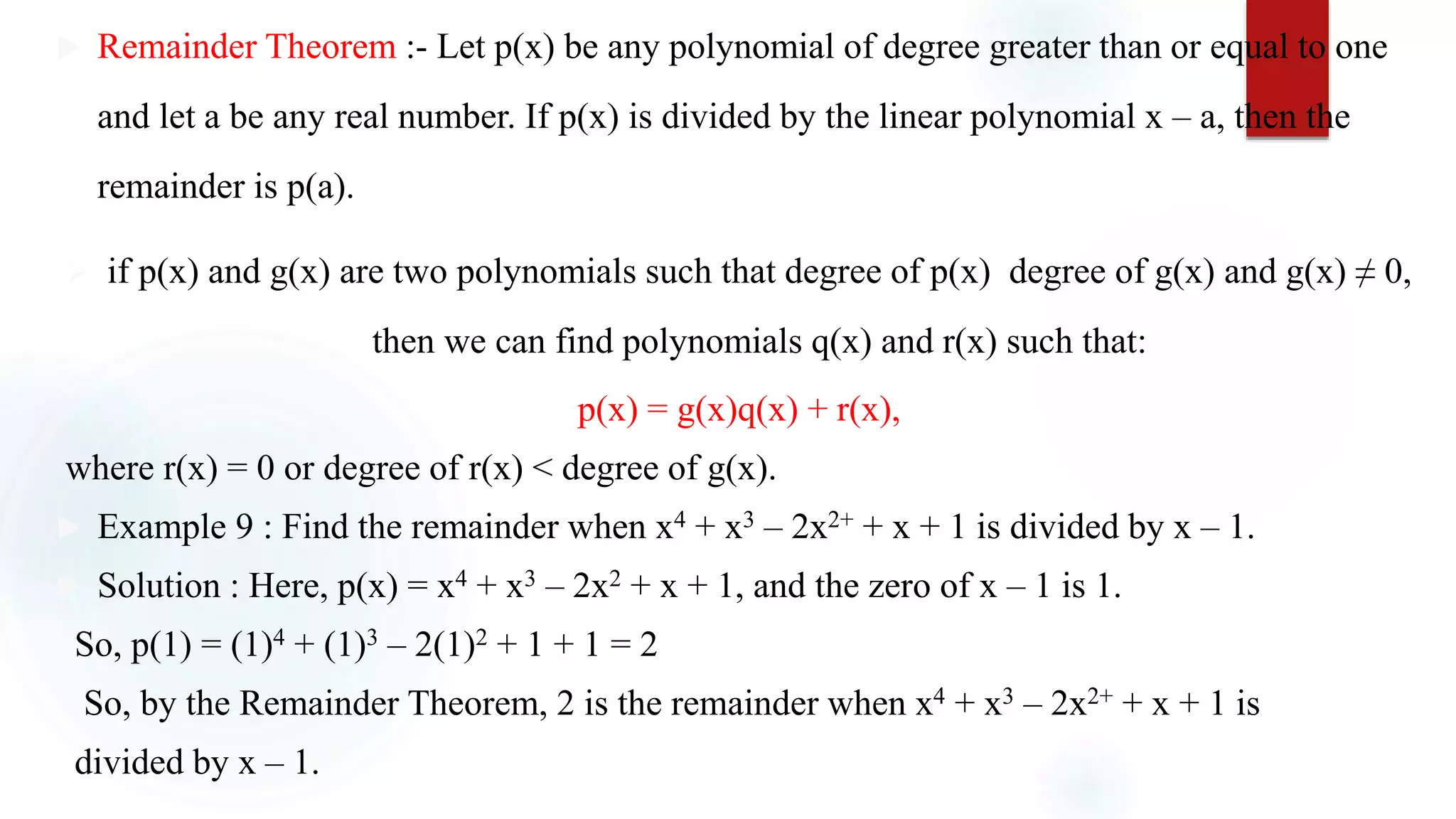
 Remainder Theorem :- Let p(x) be any polynomial of degree greater than or equal to one
and let a be any real number. If p(x) is divided by the linear polynomial x – a, then the
remainder is p(a).
 if p(x) and g(x) are two polynomials such that degree of p(x) degree of g(x) and g(x) ≠ 0,
then we can find polynomials q(x) and r(x) such that:
p(x) = g(x)q(x) + r(x),
where r(x) = 0 or degree of r(x) < degree of g(x).
 Example 9 : Find the remainder when x4 + x3 – 2x2+ + x + 1 is divided by x – 1.
 Solution : Here, p(x) = x4 + x3 – 2x2 + x + 1, and the zero of x – 1 is 1.
So, p(1) = (1)4 + (1)3 – 2(1)2 + 1 + 1 = 2
So, by the Remainder Theorem, 2 is the remainder when x4 + x3 – 2x2+ + x + 1 is
divided by x – 1.
 Factorisation of Polynomials
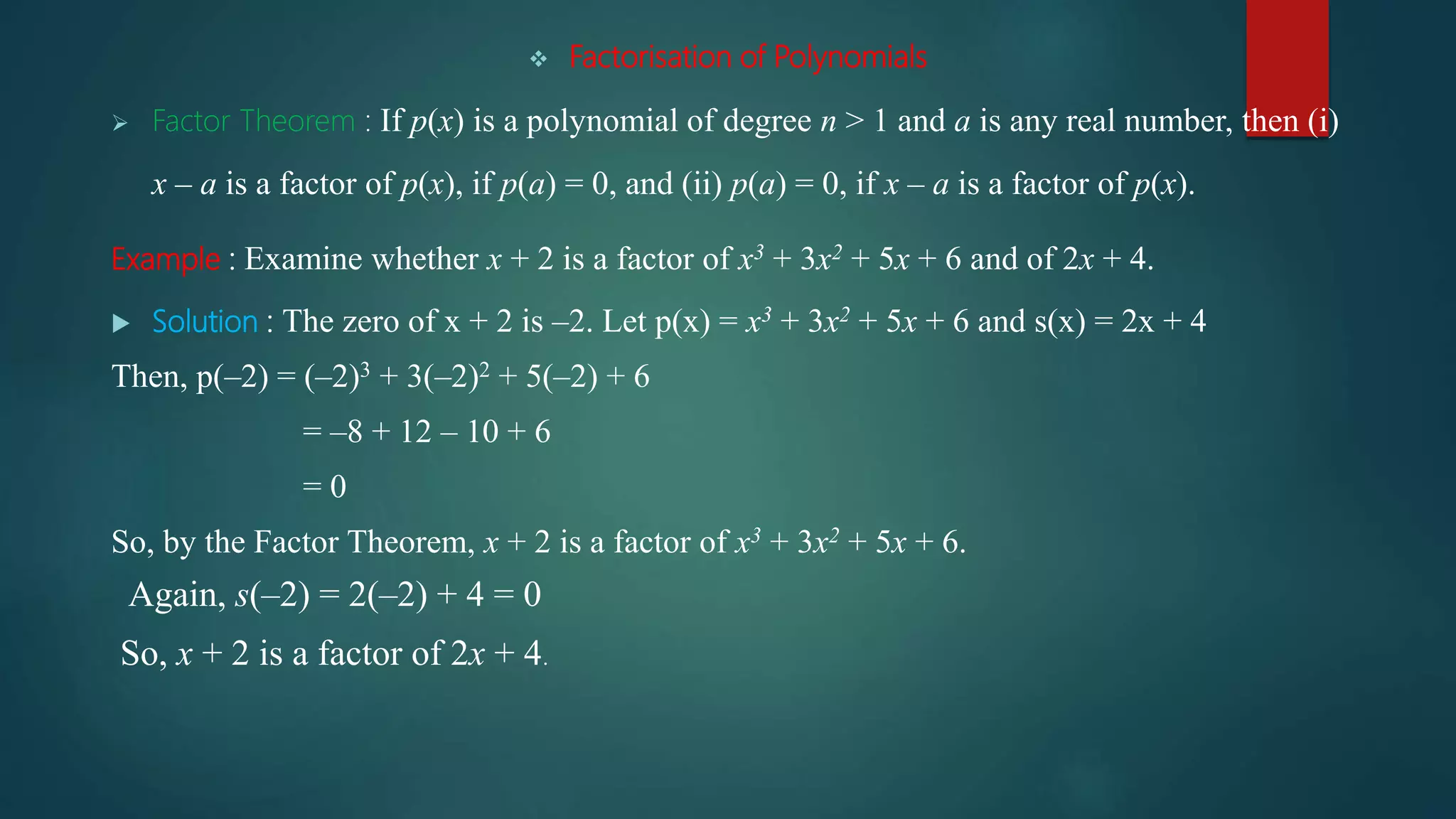
 Factor Theorem : If p(x) is a polynomial of degree n > 1 and a is any real number, then (i)
x – a is a factor of p(x), if p(a) = 0, and (ii) p(a) = 0, if x – a is a factor of p(x).
Example : Examine whether x + 2 is a factor of x3 + 3x2 + 5x + 6 and of 2x + 4.
 Solution : The zero of x + 2 is –2. Let p(x) = x3 + 3x2 + 5x + 6 and s(x) = 2x + 4
Then, p(–2) = (–2)3 + 3(–2)2 + 5(–2) + 6
= –8 + 12 – 10 + 6
= 0
So, by the Factor Theorem, x + 2 is a factor of x3 + 3x2 + 5x + 6.
Again, s(–2) = 2(–2) + 4 = 0
So, x + 2 is a factor of 2x + 4.
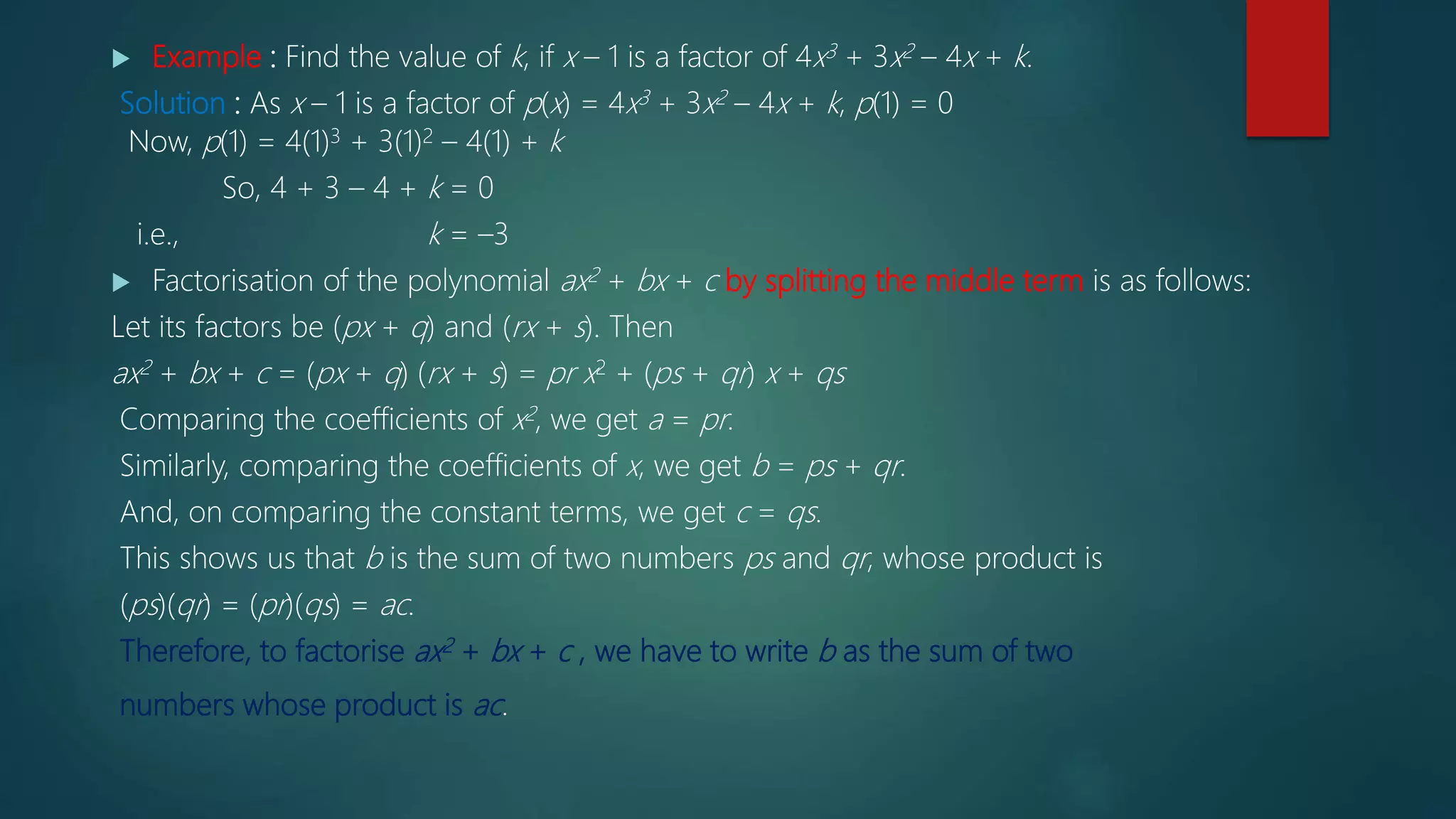
 Example : Find the value of k, if x – 1 is a factor of 4x3 + 3x2 – 4x + k.
Solution : As x – 1 is a factor of p(x) = 4x3 + 3x2 – 4x + k, p(1) = 0
Now, p(1) = 4(1)3 + 3(1)2 – 4(1) + k
So, 4 + 3 – 4 + k = 0
i.e., k = –3
 Factorisation of the polynomial ax2 + bx + c by splitting the middle term is as follows:
Let its factors be (px + q) and (rx + s). Then
ax2 + bx + c = (px + q) (rx + s) = pr x2 + (ps + qr) x + qs
Comparing the coefficients of x2, we get a = pr.
Similarly, comparing the coefficients of x, we get b = ps + qr.
And, on comparing the constant terms, we get c = qs.
This shows us that b is the sum of two numbers ps and qr, whose product is
(ps)(qr) = (pr)(qs) = ac.
Therefore, to factorise ax2 + bx + c , we have to write b as the sum of two
numbers whose product is ac.
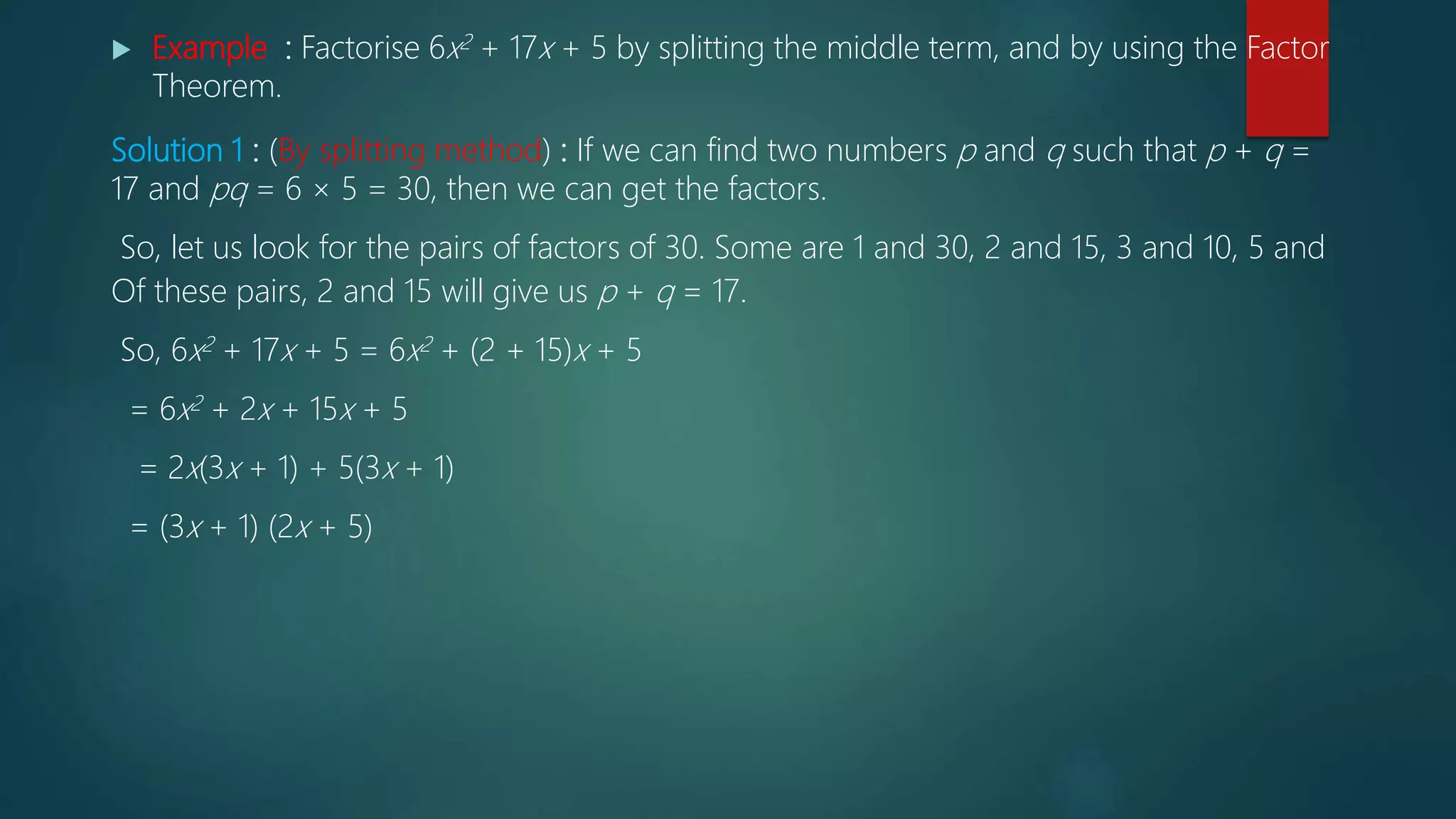
 Example : Factorise 6x2 + 17x + 5 by splitting the middle term, and by using the Factor
Theorem.
Solution 1 : (By splitting method) : If we can find two numbers p and q such that p + q =
17 and pq = 6 × 5 = 30, then we can get the factors.
So, let us look for the pairs of factors of 30. Some are 1 and 30, 2 and 15, 3 and 10, 5 and
Of these pairs, 2 and 15 will give us p + q = 17.
So, 6x2 + 17x + 5 = 6x2 + (2 + 15)x + 5
= 6x2 + 2x + 15x + 5
= 2x(3x + 1) + 5(3x + 1)
= (3x + 1) (2x + 5)
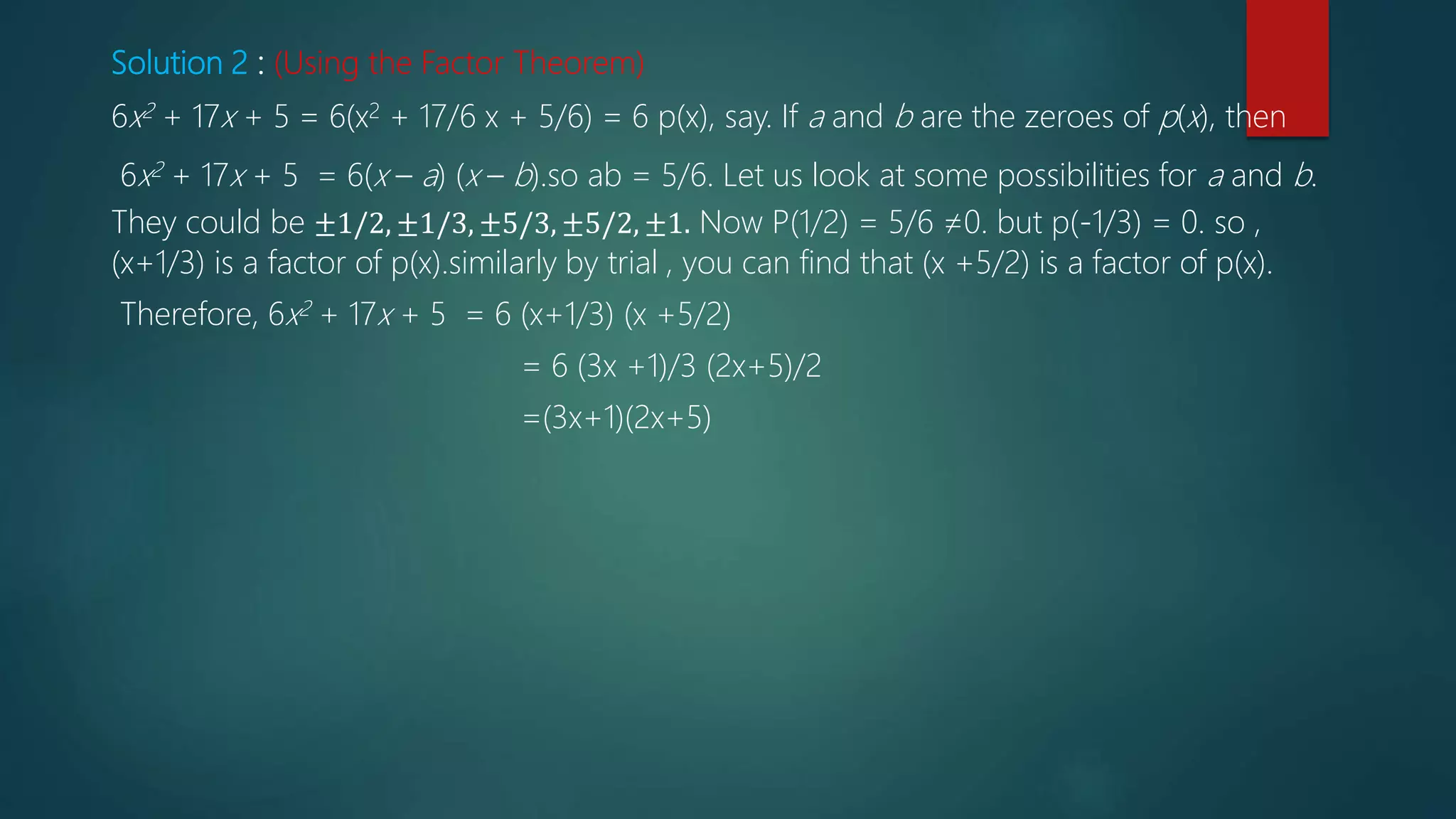
Solution 2 : (Using the Factor Theorem)
6x2 + 17x + 5 = 6(x2 + 17/6 x + 5/6) = 6 p(x), say. If a and b are the zeroes of p(x), then
6x2 + 17x + 5 = 6(x – a) (x – b).so ab = 5/6. Let us look at some possibilities for a and b.
They could be ±1/2, ±1/3, ±5/3, ±5/2, ±1. Now P(1/2) = 5/6 ≠0. but p(-1/3) = 0. so ,
(x+1/3) is a factor of p(x).similarly by trial , you can find that (x +5/2) is a factor of p(x).
Therefore, 6x2 + 17x + 5 = 6 (x+1/3) (x +5/2)
= 6 (3x +1)/3 (2x+5)/2
=(3x+1)(2x+5)
 Algebraic Identities:
 Identity I : (x + y)2 = x2+ + 2xy + y2
 Identity II : (x – y)2 = x2 – 2xy + y2
 Identity III : x2 – y2 = (x + y) (x – y)
 Identity IV : (x + a) (x + b) = x2 + (a + b)x + ab
Example : Find the following products using appropriate identities:
(i) (x + 3) (x + 3) (ii) (x – 3) (x + 5)
Solution : (i) Here we can use Identity I : (x + y)2 = x2+ + 2xy + y2. Putting y = 3 in it,
we get
(x + 3) (x + 3) = (x + 3)2 = x2 + 2(x)(3) + (3)2
= x2 + 6x + 9
(ii) Using Identity IV above, i.e., (x + a) (x + b) = x2 + (a + b)x + ab, we have
(x – 3) (x + 5) = x2 + (–3 + 5)x + (–3)(5)
= x2 + 2x – 15
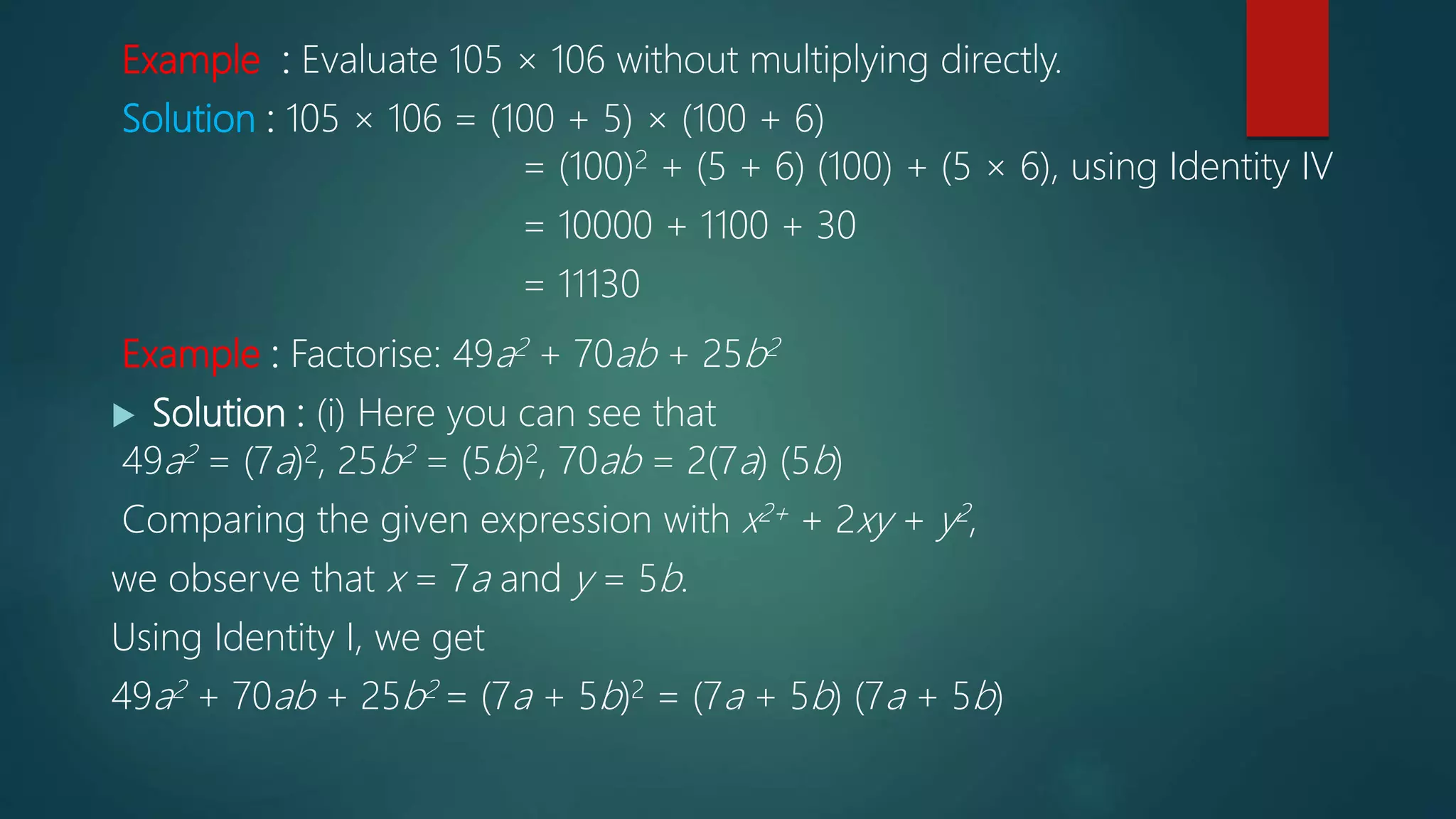
Example : Evaluate 105 × 106 without multiplying directly.
Solution : 105 × 106 = (100 + 5) × (100 + 6)
= (100)2 + (5 + 6) (100) + (5 × 6), using Identity IV
= 10000 + 1100 + 30
= 11130
Example : Factorise: 49a2 + 70ab + 25b2
 Solution : (i) Here you can see that
49a2 = (7a)2, 25b2 = (5b)2, 70ab = 2(7a) (5b)
Comparing the given expression with x2+ + 2xy + y2,
we observe that x = 7a and y = 5b.
Using Identity I, we get
49a2 + 70ab + 25b2 = (7a + 5b)2 = (7a + 5b) (7a + 5b)
 Identity V : (x + y + z)2= x2 + y2 + z2 + 2xy + 2yz + 2zx
 Identity VI : (x + y)3 = x3 + y3 + 3xy (x + y)
 Identity VII : (x - y)3 = x3 - y3 - 3xy (x - y)
 Identity VIII : x3 + y3 + z3 – 3xyz = (x + y + z)(x2 + y2 + z2 – xy – yz – zx)
Example : Expand (4a – 2b – 3c)2.
Solution : Using Identity V, we have
(4a – 2b – 3c)2 = [4a + (–2b) + (–3c)]2
= (4a)2 + (–2b)2 + (–3c)2 + 2(4a)(–2b) + 2(–2b)(–3c) + 2(–3c)(4a)
= 16a2 + 4b2 + 9c2 – 16ab + 12bc – 24ac
Example : Factorise 4x2 + y2 + z2 – 4xy – 2yz + 4xz.
Solution : We have 4x2 + y2 + z2 – 4xy – 2yz + 4xz = (2x)2 + (–y)2 + (z)2 + 2(2x)(–y)+ 2(–y)(z)
+ 2(2x)(z)
= [2x + (–y) + z]2 (Using Identity V)
= (2x – y + z)2 = (2x – y + z)(2x – y + z)
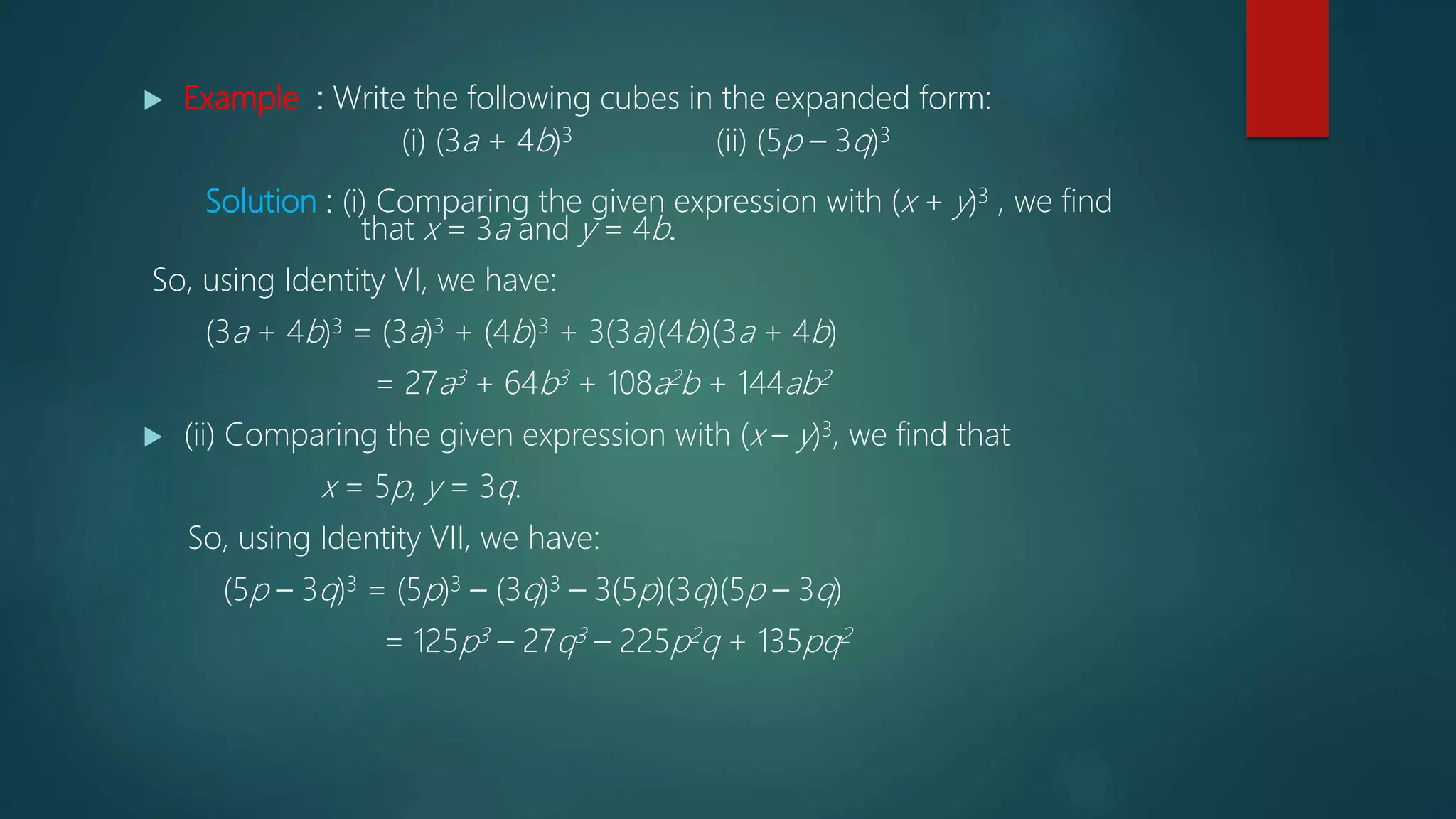
 Example : Write the following cubes in the expanded form:
(i) (3a + 4b)3 (ii) (5p – 3q)3
Solution : (i) Comparing the given expression with (x + y)3 , we find
that x = 3a and y = 4b.
So, using Identity VI, we have:
(3a + 4b)3 = (3a)3 + (4b)3 + 3(3a)(4b)(3a + 4b)
= 27a3 + 64b3 + 108a2b + 144ab2
 (ii) Comparing the given expression with (x – y)3, we find that
x = 5p, y = 3q.
So, using Identity VII, we have:
(5p – 3q)3 = (5p)3 – (3q)3 – 3(5p)(3q)(5p – 3q)
= 125p3 – 27q3 – 225p2q + 135pq2
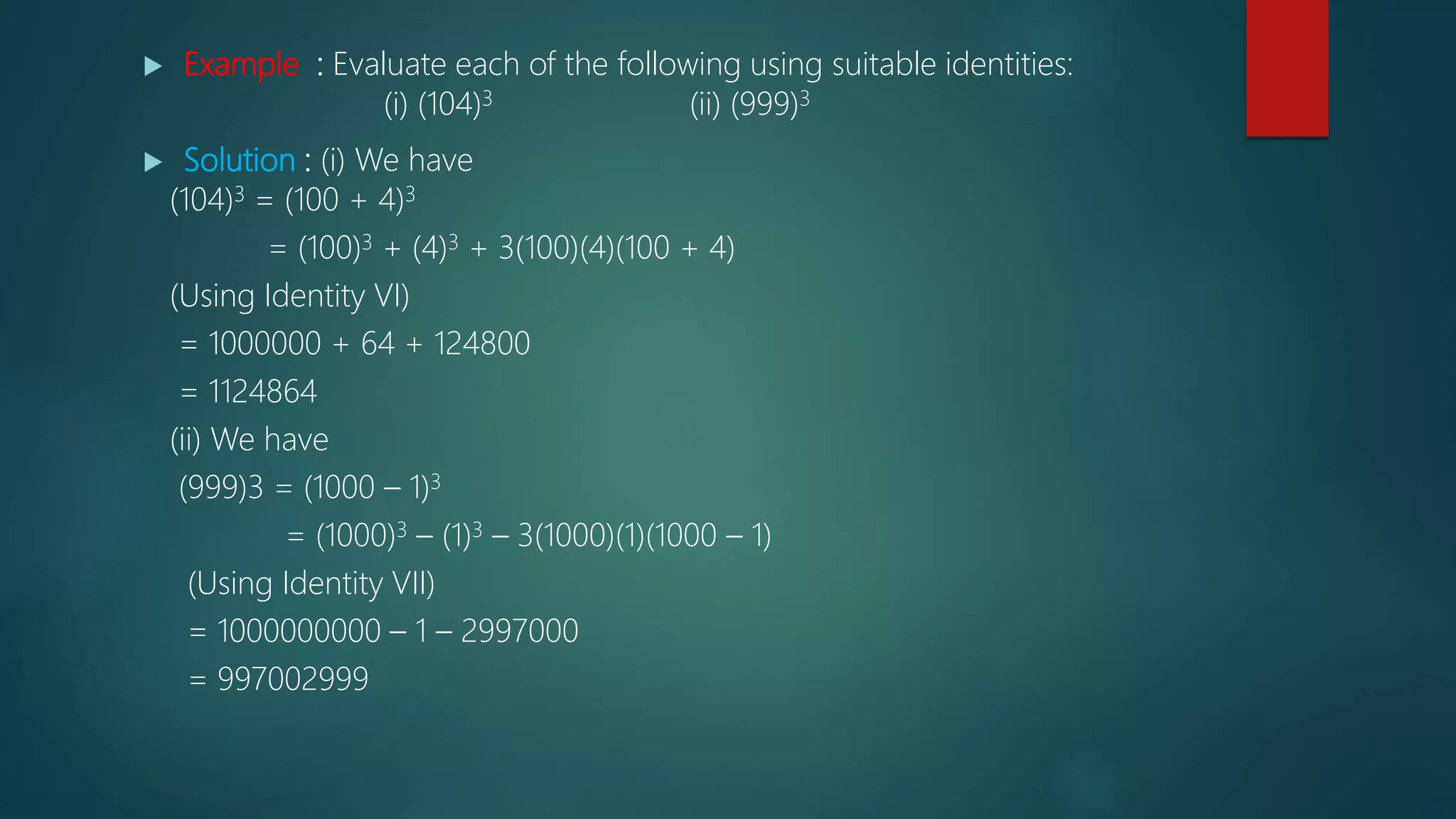
 Example : Evaluate each of the following using suitable identities:
(i) (104)3 (ii) (999)3
 Solution : (i) We have
(104)3 = (100 + 4)3
= (100)3 + (4)3 + 3(100)(4)(100 + 4)
(Using Identity VI)
= 1000000 + 64 + 124800
= 1124864
(ii) We have
(999)3 = (1000 – 1)3
= (1000)3 – (1)3 – 3(1000)(1)(1000 – 1)
(Using Identity VII)
= 1000000000 – 1 – 2997000
= 997002999
 Example : Factorise 8x3 + 27y3 + 36x2y + 54xy2
Solution : The given expression can be written as
(2x)3 + (3y)3 + 3(4x2)(3y) + 3(2x)(9y2)
= (2x)3 + (3y)3 + 3(2x)2(3y) + 3(2x)(3y)2
= (2x + 3y)3 (Using Identity VI)
= (2x + 3y)(2x + 3y)(2x + 3y)
Example : Factorise : 8x3 + y3 + 27z3 – 18xyz
Solution : Here, we have
8x3 + y3 + 27z3 – 18xyz
= (2x)3 + y3 + (3z)3 – 3(2x)(y)(3z)
= (2x + y + 3z)[(2x)2 + y2 + (3z)2 – (2x)(y) – (y)(3z) – (2x)(3z)] (Using the Identity VIII)
= (2x + y + 3z) (4x2 + y2 + 9z2 – 2xy – 3yz – 6xz)
Thank You

NCERT Class 9 Maths Polynomials

  • 1.
  • 2.
     Zeros ofa Polynomial  Value of a Polynomial P(x) at x = a is given by P(a) that means put a in the place of x everywhere in P(x). For example let p(x) = 5x3 – 2x2 + 3x – 2. if we replace x by 1 everywhere in p(x), we get p(1) = 5 x (1)3 – 2 x (1)2 +3(1) – 2 = 5 -2 + 3 – 2 = 4 So we say that the value of p(x) at x =1 is 4.  Now consider p(x) = x – 1. than p(1) = 1 -1 = 0. As p(1) = 0, we say that 1 is a zero of the polynomial p(x).  In general a zero of a polynomial p(x) is a number c such that p(c) = 0.
  • 3.
     a non-zeroconstant polynomial has no zero.  every real number is a zero of the zero polynomial. Example : Check whether –2 and 2 are zeroes of the polynomial x + 2.  Solution : Let p(x) = x + 2. Then p(2) = 2 + 2 = 4, p(–2) = –2 + 2 = 0 Therefore, –2 is a zero of the polynomial x + 2, but 2 is not. Example : Find a zero of the polynomial p(x) = 2x + 1. Solution : Finding a zero of p(x), is the same as solving the equation Now, 2x + 1 = 0 gives us x = -1/2 So , -1/2 is a zero of the polynomial 2x +1.
  • 4.
     Example :Dividethe polynomial 3x4 – 4x3 – 3x –1 by x – 1. Solution : By long division, we have: here , the remainder is -5. Now the zero of x – 1 is 1 so, putting x = 1 in p(x), we see that p(1) = 3(1)4 -4(1)3 – 3(1) – 1 = 3 – 4 – 3 – 1 = -5 , which is the remainder.  Dividend = (Divisor × Quotient) + Remainder
  • 5.
     Remainder Theorem:- Let p(x) be any polynomial of degree greater than or equal to one and let a be any real number. If p(x) is divided by the linear polynomial x – a, then the remainder is p(a).  if p(x) and g(x) are two polynomials such that degree of p(x) degree of g(x) and g(x) ≠ 0, then we can find polynomials q(x) and r(x) such that: p(x) = g(x)q(x) + r(x), where r(x) = 0 or degree of r(x) < degree of g(x).  Example 9 : Find the remainder when x4 + x3 – 2x2+ + x + 1 is divided by x – 1.  Solution : Here, p(x) = x4 + x3 – 2x2 + x + 1, and the zero of x – 1 is 1. So, p(1) = (1)4 + (1)3 – 2(1)2 + 1 + 1 = 2 So, by the Remainder Theorem, 2 is the remainder when x4 + x3 – 2x2+ + x + 1 is divided by x – 1.
  • 6.
     Factorisation ofPolynomials  Factor Theorem : If p(x) is a polynomial of degree n > 1 and a is any real number, then (i) x – a is a factor of p(x), if p(a) = 0, and (ii) p(a) = 0, if x – a is a factor of p(x). Example : Examine whether x + 2 is a factor of x3 + 3x2 + 5x + 6 and of 2x + 4.  Solution : The zero of x + 2 is –2. Let p(x) = x3 + 3x2 + 5x + 6 and s(x) = 2x + 4 Then, p(–2) = (–2)3 + 3(–2)2 + 5(–2) + 6 = –8 + 12 – 10 + 6 = 0 So, by the Factor Theorem, x + 2 is a factor of x3 + 3x2 + 5x + 6. Again, s(–2) = 2(–2) + 4 = 0 So, x + 2 is a factor of 2x + 4.
  • 7.
     Example :Find the value of k, if x – 1 is a factor of 4x3 + 3x2 – 4x + k. Solution : As x – 1 is a factor of p(x) = 4x3 + 3x2 – 4x + k, p(1) = 0 Now, p(1) = 4(1)3 + 3(1)2 – 4(1) + k So, 4 + 3 – 4 + k = 0 i.e., k = –3  Factorisation of the polynomial ax2 + bx + c by splitting the middle term is as follows: Let its factors be (px + q) and (rx + s). Then ax2 + bx + c = (px + q) (rx + s) = pr x2 + (ps + qr) x + qs Comparing the coefficients of x2, we get a = pr. Similarly, comparing the coefficients of x, we get b = ps + qr. And, on comparing the constant terms, we get c = qs. This shows us that b is the sum of two numbers ps and qr, whose product is (ps)(qr) = (pr)(qs) = ac. Therefore, to factorise ax2 + bx + c , we have to write b as the sum of two numbers whose product is ac.
  • 8.
     Example :Factorise 6x2 + 17x + 5 by splitting the middle term, and by using the Factor Theorem. Solution 1 : (By splitting method) : If we can find two numbers p and q such that p + q = 17 and pq = 6 × 5 = 30, then we can get the factors. So, let us look for the pairs of factors of 30. Some are 1 and 30, 2 and 15, 3 and 10, 5 and Of these pairs, 2 and 15 will give us p + q = 17. So, 6x2 + 17x + 5 = 6x2 + (2 + 15)x + 5 = 6x2 + 2x + 15x + 5 = 2x(3x + 1) + 5(3x + 1) = (3x + 1) (2x + 5)
  • 9.
    Solution 2 :(Using the Factor Theorem) 6x2 + 17x + 5 = 6(x2 + 17/6 x + 5/6) = 6 p(x), say. If a and b are the zeroes of p(x), then 6x2 + 17x + 5 = 6(x – a) (x – b).so ab = 5/6. Let us look at some possibilities for a and b. They could be ±1/2, ±1/3, ±5/3, ±5/2, ±1. Now P(1/2) = 5/6 ≠0. but p(-1/3) = 0. so , (x+1/3) is a factor of p(x).similarly by trial , you can find that (x +5/2) is a factor of p(x). Therefore, 6x2 + 17x + 5 = 6 (x+1/3) (x +5/2) = 6 (3x +1)/3 (2x+5)/2 =(3x+1)(2x+5)
  • 10.
     Algebraic Identities: Identity I : (x + y)2 = x2+ + 2xy + y2  Identity II : (x – y)2 = x2 – 2xy + y2  Identity III : x2 – y2 = (x + y) (x – y)  Identity IV : (x + a) (x + b) = x2 + (a + b)x + ab Example : Find the following products using appropriate identities: (i) (x + 3) (x + 3) (ii) (x – 3) (x + 5) Solution : (i) Here we can use Identity I : (x + y)2 = x2+ + 2xy + y2. Putting y = 3 in it, we get (x + 3) (x + 3) = (x + 3)2 = x2 + 2(x)(3) + (3)2 = x2 + 6x + 9 (ii) Using Identity IV above, i.e., (x + a) (x + b) = x2 + (a + b)x + ab, we have (x – 3) (x + 5) = x2 + (–3 + 5)x + (–3)(5) = x2 + 2x – 15
  • 11.
    Example : Evaluate105 × 106 without multiplying directly. Solution : 105 × 106 = (100 + 5) × (100 + 6) = (100)2 + (5 + 6) (100) + (5 × 6), using Identity IV = 10000 + 1100 + 30 = 11130 Example : Factorise: 49a2 + 70ab + 25b2  Solution : (i) Here you can see that 49a2 = (7a)2, 25b2 = (5b)2, 70ab = 2(7a) (5b) Comparing the given expression with x2+ + 2xy + y2, we observe that x = 7a and y = 5b. Using Identity I, we get 49a2 + 70ab + 25b2 = (7a + 5b)2 = (7a + 5b) (7a + 5b)
  • 12.
     Identity V: (x + y + z)2= x2 + y2 + z2 + 2xy + 2yz + 2zx  Identity VI : (x + y)3 = x3 + y3 + 3xy (x + y)  Identity VII : (x - y)3 = x3 - y3 - 3xy (x - y)  Identity VIII : x3 + y3 + z3 – 3xyz = (x + y + z)(x2 + y2 + z2 – xy – yz – zx) Example : Expand (4a – 2b – 3c)2. Solution : Using Identity V, we have (4a – 2b – 3c)2 = [4a + (–2b) + (–3c)]2 = (4a)2 + (–2b)2 + (–3c)2 + 2(4a)(–2b) + 2(–2b)(–3c) + 2(–3c)(4a) = 16a2 + 4b2 + 9c2 – 16ab + 12bc – 24ac Example : Factorise 4x2 + y2 + z2 – 4xy – 2yz + 4xz. Solution : We have 4x2 + y2 + z2 – 4xy – 2yz + 4xz = (2x)2 + (–y)2 + (z)2 + 2(2x)(–y)+ 2(–y)(z) + 2(2x)(z) = [2x + (–y) + z]2 (Using Identity V) = (2x – y + z)2 = (2x – y + z)(2x – y + z)
  • 13.
     Example :Write the following cubes in the expanded form: (i) (3a + 4b)3 (ii) (5p – 3q)3 Solution : (i) Comparing the given expression with (x + y)3 , we find that x = 3a and y = 4b. So, using Identity VI, we have: (3a + 4b)3 = (3a)3 + (4b)3 + 3(3a)(4b)(3a + 4b) = 27a3 + 64b3 + 108a2b + 144ab2  (ii) Comparing the given expression with (x – y)3, we find that x = 5p, y = 3q. So, using Identity VII, we have: (5p – 3q)3 = (5p)3 – (3q)3 – 3(5p)(3q)(5p – 3q) = 125p3 – 27q3 – 225p2q + 135pq2
  • 14.
     Example :Evaluate each of the following using suitable identities: (i) (104)3 (ii) (999)3  Solution : (i) We have (104)3 = (100 + 4)3 = (100)3 + (4)3 + 3(100)(4)(100 + 4) (Using Identity VI) = 1000000 + 64 + 124800 = 1124864 (ii) We have (999)3 = (1000 – 1)3 = (1000)3 – (1)3 – 3(1000)(1)(1000 – 1) (Using Identity VII) = 1000000000 – 1 – 2997000 = 997002999
  • 15.
     Example :Factorise 8x3 + 27y3 + 36x2y + 54xy2 Solution : The given expression can be written as (2x)3 + (3y)3 + 3(4x2)(3y) + 3(2x)(9y2) = (2x)3 + (3y)3 + 3(2x)2(3y) + 3(2x)(3y)2 = (2x + 3y)3 (Using Identity VI) = (2x + 3y)(2x + 3y)(2x + 3y) Example : Factorise : 8x3 + y3 + 27z3 – 18xyz Solution : Here, we have 8x3 + y3 + 27z3 – 18xyz = (2x)3 + y3 + (3z)3 – 3(2x)(y)(3z) = (2x + y + 3z)[(2x)2 + y2 + (3z)2 – (2x)(y) – (y)(3z) – (2x)(3z)] (Using the Identity VIII) = (2x + y + 3z) (4x2 + y2 + 9z2 – 2xy – 3yz – 6xz)
  • 16.