• Identify the different operation on functions.
• Solve problems involving functions
• Define piecewise function
Piecewise
Prepared by: Mr. Dane Andrei V. Aguinaldo
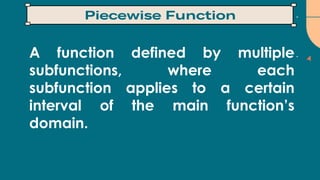
A function defined by multiple
subfunctions, where each
subfunction applies to a certain
interval of the main function’s
domain.
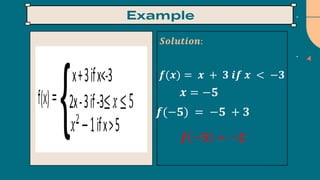
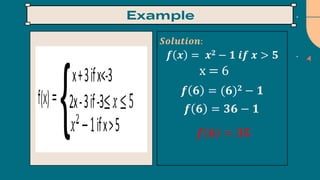
𝑺𝒐𝒍𝒖𝒕𝒊𝒐𝒏:
𝒇(𝒙) = 𝒙 + 𝟑 𝒊𝒇 𝒙 < −𝟑
𝒙 = −𝟓
𝒇(−𝟓) = −𝟓 + 𝟑
𝒇 −𝟓 = −𝟐
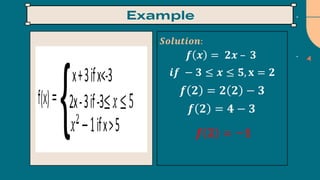
𝑺𝒐𝒍𝒖𝒕𝒊𝒐𝒏:
𝒇 𝒙 = 𝟐𝒙 – 𝟑
𝒊𝒇 − 𝟑 ≤ 𝒙 ≤ 𝟓, 𝐱 = 𝟐
𝒇 𝟐 = 𝟐 𝟐 − 𝟑
𝒇 𝟐 = −𝟏
𝒇 𝟐 = 𝟒 − 𝟑
𝑺𝒐𝒍𝒖𝒕𝒊𝒐𝒏:
𝒇 𝒙 = 𝒙𝟐 − 𝟏 𝒊𝒇 𝒙 > 𝟓
𝒇 𝟔 = (𝟔)𝟐 − 𝟏
𝒇 𝟔 = 𝟑𝟓
𝒇 𝟔 = 𝟑𝟔 − 𝟏
x = 6
Operation on
Prepared by: Mr. Dane Andrei V. Aguinaldo
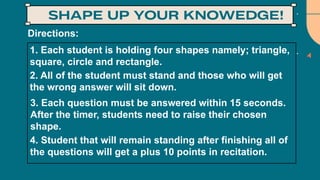
Directions:
1. Each student is holding four shapes namely; triangle,
square, circle and rectangle.
3. Each question must be answered within 15 seconds.
After the timer, students need to raise their chosen
shape.
2. All of the student must stand and those who will get
the wrong answer will sit down.
4. Student that will remain standing after finishing all of
the questions will get a plus 10 points in recitation.
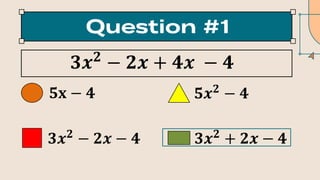
𝟑𝒙𝟐
− 𝟐𝒙 + 𝟒𝒙 − 𝟒
𝟓𝐱 − 𝟒 𝟓𝒙𝟐
− 𝟒
𝟑𝒙𝟐
− 𝟐𝒙 − 𝟒 𝟑𝒙𝟐
+ 𝟐𝒙 − 𝟒
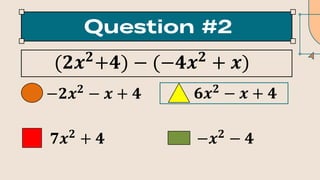
(𝟐𝒙𝟐
+𝟒) − (−𝟒𝒙𝟐
+ 𝒙)
−𝟐𝒙𝟐
− 𝒙 + 𝟒 𝟔𝒙𝟐
− 𝒙 + 𝟒
𝟕𝒙𝟐
+ 𝟒 −𝒙𝟐
− 𝟒
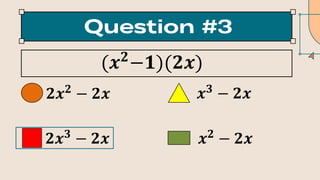
(𝒙𝟐
−𝟏)(𝟐𝒙)
𝟐𝒙𝟐
− 𝟐𝒙 𝒙𝟑
− 𝟐𝒙
𝟐𝒙𝟑
− 𝟐𝒙 𝒙𝟐
− 𝟐𝒙
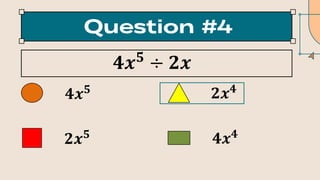
𝟒𝒙𝟓
÷ 𝟐𝒙
𝟒𝒙𝟓 𝟐𝒙𝟒
𝟐𝒙𝟓 𝟒𝒙𝟒
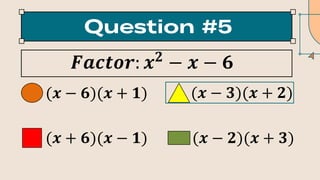
𝑭𝒂𝒄𝒕𝒐𝒓: 𝒙𝟐
− 𝒙 − 𝟔
(𝒙 − 𝟔)(𝒙 + 𝟏) (𝒙 − 𝟑)(𝒙 + 𝟐)
(𝒙 + 𝟔)(𝒙 − 𝟏) (𝒙 − 𝟐)(𝒙 + 𝟑)
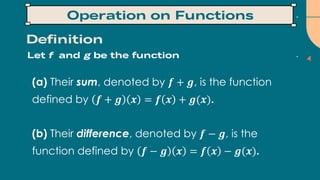
(a) Their sum, denoted by 𝒇 + 𝒈, is the function
defined by 𝒇 + 𝒈 𝒙 = 𝒇 𝒙 + 𝒈(𝒙).
(b) Their difference, denoted by 𝒇 − 𝒈, is the
function defined by 𝒇 − 𝒈 𝒙 = 𝒇 𝒙 − 𝒈(𝒙).
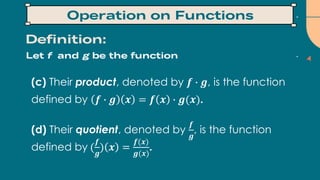
(c) Their product, denoted by 𝒇 ∙ 𝒈, is the function
defined by 𝒇 ∙ 𝒈 𝒙 = 𝒇 𝒙 ∙ 𝒈(𝒙).
(d) Their quotient, denoted by
𝒇
𝒈
, is the function
defined by (
𝒇
𝒈
) 𝒙 =
𝒇(𝒙)
𝒈(𝒙)
.
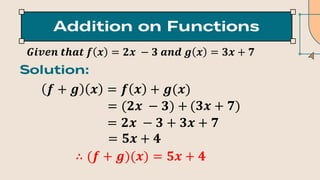
𝑮𝒊𝒗𝒆𝒏 𝒕𝒉𝒂𝒕 𝒇 𝒙 = 𝟐𝒙 − 𝟑 𝒂𝒏𝒅 𝒈 𝒙 = 𝟑𝒙 + 𝟕
𝒇 + 𝒈 𝒙 = 𝒇 𝒙 + 𝒈(𝒙)
= (𝟐𝒙 − 𝟑) +
= 𝟐𝒙 − 𝟑 + 𝟑𝒙 + 𝟕
= 𝟓𝒙
∴ (𝒇 + 𝒈)(𝒙) = 𝟓𝒙 + 𝟒
(𝟑𝒙 + 𝟕)
+ 𝟒
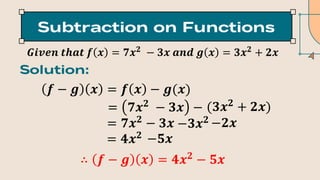
𝑮𝒊𝒗𝒆𝒏 𝒕𝒉𝒂𝒕 𝒇 𝒙 = 𝟕𝒙𝟐
− 𝟑𝒙 𝒂𝒏𝒅 𝒈 𝒙 = 𝟑𝒙𝟐
+ 𝟐𝒙
𝒇 − 𝒈 𝒙 = 𝒇 𝒙 − 𝒈(𝒙)
= 𝟕𝒙𝟐
− 𝟑𝒙 −
= 𝟕𝒙𝟐
− 𝟑𝒙
= 𝟒𝒙𝟐
∴ 𝒇 − 𝒈 𝒙 = 𝟒𝒙𝟐
− 𝟓𝒙
−𝟑𝒙𝟐 −𝟐𝒙
(𝟑𝒙𝟐
+ 𝟐𝒙)
−𝟓𝒙
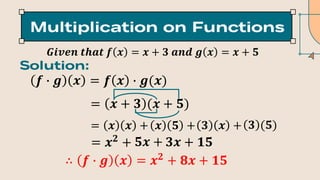
𝑮𝒊𝒗𝒆𝒏 𝒕𝒉𝒂𝒕 𝒇 𝒙 = 𝒙 + 𝟑 𝒂𝒏𝒅 𝒈 𝒙 = 𝒙 + 𝟓
𝒇 ∙ 𝒈 𝒙 = 𝒇 𝒙 ∙ 𝒈(𝒙)
= 𝒙 + 𝟑 (𝒙 + 𝟓)
∴ 𝒇 ∙ 𝒈 𝒙 = 𝒙𝟐
+ 𝟖𝒙 + 𝟏𝟓
= 𝒙𝟐
+
= 𝒙 𝒙 + 𝒙 𝟓 + 𝟑 𝒙 + 𝟑 (𝟓)
𝟓𝒙 + 𝟑𝒙 + 𝟏𝟓
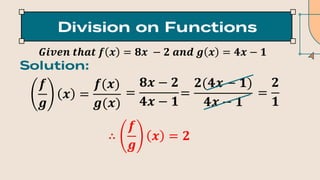
𝑮𝒊𝒗𝒆𝒏 𝒕𝒉𝒂𝒕 𝒇 𝒙 = 𝟖𝒙 − 𝟐 𝒂𝒏𝒅 𝒈 𝒙 = 𝟒𝒙 − 𝟏
𝒇
𝒈
𝒙 =
𝒇(𝒙)
𝒈(𝒙)
∴
𝒇
𝒈
𝒙 = 𝟐
=
𝟖𝒙 − 𝟐
𝟒𝒙 − 𝟏
=
𝟐(𝟒𝒙 − 𝟏)
𝟒𝒙 − 𝟏
=
𝟐
𝟏
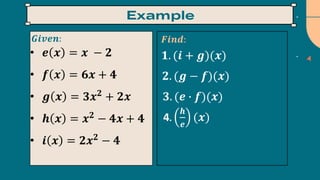
• 𝒆 𝒙 = 𝒙 − 𝟐
• 𝒇 𝒙 = 𝟔𝒙 + 𝟒
• 𝒈 𝒙 = 𝟑𝒙𝟐
+ 𝟐𝒙
• 𝒉 𝒙 = 𝒙𝟐
− 𝟒𝒙 + 𝟒
• 𝒊 𝒙 = 𝟐𝒙𝟐
− 𝟒
𝑮𝒊𝒗𝒆𝒏: 𝑭𝒊𝒏𝒅:
𝟏. (𝒊 + 𝒈)(𝒙)
𝟐. (𝒈 − 𝒇)(𝒙)
𝟑. (𝒆 ∙ 𝒇)(𝒙)
4.
𝒉
𝒆
(𝒙)
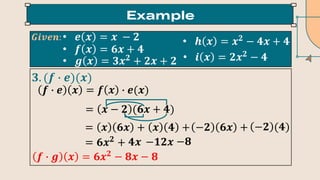
• 𝒆 𝒙 = 𝒙 − 𝟐
• 𝒇 𝒙 = 𝟔𝒙 + 𝟒
• 𝒈 𝒙 = 𝟑𝒙𝟐
+ 𝟐𝒙 + 𝟐
• 𝒉 𝒙 = 𝒙𝟐
− 𝟒𝒙 + 𝟒
• 𝒊 𝒙 = 𝟐𝒙𝟐
− 𝟒
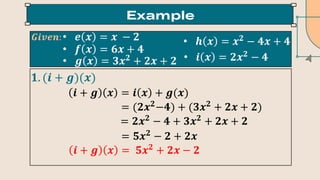
𝑮𝒊𝒗𝒆𝒏:
𝟏. (𝒊 + 𝒈)(𝒙)
𝒊 + 𝒈 𝒙 = 𝒊 𝒙 + 𝒈(𝒙)
= (𝟐𝒙𝟐
−𝟒) + (𝟑𝒙𝟐
+ 𝟐𝒙 + 𝟐)
= 𝟐𝒙𝟐
− 𝟒 + 𝟑𝒙𝟐
+ 𝟐𝒙 + 𝟐
= 𝟓𝒙𝟐
− 𝟐 + 𝟐𝒙
𝒊 + 𝒈 𝒙 = 𝟓𝒙𝟐
+ 𝟐𝒙 − 𝟐
• 𝒆 𝒙 = 𝒙 − 𝟐
• 𝒇 𝒙 = 𝟔𝒙 + 𝟒
• 𝒈 𝒙 = 𝟑𝒙𝟐
+ 𝟐𝒙 + 𝟐
• 𝒉 𝒙 = 𝒙𝟐
− 𝟒𝒙 + 𝟒
• 𝒊 𝒙 = 𝟐𝒙𝟐
− 𝟒
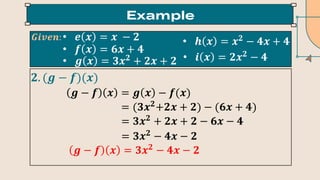
𝑮𝒊𝒗𝒆𝒏:
𝟐. (𝒈 − 𝒇)(𝒙)
𝒈 − 𝒇 𝒙 = 𝒈 𝒙 − 𝒇(𝒙)
= (𝟑𝒙𝟐
+𝟐𝒙 + 𝟐) − (𝟔𝒙 + 𝟒)
= 𝟑𝒙𝟐
+ 𝟐𝒙 + 𝟐 − 𝟔𝒙 − 𝟒
= 𝟑𝒙𝟐
− 𝟒𝒙 − 𝟐
𝒈 − 𝒇 𝒙 = 𝟑𝒙𝟐
− 𝟒𝒙 − 𝟐
• 𝒆 𝒙 = 𝒙 − 𝟐
• 𝒇 𝒙 = 𝟔𝒙 + 𝟒
• 𝒈 𝒙 = 𝟑𝒙𝟐
+ 𝟐𝒙 + 𝟐
• 𝒉 𝒙 = 𝒙𝟐
− 𝟒𝒙 + 𝟒
• 𝒊 𝒙 = 𝟐𝒙𝟐
− 𝟒
𝑮𝒊𝒗𝒆𝒏:
𝟑. (𝒇 ∙ 𝒆)(𝒙)
𝒇 ∙ 𝒆 𝒙 = 𝒇 𝒙 ∙ 𝒆(𝒙)
= 𝒙 − 𝟐 (𝟔𝒙 + 𝟒)
= 𝒙 𝟔𝒙 + 𝒙 𝟒 + −𝟐 𝟔𝒙 + −𝟐 (𝟒)
= 𝟔𝒙𝟐
+ 𝟒𝒙 −𝟏𝟐𝒙 −𝟖
𝒇 ∙ 𝒈 𝒙 = 𝟔𝒙𝟐
− 𝟖𝒙 − 𝟖
• 𝒆 𝒙 = 𝒙 − 𝟐
• 𝒇 𝒙 = 𝟔𝒙 + 𝟒
• 𝒈 𝒙 = 𝟑𝒙𝟐
+ 𝟐𝒙 + 𝟐
• 𝒉 𝒙 = 𝒙𝟐
− 𝟒𝒙 + 𝟒
• 𝒊 𝒙 = 𝟐𝒙𝟐
− 𝟒
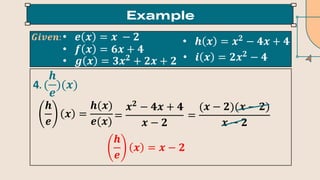
𝑮𝒊𝒗𝒆𝒏:
4. (
𝒉
𝒆
)(𝒙)
𝒉
𝒆
𝒙 =
𝒉(𝒙)
𝒆(𝒙)
𝒉
𝒆
𝒙 = 𝒙 − 𝟐
=
𝒙𝟐
− 𝟒𝒙 + 𝟒
𝒙 − 𝟐
=
(𝒙 − 𝟐)(𝒙 − 𝟐)
𝒙 − 𝟐
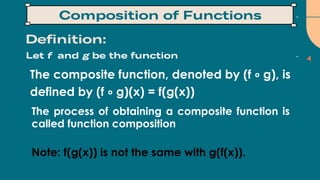
The composite function, denoted by (f ∘ g), is
defined by (f ∘ g)(x) = f(g(x))
The process of obtaining a composite function is
called function composition
Note: f(g(x)) is not the same with g(f(x)).
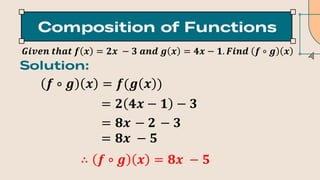
𝑮𝒊𝒗𝒆𝒏 𝒕𝒉𝒂𝒕 𝒇 𝒙 = 𝟐𝒙 − 𝟑 𝒂𝒏𝒅 𝒈 𝒙 = 𝟒𝒙 − 𝟏. 𝑭𝒊𝒏𝒅 𝒇 ∘ 𝒈 𝒙
𝒇 ∘ 𝒈 𝒙 = 𝒇(𝒈 𝒙 )
∴ 𝒇 ∘ 𝒈 𝒙 = 𝟖𝒙 − 𝟓
= 𝟐 𝟒𝒙 − 𝟏 − 𝟑
= 𝟖𝒙 − 𝟐 − 𝟑
= 𝟖𝒙 − 𝟓
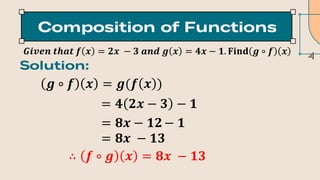
𝑮𝒊𝒗𝒆𝒏 𝒕𝒉𝒂𝒕 𝒇 𝒙 = 𝟐𝒙 − 𝟑 𝒂𝒏𝒅 𝒈 𝒙 = 𝟒𝒙 − 𝟏. 𝐅𝐢𝐧𝐝 𝒈 ∘ 𝒇 𝒙
𝒈 ∘ 𝒇 𝒙 = 𝒈(𝒇 𝒙 )
∴ 𝒇 ∘ 𝒈 𝒙 = 𝟖𝒙 − 𝟏𝟑
= 𝟒 𝟐𝒙 − 𝟑 − 𝟏
= 𝟖𝒙 − 𝟏𝟐− 𝟏
= 𝟖𝒙 − 𝟏𝟑
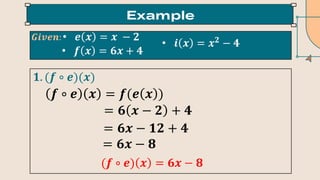
• 𝒆 𝒙 = 𝒙 − 𝟐
• 𝒇 𝒙 = 𝟔𝒙 + 𝟒
• 𝒊 𝒙 = 𝒙𝟐
− 𝟒
𝑮𝒊𝒗𝒆𝒏:
𝟏. (𝒇 ∘ 𝒆)(𝒙)
(𝒇 ∘ 𝒆) 𝒙 = 𝟔𝒙 − 𝟖
𝒇 ∘ 𝒆 𝒙 = 𝒇(𝒆 𝒙 )
= 𝟔 𝒙 − 𝟐 + 𝟒
= 𝟔𝒙 − 𝟏𝟐 + 𝟒
= 𝟔𝒙 − 𝟖
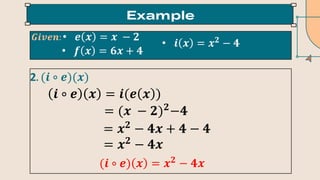
• 𝒆 𝒙 = 𝒙 − 𝟐
• 𝒇 𝒙 = 𝟔𝒙 + 𝟒
• 𝒊 𝒙 = 𝒙𝟐
− 𝟒
𝑮𝒊𝒗𝒆𝒏:
2. (𝒊 ∘ 𝒆)(𝒙)
(𝒊 ∘ 𝒆) 𝒙 = 𝒙𝟐
− 𝟒𝒙
𝒊 ∘ 𝒆 𝒙 = 𝒊(𝒆 𝒙 )
= (𝒙 − 𝟐)𝟐
−𝟒
= 𝒙𝟐
− 𝟒𝒙 + 𝟒 − 𝟒
= 𝒙𝟐
− 𝟒𝒙
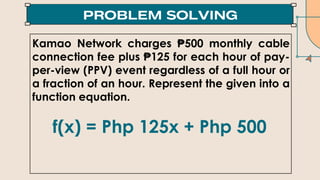
Kamao Network charges ₱500 monthly cable
connection fee plus ₱125 for each hour of pay-
per-view (PPV) event regardless of a full hour or
a fraction of an hour. Represent the given into a
function equation.
f(x) = Php 125x + Php 500
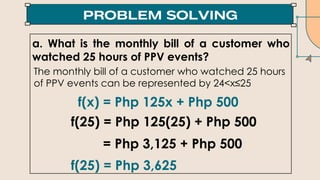
a. What is the monthly bill of a customer who
watched 25 hours of PPV events?
f(x) = Php 125x + Php 500
f(25) = Php 125(25) + Php 500
= Php 3,125 + Php 500
f(25) = Php 3,625
The monthly bill of a customer who watched 25 hours
of PPV events can be represented by 24<x≤25
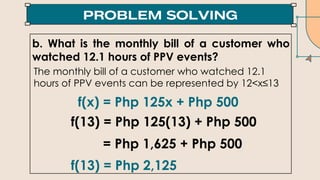
b. What is the monthly bill of a customer who
watched 12.1 hours of PPV events?
f(x) = Php 125x + Php 500
f(13) = Php 125(13) + Php 500
= Php 1,625 + Php 500
f(13) = Php 2,125
The monthly bill of a customer who watched 12.1
hours of PPV events can be represented by 12<x≤13
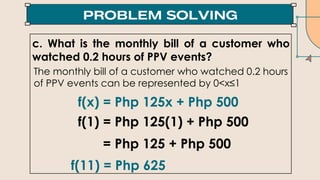
c. What is the monthly bill of a customer who
watched 0.2 hours of PPV events?
f(x) = Php 125x + Php 500
f(1) = Php 125(1) + Php 500
= Php 125 + Php 500
f(11) = Php 625
The monthly bill of a customer who watched 0.2 hours
of PPV events can be represented by 0<x≤1
Week-2-Operation-on-Functions-Genmathg11

Week-2-Operation-on-Functions-Genmathg11

  • 2.
    • Identify thedifferent operation on functions. • Solve problems involving functions • Define piecewise function

  • 3.
    Piecewise Prepared by: Mr.Dane Andrei V. Aguinaldo
  • 4.
    A function definedby multiple subfunctions, where each subfunction applies to a certain interval of the main function’s domain.
  • 5.
    𝑺𝒐𝒍𝒖𝒕𝒊𝒐𝒏: 𝒇(𝒙) = 𝒙+ 𝟑 𝒊𝒇 𝒙 < −𝟑 𝒙 = −𝟓 𝒇(−𝟓) = −𝟓 + 𝟑 𝒇 −𝟓 = −𝟐
  • 6.
    𝑺𝒐𝒍𝒖𝒕𝒊𝒐𝒏: 𝒇 𝒙 =𝟐𝒙 – 𝟑 𝒊𝒇 − 𝟑 ≤ 𝒙 ≤ 𝟓, 𝐱 = 𝟐 𝒇 𝟐 = 𝟐 𝟐 − 𝟑 𝒇 𝟐 = −𝟏 𝒇 𝟐 = 𝟒 − 𝟑
  • 7.
    𝑺𝒐𝒍𝒖𝒕𝒊𝒐𝒏: 𝒇 𝒙 =𝒙𝟐 − 𝟏 𝒊𝒇 𝒙 > 𝟓 𝒇 𝟔 = (𝟔)𝟐 − 𝟏 𝒇 𝟔 = 𝟑𝟓 𝒇 𝟔 = 𝟑𝟔 − 𝟏 x = 6
  • 8.
    Operation on Prepared by:Mr. Dane Andrei V. Aguinaldo
  • 9.
    Directions: 1. Each studentis holding four shapes namely; triangle, square, circle and rectangle. 3. Each question must be answered within 15 seconds. After the timer, students need to raise their chosen shape. 2. All of the student must stand and those who will get the wrong answer will sit down. 4. Student that will remain standing after finishing all of the questions will get a plus 10 points in recitation.
  • 10.
    𝟑𝒙𝟐 − 𝟐𝒙 +𝟒𝒙 − 𝟒 𝟓𝐱 − 𝟒 𝟓𝒙𝟐 − 𝟒 𝟑𝒙𝟐 − 𝟐𝒙 − 𝟒 𝟑𝒙𝟐 + 𝟐𝒙 − 𝟒
  • 11.
    (𝟐𝒙𝟐 +𝟒) − (−𝟒𝒙𝟐 +𝒙) −𝟐𝒙𝟐 − 𝒙 + 𝟒 𝟔𝒙𝟐 − 𝒙 + 𝟒 𝟕𝒙𝟐 + 𝟒 −𝒙𝟐 − 𝟒
  • 12.
    (𝒙𝟐 −𝟏)(𝟐𝒙) 𝟐𝒙𝟐 − 𝟐𝒙 𝒙𝟑 −𝟐𝒙 𝟐𝒙𝟑 − 𝟐𝒙 𝒙𝟐 − 𝟐𝒙
  • 13.
  • 14.
    𝑭𝒂𝒄𝒕𝒐𝒓: 𝒙𝟐 − 𝒙− 𝟔 (𝒙 − 𝟔)(𝒙 + 𝟏) (𝒙 − 𝟑)(𝒙 + 𝟐) (𝒙 + 𝟔)(𝒙 − 𝟏) (𝒙 − 𝟐)(𝒙 + 𝟑)
  • 15.
    (a) Their sum,denoted by 𝒇 + 𝒈, is the function defined by 𝒇 + 𝒈 𝒙 = 𝒇 𝒙 + 𝒈(𝒙). (b) Their difference, denoted by 𝒇 − 𝒈, is the function defined by 𝒇 − 𝒈 𝒙 = 𝒇 𝒙 − 𝒈(𝒙).
  • 16.
    (c) Their product,denoted by 𝒇 ∙ 𝒈, is the function defined by 𝒇 ∙ 𝒈 𝒙 = 𝒇 𝒙 ∙ 𝒈(𝒙). (d) Their quotient, denoted by 𝒇 𝒈 , is the function defined by ( 𝒇 𝒈 ) 𝒙 = 𝒇(𝒙) 𝒈(𝒙) .
  • 17.
    𝑮𝒊𝒗𝒆𝒏 𝒕𝒉𝒂𝒕 𝒇𝒙 = 𝟐𝒙 − 𝟑 𝒂𝒏𝒅 𝒈 𝒙 = 𝟑𝒙 + 𝟕 𝒇 + 𝒈 𝒙 = 𝒇 𝒙 + 𝒈(𝒙) = (𝟐𝒙 − 𝟑) + = 𝟐𝒙 − 𝟑 + 𝟑𝒙 + 𝟕 = 𝟓𝒙 ∴ (𝒇 + 𝒈)(𝒙) = 𝟓𝒙 + 𝟒 (𝟑𝒙 + 𝟕) + 𝟒
  • 18.
    𝑮𝒊𝒗𝒆𝒏 𝒕𝒉𝒂𝒕 𝒇𝒙 = 𝟕𝒙𝟐 − 𝟑𝒙 𝒂𝒏𝒅 𝒈 𝒙 = 𝟑𝒙𝟐 + 𝟐𝒙 𝒇 − 𝒈 𝒙 = 𝒇 𝒙 − 𝒈(𝒙) = 𝟕𝒙𝟐 − 𝟑𝒙 − = 𝟕𝒙𝟐 − 𝟑𝒙 = 𝟒𝒙𝟐 ∴ 𝒇 − 𝒈 𝒙 = 𝟒𝒙𝟐 − 𝟓𝒙 −𝟑𝒙𝟐 −𝟐𝒙 (𝟑𝒙𝟐 + 𝟐𝒙) −𝟓𝒙
  • 19.
    𝑮𝒊𝒗𝒆𝒏 𝒕𝒉𝒂𝒕 𝒇𝒙 = 𝒙 + 𝟑 𝒂𝒏𝒅 𝒈 𝒙 = 𝒙 + 𝟓 𝒇 ∙ 𝒈 𝒙 = 𝒇 𝒙 ∙ 𝒈(𝒙) = 𝒙 + 𝟑 (𝒙 + 𝟓) ∴ 𝒇 ∙ 𝒈 𝒙 = 𝒙𝟐 + 𝟖𝒙 + 𝟏𝟓 = 𝒙𝟐 + = 𝒙 𝒙 + 𝒙 𝟓 + 𝟑 𝒙 + 𝟑 (𝟓) 𝟓𝒙 + 𝟑𝒙 + 𝟏𝟓
  • 20.
    𝑮𝒊𝒗𝒆𝒏 𝒕𝒉𝒂𝒕 𝒇𝒙 = 𝟖𝒙 − 𝟐 𝒂𝒏𝒅 𝒈 𝒙 = 𝟒𝒙 − 𝟏 𝒇 𝒈 𝒙 = 𝒇(𝒙) 𝒈(𝒙) ∴ 𝒇 𝒈 𝒙 = 𝟐 = 𝟖𝒙 − 𝟐 𝟒𝒙 − 𝟏 = 𝟐(𝟒𝒙 − 𝟏) 𝟒𝒙 − 𝟏 = 𝟐 𝟏
  • 21.
    • 𝒆 𝒙= 𝒙 − 𝟐 • 𝒇 𝒙 = 𝟔𝒙 + 𝟒 • 𝒈 𝒙 = 𝟑𝒙𝟐 + 𝟐𝒙 • 𝒉 𝒙 = 𝒙𝟐 − 𝟒𝒙 + 𝟒 • 𝒊 𝒙 = 𝟐𝒙𝟐 − 𝟒 𝑮𝒊𝒗𝒆𝒏: 𝑭𝒊𝒏𝒅: 𝟏. (𝒊 + 𝒈)(𝒙) 𝟐. (𝒈 − 𝒇)(𝒙) 𝟑. (𝒆 ∙ 𝒇)(𝒙) 4. 𝒉 𝒆 (𝒙)
  • 22.
    • 𝒆 𝒙= 𝒙 − 𝟐 • 𝒇 𝒙 = 𝟔𝒙 + 𝟒 • 𝒈 𝒙 = 𝟑𝒙𝟐 + 𝟐𝒙 + 𝟐 • 𝒉 𝒙 = 𝒙𝟐 − 𝟒𝒙 + 𝟒 • 𝒊 𝒙 = 𝟐𝒙𝟐 − 𝟒 𝑮𝒊𝒗𝒆𝒏: 𝟏. (𝒊 + 𝒈)(𝒙) 𝒊 + 𝒈 𝒙 = 𝒊 𝒙 + 𝒈(𝒙) = (𝟐𝒙𝟐 −𝟒) + (𝟑𝒙𝟐 + 𝟐𝒙 + 𝟐) = 𝟐𝒙𝟐 − 𝟒 + 𝟑𝒙𝟐 + 𝟐𝒙 + 𝟐 = 𝟓𝒙𝟐 − 𝟐 + 𝟐𝒙 𝒊 + 𝒈 𝒙 = 𝟓𝒙𝟐 + 𝟐𝒙 − 𝟐
  • 23.
    • 𝒆 𝒙= 𝒙 − 𝟐 • 𝒇 𝒙 = 𝟔𝒙 + 𝟒 • 𝒈 𝒙 = 𝟑𝒙𝟐 + 𝟐𝒙 + 𝟐 • 𝒉 𝒙 = 𝒙𝟐 − 𝟒𝒙 + 𝟒 • 𝒊 𝒙 = 𝟐𝒙𝟐 − 𝟒 𝑮𝒊𝒗𝒆𝒏: 𝟐. (𝒈 − 𝒇)(𝒙) 𝒈 − 𝒇 𝒙 = 𝒈 𝒙 − 𝒇(𝒙) = (𝟑𝒙𝟐 +𝟐𝒙 + 𝟐) − (𝟔𝒙 + 𝟒) = 𝟑𝒙𝟐 + 𝟐𝒙 + 𝟐 − 𝟔𝒙 − 𝟒 = 𝟑𝒙𝟐 − 𝟒𝒙 − 𝟐 𝒈 − 𝒇 𝒙 = 𝟑𝒙𝟐 − 𝟒𝒙 − 𝟐
  • 24.
    • 𝒆 𝒙= 𝒙 − 𝟐 • 𝒇 𝒙 = 𝟔𝒙 + 𝟒 • 𝒈 𝒙 = 𝟑𝒙𝟐 + 𝟐𝒙 + 𝟐 • 𝒉 𝒙 = 𝒙𝟐 − 𝟒𝒙 + 𝟒 • 𝒊 𝒙 = 𝟐𝒙𝟐 − 𝟒 𝑮𝒊𝒗𝒆𝒏: 𝟑. (𝒇 ∙ 𝒆)(𝒙) 𝒇 ∙ 𝒆 𝒙 = 𝒇 𝒙 ∙ 𝒆(𝒙) = 𝒙 − 𝟐 (𝟔𝒙 + 𝟒) = 𝒙 𝟔𝒙 + 𝒙 𝟒 + −𝟐 𝟔𝒙 + −𝟐 (𝟒) = 𝟔𝒙𝟐 + 𝟒𝒙 −𝟏𝟐𝒙 −𝟖 𝒇 ∙ 𝒈 𝒙 = 𝟔𝒙𝟐 − 𝟖𝒙 − 𝟖
  • 25.
    • 𝒆 𝒙= 𝒙 − 𝟐 • 𝒇 𝒙 = 𝟔𝒙 + 𝟒 • 𝒈 𝒙 = 𝟑𝒙𝟐 + 𝟐𝒙 + 𝟐 • 𝒉 𝒙 = 𝒙𝟐 − 𝟒𝒙 + 𝟒 • 𝒊 𝒙 = 𝟐𝒙𝟐 − 𝟒 𝑮𝒊𝒗𝒆𝒏: 4. ( 𝒉 𝒆 )(𝒙) 𝒉 𝒆 𝒙 = 𝒉(𝒙) 𝒆(𝒙) 𝒉 𝒆 𝒙 = 𝒙 − 𝟐 = 𝒙𝟐 − 𝟒𝒙 + 𝟒 𝒙 − 𝟐 = (𝒙 − 𝟐)(𝒙 − 𝟐) 𝒙 − 𝟐
  • 26.
    The composite function,denoted by (f ∘ g), is defined by (f ∘ g)(x) = f(g(x)) The process of obtaining a composite function is called function composition Note: f(g(x)) is not the same with g(f(x)).
  • 27.
    𝑮𝒊𝒗𝒆𝒏 𝒕𝒉𝒂𝒕 𝒇𝒙 = 𝟐𝒙 − 𝟑 𝒂𝒏𝒅 𝒈 𝒙 = 𝟒𝒙 − 𝟏. 𝑭𝒊𝒏𝒅 𝒇 ∘ 𝒈 𝒙 𝒇 ∘ 𝒈 𝒙 = 𝒇(𝒈 𝒙 ) ∴ 𝒇 ∘ 𝒈 𝒙 = 𝟖𝒙 − 𝟓 = 𝟐 𝟒𝒙 − 𝟏 − 𝟑 = 𝟖𝒙 − 𝟐 − 𝟑 = 𝟖𝒙 − 𝟓
  • 28.
    𝑮𝒊𝒗𝒆𝒏 𝒕𝒉𝒂𝒕 𝒇𝒙 = 𝟐𝒙 − 𝟑 𝒂𝒏𝒅 𝒈 𝒙 = 𝟒𝒙 − 𝟏. 𝐅𝐢𝐧𝐝 𝒈 ∘ 𝒇 𝒙 𝒈 ∘ 𝒇 𝒙 = 𝒈(𝒇 𝒙 ) ∴ 𝒇 ∘ 𝒈 𝒙 = 𝟖𝒙 − 𝟏𝟑 = 𝟒 𝟐𝒙 − 𝟑 − 𝟏 = 𝟖𝒙 − 𝟏𝟐− 𝟏 = 𝟖𝒙 − 𝟏𝟑
  • 29.
    • 𝒆 𝒙= 𝒙 − 𝟐 • 𝒇 𝒙 = 𝟔𝒙 + 𝟒 • 𝒊 𝒙 = 𝒙𝟐 − 𝟒 𝑮𝒊𝒗𝒆𝒏: 𝟏. (𝒇 ∘ 𝒆)(𝒙) (𝒇 ∘ 𝒆) 𝒙 = 𝟔𝒙 − 𝟖 𝒇 ∘ 𝒆 𝒙 = 𝒇(𝒆 𝒙 ) = 𝟔 𝒙 − 𝟐 + 𝟒 = 𝟔𝒙 − 𝟏𝟐 + 𝟒 = 𝟔𝒙 − 𝟖
  • 30.
    • 𝒆 𝒙= 𝒙 − 𝟐 • 𝒇 𝒙 = 𝟔𝒙 + 𝟒 • 𝒊 𝒙 = 𝒙𝟐 − 𝟒 𝑮𝒊𝒗𝒆𝒏: 2. (𝒊 ∘ 𝒆)(𝒙) (𝒊 ∘ 𝒆) 𝒙 = 𝒙𝟐 − 𝟒𝒙 𝒊 ∘ 𝒆 𝒙 = 𝒊(𝒆 𝒙 ) = (𝒙 − 𝟐)𝟐 −𝟒 = 𝒙𝟐 − 𝟒𝒙 + 𝟒 − 𝟒 = 𝒙𝟐 − 𝟒𝒙
  • 31.
    Kamao Network charges₱500 monthly cable connection fee plus ₱125 for each hour of pay- per-view (PPV) event regardless of a full hour or a fraction of an hour. Represent the given into a function equation. f(x) = Php 125x + Php 500
  • 32.
    a. What isthe monthly bill of a customer who watched 25 hours of PPV events? f(x) = Php 125x + Php 500 f(25) = Php 125(25) + Php 500 = Php 3,125 + Php 500 f(25) = Php 3,625 The monthly bill of a customer who watched 25 hours of PPV events can be represented by 24<x≤25
  • 33.
    b. What isthe monthly bill of a customer who watched 12.1 hours of PPV events? f(x) = Php 125x + Php 500 f(13) = Php 125(13) + Php 500 = Php 1,625 + Php 500 f(13) = Php 2,125 The monthly bill of a customer who watched 12.1 hours of PPV events can be represented by 12<x≤13
  • 34.
    c. What isthe monthly bill of a customer who watched 0.2 hours of PPV events? f(x) = Php 125x + Php 500 f(1) = Php 125(1) + Php 500 = Php 125 + Php 500 f(11) = Php 625 The monthly bill of a customer who watched 0.2 hours of PPV events can be represented by 0<x≤1