7.2 
Matrix Algebra 
Copyright © 2011 Pearson, Inc.
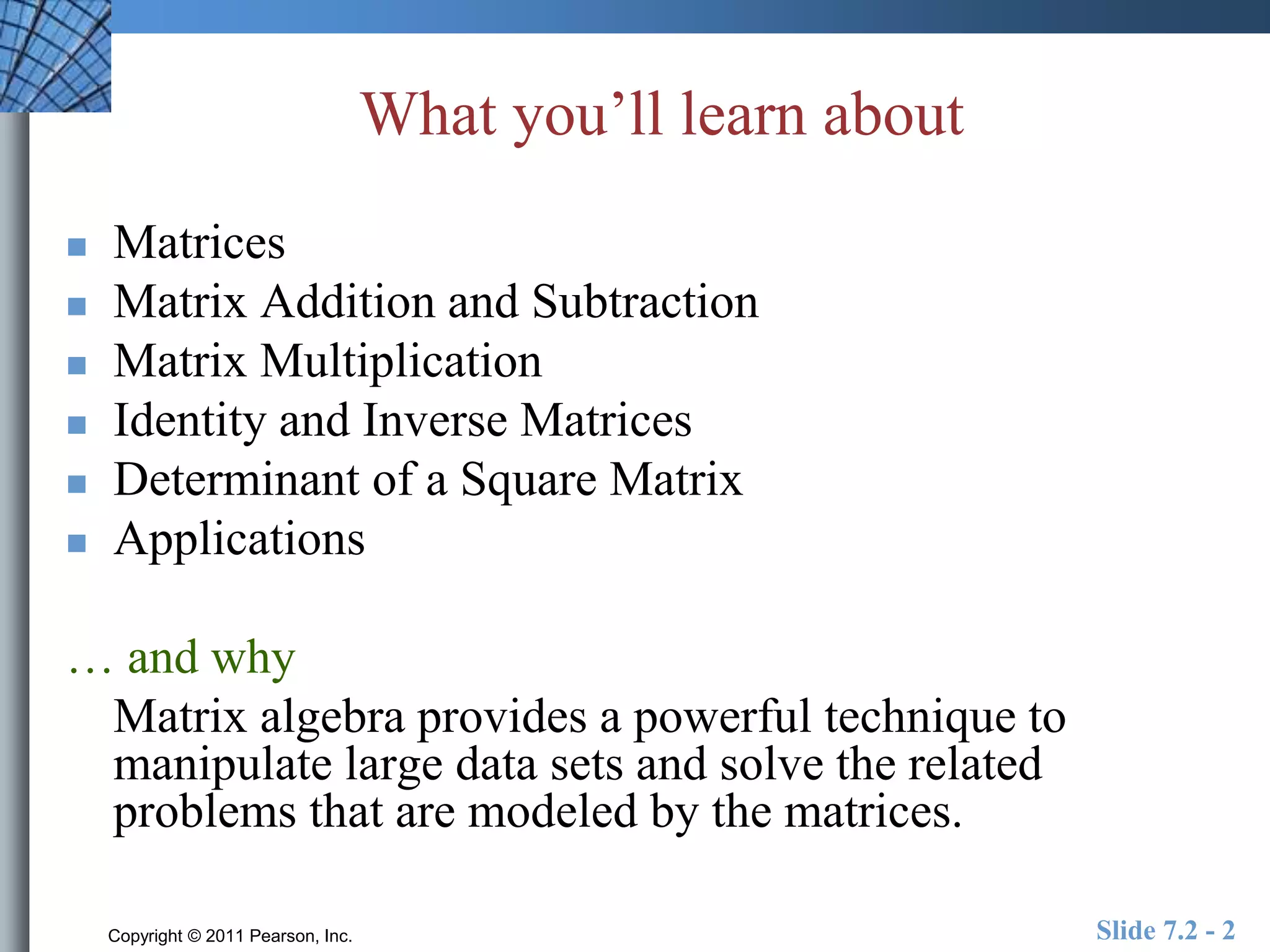
What you’ll learn about 
 Matrices 
 Matrix Addition and Subtraction 
 Matrix Multiplication 
 Identity and Inverse Matrices 
 Determinant of a Square Matrix 
 Applications 
… and why 
Matrix algebra provides a powerful technique to 
manipulate large data sets and solve the related 
problems that are modeled by the matrices. 
Copyright © 2011 Pearson, Inc. Slide 7.2 - 2
Matrix 
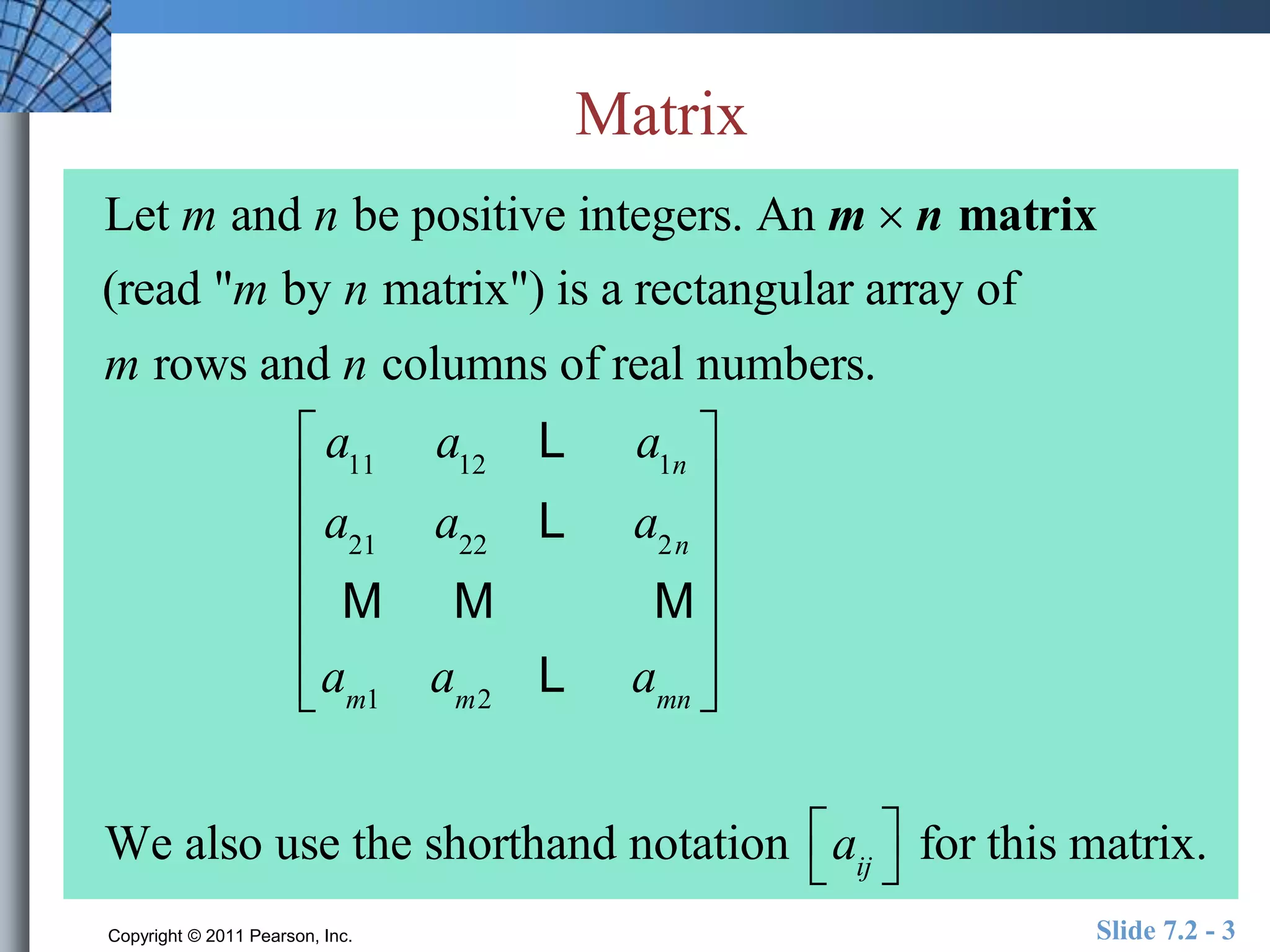
Let m and n be positive integers. An m  n matrix 
(read "m by n matrix") is a rectangular array of 
m rows and n columns of real numbers. 
a11 a12 L a1n 
a21 a22 L a2n 
M M M 
am1 am2 L amn 
 
 
 
 
 
 
 
 
 
 
 
 
 
 
 
We also use the shorthand notation aij 
 
for this matrix. 
Copyright © 2011 Pearson, Inc. Slide 7.2 - 3
Matrix Vocabulary 
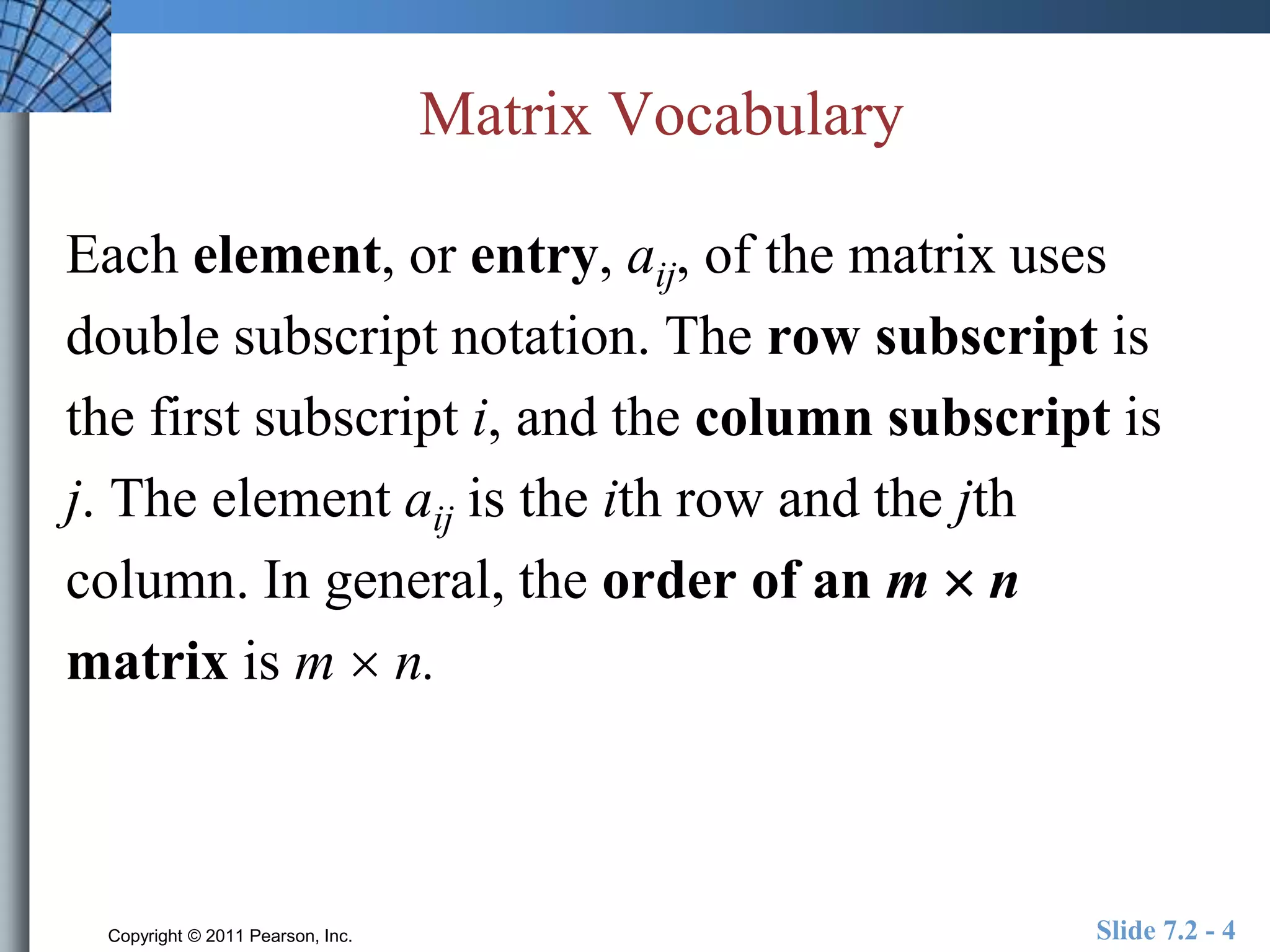
Each element, or entry, aij, of the matrix uses 
double subscript notation. The row subscript is 
the first subscript i, and the column subscript is 
j. The element aij is the ith row and the jth 
column. In general, the order of an m  n 
matrix is m  n. 
Copyright © 2011 Pearson, Inc. Slide 7.2 - 4
Example Determining the Order of a 
Matrix 
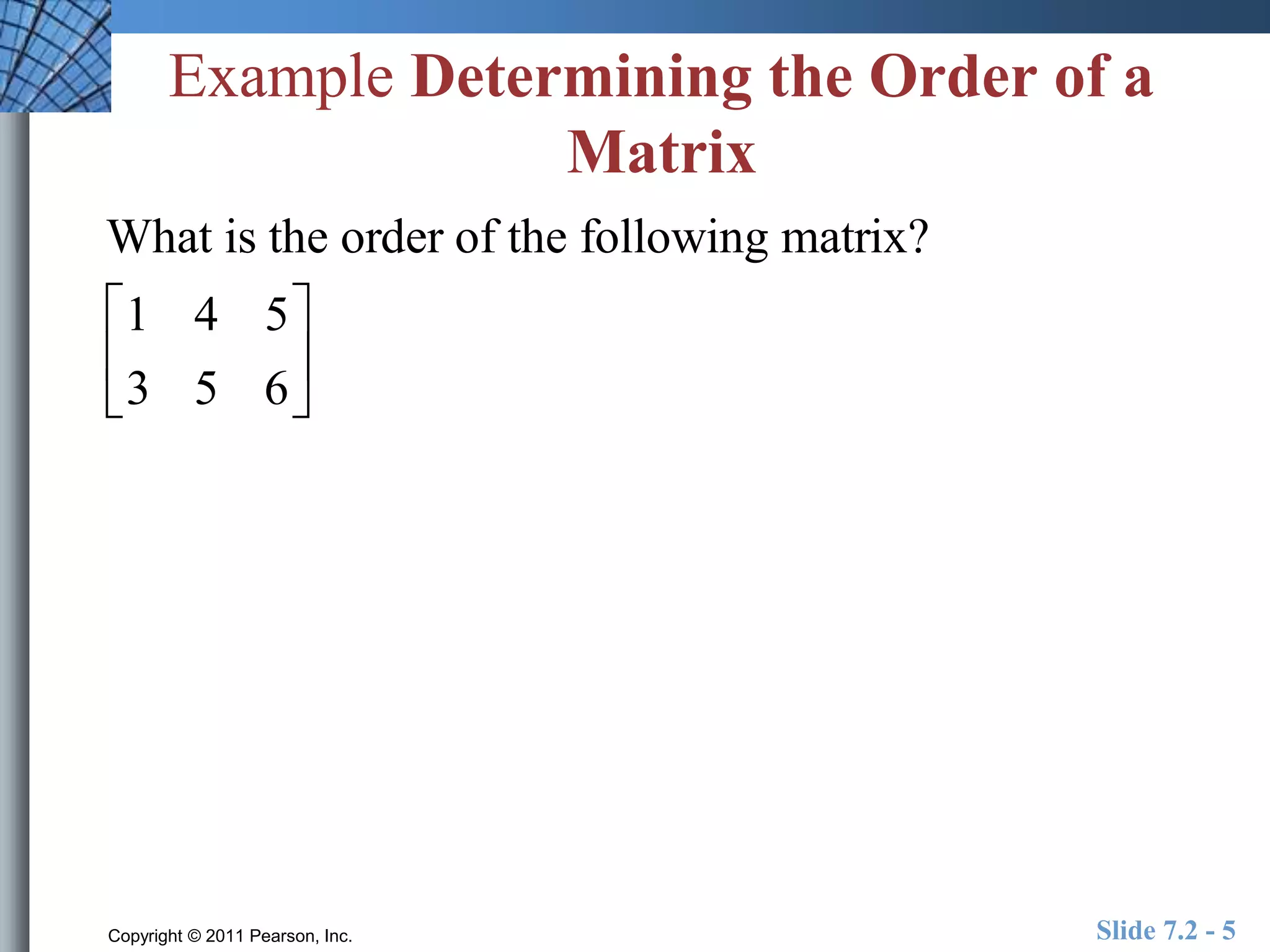
What is the order of the following matrix? 
 
1 4 5 
3 5 6 
 
 
 
 
 
Copyright © 2011 Pearson, Inc. Slide 7.2 - 5
Example Determining the Order of a 
Matrix 
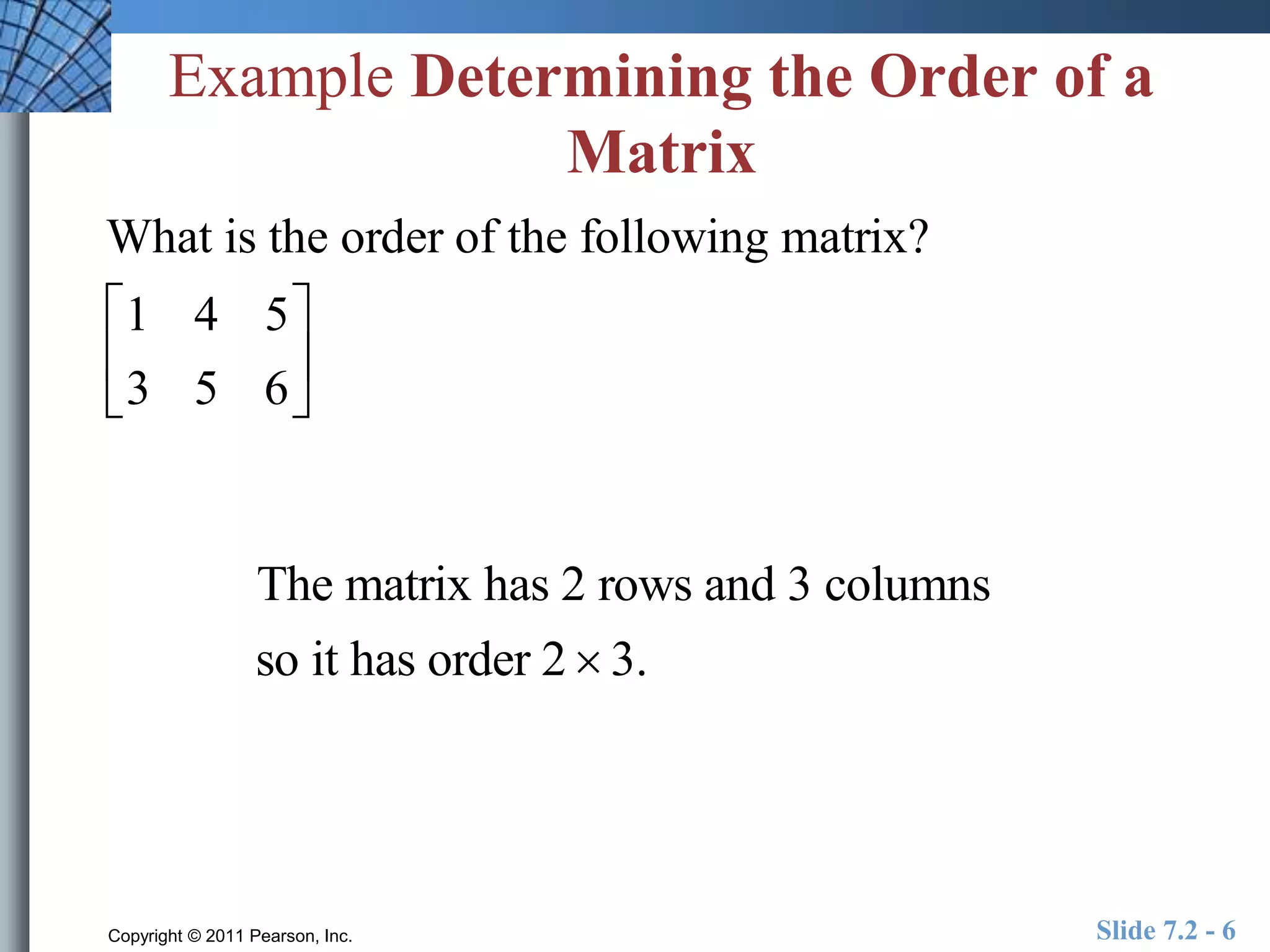
What is the order of the following matrix? 
1 4 5 
 
3 5 6 
 
 
The matrix has 2 rows and 3 columns 
so it has order 2  3. 
 
 
 
Copyright © 2011 Pearson, Inc. Slide 7.2 - 6
Matrix Addition and Matrix 
Subtraction 
 
 
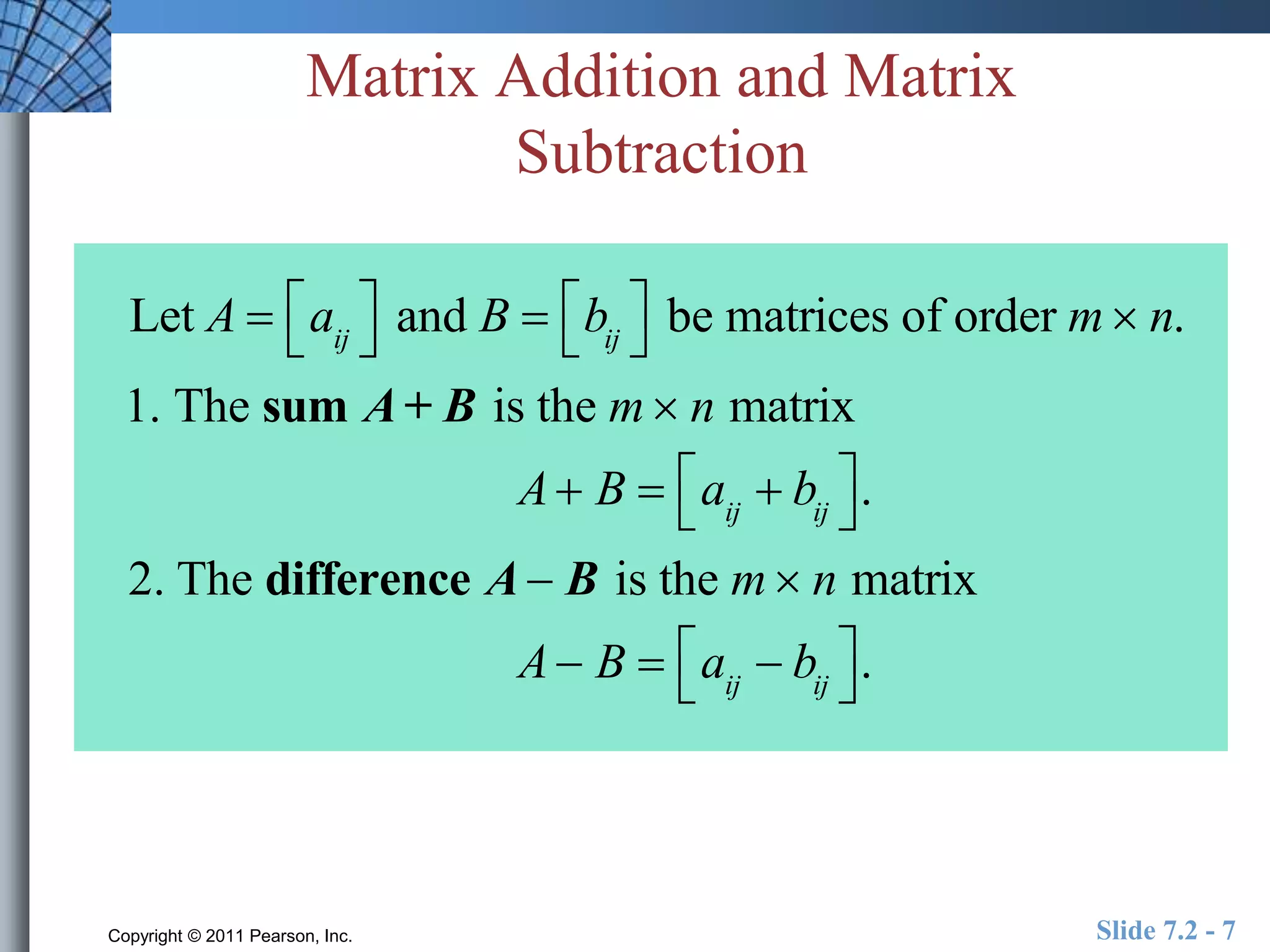
Let A  aij 
and  
B   
 
 bij 
 
 be matrices of order m n. 
1. The sum A+ B is the m n matrix 
 
 
A B  aij  bij 
 
. 
2. The difference A B is the m n matrix 
 
 
A B  aij  bij 
 
. 
Copyright © 2011 Pearson, Inc. Slide 7.2 - 7
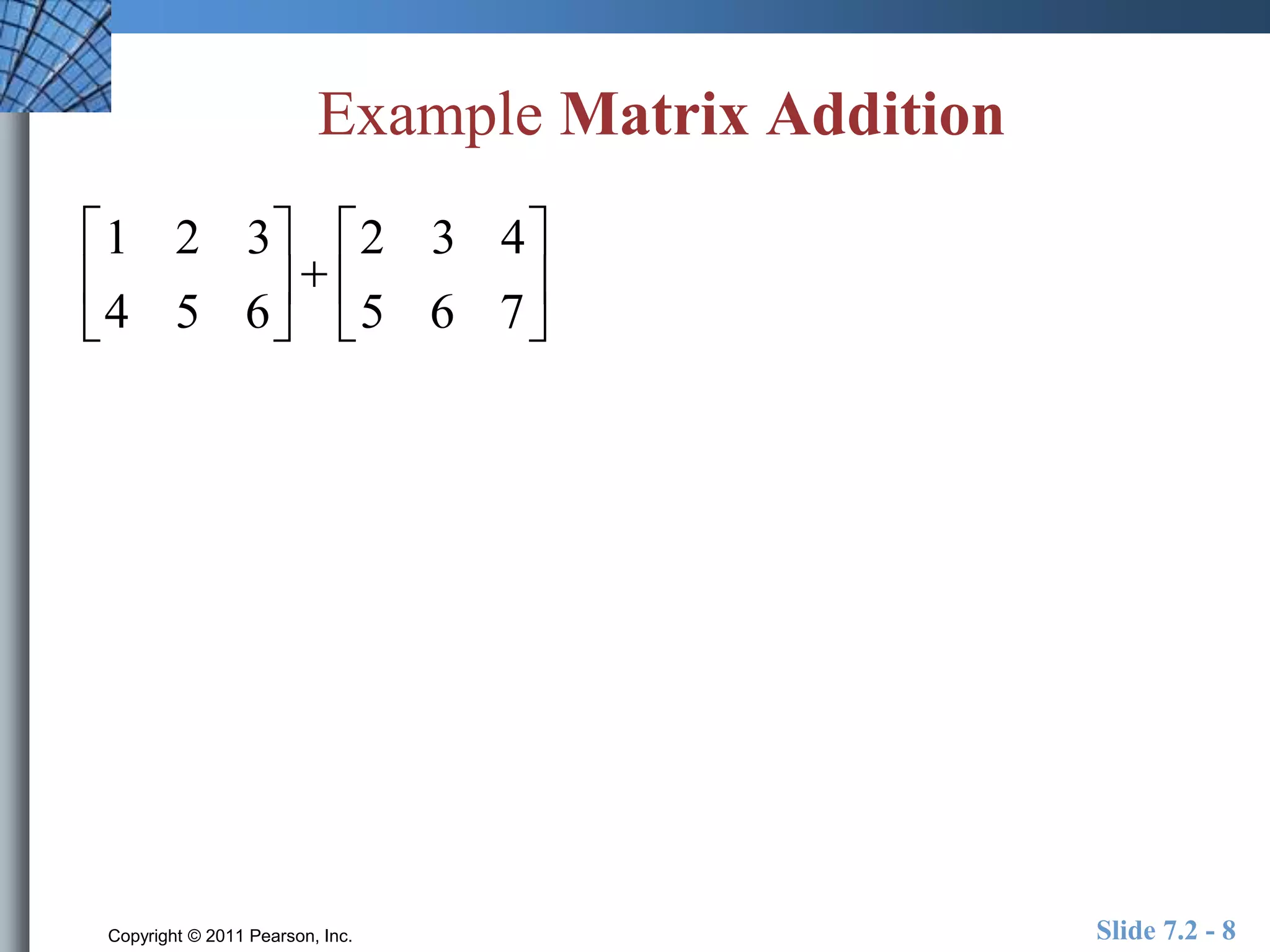
Example Matrix Addition 
1 2 3 
4 5 6 
Copyright © 2011 Pearson, Inc. Slide 7.2 - 8 
 
 
 
 
 
 
2 3 4 
5 6 7 
 
 
 
 
 

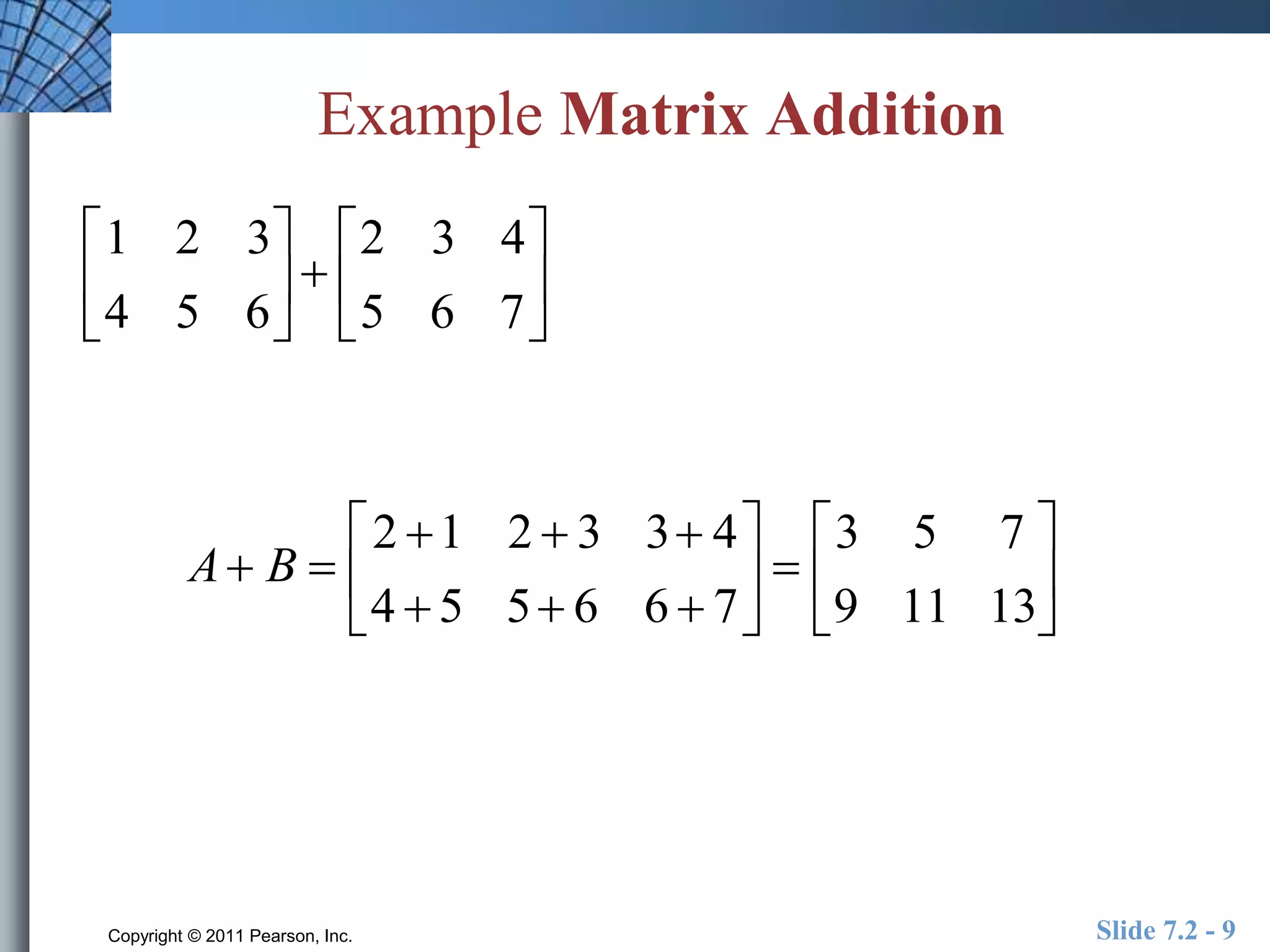
Example Matrix Addition 
1 2 3 
4 5 6 
A B  
2 1 2  3 3 4 
4  5 5 6 6  7 
 
 
 
 
 
 
 
3 5 7 
9 11 13 
 
 
 
 
 
Copyright © 2011 Pearson, Inc. Slide 7.2 - 9 
 
 
 
 
 
 
2 3 4 
5 6 7 
 
 
 
 
 

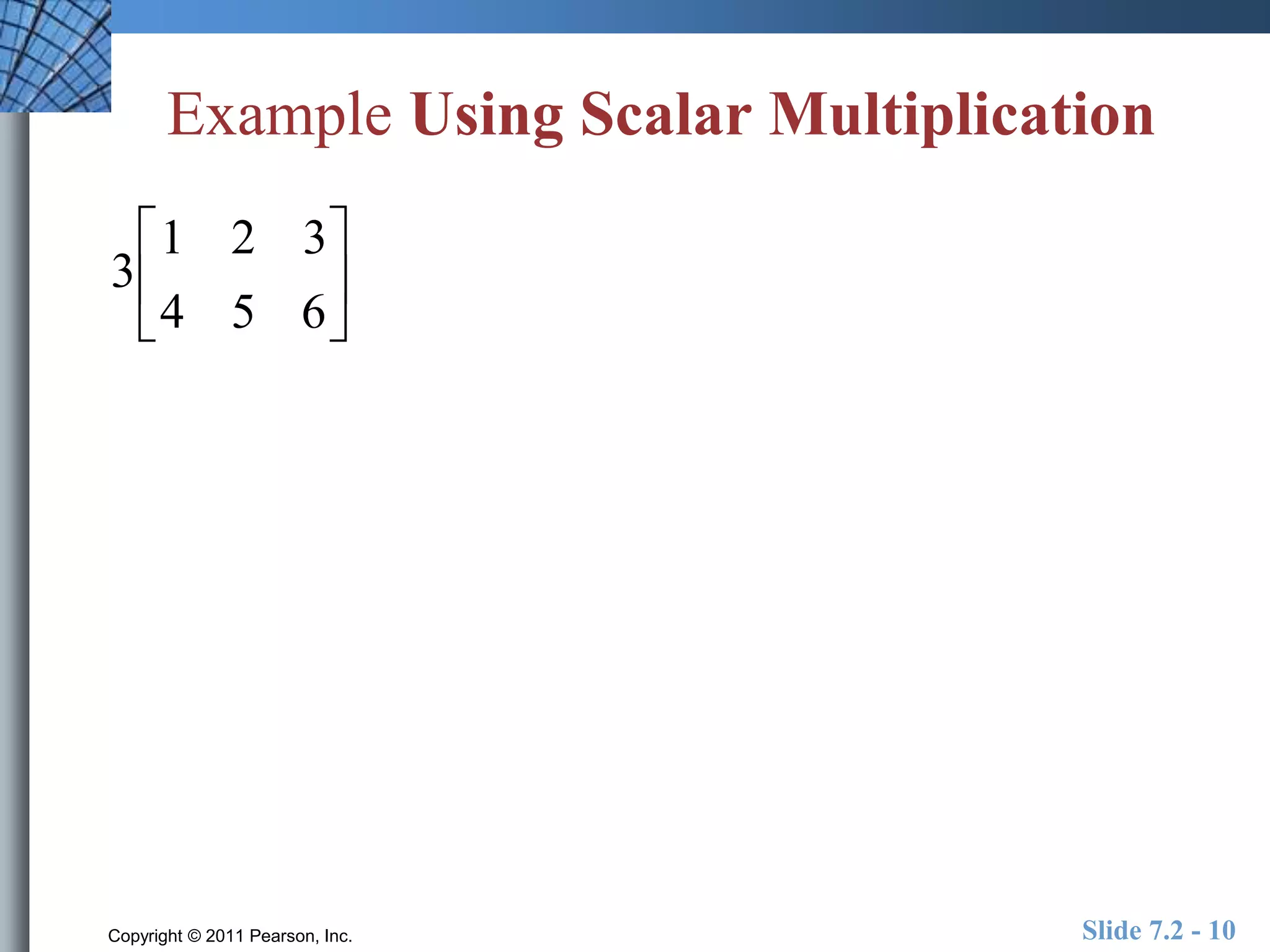
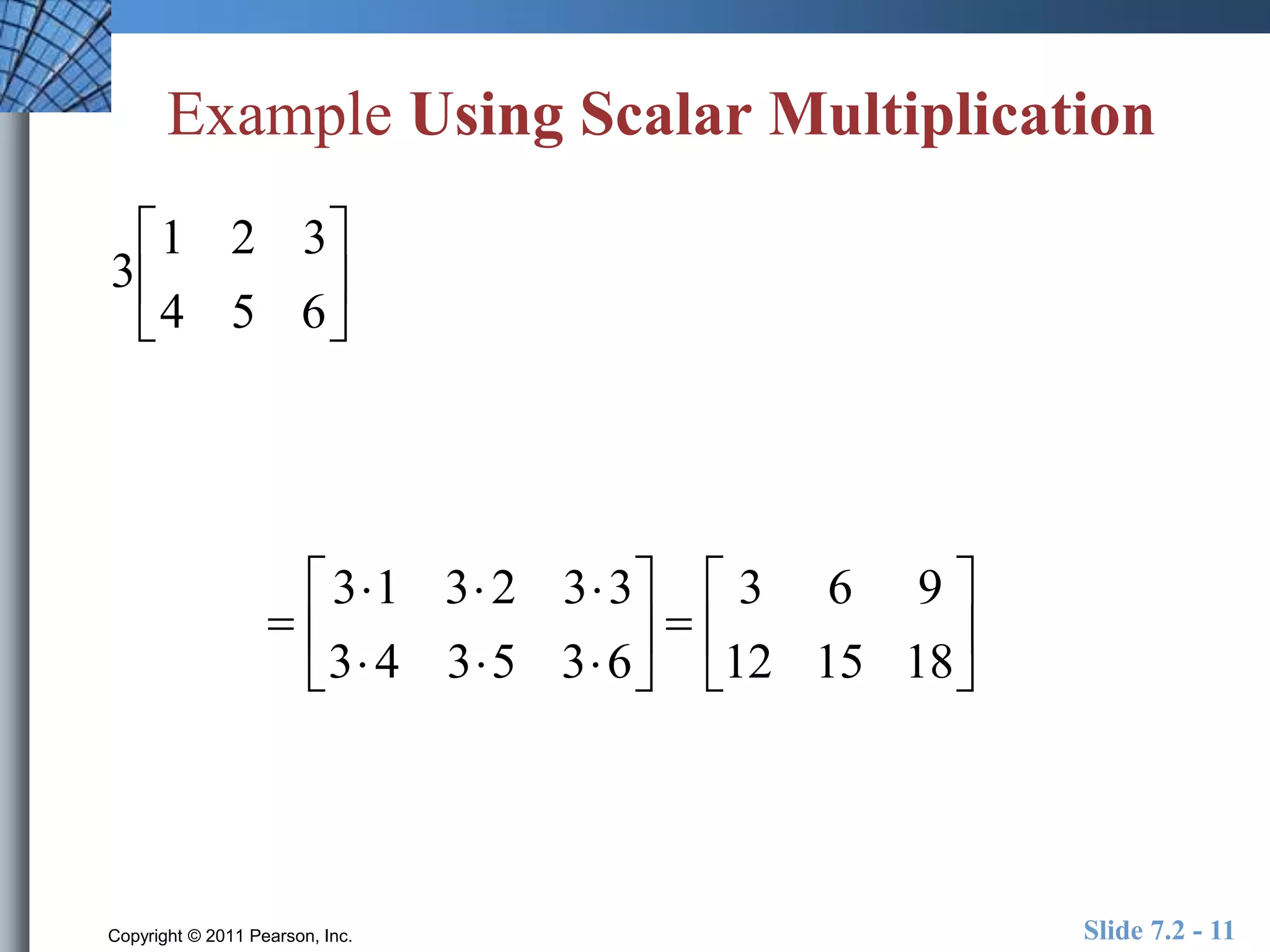
Example Using Scalar Multiplication 
3 
1 2 3 
4 5 6 
 
 
 
 
 
 
Copyright © 2011 Pearson, Inc. Slide 7.2 - 10
Example Using Scalar Multiplication 
1 2 3 
4 5 6 
 
 
 
 
31 32 33 
34 35 36 
 
 
 
 
 
 
 
3 6 9 
12 15 18 
 
 
 
 
 
3 
 
 
 
Copyright © 2011 Pearson, Inc. Slide 7.2 - 11
The Zero Matrix 
The m n matrix 0  [0] consisting entirely of 
zeros is the zero matrix. 
Copyright © 2011 Pearson, Inc. Slide 7.2 - 12
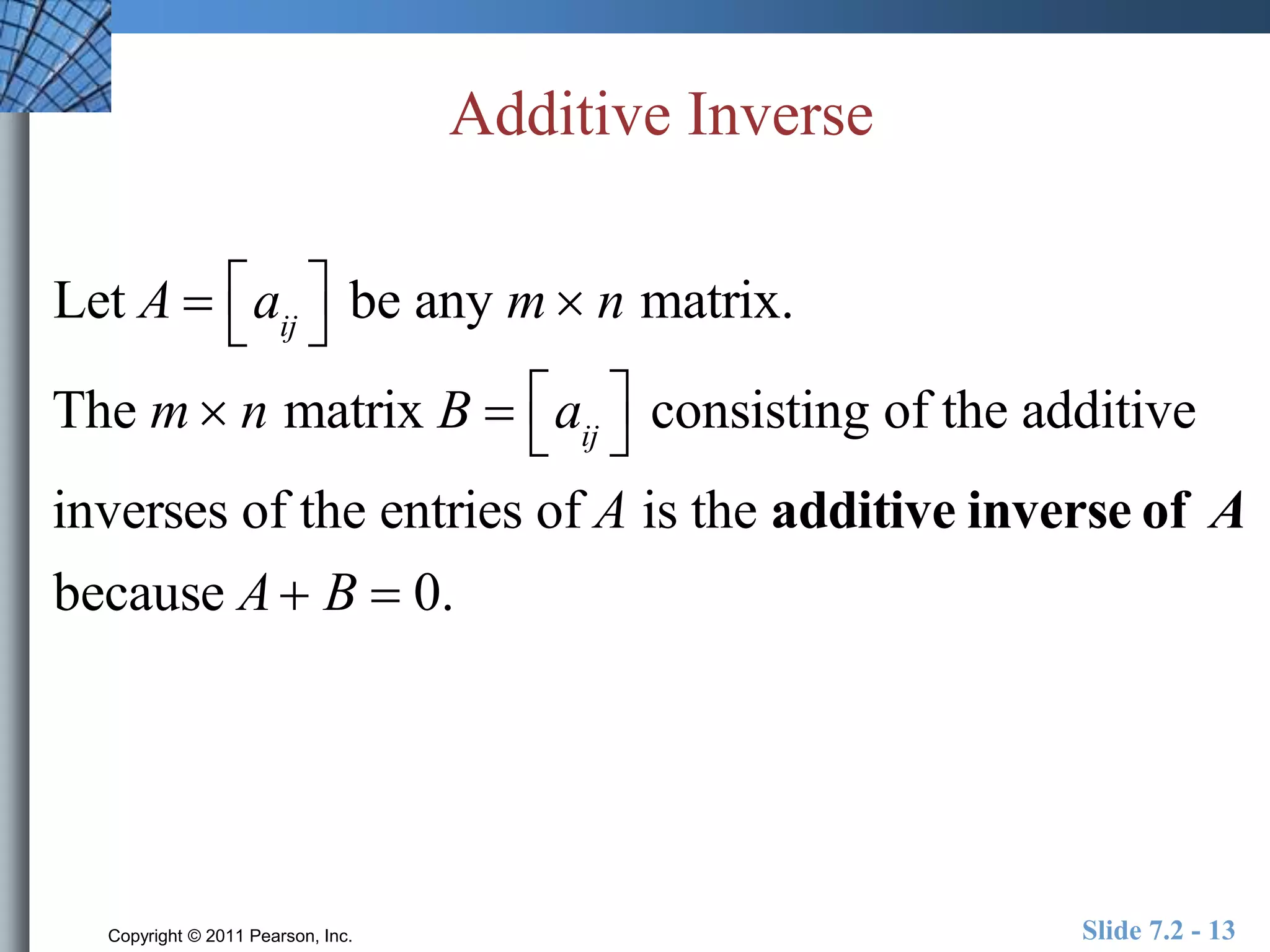
Additive Inverse 
 
Let A  aij 
 
be any m n matrix. 
  
The m n matrix B  aij 
consisting of the additive 
inverses of the entries of A is the additive inverse of A 
because A B  0. 
Copyright © 2011 Pearson, Inc. Slide 7.2 - 13
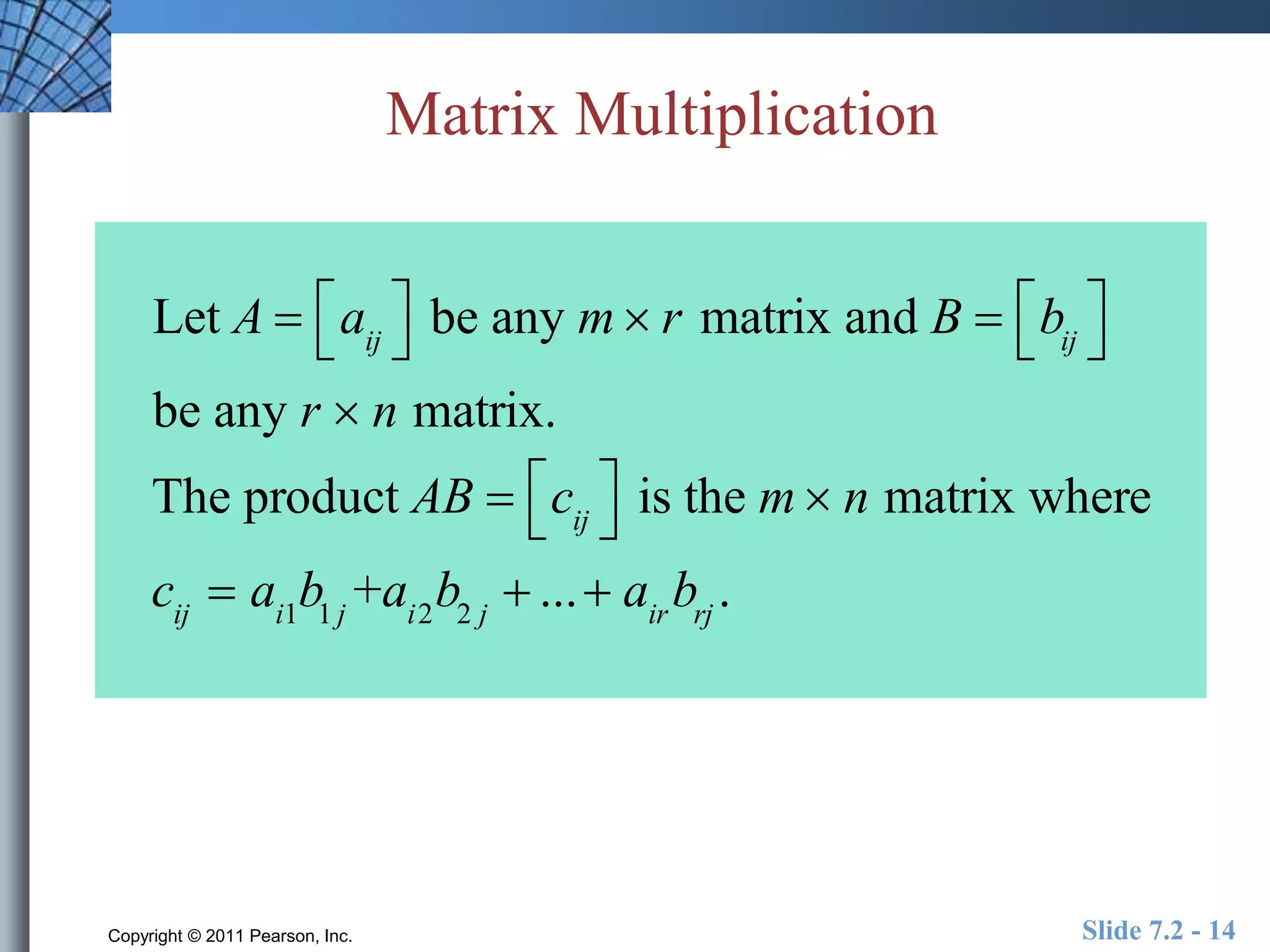
Matrix Multiplication 
 
 
Let A  aij 
be  
any m r matrix and B   
 
 bij 
 
 
be any r  n matrix. 
The product AB  cij 
 
 
 
 is the m n matrix where 
cij  ai1b1 j +ai2b2 j  ...  airbrj . 
Copyright © 2011 Pearson, Inc. Slide 7.2 - 14
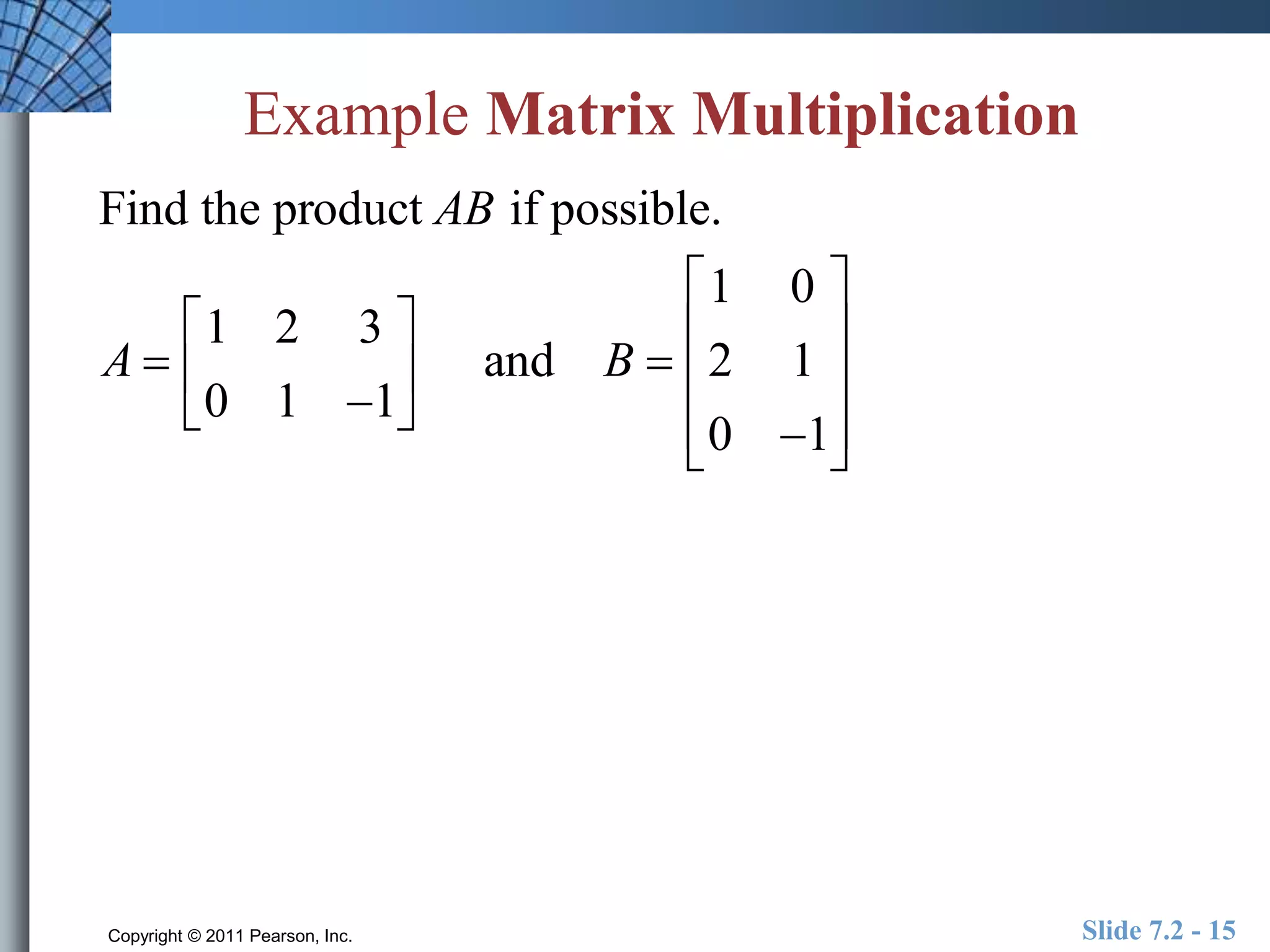
Example Matrix Multiplication 
Find the product AB if possible. 
A  
 
1 2 3 
0 1 1 
 
 
 
 
 and B  
 
1 0 
2 1 
0 1 
 
 
 
 
 
 
 
 
 
Copyright © 2011 Pearson, Inc. Slide 7.2 - 15
Example Matrix Multiplication 
A  
 
1 2 3 
0 1 1 
 
 
 
 
 and B  
 
1 0 
2 1 
0 1 
 
 
 
 
 
 
 
 
 
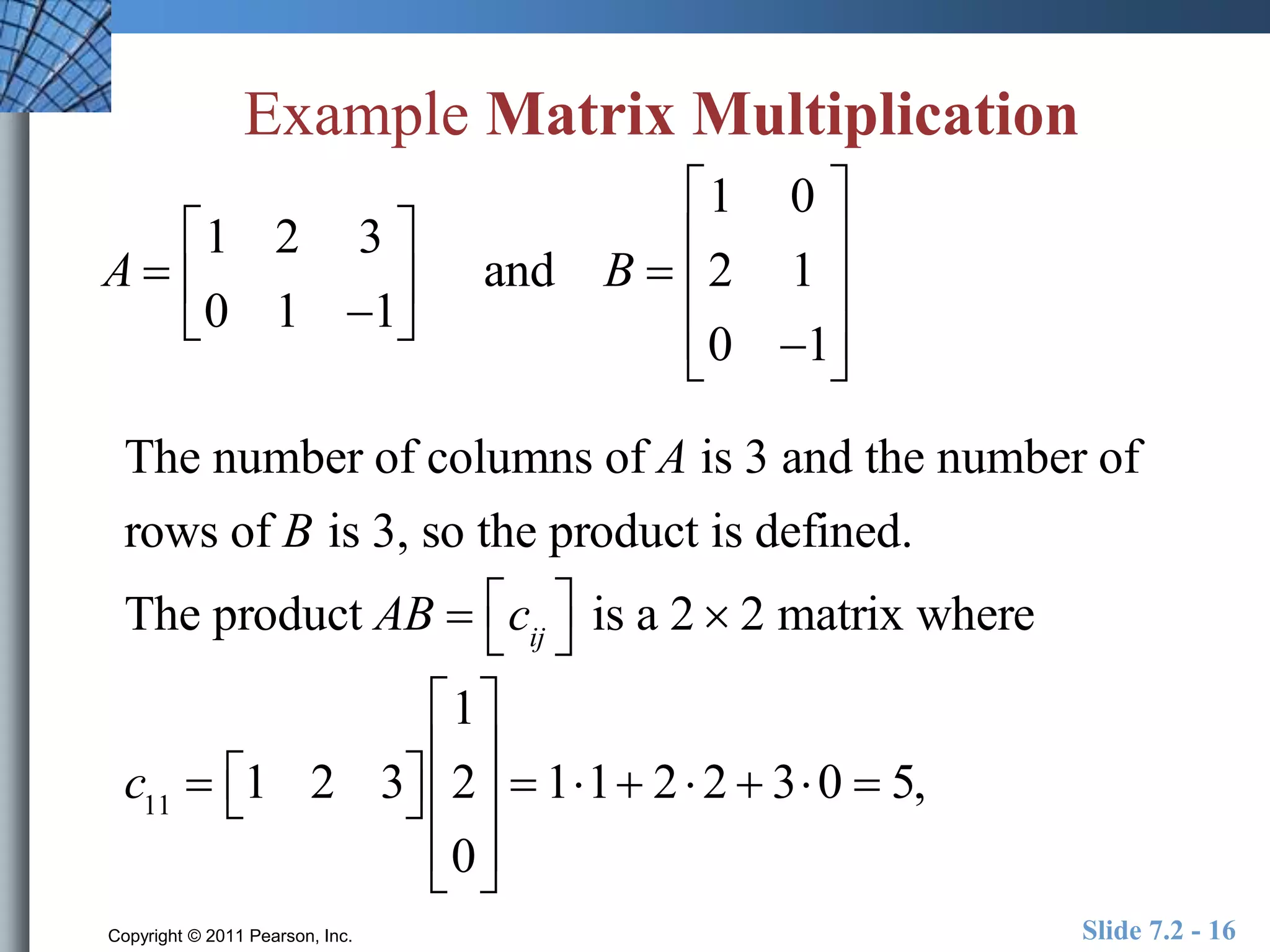
The number of columns of A is 3 and the number of 
rows of B is 3, so the product is defined. 
The product AB  cij 
 
 
is a 2  2 matrix where 
c11  1 2 3  
 
1 
2 
0 
 
 
 
 
 
 
 
 
 
 
 11 2  2  30  5, 
Copyright © 2011 Pearson, Inc. Slide 7.2 - 16
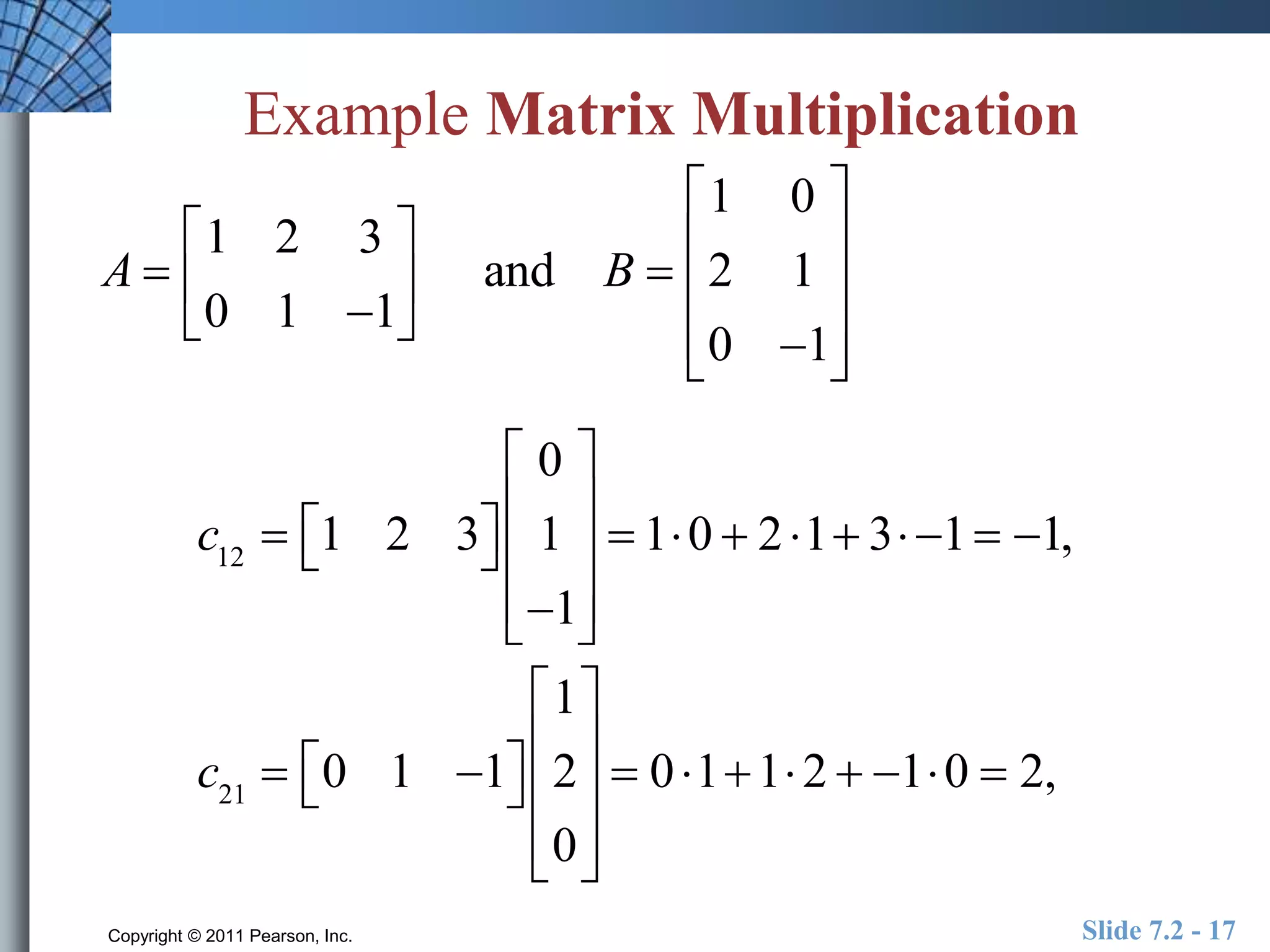
Example Matrix Multiplication 
A  
 
1 2 3 
0 1 1 
 
 
 
 
 and B  
 
1 0 
2 1 
0 1 
 
 
 
 
 
 
 
 
 
 
 0 
c12  1 2 3  
 
 
 
 
1 
1 
 
 
 
 
 
 10  2 1 3 1  1, 
c21  0 1 1  
 
1 
2 
0 
 
 
 
 
 
 
 
 
 
 
 011 2  10  2, 
Copyright © 2011 Pearson, Inc. Slide 7.2 - 17
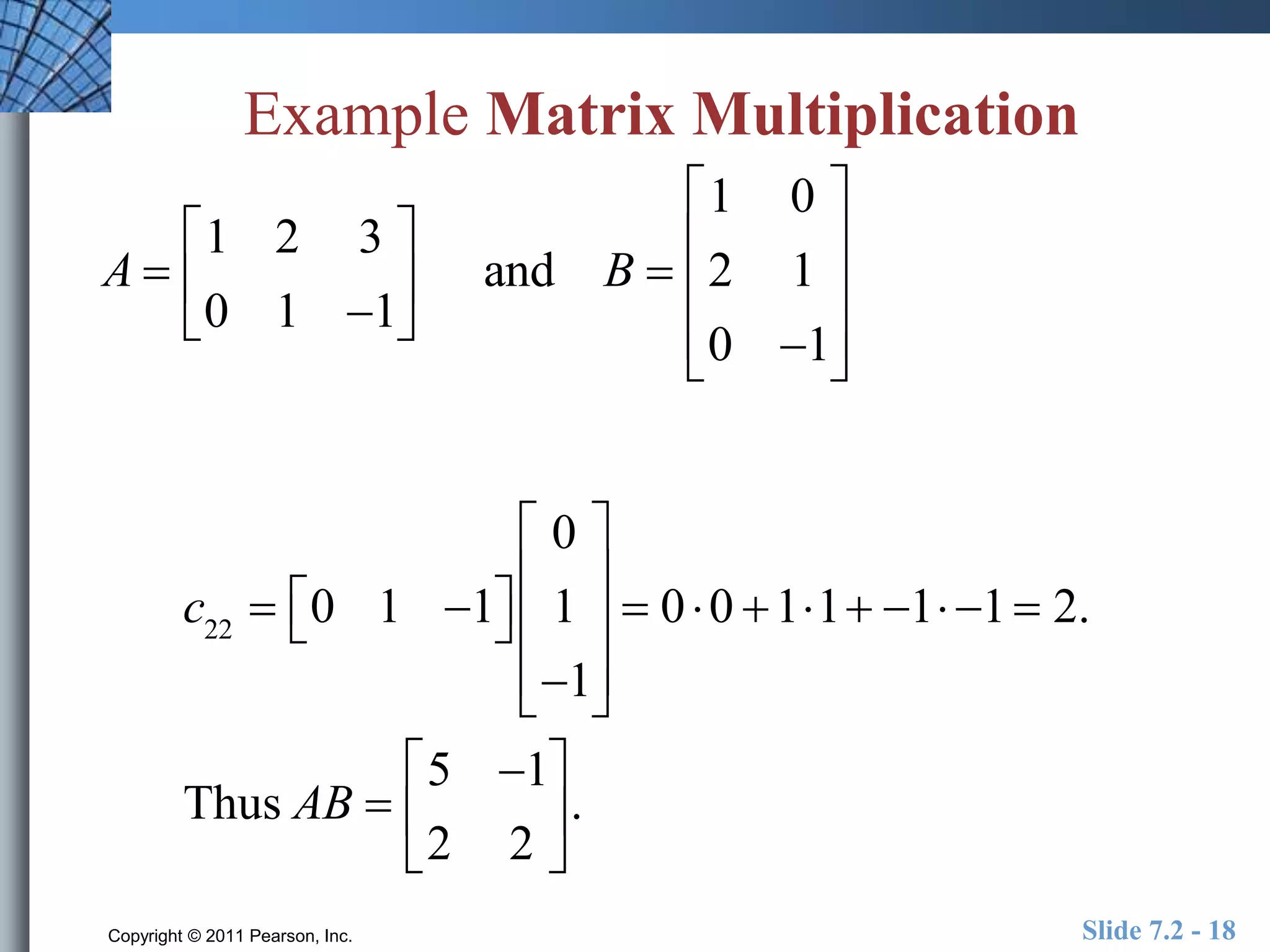
Example Matrix Multiplication 
A  
 
1 2 3 
0 1 1 
 
 
 
 
 and B  
 
1 0 
2 1 
0 1 
 
 
 
 
 
 
 
 
 
c22  0 1 1   
 
0 
1 
1 
 
 
 
 
 
 
 
 
 
 0 0 11 1 1  2. 
Thus AB  
 
5 1 
2 2 
 
 
 
 
. 
Copyright © 2011 Pearson, Inc. Slide 7.2 - 18
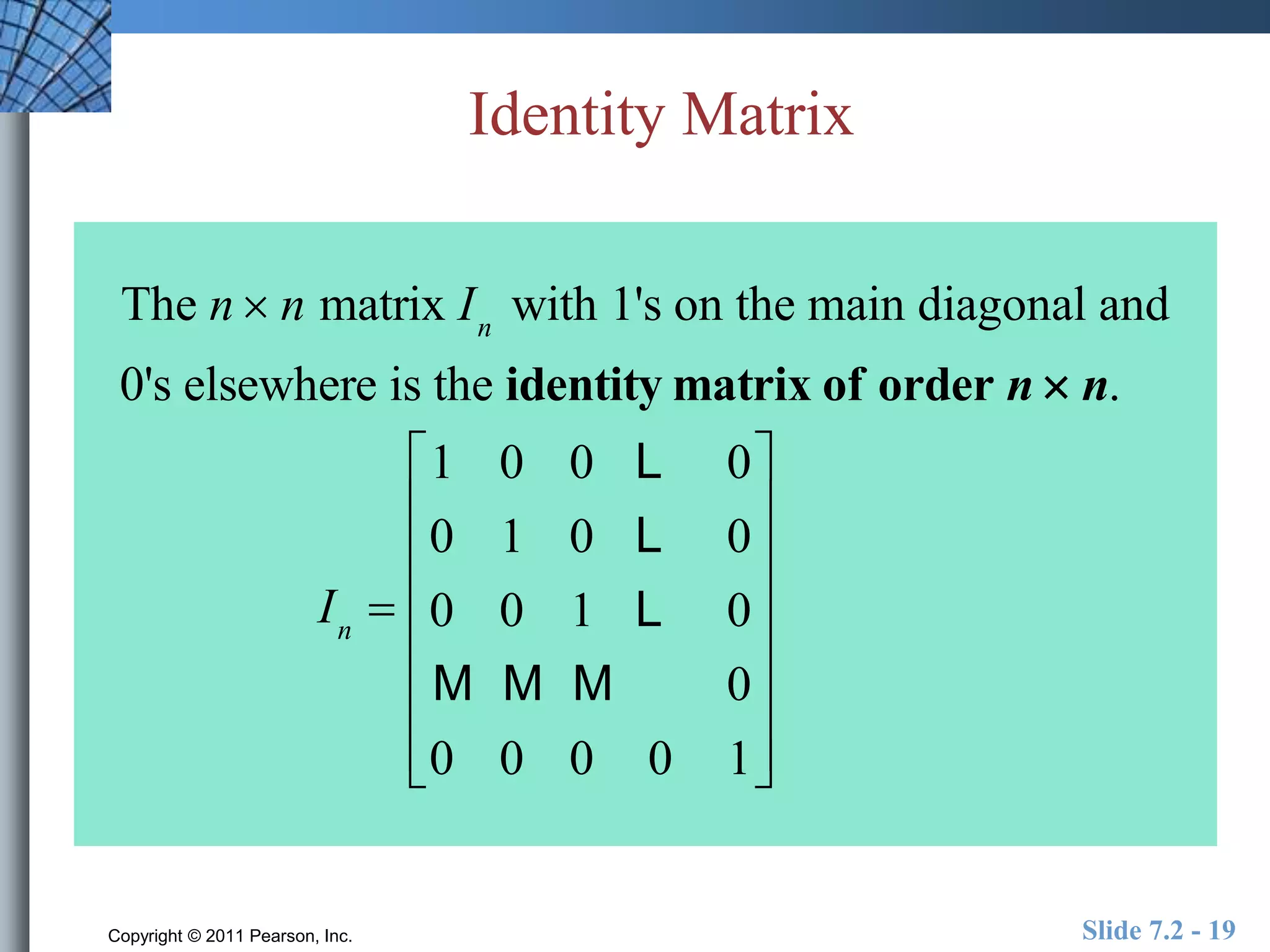
Identity Matrix 
The n  n matrix In with 1's on the main diagonal and 
0's elsewhere is the identity matrix of order n  n. 
In  
1 0 0 L 0 
0 1 0 L 0 
0 0 1 L 0 
M M M 0 
0 0 0 0 1 
 
 
 
 
 
 
 
 
 
 
 
 
 
 
 
 
Copyright © 2011 Pearson, Inc. Slide 7.2 - 19
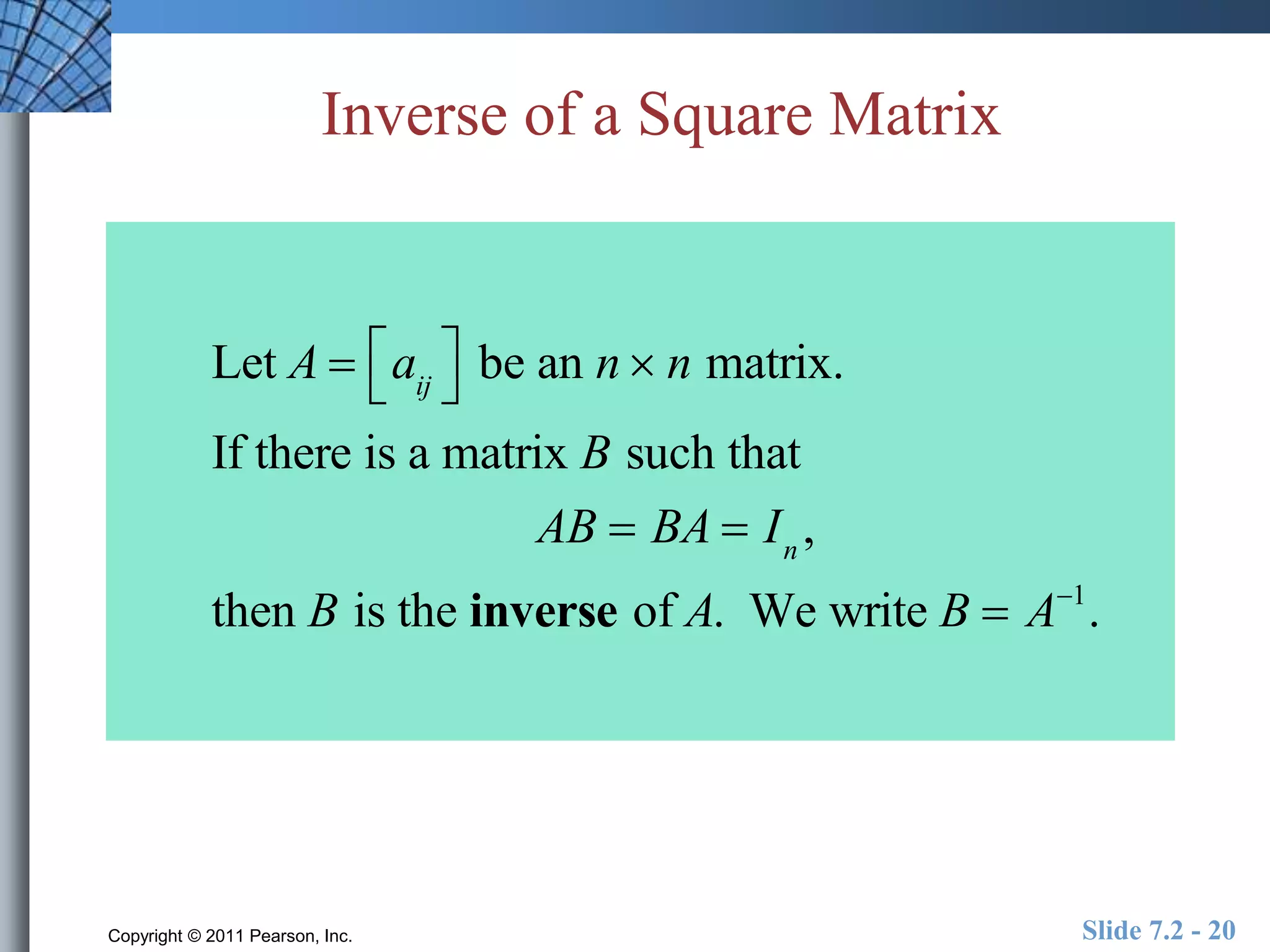
Inverse of a Square Matrix 
 
Let A  aij 
 
be an n  n matrix. 
If there is a matrix B such that 
AB  BA  In , 
then B is the inverse of A. We write B  A1. 
Copyright © 2011 Pearson, Inc. Slide 7.2 - 20
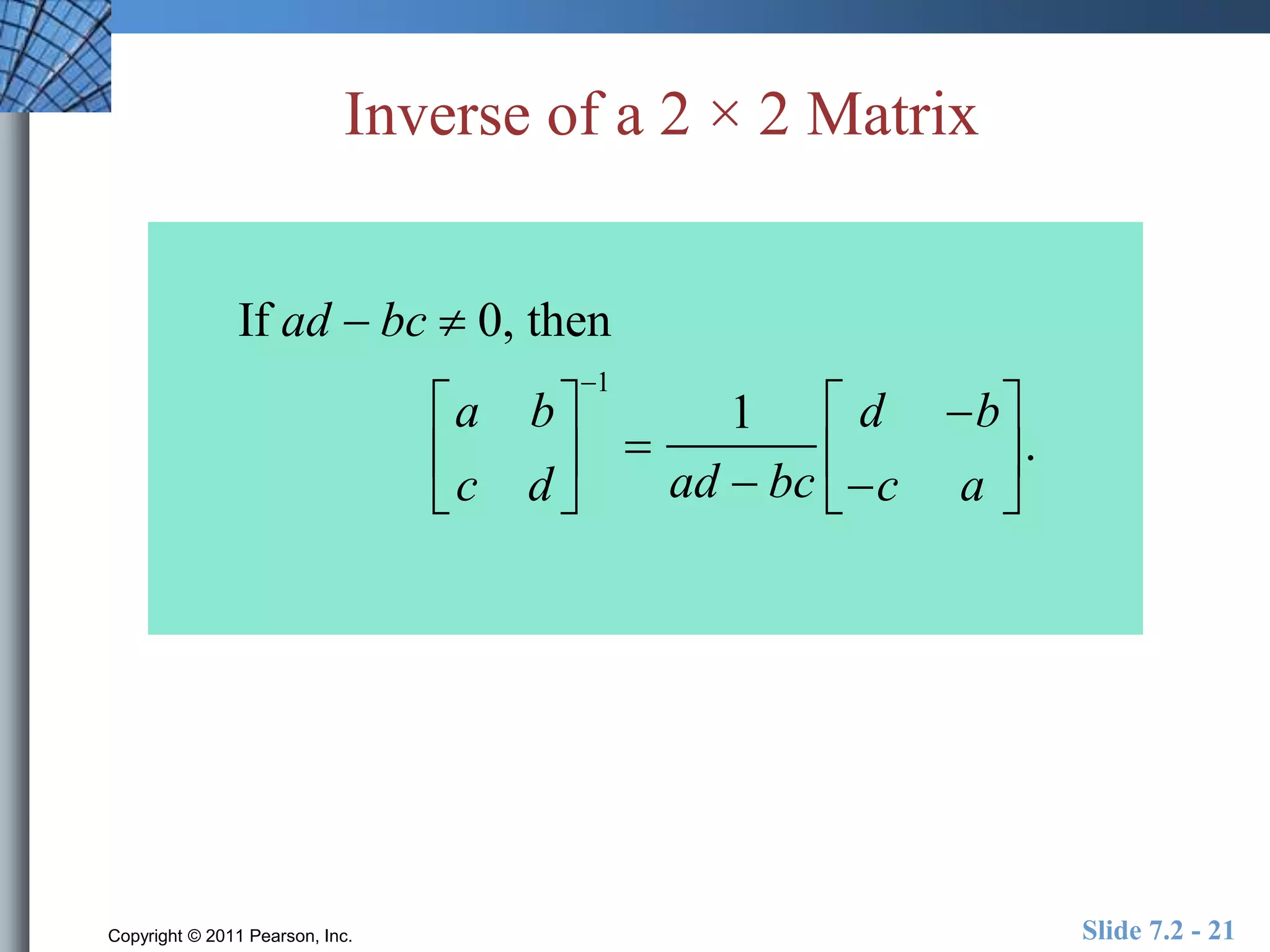
Inverse of a 2 × 2 Matrix 
If ad  bc  0, then 
a b 
c d 
 
  
  1 
 
 
1 
ad  bc 
d b 
c a 
 
  
 
  
. 
Copyright © 2011 Pearson, Inc. Slide 7.2 - 21
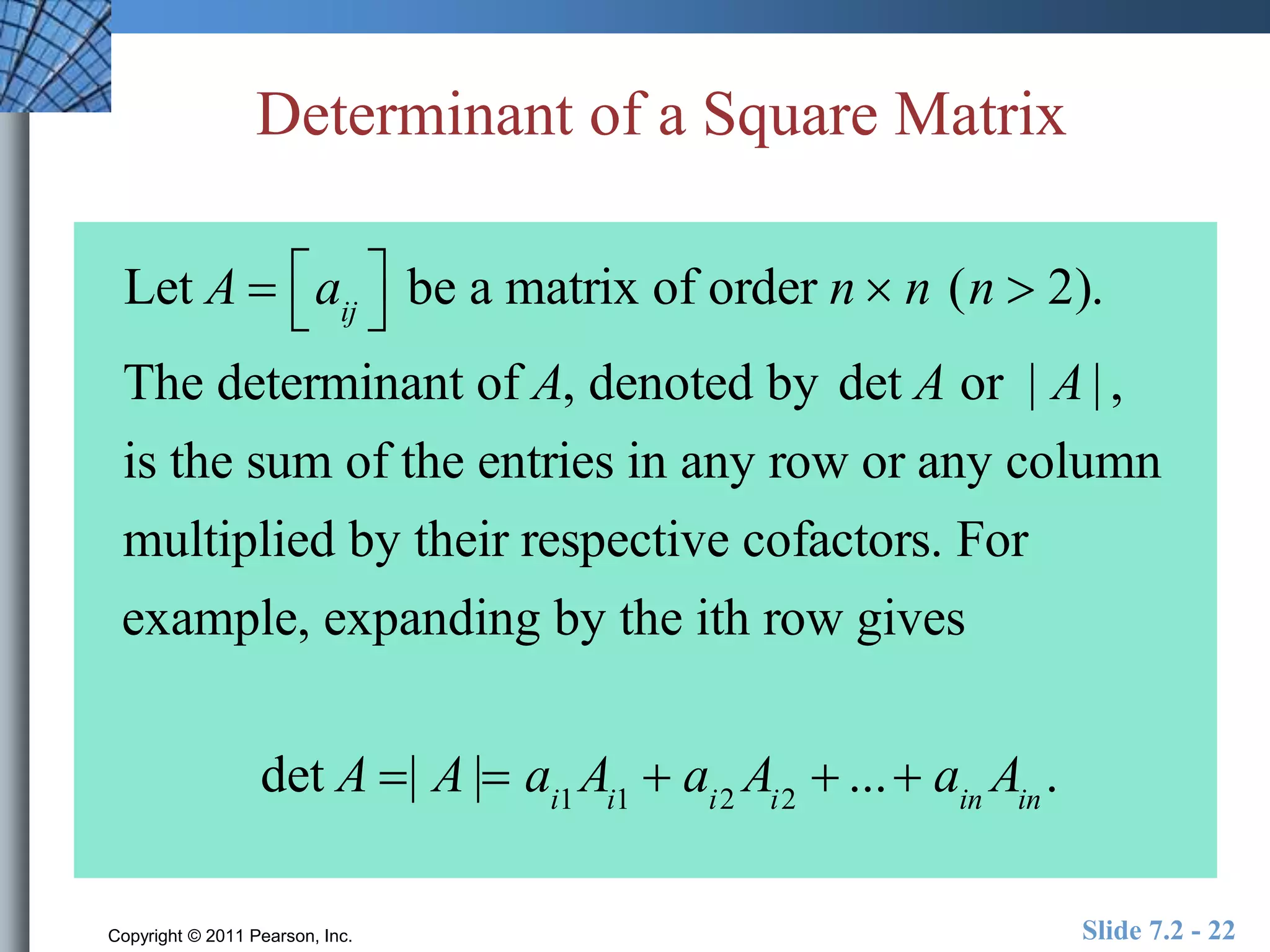
Determinant of a Square Matrix 
 
 
Let A  aij 
 
 be a matrix of order n  n (n  2). 
The determinant of A, denoted by det A or | A | , 
is the sum of the entries in any row or any column 
multiplied by their respective cofactors. For 
example, expanding by the ith row gives 
det A | A | ai1Ai1  ai2Ai2  ...  ainAin . 
Copyright © 2011 Pearson, Inc. Slide 7.2 - 22
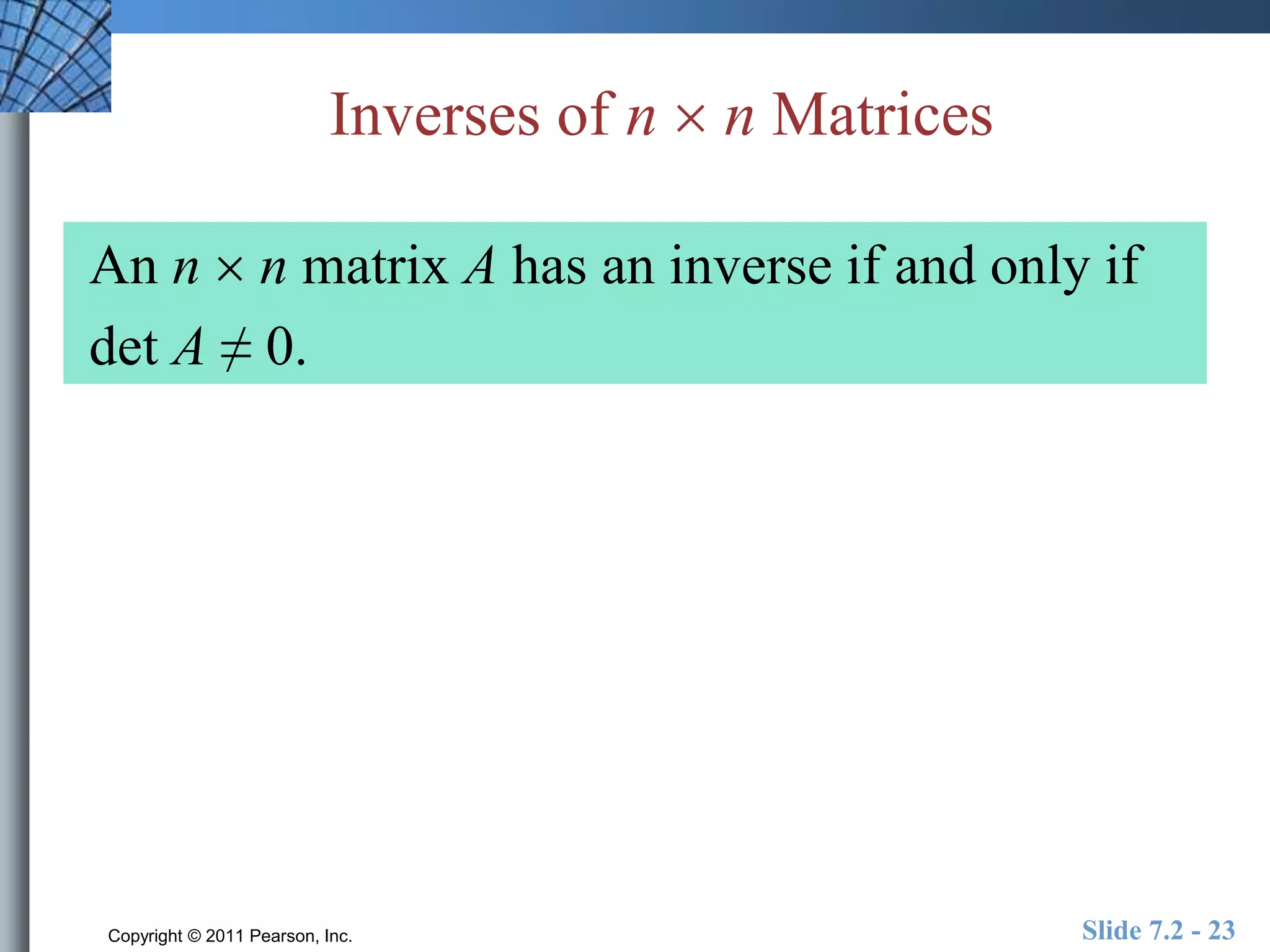
Inverses of n  n Matrices 
An n  n matrix A has an inverse if and only if 
det A ≠ 0. 
Copyright © 2011 Pearson, Inc. Slide 7.2 - 23
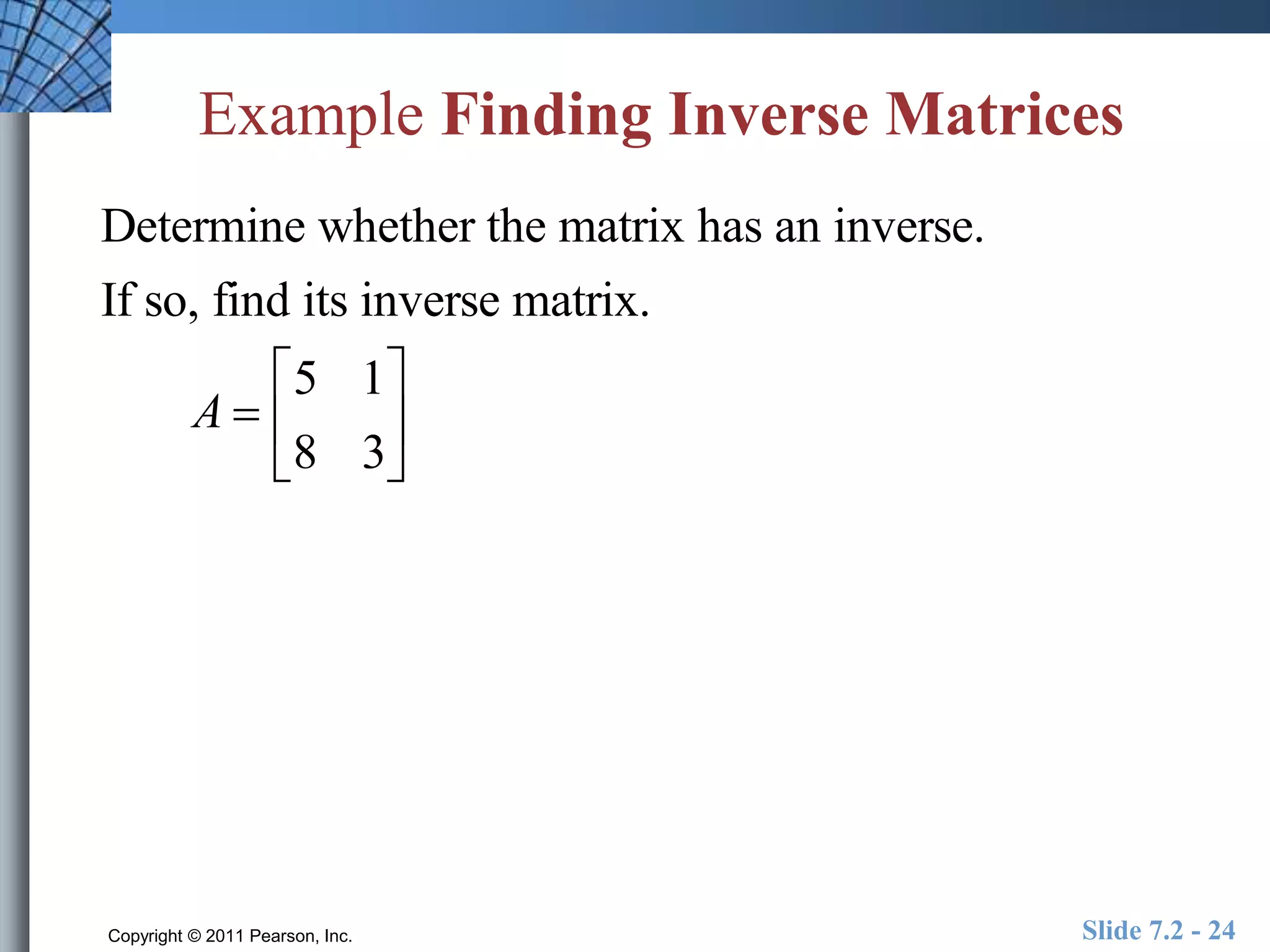
Example Finding Inverse Matrices 
Determine whether the matrix has an inverse. 
If so, find its inverse matrix. 
A  
 
5 1 
8 3 
 
 
 
 
 
Copyright © 2011 Pearson, Inc. Slide 7.2 - 24
Example Finding Inverse Matrices 
A  
 
5 1 
8 3 
 
 
 
 
 
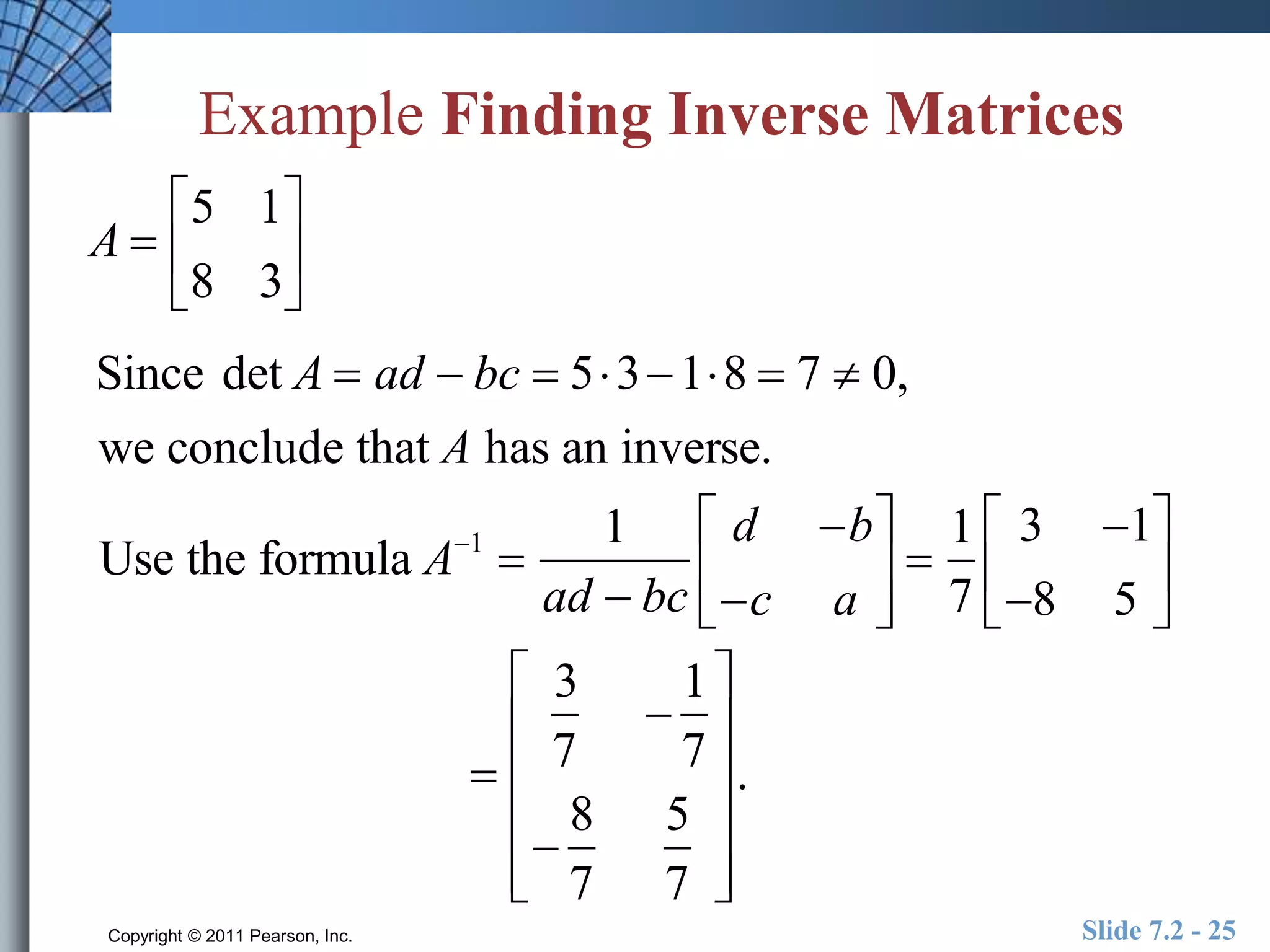
Since det A  ad  bc  5318  7  0, 
we conclude that A has an inverse. 
Use the formula A1  
1 
ad  bc 
d b 
c a 
 
  
 
  
 
1 
7 
 
3 1 
8 5 
 
  
  
 
3 
7 
 
1 
7 
 
8 
7 
5 
7 
 
 
 
 
 
 
 
 
 
 
 
 
. 
Copyright © 2011 Pearson, Inc. Slide 7.2 - 25
Example Finding Inverse Matrices 
A  
 
5 1 
8 3 
 
 
 
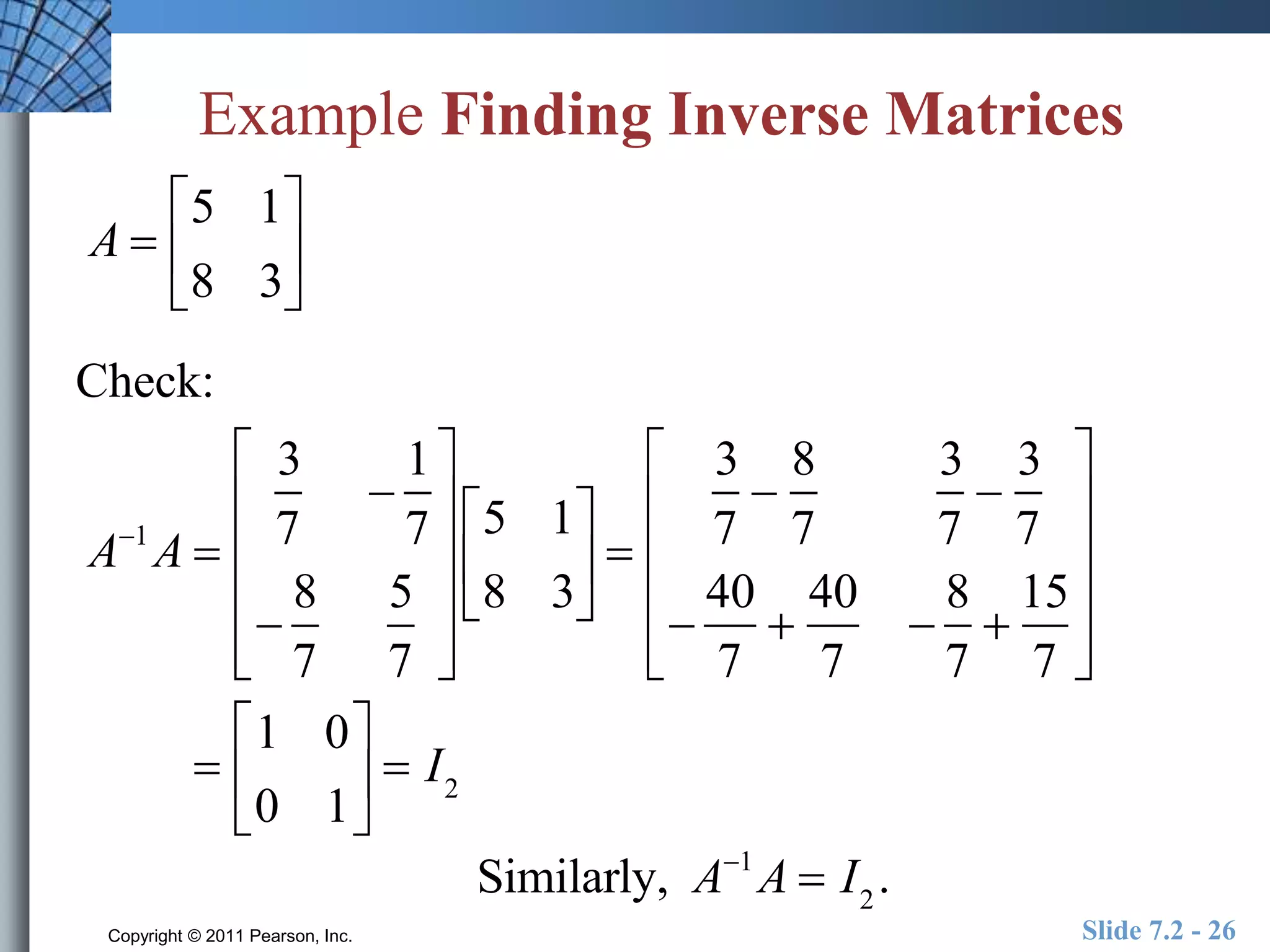
Check: 
A1A  
 
 
3 
7 
 
1 
7 
 
8 
7 
5 
7 
 
 
 
 
 
 
 
 
 
 
 
 
 
5 1 
8 3 
 
 
 
 
 
3 
7 
 
8 
7 
3 
7 
 
3 
7 
 
40 
7 
 
40 
7 
 
8 
7 
 
15 
7 
 
 
 
 
 
 
 
 
 
 
 
 
 
1 0 
0 1 
 
 
 
 
 
 I2 
Similarly, A1A  I2 . 
Copyright © 2011 Pearson, Inc. Slide 7.2 - 26
Properties of Matrices 
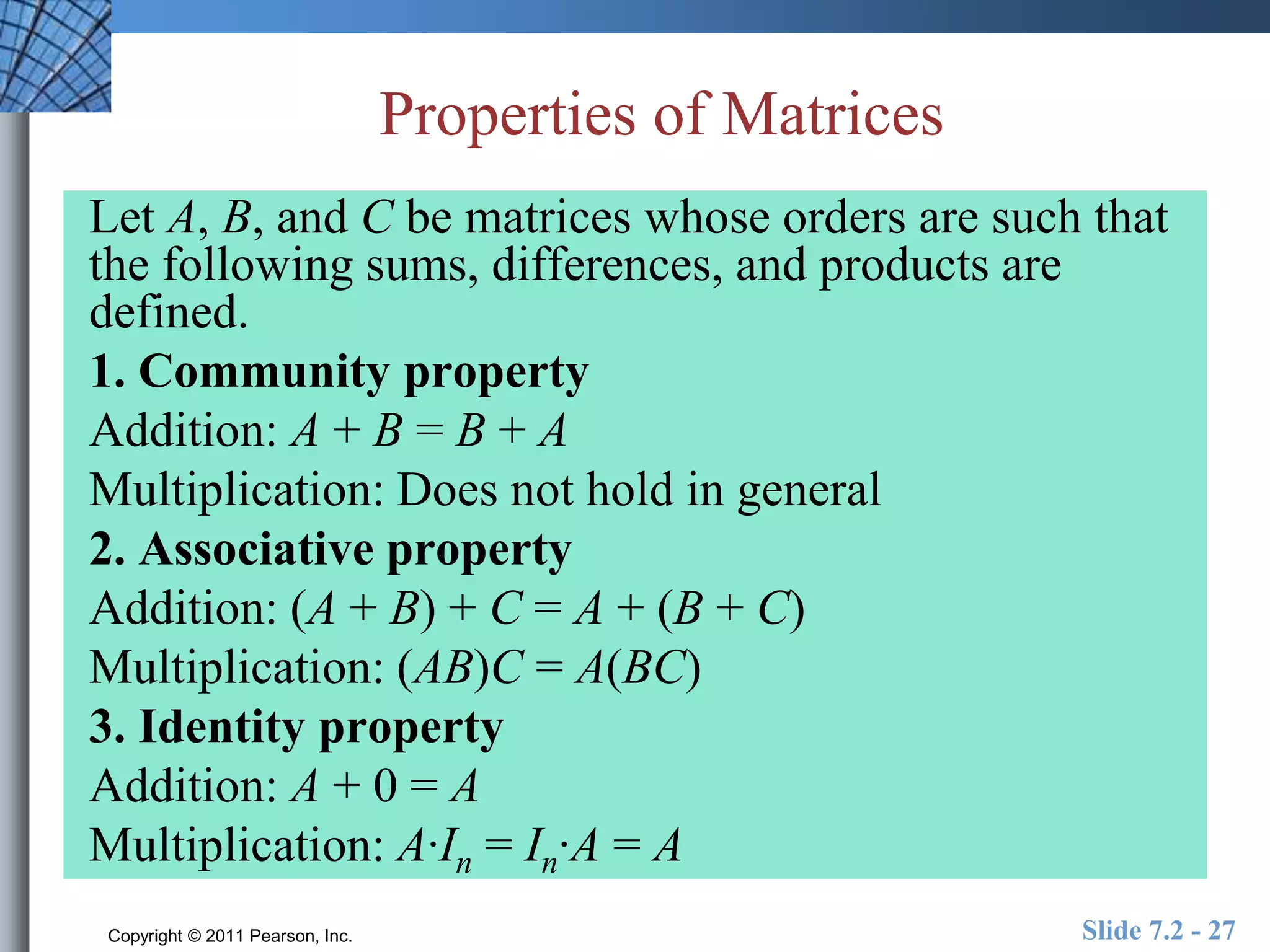
Let A, B, and C be matrices whose orders are such that 
the following sums, differences, and products are 
defined. 
1. Community property 
Addition: A + B = B + A 
Multiplication: Does not hold in general 
2. Associative property 
Addition: (A + B) + C = A + (B + C) 
Multiplication: (AB)C = A(BC) 
3. Identity property 
Addition: A + 0 = A 
Multiplication: A·In = In·A = A 
Copyright © 2011 Pearson, Inc. Slide 7.2 - 27
Properties of Matrices 
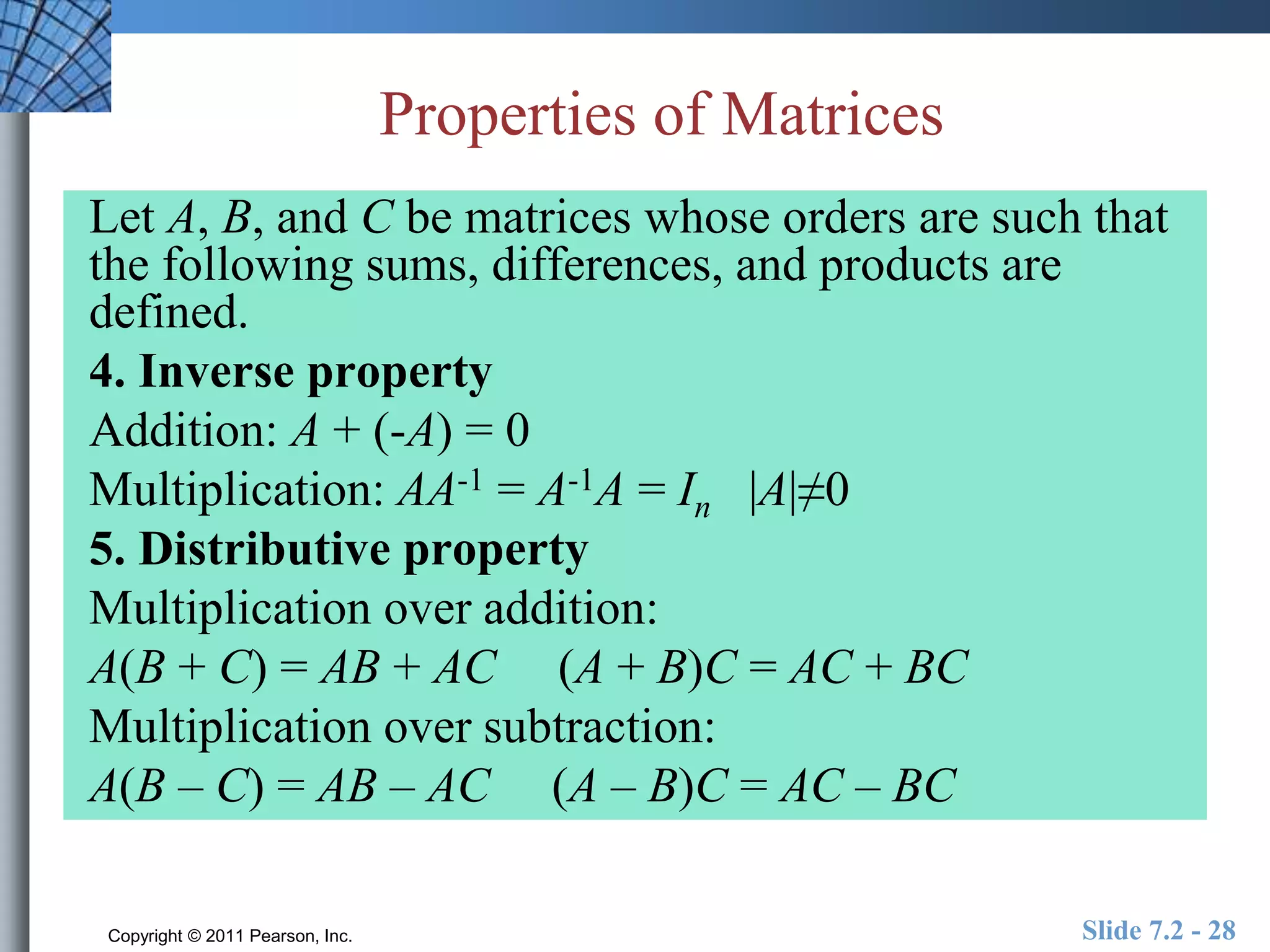
Let A, B, and C be matrices whose orders are such that 
the following sums, differences, and products are 
defined. 
4. Inverse property 
Addition: A + (-A) = 0 
Multiplication: AA-1 = A-1A = In |A|≠0 
5. Distributive property 
Multiplication over addition: 
A(B + C) = AB + AC (A + B)C = AC + BC 
Multiplication over subtraction: 
A(B – C) = AB – AC (A – B)C = AC – BC 
Copyright © 2011 Pearson, Inc. Slide 7.2 - 28
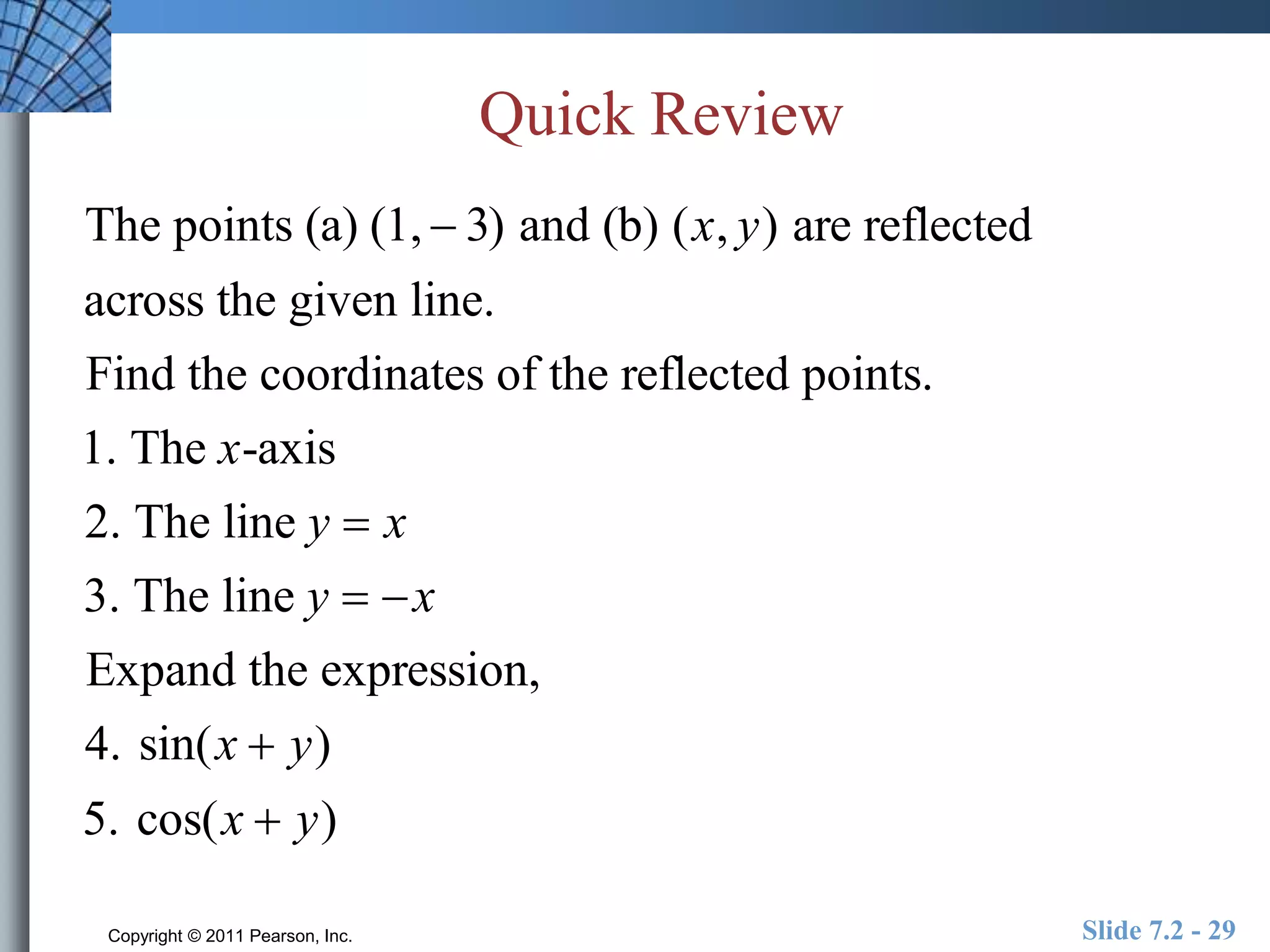
Quick Review 
The points (a) (1,  3) and (b) (x, y) are reflected 
across the given line. 
Find the coordinates of the reflected points. 
1. The x-axis 
2. The line y  x 
3. The line y  x 
Expand the expression, 
4. sin(x  y) 
5. cos(x  y) 
Copyright © 2011 Pearson, Inc. Slide 7.2 - 29
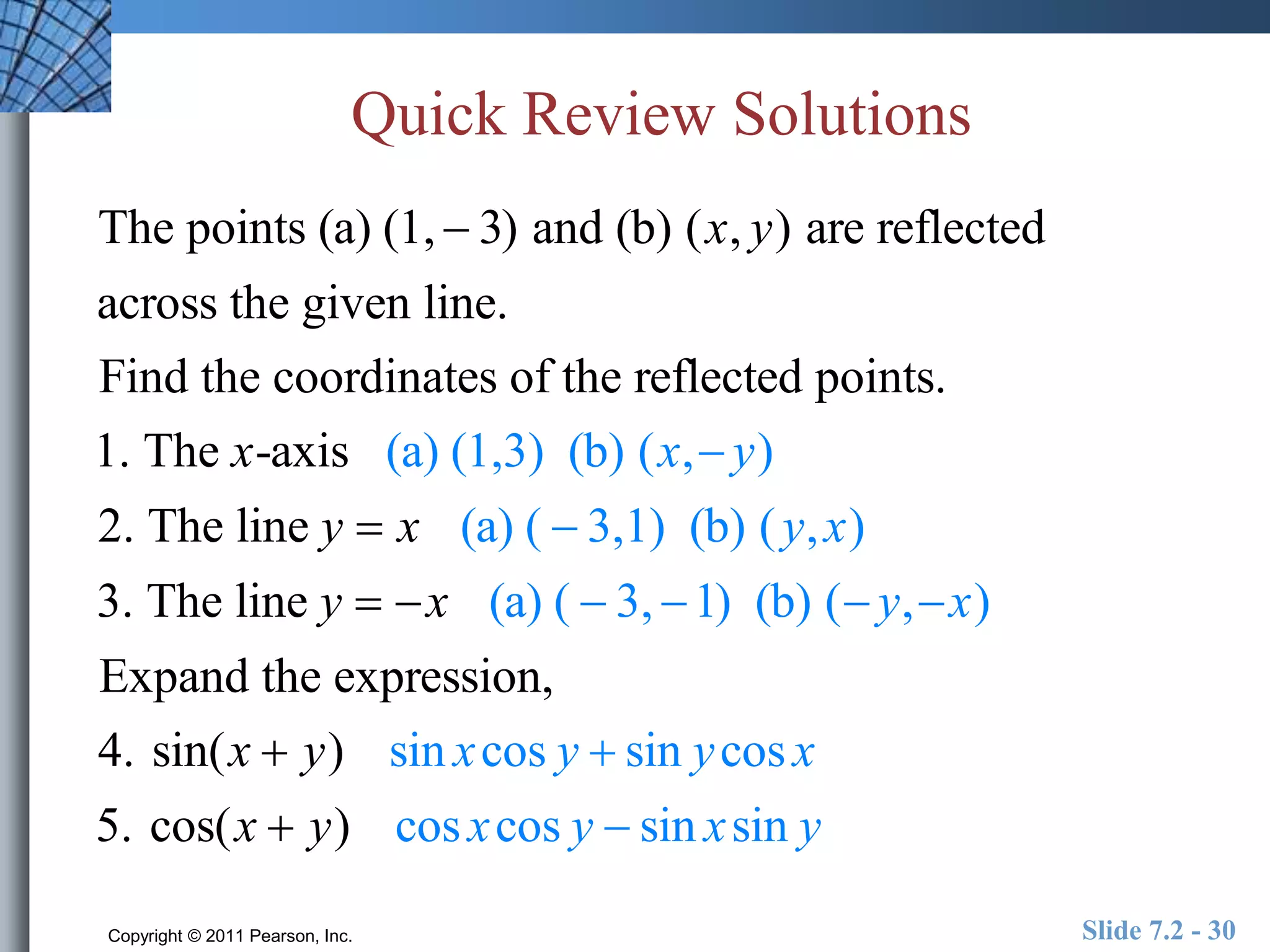
Quick Review Solutions 
The points (a) (1,  3) and (b) (x, y) are reflected 
across the given line. 
Find the coordinates of the reflected points. 
1. The x-axis (a) (1,3) (b) (x,  y) 
2. The line y  x (a) (  3,1) (b) ( y, x) 
3. The line y  x (a) (  3, 1) (b) ( y, x) 
Expand the expression, 
4. sin(x  y) sin x cos y  sin y cos x 
5. cos(x  y) cos x cos y  sin x sin y 
Copyright © 2011 Pearson, Inc. Slide 7.2 - 30

Unit 7.2

  • 1.
    7.2 Matrix Algebra Copyright © 2011 Pearson, Inc.
  • 2.
    What you’ll learnabout  Matrices  Matrix Addition and Subtraction  Matrix Multiplication  Identity and Inverse Matrices  Determinant of a Square Matrix  Applications … and why Matrix algebra provides a powerful technique to manipulate large data sets and solve the related problems that are modeled by the matrices. Copyright © 2011 Pearson, Inc. Slide 7.2 - 2
  • 3.
    Matrix Let mand n be positive integers. An m  n matrix (read "m by n matrix") is a rectangular array of m rows and n columns of real numbers. a11 a12 L a1n a21 a22 L a2n M M M am1 am2 L amn                We also use the shorthand notation aij  for this matrix. Copyright © 2011 Pearson, Inc. Slide 7.2 - 3
  • 4.
    Matrix Vocabulary Eachelement, or entry, aij, of the matrix uses double subscript notation. The row subscript is the first subscript i, and the column subscript is j. The element aij is the ith row and the jth column. In general, the order of an m  n matrix is m  n. Copyright © 2011 Pearson, Inc. Slide 7.2 - 4
  • 5.
    Example Determining theOrder of a Matrix What is the order of the following matrix?  1 4 5 3 5 6      Copyright © 2011 Pearson, Inc. Slide 7.2 - 5
  • 6.
    Example Determining theOrder of a Matrix What is the order of the following matrix? 1 4 5  3 5 6   The matrix has 2 rows and 3 columns so it has order 2  3.    Copyright © 2011 Pearson, Inc. Slide 7.2 - 6
  • 7.
    Matrix Addition andMatrix Subtraction   Let A  aij and  B     bij   be matrices of order m n. 1. The sum A+ B is the m n matrix   A B  aij  bij  . 2. The difference A B is the m n matrix   A B  aij  bij  . Copyright © 2011 Pearson, Inc. Slide 7.2 - 7
  • 8.
    Example Matrix Addition 1 2 3 4 5 6 Copyright © 2011 Pearson, Inc. Slide 7.2 - 8       2 3 4 5 6 7      
  • 9.
    Example Matrix Addition 1 2 3 4 5 6 A B  2 1 2  3 3 4 4  5 5 6 6  7        3 5 7 9 11 13      Copyright © 2011 Pearson, Inc. Slide 7.2 - 9       2 3 4 5 6 7      
  • 10.
    Example Using ScalarMultiplication 3 1 2 3 4 5 6       Copyright © 2011 Pearson, Inc. Slide 7.2 - 10
  • 11.
    Example Using ScalarMultiplication 1 2 3 4 5 6     31 32 33 34 35 36        3 6 9 12 15 18      3    Copyright © 2011 Pearson, Inc. Slide 7.2 - 11
  • 12.
    The Zero Matrix The m n matrix 0  [0] consisting entirely of zeros is the zero matrix. Copyright © 2011 Pearson, Inc. Slide 7.2 - 12
  • 13.
    Additive Inverse  Let A  aij  be any m n matrix.   The m n matrix B  aij consisting of the additive inverses of the entries of A is the additive inverse of A because A B  0. Copyright © 2011 Pearson, Inc. Slide 7.2 - 13
  • 14.
    Matrix Multiplication   Let A  aij be  any m r matrix and B     bij   be any r  n matrix. The product AB  cij     is the m n matrix where cij  ai1b1 j +ai2b2 j  ...  airbrj . Copyright © 2011 Pearson, Inc. Slide 7.2 - 14
  • 15.
    Example Matrix Multiplication Find the product AB if possible. A   1 2 3 0 1 1      and B   1 0 2 1 0 1          Copyright © 2011 Pearson, Inc. Slide 7.2 - 15
  • 16.
    Example Matrix Multiplication A   1 2 3 0 1 1      and B   1 0 2 1 0 1          The number of columns of A is 3 and the number of rows of B is 3, so the product is defined. The product AB  cij   is a 2  2 matrix where c11  1 2 3   1 2 0            11 2  2  30  5, Copyright © 2011 Pearson, Inc. Slide 7.2 - 16
  • 17.
    Example Matrix Multiplication A   1 2 3 0 1 1      and B   1 0 2 1 0 1            0 c12  1 2 3      1 1       10  2 1 3 1  1, c21  0 1 1   1 2 0            011 2  10  2, Copyright © 2011 Pearson, Inc. Slide 7.2 - 17
  • 18.
    Example Matrix Multiplication A   1 2 3 0 1 1      and B   1 0 2 1 0 1          c22  0 1 1    0 1 1           0 0 11 1 1  2. Thus AB   5 1 2 2     . Copyright © 2011 Pearson, Inc. Slide 7.2 - 18
  • 19.
    Identity Matrix Then  n matrix In with 1's on the main diagonal and 0's elsewhere is the identity matrix of order n  n. In  1 0 0 L 0 0 1 0 L 0 0 0 1 L 0 M M M 0 0 0 0 0 1                 Copyright © 2011 Pearson, Inc. Slide 7.2 - 19
  • 20.
    Inverse of aSquare Matrix  Let A  aij  be an n  n matrix. If there is a matrix B such that AB  BA  In , then B is the inverse of A. We write B  A1. Copyright © 2011 Pearson, Inc. Slide 7.2 - 20
  • 21.
    Inverse of a2 × 2 Matrix If ad  bc  0, then a b c d      1   1 ad  bc d b c a       . Copyright © 2011 Pearson, Inc. Slide 7.2 - 21
  • 22.
    Determinant of aSquare Matrix   Let A  aij   be a matrix of order n  n (n  2). The determinant of A, denoted by det A or | A | , is the sum of the entries in any row or any column multiplied by their respective cofactors. For example, expanding by the ith row gives det A | A | ai1Ai1  ai2Ai2  ...  ainAin . Copyright © 2011 Pearson, Inc. Slide 7.2 - 22
  • 23.
    Inverses of n n Matrices An n  n matrix A has an inverse if and only if det A ≠ 0. Copyright © 2011 Pearson, Inc. Slide 7.2 - 23
  • 24.
    Example Finding InverseMatrices Determine whether the matrix has an inverse. If so, find its inverse matrix. A   5 1 8 3      Copyright © 2011 Pearson, Inc. Slide 7.2 - 24
  • 25.
    Example Finding InverseMatrices A   5 1 8 3      Since det A  ad  bc  5318  7  0, we conclude that A has an inverse. Use the formula A1  1 ad  bc d b c a        1 7  3 1 8 5       3 7  1 7  8 7 5 7             . Copyright © 2011 Pearson, Inc. Slide 7.2 - 25
  • 26.
    Example Finding InverseMatrices A   5 1 8 3    Check: A1A    3 7  1 7  8 7 5 7              5 1 8 3      3 7  8 7 3 7  3 7  40 7  40 7  8 7  15 7              1 0 0 1       I2 Similarly, A1A  I2 . Copyright © 2011 Pearson, Inc. Slide 7.2 - 26
  • 27.
    Properties of Matrices Let A, B, and C be matrices whose orders are such that the following sums, differences, and products are defined. 1. Community property Addition: A + B = B + A Multiplication: Does not hold in general 2. Associative property Addition: (A + B) + C = A + (B + C) Multiplication: (AB)C = A(BC) 3. Identity property Addition: A + 0 = A Multiplication: A·In = In·A = A Copyright © 2011 Pearson, Inc. Slide 7.2 - 27
  • 28.
    Properties of Matrices Let A, B, and C be matrices whose orders are such that the following sums, differences, and products are defined. 4. Inverse property Addition: A + (-A) = 0 Multiplication: AA-1 = A-1A = In |A|≠0 5. Distributive property Multiplication over addition: A(B + C) = AB + AC (A + B)C = AC + BC Multiplication over subtraction: A(B – C) = AB – AC (A – B)C = AC – BC Copyright © 2011 Pearson, Inc. Slide 7.2 - 28
  • 29.
    Quick Review Thepoints (a) (1,  3) and (b) (x, y) are reflected across the given line. Find the coordinates of the reflected points. 1. The x-axis 2. The line y  x 3. The line y  x Expand the expression, 4. sin(x  y) 5. cos(x  y) Copyright © 2011 Pearson, Inc. Slide 7.2 - 29
  • 30.
    Quick Review Solutions The points (a) (1,  3) and (b) (x, y) are reflected across the given line. Find the coordinates of the reflected points. 1. The x-axis (a) (1,3) (b) (x,  y) 2. The line y  x (a) (  3,1) (b) ( y, x) 3. The line y  x (a) (  3, 1) (b) ( y, x) Expand the expression, 4. sin(x  y) sin x cos y  sin y cos x 5. cos(x  y) cos x cos y  sin x sin y Copyright © 2011 Pearson, Inc. Slide 7.2 - 30