2.4 
Real Zeros of 
Polynomial 
Functions 
Copyright © 2011 Pearson, Inc.
What you’ll learn about 
 Long Division and the Division Algorithm 
 Remainder and Factor Theorems 
 Synthetic Division 
 Rational Zeros Theorem 
 Upper and Lower Bounds 
… and why 
These topics help identify and locate the real zeros of 
polynomial functions. 
Copyright © 2011 Pearson, Inc. Slide 2.4 - 2
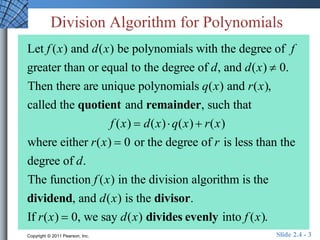
Division Algorithm for Polynomials 
Let f (x) and d(x) be polynomials with the degree of f 
greater than or equal to the degree of d, and d(x)  0. 
Then there are unique polynomials q(x) and r(x), 
called the quotient and remainder, such that 
f (x)  d(x)  q(x)  r(x) 
where either r(x)  0 or the degree of r is less than the 
degree of d. 
The function f (x) in the division algorithm is the 
dividend, and d(x) is the divisor. 
If r(x)  0, we say d(x) divides evenly into f (x). 
Copyright © 2011 Pearson, Inc. Slide 2.4 - 3
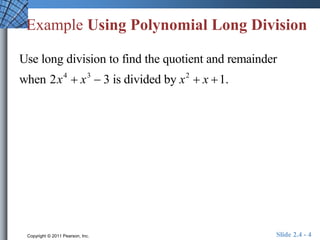
Example Using Polynomial Long Division 
Use long division to find the quotient and remainder 
when 2x4  x3  3 is divided by x2  x 1. 
Copyright © 2011 Pearson, Inc. Slide 2.4 - 4
Example Using Polynomial Long Division 
2x2  x 1 
x2  x 1 2x4  x3  0x2  0x  3 
2x4  2x3  2x2 
 x3  2x2  0x  3 
x3  x2  x 
 x2 + x  3 
x2  x 1 
2x  2 
2x4  x3  3 x2   x 1 2x2  x 1 
2x  2 
x2  x 1 
Copyright © 2011 Pearson, Inc. Slide 2.4 - 5
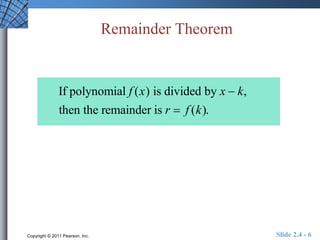
Remainder Theorem 
If polynomial f (x) is divided by x  k, 
then the remainder is r  f (k). 
Copyright © 2011 Pearson, Inc. Slide 2.4 - 6
Example Using the Remainder 
Theorem 
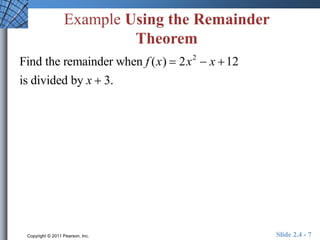
Find the remainder when f (x)  2x2  x 12 
is divided by x  3. 
Copyright © 2011 Pearson, Inc. Slide 2.4 - 7
Example Using the Remainder 
Theorem 
Find the remainder when f (x)  2x2  x 12 
is divided by x  3. 
r  f (3)  232 
 312 =33 
Copyright © 2011 Pearson, Inc. Slide 2.4 - 8
Factor Theorem 
A polynomial function f (x) has a factor x  k 
if and only if f (k)  0. 
Copyright © 2011 Pearson, Inc. Slide 2.4 - 9
Fundamental Connections for 
Polynomial Functions 
For a polynomial function f and a real number k 
the following statements are equivalent: 
1. x = k is a solution (or root) of the equation f(x) = 0 
2. k is a zero of the function f. 
3. k is an x-intercept of the graph of y = f(x). 
4. x – k is a factor of f(x). 
Copyright © 2011 Pearson, Inc. Slide 2.4 - 10
Example Using Synthetic Division 
Divide 3x3  2x2  x  5 by x 1 using synthetic division. 
Copyright © 2011 Pearson, Inc. Slide 2.4 - 11
Example Using Synthetic Division 
Divide 3x3  2x2  x  5 by x 1 using synthetic division. 
1 3  2 1  5 
3 
1 3  2 1  5 
3 1 2 
3 1 2  3 
3x3  2x2  x  5 
x 1 
 3x2  x  2  
3 
x 1 
Copyright © 2011 Pearson, Inc. Slide 2.4 - 12
Rational Zeros Theorem 
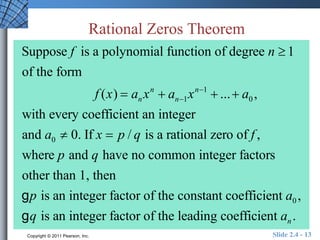
Suppose f is a polynomial function of degree n  1 
of the form 
f (x)  anxn  an1xn1  ...  a0 , 
with every coefficient an integer 
and a0  0. If x  p / q is a rational zero of f , 
where p and q have no common integer factors 
other than 1, then 
g p is an integer factor of the constant coefficient a0 , 
g q is an integer factor of the leading coefficient an . 
Copyright © 2011 Pearson, Inc. Slide 2.4 - 13
Upper and Lower Bound Tests for 
Real Zeros 
Let f be a polynomial function of degree n  1 with a 
positive leading coefficient. Suppose f (x) is divided 
by x  k using synthetic division. 
g If k  0 and every number in the last line is nonnegative 
(positive or zero), then k is an upper bound for the 
real zeros of f . 
g If k  0 and the numbers in the last line are alternately 
nonnegative and nonpositive, then k is a lower bound 
for the real zeros of f . 
Copyright © 2011 Pearson, Inc. Slide 2.4 - 14
Example Finding the Real Zeros of a 
Polynomial Function 
Find all of the real zeros of 
f (x)  2x5  x4  2x3 14x2  6x  36 
and identify them as rational or irrational. 
Copyright © 2011 Pearson, Inc. Slide 2.4 - 15
Example Finding the Real Zeros of a 
Polynomial Function 
Find all of the real zeros of 
f (x)  2x5  x4  2x3 14x2  6x  36 
and identify them as rational or irrational. 
Potential Rational Zeros : 
Factors of 36 
Factors of 2 
: 1, 2, 3, 4, 6, 9, 12, 18, 36, 
 
1 
2 
,  
3 
2 
,  
9 
2 
Copyright © 2011 Pearson, Inc. Slide 2.4 - 16
Example Finding the Real Zeros of a 
Polynomial Function 
The graph suggests that only 
x   
3 
2 
, x  
3 
2 
, and x  2 be 
considered. Synthetic division 
shows that only x   
3 
2 
, and 
x  2are zeros of f , and 
f x 2x  3x  2 x3   2x  6. 
Copyright © 2011 Pearson, Inc. Slide 2.4 - 17
Example Finding the Real Zeros of a 
Polynomial Function 
Now let gx x3  2x  6. 
potential zeros : 
1, 2, 3, 6 
but the graph shows that 
these values are not zeros of g. 
So f has no more rational zeros. 
Copyright © 2011 Pearson, Inc. Slide 2.4 - 18
Example Finding the Real Zeros of a 
Polynomial Function 
Using grapher methods with either function 
 f or g shows that an irrational zero exists 
at x  1.456. The upper and lower bound 
tests can be applied to f or g to show that 
there are no zeros outside the viewing 
windows shown. 
The real zeros of f are the rational numbers 
x   
3 
2 
and x  2, and an irrational number 
x  1.456. 
Copyright © 2011 Pearson, Inc. Slide 2.4 - 19
Example Finding the Real Zeros of a 
Polynomial Function 
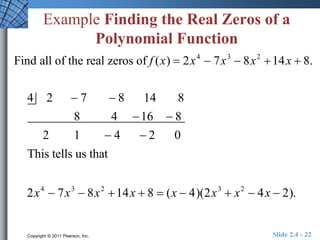
Find all of the real zeros of f (x)  2x4  7x3  8x2 14x  8. 
Copyright © 2011 Pearson, Inc. Slide 2.4 - 20
Example Finding the Real Zeros of a 
Polynomial Function 
Find all of the real zeros of f (x)  2x4  7x3  8x2 14x  8. 
Potential Rational Zeros : 
Factors of 8 
: 
Factors of 2 
1, 2, 4, 8 
1, 2 
 1, 2, 4, 8,  
1 
2 
Compare the x-intercepts of the 
graph and the list of possibilities, 
and decide that 4 and 1/2 are 
potential rational zeros. 
Copyright © 2011 Pearson, Inc. Slide 2.4 - 21
Example Finding the Real Zeros of a 
Polynomial Function 
Find all of the real zeros of f (x)  2x4  7x3  8x2 14x  8. 
4 2  7  8 14 8 
8 4 16  8 
2 1  4  2 0 
This tells us that 
2x4  7x3  8x2 14x  8  (x  4)(2x3  x2  4x  2). 
Copyright © 2011 Pearson, Inc. Slide 2.4 - 22
Example Finding the Real Zeros of a 
Polynomial Function 
Find all of the real zeros of f (x)  2x4  7x3  8x2 14x  8. 
1 / 2 2 1  4  2 
1 0 2 
2 0  4 0 
This tells us that 
 
2x4  7x3  8x2 14x  8  2(x  4) x  
1 
2 
  
 
 x2  2  . 
The real zeros are 4,  
1 
2 
,  2. 
Copyright © 2011 Pearson, Inc. Slide 2.4 - 23
Quick Review 
Rewrite the expression as a polynomial in standard form. 
1. 
2x3  3x2  x 
x 
2. 
2x5  8x3  x2 
2x2 
Factor the polynomial into linear factors. 
3. x3 16x 
4. x3  x2  4x  4 
5. 6x2  24 
Copyright © 2011 Pearson, Inc. Slide 2.4 - 24
Quick Review Solutions 
Rewrite the expression as a polynomial in standard form. 
1. 
2x3  3x2  x 
x 
2x2  3x 1 
2. 
2x5  8x3  x2 
2x2 x3  4x  
1 
2 
Factor the polynomial into linear factors. 
3. x3 16x xx  4x  4 
4. x3  x2  4x  4 x 1x  2x  2 
5. 6x2  24 6x  2x  2 
Copyright © 2011 Pearson, Inc. Slide 2.4 - 25

Unit 2.4

  • 1.
    2.4 Real Zerosof Polynomial Functions Copyright © 2011 Pearson, Inc.
  • 2.
    What you’ll learnabout  Long Division and the Division Algorithm  Remainder and Factor Theorems  Synthetic Division  Rational Zeros Theorem  Upper and Lower Bounds … and why These topics help identify and locate the real zeros of polynomial functions. Copyright © 2011 Pearson, Inc. Slide 2.4 - 2
  • 3.
    Division Algorithm forPolynomials Let f (x) and d(x) be polynomials with the degree of f greater than or equal to the degree of d, and d(x)  0. Then there are unique polynomials q(x) and r(x), called the quotient and remainder, such that f (x)  d(x)  q(x)  r(x) where either r(x)  0 or the degree of r is less than the degree of d. The function f (x) in the division algorithm is the dividend, and d(x) is the divisor. If r(x)  0, we say d(x) divides evenly into f (x). Copyright © 2011 Pearson, Inc. Slide 2.4 - 3
  • 4.
    Example Using PolynomialLong Division Use long division to find the quotient and remainder when 2x4  x3  3 is divided by x2  x 1. Copyright © 2011 Pearson, Inc. Slide 2.4 - 4
  • 5.
    Example Using PolynomialLong Division 2x2  x 1 x2  x 1 2x4  x3  0x2  0x  3 2x4  2x3  2x2  x3  2x2  0x  3 x3  x2  x  x2 + x  3 x2  x 1 2x  2 2x4  x3  3 x2   x 1 2x2  x 1 2x  2 x2  x 1 Copyright © 2011 Pearson, Inc. Slide 2.4 - 5
  • 6.
    Remainder Theorem Ifpolynomial f (x) is divided by x  k, then the remainder is r  f (k). Copyright © 2011 Pearson, Inc. Slide 2.4 - 6
  • 7.
    Example Using theRemainder Theorem Find the remainder when f (x)  2x2  x 12 is divided by x  3. Copyright © 2011 Pearson, Inc. Slide 2.4 - 7
  • 8.
    Example Using theRemainder Theorem Find the remainder when f (x)  2x2  x 12 is divided by x  3. r  f (3)  232  312 =33 Copyright © 2011 Pearson, Inc. Slide 2.4 - 8
  • 9.
    Factor Theorem Apolynomial function f (x) has a factor x  k if and only if f (k)  0. Copyright © 2011 Pearson, Inc. Slide 2.4 - 9
  • 10.
    Fundamental Connections for Polynomial Functions For a polynomial function f and a real number k the following statements are equivalent: 1. x = k is a solution (or root) of the equation f(x) = 0 2. k is a zero of the function f. 3. k is an x-intercept of the graph of y = f(x). 4. x – k is a factor of f(x). Copyright © 2011 Pearson, Inc. Slide 2.4 - 10
  • 11.
    Example Using SyntheticDivision Divide 3x3  2x2  x  5 by x 1 using synthetic division. Copyright © 2011 Pearson, Inc. Slide 2.4 - 11
  • 12.
    Example Using SyntheticDivision Divide 3x3  2x2  x  5 by x 1 using synthetic division. 1 3  2 1  5 3 1 3  2 1  5 3 1 2 3 1 2  3 3x3  2x2  x  5 x 1  3x2  x  2  3 x 1 Copyright © 2011 Pearson, Inc. Slide 2.4 - 12
  • 13.
    Rational Zeros Theorem Suppose f is a polynomial function of degree n  1 of the form f (x)  anxn  an1xn1  ...  a0 , with every coefficient an integer and a0  0. If x  p / q is a rational zero of f , where p and q have no common integer factors other than 1, then g p is an integer factor of the constant coefficient a0 , g q is an integer factor of the leading coefficient an . Copyright © 2011 Pearson, Inc. Slide 2.4 - 13
  • 14.
    Upper and LowerBound Tests for Real Zeros Let f be a polynomial function of degree n  1 with a positive leading coefficient. Suppose f (x) is divided by x  k using synthetic division. g If k  0 and every number in the last line is nonnegative (positive or zero), then k is an upper bound for the real zeros of f . g If k  0 and the numbers in the last line are alternately nonnegative and nonpositive, then k is a lower bound for the real zeros of f . Copyright © 2011 Pearson, Inc. Slide 2.4 - 14
  • 15.
    Example Finding theReal Zeros of a Polynomial Function Find all of the real zeros of f (x)  2x5  x4  2x3 14x2  6x  36 and identify them as rational or irrational. Copyright © 2011 Pearson, Inc. Slide 2.4 - 15
  • 16.
    Example Finding theReal Zeros of a Polynomial Function Find all of the real zeros of f (x)  2x5  x4  2x3 14x2  6x  36 and identify them as rational or irrational. Potential Rational Zeros : Factors of 36 Factors of 2 : 1, 2, 3, 4, 6, 9, 12, 18, 36,  1 2 ,  3 2 ,  9 2 Copyright © 2011 Pearson, Inc. Slide 2.4 - 16
  • 17.
    Example Finding theReal Zeros of a Polynomial Function The graph suggests that only x   3 2 , x  3 2 , and x  2 be considered. Synthetic division shows that only x   3 2 , and x  2are zeros of f , and f x 2x  3x  2 x3   2x  6. Copyright © 2011 Pearson, Inc. Slide 2.4 - 17
  • 18.
    Example Finding theReal Zeros of a Polynomial Function Now let gx x3  2x  6. potential zeros : 1, 2, 3, 6 but the graph shows that these values are not zeros of g. So f has no more rational zeros. Copyright © 2011 Pearson, Inc. Slide 2.4 - 18
  • 19.
    Example Finding theReal Zeros of a Polynomial Function Using grapher methods with either function  f or g shows that an irrational zero exists at x  1.456. The upper and lower bound tests can be applied to f or g to show that there are no zeros outside the viewing windows shown. The real zeros of f are the rational numbers x   3 2 and x  2, and an irrational number x  1.456. Copyright © 2011 Pearson, Inc. Slide 2.4 - 19
  • 20.
    Example Finding theReal Zeros of a Polynomial Function Find all of the real zeros of f (x)  2x4  7x3  8x2 14x  8. Copyright © 2011 Pearson, Inc. Slide 2.4 - 20
  • 21.
    Example Finding theReal Zeros of a Polynomial Function Find all of the real zeros of f (x)  2x4  7x3  8x2 14x  8. Potential Rational Zeros : Factors of 8 : Factors of 2 1, 2, 4, 8 1, 2  1, 2, 4, 8,  1 2 Compare the x-intercepts of the graph and the list of possibilities, and decide that 4 and 1/2 are potential rational zeros. Copyright © 2011 Pearson, Inc. Slide 2.4 - 21
  • 22.
    Example Finding theReal Zeros of a Polynomial Function Find all of the real zeros of f (x)  2x4  7x3  8x2 14x  8. 4 2  7  8 14 8 8 4 16  8 2 1  4  2 0 This tells us that 2x4  7x3  8x2 14x  8  (x  4)(2x3  x2  4x  2). Copyright © 2011 Pearson, Inc. Slide 2.4 - 22
  • 23.
    Example Finding theReal Zeros of a Polynomial Function Find all of the real zeros of f (x)  2x4  7x3  8x2 14x  8. 1 / 2 2 1  4  2 1 0 2 2 0  4 0 This tells us that  2x4  7x3  8x2 14x  8  2(x  4) x  1 2     x2  2  . The real zeros are 4,  1 2 ,  2. Copyright © 2011 Pearson, Inc. Slide 2.4 - 23
  • 24.
    Quick Review Rewritethe expression as a polynomial in standard form. 1. 2x3  3x2  x x 2. 2x5  8x3  x2 2x2 Factor the polynomial into linear factors. 3. x3 16x 4. x3  x2  4x  4 5. 6x2  24 Copyright © 2011 Pearson, Inc. Slide 2.4 - 24
  • 25.
    Quick Review Solutions Rewrite the expression as a polynomial in standard form. 1. 2x3  3x2  x x 2x2  3x 1 2. 2x5  8x3  x2 2x2 x3  4x  1 2 Factor the polynomial into linear factors. 3. x3 16x xx  4x  4 4. x3  x2  4x  4 x 1x  2x  2 5. 6x2  24 6x  2x  2 Copyright © 2011 Pearson, Inc. Slide 2.4 - 25