3.3 
Logarithmic 
Functions and 
Their Graphs 
Copyright © 2011 Pearson, Inc.
What you’ll learn about 
 Inverses of Exponential Functions 
 Common Logarithms – Base 10 
 Natural Logarithms – Base e 
 Graphs of Logarithmic Functions 
 Measuring Sound Using Decibels 
… and why 
Logarithmic functions are used in many applications, 
including the measurement of the relative intensity of 
sounds. 
Copyright © 2011 Pearson, Inc. Slide 3.3 - 2
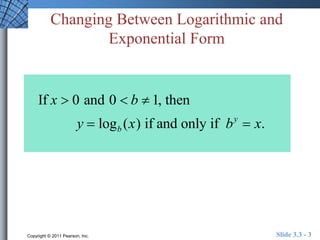
Changing Between Logarithmic and 
Exponential Form 
If x  0 and 0  b  1, then 
y  logb (x) if and only if by  x. 
Copyright © 2011 Pearson, Inc. Slide 3.3 - 3
Inverses of Exponential Functions 
Copyright © 2011 Pearson, Inc. Slide 3.3 - 4
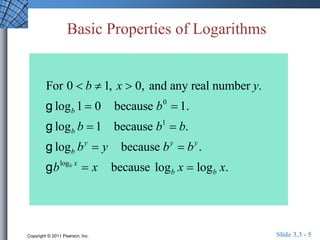
Basic Properties of Logarithms 
For 0  b  1, x  0, and any real number y. 
g logb 1  0 because b0  1. 
g logb b  1 because b1  b. 
g logb by  y because by  by . 
g blogb x  x because logb x  logb x. 
Copyright © 2011 Pearson, Inc. Slide 3.3 - 5
An Exponential Function and Its 
Inverse 
Copyright © 2011 Pearson, Inc. Slide 3.3 - 6
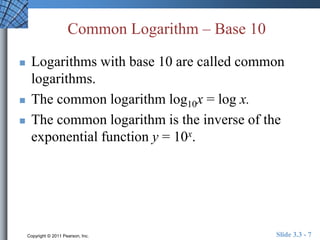
Common Logarithm – Base 10 
 Logarithms with base 10 are called common 
logarithms. 
 The common logarithm log10x = log x. 
 The common logarithm is the inverse of the 
exponential function y = 10x. 
Copyright © 2011 Pearson, Inc. Slide 3.3 - 7
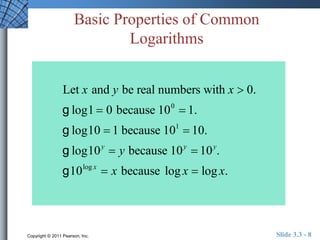
Basic Properties of Common 
Logarithms 
Let x and y be real numbers with x  0. 
g log1  0 because 100  1. 
g log10  1 because 101  10. 
g log10y  y because 10y  10y. 
g 10log x  x because log x  log x. 
Copyright © 2011 Pearson, Inc. Slide 3.3 - 8
Example Solving Simple Logarithmic 
Equations 
Solve the equation by changing it to exponential form. 
log x  4 
Copyright © 2011 Pearson, Inc. Slide 3.3 - 9
Example Solving Simple Logarithmic 
Equations 
Solve the equation by changing it to exponential form. 
log x  4 
x  104  10,000 
Copyright © 2011 Pearson, Inc. Slide 3.3 - 10
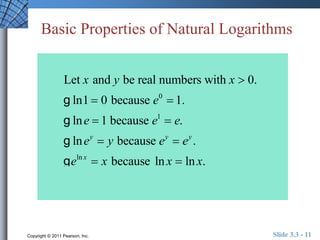
Basic Properties of Natural Logarithms 
Let x and y be real numbers with x  0. 
g ln1  0 because e0  1. 
g lne  1 because e1  e. 
g lney  y because ey  ey . 
g eln x  x because ln x  ln x. 
Copyright © 2011 Pearson, Inc. Slide 3.3 - 11
Graphs of the Common and Natural 
Logarithm 
Copyright © 2011 Pearson, Inc. Slide 3.3 - 12
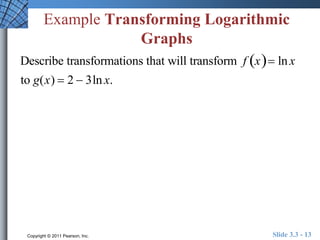
Example Transforming Logarithmic 
Graphs 
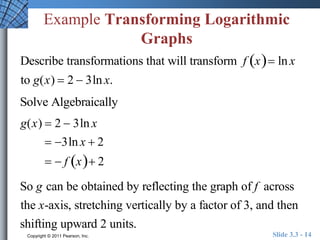
Describe transformations that will transform f x ln x 
to g(x)  2  3ln x. 
Copyright © 2011 Pearson, Inc. Slide 3.3 - 13
Example Transforming Logarithmic 
Graphs 
Describe transformations that will transform f x ln x 
to g(x)  2  3ln x. 
Solve Algebraically 
g(x)  2  3ln x 
 3ln x  2 
  f x 2 
So g can be obtained by reflecting the graph of f across 
the x-axis, stretching vertically by a factor of 3, and then 
shifting upward 2 units. 
Copyright © 2011 Pearson, Inc. Slide 3.3 - 14
Example Transforming Logarithmic 
Graphs 
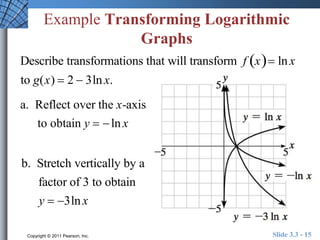
Describe transformations that will transform f x ln x 
to g(x)  2  3ln x. 
a. Reflect over the x-axis 
to obtain y   ln x 
b. Stretch vertically by a 
factor of 3 to obtain 
y  3ln x 
Copyright © 2011 Pearson, Inc. Slide 3.3 - 15
Example Transforming Logarithmic 
Graphs 
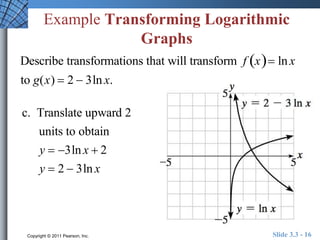
Describe transformations that will transform f x ln x 
to g(x)  2  3ln x. 
c. Translate upward 2 
units to obtain 
y  3ln x  2 
y  2  3ln x 
Copyright © 2011 Pearson, Inc. Slide 3.3 - 16
Decibels 
The level of sound intensity in decibels (dB) is 
  10log 
I 
I0 
 
  
 
 , 
where  (beta) is the number of decibels, 
I is the sound intensity in W/m2 , and 
I0  1012 W/m2 is the threshold of human 
hearing (the quietest audible sound intensity). 
Copyright © 2011 Pearson, Inc. Slide 3.3 - 17
Quick Review 
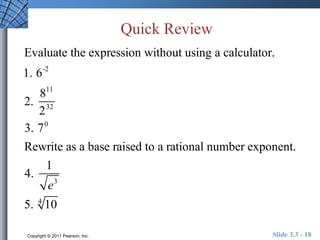
Evaluate the expression without using a calculator. 
1. 6-2 
2. 
811 
232 
3. 70 
Rewrite as a base raised to a rational number exponent. 
4. 
1 
e3 
5. 10 4 
Copyright © 2011 Pearson, Inc. Slide 3.3 - 18
Quick Review Solutions 
Evaluate the expression without using a calculator. 
1. 6-2 
1 
36 
2. 
811 
232 2 
3. 70 1 
Rewrite as a base raised to a rational number exponent. 
4. 
1 
e3 
e3/2 
5. 10 4 101/4 
Copyright © 2011 Pearson, Inc. Slide 3.3 - 19

Unit 3.3

  • 1.
    3.3 Logarithmic Functionsand Their Graphs Copyright © 2011 Pearson, Inc.
  • 2.
    What you’ll learnabout  Inverses of Exponential Functions  Common Logarithms – Base 10  Natural Logarithms – Base e  Graphs of Logarithmic Functions  Measuring Sound Using Decibels … and why Logarithmic functions are used in many applications, including the measurement of the relative intensity of sounds. Copyright © 2011 Pearson, Inc. Slide 3.3 - 2
  • 3.
    Changing Between Logarithmicand Exponential Form If x  0 and 0  b  1, then y  logb (x) if and only if by  x. Copyright © 2011 Pearson, Inc. Slide 3.3 - 3
  • 4.
    Inverses of ExponentialFunctions Copyright © 2011 Pearson, Inc. Slide 3.3 - 4
  • 5.
    Basic Properties ofLogarithms For 0  b  1, x  0, and any real number y. g logb 1  0 because b0  1. g logb b  1 because b1  b. g logb by  y because by  by . g blogb x  x because logb x  logb x. Copyright © 2011 Pearson, Inc. Slide 3.3 - 5
  • 6.
    An Exponential Functionand Its Inverse Copyright © 2011 Pearson, Inc. Slide 3.3 - 6
  • 7.
    Common Logarithm –Base 10  Logarithms with base 10 are called common logarithms.  The common logarithm log10x = log x.  The common logarithm is the inverse of the exponential function y = 10x. Copyright © 2011 Pearson, Inc. Slide 3.3 - 7
  • 8.
    Basic Properties ofCommon Logarithms Let x and y be real numbers with x  0. g log1  0 because 100  1. g log10  1 because 101  10. g log10y  y because 10y  10y. g 10log x  x because log x  log x. Copyright © 2011 Pearson, Inc. Slide 3.3 - 8
  • 9.
    Example Solving SimpleLogarithmic Equations Solve the equation by changing it to exponential form. log x  4 Copyright © 2011 Pearson, Inc. Slide 3.3 - 9
  • 10.
    Example Solving SimpleLogarithmic Equations Solve the equation by changing it to exponential form. log x  4 x  104  10,000 Copyright © 2011 Pearson, Inc. Slide 3.3 - 10
  • 11.
    Basic Properties ofNatural Logarithms Let x and y be real numbers with x  0. g ln1  0 because e0  1. g lne  1 because e1  e. g lney  y because ey  ey . g eln x  x because ln x  ln x. Copyright © 2011 Pearson, Inc. Slide 3.3 - 11
  • 12.
    Graphs of theCommon and Natural Logarithm Copyright © 2011 Pearson, Inc. Slide 3.3 - 12
  • 13.
    Example Transforming Logarithmic Graphs Describe transformations that will transform f x ln x to g(x)  2  3ln x. Copyright © 2011 Pearson, Inc. Slide 3.3 - 13
  • 14.
    Example Transforming Logarithmic Graphs Describe transformations that will transform f x ln x to g(x)  2  3ln x. Solve Algebraically g(x)  2  3ln x  3ln x  2   f x 2 So g can be obtained by reflecting the graph of f across the x-axis, stretching vertically by a factor of 3, and then shifting upward 2 units. Copyright © 2011 Pearson, Inc. Slide 3.3 - 14
  • 15.
    Example Transforming Logarithmic Graphs Describe transformations that will transform f x ln x to g(x)  2  3ln x. a. Reflect over the x-axis to obtain y   ln x b. Stretch vertically by a factor of 3 to obtain y  3ln x Copyright © 2011 Pearson, Inc. Slide 3.3 - 15
  • 16.
    Example Transforming Logarithmic Graphs Describe transformations that will transform f x ln x to g(x)  2  3ln x. c. Translate upward 2 units to obtain y  3ln x  2 y  2  3ln x Copyright © 2011 Pearson, Inc. Slide 3.3 - 16
  • 17.
    Decibels The levelof sound intensity in decibels (dB) is   10log I I0      , where  (beta) is the number of decibels, I is the sound intensity in W/m2 , and I0  1012 W/m2 is the threshold of human hearing (the quietest audible sound intensity). Copyright © 2011 Pearson, Inc. Slide 3.3 - 17
  • 18.
    Quick Review Evaluatethe expression without using a calculator. 1. 6-2 2. 811 232 3. 70 Rewrite as a base raised to a rational number exponent. 4. 1 e3 5. 10 4 Copyright © 2011 Pearson, Inc. Slide 3.3 - 18
  • 19.
    Quick Review Solutions Evaluate the expression without using a calculator. 1. 6-2 1 36 2. 811 232 2 3. 70 1 Rewrite as a base raised to a rational number exponent. 4. 1 e3 e3/2 5. 10 4 101/4 Copyright © 2011 Pearson, Inc. Slide 3.3 - 19