PRESENTED BY:
   Nikhi jain
Salini bhadoria
Gunjan dwivedi
  Shilpi barua
  Ritu Tomar
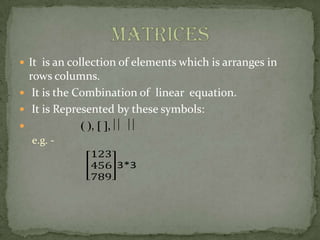
 It is an collection of elements which is arranges in
  rows columns.
 It is the Combination of linear equation.
 It is Represented by these symbols:
              , ,
  e.g. -

                    3*3
1.   Row matrices – A matrices which has only one row
     called row matrices e.g.-

                   [123]1*3
2. Column matrices – A matrices which has only one
   column is called column matrices e.g. –
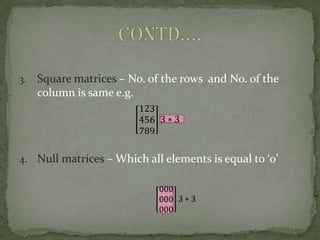
3.   Square matrices – No. of the rows and No. of the
     column is same e.g.


4. Null matrices – Which all elements is equal to ‘0’
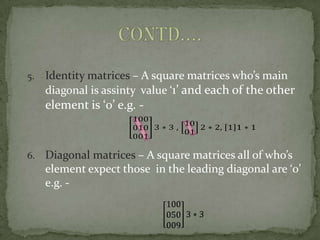
5.   Identity matrices – A square matrices who’s main
     diagonal is assinty value ‘1’ and each of the other
     element is ‘0’ e.g. -
                               ,


6.   Diagonal matrices – A square matrices all of who’s
     element expect those in the leading diagonal are ‘0’
     e.g. -
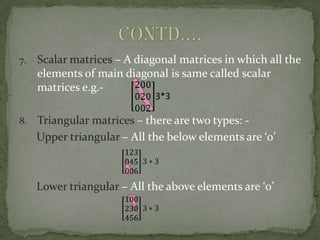
7.   Scalar matrices – A diagonal matrices in which all the
     elements of main diagonal is same called scalar
     matrices e.g.-
                             3*3

8.   Triangular matrices – there are two types: -
     Upper triangular – All the below elements are ‘0’


     Lower triangular – All the above elements are ‘0’
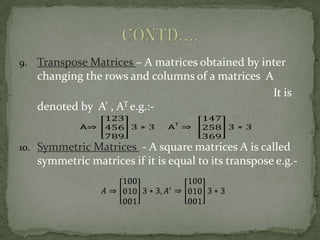
9.   Transpose Matrices – A matrices obtained by inter
     changing the rows and columns of a matrices A
                                                   It is
     denoted by A’ , AT e.g.:-
              A                  AT

10. Symmetric Matrices - A square matrices A is called
     symmetric matrices if it is equal to its transpose e.g.-
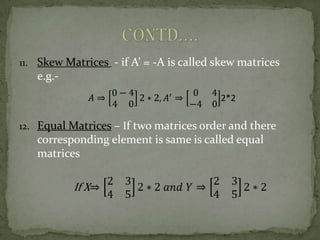
11. Skew Matrices - if A’ = -A is called skew matrices
   e.g.-
                                         2*2

12. Equal Matrices – If two matrices order and there
   corresponding element is same is called equal
   matrices

           If X
13. Algebraic Matrices – There are three type:-
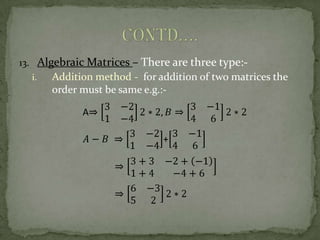
  i.   Addition method - for addition of two matrices the
       order must be same e.g.:-

             A

                              +
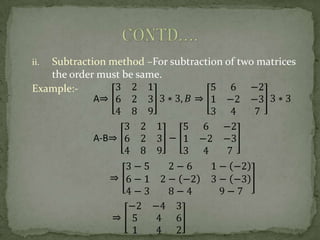
ii.Subtraction method –For subtraction of two matrices
   the order must be same.
Example:-
            A


            A-B
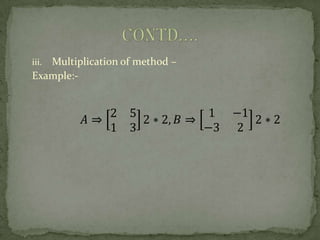
Multiplication of method –
iii.
Example:-
 presentation on matrix

presentation on matrix

  • 1.
    PRESENTED BY: Nikhi jain Salini bhadoria Gunjan dwivedi Shilpi barua Ritu Tomar
  • 2.
     It isan collection of elements which is arranges in rows columns.  It is the Combination of linear equation.  It is Represented by these symbols:  , , e.g. - 3*3
  • 3.
    1. Row matrices – A matrices which has only one row called row matrices e.g.- [123]1*3 2. Column matrices – A matrices which has only one column is called column matrices e.g. –
  • 4.
    3. Square matrices – No. of the rows and No. of the column is same e.g. 4. Null matrices – Which all elements is equal to ‘0’
  • 5.
    5. Identity matrices – A square matrices who’s main diagonal is assinty value ‘1’ and each of the other element is ‘0’ e.g. - , 6. Diagonal matrices – A square matrices all of who’s element expect those in the leading diagonal are ‘0’ e.g. -
  • 6.
    7. Scalar matrices – A diagonal matrices in which all the elements of main diagonal is same called scalar matrices e.g.- 3*3 8. Triangular matrices – there are two types: - Upper triangular – All the below elements are ‘0’ Lower triangular – All the above elements are ‘0’
  • 7.
    9. Transpose Matrices – A matrices obtained by inter changing the rows and columns of a matrices A It is denoted by A’ , AT e.g.:- A AT 10. Symmetric Matrices - A square matrices A is called symmetric matrices if it is equal to its transpose e.g.-
  • 8.
    11. Skew Matrices- if A’ = -A is called skew matrices e.g.- 2*2 12. Equal Matrices – If two matrices order and there corresponding element is same is called equal matrices If X
  • 9.
    13. Algebraic Matrices– There are three type:- i. Addition method - for addition of two matrices the order must be same e.g.:- A +
  • 10.
    ii.Subtraction method –Forsubtraction of two matrices the order must be same. Example:- A A-B
  • 11.
    Multiplication of method– iii. Example:-