Proof that √2 is irrational
Proof by contradiction
By: D K SAHARAWAT
• 1.INTRODUCTION
• 2.GEOMETRICAL MEANING OF ZEROES OF THE POLYNOMIAL
• 3.RELATION BETWEEN ZEROES AND COEFFICIENTS OF A POLYNOMIAL
• 4.DIVISION ALGORITHM FOR POLYNOMIAL
• 5.SUMMARY
• 6.QUESTIONS AND EXERCISE
Contents
Polynomials
Introduction :
• A polynomial is an expression of finite length constructed
from
• variables and constants, using only the operations of
addition,
• subtraction, multiplication, and non-negative, whole-
number exponents.
• Polynomials appear in a wide variety.
Let x be a variable n, be a positive integer
and as, a1,a2,….an be constants (real nos.)
Then, f(x) = anxn+ an-1xn-1+….+a1x+xo
 anxn,an-1xn-1,….a1x and ao are known as the
terms of the polynomial.
 an,an-1,an-2,….a1 and ao are their
coefficients.
For example:
• p(x) = 3x – 2 is a polynomial in variable x.
• q(x) = 3y2 – 2y + 4 is a polynomial in variable y.
• f(u) = 1/2u3 – 3u2 + 2u – 4 is a polynomial in variable u.
NOTE: 2x2 – 3√x + 5, 1/x2 – 2x +5 , 2x3 – 3/x +4 are not polynomials.
Cont…
The exponent of the highest degree term in a polynomial is known
as its
degree.
For example:
 f(x) = 3x + ½ is a polynomial in the
variable x of degree 1.
 g(y) = 2y2 – 3/2y + 7 is a polynomial in
the variable y of degree 2.
 p(x) = 5x3 – 3x2 + x – 1/√2 is a polynomial
in the variable x of degree 3.
 q(u) = 9u5 – 2/3u4 + u2 – ½ is a polynomial
in the variable u of degree 5.
Degree of polynomial
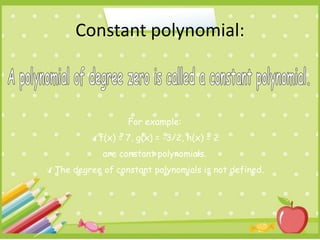
Constant polynomial:
For example:
f(x) = 7, g(x) = -3/2, h(x) = 2
are constant polynomials.
The degree of constant polynomials is not defined.
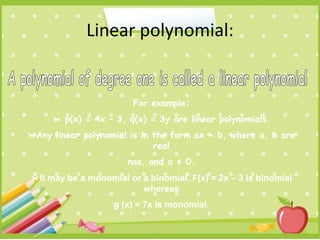
Linear polynomial:
For example:
 p(x) = 4x – 3, q(x) = 3y are linear polynomials.
Any linear polynomial is in the form ax + b, where a, b are
real
nos. and a ≠ 0.
It may be a monomial or a binomial. F(x) = 2x – 3 is binomial
whereas
g (x) = 7x is monomial.
Types of polynomial:
 A polynomial of degree two
is called a quadratic polynomial.
 f(x) = √3x2 – 4/3x + ½, q(w)
= 2/3w2 + 4 are quadratic
polynomials with real
coefficients.
Any quadratic is always in the
form f(x) = ax2 + bx +c where
a,b,c are real nos. and a ≠ 0.
 A polynomial of degree
three is called a cubic
polynomial.
 f(x) = 9/5x3 – 2x2 + 7/3x
_1/5 is a cubic polynomial in
variable x.
Any cubic polynomial is
always in the form f(x = ax3
+ bx2 +cx + d where a,b,c,d
are real nos.
Value’s & zero’s of Polynomial
A real no. x is a zero of the
polynomial f(x),is f(x) = 0
Finding a zero of the
polynomial means solving
polynomial equation f(x) = 0.
If f(x) is a polynomial and
y is any real no. then real
no. obtained by replacing x
by y in f(x) is called the
value of f(x) at x = y and
is denoted by f(x).
Value of f(x) at x = 1
f(x) = 2x2 – 3x – 2
 f(1) = 2(1)2 – 3 x 1 – 2
= 2 – 3 – 2
= -3
Zero of the polynomial
f(x) = x2 + 7x +12
 f(x) = 0
x2 + 7x + 12 = 0
(x + 4) (x + 3) = 0
x + 4 = 0 or, x + 3 = 0
x = -4 , -3
GENERAL SHAPES OF
POLYNOMIAL
f(x) = 3
CONSTANT FUNCTION
DEGREE = 0
MAX. ZEROES = 0
1
Cont….
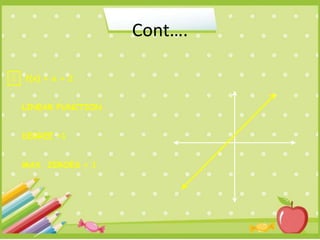
f(x) = x + 2
LINEAR FUNCTION
DEGREE =1
MAX. ZEROES = 1
2
Cont…
f(x) = x2 + 3x + 2
QUADRATIC FUNCTION
DEGREE = 2
MAX. ZEROES = 2
3
Cont…
f(x) = x3 + 4x2 + 2
CUBIC FUNCTION
DEGREE = 3
MAX. ZEROES = 3
4
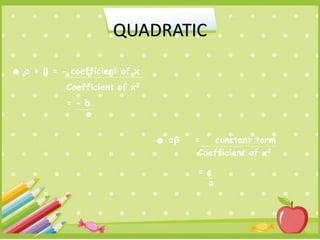
QUADRATIC
☻ α + β = - coefficient of x
Coefficient of x2
= - b
a
☻ αβ = constant term
Coefficient of x2
= c
a
CUBIC
 α+β +γ = -Coefficient of x2 = -b
Coefficient of x3
a
 αβ+βγ+γα=Coefficient of x = c
Coefficient of x3 a
 αβγ=- Constant term = d
Coefficient of x3 a
Relationships
If f(x) and g(x) are any
two polynomials with g(x) ≠
0,then we can always find
polynomials q(x), and r(x)
such that :
F(x) = q(x) g(x) + r(x),
Where r(x) = 0 or degree
r(x) < degree g(x)
 ON VERYFYING THE
DIVISION ALGORITHM
FOR POLYNOMIALS.
ON FINDING THE
QUOTIENT AND
REMAINDER USING
DIVISION ALGORITHM.
ON CHECKING WHETHER
A GIVEN POLYNOMIAL IS A
FACTOR OF THE OTHER
POLYNIMIAL BY APPLYING
THEDIVISION ALGORITHM
ON FINDING THE
REMAINING ZEROES OF A
POLYNOMIAL WHEN SOME OF
ITS ZEROES ARE GIVEN.
• An irrational number is one that cannot be
written as a fraction.
Some points first
 Any fraction can be simplified if the numerator and
denominator have common factors.
 Every fraction has a simplest form. That is, it cannot be
repeatedly simplified indefinitely.
 Even x Even = Even and Odd x Odd = Odd
 An even number is a multiple of two and vice versa.
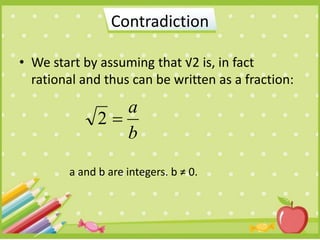
• We start by assuming that √2 is, in fact
rational and thus can be written as a fraction:
Contradiction
b
a
2
a and b are integers. b ≠ 0.
• So, if we square both sides:
Following things through
22
2
2
2
2
2
2
2
ba
b
a
b
a
b
a










2
22
b
a
b
a
b
a
b
a






• Well, that means that a2 is an even number.
So?
 If a2 is an even number, that means a must be an even
number too.
 (Because of this point from the second slide):
 Even x Even = Even and Odd x Odd = Odd
⇒ Odd2= Odd
• If a is an even number, that means there must
be another integer, r say, such that
Ok then, carry on….
ra 2
 This comes from point 4 on the second slide.
• So, substituting into previous parts:
Keep going
22
22
22
22
2
24
2)2(
2
rb
br
br
ba



 ra 2
• Well, like before, that means that b2 must be
even and therefore, b must be even.
What does that mean?
 And if b is an even number, that means there must be
another integer, q say, such that
qb 2
• This means that:
And why does that matter?
q
r
b
a
2
2
2 
a,b, r and q are integers.
b ≠ 0.q ≠ 0.
 Since the numerator and denominator of this fraction
clearly have a common factor of 2, we can simplify it
to:
q
r
2
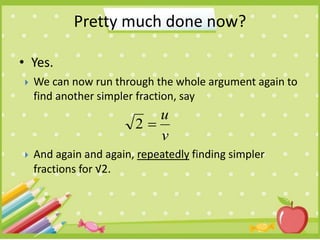
• Yes.
Pretty much done now?
 We can now run through the whole argument again to
find another simpler fraction, say
v
u
2
 And again and again, repeatedly finding simpler
fractions for √2.
• That directly contradicts the fact that every
fraction has a simplest form and cannot be
repeatedly simplified.
CONTRADICTION!!!
 Since every step we’ve taken has been rigorous and
correct, the only conclusion we can come to is that our
original assumption was wrong.
 √2 being rational produces a logical contradiction and,
hence, it must not be rational, ie irrational.
• The square root of 2 is irrefutably irrational.
There you have it.
Proof that √5 is irrational
Proof by contradiction
By: D K SAHARAWAT
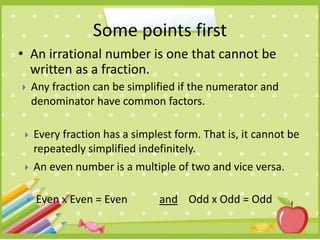
• An irrational number is one that cannot be
written as a fraction.
Some points first
 Any fraction can be simplified if the numerator and
denominator have common factors.
 Every fraction has a simplest form. That is, it cannot be
repeatedly simplified indefinitely.
 Even x Even = Even and Odd x Odd = Odd
 An even number is a multiple of two and vice versa.
• We start by assuming that √5 is, in fact
rational and thus can be written as a fraction:
Contradiction
⇒√5=p/q
⇒5=p²/q² {Squaring both the sides}
⇒5q²=p² (1)
⇒p² is a multiple of 5. {Euclid's Division Lemma}
• ⇒p is also a multiple of 5. {Fundamental Theorm
of arithmetic}
• ⇒p=5m
Following things through
• ⇒p²=25m² (2)
• From equations (1) and (2), we get,
• 5q²=25m²
• ⇒q²=5m²
• ⇒q² is a multiple of 5. {Euclid's Division Lemma}
• ⇒q is a multiple of 5.{Fundamental Theorm of
Arithmetic}
• Hence, p,q have a common factor 5. this
contradicts that they are co-primes. Therefore,
p/q is not a rational number. This proves that
√5 is an irrational number.
• For the second query, as we've proved √5
irrational. Therefore 2-√5 is also irrational
because difference of a rational and an
irrational number is always an irrational
number.
NUMBER SYSTEM
BY- D.K.SAHARAWAT
JNV GHAZIABAD UP
Prove that 3+2√5 is irrational.
• ANSWER
• Prove 3+2√5 is irrational.
• → let us take that 3+2√5 is rational number
• → so, we can write 3+2√5 as a fraction (a/b)
• ⇒ b
a
 523
• Here a & b use two coprime number and
b
ba
b
ba
b
a
2
3
5
3
52
352





0b
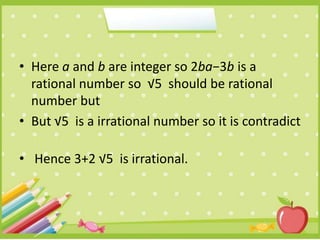
• Here a and b are integer so 2ba−3b is a
rational number so √5 should be rational
number but
• But √5 is a irrational number so it is contradict
• Hence 3+2 √5 is irrational.
Summary
In this chapter, you have studied the following points:
• 1. Euclid’s division lemma :
• Given positive integers a and b, there exist
whole numbers q and r satisfying a = bq + r,
• 0 ≤ r < b.
• 2. Euclid’s division algorithm : This is based on Euclid’s
division lemma. According to this,
• the HCF of any two positive integers a and b, with a > b, is
obtained as follows:
• Step 1 : Apply the division lemma to find q and r where a = bq
+ r, 0 £ r < b.
• Step 2 : If r = 0, the HCF is b. If r ¹ 0, apply Euclid’s lemma to b
and r.
• Step 3 : Continue the process till the remainder is zero. The
divisor at this stage will be
• HCF (a, b). Also, HCF(a, b) = HCF(b, r).
• 3. The Fundamental Theorem of Arithmetic :
• Every composite number can be expressed (factorised) as a
product of primes, and this
• factorisation is unique, apart from the order in which the
prime factors occur.
• 4. If p is a prime and p divides a2, then p divides a, where a is
a positive integer.
• 5. To prove that √2, √3 are irrationals.
• 6. Let x be a rational number whose decimal
expansion terminates. Then we can express x
• in the form p/q , where p and q are coprime, and the
prime factorisation of q is of the form
• 7. Let x =p/q be a rational number, such that the
prime factorisation of q is of the form 2n5m, where
n, m are non-negative integers. Then x has a decimal
expansion which terminates.
• 8. Let x =p/q be a rational number, such that
the prime factorisation of q is not of the form
• 2n 5m, where n, m are non-negative integers.
Then x has a decimal expansion which is
• non-terminating repeating (recurring).
• 2n 5m, where n, m are non-negative integers.

Chap 1 real number

  • 1.
    Proof that √2is irrational Proof by contradiction By: D K SAHARAWAT
  • 2.
    • 1.INTRODUCTION • 2.GEOMETRICALMEANING OF ZEROES OF THE POLYNOMIAL • 3.RELATION BETWEEN ZEROES AND COEFFICIENTS OF A POLYNOMIAL • 4.DIVISION ALGORITHM FOR POLYNOMIAL • 5.SUMMARY • 6.QUESTIONS AND EXERCISE Contents
  • 3.
  • 4.
    Introduction : • Apolynomial is an expression of finite length constructed from • variables and constants, using only the operations of addition, • subtraction, multiplication, and non-negative, whole- number exponents. • Polynomials appear in a wide variety.
  • 5.
    Let x bea variable n, be a positive integer and as, a1,a2,….an be constants (real nos.) Then, f(x) = anxn+ an-1xn-1+….+a1x+xo  anxn,an-1xn-1,….a1x and ao are known as the terms of the polynomial.  an,an-1,an-2,….a1 and ao are their coefficients. For example: • p(x) = 3x – 2 is a polynomial in variable x. • q(x) = 3y2 – 2y + 4 is a polynomial in variable y. • f(u) = 1/2u3 – 3u2 + 2u – 4 is a polynomial in variable u. NOTE: 2x2 – 3√x + 5, 1/x2 – 2x +5 , 2x3 – 3/x +4 are not polynomials. Cont…
  • 6.
    The exponent ofthe highest degree term in a polynomial is known as its degree. For example:  f(x) = 3x + ½ is a polynomial in the variable x of degree 1.  g(y) = 2y2 – 3/2y + 7 is a polynomial in the variable y of degree 2.  p(x) = 5x3 – 3x2 + x – 1/√2 is a polynomial in the variable x of degree 3.  q(u) = 9u5 – 2/3u4 + u2 – ½ is a polynomial in the variable u of degree 5. Degree of polynomial
  • 7.
    Constant polynomial: For example: f(x)= 7, g(x) = -3/2, h(x) = 2 are constant polynomials. The degree of constant polynomials is not defined.
  • 8.
    Linear polynomial: For example: p(x) = 4x – 3, q(x) = 3y are linear polynomials. Any linear polynomial is in the form ax + b, where a, b are real nos. and a ≠ 0. It may be a monomial or a binomial. F(x) = 2x – 3 is binomial whereas g (x) = 7x is monomial.
  • 9.
    Types of polynomial: A polynomial of degree two is called a quadratic polynomial.  f(x) = √3x2 – 4/3x + ½, q(w) = 2/3w2 + 4 are quadratic polynomials with real coefficients. Any quadratic is always in the form f(x) = ax2 + bx +c where a,b,c are real nos. and a ≠ 0.  A polynomial of degree three is called a cubic polynomial.  f(x) = 9/5x3 – 2x2 + 7/3x _1/5 is a cubic polynomial in variable x. Any cubic polynomial is always in the form f(x = ax3 + bx2 +cx + d where a,b,c,d are real nos.
  • 10.
    Value’s & zero’sof Polynomial A real no. x is a zero of the polynomial f(x),is f(x) = 0 Finding a zero of the polynomial means solving polynomial equation f(x) = 0. If f(x) is a polynomial and y is any real no. then real no. obtained by replacing x by y in f(x) is called the value of f(x) at x = y and is denoted by f(x). Value of f(x) at x = 1 f(x) = 2x2 – 3x – 2  f(1) = 2(1)2 – 3 x 1 – 2 = 2 – 3 – 2 = -3 Zero of the polynomial f(x) = x2 + 7x +12  f(x) = 0 x2 + 7x + 12 = 0 (x + 4) (x + 3) = 0 x + 4 = 0 or, x + 3 = 0 x = -4 , -3
  • 12.
    GENERAL SHAPES OF POLYNOMIAL f(x)= 3 CONSTANT FUNCTION DEGREE = 0 MAX. ZEROES = 0 1
  • 13.
    Cont…. f(x) = x+ 2 LINEAR FUNCTION DEGREE =1 MAX. ZEROES = 1 2
  • 14.
    Cont… f(x) = x2+ 3x + 2 QUADRATIC FUNCTION DEGREE = 2 MAX. ZEROES = 2 3
  • 15.
    Cont… f(x) = x3+ 4x2 + 2 CUBIC FUNCTION DEGREE = 3 MAX. ZEROES = 3 4
  • 17.
    QUADRATIC ☻ α +β = - coefficient of x Coefficient of x2 = - b a ☻ αβ = constant term Coefficient of x2 = c a
  • 18.
    CUBIC  α+β +γ= -Coefficient of x2 = -b Coefficient of x3 a  αβ+βγ+γα=Coefficient of x = c Coefficient of x3 a  αβγ=- Constant term = d Coefficient of x3 a
  • 19.
  • 21.
    If f(x) andg(x) are any two polynomials with g(x) ≠ 0,then we can always find polynomials q(x), and r(x) such that : F(x) = q(x) g(x) + r(x), Where r(x) = 0 or degree r(x) < degree g(x)  ON VERYFYING THE DIVISION ALGORITHM FOR POLYNOMIALS. ON FINDING THE QUOTIENT AND REMAINDER USING DIVISION ALGORITHM. ON CHECKING WHETHER A GIVEN POLYNOMIAL IS A FACTOR OF THE OTHER POLYNIMIAL BY APPLYING THEDIVISION ALGORITHM ON FINDING THE REMAINING ZEROES OF A POLYNOMIAL WHEN SOME OF ITS ZEROES ARE GIVEN.
  • 22.
    • An irrationalnumber is one that cannot be written as a fraction. Some points first  Any fraction can be simplified if the numerator and denominator have common factors.  Every fraction has a simplest form. That is, it cannot be repeatedly simplified indefinitely.  Even x Even = Even and Odd x Odd = Odd  An even number is a multiple of two and vice versa.
  • 23.
    • We startby assuming that √2 is, in fact rational and thus can be written as a fraction: Contradiction b a 2 a and b are integers. b ≠ 0.
  • 24.
    • So, ifwe square both sides: Following things through 22 2 2 2 2 2 2 2 ba b a b a b a           2 22 b a b a b a b a      
  • 25.
    • Well, thatmeans that a2 is an even number. So?  If a2 is an even number, that means a must be an even number too.  (Because of this point from the second slide):  Even x Even = Even and Odd x Odd = Odd ⇒ Odd2= Odd
  • 26.
    • If ais an even number, that means there must be another integer, r say, such that Ok then, carry on…. ra 2  This comes from point 4 on the second slide.
  • 27.
    • So, substitutinginto previous parts: Keep going 22 22 22 22 2 24 2)2( 2 rb br br ba     ra 2
  • 28.
    • Well, likebefore, that means that b2 must be even and therefore, b must be even. What does that mean?  And if b is an even number, that means there must be another integer, q say, such that qb 2
  • 29.
    • This meansthat: And why does that matter? q r b a 2 2 2  a,b, r and q are integers. b ≠ 0.q ≠ 0.  Since the numerator and denominator of this fraction clearly have a common factor of 2, we can simplify it to: q r 2
  • 30.
    • Yes. Pretty muchdone now?  We can now run through the whole argument again to find another simpler fraction, say v u 2  And again and again, repeatedly finding simpler fractions for √2.
  • 31.
    • That directlycontradicts the fact that every fraction has a simplest form and cannot be repeatedly simplified. CONTRADICTION!!!  Since every step we’ve taken has been rigorous and correct, the only conclusion we can come to is that our original assumption was wrong.  √2 being rational produces a logical contradiction and, hence, it must not be rational, ie irrational.
  • 32.
    • The squareroot of 2 is irrefutably irrational. There you have it.
  • 33.
    Proof that √5is irrational Proof by contradiction By: D K SAHARAWAT
  • 34.
    • An irrationalnumber is one that cannot be written as a fraction. Some points first  Any fraction can be simplified if the numerator and denominator have common factors.  Every fraction has a simplest form. That is, it cannot be repeatedly simplified indefinitely.  Even x Even = Even and Odd x Odd = Odd  An even number is a multiple of two and vice versa.
  • 35.
    • We startby assuming that √5 is, in fact rational and thus can be written as a fraction: Contradiction ⇒√5=p/q ⇒5=p²/q² {Squaring both the sides} ⇒5q²=p² (1) ⇒p² is a multiple of 5. {Euclid's Division Lemma}
  • 36.
    • ⇒p isalso a multiple of 5. {Fundamental Theorm of arithmetic} • ⇒p=5m Following things through
  • 37.
    • ⇒p²=25m² (2) •From equations (1) and (2), we get, • 5q²=25m² • ⇒q²=5m² • ⇒q² is a multiple of 5. {Euclid's Division Lemma} • ⇒q is a multiple of 5.{Fundamental Theorm of Arithmetic}
  • 38.
    • Hence, p,qhave a common factor 5. this contradicts that they are co-primes. Therefore, p/q is not a rational number. This proves that √5 is an irrational number. • For the second query, as we've proved √5 irrational. Therefore 2-√5 is also irrational because difference of a rational and an irrational number is always an irrational number.
  • 39.
  • 40.
    Prove that 3+2√5is irrational. • ANSWER • Prove 3+2√5 is irrational. • → let us take that 3+2√5 is rational number • → so, we can write 3+2√5 as a fraction (a/b) • ⇒ b a  523
  • 41.
    • Here a& b use two coprime number and b ba b ba b a 2 3 5 3 52 352      0b
  • 42.
    • Here aand b are integer so 2ba−3b is a rational number so √5 should be rational number but • But √5 is a irrational number so it is contradict • Hence 3+2 √5 is irrational.
  • 43.
    Summary In this chapter,you have studied the following points: • 1. Euclid’s division lemma : • Given positive integers a and b, there exist whole numbers q and r satisfying a = bq + r, • 0 ≤ r < b.
  • 44.
    • 2. Euclid’sdivision algorithm : This is based on Euclid’s division lemma. According to this, • the HCF of any two positive integers a and b, with a > b, is obtained as follows: • Step 1 : Apply the division lemma to find q and r where a = bq + r, 0 £ r < b. • Step 2 : If r = 0, the HCF is b. If r ¹ 0, apply Euclid’s lemma to b and r. • Step 3 : Continue the process till the remainder is zero. The divisor at this stage will be • HCF (a, b). Also, HCF(a, b) = HCF(b, r).
  • 45.
    • 3. TheFundamental Theorem of Arithmetic : • Every composite number can be expressed (factorised) as a product of primes, and this • factorisation is unique, apart from the order in which the prime factors occur. • 4. If p is a prime and p divides a2, then p divides a, where a is a positive integer. • 5. To prove that √2, √3 are irrationals.
  • 46.
    • 6. Letx be a rational number whose decimal expansion terminates. Then we can express x • in the form p/q , where p and q are coprime, and the prime factorisation of q is of the form • 7. Let x =p/q be a rational number, such that the prime factorisation of q is of the form 2n5m, where n, m are non-negative integers. Then x has a decimal expansion which terminates.
  • 47.
    • 8. Letx =p/q be a rational number, such that the prime factorisation of q is not of the form • 2n 5m, where n, m are non-negative integers. Then x has a decimal expansion which is • non-terminating repeating (recurring). • 2n 5m, where n, m are non-negative integers.