Automobile
   Tyres
Contents
Tyre-functions & Properties.
Tyre-Types
 Types of carcass(Tread)
Comparison of radial & bias-ply tyres
Tyre materials & Considerations in tread
 design
Tyre designation & Factors affecting tyre
 life
Tyre trouble shooting & Tyre
 manufacturing
Tyre and its functions
Tyre is a rubber member which gives
 the cushion to the automobile. It
 consists of outer cover i.e. tyre proper
 and tube inside.
The tyre-tube assembly is mounted over
 the wheel rim and air inside the tube
 carries entire load and provides
 cushion.
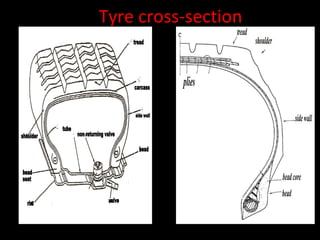
Tyre cross-section
Functions of tyre
To support the vehicle load.
To provide cushion against the
 shocks.
To transmit driving and braking
 forces to the road.
To provide cornering power for
 smooth steering.
Properties of tyres
Non-skidding
Uniform wear
Load-carrying
Cushioning
 Power consumption
Tyre noise
Balancing
Types of tyres
Conventional tubed tyre.

Tubeless tyre.
Tubed tyre
Tubeless tyre
Advantages of tubeless tyres

Lesser unsprung weight.
Better cooling.
Lesser rolling resistance.
Comfortable ride.
Slower leakage of air.
Simpler assembly.
Improved safety.
Types of carcass(Tread)

Cross ply (or) bias ply type.
Radial ply type.
Belted bias ply type.
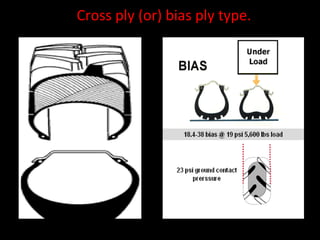
Cross ply (or) bias ply type.
Radial ply type
Radial ply type.
Belted bias ply type
Comparison of radial and bias-ply
               tyres
Advantages of radial ply tyres:-
 The side walls can be bend readily ,its shock
  absorbing capacity is 25% more than bias
  ply or cross ply.

 The breaker strips of radial tyres act
  independently of the wall plies unlike in
  cross ply where there is no breaker strip.

 Lower rolling resistance and hysteresis loss
  leads to less fuel consumption.
 Longer tread life because of less heat build
  in tyre.

 Breaking efficiency on wet roads is better
  because of greater sidewall flexibility and
  tread stiffness.

 Smaller slip angles and higher cornering
  power which results in Better steering
  characteristics.

 While taking turns it has less tendency to
  distort and lift off the road from one side.

 Larger resistance to punctures ,cuts and
  impacts in the tread area.
Tyre materials
For carcass:-
 At the time of second world war, staple cotton
  was the tyre carcass material and it was
  replaced with rayon.

 Then nylon was introduced which is stronger,
  more elastic and cooler running than rayon.

 Then terylene was introduced.
For cords of stabilizer belts:-

 Rayon ,Terylene ,glass fibre or steel.


Rubber :-
 Rubber used in tyres is blend of natural and
  synthetic rubbers to which various
  chemicals are added to obtain desired
  properties like wear resistance ,reduced
  hysteresis, less internal friction.
Considerations in tread
           design

 Grip

 Noise

 wear
Tyre designation
Factors affecting tyre life

 Inflation

 Vehicle maintenance

 Manner of driving

 Miscellaneous factors
Tyre trouble shooting
 Side wear of tyres
 One side wear of tyres
 Centre wear of tyre tread
 Uneven tyre wear
 Uniform rapid wear
 Rapid wear with feathered edges on the tread
 Tread cracking
 Tread or ply separation
 Loss of tyre pressure
 Radial tyre lead
 Radial tyre waddle
Tyre manufacturing
Thank you

Tyres

  • 1.
  • 2.
    Contents Tyre-functions & Properties. Tyre-Types Types of carcass(Tread) Comparison of radial & bias-ply tyres Tyre materials & Considerations in tread design Tyre designation & Factors affecting tyre life Tyre trouble shooting & Tyre manufacturing
  • 3.
    Tyre and itsfunctions Tyre is a rubber member which gives the cushion to the automobile. It consists of outer cover i.e. tyre proper and tube inside. The tyre-tube assembly is mounted over the wheel rim and air inside the tube carries entire load and provides cushion.
  • 4.
  • 5.
    Functions of tyre Tosupport the vehicle load. To provide cushion against the shocks. To transmit driving and braking forces to the road. To provide cornering power for smooth steering.
  • 6.
    Properties of tyres Non-skidding Uniformwear Load-carrying Cushioning  Power consumption Tyre noise Balancing
  • 7.
    Types of tyres Conventionaltubed tyre. Tubeless tyre.
  • 8.
  • 9.
  • 10.
    Advantages of tubelesstyres Lesser unsprung weight. Better cooling. Lesser rolling resistance. Comfortable ride. Slower leakage of air. Simpler assembly. Improved safety.
  • 11.
    Types of carcass(Tread) Crossply (or) bias ply type. Radial ply type. Belted bias ply type.
  • 12.
    Cross ply (or)bias ply type.
  • 13.
    Cross ply (or)bias ply type.
  • 14.
  • 15.
  • 16.
  • 18.
    Comparison of radialand bias-ply tyres Advantages of radial ply tyres:-  The side walls can be bend readily ,its shock absorbing capacity is 25% more than bias ply or cross ply.  The breaker strips of radial tyres act independently of the wall plies unlike in cross ply where there is no breaker strip.  Lower rolling resistance and hysteresis loss leads to less fuel consumption.
  • 19.
     Longer treadlife because of less heat build in tyre.  Breaking efficiency on wet roads is better because of greater sidewall flexibility and tread stiffness.  Smaller slip angles and higher cornering power which results in Better steering characteristics.  While taking turns it has less tendency to distort and lift off the road from one side.  Larger resistance to punctures ,cuts and impacts in the tread area.
  • 20.
    Tyre materials For carcass:- At the time of second world war, staple cotton was the tyre carcass material and it was replaced with rayon.  Then nylon was introduced which is stronger, more elastic and cooler running than rayon.  Then terylene was introduced.
  • 21.
    For cords ofstabilizer belts:-  Rayon ,Terylene ,glass fibre or steel. Rubber :-  Rubber used in tyres is blend of natural and synthetic rubbers to which various chemicals are added to obtain desired properties like wear resistance ,reduced hysteresis, less internal friction.
  • 22.
    Considerations in tread design  Grip  Noise  wear
  • 23.
  • 25.
    Factors affecting tyrelife  Inflation  Vehicle maintenance  Manner of driving  Miscellaneous factors
  • 26.
    Tyre trouble shooting Side wear of tyres  One side wear of tyres  Centre wear of tyre tread  Uneven tyre wear  Uniform rapid wear  Rapid wear with feathered edges on the tread  Tread cracking  Tread or ply separation  Loss of tyre pressure  Radial tyre lead  Radial tyre waddle
  • 27.
  • 28.