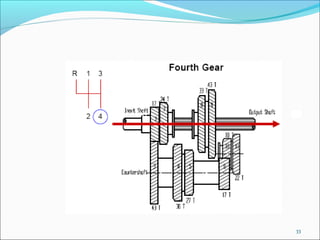
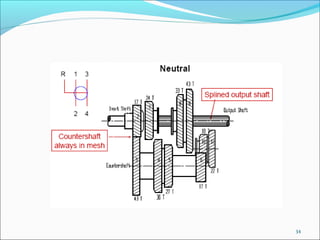
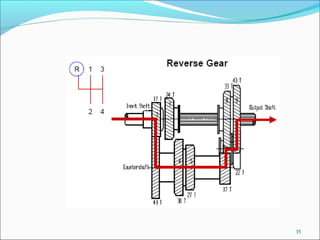
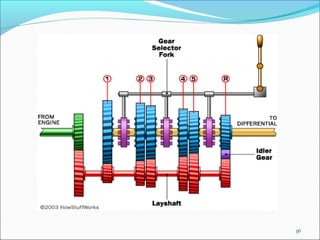
INTRODUCTION TO THE GEARS,
   NEED FOR GEAR BOX AND
RESISTANCE TO VEHICLE MOTION
Gear Trains
 A gear train is two or more gear working together
 by meshing their teeth and turning each other in a
 system to generate power and speed. It reduces
 speed and increases torque. To create large gear
 ratio, gears are connected together to form gear
 trains. They often consist of multiple gears in the
 train.
 The most common of the gear train is the gear
 pair connecting parallel shafts. The teeth of this
 type can be spur, helical or herringbone. The
 angular velocity is simply the reverse of the tooth
 ratio.
                                                       2
Gear Trains
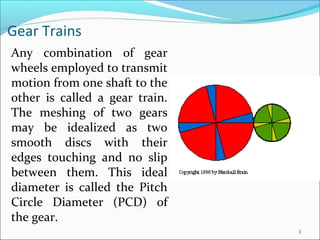
Any combination of gear
wheels employed to transmit
motion from one shaft to the
other is called a gear train.
The meshing of two gears
may be idealized as two
smooth discs with their
edges touching and no slip
between them. This ideal
diameter is called the Pitch
Circle Diameter (PCD) of
the gear.
                                3
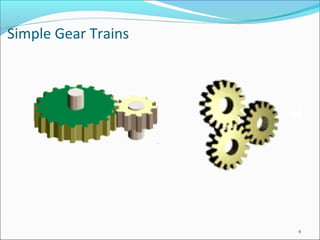
Simple Gear Trains


                     4
Simple Gear Trains
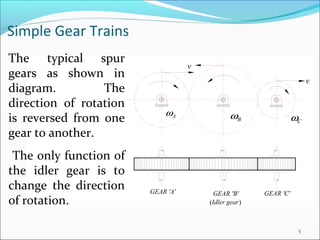
The typical spur
                                   v
gears as shown in
                                                                      v
diagram.         The
direction of rotation
                            ωA                ωB
is reversed from one                                             ωC
gear to another.
 The only function of
the idler gear is to
change the direction    GEAR 'A'         GEAR 'B'     GEAR 'C'
of rotation.                           (Idler gear)


                                                                  5
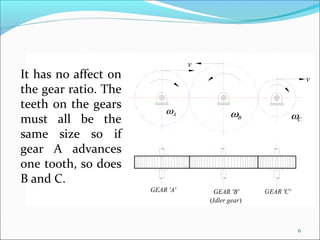
v
It has no affect on                                                 v
the gear ratio. The
teeth on the gears        ωA                ωB                 ωC
must all be the
same size so if
gear A advances
one tooth, so does
B and C.
                      GEAR 'A'         GEAR 'B'     GEAR 'C'
                                     (Idler gear)


                                                                6
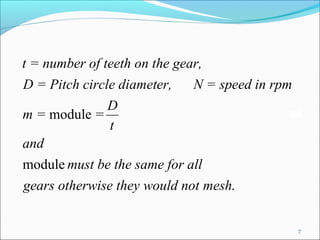
t = number of teeth on the gear,
D = Pitch circle diameter,    N = speed in rpm
               D
m = module =
               t
and
module must be the same for all
gears otherwise they would not mesh.


                                                 7
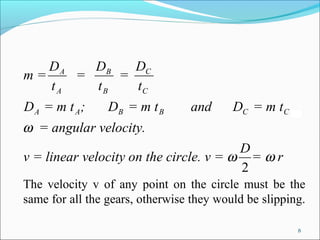
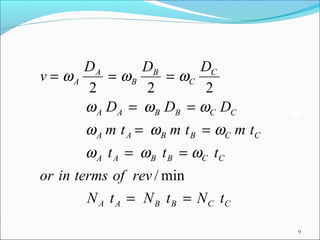
DA   DB   DC
m=    =    =
   tA   tB   tC
DA = m t A;      DB = m t B      and      DC = m t C
ω = angular velocity.
                                        D
v = linear velocity on the circle. v = ω = ω r
                                        2
The velocity v of any point on the circle must be the
same for all the gears, otherwise they would be slipping.

                                                       8
DA       DB       DC
v = ωA     = ωB     = ωC
       2        2         2
       ω A DA = ω B DB = ωC DC
        ω A m t A = ω B m t B = ωC m t C
        ω A t A = ω B t B = ωC t C
or in terms of rev / min
        N A t A = N B t B = N C tC
                                           9
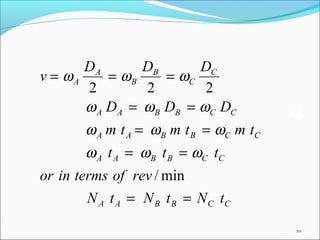
DA       DB       DC
v = ωA     = ωB     = ωC
       2        2         2
       ω A DA = ω B DB = ωC DC
        ω A m t A = ω B m t B = ωC m t C
        ω A t A = ω B t B = ωC t C
or in terms of rev / min
        N A t A = N B t B = N C tC
                                           10
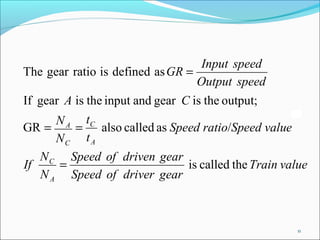
Input speed
The gear ratio is defined as GR =
                                  Output speed
If gear A is the input and gear C is the output;
      N A tC
GR =      =     also called as Speed ratio/Speed value
      NC t A
   N C Speed of driven gear
If    =                     is called the Train value
   N A Speed of driver gear


                                                         11
Simple Gear Trains

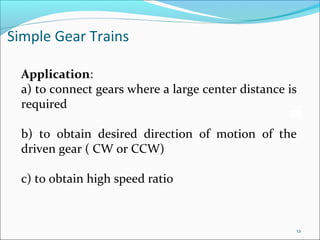
  Application:
  a) to connect gears where a large center distance is
  required

  b) to obtain desired direction of motion of the
  driven gear ( CW or CCW)

  c) to obtain high speed ratio


                                                     12
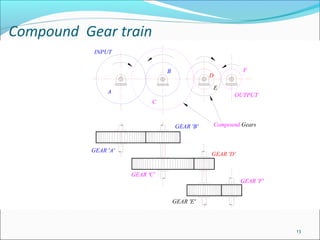
Compound Gear train
           INPUT


                                B                           F
                                               D

                                                   E
               A
                                                         OUTPUT
                            C


                                    GEAR 'B'       Compound Gears


          GEAR 'A'
                                               GEAR 'D'


                     GEAR 'C'
                                                           GEAR 'F'


                                    GEAR 'E'


                                                                      13
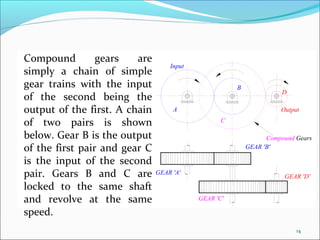
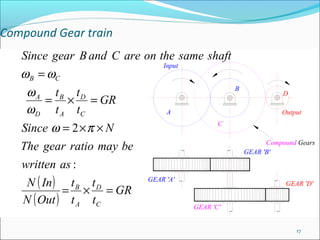
Compound         gears   are
                                   Input
simply a chain of simple
gear trains with the input                            B
                                                                    D
of the second being the
output of the first. A chain        A                               Output

of two pairs is shown                             C

below. Gear B is the output                                     Compound Gears
of the first pair and gear C                              GEAR 'B'

is the input of the second
pair. Gears B and C are        GEAR 'A'
                                                                     GEAR 'D'
locked to the same shaft
and revolve at the same                    GEAR 'C'

speed.
                                                                         14
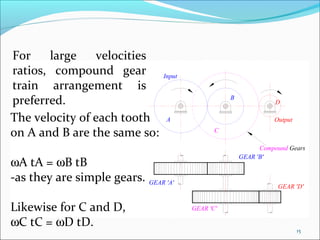
For    large    velocities
ratios, compound gear           Input
train arrangement is
preferred.                                         B
                                                                 D

The velocity of each tooth       A                               Output

on A and B are the same so:                    C

                                                             Compound Gears
                                                       GEAR 'B'
ωA tA = ωB tB
-as they are simple gears. GEAR 'A'
                                                                  GEAR 'D'


Likewise for C and D,                   GEAR 'C'

ωC tC = ωD tD.
                                                                          15
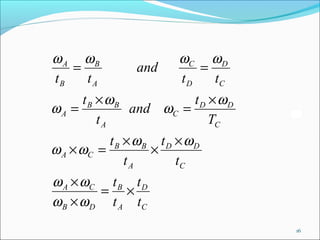
ω A ωB                   ωC ω D
     =             and       =
tB      tA               tD     tC
       tB × ωB              tD × ωD
ωA =             and ωC =
          tA                   TC
             tB × ωB tD × ωD
ω A × ωC =           ×
                tA      tC
ω A × ωC t B t D
           = ×
ω B × ω D t A tC
                                      16
Compound Gear train
   Since gear B and C are on the same shaft
                               Input
   ω B = ωC
    ω A tB tD                                     B
                                                                D
         = × = GR
    ω D t A tC                  A                               Output

   Since ω = 2 × π × N                        C

                                                            Compound Gears
   The gear ratio may be                              GEAR 'B'

   written as :
    N ( In ) t B t D       GEAR 'A'
                                                                 GEAR 'D'
            = × = GR
   N ( Out ) t A tC                    GEAR 'C'


                                                                    17
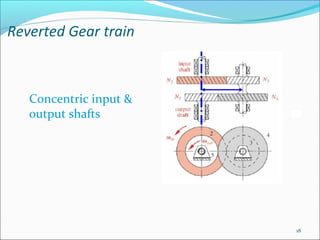
Reverted Gear train


   Concentric input &
   output shafts


                        18
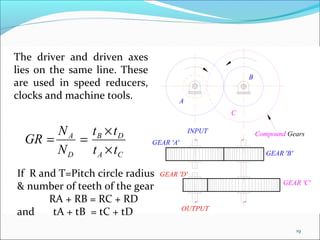
The driver and driven axes
lies on the same line. These
                                                          B
are used in speed reducers,
clocks and machine tools.                 A
                                                      C

       N A tB × tD                            INPUT
  GR =    =
                                                              Compound Gears
                               GEAR 'A'
       N D t A × tC                                              GEAR 'B'


If R and T=Pitch circle radius   GEAR 'D'
                                                                      GEAR 'C'
& number of teeth of the gear
       RA + RB = RC + RD
                                          OUTPUT
and     tA + tB = tC + tD
                                                                            19
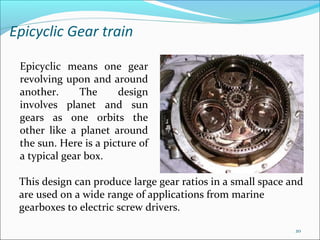
Epicyclic Gear train

 Epicyclic means one gear
 revolving upon and around
 another.      The     design
 involves planet and sun
 gears as one orbits the
 other like a planet around
 the sun. Here is a picture of
 a typical gear box.

 This design can produce large gear ratios in a small space and
 are used on a wide range of applications from marine
 gearboxes to electric screw drivers.

                                                             20
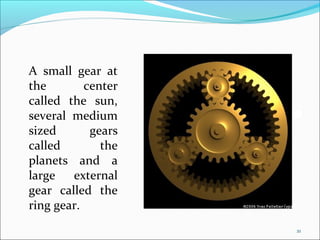
A small gear at
the        center
called the sun,
several medium
sized       gears
called        the
planets and a
large   external
gear called the
ring gear.
                    21
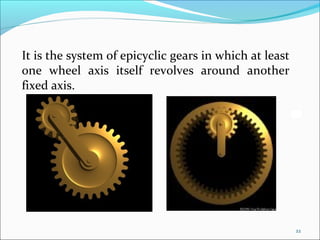
It is the system of epicyclic gears in which at least
one wheel axis itself revolves around another
fixed axis.


                                                        22
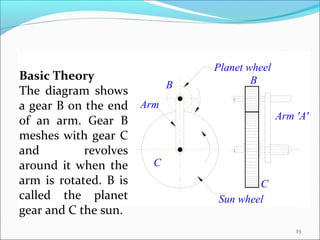
Planet wheel
Basic Theory                        B
                        B
The diagram shows
a gear B on the end Arm
of an arm. Gear B                          Arm 'A'
meshes with gear C
and         revolves
around it when the    C
arm is rotated. B is                C
called the planet           Sun wheel
gear and C the sun.
                                               23
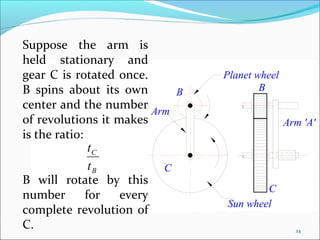
Suppose the arm is
held stationary and
gear C is rotated once.        Planet wheel
B spins about its own      B           B
center and the number Arm
of revolutions it makes                       Arm 'A'
is the ratio:
               tC
               tB        C
B will rotate by this
                                       C
number        for  every
                               Sun wheel
complete revolution of
C.                                              24
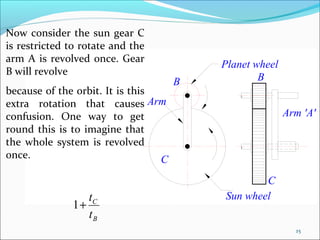
Now consider the sun gear C
is restricted to rotate and the
arm A is revolved once. Gear
                                         Planet wheel
B will revolve
                                     B           B
because of the orbit. It is this
extra rotation that causes Arm
confusion. One way to get                               Arm 'A'
round this is to imagine that
the whole system is revolved
once.                            C
                                                 C
                 tC                      Sun wheel
              1+
                 tB
                                                          25
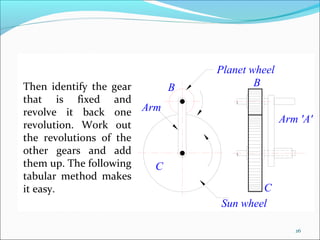
Planet wheel
Then identify the gear   B           B
that is fixed and
revolve it back one Arm
                                            Arm 'A'
revolution. Work out
the revolutions of the
other gears and add
them up. The following C
tabular method makes
it easy.                             C
                             Sun wheel

                                               26
27
28
29
30
31
32
33
34
35
36
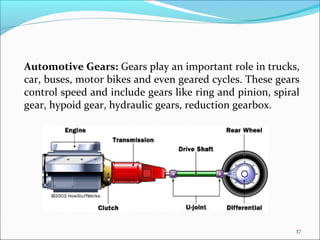
Automotive Gears: Gears play an important role in trucks,
car, buses, motor bikes and even geared cycles. These gears
control speed and include gears like ring and pinion, spiral
gear, hypoid gear, hydraulic gears, reduction gearbox.


                                                           37
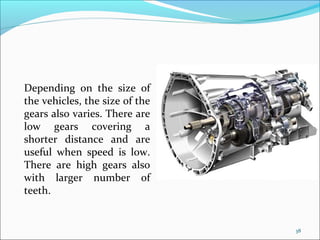
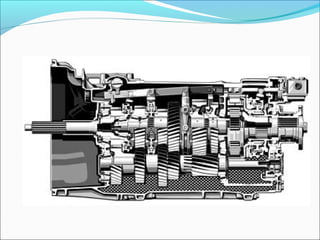
Depending on the size of
the vehicles, the size of the
gears also varies. There are
low gears covering a
shorter distance and are
useful when speed is low.
There are high gears also
with larger number of
teeth.


                                38
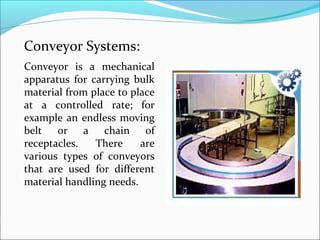
Conveyor Systems:
Conveyor is a mechanical
apparatus for carrying bulk
material from place to place
at a controlled rate; for
example an endless moving
belt or a chain of
receptacles.   There     are
various types of conveyors
that are used for different
material handling needs.
Agro Industry: All agro machinery consists of different
types of gears depending upon their function and
property. Different gears are used differently in the
industry.

Wind Turbine: When the rotor rotates, the load on the
main shaft is very heavy. It runs with approximate 22
revolutions per minute but generator has to go a lot faster.
It cannot use the turning force to increase the number of
revolutions and that is why wind turbine uses gear to
increase the speed.
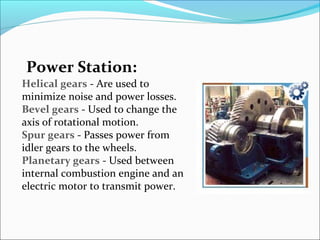
Power Station:
Helical gears - Are used to
minimize noise and power losses.
Bevel gears - Used to change the
axis of rotational motion.
Spur gears - Passes power from
idler gears to the wheels.
Planetary gears - Used between
internal combustion engine and an
electric motor to transmit power.
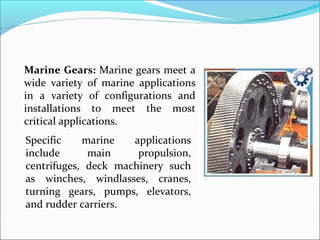
Marine Gears: Marine gears meet a
wide variety of marine applications
in a variety of configurations and
installations to meet the most
critical applications.
Specific    marine   applications
include      main     propulsion,
centrifuges, deck machinery such
as winches, windlasses, cranes,
turning gears, pumps, elevators,
and rudder carriers.
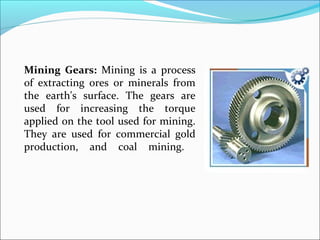
Mining Gears: Mining is a process
of extracting ores or minerals from
the earth's surface. The gears are
used for increasing the torque
applied on the tool used for mining.
They are used for commercial gold
production, and coal mining.
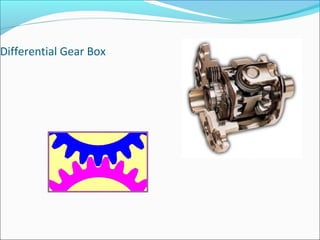
Differential Gear Box
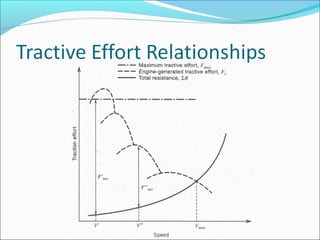
Throttle pedal , simply regulates the rate at which
the engine is doing work

At high speeds power output is high but torque
is low

Maximum torque may be available over only a
very limited speed range
One need to control power output and speed
range of the engine relative to range of speed over
which the vehicle is at any time likely to be
required to operate

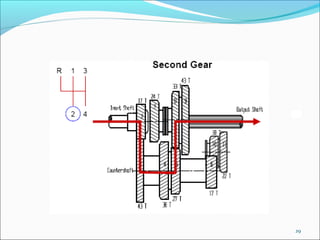
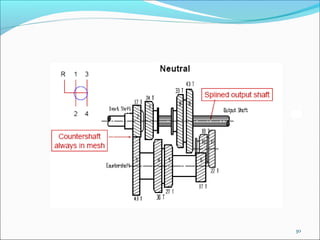
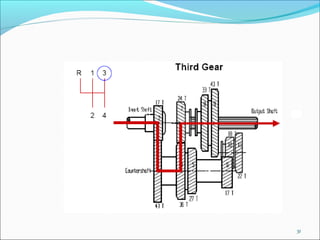
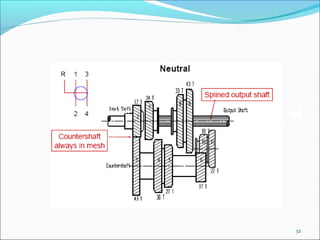
A gear box is necessary , therefore , so that the
driver can regulate torque by selecting the
appropriate speed range or in other words , the
vehicle speed at which the maximum torque is
obtainable.
1. Resistance
  a. Aerodynamic
  b. Rolling
  c. Grade
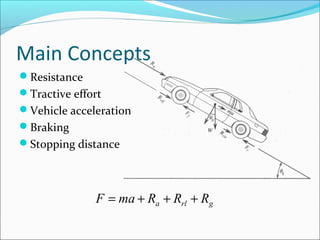
Main Concepts
Resistance
Tractive effort
Vehicle acceleration
Braking
Stopping distance


              F = ma + Ra + Rrl + Rg
Resistance is defined as the force impeding vehicle
   motion
   1. What is this force?
   2. Aerodynamic resistance
   3. Rolling resistance
   4. Grade resistance


                   F = ma + Ra + Rrl + Rg
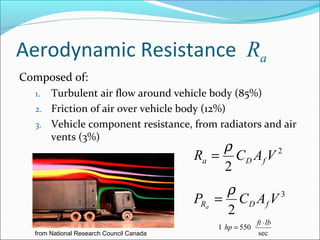
Aerodynamic Resistance Ra
Composed of:
  1. Turbulent air flow around vehicle body (85%)
  2. Friction of air over vehicle body (12%)
  3. Vehicle component resistance, from radiators and air
     vents (3%)
                                              ρ
                                          Ra = C D A f V 2
                                              2
                                               ρ
                                          PRa = C D A f V 3

                                               2
                                                           ft ⋅ lb
                                              1 hp = 550
  from National Research Council Canada                     sec
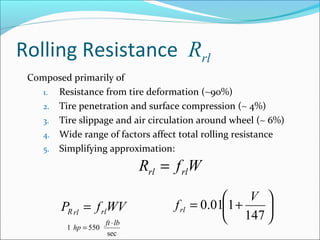
Rolling Resistance Rrl
 Composed primarily of
    1. Resistance from tire deformation (∼90%)
    2. Tire penetration and surface compression (∼ 4%)
    3. Tire slippage and air circulation around wheel (∼ 6%)
    4. Wide range of factors affect total rolling resistance
    5. Simplifying approximation:

                                 Rrl = f rlW
                                                      V 
        PR rl = f rlWV                 f rl = 0.011 +   
                       ft ⋅ lb
                                                   147 
          1 hp = 550
                        sec
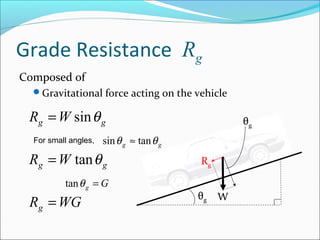
Grade Resistance Rg
Composed of
  Gravitational force acting on the vehicle

 Rg = W sin θ g                                    θg
  For small angles,   sin θ g ≈ tan θ g
 Rg = W tan θ g                           Rg

          tan θ g = G
                                          θg   W
 Rg = WG
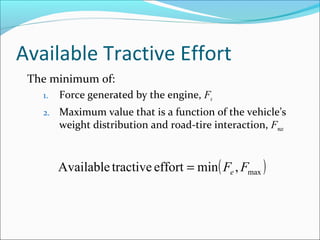
Available Tractive Effort
 The minimum of:
   1.   Force generated by the engine, Fe
   2.   Maximum value that is a function of the vehicle’s
        weight distribution and road-tire interaction, Fmax


        Available tractive effort = min ( Fe , Fmax )
Gears

Gears

  • 1.
    INTRODUCTION TO THEGEARS, NEED FOR GEAR BOX AND RESISTANCE TO VEHICLE MOTION
  • 2.
    Gear Trains Agear train is two or more gear working together by meshing their teeth and turning each other in a system to generate power and speed. It reduces speed and increases torque. To create large gear ratio, gears are connected together to form gear trains. They often consist of multiple gears in the train. The most common of the gear train is the gear pair connecting parallel shafts. The teeth of this type can be spur, helical or herringbone. The angular velocity is simply the reverse of the tooth ratio. 2
  • 3.
    Gear Trains Any combinationof gear wheels employed to transmit motion from one shaft to the other is called a gear train. The meshing of two gears may be idealized as two smooth discs with their edges touching and no slip between them. This ideal diameter is called the Pitch Circle Diameter (PCD) of the gear. 3
  • 4.
  • 5.
    Simple Gear Trains Thetypical spur v gears as shown in v diagram. The direction of rotation ωA ωB is reversed from one ωC gear to another. The only function of the idler gear is to change the direction GEAR 'A' GEAR 'B' GEAR 'C' of rotation. (Idler gear) 5
  • 6.
    v It has noaffect on v the gear ratio. The teeth on the gears ωA ωB ωC must all be the same size so if gear A advances one tooth, so does B and C. GEAR 'A' GEAR 'B' GEAR 'C' (Idler gear) 6
  • 7.
    t = numberof teeth on the gear, D = Pitch circle diameter, N = speed in rpm D m = module = t and module must be the same for all gears otherwise they would not mesh. 7
  • 8.
    DA DB DC m= = = tA tB tC DA = m t A; DB = m t B and DC = m t C ω = angular velocity. D v = linear velocity on the circle. v = ω = ω r 2 The velocity v of any point on the circle must be the same for all the gears, otherwise they would be slipping. 8
  • 9.
    DA DB DC v = ωA = ωB = ωC 2 2 2 ω A DA = ω B DB = ωC DC ω A m t A = ω B m t B = ωC m t C ω A t A = ω B t B = ωC t C or in terms of rev / min N A t A = N B t B = N C tC 9
  • 10.
    DA DB DC v = ωA = ωB = ωC 2 2 2 ω A DA = ω B DB = ωC DC ω A m t A = ω B m t B = ωC m t C ω A t A = ω B t B = ωC t C or in terms of rev / min N A t A = N B t B = N C tC 10
  • 11.
    Input speed The gearratio is defined as GR = Output speed If gear A is the input and gear C is the output; N A tC GR = = also called as Speed ratio/Speed value NC t A N C Speed of driven gear If = is called the Train value N A Speed of driver gear 11
  • 12.
    Simple Gear Trains Application: a) to connect gears where a large center distance is required b) to obtain desired direction of motion of the driven gear ( CW or CCW) c) to obtain high speed ratio 12
  • 13.
    Compound Gear train INPUT B F D E A OUTPUT C GEAR 'B' Compound Gears GEAR 'A' GEAR 'D' GEAR 'C' GEAR 'F' GEAR 'E' 13
  • 14.
    Compound gears are Input simply a chain of simple gear trains with the input B D of the second being the output of the first. A chain A Output of two pairs is shown C below. Gear B is the output Compound Gears of the first pair and gear C GEAR 'B' is the input of the second pair. Gears B and C are GEAR 'A' GEAR 'D' locked to the same shaft and revolve at the same GEAR 'C' speed. 14
  • 15.
    For large velocities ratios, compound gear Input train arrangement is preferred. B D The velocity of each tooth A Output on A and B are the same so: C Compound Gears GEAR 'B' ωA tA = ωB tB -as they are simple gears. GEAR 'A' GEAR 'D' Likewise for C and D, GEAR 'C' ωC tC = ωD tD. 15
  • 16.
    ω A ωB ωC ω D = and = tB tA tD tC tB × ωB tD × ωD ωA = and ωC = tA TC tB × ωB tD × ωD ω A × ωC = × tA tC ω A × ωC t B t D = × ω B × ω D t A tC 16
  • 17.
    Compound Gear train Since gear B and C are on the same shaft Input ω B = ωC ω A tB tD B D = × = GR ω D t A tC A Output Since ω = 2 × π × N C Compound Gears The gear ratio may be GEAR 'B' written as : N ( In ) t B t D GEAR 'A' GEAR 'D' = × = GR N ( Out ) t A tC GEAR 'C' 17
  • 18.
    Reverted Gear train Concentric input & output shafts 18
  • 19.
    The driver anddriven axes lies on the same line. These B are used in speed reducers, clocks and machine tools. A C N A tB × tD INPUT GR = = Compound Gears GEAR 'A' N D t A × tC GEAR 'B' If R and T=Pitch circle radius GEAR 'D' GEAR 'C' & number of teeth of the gear RA + RB = RC + RD OUTPUT and tA + tB = tC + tD 19
  • 20.
    Epicyclic Gear train Epicyclic means one gear revolving upon and around another. The design involves planet and sun gears as one orbits the other like a planet around the sun. Here is a picture of a typical gear box. This design can produce large gear ratios in a small space and are used on a wide range of applications from marine gearboxes to electric screw drivers. 20
  • 21.
    A small gearat the center called the sun, several medium sized gears called the planets and a large external gear called the ring gear. 21
  • 22.
    It is thesystem of epicyclic gears in which at least one wheel axis itself revolves around another fixed axis. 22
  • 23.
    Planet wheel Basic Theory B B The diagram shows a gear B on the end Arm of an arm. Gear B Arm 'A' meshes with gear C and revolves around it when the C arm is rotated. B is C called the planet Sun wheel gear and C the sun. 23
  • 24.
    Suppose the armis held stationary and gear C is rotated once. Planet wheel B spins about its own B B center and the number Arm of revolutions it makes Arm 'A' is the ratio: tC tB C B will rotate by this C number for every Sun wheel complete revolution of C. 24
  • 25.
    Now consider thesun gear C is restricted to rotate and the arm A is revolved once. Gear Planet wheel B will revolve B B because of the orbit. It is this extra rotation that causes Arm confusion. One way to get Arm 'A' round this is to imagine that the whole system is revolved once. C C tC Sun wheel 1+ tB 25
  • 26.
    Planet wheel Then identifythe gear B B that is fixed and revolve it back one Arm Arm 'A' revolution. Work out the revolutions of the other gears and add them up. The following C tabular method makes it easy. C Sun wheel 26
  • 27.
  • 28.
  • 29.
  • 30.
  • 31.
  • 32.
  • 33.
  • 34.
  • 35.
  • 36.
  • 37.
    Automotive Gears: Gearsplay an important role in trucks, car, buses, motor bikes and even geared cycles. These gears control speed and include gears like ring and pinion, spiral gear, hypoid gear, hydraulic gears, reduction gearbox. 37
  • 38.
    Depending on thesize of the vehicles, the size of the gears also varies. There are low gears covering a shorter distance and are useful when speed is low. There are high gears also with larger number of teeth. 38
  • 40.
    Conveyor Systems: Conveyor isa mechanical apparatus for carrying bulk material from place to place at a controlled rate; for example an endless moving belt or a chain of receptacles. There are various types of conveyors that are used for different material handling needs.
  • 41.
    Agro Industry: Allagro machinery consists of different types of gears depending upon their function and property. Different gears are used differently in the industry. Wind Turbine: When the rotor rotates, the load on the main shaft is very heavy. It runs with approximate 22 revolutions per minute but generator has to go a lot faster. It cannot use the turning force to increase the number of revolutions and that is why wind turbine uses gear to increase the speed.
  • 42.
    Power Station: Helical gears- Are used to minimize noise and power losses. Bevel gears - Used to change the axis of rotational motion. Spur gears - Passes power from idler gears to the wheels. Planetary gears - Used between internal combustion engine and an electric motor to transmit power.
  • 43.
    Marine Gears: Marinegears meet a wide variety of marine applications in a variety of configurations and installations to meet the most critical applications. Specific marine applications include main propulsion, centrifuges, deck machinery such as winches, windlasses, cranes, turning gears, pumps, elevators, and rudder carriers.
  • 44.
    Mining Gears: Miningis a process of extracting ores or minerals from the earth's surface. The gears are used for increasing the torque applied on the tool used for mining. They are used for commercial gold production, and coal mining.
  • 45.
  • 46.
    Throttle pedal ,simply regulates the rate at which the engine is doing work At high speeds power output is high but torque is low Maximum torque may be available over only a very limited speed range
  • 47.
    One need tocontrol power output and speed range of the engine relative to range of speed over which the vehicle is at any time likely to be required to operate A gear box is necessary , therefore , so that the driver can regulate torque by selecting the appropriate speed range or in other words , the vehicle speed at which the maximum torque is obtainable.
  • 48.
    1. Resistance a. Aerodynamic b. Rolling c. Grade
  • 49.
    Main Concepts Resistance Tractive effort Vehicleacceleration Braking Stopping distance F = ma + Ra + Rrl + Rg
  • 50.
    Resistance is definedas the force impeding vehicle motion 1. What is this force? 2. Aerodynamic resistance 3. Rolling resistance 4. Grade resistance F = ma + Ra + Rrl + Rg
  • 51.
    Aerodynamic Resistance Ra Composedof: 1. Turbulent air flow around vehicle body (85%) 2. Friction of air over vehicle body (12%) 3. Vehicle component resistance, from radiators and air vents (3%) ρ Ra = C D A f V 2 2 ρ PRa = C D A f V 3 2 ft ⋅ lb 1 hp = 550 from National Research Council Canada sec
  • 52.
    Rolling Resistance Rrl Composed primarily of 1. Resistance from tire deformation (∼90%) 2. Tire penetration and surface compression (∼ 4%) 3. Tire slippage and air circulation around wheel (∼ 6%) 4. Wide range of factors affect total rolling resistance 5. Simplifying approximation: Rrl = f rlW  V  PR rl = f rlWV f rl = 0.011 +  ft ⋅ lb  147  1 hp = 550 sec
  • 53.
    Grade Resistance Rg Composedof Gravitational force acting on the vehicle Rg = W sin θ g θg For small angles, sin θ g ≈ tan θ g Rg = W tan θ g Rg tan θ g = G θg W Rg = WG
  • 54.
    Available Tractive Effort The minimum of: 1. Force generated by the engine, Fe 2. Maximum value that is a function of the vehicle’s weight distribution and road-tire interaction, Fmax Available tractive effort = min ( Fe , Fmax )

Editor's Notes

  • #2 Introduction to the gears ,need for gear box and resistance to vehicle motion
  • #47 Throttle pedal , simply regulates the rate at which the engine is doing work
  • #48 jg
  • #52 Power is in ft-lb/sec
  • #53 Rolling resistance = 2 components Hysteresis = energy loss due to deformation of the tire Adhesion = bonding between tire and roadway