Brakes
&
Braking system
Dr. Chetan S. Mistry
BRAKES
• Principle
• Braking distance
• Braking efficiency
• Weight transfer
• Wheel skidding
• Principle and working of various types of brakes
• Anti-lock Brake systems (ABS)
Braking requirements:
It MUST
•Stop the vehicle within smallest possible distance.
• Act instantaneously in case of an emergency.
• Strong enough to sustain sudden braking force.
• Neither slip nor should cause any skid the vehicle.
•Brake lining should have longer life.
• Operate with the least effort.
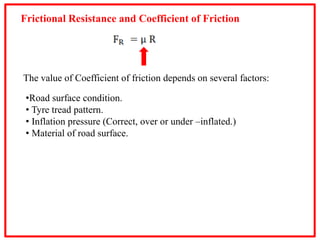
Frictional Resistance and Coefficient of Friction
The value of Coefficient of friction depends on several factors:
•Road surface condition.
• Tyre tread pattern.
• Inflation pressure (Correct, over or under –inflated.)
• Material of road surface.
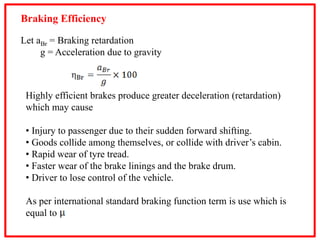
Braking Efficiency
Let aBr = Braking retardation
g = Acceleration due to gravity
Highly efficient brakes produce greater deceleration (retardation)
which may cause
• Injury to passenger due to their sudden forward shifting.
• Goods collide among themselves, or collide with driver’s cabin.
• Rapid wear of tyre tread.
• Faster wear of the brake linings and the brake drum.
• Driver to lose control of the vehicle.
As per international standard braking function term is use which is
equal to
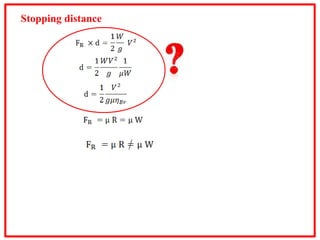
Stopping distance
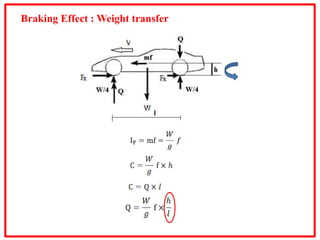
Braking Effect : Weight transfer
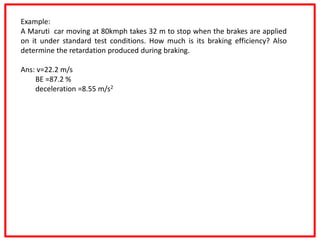
Example:
A Maruti car moving at 80kmph takes 32 m to stop when the brakes are applied
on it under standard test conditions. How much is its braking efficiency? Also
determine the retardation produced during braking.
Ans: v=22.2 m/s
BE =87.2 %
deceleration =8.55 m/s2
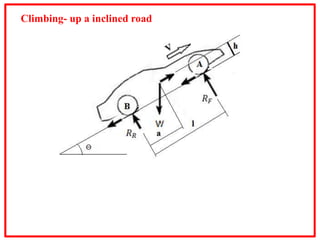
Climbing- up a inclined road
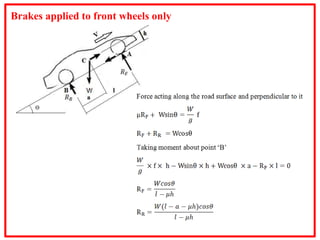
Brakes applied to front wheels only
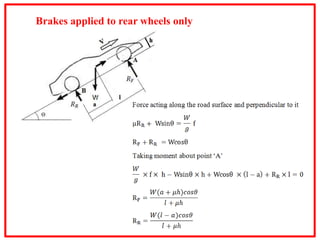
Brakes applied to rear wheels only
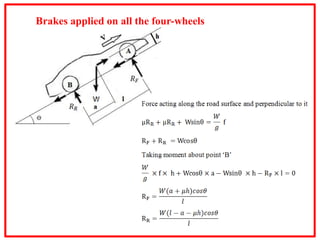
Brakes applied on all the four-wheels
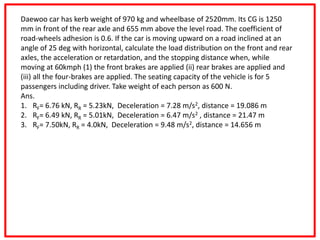
Daewoo car has kerb weight of 970 kg and wheelbase of 2520mm. Its CG is 1250
mm in front of the rear axle and 655 mm above the level road. The coefficient of
road-wheels adhesion is 0.6. If the car is moving upward on a road inclined at an
angle of 25 deg with horizontal, calculate the load distribution on the front and rear
axles, the acceleration or retardation, and the stopping distance when, while
moving at 60kmph (1) the front brakes are applied (ii) rear brakes are applied and
(iii) all the four-brakes are applied. The seating capacity of the vehicle is for 5
passengers including driver. Take weight of each person as 600 N.
Ans.
1. RF= 6.76 kN, RR = 5.23kN, Deceleration = 7.28 m/s2, distance = 19.086 m
2. RF= 6.49 kN, RR = 5.01kN, Deceleration = 6.47 m/s2 , distance = 21.47 m
3. RF= 7.50kN, RR = 4.0kN, Deceleration = 9.48 m/s2, distance = 14.656 m
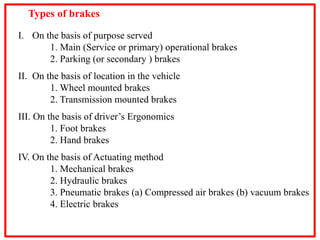
Types of brakes
I. On the basis of purpose served
1. Main (Service or primary) operational brakes
2. Parking (or secondary ) brakes
II. On the basis of location in the vehicle
1. Wheel mounted brakes
2. Transmission mounted brakes
III. On the basis of driver’s Ergonomics
1. Foot brakes
2. Hand brakes
IV. On the basis of Actuating method
1. Mechanical brakes
2. Hydraulic brakes
3. Pneumatic brakes (a) Compressed air brakes (b) vacuum brakes
4. Electric brakes
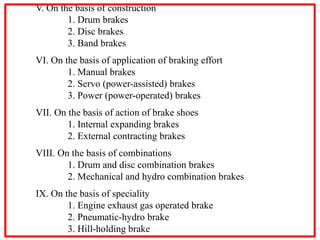
V. On the basis of construction
1. Drum brakes
2. Disc brakes
3. Band brakes
VI. On the basis of application of braking effort
1. Manual brakes
2. Servo (power-assisted) brakes
3. Power (power-operated) brakes
VII. On the basis of action of brake shoes
1. Internal expanding brakes
2. External contracting brakes
VIII. On the basis of combinations
1. Drum and disc combination brakes
2. Mechanical and hydro combination brakes
IX. On the basis of speciality
1. Engine exhaust gas operated brake
2. Pneumatic-hydro brake
3. Hill-holding brake
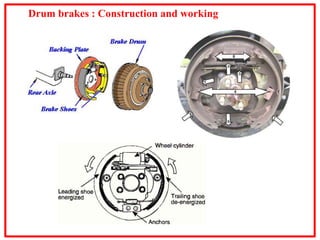
Drum brakes : Construction and working
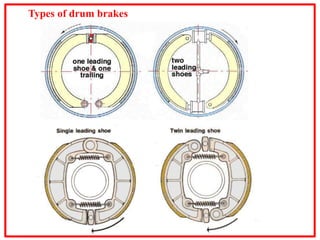
Types of drum brakes
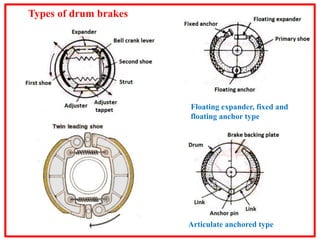
Articulate anchored type
Floating expander, fixed and
floating anchor type
Types of drum brakes
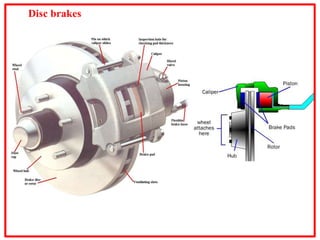
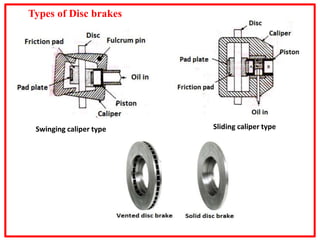
Disc brakes
Swinging caliper type Sliding caliper type
Types of Disc brakes
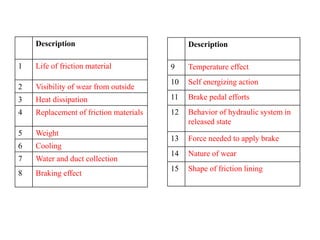
Description
1 Life of friction material
2 Visibility of wear from outside
3 Heat dissipation
4 Replacement of friction materials
5 Weight
6 Cooling
7 Water and duct collection
8 Braking effect
Description
9 Temperature effect
10 Self energizing action
11 Brake pedal efforts
12 Behavior of hydraulic system in
released state
13 Force needed to apply brake
14 Nature of wear
15 Shape of friction lining
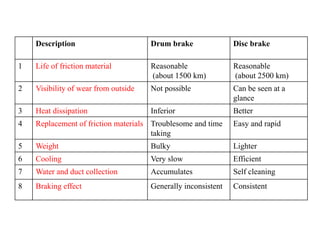
Description Drum brake Disc brake
1 Life of friction material Reasonable
(about 1500 km)
Reasonable
(about 2500 km)
2 Visibility of wear from outside Not possible Can be seen at a
glance
3 Heat dissipation Inferior Better
4 Replacement of friction materials Troublesome and time
taking
Easy and rapid
5 Weight Bulky Lighter
6 Cooling Very slow Efficient
7 Water and duct collection Accumulates Self cleaning
8 Braking effect Generally inconsistent Consistent
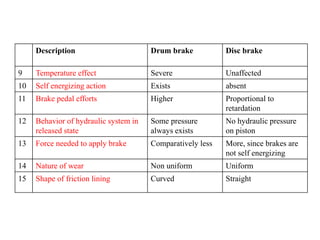
Description Drum brake Disc brake
9 Temperature effect Severe Unaffected
10 Self energizing action Exists absent
11 Brake pedal efforts Higher Proportional to
retardation
12 Behavior of hydraulic system in
released state
Some pressure
always exists
No hydraulic pressure
on piston
13 Force needed to apply brake Comparatively less More, since brakes are
not self energizing
14 Nature of wear Non uniform Uniform
15 Shape of friction lining Curved Straight
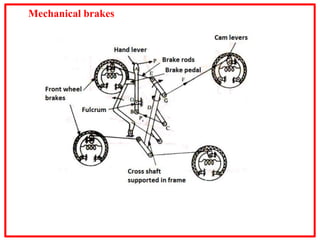
Mechanical brakes
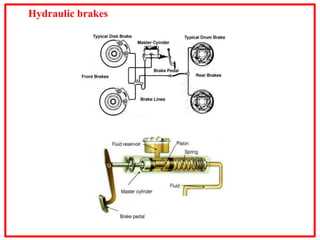
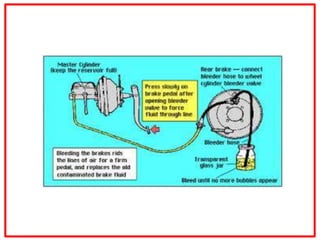
Hydraulic brakes
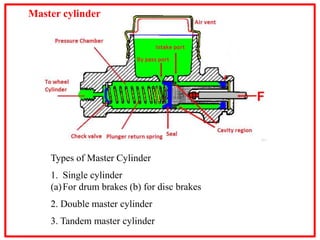
Types of Master Cylinder
1. Single cylinder
(a)For drum brakes (b) for disc brakes
2. Double master cylinder
3. Tandem master cylinder
Master cylinder
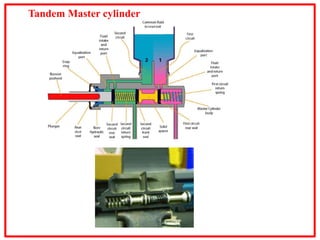
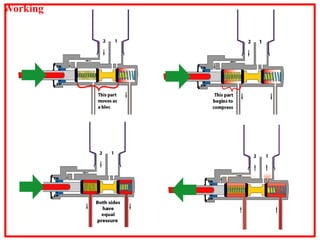
Tandem Master cylinder
Working
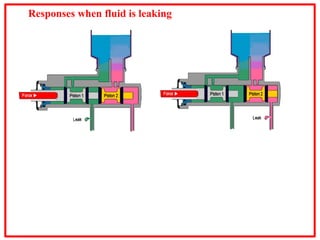
Responses when fluid is leaking
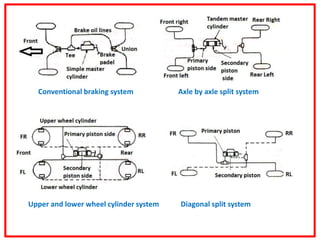
Conventional braking system Axle by axle split system
Upper and lower wheel cylinder system Diagonal split system
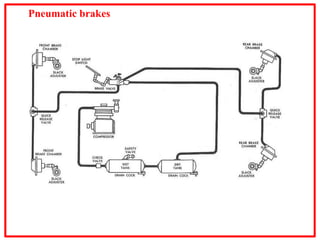
Pneumatic brakes
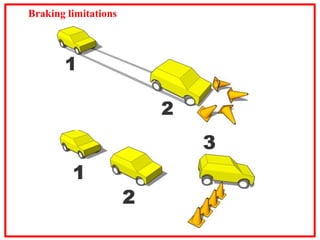
Braking limitations
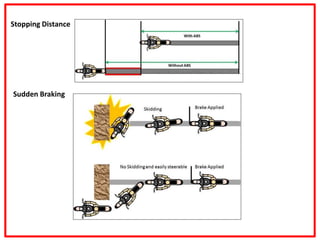
Stopping Distance
Sudden Braking
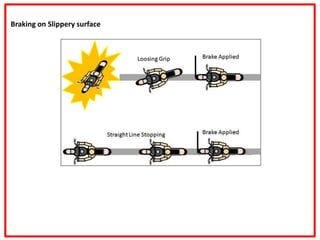
Braking on Slippery surface
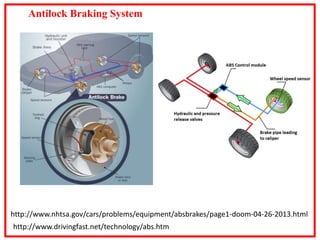
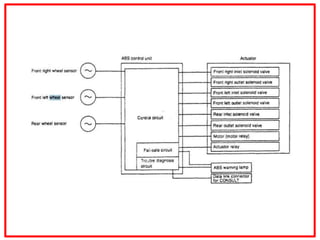
Antilock Braking System
http://www.nhtsa.gov/cars/problems/equipment/absbrakes/page1-doom-04-26-2013.html
http://www.drivingfast.net/technology/abs.htm
Brakes and Braking system

Brakes and Braking system

  • 1.
  • 2.
    BRAKES • Principle • Brakingdistance • Braking efficiency • Weight transfer • Wheel skidding • Principle and working of various types of brakes • Anti-lock Brake systems (ABS)
  • 3.
    Braking requirements: It MUST •Stopthe vehicle within smallest possible distance. • Act instantaneously in case of an emergency. • Strong enough to sustain sudden braking force. • Neither slip nor should cause any skid the vehicle. •Brake lining should have longer life. • Operate with the least effort.
  • 5.
    Frictional Resistance andCoefficient of Friction The value of Coefficient of friction depends on several factors: •Road surface condition. • Tyre tread pattern. • Inflation pressure (Correct, over or under –inflated.) • Material of road surface.
  • 6.
    Braking Efficiency Let aBr= Braking retardation g = Acceleration due to gravity Highly efficient brakes produce greater deceleration (retardation) which may cause • Injury to passenger due to their sudden forward shifting. • Goods collide among themselves, or collide with driver’s cabin. • Rapid wear of tyre tread. • Faster wear of the brake linings and the brake drum. • Driver to lose control of the vehicle. As per international standard braking function term is use which is equal to
  • 7.
  • 8.
    Braking Effect :Weight transfer
  • 9.
    Example: A Maruti carmoving at 80kmph takes 32 m to stop when the brakes are applied on it under standard test conditions. How much is its braking efficiency? Also determine the retardation produced during braking. Ans: v=22.2 m/s BE =87.2 % deceleration =8.55 m/s2
  • 10.
    Climbing- up ainclined road
  • 11.
    Brakes applied tofront wheels only
  • 12.
    Brakes applied torear wheels only
  • 13.
    Brakes applied onall the four-wheels
  • 14.
    Daewoo car haskerb weight of 970 kg and wheelbase of 2520mm. Its CG is 1250 mm in front of the rear axle and 655 mm above the level road. The coefficient of road-wheels adhesion is 0.6. If the car is moving upward on a road inclined at an angle of 25 deg with horizontal, calculate the load distribution on the front and rear axles, the acceleration or retardation, and the stopping distance when, while moving at 60kmph (1) the front brakes are applied (ii) rear brakes are applied and (iii) all the four-brakes are applied. The seating capacity of the vehicle is for 5 passengers including driver. Take weight of each person as 600 N. Ans. 1. RF= 6.76 kN, RR = 5.23kN, Deceleration = 7.28 m/s2, distance = 19.086 m 2. RF= 6.49 kN, RR = 5.01kN, Deceleration = 6.47 m/s2 , distance = 21.47 m 3. RF= 7.50kN, RR = 4.0kN, Deceleration = 9.48 m/s2, distance = 14.656 m
  • 15.
    Types of brakes I.On the basis of purpose served 1. Main (Service or primary) operational brakes 2. Parking (or secondary ) brakes II. On the basis of location in the vehicle 1. Wheel mounted brakes 2. Transmission mounted brakes III. On the basis of driver’s Ergonomics 1. Foot brakes 2. Hand brakes IV. On the basis of Actuating method 1. Mechanical brakes 2. Hydraulic brakes 3. Pneumatic brakes (a) Compressed air brakes (b) vacuum brakes 4. Electric brakes
  • 16.
    V. On thebasis of construction 1. Drum brakes 2. Disc brakes 3. Band brakes VI. On the basis of application of braking effort 1. Manual brakes 2. Servo (power-assisted) brakes 3. Power (power-operated) brakes VII. On the basis of action of brake shoes 1. Internal expanding brakes 2. External contracting brakes VIII. On the basis of combinations 1. Drum and disc combination brakes 2. Mechanical and hydro combination brakes IX. On the basis of speciality 1. Engine exhaust gas operated brake 2. Pneumatic-hydro brake 3. Hill-holding brake
  • 17.
    Drum brakes :Construction and working
  • 18.
  • 19.
    Articulate anchored type Floatingexpander, fixed and floating anchor type Types of drum brakes
  • 20.
  • 21.
    Swinging caliper typeSliding caliper type Types of Disc brakes
  • 22.
    Description 1 Life offriction material 2 Visibility of wear from outside 3 Heat dissipation 4 Replacement of friction materials 5 Weight 6 Cooling 7 Water and duct collection 8 Braking effect Description 9 Temperature effect 10 Self energizing action 11 Brake pedal efforts 12 Behavior of hydraulic system in released state 13 Force needed to apply brake 14 Nature of wear 15 Shape of friction lining
  • 23.
    Description Drum brakeDisc brake 1 Life of friction material Reasonable (about 1500 km) Reasonable (about 2500 km) 2 Visibility of wear from outside Not possible Can be seen at a glance 3 Heat dissipation Inferior Better 4 Replacement of friction materials Troublesome and time taking Easy and rapid 5 Weight Bulky Lighter 6 Cooling Very slow Efficient 7 Water and duct collection Accumulates Self cleaning 8 Braking effect Generally inconsistent Consistent
  • 24.
    Description Drum brakeDisc brake 9 Temperature effect Severe Unaffected 10 Self energizing action Exists absent 11 Brake pedal efforts Higher Proportional to retardation 12 Behavior of hydraulic system in released state Some pressure always exists No hydraulic pressure on piston 13 Force needed to apply brake Comparatively less More, since brakes are not self energizing 14 Nature of wear Non uniform Uniform 15 Shape of friction lining Curved Straight
  • 25.
  • 26.
  • 27.
    Types of MasterCylinder 1. Single cylinder (a)For drum brakes (b) for disc brakes 2. Double master cylinder 3. Tandem master cylinder Master cylinder
  • 28.
  • 29.
  • 30.
  • 31.
    Conventional braking systemAxle by axle split system Upper and lower wheel cylinder system Diagonal split system
  • 32.
  • 33.
  • 34.
  • 35.
  • 36.